

Headcount Planning vs Workforce Planning: Key Differences in 2026
Not sure when to use headcount planning vs. workforce planning? Explore the right decision framework that every growth-stage company actually needs.

What if the reason your headcount plan keeps breaking is that you're solving the wrong problem? Since 71% of employees already handle responsibilities beyond their formal job descriptions, headcount-based planning relies on outdated data.
This misalignment slows hiring, skews budgets, and weakens leadership trust. Headcount planning vs workforce planning sounds interchangeable. But one is tactical and budget-bound. The other is strategic and long-horizon.
Defaulting to the wrong one at the wrong stage wastes time, misaligns teams, and creates planning debt you'll pay for later.
This blog clearly breaks down the concepts of headcount planning vs workforce planning, shows when each applies, and gives you a practical framework to build a headcount plan that actually holds.
Highlights
- Headcount planning is tactical and budget-driven, focused on FTE forecasting within an operating cycle, while workforce planning is long-term and capability-focused.
- Growth-stage companies benefit more from disciplined headcount planning first. Clean req-level data and HR–Finance alignment are prerequisites for a broader workforce strategy.
- A real headcount plan ties compensation bands to every approved requisition, and CandorIQ connects pay validation, requisition approvals, and workflows in a single system.
- Budget control breaks when compensation and headcount forecasting are disconnected; CandorIQ provides a single source of truth for req approvals, offer budgets, and real-time FTE cost modeling.
- Use headcount planning for operating plans and board updates, and adopt full workforce planning only once your data is clean and organizational complexity demands it.
What Is Headcount Planning?
Headcount planning is the tactical, budget-tied process of determining how many people to hire, when to hire them, at what cost, and into which roles. It lives inside your operating plan and drives every hiring decision your organization makes in a given quarter or fiscal year.
Here's what it actually covers:
- Approved Vs. Open Vs. Backfilled Requisitions: You need to know the difference between a requisition that's been approved by Finance, one that's open in your ATS, and one that's replacing a departed employee. Treating all three the same breaks your budget model.
- Fte Cost Modeling With Total Compensation: Every headcount decision should be modeled on total cost, including base salary, benefits, equity, payroll taxes, not just the number on an offer letter.
- Departmental Hiring Timelines, Tied To Revenue Milestones: If your sales team needs to hit a number by Q3, your engineering hires need to be onboarded by Q1. Headcount planning maps those dependencies explicitly.
- Headcount Request and Approval Workflows: It's the mechanism that keeps your plan accurate when reality changes. Every new requisition, planned or off-cycle, requires a formal approval path.
Headcount planning is a live budget document, not a spreadsheet you update once a year. When it's disconnected from your compensation data and approval workflows, you end up with three different headcount numbers circulating among your HR, Finance, and leadership teams, none of which are correct.
Once you have headcount planning running tightly, you're ready to think about something bigger: workforce planning.

What Is Workforce Planning?
Workforce planning is the longer-horizon, capability-focused process of aligning your talent supply with your projected business demand. It asks a different question than headcount planning.
Instead of "how many people do we hire this quarter?" it asks, "Do we have the right organizational capabilities to execute our strategy over the next two years?"
Workforce planning includes headcount planning, but it layers on several additional dimensions:
- Skills Inventory and Capability Mapping: You're assessing what capabilities your current workforce has and identifying where the gaps are relative to your strategic roadmap.
- Internal Mobility And Succession Pipelines: Workforce planning accounts for promoting from within, cross-functional moves, and building leadership pipelines, not just external hiring.
- Attrition Forecasting By Department Or Role Cluster: If your customer success team has 25% annual turnover, your workforce plan accounts for that as a structural variable, not a one-time surprise.
- Organizational Design Decisions: Spans of control, management layers, team structures, and workforce planning shape the organization, not just fill it.
Workforce planning requires clean historical people data, a dedicated people analytics function, and enough organizational complexity to justify the investment. If you're a lean team scaling fast, a rigorous headcount planning process with strong HR-Finance alignment is the higher-leverage activity right now.
Now that both are defined, let's put them side by side so the distinction is clear.
Headcount Planning vs. Workforce Planning: Comparison
Headcount planning vs workforce planning both involve people, planning, and budgets. But they operate on different time horizons and serve different purposes.
The key insight is that they operate at different altitudes. You need the operational discipline of headcount planning before the strategic ambition of workforce planning can actually deliver results.
Knowing the difference matters. But knowing when to use each one is where this becomes actionable.
When to Use Headcount Planning vs. Workforce Planning
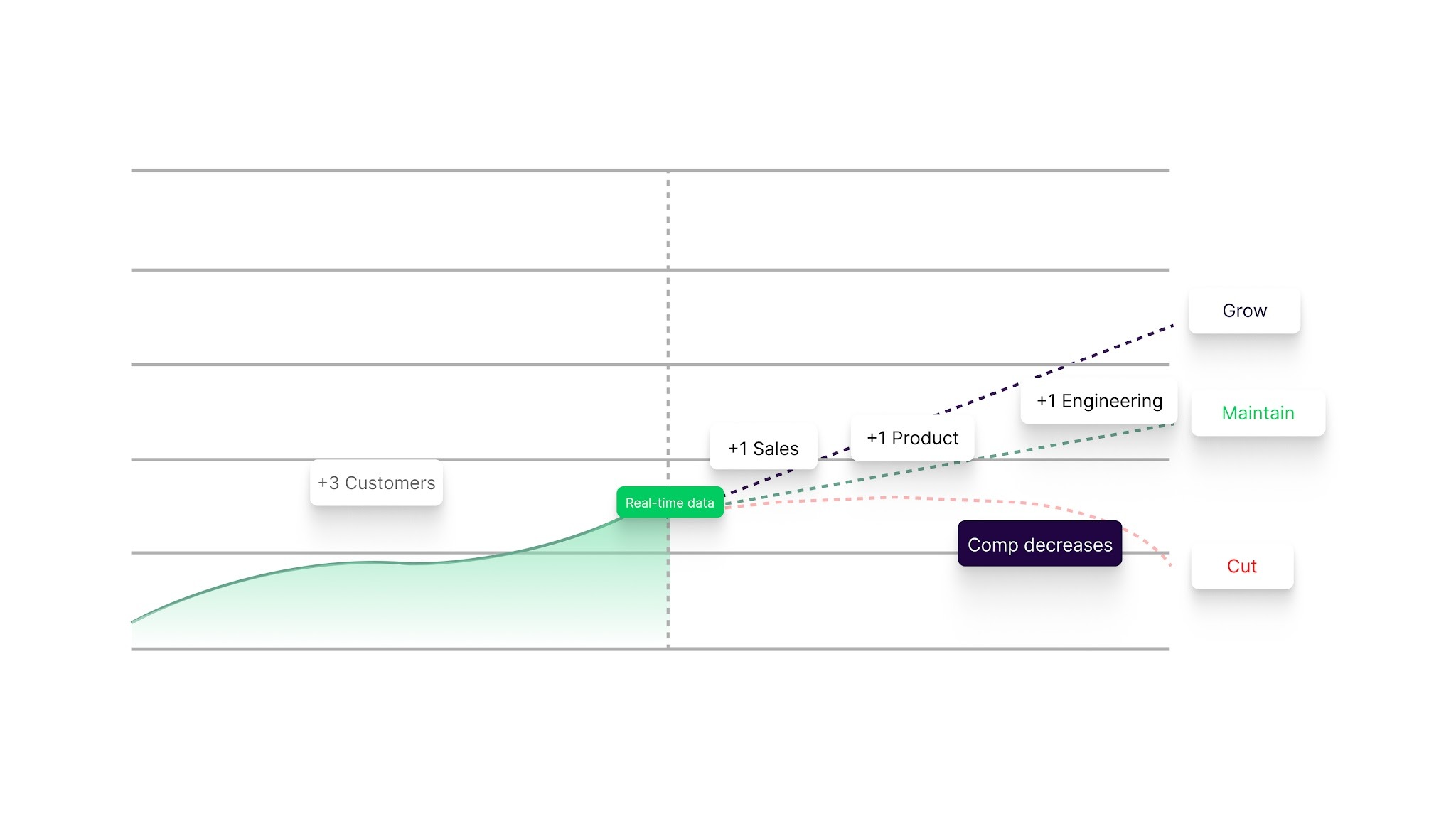
The right choice isn't about preference. I's about your company's stage, the decision you're making, and what data you actually have to work with. Here's a practical trigger matrix.
Use headcount planning when:
- You're building or revising your annual operating plan and need Finance-approved hiring targets
- You're preparing for a board meeting or investor update and need revenue-per-FTE or hiring pacing data
- You're managing a hiring freeze or reduction in force and need real-time req-level visibility
- You're scaling a new team or product line and need to model FTE costs against revenue milestones
- Your Finance and HR teams are working from different headcount numbers and need a single source of truth
Use workforce planning when:
- You're post-Series C or pre-IPO and need a multi-year organizational design strategy
- You're experiencing high attrition in a critical function and need a capability resilience plan
- You're undergoing a significant M&A event, restructure, or major geographic expansion
- You have a dedicated People Analytics function with clean historical workforce data to work from
Use both — integrated — when:
- You're at 500–1,500 employees and want to mature from reactive hiring to a proactive talent strategy
- Your CPO or CHRO is building an operating model that needs to scale to 2,000+ employees
- You're at a stage where board-level workforce metrics (revenue per FTE, manager-to-IC ratio) are becoming part of your investor narrative
Once you know which framework applies, the next step is building a headcount plan that actually holds up under pressure.
How to Build a Headcount Plan That Actually Works
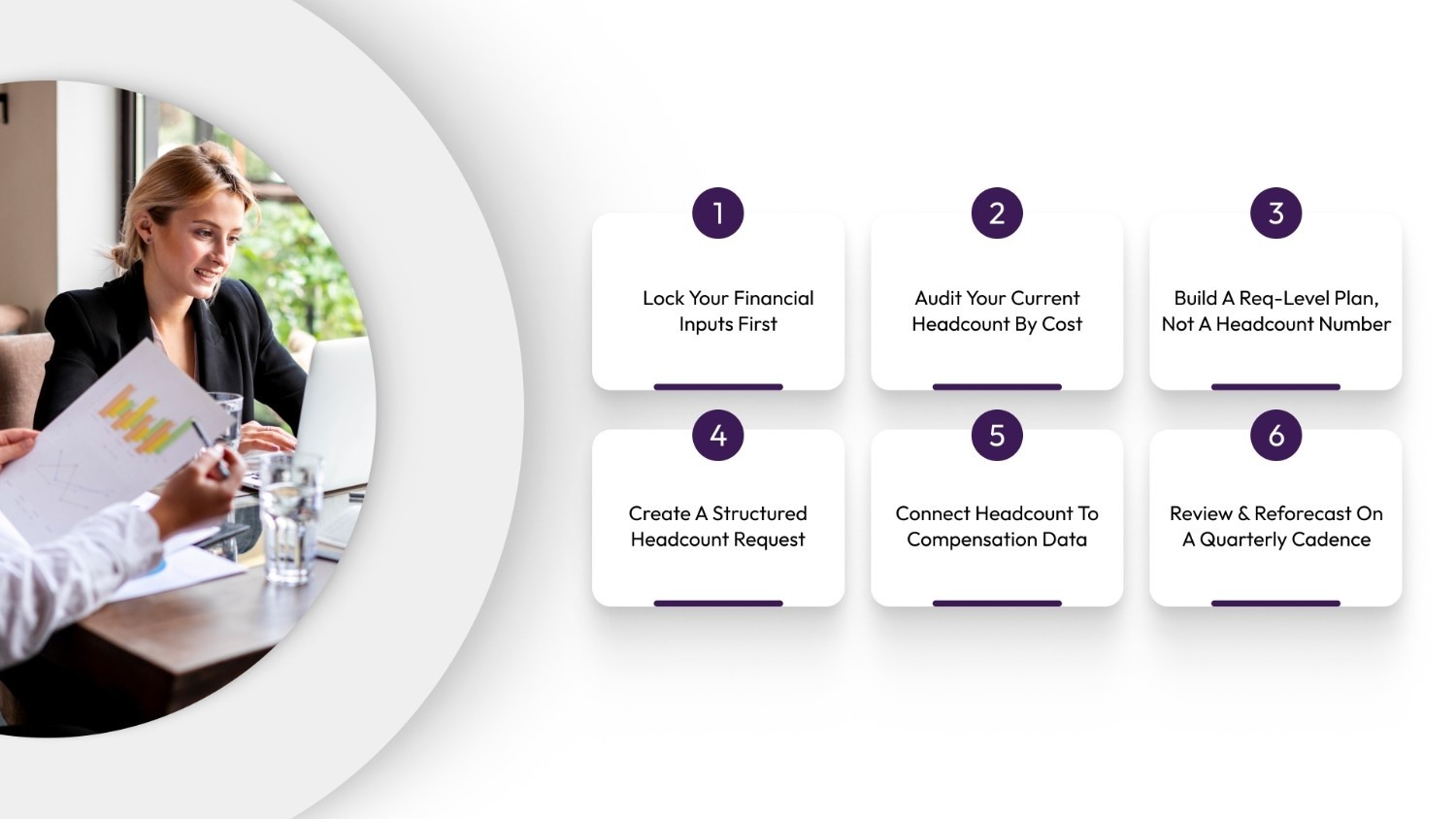
Most headcount plans fail because they're built without the right inputs, at the wrong cadence, or disconnected from the systems that govern comp and approvals. Here's a six-step process built for lean HR and Finance teams at scaling companies.
Step 1: Lock Your Financial Inputs First
Headcount planning starts with Finance, not HR. Before any requisition gets opened, get alignment on your approved opex budget, revenue targets by segment, and hiring pacing assumptions.
Model three scenarios: base, upside, and conservative. This gives you guardrails that prevent over-hiring when the business underperforms.
Step 2: Audit Your Current Headcount By Cost And Status
Know your approved FTEs versus filled FTEs versus open reqs. Understand your fully-loaded cost per head, not just base salary. Equity, benefits, and payroll taxes can add extra cost on top of base.
Misunderstanding this is how companies blow their labor budget before the last quarter even starts.
Step 3: Build A Req-Level Plan, Not A Headcount Number
"We're hiring 40 people" is not a plan. A real headcount plan specifies the role, department, level, target start date, comp range tied to your pay bands, reporting structure, and business justification.
That level of detail is what allows Finance to approve it and HR to execute it without constant back-and-forth.
Step 4: Create A Structured Headcount Request And Approval Workflow
Every new requisition, whether it was in the original plan or came in off-cycle, should go through the same approval chain: hiring manager → department head → Finance → HR.
A formal workflow kills shadow headcount lists, reduces "surprise" budget overruns, and keeps your plan accurate as the year progresses.
Step 5: Connect Headcount To Compensation Data In Real Time
When finance approves a head, the compensation range should already be modeled against your pay bands. When recruiting extends an offer, it should be validated against the approved range.
Disconnecting these steps creates a significant budget risk during the offer stage, when timing and accuracy are critical.
Step 6: Review And Reforecast On A Quarterly Cadence
Headcount plans are living documents. Tie your review cadence to your financial close cycle. Build in a deliberate process for re-prioritizing or deprioritizing entreaties when business conditions shift.
Now, the challenge for most scaling companies is executing this process well, which requires more than discipline. It requires the right infrastructure.
Also Read: The 7 Best Headcount Planning Strategies to Scale Smarter
How CandorIQ Can Help You Build a Headcount Planning Workflow
Most growth-stage companies do not struggle because they lack process. They struggle because their tools cannot sustain the process as the company scales.
CandorIQ is a unified compensation and headcount planning platform built for scaling HR and Finance teams. It replaces fragmented spreadsheets and disconnected workflows with a single system of record, ensuring everyone operates from the same live data instead of reconciling outdated versions.
Here's what that looks like in practice:
- Headcount Scenario Planning: Model multiple hiring scenarios and compare them against your budget thresholds in real time. Toggle between base, upside, and conservative plans without rebuilding from scratch.
- Headcount Requests & Approvals: Every new hire request moves through a structured, dynamic approval workflow routed by team, location, or comp range. No more email chains. No more shadow req lists.
- Compensation & Payband Builder: Define pay bands by level, location, and department. When Finance approves a head, the comp range is already built into the plan. When Recruiting makes an offer, it's validated against the approved band automatically.
- Workforce Management: Track open roles, filled seats, attrition, and promotion rates in one dashboard. Align actuals versus plan on headcount and comp. Build custom views for your exec team, FP&A, or HRBPs.
- Compensation Cycle: Automate merit and bonus reviews with built-in approval logic and real-time budget tracking by department.
- AI Agent: Ask natural language questions to analyze comp gaps, forecast headcount needs, or model the budget impact of a hiring decision. Get the analytical depth of a professional analyst without the manual work.
CandorIQ turns headcount planning from a coordination problem into a strategic capability, giving HR teams the structure to be genuine partners to Finance and leadership.
Conclusion
Headcount planning and workforce planning serve different purposes. Confusing them leads to errors in tracking changes, budget inaccuracies, and misalignment between HR and Finance teams.
If you're growing fast, your highest-leverage move is nailing headcount planning first. Clean req-level data, comp tied to approvals, and a quarterly reforecast cycle that Finance actually trusts. When that's working, workforce planning becomes a natural extension.
Ready to see how a unified headcount and compensation workflow actually looks in practice? Book a demo with CandorIQ.
.png)
FAQs
Q. How often should you update your headcount plan?
At a minimum, quarterly, tied to your financial close cycle. Fast-growing companies often review headcount plans monthly to account for off-cycle requests and shifting revenue assumptions.
Q. What is a headcount request workflow?
It's a structured approval process for every new hire request, planned or off-cycle, routed through the hiring manager, department head, Finance, and HR before a position can be opened.
Q. Do small companies need workforce planning?
Most companies with fewer than 1,000 employees get more value from rigorous headcount planning than from full workforce planning. Workforce planning requires clean historical data and a People Analytics function most lean teams don't yet have.
Q. What is FTE cost modeling in headcount planning?
It's the process of calculating the true, fully-loaded cost of a hire, including base salary, benefits, equity, and payroll taxes, to give Finance an accurate picture of labor spend before approving a req.
Ready to modernize your workforce and compensation strategy?
See how CandorIQ brings workforce planning and compensation together with AI.