

A Practical Guide to Headcount Forecasting for High-Growth Teams
Learn proven headcount forecasting strategies to align hiring and budgets, reduce overspending, and scale smarter with real-time workforce insights.

Rapid growth brings incredible opportunity, but also uncertainty. New product bets, shifting market conditions, and revenue fluctuations mean hiring needs rarely move in a straight line. Without a clear forecast, companies risk overshooting budgets or falling behind on execution when talent gaps widen.
In U.S. private-industry firms, wages and salaries account for around 70% of total employer compensation costs, making workforce decisions one of the largest influences on financial performance.
Headcount forecasting helps companies anticipate the talent they’ll need, when they’ll need it, and what it will cost, ensuring hiring stays aligned with strategy, not guesswork.
This guide shares proven forecasting strategies HR and Finance leaders use to scale with confidence and protect runway through smarter workforce planning.
Need to know
- Headcount forecasting ensures hiring stays aligned with strategy, runway, and real-time performance rather than assumptions or reactive requests.
- Choosing the right forecasting model, demand, supply, scenario-based, sales capacity, etc., depends on business goals, talent dynamics, and growth stage.
- Accurate forecasts consider hiring velocity, ramp time, attrition, and total cost per employee, not just base salaries.
- Forecasting must be a continual process with quarterly updates (or more frequent for rapid-scale teams), not a one-time annual planning exercise.
- Unified systems allowing HR and Finance to collaborate in real time help prevent version chaos, budget surprises, and hiring delays.
What Is Headcount Forecasting?
Headcount forecasting is the process of predicting the number of employees a company will need in the future, along with the timing and cost of hiring them. It helps HR and Finance ensure staffing aligns with growth goals, budget constraints, and upcoming business priorities. Rather than reacting to hiring gaps, companies proactively plan talent requirements and financial impact.
Before diving into strategy, it’s important to understand how headcount forecasting fits alongside other planning practices that HR and Finance teams often use interchangeably.
Headcount Forecasting vs. Headcount Analysis vs. Workforce Planning
These three activities work together to support scalable hiring, but they serve different purposes:
- Headcount forecasting guides the future: Anticipates who needs to be hired, when, and at what cost, so HR and Finance can proactively support growth instead of reacting to urgent requests.
- Headcount analysis keeps plans grounded in reality: Tracks current staffing vs. plan, flags variances early, and helps leaders rebalance resources before productivity or budget performance suffers.
- Workforce planning builds long-term readiness: Ensures the organization has the right skills, leadership pipeline, and structure to support future transformation, not just immediate hiring needs.
Why Understanding Headcount Forecasting Is Critical for Growth
As companies scale, hiring decisions become more complex, and more expensive. Understanding headcount forecasting helps organizations stay ahead of those challenges instead of reacting when it’s already too late.
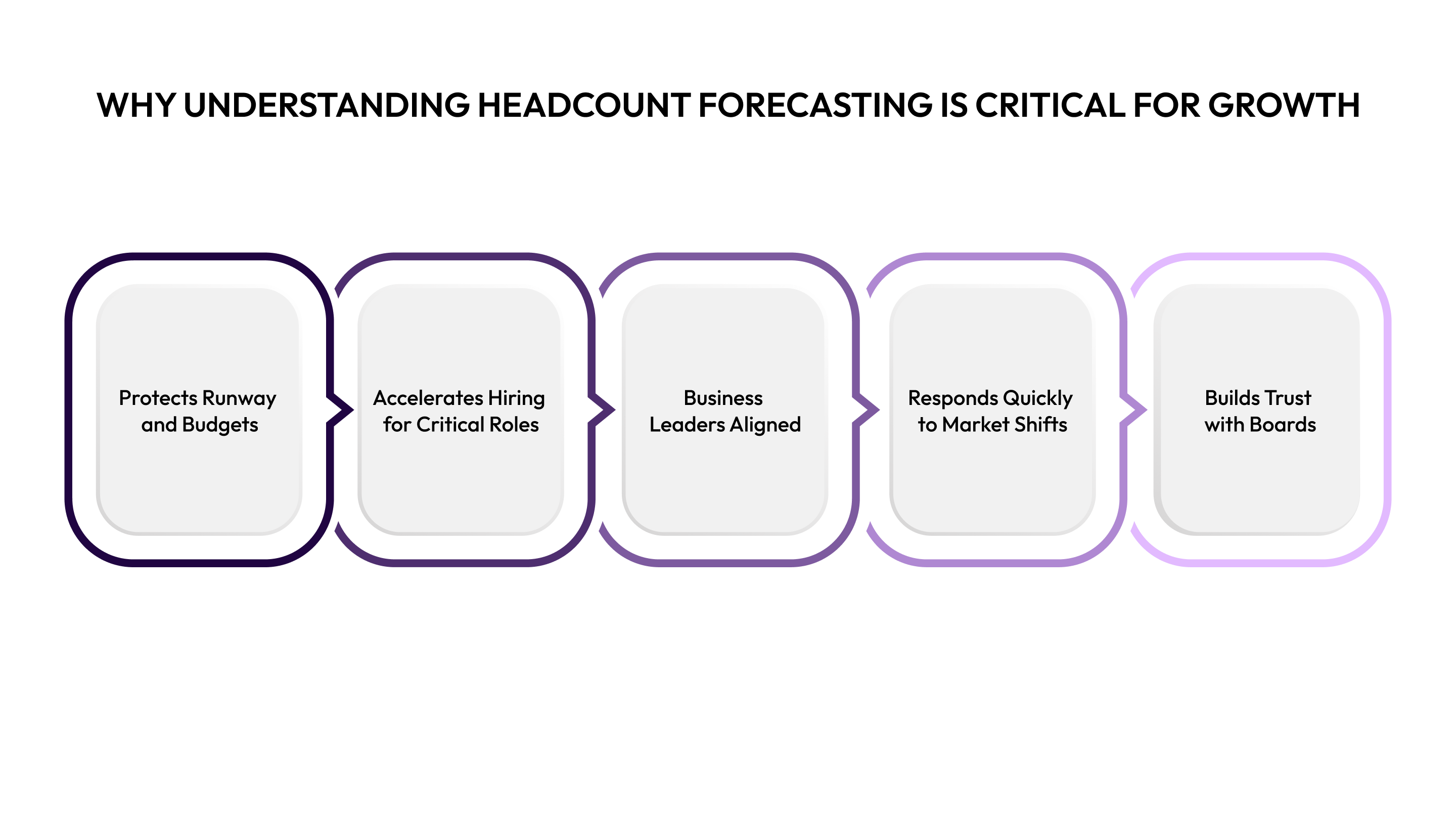
Here’s why it matters:
- Protects runway and budgets: Forecasting prevents unplanned hiring spikes and ensures salary, equity, and benefits costs stay within financial guardrails.
- Accelerates hiring for critical roles: When you know what talent you’ll need and when, recruiters can build pipelines early and reduce delayed execution.
- Keeps HR, Finance, and business leaders aligned: Everyone operates from the same assumptions, reducing back-and-forth approval friction and hiring confusion.
- Responds quickly to market shifts: Forecasts can adjust when revenue slows or product demand increases, without rewriting the entire plan.
- Builds trust with boards and investors: Accurate headcount forecasts give leadership confidence in burn projections and hiring ROI.
Understanding headcount forecasting ensures growth isn’t driven by guesswork, but by data, strategy, and proactive decision-making.

Types of Headcount Forecasting Models
Different forecasting models help organizations plan hiring more accurately depending on their growth stage and available data. Here are the most common types:
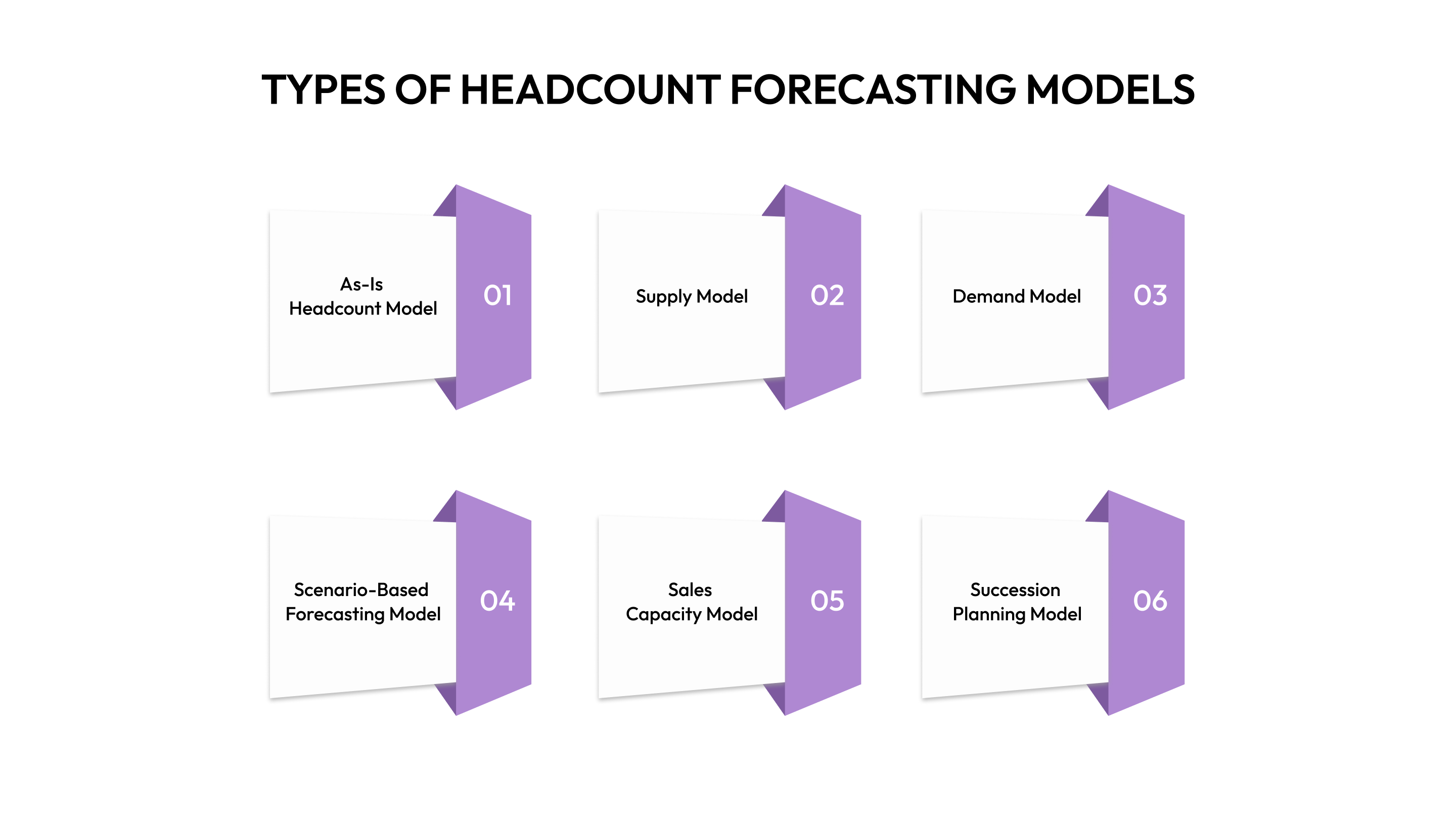
1. As-Is Headcount Model
A snapshot of your current workforce, including active employees, pending hires, upcoming departures, vacancies, and your organizational structure.
How It Helps: Provides a clear baseline of where you stand today; essential for any future forecasting or planning.
Example: You run a report showing 450 active employees, 15 pending new hires, and 8 confirmed terminations, this creates a baseline headcount ahead of your next hiring cycle.
2. Supply Model
Evaluates your existing workforce’s capacity, what roles are filled, workload capacity, and when existing resources might become insufficient.
How It Helps: Helps determine when to hire, or when contractors/outsourced support may be needed; ensures you aren’t over-allocating staff relative to demand.
Example: A services firm calculates that with current staff capacity, they can support up to 120 active clients. Once they forecast exceeding that, supply model triggers hiring 5 more support agents.
3. Demand Model
Starts from business goals, product launches, sales targets, customer growth, and works backward to estimate how many people will be needed to meet that demand.
How It Helps: Ensures hiring aligns directly with business output, growth targets, or revenue goals rather than just maintaining headcount.
Example: If the company aims to grow MRR by $300-000 in Q2, demand model shows needing 2 more sales reps plus 1 more customer success manager to support the increased load.
4. Scenario-Based Forecasting Model
Plans multiple versions of the future, conservative, base, and accelerated, to stay prepared for changes.
How It Helps:
- Supports quick decisions when performance shifts
- Reduces panic hiring or sudden freezes
Example: If pipeline increases unexpectedly, stretch-scenario hiring activates without redoing the forecast.
5. Sales Capacity Model
A variant of the demand model, focused specifically on revenue-generating teams (sales, success), using historical quota/ramp data to forecast how many reps you need to hit revenue targets.
How It Helps: Aligns sales headcount with revenue targets; helps predict hiring needs in sales based on quota, ramp time, and expected conversions.
Example: Based on average revenue per sales rep and ramp time, the forecast shows hiring 4 new AEs to reach next quarter’s sales goal, with projections on break-even and ramp-up cost.
6. Succession Planning Model
Focuses on critical roles and leadership pipeline, forecasts when senior roles may need replacement and plans for internal promotions or external hiring.
How It Helps: Prepares for attrition or growth at leadership levels; ensures business continuity and smooth transitions when key people leave.
Example: A startup with 50 engineers forecasts when likely senior engineers will retire or leave in next 2–3 years, triggers development tracks or hiring for lead roles in advance.
A scalable forecast often blends two or more models to balance accuracy with agility, especially in fast-growth, distributed teams.
Need a faster way to align hiring plans with budget approvals? CandorIQ gives HR and Finance a real-time view of planned vs. actual headcount and costs, so every hiring decision stays strategic and on track.
Step-by-Step Guide to Effective Headcount Forecasting
Headcount forecasting is the systematic process of projecting an organization’s future staffing needs, factoring in growth targets, turnover, hiring timelines, and compensation costs, to ensure hiring aligns with business goals and budgets. Done right, it transforms hiring from a reactive scramble into a strategic roadmap that protects cash flow and readiness.
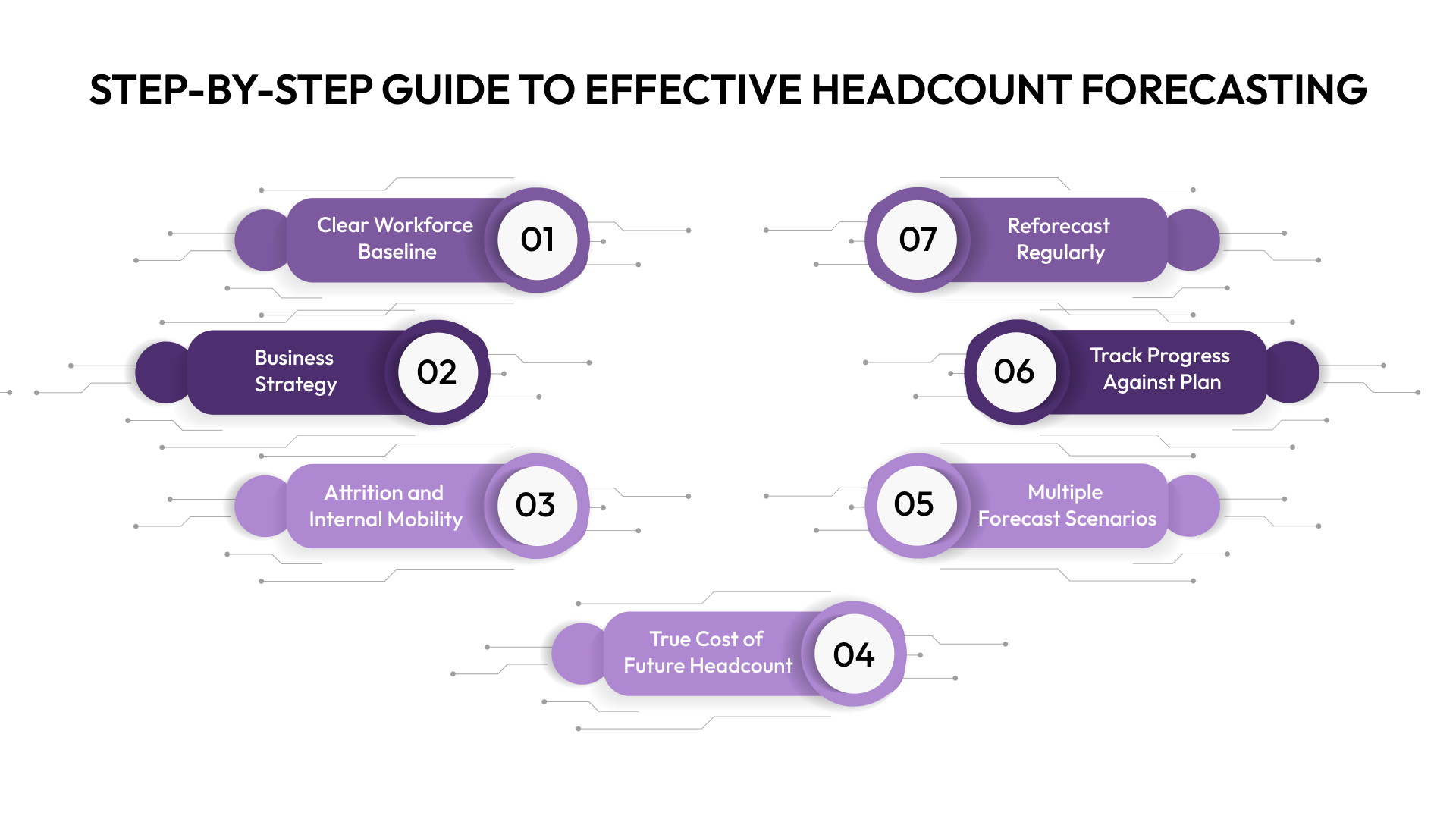
1. Establish a Clear Workforce Baseline
Begin by documenting your current team, who is employed, which roles are open, and which positions may change soon. This baseline gives you full visibility into your starting point and highlights immediate staffing needs.
2. Align Hiring Needs With Business Strategy
Meet with key stakeholders to understand upcoming initiatives, product launches, revenue expectations, and operational demands. This ensures that every future hire supports strategic priorities rather than simply filling seats.
3. Factor in Attrition and Internal Mobility
Employees leave, get promoted, or shift into new roles. Build assumptions for anticipated turnover and internal backfills so your forecast reflects real workforce dynamics and avoids unexpected staffing gaps.
4. Calculate the True Cost of Future Headcount
Develop a full financial picture of hiring needs, including base salary, variable pay, benefits, taxes, recruiting fees, and onboarding costs. This step ensures forecasts reflect actual spend, not just salary ranges.
5. Build Multiple Forecast Scenarios
Create base, stretch, and conservative forecasts to plan for different growth outcomes. Scenario planning allows HR and Finance to adjust hiring quickly, whether conditions accelerate or slow down.
6. Track Progress Against Plan in Real Time
Monitor how actual hiring, compensation, and turnover compare to the forecast. Variance insights help identify over- or under-hiring early, so leaders can adjust before performance or budgets are impacted.
7. Reforecast Regularly as Conditions Change
Treat forecasting as an ongoing cycle, not a once-a-year task. Quarterly reviews, or even more frequent updates, ensure hiring plans adapt to shifting priorities, performance trends, and financial realities.
How to Forecast Headcount: Quick Formulas & Examples
When these steps come together, headcount forecasting evolves from manual guesswork into a strategic capability that supports fast, cost-effective growth.
Suggested read: Compensation and Headcount Planning Scenarios Explained
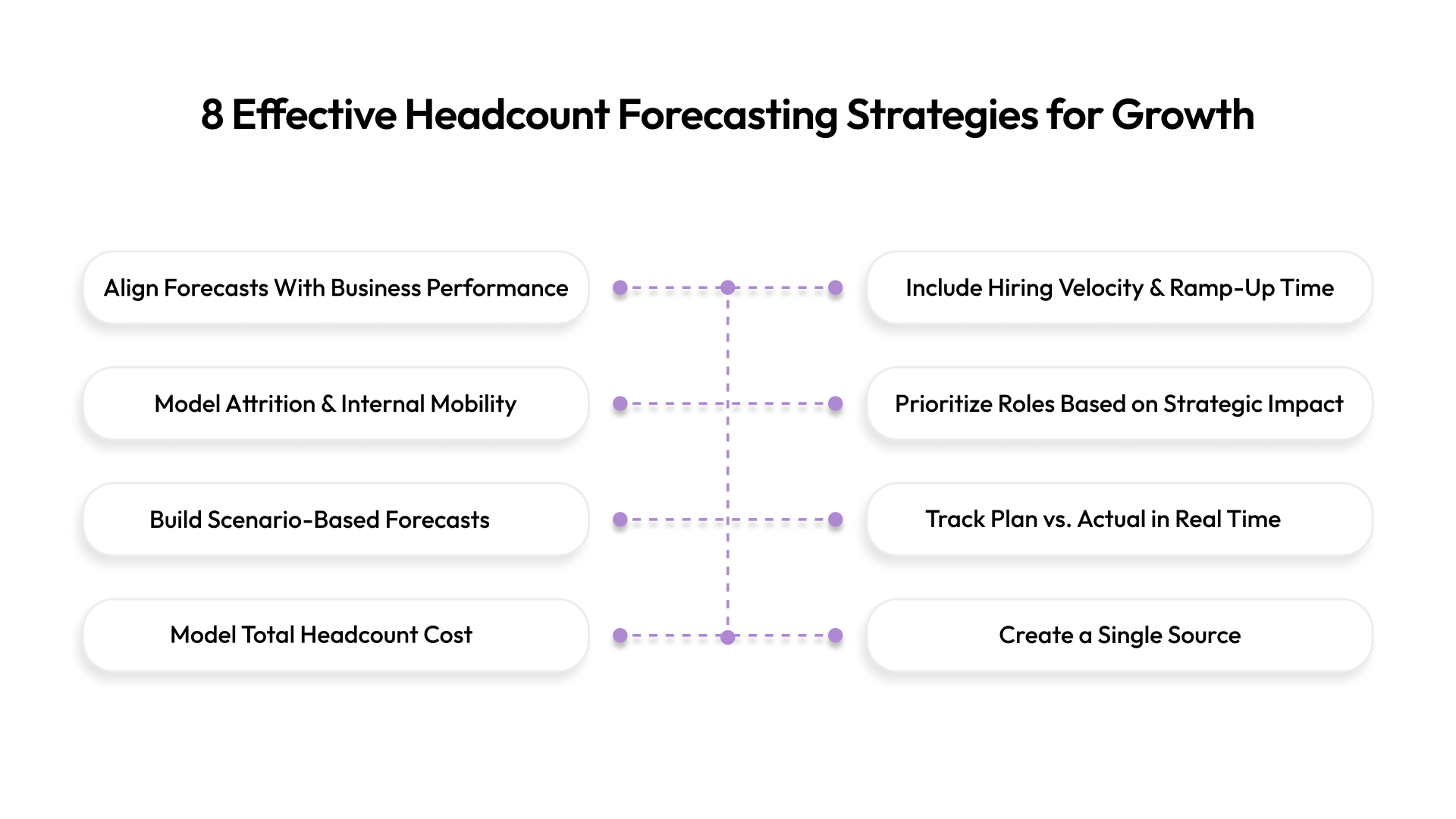
8 Effective Headcount Forecasting Strategies for Growth
Effective headcount forecasting blends real-time business data, hiring realities, and financial guardrails, ensuring that the company scales the right teams at the right time. The strategies below help teams stay agile, budget-smart, and aligned as hiring accelerates.
1. Align Forecasts With Business Performance
Headcount should be directly tied to performance indicators such as revenue growth, product release timelines, customer expansion, and operational demand. When business momentum shifts, hiring plans must shift with it.
Example: If pipeline coverage increases by 40% for Q3-Q4, hiring plans adjust to add 6 AEs and 3 CSMs to support expected demand, not based on manager gut feel.
2. Include Hiring Velocity and Ramp-Up Time
Hiring may take 30–120+ days depending on the role. Add ramp-up time to ensure new hires become productive exactly when the business needs them, not after deadlines start slipping.
Example: A Support Manager takes 45 days to hire and 60 days to ramp, the forecast schedules the hire 3 months before opening a new product line to prevent ticket backlogs.
3. Model Attrition and Internal Mobility
People leave, get promoted, or change teams, forecasting must anticipate churn and internal movement. This prevents last-minute backfill panic and capacity gaps.
Example: Historical data shows a 12% attrition rate in engineering. Forecasts proactively include 8–10 backfills each year so product delivery stays on track.
4. Prioritize Roles Based on Strategic Impact
Not every request can be approved. Prioritize hiring that accelerates revenue, product delivery, compliance, or customer success, and deprioritize roles with limited ROI.
Example: Customer onboarding delays are blocking revenue recognition, so the forecast moves 4 Implementation Specialists ahead of 2 general operations roles.
5. Build Scenario-Based Forecasts
Markets shift fast. Scenario models (best-case, base-case, worst-case) help teams pivot hiring quickly without rebuilding the entire plan each time.
Example: If fundraising delays occur, a “conservative” hiring plan pauses 15 non-critical roles, protecting runway while maintaining essential product delivery hires.
6. Track Plan vs. Actual in Real Time
Forecasts become inaccurate the moment they aren’t updated. Live dashboards ensure leaders catch and correct issues, hiring slowdowns, and unexpected budget burn, before they escalate.
Example: If recruitment fills only 50% of planned roles by mid-quarter, forecasts adjust revenue and cost expectations before the board meeting, not after.
7. Model Total Headcount Cost
Hiring decisions must consider the full cost per employee; salary is just one element. Forecasts should include benefits, equity refreshers, taxes, onboarding, and tech stack costs.
Example: A Data Engineer budgeted at $160k actually costs $210k all-in. The forecast adjusts the cost model early, preventing a year-end budget shortfall.
8. Create a Single Source of Truth for HR + Finance
Disconnected systems lead to mismatched data, delayed decisions, and accidental overspending. Unified planning keeps hiring aligned to budgets, approvals, and timelines.
Example: CandorIQ gives Finance and People teams one real-time checklist of approved roles, forecast cost changes, and hiring progress, so hiring decisions move faster and stay accurate.
With these strategies in place, companies gain confidence and agility as they scale, without losing financial control or hiring momentum.
Suggested read: The Ultimate Guide to Headcount Analysis and Workforce Planning

What Challenges Do Businesses Face in Headcount Forecasting? (And How to Overcome Them)
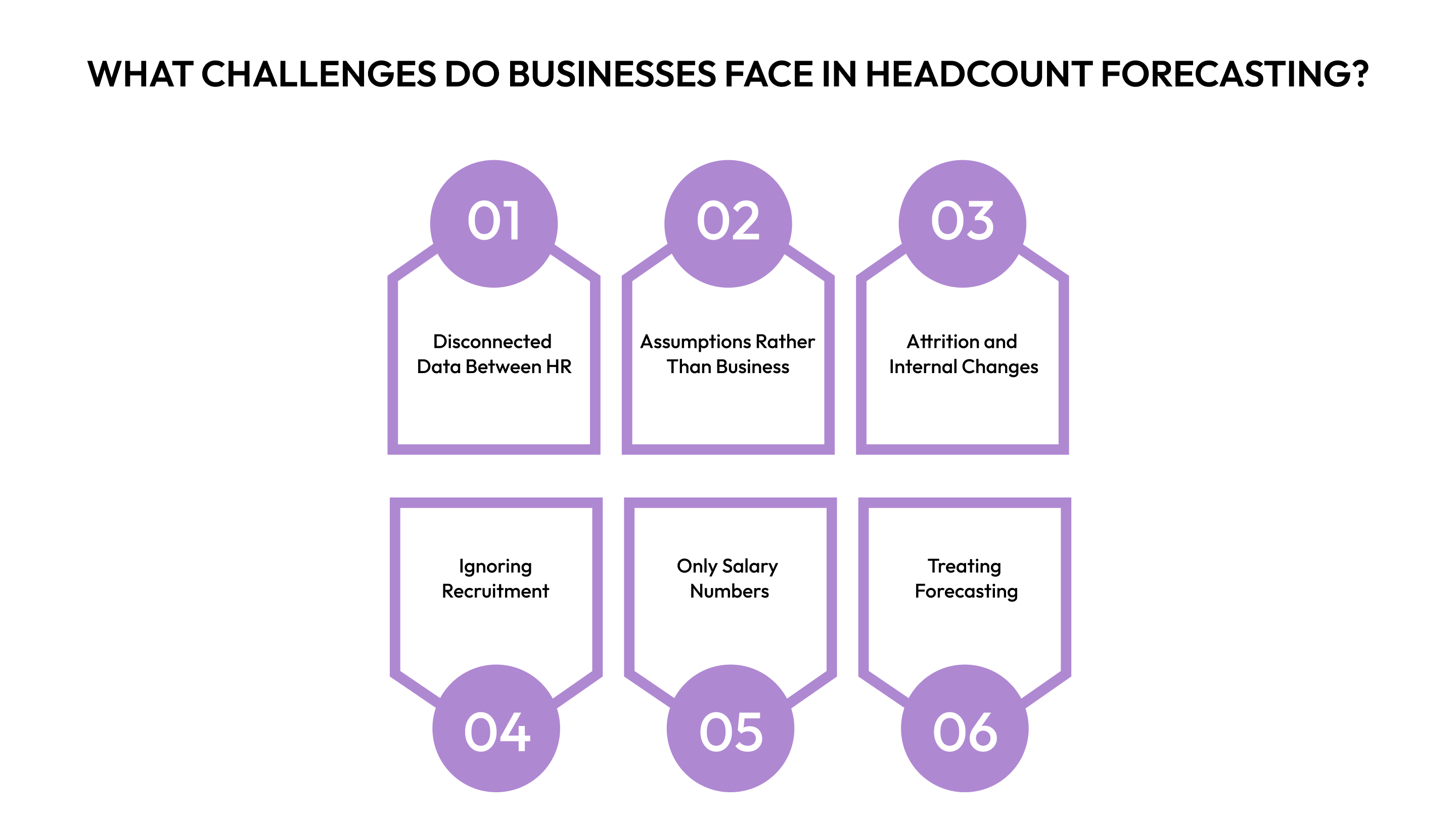
Even with the right intentions, many organizations struggle to forecast headcount accurately especially during rapid growth. Here are the most common obstacles and the best ways to resolve them:
1. Disconnected Data Between HR and Finance
The challenge: Headcount, hiring progress, and budget data live in separate systems, causing version confusion and slow decisions.
How to overcome it: Create a single source of truth that tracks roles, approvals, costs, and status in real time.
2. Hiring Based on Assumptions Rather Than Business Priorities
The challenge: Teams request roles without linking them to revenue, product goals, or workload signals.
How to overcome it: Tie every headcount request to a measurable business outcome before approving it.
3. Underestimating Attrition and Internal Changes
The challenge: Forecasts don’t account for resignations, transfers, or retirements, leading to surprise vacancies.
How to overcome it: Use historical data to model expected turnover and internal mobility, updating projections quarterly.
4. Ignoring Recruitment Lead Times
The challenge: Forecasts assume roles can be filled instantly, but hiring delays slow execution.
How to overcome it: Include realistic time-to-hire and ramp-up assumptions for each function or location.
5. Forecasting With Only Salary Numbers
The challenge: Budgets get blown when bonuses, benefits, onboarding, or equity costs are left out.
How to overcome it: Model total cost of headcount, not just compensation bands.
6. Treating Forecasting as a One-Time Project
The challenge: Annual plans become outdated as soon as market conditions or performance shift.
How to overcome it: Review and refresh forecasts regularly, quarterly at minimum for scaling businesses.
Forecasting challenges aren’t solved with more spreadsheets, they’re solved with visibility, ownership, and flexible planning that evolves with the business.
Conclusion
Headcount forecasting done poorly leads to chaos: blown budgets, stalled hiring, misaligned teams, and talent gaps that slow growth when it matters most. Hiring moves faster, the runway becomes predictable, and leaders gain confidence in every people decision. Conversations shift from scrambling to fill roles to building a workforce that can win.
This is where modern headcount planning platforms like CandorIQ help. We eliminate fragmented spreadsheets, align HR and Finance on a single live forecast, and automatically show the financial impact of every hiring move before decisions are made.
If you're spending hours reconciling different versions of headcount plans, struggling with surprise burn, or facing hiring delays due to misalignment. In that case, it’s time to replace reactive planning with a unified, strategic system.
See how CandorIQ helps growth-stage teams forecast smarter and scale sustainably, without spreadsheet chaos. Book a demo today.
FAQs
1. What is the purpose of headcount forecasting?
To predict future staffing needs and plan hiring budgets so a company has the right number of people at the right time, without overspending or slowing execution.
2. Who is responsible for headcount forecasting?
HR leads the workforce strategy, Finance owns budget guardrails, and department heads provide role requirements. Alignment across all three makes forecasts accurate and actionable.
3. How often should headcount forecasts be updated?
Quarterly for most scaling teams, with monthly checkpoints for high-growth or rapidly shifting business environments.
4. What data is needed for accurate headcount forecasting?
Forecasting requires hiring plans, compensation benchmarks, attrition trends, productivity metrics, and business performance data to project staffing needs confidently.
5. When should companies move away from spreadsheets?
When version control issues delay hiring, approvals become unclear, or Finance and HR are no longer working from the same numbers, that’s the time to adopt a centralized planning platform.
Ready to modernize your workforce and compensation strategy?
See how CandorIQ brings workforce planning and compensation together with AI.