

The 7 Best Headcount Planning Strategies to Scale Smarter
Discover the essential headcount planning tips that help CFOs and HR leaders align hiring with budget, reduce overspending, and support organizational growth.

Your leadership team just green-lighted 50 new hires this quarter. But onboarding stalls because approvals aren’t aligned. Finance claims hiring is exceeding budget, HR insists roles were already approved, and department heads are now confused about what positions they can actually open.
According to McKinsey’s 2025 HR Monitor, while 73% of organizations conduct workforce-planning exercises, only 12% of U.S. HR leaders say they engage in planning that looks three or more years ahead, suggesting most companies remain reactive rather than strategic.
Managing headcount is about making the right bets on people at the right moment, not manually tracking roles in tools never built for strategic planning.
This guide gives you the essential tips modern People and Finance teams need to build a scalable headcount strategy that keeps hiring velocity and budget health in sync.
Need to know
- Headcount planning is a strategic business function, not an administrative one; it directly impacts runway, hiring velocity, and execution speed.
- HR and Finance alignment is essential to ensure every approved role supports current business priorities and future growth plans.
- Real-time visibility prevents surprise overspend, duplicated roles, and miscommunication across distributed teams.
- Quarterly reviews and scenario modeling keep plans relevant as revenue and market conditions evolve.
- Unified systems outperform spreadsheets by enabling collaboration, faster approvals, and accurate budget tracking as teams scale.
What is Headcount Planning?
Headcount planning is the process of aligning your workforce needs with your company’s financial and strategic goals. It ensures that the right roles are created, approved, and filled at the right time, without overspending or slowing down execution. For scaling organizations, it’s a unified approach that keeps HR, Finance, and business leaders operating from the same hiring roadmap.
Why Headcount Planning Matters More for Scaling Teams
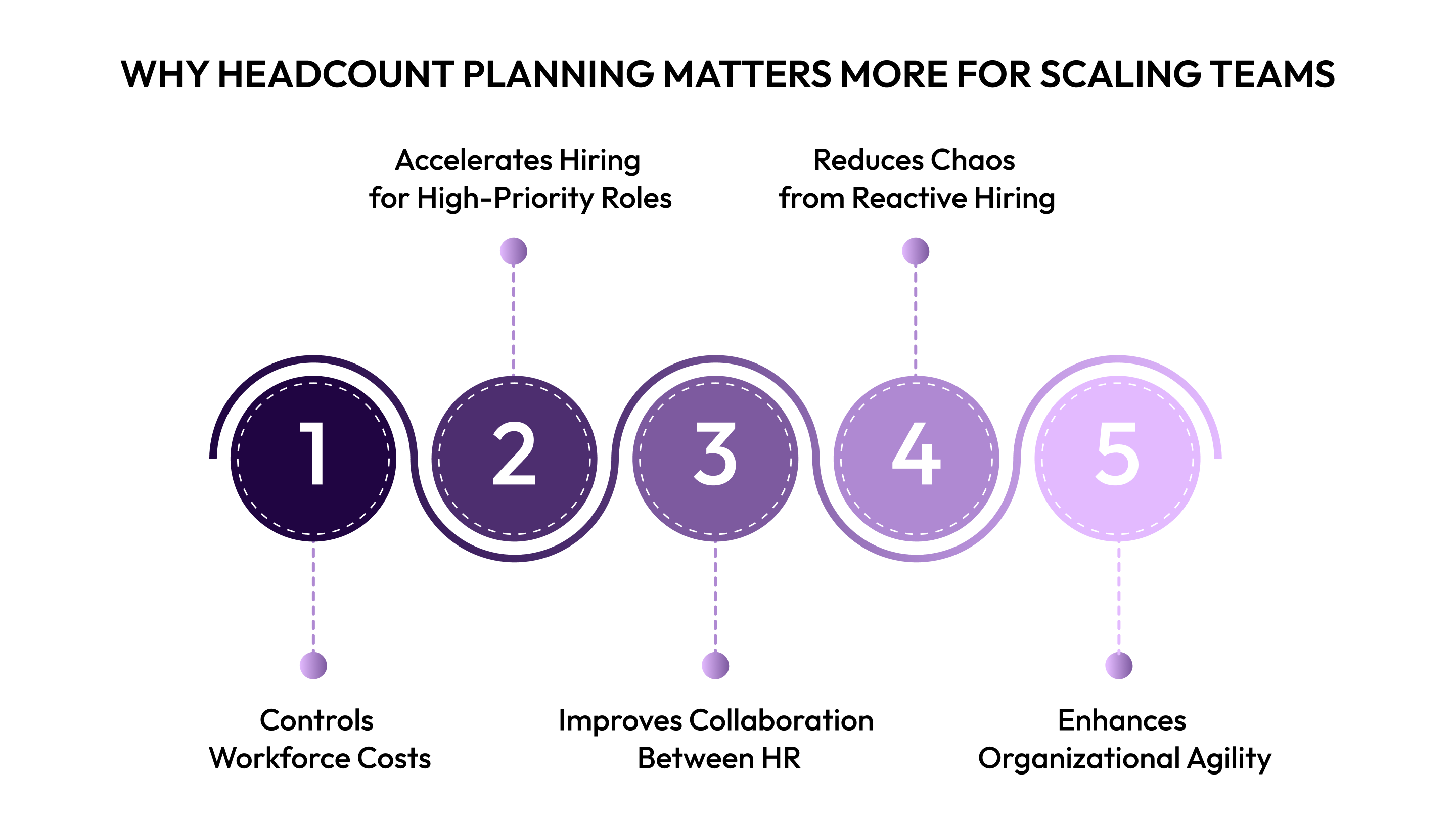
- Controls workforce costs and runway: Prevents unexpected budget spikes by forecasting hiring spend, compensation, and operational impact early.
- Accelerates hiring for high-priority roles: Aligns recruiting efforts with real business needs so critical positions get filled faster, improving execution speed.
- Improves collaboration between HR and Finance: Creates transparency around approved roles, compensation, and future hiring plans, eliminating strategic misalignment.
- Reduces chaos from reactive hiring: Replaces last-minute hiring requests with structured planning cycles and scenario modeling to adapt to change.
- Enhances organizational agility: Helps leaders pause, pivot, or accelerate hiring quickly in response to market shifts and internal performance insights.
Before building a solid headcount strategy, it’s important to understand how it differs from broader workforce planning.
.png)
What is the Difference Between Headcount Planning and Workforce Planning?
Headcount planning focuses on the number of roles needed to support near-term business goals and budget constraints. Workforce planning takes a broader, long-term view, ensuring the organization has the right skills, capabilities, and structure to achieve future strategy.
Both work together: headcount planning drives execution today, while workforce planning prepares the organization for tomorrow.
Scaling companies need both: headcount planning to control burn today and workforce planning to build competitive advantage tomorrow.
Suggested read: The Ultimate Guide to Headcount Analysis and Workforce Planning
With a clear understanding of headcount planning and how it connects to broader workforce strategy, the next step is putting it into action. Here are the most essential tips scaling companies rely on to plan smart hiring, protect budgets, and stay aligned as they grow.
7 Essential Tips for Effective Headcount Planning
Effective headcount planning requires more than listing open roles, it demands a strategic, collaborative approach that balances hiring needs with financial discipline. These seven tips help scaling companies improve accuracy, accelerate hiring, and prevent budget surprises.
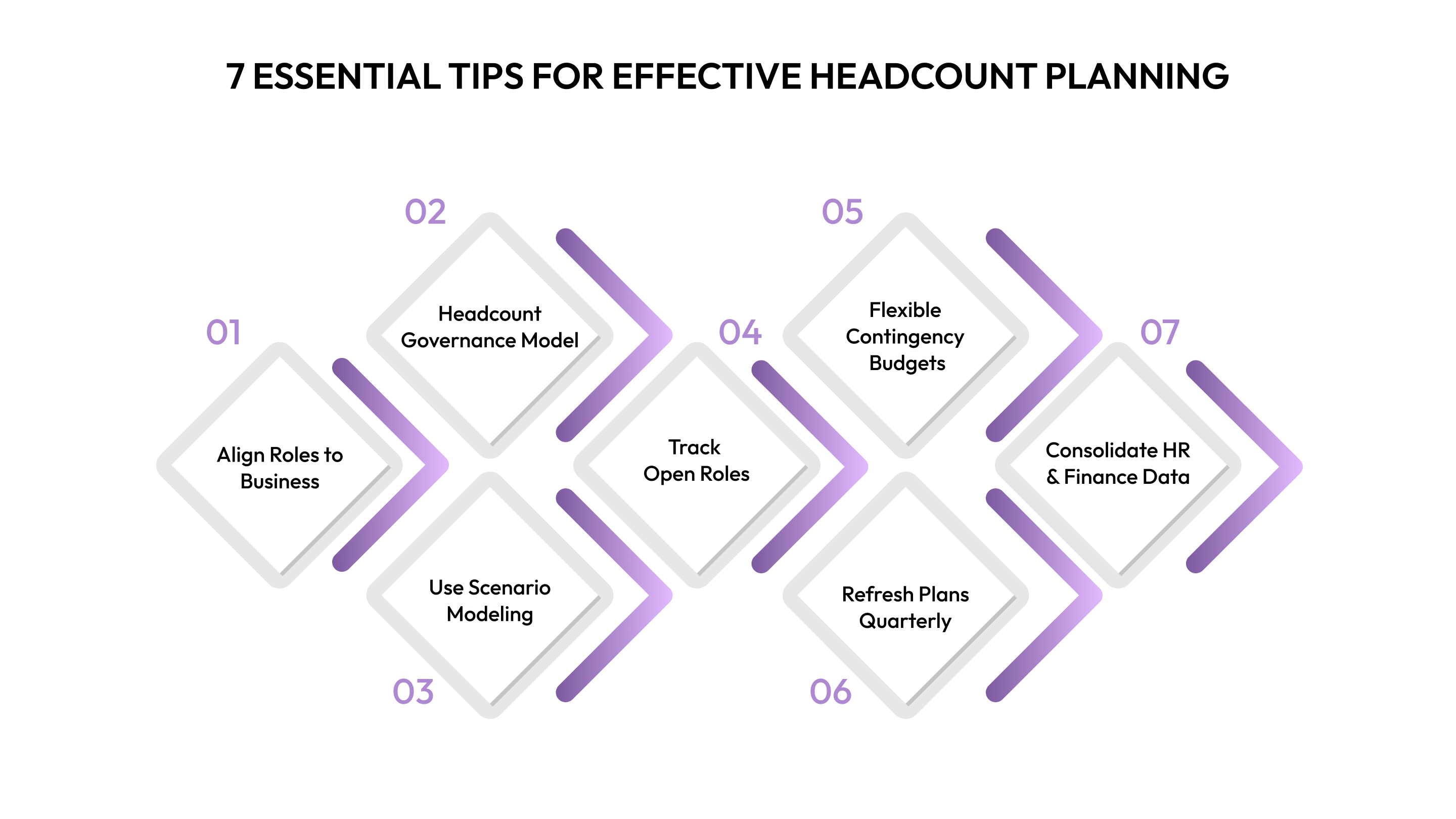
Tip 1: Align Roles to Business Priorities
Start with what drives revenue, product delivery, or operational efficiency. Every role must support a measurable business goal, not just team requests.
How it Benefits You:
- Better hiring focus: Ensures critical roles are prioritized first.
- Faster execution: Talent directly impacts product and revenue outcomes.
- Reduced internal friction: Aligns leadership around shared goals.
Best For: Companies scaling rapidly and struggling to justify headcount expansion.
Example: If customer onboarding delays are slowing revenue recognition, prioritize hiring implementation specialists before administrative roles.
2. Build a Clear Headcount Governance Model
Define who owns headcount requests, approvals, budgets, and hiring decisions to avoid miscommunication and delays.
How it Benefits You:
- Accountability baked in: No confusion about who approves what.
- Consistency in decision-making: Clear rules across teams and regions.
- Prevents unauthorized hiring: Aligns spend with finance strategy.
Best For: Organizations shifting from informal management to structured growth.
Example: Approval workflow: Department request → HR validation → Finance budget check → Executive sign-off for roles above midpoint salary.
3. Use Scenario Modeling to Adapt Quickly
Plan for different hiring outcomes, growth acceleration, slower revenue, or market fluctuations.
How it Benefits You:
- Predictable spend: Forecast burn under multiple scenarios.
- Faster pivots: Easily adjust hiring without starting from scratch.
- Data-driven decisions: Leadership sees direct financial impact.
Best For: Teams hiring in uncertain or competitive markets.
Example: Model hiring 20 vs. 40 new reps and compare CAC payback and gross margin impacts before finalizing revenue headcount.
4. Track Open Roles and Status in Real Time
Once roles are approved, track them continuously, open, paused, filled, or backfilled, across departments and locations.
How it Benefits You:
- Visibility into spend and progress at every stage.
- Prevents duplicate positions being opened by teams.
- Reduces finance-HR disputes over “who approved what.”
Best For: Organizations expanding across multiple teams or regions.
Example: A centralized dashboard shows 12 open engineering roles, 6 active, 3 on hold, 3 awaiting budget, preventing re-approval.
5. Maintain Flexible Contingency Budgets
Hiring rarely goes exactly as planned. Build buffers to handle negotiations, higher-cost markets, or urgent talent needs.
How it Benefits You:
- Avoids budget panic when offers exceed salary bands.
- Supports hiring velocity for hard-to-fill roles.
- Prepares for market rate changes quarter to quarter.
Best For: VC-backed companies where runways and budgets shift frequently.
Example: Reserve an extra 7–10% in compensation for key roles like senior engineers who may demand above-midpoint offers.
6. Review and Refresh Plans Quarterly
Fast-growth teams need ongoing adjustments, not annual planning that’s outdated before Q2 begins.
How it Benefits You:
- Reduces over- or under-hiring risk based on real performance.
- Keeps hiring aligned with shifting priorities.
- Improves forecasting accuracy for investors and boards.
Best For: Organizations scaling headcount 2–3x yearly.
Example: After Q1, a company pauses hiring 8 sales roles due to a slower pipeline but increases product roles to accelerate feature delivery.
7. Consolidate HR and Finance Data Into One Source of Truth
Disconnected systems create version chaos. Unified tools keep everyone aligned on the same hiring and budgeting data.
How it Benefits You:
- Eliminates manual reconciliation errors from spreadsheets.
- Improves cross-functional visibility for leaders.
- Enables real-time workforce reporting and cash burn insights.
Best For: Companies with headcount spread across multiple systems (ATS, HRIS, spreadsheets).
Example: CandorIQ syncs hiring requests and compensation data directly to financial reporting, so Finance and HR always see the same live numbers, making decisions faster and reducing back-and-forth approvals. This kind of unified visibility becomes crucial as teams scale, ensuring every hiring move supports both budget and business priorities without extra manual effort.
Even with the right strategies in place, there are a few traps that can derail headcount planning if you’re not careful.
5 Headcount Planning Mistakes You Can’t Afford to Ignore
Even well-structured plans can fall apart if execution isn’t monitored closely. Many organizations stumble into the same traps: outdated assumptions, unclear ownership, and fragmented data.
Here are the most common mistakes scaling companies make, and how to correct them before they impact cost, hiring velocity, or organizational alignment.
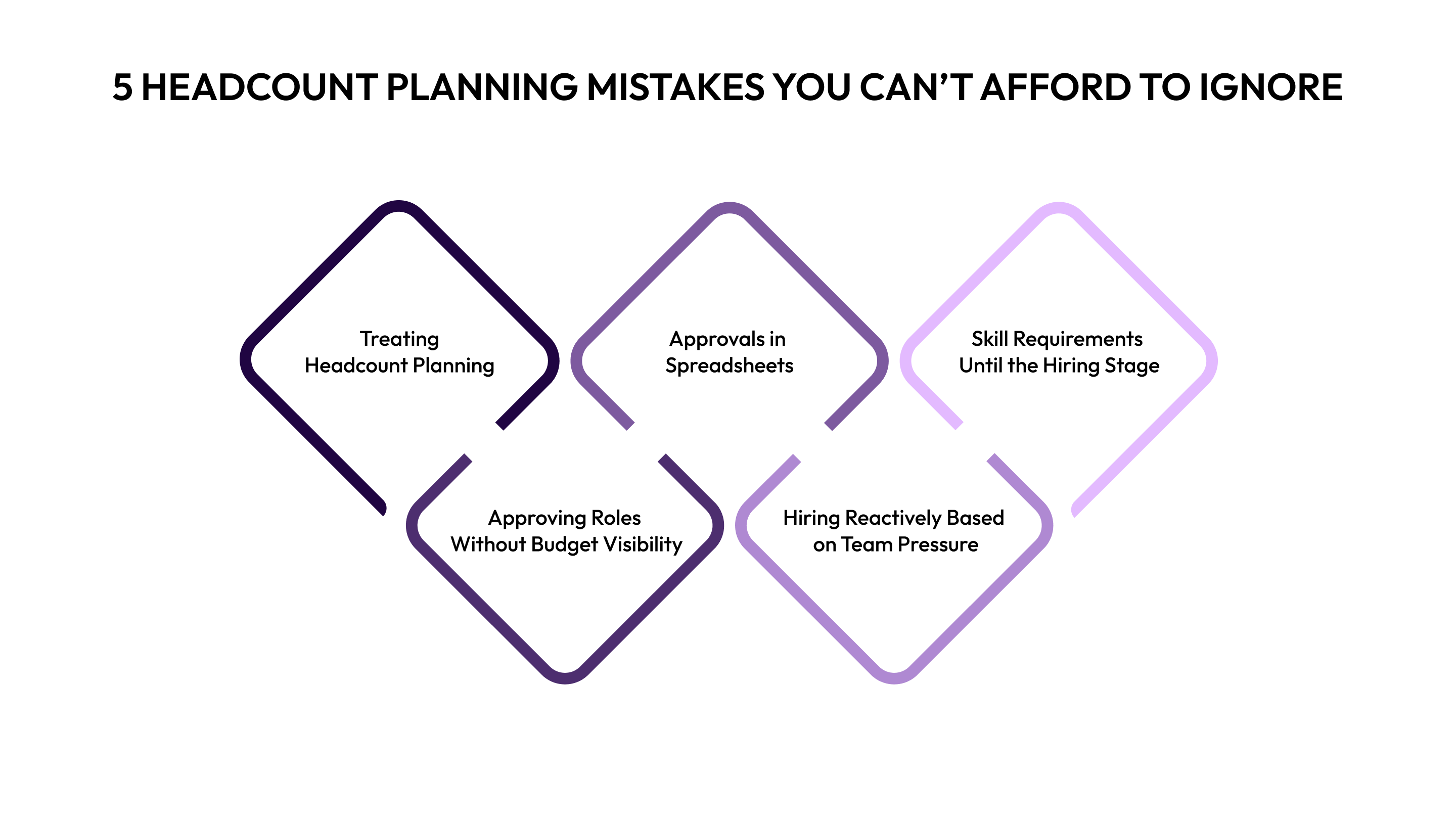
1. Treating Headcount Planning as a One-Time Exercise
The Challenge: Annual plans quickly become irrelevant when revenue shifts, hiring slows, or priorities change, causing overstaffing in some teams and talent gaps in others.
Solution: Shift to quarterly planning cycles with monthly checkpoints tied to real performance data. This keeps hiring aligned to the company’s current trajectory, not last year’s goals.
2. Approving Roles Without Budget Visibility
The Challenge: Roles get green-lit based on need, but Finance isn’t looped in on compensation impacts, leading to surprise burn or mid-cycle hiring freezes.
Solution: Make budget impact part of the request workflow. Every new role should show forecasted cost (salary + equity + benefits) and expected business impact before approval.
3. Managing Requests and Approvals in Spreadsheets
The Challenge: Disjointed trackers cause version confusion and delays, with roles accidentally duplicated or approved twice.
Solution: Create a single shared source of truth where HR and Finance can collaboratively track request status, approvals, and hiring progress in real time.
4. Hiring Reactively Based on Team Pressure
The Challenge: Departments push urgent roles that don’t align with product or revenue priorities, stretching budgets thin and slowing impact.
Solution: Adopt a business-aligned prioritization model: critical roles tied to revenue, product timelines, and customer experience are filled first.
5. Ignoring Scope and Skill Requirements Until the Hiring Stage
The Challenge: Roles are requested with vague expectations, causing misalignment in salary benchmarking, recruiting targets, and business outcomes.
Solution: Define role purpose, level, and success metrics upfront to ensure accurate compensation planning and faster hiring alignment.
When these mistakes pile up, hiring slows while costs rise, a tough combination for any company trying to scale responsibly.
Suggested read: Compensation and Headcount Planning Scenarios Explained
.png)
Conclusion
Headcount planning is where business ambition meets operational reality. When hiring decisions are made without shared visibility or budget alignment, even the strongest growth plans can start to break down quickly. But when organizations treat headcount planning as a strategic discipline, they gain something far more valuable than a clean spreadsheet: clarity, confidence, and control over how the company scales.
That shift requires systems that support the way modern teams operate, fast-moving, distributed, and constantly adapting.
CandorIQ gives People and Finance leaders a shared, real-time view of planned vs. actual headcount, compensation impact, and burn forecasts, so hiring never becomes a surprise. It helps teams course-correct sooner, align approvals faster, and move from reactive hiring to intentional workforce planning.
Book a demo with CandorIQ and explore how CandorIQ supports smarter headcount decisions and sustainable growth, without the spreadsheet sprawl.
FAQs
1. What is the main goal of headcount planning?
The goal is to ensure a company has the right number of roles approved and filled at the right time, all while staying within budget and aligned to business priorities. It helps teams make hiring decisions that directly support growth.
2. Who should be responsible for headcount planning?
Headcount planning is a shared responsibility. HR leads talent strategy, Finance owns budget guardrails, and department leaders provide role requirements and timing. Alignment across these teams is what makes planning accurate and actionable.
3. How often should headcount plans be reviewed?
Quarterly reviews are ideal for fast-growing companies, with monthly checkpoints tied to real performance. Annual planning alone is too static for changing revenue models, shifting priorities, or hiring velocity adjustments.
4. What should be included in a headcount plan?
A strong plan includes approved roles, compensation estimates, hiring timelines, scenario models, and clear cost impact. Tracking role status, open, filled, on hold, or canceled, is critical for visibility and control.
5. When should a company move away from spreadsheets for headcount planning?
Once hiring spans multiple teams, locations, or approval workflows, spreadsheets become error-prone and slow. If you’re spending too much time reconciling versions or explaining budget variances, it’s time to upgrade to a centralized system.
Ready to modernize your workforce and compensation strategy?
See how CandorIQ brings workforce planning and compensation together with AI.