

How to Establish Salary Ranges: Competitive Analysis Factors
Learn the competitive factors that inform salary range decisions at growth-stage companies. A strategic framework for CPOs and CFOs balancing talent and budget.

Your engineering manager just resigned. Why? A competitor offered her $40,000 more, well beyond the range you thought existed in your market. Meanwhile, your CFO is questioning why your latest engineering salaries are 15% above budget.
Sound familiar? In 2024, 16% of the employees left their jobs for lower pay ranges.
Most compensation guides treat salary ranges as fixed numbers. But for companies scaling from 50 to 5000 employees, they’re strategic tools that can either fuel or hinder growth. The key difference between businesses losing talent to pay gaps and those building fair, predictable compensation structures is understanding the factors that truly matter in competitive analysis.
This blog isn't compensation 101. It's for CPOs and CFOs at growth-stage companies who need to go beyond spreadsheets and create compensation frameworks that balance hiring needs with budget realities.
Key Takeaways
- Growth-stage companies need to establish flexible, strategic salary ranges to stay competitive, not just rely on outdated market data.
- Focus on your specific competitive set (not just "the market") and consider factors like geography, funding, and company stage when setting salary ranges.
- Pay compression within your company can kill morale. Ensure consistency in pay across similar roles and levels.
- Not all roles need to be paid at the market median. Strategic roles should be compensated more generously to attract the best talent.
- Use CandorIQ to build scalable compensation frameworks with real-time collaboration, scenario modeling, and geo-adjusted salary ranges to stay competitive and budget-conscious.
Why Traditional Competitive Analysis Falls Short at Scale?
Most companies rely on "Glassdoor says this role pays $X," which works until you're hiring across multiple states and countries. That’s when the cracks appear.
The issue isn’t the data itself, but the false precision trap. When competing with companies at different stages, sizes, and funding levels, "market median" becomes irrelevant.
For example, a 200-person Series B SaaS company is losing senior engineers to FAANG (who offer 40% more in cash) and early-stage startups (who offer 2x the equity). Which "market" should you benchmark against?
- Informal compensation structure: Most growth-stage companies (100-1,000 employees) lack formalized compensation bands.
- Cost of mis-hire: Thousands of dollars for senior-level roles, factoring in recruiting fees, onboarding, lost productivity, and team disruption.
- The cost of unfilled critical roles is even higher, especially when existing teams burn out covering the gap.
Now, shift your framework:
- From: "What does this role pay?"
- To: "What do we need to pay to win talent in the markets we operate, at our stage and competitive position?"
Competitive salary analysis isn’t about finding "the right number." It's about evaluating the factors that make your compensation defensible, scalable, and strategic. Let’s break down how to do that.
6 Critical Competitive Analysis Factors That Define Your Salary Ranges
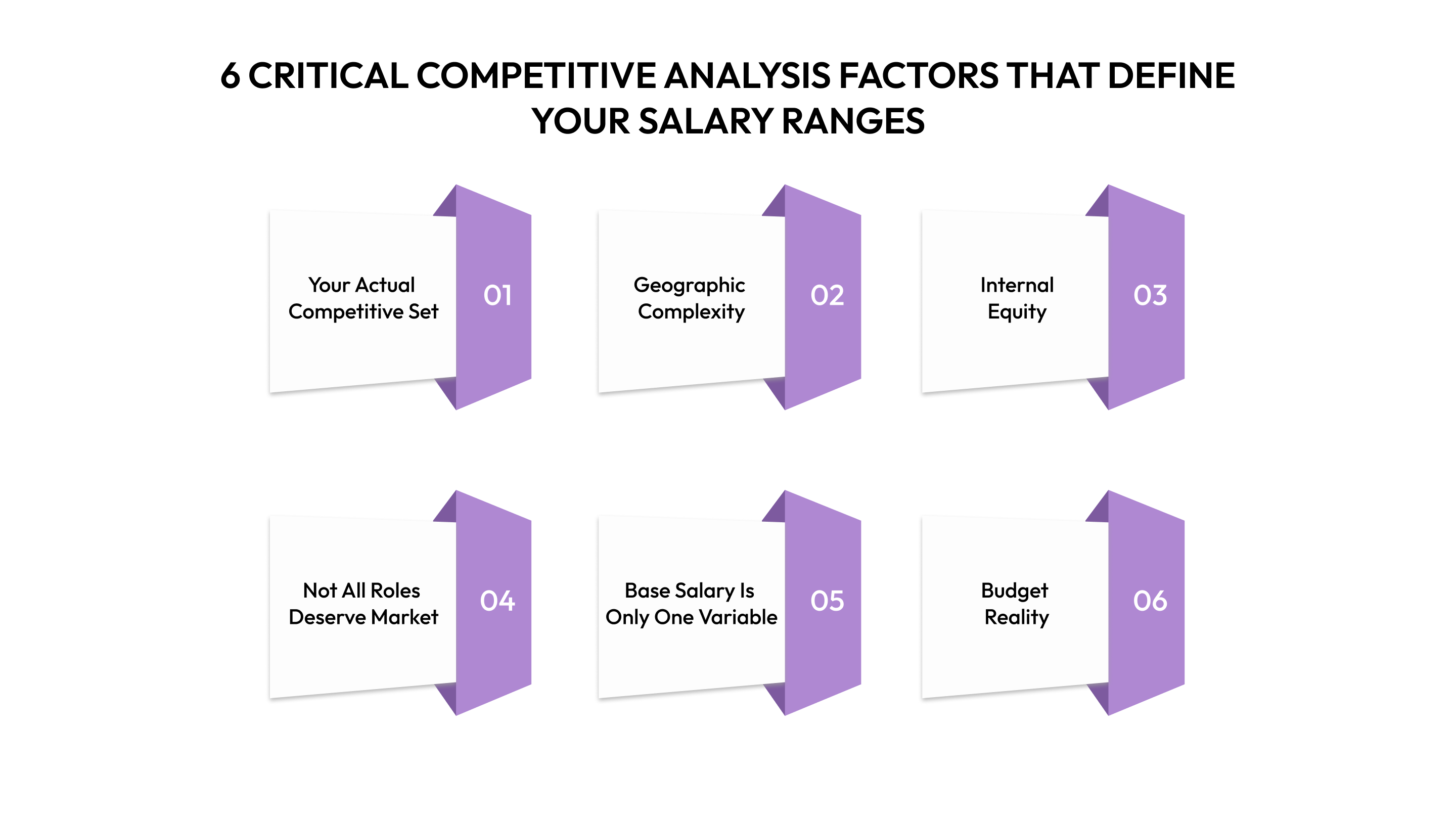
While analyzing compensation strategies across the growth-stage companies, there are six factors that consistently separate scalable frameworks from reactive ones. Here’s how to evaluate each:
Factor 1: Your Actual Competitive Set, Not "The Market"
You're competing with 15-20 specific companies for the same talent, not "the market."
- Industry overlap matters: SaaS competes with SaaS; fintech with fintech. Even within SaaS, horizontal tools compete differently from vertical solutions.
- Stage similarity: Series B companies compete with other Series B and C companies, not with public companies or seed-stage startups.
- Geography intersect: Where do your candidates come from? Where do departed employees go? If you're losing Bay Area engineers to fully-remote companies paying Bay Area wages, that's your competitive set, regardless of where those companies are headquartered.
- Funding and runway: Well-funded companies can pay differently than bootstrap-efficient ones. When a competitor raises a $100M Series C, expect their salary ranges to shift 10-15% upward within six months.
Create a competitive matrix of 15-20 companies. Track funding, hiring velocity, salary data, and employee movement. Modern compensation platforms like CndaorIQ integrate real-time competitive intelligence into range recommendations, alerting you when competitors make moves that affect your talent market.
Factor 2: Geographic Complexity: The Real Challenge of Distributed Teams
“Remote-first” sounds simple until deciding if a senior engineer in Bangalore should earn the same as one in San Francisco.
- Cost-of-living differentials: Consider total purchasing power (housing, healthcare, taxes).
- Talent supply: Some locations have talent surpluses (lower pay), others have shortages (premium pay).
- Remote work policy impact: Should you pay SF wages to someone who moves to Austin?
- Legal and tax considerations: International hires bring currency fluctuation and tax issues.
Geographic models:
- National bands (simplest, most expensive): Same pay across all locations.
- Tiered zones (balanced): Different pay based on cost of living.
- Fully localized (complex, cost-efficient): Custom ranges for each metro.
Choose a model based on talent market realities, not ideology. Confused? Read when and why to add geographic pay to your compensation toolbox.
Factor 3: Internal Equity: The Silent Killer of Morale
Market rates matter, but internal fairness matters more. Pay compression kills retention faster than below-market offers. New hires making more than tenured employees leads to dissatisfaction.
- New hire vs. existing employee gaps reveal your compression problem. Pull a report showing compensation by role, level, and tenure. If your engineers hired in the last six months earn 15%+ more than engineers hired two years ago at the same level, you have compression.
- Promotion vs. market hire premiums: Ensure promotions bring employees to market rates.
- Role-level consistency: It matters for perceived fairness. Ensure all employees of the same role are paid within similar ranges. Inconsistency breeds resentment.
Proactively manage internal equity:
- Audit pay gaps quarterly.
- Set aside budget for compression adjustments.
- Build promotion frameworks that align pay with market rates.
If you're not intentionally managing internal equity, you're accidentally creating retention risk.
Factor 4: Not All Roles Deserve Market Median
Not every role needs to be at the median market rate. Some roles are strategic differentiators and require premium pay.
- Revenue-critical roles deserve premium positioning. These roles directly impact revenue and should be paid at the 60th-75th percentile or higher.
- Hard-to-fill specializations command market premiums. AI/ML engineers, certain security roles (particularly cloud security and AppSec), and niche domain experts (healthcare compliance, financial services regulation) have supply-demand imbalances that force premium pay.
- Time-to-productivity matters for the total cost of ownership. Roles that take 6-9 months to ramp cost significantly more to under-hire.
- Competitive targeting reveals where others over-invest. If your competitors consistently lose product managers to you, you can probably lag the market slightly on PM comp. If you're losing every senior backend engineer to competitors, you need to lead.
Strategic segmentation in practice:
- Lead the market (60-75th percentile): Core engineering, customer-facing sales, product leadership
- Match the market (45-55th percentile): Standard operations, established functions, support roles
- Lag consciously (35-45th percentile): Non-strategic admin roles, outsourceable functions
This approach lets you over-invest where it matters while maintaining overall budget discipline.

Factor 5: Base Salary Is Only One Variable
Growth-stage companies have leverage beyond cash. Use equity, career velocity, and scope to balance lower base salaries.
- Equity value: For Series B companies, equity can offset lower base salaries (if transparent about valuation and ownership).
- Variable compensation: Bonuses and commission plans can provide meaningful upside.
- Benefits: Learning budgets, healthcare, and remote work flexibility add value.
- Career velocity: Faster promotions and learning opportunities matter more than just cash.
For senior roles, equity and career growth matter more than cash. Be transparent about what candidates value.
Factor 6: Budget Reality: What CFOs Actually Care About
The best compensation strategy is useless if it blows your budget. CFOs care about the total cost over 12 months.
- Current burn rate and runway determine your flexibility. Pre-revenue companies have different constraints than profitable ones.
- Hiring plan velocity affects how much buffer you need. Hiring 50 people this quarter requires flexibility in salary ranges.
- Funding timeline: Pre-raise ranges may differ from post-raise ranges. If you're raising in Q2, you might set conservative ranges for Q1, knowing you'll refresh them after the raise closes.
- Scenario modeling answers the questions that keep CFOs up at night: What if market rates increase 10%? What if we hire 30% more engineers than planned? What if 80% of our offers come in at the 70th percentile instead of the median?
Build flexible ranges:
- Set ranges 5-10% above the current market to accommodate 1-2 quarters of market drift
- Model at 65-70th percentile occupancy, not 50th. Candidates negotiate up, not down
- Separate "approved ranges" from "approved budget". Ranges can be wider than your target spend
- Create approval workflows for offers exceeding the 75th percentile
Use compensation planning tools like CandorIQ to model real-time scenarios. Otherwise, you risk exceeding your budget. No salary range survives first contact with a competitive hiring market. Build flexibility in, or expect budget misses.
Also Read: How to Manage Salary Band Structures
How to Build Reasonable Salary Ranges?
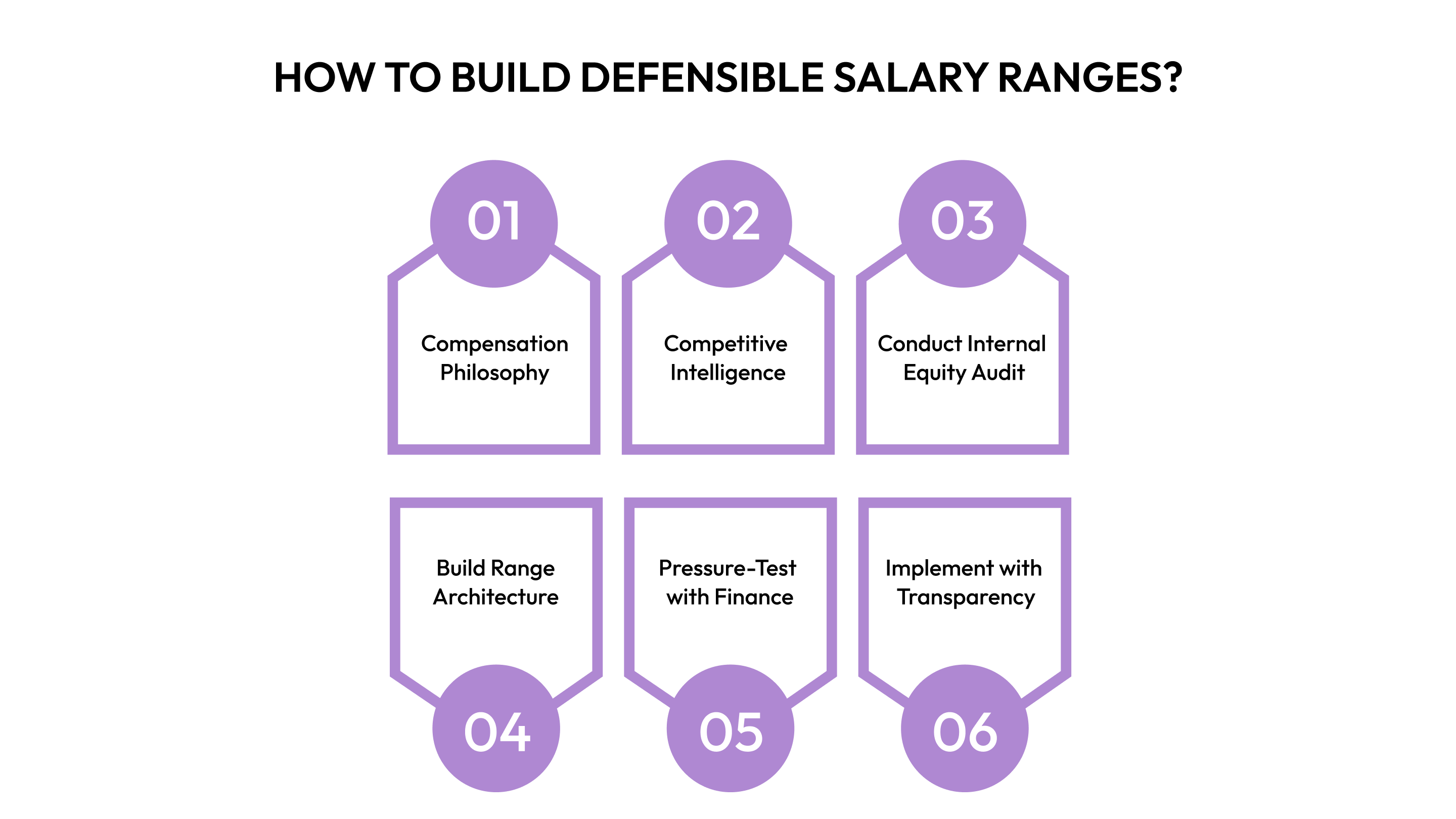
Knowing the factors is just the beginning. Here’s the workflow growth-stage companies use to turn analysis into actionable salary ranges.
Step 1: Define Your Compensation Philosophy
Start by answering the big questions: Will you lead, match, or lag the market for each role family? Align with executives on trade-offs, cash vs. equity, geo-parity vs. cost-efficiency, consistency vs. flexibility. Document criteria for exceptions so your team isn't reinventing the wheel for every edge case.
Your compensation philosophy should be a single page that answers:
- Market positioning
- Role segmentation
- Geographic approach
- Balancing internal equity with external competitiveness
Step 2: Gather Competitive Intelligence
Identify your true competitive set—15-20 companies you actually compete with for talent. Pull data from 3-5 sources (Radford, Pave, Carta, LinkedIn Salary, and public pay transparency laws). Don't rely on a single source; triangulate.
Then, validate with real-world data. Review recent offers: Which did you win? Which did you lose? What were the competing companies offering? This beats survey data every time.
Step 3: Conduct Internal Equity Audit
Analyze pay by level, role, tenure, and performance. Identify:
- Compression gaps: New hires, earning more than tenured employees.
- Outliers: People paid 30% above or below their level.
- Inconsistencies: Same role, different pay levels.
Calculate the cost to bring employees into new ranges. Address equity gaps before launching new ranges to avoid retention issues.
Step 4: Build Range Architecture
Define job levels that work for your company. For example, IC1-IC6 for individual contributors, M1-M3 for managers. Set minimum, midpoint, and maximum for each level; range spreads are typically 30-40%.
For tiered geographic models, apply your multipliers. Model the total budget impact under different hiring scenarios (e.g., at the 50th, 65th, and 75th percentiles).
Step 5: Pressure-Test with Finance
Collaborate with your CFO. Run scenarios at the 50th, 65th, and 75th percentiles. Identify budget triggers: "If 60% of offers exceed the midpoint, we’ll overspend by $X." Set approval workflows for out-of-range offers to prevent budget overruns.
Get CFO buy-in upfront to avoid the classic disconnect between HR and Finance.
Step 6: Implement with Transparency
Train hiring managers on using ranges, positioning offers, and escalating when needed. Establish clear offer approval workflows for different percentiles and exceptions.
Set a quarterly review cadence. Markets change, so should your ranges.
For a 200-person company, expect 6-8 weeks for initial implementation, followed by quarterly refinements. The alternative, reactive, ad-hoc compensation decisions, will cost far more in mis-hires, retention failures, and budget overruns.
Also Read: Effective Salary Increase Guidelines for Managers
4 Mistakes That Can Undermine Competitive Salary Analysis
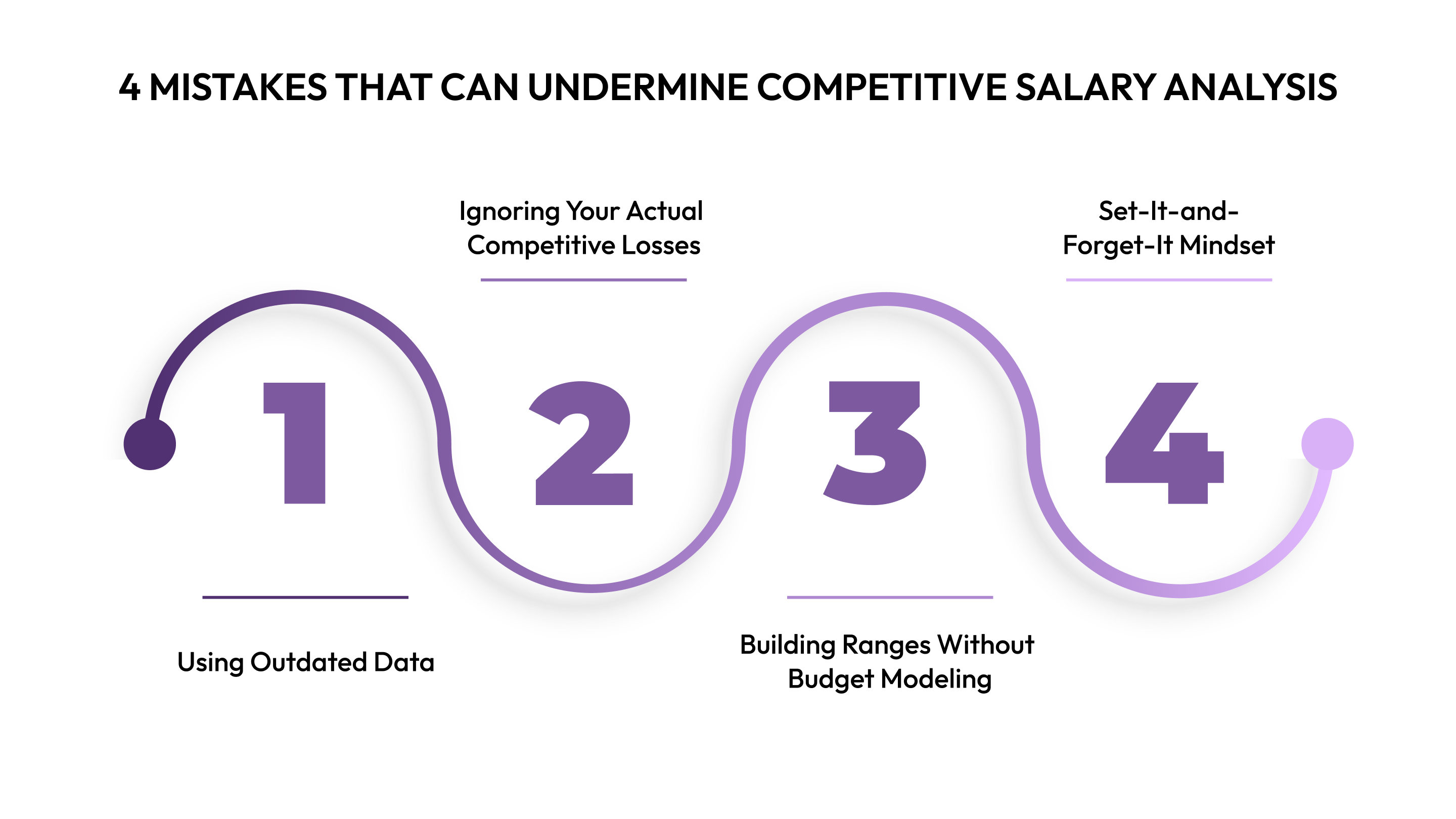
You can have the perfect six-factor framework, a well-designed workflow, and full executive buy-in, and still fail at competitive compensation. Why? Because the gap between strategy and execution is where most companies fall apart.
Pitfall 1: Using Outdated Data
Market data gets old fast. Using 12-month-old surveys in a hot market puts you 15% behind before you even start. By the time you pull data, analyze it, and get approval, the market may have shifted by 18 months.
Solution: Update primary data sources quarterly. Add real-time signals—LinkedIn salary posts, H1B visa data, and offers lost to competitors. Treat compensation data like sales pipeline data: it needs constant updates.
Pitfall 2: Ignoring Your Actual Competitive Losses
You’ve lost three engineers to Datadog in two months. Your ranges say you’re competitive, but the market says otherwise.
Solution: Track every lost offer by reason. Make "compensation" a mandatory range review trigger. If patterns emerge, act fast.
Pitfall 3: Building Ranges Without Budget Modeling
You built beautiful ranges assuming median offers, but candidates negotiate to the 70th percentile because they know their worth. Now you’ve overspent by 20%.
Solution: Model at realistic percentiles, not optimistic ones. Most growth-stage companies find offers cluster at the 60th-70th percentile. Model accordingly.
Pitfall 4: Set-It-and-Forget-It Mindset
You built ranges in January, but by September, market rates have moved 12%. Your ranges are now outdated.
Solution: Conduct quarterly reviews, not annual ones. In fast-moving markets, annual reviews are too slow. Some companies review monthly for key roles. The cost of outdated ranges is higher than that of frequent updates.
These four pitfalls are the difference between salary ranges that work and ranges that become shelf-ware within six months.
Also Read: How to Build a Scalable Salary and Raise Structure for Growing Organizations?

Conclusion
Growth-stage companies succeed by being strategically competitive, not by paying the most. They focus on paying enough to attract the right talent in key markets while sticking to budget discipline that allows them to out-execute competitors.
They create frameworks that are principled yet flexible, collaborating across HR and Finance in real-time rather than battling over quarterly budgets. Compensation is seen as a strategic capability, not just an administrative task.
Strong compensation frameworks aren’t built in spreadsheets. They’re built on platforms that enable real-time collaboration, instant scenario modeling, and adaptability to market changes.
Ready to move beyond spreadsheets? Book a demo with CandorIQ to help growth-stage companies create scalable compensation frameworks with real-time collaboration, scenario modeling, and geo-adjusted ranges.
Frequently Asked Questions
1. How often should I update salary ranges?
It's crucial to update salary data quarterly or even monthly for key roles in fast-moving markets to stay competitive.
2. What are the risks of using outdated salary data?
Using outdated data can result in offers being 10-15% below current market rates, leading to missed opportunities and talent loss.
3. How do I handle pay compression among existing employees?
Regularly audit pay gaps between new hires and tenured employees, and adjust pay during promotions or as part of a quarterly review process.
4. How do I balance competitive pay with company budget constraints?
Build flexible salary ranges that allow for adjustments, including scenario modeling, and always have a 5-10% buffer above the market median to accommodate changes.
Ready to modernize your workforce and compensation strategy?
See how CandorIQ brings workforce planning and compensation together with AI.