

What Is Compensation Justification: A Guide for HR Teams in 2026
Learn what compensation justification means, why it matters for pay equity and compliance, and how growing U.S. companies can build a defensible pay decision process.


Are your pay decisions ready to hold up under scrutiny? In 2026, even though 77% claim to be working on one, only 14% of organizations have fully implemented a pay transparency strategy.
For HR teams at growing U.S. companies, that gap is a real liability. Pay transparency laws are expanding fast, and state laws will require employers to disclose pay ranges. If your team cannot explain why someone earns what they earn, you are already exposed.
Inconsistent, gut-feel pay decisions invite legal risk, erode employee trust, and damage your employer brand. This guide covers what compensation justification is, why it matters in 2026, what a strong process looks like, and how to build one that scales.
Quick Overview
- Compensation justification is the documented rationale behind every pay decision your company makes.
- Informal pay decisions no longer hold up against legal scrutiny, employee questions, or pay equity audits.
- Strong justification requires five things: market data, internal equity, role criteria, performance evidence, and documentation.
- A seven-step process helps your team apply the same logic to every pay decision, every time.
- CandorIQ connects market data, equity analysis, and approval workflows so your team documents justification at the point of decision.
.png)
What Is Compensation Justification?
Compensation justification is the documented explanation of why a specific employee receives a specific level of pay. It connects a pay decision, a starting salary, a raise, a promotion, or a bonus to a clear set of criteria.
Those criteria include market data, the employee's role and responsibilities, their experience, their performance, and where they sit in your internal pay structure.
Here’s why improvisation no longer works:
- Rising Pay Transparency Laws: Illinois, Minnesota, New Jersey, Massachusetts, and California all passed or strengthened pay transparency requirements in 2026. If you post a salary range without data to back it up, you are already in compliance grey territory.
- Higher Employee Expectations: Pay secrecy is eroding. Workers share compensation data on Glassdoor and LinkedIn. When your team spots inconsistencies you cannot explain, trust breaks down, and turnover follows.
- Litigation Risk is Rising: Pay discrimination claims under the Equal Pay Act and Title VII are not going away. Without documented justification, you have no defense when a disparity surfaces.
- The EU Pay Transparency Directive: For U.S. companies with European operations, this directive requires employers to explain pay gaps and provide justification for compensation decisions. Multinational HR teams need a unified framework.
- Inconsistency Compounds at Scale: A 20-person startup may get away with informal decisions. A 200-person company cannot. Every undocumented decision sets a precedent that affects the next hire, the next raise, and the next promotion.
- High Performers Leave Quietly: Employees who sense inequity rarely complain. They accept competing offers. They move to employers who can articulate a fair and transparent compensation philosophy.
So what actually makes a compensation justification strong enough to stand up to scrutiny?
5 Core Elements of a Strong Compensation Justification

A good compensation justification is a structured argument that connects a pay decision to evidence. These five elements build that argument.
1. Market Data
This is your external reference point for what comparable companies pay for the same type of role. Data needs to be current, sourced from credible benchmarking tools, and matched to the right function.
Using two-year-old data or benchmarking a senior engineer against a generic "tech" category creates a weak foundation. Your pay philosophy should specify which market percentile you target and why.
2. Internal Equity
This element answers a specific question: how does this pay decision compare to what others in similar roles earn inside the company? Internal equity is about ensuring that differences in pay reflect differences in scope, experience, and performance, not inconsistency or bias. When a gap exists, you need documentation explaining the legitimate reason for it.
3. Role and Leveling Criteria
Every pay decision should map to a clearly defined role level. What does Level 2 look like versus Level 3? What skills, scope, and impact does each require?
Without clear leveling, managers across departments apply different standards and create pay inconsistencies that are difficult to reverse. Leveling criteria give every pay decision a shared anchor.
4. Performance and Contribution
Performance should determine where someone sits within a pay range, and merit increases should connect to measurable outcomes. When performance justification is absent, pay defaults to whoever negotiates hardest.
This causes disadvantages to employees who are equally productive but less assertive. Documenting performance evidence at review time closes that gap.
5. Documentation
Documentation means recording the market data you referenced, the internal comparisons you made, the level criteria you applied, and the performance evidence you considered at the time of the decision. Without it, nothing holds up in a compliance review or employee conversation.
These five elements work together. Market data without internal equity analysis can produce offers that sound fair externally but create inequity internally. And none of it matters without documentation.
With these building blocks in place, the next challenge is operationalizing them consistently.
How to Build a Repeatable Compensation Justification Process: 7 Steps
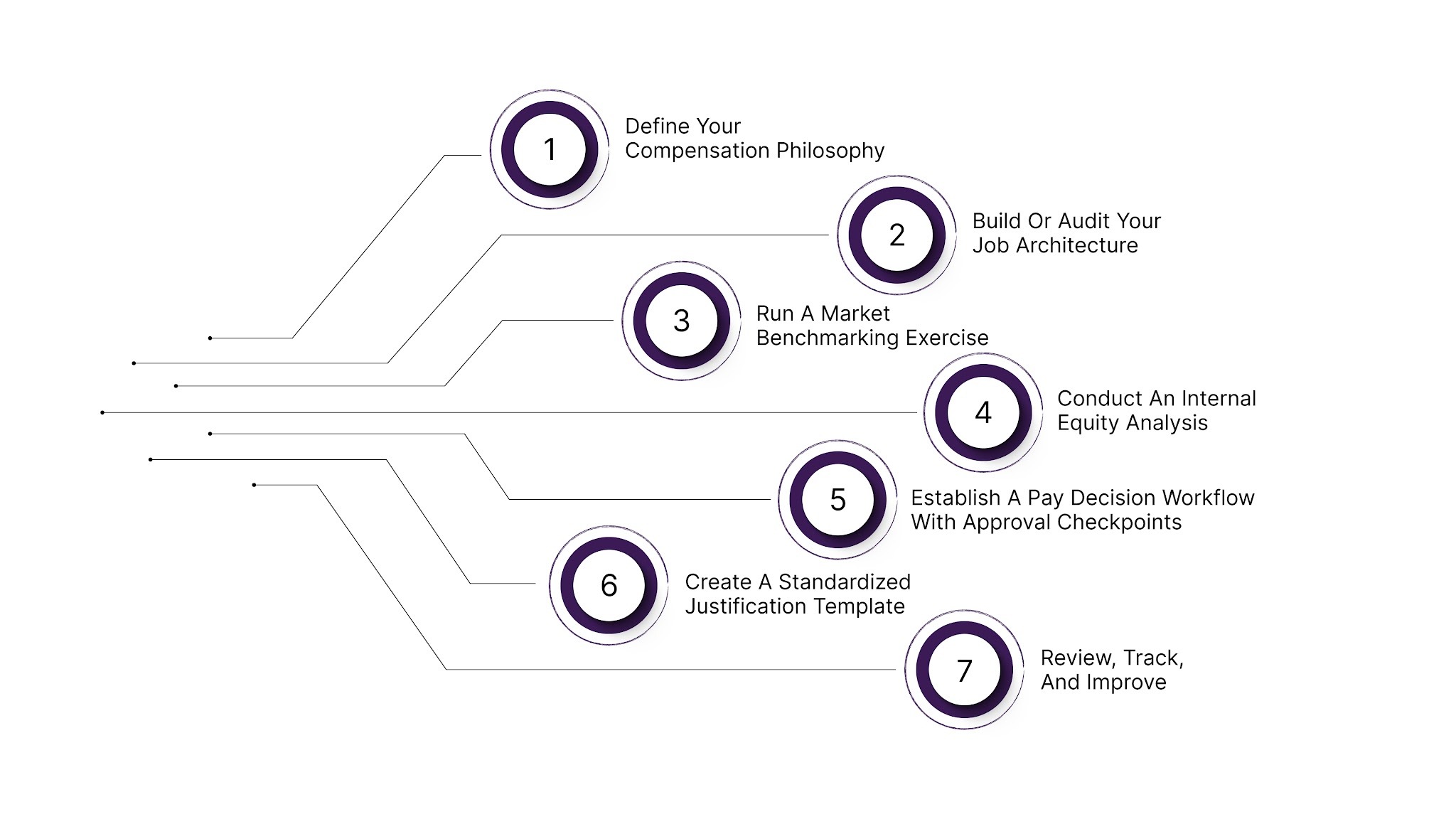
A strong framework only works if your team actually uses it consistently. Here is how to turn principles into a practical workflow.
Step 1: Define Your Compensation Philosophy.
Before you can justify a pay decision, you need a stated position on how your company approaches pay. Which benchmarking sources do you use? Do you target the 50th or 75th market percentile?
Your philosophy is the foundation every justification rests on. Without it, different managers apply different logic, leading to inconsistency.
Step 2: Build Or Audit Your Job Architecture.
Each role level needs clear, written criteria about what someone must demonstrate in skills, scope, and impact to qualify. If your architecture is incomplete, every compensation decision built on it will be difficult to defend.
Audit your current roles and identify where definitions are missing or where similar work has been leveled differently across teams.
Step 3: Run A Market Benchmarking Exercise.
Match your roles to benchmark jobs in credible salary surveys. Document the source, the date, and the percentile target for each benchmark. Refresh this data at least annually, and document each refresh. Real-time data prevents the slow drift where your ranges fall behind the market without anyone noticing.
Step 4: Conduct An Internal Equity Analysis.
Before any new pay decision, compare the proposed compensation to what current employees in equivalent roles earn. Determine whether existing gaps reflect legitimate differences in level or performance or whether they reflect inconsistency. Document what you find and what action you take.
Step 5: Establish A Pay Decision Workflow With Approval Checkpoints.
Every pay decision, new hire offers, promotions, merit increases, and off-cycle adjustments should follow a documented workflow with clear approval steps.
Checkpoints exist to catch decisions that would create equity problems before those decisions are finalized, not to slow things down.
Step 6: Create A Standardized Justification Template
Give managers and HR business partners a consistent template for every pay decision. Prompt them to enter the market reference, the internal equity comparison, the level criteria applied, and the performance evidence considered. Consistent templates create consistent records.
Step 7: Review, Track, And Improve.
Run a pay equity analysis at least once a year. Identify whether certain groups are consistently below the market median, or whether specific managers deviate from the framework.
Use findings to update your philosophy, levels, or workflow. A process that never evolves eventually stops reflecting how your organization actually operates.
When embedded into workflows, compensation justification becomes a predictable system, not a scramble before approvals. But when exactly should you trigger a formal justification?
6 Common Scenarios That Require Formal Compensation Justification
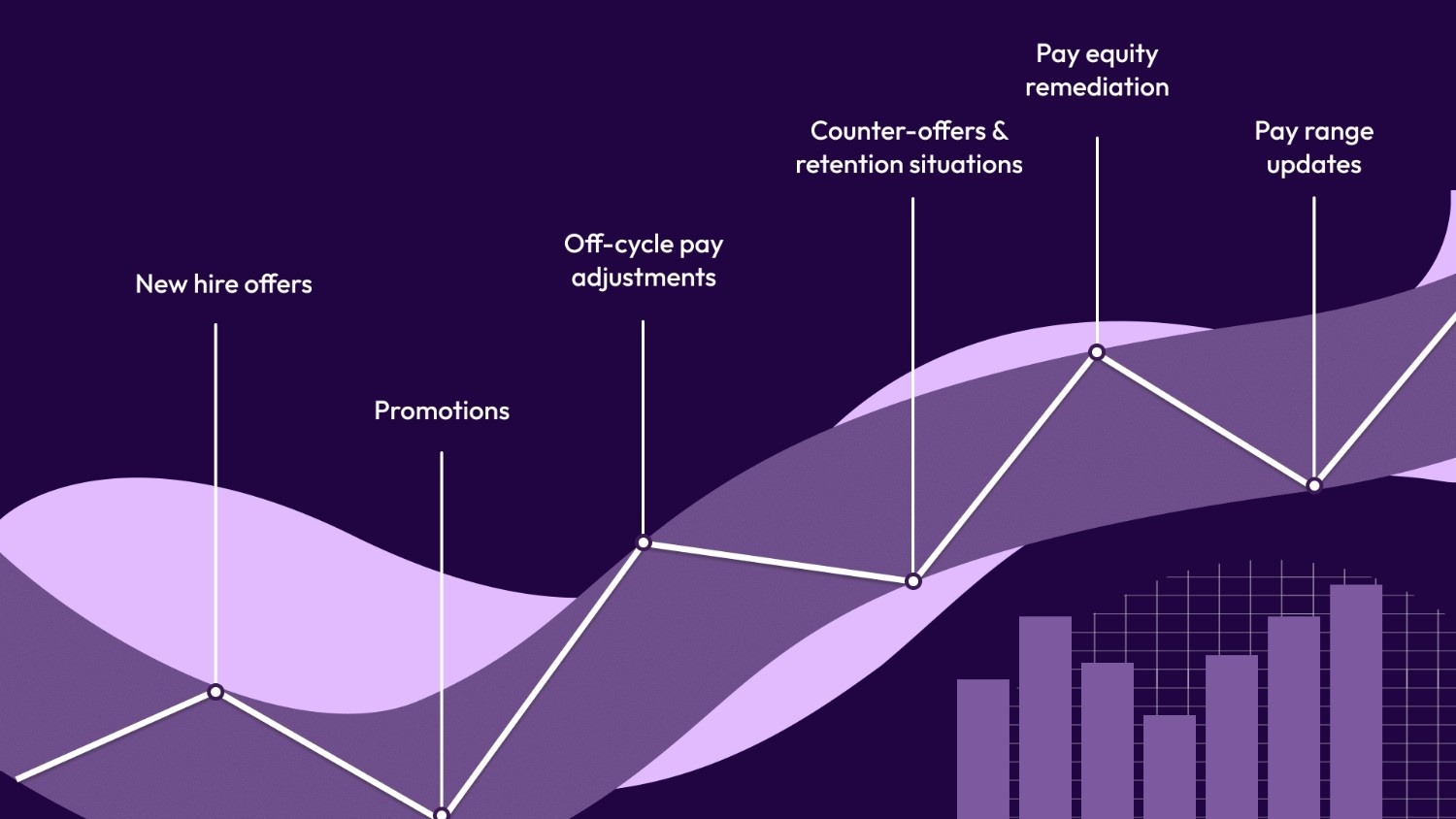
Compensation justification is not only for annual reviews. These are the situations where documented rationale is most critical, and most often missing.
- New hire offers: Every offer letter either supports or undermines your internal pay structure. A formal justification ensures the offer reflects current market data and sits consistently with what employees in similar roles already earn. This matters most when a candidate pushes back and the offer moves, because the final number still needs to hold up against the rest of your team.
- Promotions: Promotions without documented pay justification are one of the most common sources of long-term pay inequity. You need to document the new level criteria the employee meets, apply the correct pay range, and record why their pay lands where it does within that range.
- Off-cycle pay adjustments. When a manager requests an off-cycle raise to retain a team member, that request needs a documented rationale. Off-cycle adjustments made informally tend to favor employees who advocate loudly rather than those who are most deserving.
- Counter-offers and retention situations: Accepting a counter-offer without a justification process sets a precedent where pay is determined by outside leverage. Formal justification forces you to assess whether the adjustment is consistent with market data and internal equity, separate from the pressure of the moment.
- Pay equity remediation: When an audit identifies gaps, every remediation action should be documented. Record the original disparity, the evidence reviewed, and the adjustment made. This documentation protects the company if the remediation itself is ever questioned.
- Pay range updates. When you update salary ranges due to market shifts, employees who fall outside the new range need a documented plan. Without justification attached to range updates, the adjustments feel arbitrary and generate more confusion than they resolve.
Also Read: 5 Dimensions of Compensation Strategy Every HR Should Know
If these scenarios are common in your organization, manual processes quickly become unsustainable. This is where CandorIQ can help you take strategic decisions.
How CandorIQ Helps Your Growing Teams Build Justification Into Every Pay Decision
Growing organizations often rely on spreadsheets, Slack threads, and disconnected approvals to manage compensation. This leads to inconsistent logic, missing documentation, and tension between HR and Finance.
CandorIQ gives HR teams one place to manage compensation philosophy, market benchmarking, internal equity analysis, and pay decision approvals. Every pay action runs through the same workflow, and justification documentation is captured at the point of decision
With CandorIQ, teams can:
- Build and manage structured pay bands by level, department, and geography
- Apply geo-adjusted benchmarks to maintain competitive and equitable pay
- Run compensation cycles with built-in rationale logging and approval workflows
- Model headcount scenarios and see real-time financial impact before decisions are finalized
- Track budget utilization across departments during raises and hiring
- Create transparent offer experiences showing total compensation clearly
- Leverage AI-powered insights to analyze gaps and forecast pay implications
When justification becomes embedded in the system itself, compensation decisions become defensible, transparent, and scalable.
Conclusion
In 2026, compensation justification gives your team a documented answer every time an employee, a regulator, or an auditor asks why someone earns what they earn. Now, pay transparency laws cover more employees than ever, pay equity audits are common, and workers expect their pay to make sense.
Informal pay decisions carry real legal and cultural costs now. The process does not need to be complicated. Write your philosophy, define your levels, benchmark your market data, check your internal equity, and document every decision at the time you make it.
If you want to stop managing compensation one crisis at a time, schedule a demo with CandorIQ today.

FAQs
1. What is the difference between compensation justification and a pay equity audit?
A pay equity audit looks for systemic pay gaps across your entire workforce. Compensation justification documents the rationale for a single pay decision. Both matter, but they work at different levels.
2. Do small companies need a formal compensation justification process?
Yes. Several state pay transparency laws apply to companies with as few as 10 employees. Documenting pay decisions early also prevents equity problems from multiplying as you hire more people.
3. Can compensation justification help reduce employee turnover?
Yes. Employees who understand how their pay is set and see it applied consistently are far less likely to leave over pay concerns. Clear reasoning builds confidence in your pay program.
4. What happens when a company cannot justify a pay disparity during an audit?
Regulators treat undocumented pay gaps as unexplained disparities, which can trigger Equal Pay Act or Title VII claims. Consequences include back pay obligations, fines, and reputational damage.
5. How often should companies update their compensation justification documentation?
Document at every pay decision. Refresh your market benchmarking data at least once per year and review your pay ranges whenever significant market changes affect your industry.
6. Is compensation justification the same as a salary band?
No. A salary band sets the pay range for a role. Compensation justification explains why a specific employee lands at a specific point within that band. The band creates the boundaries; the justification explains the placement.
Ready to modernize your workforce and compensation strategy?
See how CandorIQ brings workforce planning and compensation together with AI.