

5 Dimensions of Compensation Strategy Every HR Should Know
Master the 5 dimensions of compensation strategy for optimal internal alignment. Boost morale with structured paths and rewards. Click to enhance your strategy!

Most companies are struggling to get pay right across distributed teams. HR and Finance leaders often deal with different priorities. They must stay within budget, ensure fairness, and align pay with company goals. Misaligned pay decisions can frustrate employees, slow hiring, and create financial strain that grows unnoticed.
In fact, a 2024 survey found that only 34% of U.S. organizations rate their pay‑transparency efforts as “excellent or above average”. This shows that even when budgets are managed, a lack of alignment and transparency can erode trust and reduce workforce engagement.
For growing or remote-first organizations, internal alignment is essential. A structured compensation strategy built on these five dimensions helps keep pay fair and budgets under control. It also helps employees feel valued without adding extra admin work.
Key Takeaways
- A good compensation strategy starts with fair pay across roles and locations, so your team feels valued and engaged.
- It also helps you stay competitive without stretching the budget, using solid market data and geo-adjusted bands to guide decisions.
- From there, you want to reward the work that truly drives results, making bonuses, equity, and raises feel earned and meaningful.
- Clarity matters too. When you make total rewards easy to understand: salary, benefits, equity, candidates feel confident saying yes.
Why Compensation Strategy Matters for Scaling, Distributed Teams
For mid-sized, fast-growing U.S. companies with distributed teams, managing compensation is more than setting salaries. HR and Finance must align on pay bands, budget limits, and approvals while supporting rapid headcount growth. Without a clear strategy, companies risk inconsistent pay, overspending, and low employee satisfaction.
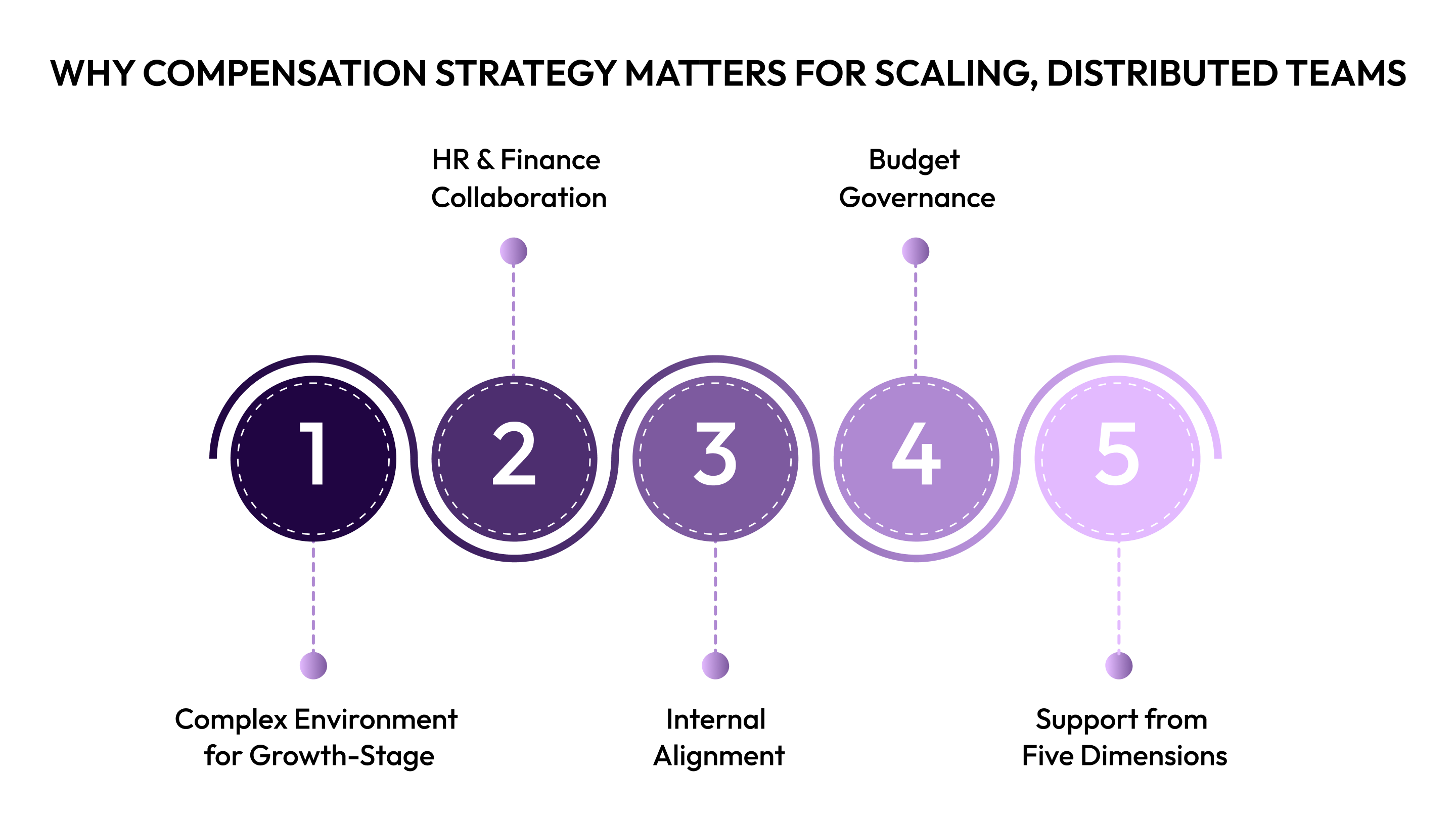
- Complex environment for growth-stage companies: Organizations scaling 2–3× annually face pressure to offer competitive pay while controlling budgets across multiple locations and departments.
- HR & Finance collaboration: Lean HR teams (1–10 people) and budget-conscious Finance leaders need a shared framework to approve raises, bonuses, and offers efficiently, reducing errors and misalignment.
- Internal alignment for distributed teams: Agreeing on pay philosophy, role-based bands, and approval workflows ensures transparency and consistency, even when teams are spread across states or working remotely.
- Budget governance: Structured compensation decisions allow CFOs and FP&A teams to forecast workforce costs accurately, prevent overspending, and maintain financial control during rapid growth.
- Support from five dimensions: Market equity, internal equity, performance pay, candidate offers, and headcount planning together enable companies to manage compensation strategically, retain talent, and align workforce plans with budgets.
With the importance of compensation strategy clear, it’s time to break down the five dimensions that ensure pay is fair, transparent, and aligned with your organization’s goals.
The Five Key Dimensions of an Effective Compensation Strategy
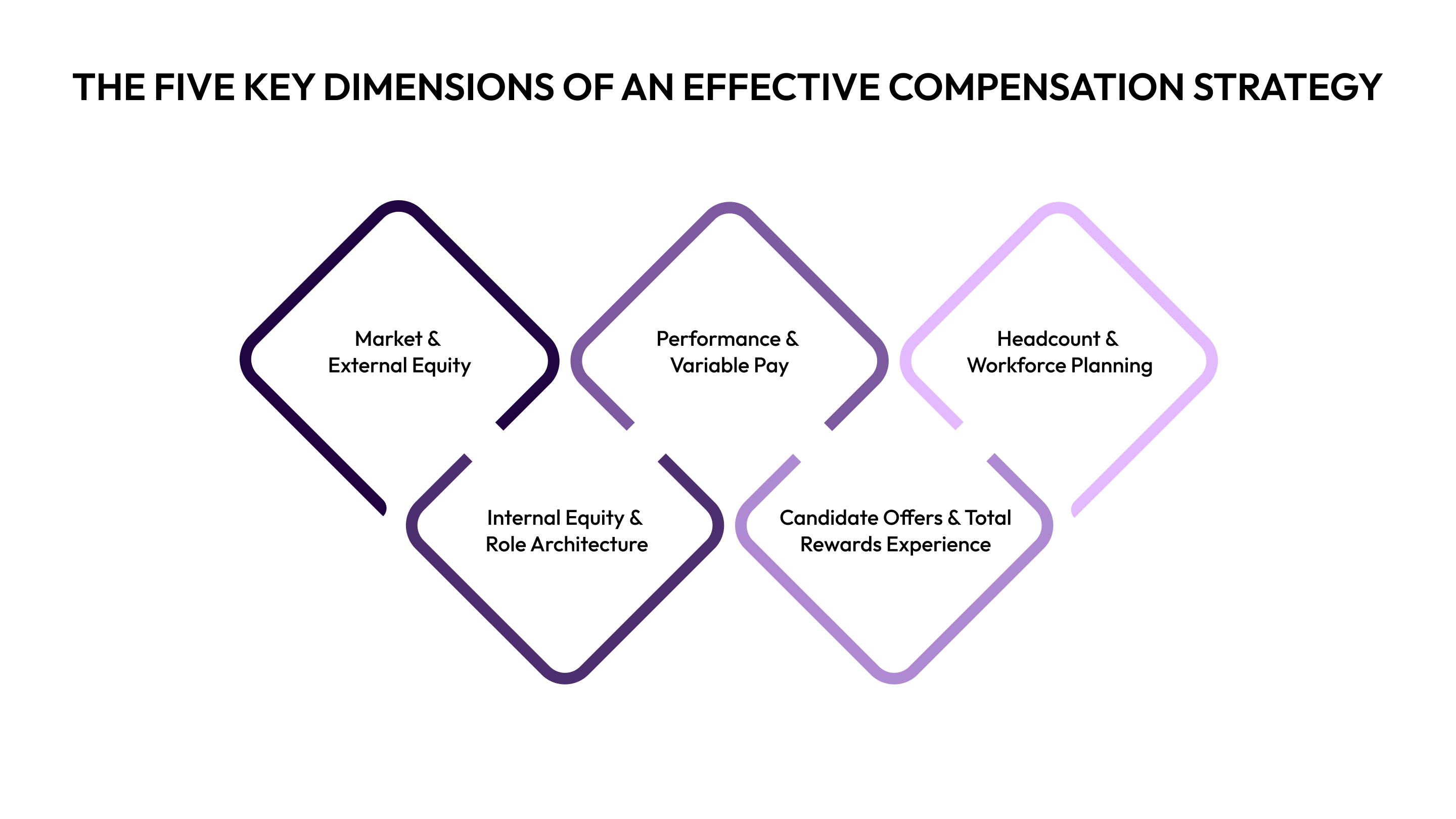
A well-designed compensation strategy goes beyond salaries. For fast-growing, distributed companies, it ensures pay is competitive, fair, and aligned with business goals. These five dimensions help HR, Finance, and leadership coordinate effectively, control budgets, attract and retain talent, and maintain transparency across teams. Each dimension addresses a specific challenge while supporting internal alignment and scalable growth.
Dimension 1: Market & External Equity
For companies scaling rapidly across multiple locations, staying competitive in the market is not optional; it’s critical. Market and external equity ensures that salaries and benefits align with industry standards, role expectations, and geographic differences. Without this alignment, companies risk losing top talent or overpaying in certain locations.
Why it matters:
- Attracts skilled employees by offering competitive compensation.
- Controls costs and prevents unplanned budget overruns.
- Supports Finance in forecasting compensation spend across regions.
How to approach:
- Collect benchmarking data from reputable sources for relevant roles and industries.
- Adjust pay for location, role, and seniority, especially for remote or multi-state teams.
- Update bands regularly to reflect market trends.
Dimension 2: Internal Equity & Role Architecture
Internal equity ensures employees perceive fairness across roles, levels, and functions. Role architecture standardizes job titles, levels, and pay bands, preventing disparities that could affect morale and retention.
Why it matters:
- Maintains trust and fairness in a distributed workforce.
- Reduces retention risk caused by perceived inequities.
- Helps Finance predict costs accurately across teams.
Steps to implement:
- Conduct job evaluation and define levels consistently across departments.
- Create pay bands by level, department, and location.
- Set approval workflows for raises and promotions to prevent ad-hoc decisions.
.png)
Dimension 3: Performance & Variable Pay
Linking pay to performance aligns individual contributions with company goals. Merit increases, bonuses, and equity awards incentivize employees while giving Finance clear insight into compensation impact.
Why it matters:
- Motivates accountability and high performance.
- Ensures pay is tied to measurable results.
- Supports retention and reduces turnover in competitive markets.
Implementation steps:
- Define measurable KPIs for each role.
- Establish bonus and incentive formulas.
- Automate approval workflows and track budget allocation in real time.
Dimension 4: Candidate Offers & Total Rewards Experience
The candidate offer stage is often the first tangible interaction a new hire has with your compensation strategy. For distributed teams, offers must reflect location, equity, benefits, and total rewards clarity.
Why it matters:
- Ensures candidates understand the full value of their compensation.
- Reduces dropouts and improves employer branding.
- Supports Finance in cost approval and leadership in tracking trends.
Steps to implement:
- Build total-compensation models including salary, bonus, equity, and benefits.
- Present offers interactively with FAQs to clarify value.
- Apply geo-adjustments for remote employees.
Dimension 5: Headcount & Workforce Planning
Fast-growing distributed teams require proactive planning of headcount, promotions, and attrition while managing compensation budgets. Without scenario planning, companies risk overspending or understaffing critical roles.
Why it matters:
- Prevents budget surprises in rapidly scaling organizations.
- Ensures workforce growth aligns with strategic objectives.
- Provides visibility for HR, Finance, and leadership in real time.
Steps to implement:
- Build org chart models and simulate hire scenarios.
- Implement workflows for headcount requests and approvals.
- Track actual vs. planned staffing and compensation in dashboards.
Now that we’ve explored the five key dimensions individually, let’s see how they connect and work together to drive internal alignment across HR, Finance, and leadership.
How These Five Dimensions Fit Together for Internal Alignment
Scaling organizations with distributed teams face a complex web of compensation challenges. Without a clear framework, HR, Finance, and leadership can easily misalign on pay, budgets, and approvals. This can lead to overspending, unfair pay, or slower hiring decisions. The five dimensions of compensation strategy act as interconnected levers to create alignment across the organization.
Key Points on Integration:
- Market & External Equity sets the baseline: HR uses external data and geo-adjustments to establish competitive pay ranges. Finance evaluates the budget implications, ensuring the company can attract top talent without overspending. Leadership gains a clear picture of market positioning.
- Internal Equity & Role Architecture enforces fairness: Standardized job levels, roles, and pay bands prevent discrepancies across functions and locations. HR maintains consistent policies, Finance monitors cost impact, and leadership tracks equity metrics, ensuring employees perceive fairness across distributed teams.
- Performance & Variable Pay links effort to outcomes: By connecting pay to KPIs and growth metrics, employees are rewarded based on measurable contributions. Finance ensures bonus payouts stay within budget, HR manages merit cycles, and leadership sees how compensation drives business results.
- Candidate Offers & Total Rewards Experience solidifies first impressions: Offers reflect total compensation, including salary, equity, and benefits, adjusted for location and role. Standardized processes ensure consistency and clarity, reducing offer drop-offs. HR sets the framework, Recruiting Managers apply it, and Finance approves the cost, giving leadership visibility into trends.
- Headcount & Workforce Planning coordinates scale: Workforce planning models hiring scenarios, promotions, and attrition to prevent budget surprises. HR submits requests, Finance approves, and leadership monitors total spend. Integrating this with pay strategy ensures that growth targets, cost controls, and talent needs move in sync.
Each dimension naturally connects with the others to create a cohesive compensation framework. Market data guides the design of role architecture, which in turn ensures that performance-based pay is applied fairly across the organization. These performance metrics influence candidate offers and total rewards, and together they inform headcount planning and budgeting decisions. When all five dimensions work together, companies get a clear view of their compensation spend in real time. They can also maintain predictable costs and ensure fair pay across distributed teams.
Now that we understand how the five dimensions work together to create internal alignment, the next step is to see how organizations can implement them effectively in a growth-stage, distributed environment.
Implementation Roadmap for Growth‑Stage, Distributed Organizations
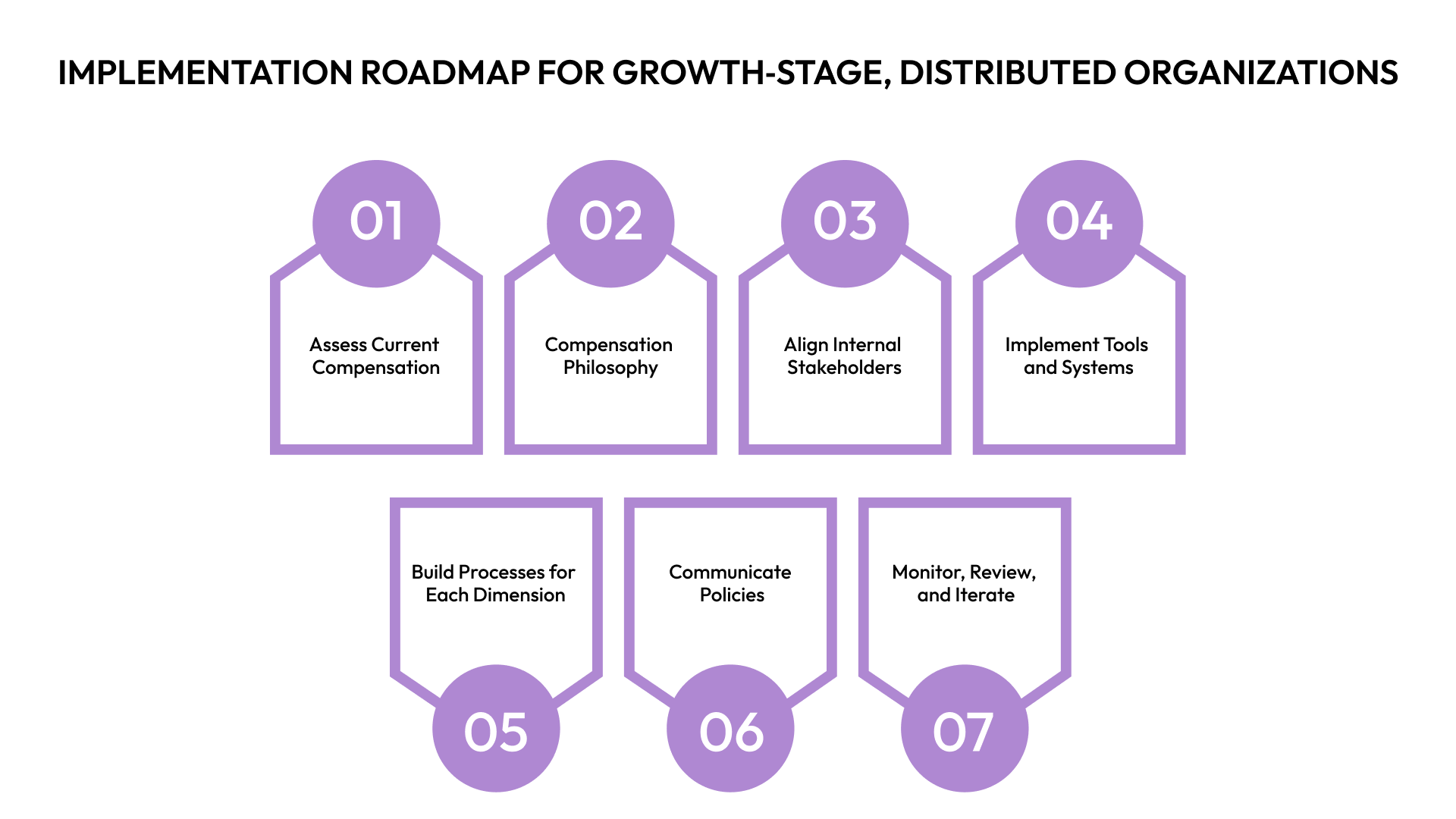
Fast-growing organizations with distributed teams often struggle to execute a consistent compensation strategy. Without a structured implementation plan, companies risk misalignment, overspending, and employee dissatisfaction. A phased roadmap helps HR, Finance, and leadership coordinate efforts, align pay practices, and scale compensation processes efficiently.
Step 1: Assess Current Compensation Practices
- Conduct an internal audit of pay bands, performance pay cycles, offer processes, and workforce planning methods.
- Identify inconsistencies across locations, departments, and roles, especially in distributed teams.
- Gather feedback from HR, Finance, and business leaders on pain points, approval bottlenecks, and visibility gaps.
Step 2: Define Compensation Philosophy and Pay Principles
- Establish clear principles for base pay, variable pay, and total rewards.
- Include geo-adjusted pay considerations for distributed or remote employees.
- Ensure leadership, HR, and Finance are aligned on the philosophy to guide all compensation decisions.
Step 3: Align Internal Stakeholders
- Set up cross-functional committees or working groups including HR, Finance, Recruiting, and Leadership.
- Map responsibilities for approving pay bands, performance bonuses, and headcount requests.
- Agree on communication protocols to prevent misalignment or delays.
Step 4: Implement Tools and Systems
- Adopt a unified platform for compensation, headcount, and offer management to replace spreadsheets and siloed workflows.
- Integrate market benchmarking data and real-time dashboards for budget visibility.
- Enable collaboration features so HR, Finance, and leadership can review, comment, and approve in one place.
Step 5: Build Processes for Each Dimension
- Market & External Equity: Set pay bands using current market data and geo adjustments.
- Internal Equity & Role Architecture: Define levels, roles, and approval logic.
- Performance & Variable Pay: Establish merit increase cycles, bonus logic, and budget tracking.
- Candidate Offers & Total Rewards: Create standardized offer structures with transparency and clarity.
- Headcount & Workforce Planning: Model hiring scenarios, promotions, and attrition while monitoring budget impact.
Step 6: Train Teams and Communicate Policies
- Educate HR, Finance, and recruiting teams on the new processes, systems, and responsibilities.
- Share compensation philosophy and guidelines with employees to build transparency and trust.
- Conduct workshops for managers on approving offers and performance-based pay.
Step 7: Monitor, Review, and Iterate
- Review alignment between pay philosophy, internal equity, and budget on a quarterly basis.
- Use dashboards to track spend, retention metrics, and offer acceptance rates.
- Adjust processes based on organizational growth, market changes, and workforce feedback.
Following this roadmap enables distributed organizations to implement a consistent, fair, and transparent compensation strategy. HR and Finance can work together efficiently, leadership has real-time visibility into budget and workforce impact, and employees perceive compensation as equitable and aligned with business goals.
Once the roadmap is in place and your team starts executing the compensation strategy, the next step is to measure its effectiveness using clear metrics and KPIs.
Metrics & KPIs to Track Compensation Strategy Success
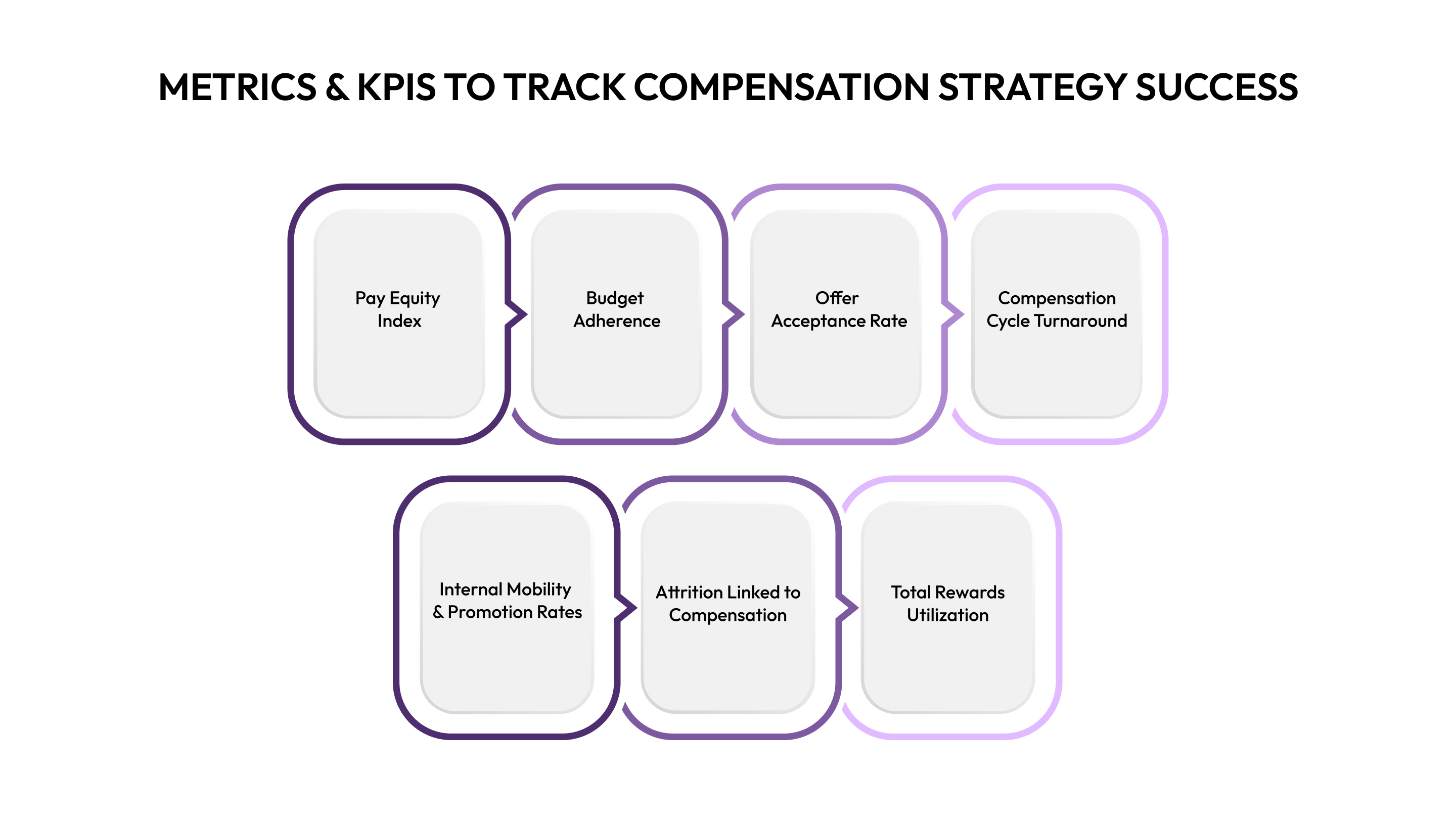
Implementing a compensation strategy is only effective if organizations can measure its impact. For growing, distributed companies, tracking the right metrics is essential. It helps HR, Finance, and leadership spot issues, manage budgets, and keep employees satisfied. These KPIs connect pay strategy to business outcomes while enabling continuous improvement.
Key Metrics to Monitor:
- Pay Equity Index: Measures fairness across roles, levels, and locations. Ensures employees performing similar work are compensated consistently, helping prevent attrition and maintain morale.
- Budget Adherence: Tracks how actual compensation spend compares to planned budgets. Helps CFOs and Finance leaders prevent cost overruns while scaling headcount.
- Time-to-Offer & Offer Acceptance Rate: Measures efficiency in presenting offers and closing candidates. Distributed organizations benefit from consistent offer processes and clear total compensation communication.
- Compensation Cycle Turnaround Time: Tracks the duration of merit increases, bonus approvals, and promotions. Shorter cycles indicate smoother collaboration between HR, Finance, and leadership.
- Internal Mobility & Promotion Rates: Monitors the flow of employees across levels and roles, ensuring internal equity and alignment with performance-based pay strategies.
- Attrition Linked to Compensation: Identifies employees leaving due to perceived pay inequities or uncompetitive offers. Critical for fast-growing, distributed teams where retention is key.
- Total Rewards Utilization: Measures how employees value different components of total compensation, including salary, equity, benefits, and bonuses. Helps optimize offers and retention strategies.
By tracking these KPIs, organizations can ensure that compensation decisions are aligned with business goals, budgets are controlled, and employees perceive pay as fair and transparent. This structured approach supports distributed teams and enables HR and Finance to act as strategic partners rather than reactive operators.
Understanding the right metrics and KPIs is only the first step; utilizing the right tools can turn those insights into action. This is where CandorIQ comes in to help HR and Finance teams execute a strategy that drives alignment and transparency.
How CandorIQ Supports Compensation Strategy and Internal Alignment
Managing compensation across distributed teams while scaling rapidly requires more than spreadsheets and ad-hoc processes. CandorIQ provides a unified platform that helps HR, Finance, and leadership work together efficiently, maintain transparency, and ensure fair, competitive pay.
Key Features and Benefits:
- Unified Compensation & Headcount Management: CandorIQ consolidates pay bands, compensation cycles, headcount forecasting, and offer workflows into a single system. This eliminates fragmented processes and reduces miscommunication between HR, Finance, and leadership.
- Geo-Adjusted Pay & Market Benchmarking: The platform enables location-based adjustments and access to market data. Distributed teams receive competitive compensation while Finance maintains budget control.
- Internal Equity & Role Architecture: CandorIQ supports structured role leveling and pay bands, ensuring consistency across departments and locations. Historical version tracking helps prevent inequities and supports audit readiness.
- Performance & Variable Pay Automation: Merit increases, bonuses, and equity awards can be tied to performance metrics and business outcomes. Built-in workflows streamline approvals and track budget impacts in real time.
.png)
Conclusion
An effective compensation strategy is critical for growth-stage organizations managing distributed teams. By focusing on the five dimensions: market and external equity, internal equity and role architecture, performance-based pay, candidate offers and total rewards, and headcount planning, companies can ensure alignment across HR, Finance, and leadership.
Implementing a structured approach not only maintains budget control but also improves employee satisfaction, retention, and fairness in pay. Tools like CandorIQ make this process actionable, providing real-time visibility, automated workflows, and data-driven insights to manage compensation consistently across locations and teams.
When these practices operate together, organizations gain a competitive advantage in attracting and retaining talent while scaling efficiently. Strategic compensation management becomes a central lever for growth, collaboration, and workforce equity.
Ready to align your compensation strategy with your business goals? Book a Demo with CandorIQ today and see how your HR and Finance teams can work smarter, faster, and more transparently.
FAQs
1. How often should companies review their compensation strategy?
Compensation strategies should be reviewed at least annually, with additional reviews during rapid growth or market shifts. Frequent updates ensure pay remains competitive, aligned with budgets, and equitable across distributed teams.
2. Can distributed teams create disparities in pay if not managed carefully?
Yes. Without geo-adjusted pay bands and standardized role architecture, employees in different locations may receive inconsistent compensation for similar work. Structured policies and tools like CandorIQ help prevent such disparities.
3. How does internal alignment affect employee retention?
Internal alignment ensures fairness and transparency in pay decisions. When employees perceive equity across roles, levels, and locations, it strengthens engagement, reduces turnover, and improves overall morale.
4. What role does leadership play in compensation strategy?
Leadership provides approval for pay bands, budgets, and compensation cycles. Their involvement ensures alignment with business goals, accountability in spending, and consistent messaging across the organization.
5. How can organizations measure the ROI of a compensation strategy?
ROI can be tracked through KPIs like attrition linked to pay, budget adherence, time-to-offer, and employee satisfaction. Real-time dashboards and reporting tools allow HR and Finance teams to quantify the impact on retention, hiring efficiency, and cost control.
Ready to modernize your workforce and compensation strategy?
See how CandorIQ brings workforce planning and compensation together with AI.