

Understanding Compensation Philosophy and Principles
Scaling fast with a lean HR team? Learn how to build a compensation philosophy that aligns talent strategy with budget reality. Practical guide inside.

When your company hits 100 employees, something shifts. The informal compensation decisions that worked when you knew everyone's name suddenly become a liability. Your CFO is asking hard questions about payroll predictability.
Your recruiting team can't explain why two engineers with similar experience are paid differently. And your best performers are starting to ask questions you can't answer consistently.
This is the moment when most growth-stage companies realize they need what the industry calls a "compensation philosophy". However, what they really need is a framework that brings order to chaos without sacrificing speed.
This blog will break down compensation philosophy and principles for you with justified, actionable insights.
Key takeaways
- A compensation philosophy ensures fair, consistent pay decisions and aligns them with business goals.
- It’s crucial for growing companies to manage complexity, market competitiveness, and internal equity.
- Key elements of a compensation philosophy include market positioning, pay mix, performance alignment, and pay equity.
- Creating a compensation philosophy involves steps like aligning leadership, auditing current pay, and setting clear pay structures.
- CandorIQ helps turn your philosophy into action by automating pay cycles and providing data-driven insights for every compensation decision.
What Is a Compensation Philosophy?
A compensation philosophy is a set of principles that keeps compensation decisions fair and consistent across roles, levels, and locations. More than a policy document, it defines what you value, how you reward it, and why those choices make business sense.
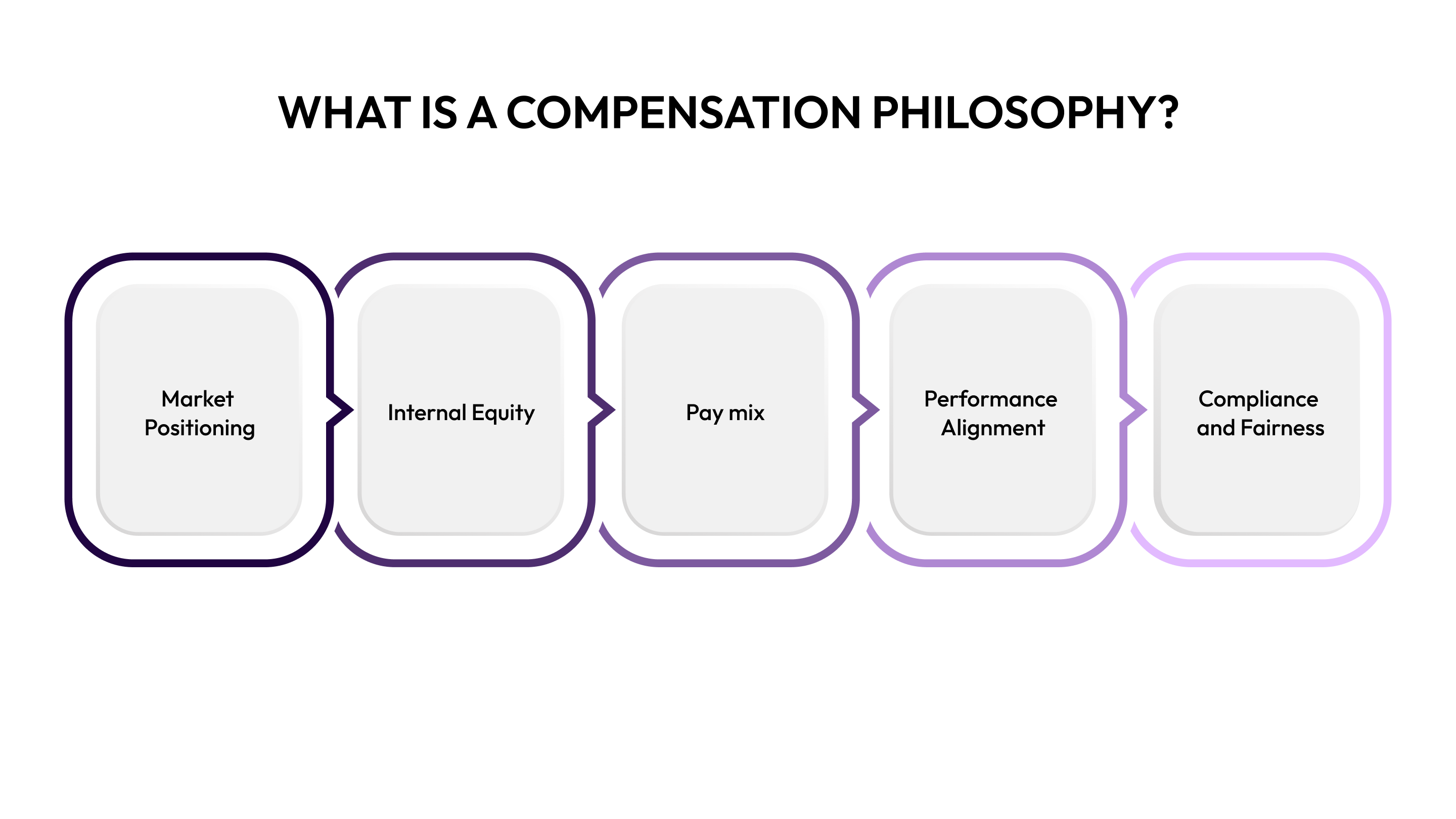
A good compensation philosophy usually covers:
- Market positioning: do you lead, match, or lag the market?
- Internal equity: how you maintain fairness among employees.
- Pay mix: how you balance salary, bonuses, stock, and benefits.
- Performance alignment: how results affect pay.
- Compliance and fairness: your commitment to ethical and legal standards.
As your company grows, pay decisions become more complex. A clear compensation philosophy helps maintain equity, competitiveness, and alignment with business priorities during this growth phase. Let’s break down why this is crucial during the scaling process.
Why Compensation Philosophy Matters at Your Stage of Growth
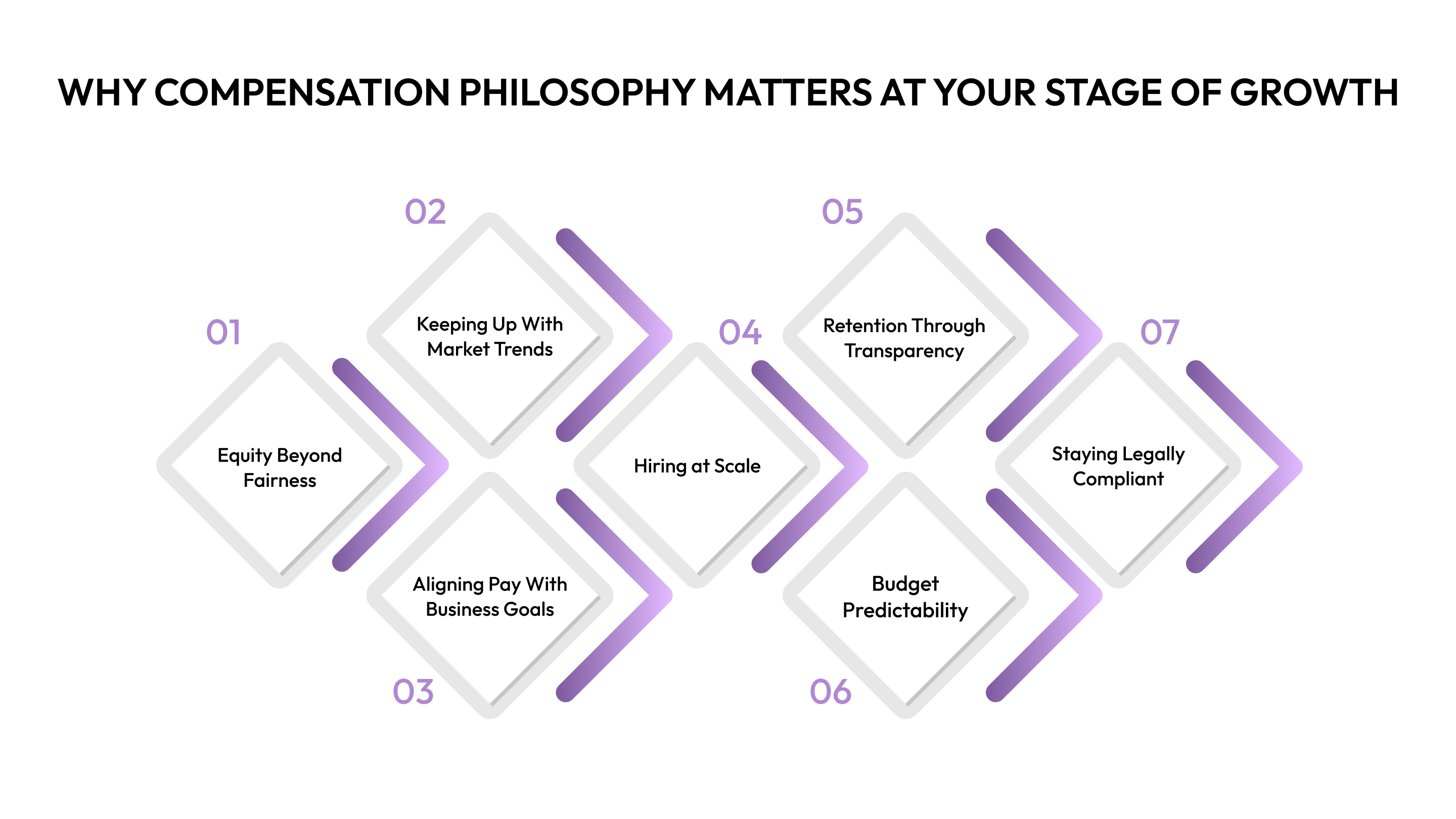
When you’re scaling from 50 to 500 people, pay decisions get complex fast. A structured compensation philosophy keeps you grounded and consistent while your company grows. Here’s why it matters now more than ever:
1. Equity Beyond Fairness
As your team expands, small inconsistencies turn into big disparities. What started as a few quick offers during the early days can snowball into systemic inequities. Studies show most pay gaps begin at hiring, when managers make one-off decisions without clear guardrails.
A compensation philosophy ensures equal work earns equal pay, protecting both your culture and your compliance.
2. Keeping Up With Market Trends
The job market moves quickly. Pay benchmarks now shift every few months, not once a year. With remote work, you’re competing with global companies, not just local ones. A defined market position helps you stay balanced, whether you aim to meet or lead the market. It keeps you from overpaying unnecessarily or losing talent to better offers.
3. Aligning Pay With Business Goals
Your pay approach should mirror your strategy. If profitability is your focus, leading the market in every role may not add up. But if speed and scale drive your growth, underpaying risks losing critical talent. A clear philosophy keeps pay decisions aligned with business priorities and financial realities.
4. Hiring at Scale
When you’re hiring at speed, you can’t afford case-by-case decisions. Recruiters need clarity on what “competitive” means within your structure. With a defined philosophy and pay bands in place, they can move fast and stay consistent—no need for leadership sign-off on every offer.
5. Retention Through Transparency
Today’s employees want clarity. They care about how pay is determined, what growth looks like, and how to move up. Companies that communicate this openly see higher trust and stronger engagement. A transparent compensation philosophy turns pay conversations into moments of trust, not tension.
6. Budget Predictability
For finance leaders, predictability is key. A documented philosophy helps forecast headcount costs confidently. When you know your target pay percentile and raise budget, planning becomes easier—no surprises, just data-driven budgeting.
7. Staying Legally Compliant
Pay laws are evolving fast across regions. Transparency rules and equity audits are becoming the norm. Having a written compensation philosophy shows your commitment to fair practices and safeguards you against compliance risks.
Now, let’s explore the key elements that should be included in your compensation philosophy to ensure it’s both comprehensive and effective in guiding pay decisions.
Also Read: Top 5 Differences Between Pay Equity and Pay Equality
What to include in a compensation philosophy
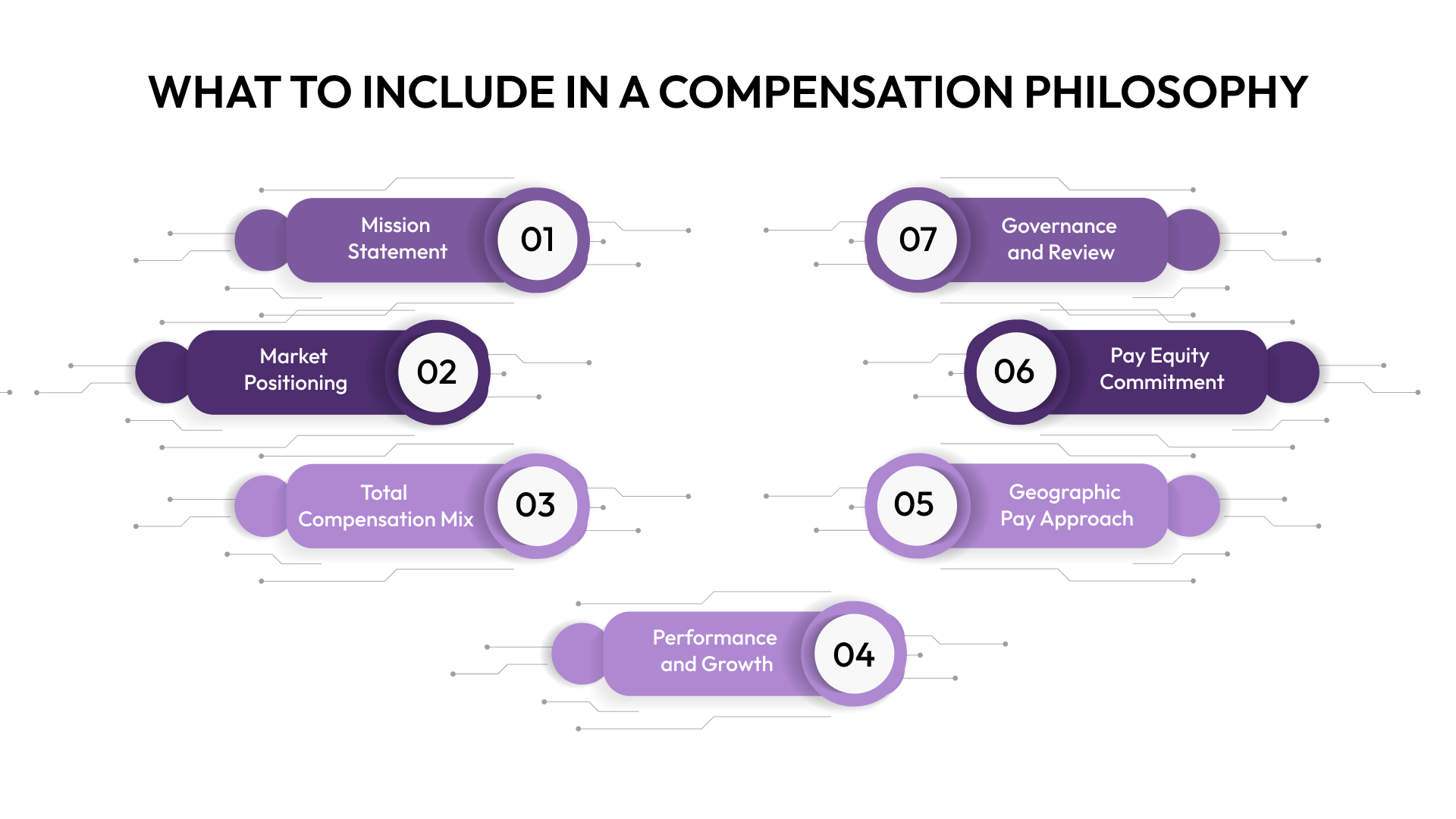
A strong compensation philosophy document is short, usually two to three pages, but powerful enough to guide daily pay decisions. Here’s what it should include:
1. Mission Statement
Open with one or two sentences that capture your pay philosophy. It should reflect what you value and how compensation supports your mission.
Example: “We offer market-competitive pay that rewards performance, ensures fairness, and helps us build the best team in fintech.”
2. Market Positioning
Define how your pay compares to the market. Be clear about which percentile you target and for whom.
Example: “We target the 60th percentile for technical roles in major tech hubs, based on peer companies at our stage and funding level.”
3. Total Compensation Mix
Spell out what’s included in total pay. This goes beyond salary to include:
- Equity or stock options
- Performance bonuses
- Benefits and wellness offerings
- Any unique perks or programs
Clarify how these elements fit together. For instance, some companies lead the market on equity but stay average on base pay to attract long-term builders.
4. Performance and Growth
Explain how growth and performance drive pay decisions. Cover:
- Merit increase timelines
- Promotion criteria
- Bonus structures and eligibility
This connects pay to measurable results and reinforces accountability.
5. Geographic Pay Approach
Remote and distributed work requires clarity on how location affects pay. Decide whether to:
- Pay equally across locations
- Use regional pay tiers
- Adjust for the cost of living
Whatever your approach, document the tradeoffs and your reasoning.
6. Pay Equity Commitment
Be explicit about your stance on fair pay. Outline how you check for and correct disparities through:
- Regular pay equity audits
- Compa-ratio reviews
- Transparent documentation of pay structures
This shows your commitment to fairness and builds trust across teams.
7. Governance and Review
Set guardrails for how compensation decisions are made and maintained. Define:
- Who approves pay changes or exceptions
- How often will the philosophy be reviewed and refined
- How it aligns with your company’s compensation cycles
Most companies revisit their philosophy annually to stay aligned with business goals and market shifts.
With the essential components of a compensation philosophy in mind, let’s explore the step-by-step process of creating one for your company. These actions will help guide you through the journey of aligning your leadership, auditing your current practices, and crafting a philosophy that works for your growing team.
Also Read: True Cost of Manual Compensation Management
11 Steps to Create a Compensation Philosophy for Your People
Creating your first compensation philosophy doesn’t require consultants or big teams. Here’s a clear, step-by-step way to build one that fits your company.
- Align Leadership Early: Get your CEO, CFO, and HR leader together first. Ask the hard questions, such as what we can afford, what talent we need, and where we want to stand in the market. Expect debate. That’s how you reach real alignment.
- Audit What You Have: Gather your salary data. Compare similar roles and check if pay aligns with the market. Be honest about what you find. The goal is clarity, not perfection.
- Define Your Market Position: Choose your stance, lead, match, or lag the market. Most growing companies aim for the middle. Be realistic about what you can support.
- Pick a Benchmarking Source: Use market data that reflects your stage and industry. Expensive surveys aren’t your only option. Modern benchmarking tools give faster insights for less cost.
- Decide on a Location Strategy: For remote teams, location matters. You can pay everyone the same, adjust fully by location, or group places into tiers. Pick what’s simple and sustainable.
- Design Total Compensation: Map your pay mix, salary, equity, bonuses, and benefits. Clarify how each element supports your goals. Early companies may lean on equity; mature ones balance base pay and bonuses.
- Link Pay to Performance: Decide how performance affects pay. Will you give raises, bonuses, or both? Keep it fair and consistent, and write down your reasoning.
- Write It Down Simply: Turn your thinking into a brief, clear document, two to three pages at most. Skip HR jargon. State your philosophy so any employee can understand it.
- Test It with a Small Group: Share your draft with a few trusted managers and employees. Ask if it makes sense and feels fair. Refine based on their feedback.
- Check the Numbers: Have your CFO model the costs. See how your new approach affects budgets and runway. Adjust if needed to stay financially sound.
- Communicate with Transparency: Roll it out with intention. Host an all-hands, explain the “why,” and acknowledge where you’re improving. Give managers the tools to talk about pay confidently. Transparency always builds trust.
For lean teams, the goal isn’t perfection. It’s building a structure that scales. A platform like CandorIQ helps by centralizing your compensation framework, benchmarking data, pay bands, and approvals in one place. It replaces messy spreadsheets and gives your CPO and CFO real-time visibility into pay decisions and their financial impact.
To further refine your understanding, let’s look at real-world examples of companies that have successfully implemented compensation philosophies. By examining their approaches, you can gain inspiration and insights that will help shape your own strategy.
Also Read: How to Communicate Compensation Changes Effectively

5 Examples of Great Compensation Philosophies
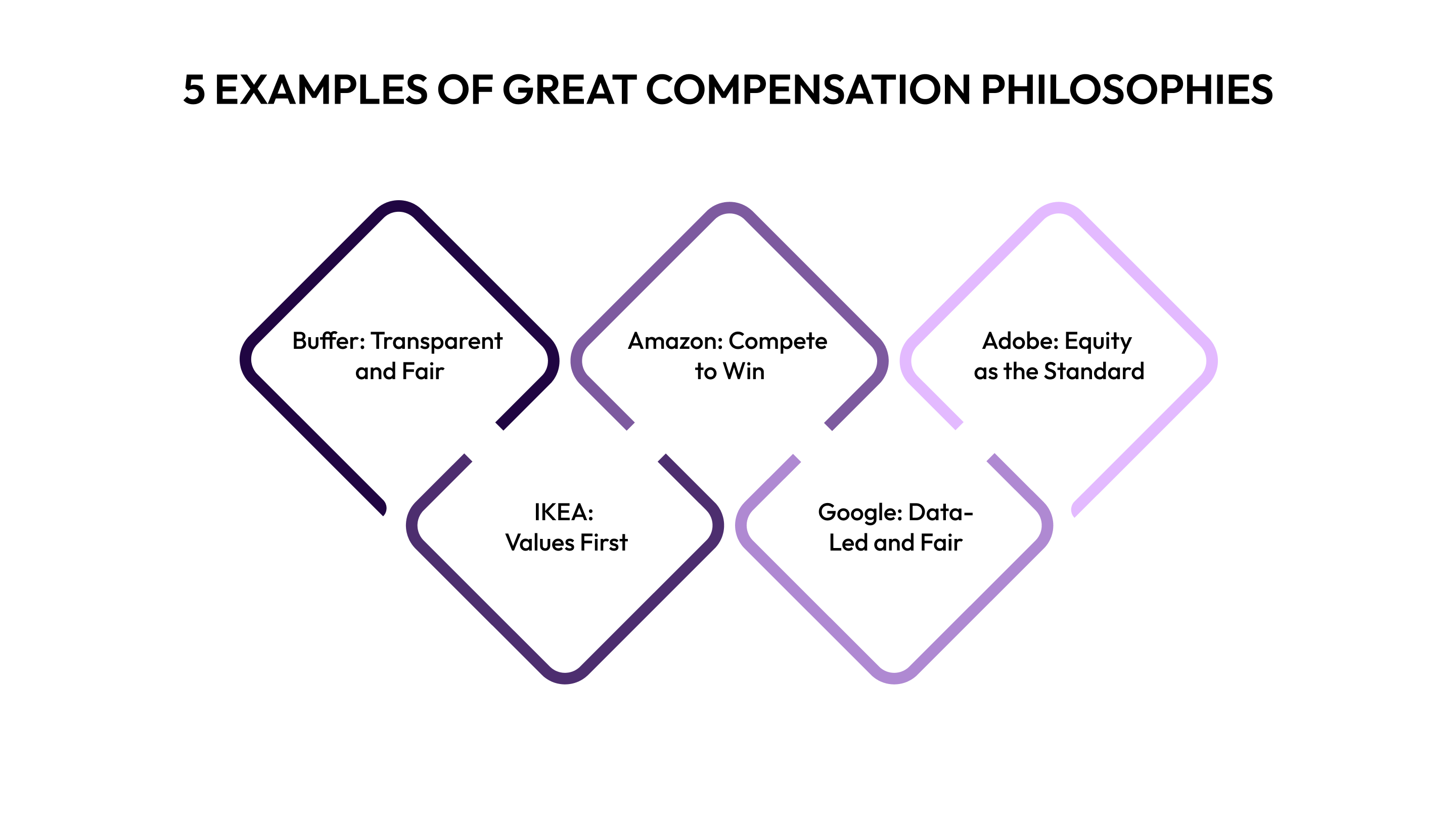
Learning from top companies can inspire how you design your own pay practices. Here’s how some of the best places to work think about compensation:
Buffer: Transparent and Fair
Buffer has led the way in open pay since 2013, publishing every employee’s salary. Their approach is simple: be transparent, stay fair, and reward generously. They use an easy formula and pay above the 50th percentile, adjusting for cost of living. The takeaway: transparency works when paired with consistency and intent.
IKEA: Values First
IKEA ties pay to purpose. They ensure every worker earns a living wage and enjoys stability, predictable hours, and growth opportunities. Their philosophy extends to partners in their supply chain, too. It’s proof that fair pay can strengthen values and culture.
Amazon: Compete to Win
Amazon pays at the top of the market to attract the best talent. High base pay, long-term stock incentives, and upfront bonuses create both motivation and retention. It’s a bold, performance-driven model built on market leadership.
Google: Data-Led and Fair
Google keeps pay decisions grounded in data. They benchmark at the 90th percentile and run reviews several times a year. Algorithms guide pay based on role, level, and performance, while equity analysis ensures fairness. The lesson: pay transparency backed by data builds trust.
Adobe: Equity as the Standard
Adobe made pay equity non-negotiable. They achieved gender and minority pay parity by 2020 and sustain it through regular checks. They post salary ranges and avoid asking for pay history. True equity, for Adobe, is a built-in system, not a one-time fix.
Accenture: Total Rewards for Every Stage
Accenture takes a holistic view of compensation. Beyond competitive pay, they offer health, retirement, and flexibility options that employees can tailor to their needs. It’s a reminder that total rewards, well-being, time off, and choice matter as much as salary.
Once you’ve crafted your compensation philosophy, translating it into daily practice is the next challenge. This is where CandorIQ comes in.
How CandorIQ Turns Your Compensation Philosophy into Action
A great compensation philosophy sets direction, but turning it into daily action is often the hard part. CandorIQ bridges that gap. It brings your compensation strategy into every offer, raise, and promotion, so fairness becomes a habit.
Here’s how we help:
- Compensation & Payband Builder: Set clear pay structures by level, location, and role. Adjust for cost-of-living differences using trusted benchmark data. Real-time pay distribution visuals make equity easy to track from hiring to promotion.
- Compensation Cycle Automation: Run reviews faster. CandorIQ automates merit and bonus cycles with built-in approvals, live budget tracking, and team collaboration through email or Slack.
- Transparent Candidate Offers: Make every offer crystal clear. Show total compensation with future growth projections. Let candidates explore built-in FAQs so HR answers fewer repeat questions. The result: trust, clarity, and stronger retention from day one.
- Strategic Headcount Planning: Plan smarter with live org charts that show the financial impact of every hire. Test scenarios, align with budgets, and avoid overspending before it starts. People Ops and Finance can now plan together seamlessly.
- Efficient Headcount Approvals: Simplify hiring requests. Add job and budget details once, route them automatically by team or location, and sync instantly with your ATS or finance system. This saves time, keeps everyone accountable, and moves hiring forward without bottlenecks.
- Comprehensive Workforce Management: Track everything, open roles, promotions, attrition, and compensation metrics, in one dashboard. Compare plans against real outcomes and share custom views with executives, HR, or finance. This brings clarity and confidence to every workforce decision.
- AI-Driven Compensation Insights: Ask questions in plain language and get smart, data-backed answers. Identify pay gaps, model raise impacts, or forecast hiring needs. CandorIQ’s AI turns data overload into actionable insight and helps every pay decision stay aligned with your goals.
CandorIQ turns your compensation philosophy into a live, data-powered framework that guides every decision. Ready to see the difference? Book a demo now!
Frequently Asked Questions
1. What types of compensation philosophies do companies usually adopt?
Common types include pay-for-performance, market-based pay, location-adjusted compensation, and pay equity-focused approaches. Each shapes how pay decisions are made and aligned with business goals.
2. How often should companies review and update their compensation plans?
Regular reviews are recommended at least annually, but many companies accelerate this to every 6 months to stay competitive and respond to market changes quickly.
3. What is the difference between compensation philosophy, strategy, and policy?
Philosophy is your high-level belief about pay and rewards. Strategy outlines how you act on that philosophy. Policy is the detailed rules applied in day-to-day pay decisions.
4. Can compensation management software integrate with HR and finance systems?
Yes. Integration with ATS, payroll, and finance tools streamlines workflows and keeps all teams aligned on budget, headcount, and pay decisions.
5. Is AI reliable for making compensation recommendations?
When based on solid data and market benchmarks, AI supports unbiased, strategic pay decisions and helps forecast financial impacts efficiently.
Ready to modernize your workforce and compensation strategy?
See how CandorIQ brings workforce planning and compensation together with AI.