

How Transparency in Headcount Requests Drives Faster Hiring in 2026
Headcount request transparency in 2026 helps teams improve approvals with budget visibility and tracking. Learn how to reduce delays and align HR and Finance.

Introduction
Why do headcount approvals slow down just when hiring demand increases? For People Ops and Finance teams, the issue isn’t hiring intent, it’s visibility. When requests move across spreadsheets, Slack, and email, no one has a clear view of ownership, budget impact, or approval status.
In distributed organizations, this becomes harder. Remote teams rely on asynchronous decisions, but most approval workflows are still manual. As highlighted by Forbes, executive failure rates are often linked to slow or unclear decision-making, showing how delays can impact outcomes at scale.
This is where the headcount request transparency starts to break. Without structured visibility, hiring slows, budgets drift, and alignment between HR and Finance weakens. This article breaks down where these workflows fail and how to fix them with structured, transparent systems.
In a nutshell
- Headcount approvals slow down when requests lack visibility into cost, ownership, and status across HR and Finance.
- Remote teams face higher delays because approvals happen across tools without centralized context or real-time tracking. Each missing input adds approval cycles and increases decision time.
- Headcount request transparency ensures every request is complete, budget-linked, and trackable before approval.
- Lack of transparency leads to budget overruns, hiring misalignment, and reactive decisions across teams.
- CandorIQ helps teams standardize headcount requests, track approvals, and link hiring decisions to budget visibility. This reduces delays, improves alignment, and keeps workforce plans on track.

Where Headcount Requests Lose Visibility Today
Most headcount requests don’t fail because of bad planning. They fail because no one can see what’s happening.
Common breakdown points:
- Requests submitted in email or Slack without a standard format
- Missing budget context during approvals
- No clear ownership of decision-making
- Multiple stakeholders reviewing different versions
For remote teams, this gets worse. Approvals happen across time zones, and delays stack up because context is not centralized.
Impact:
- Hiring timelines stretch unpredictably
- Finance cannot track real-time hiring impact
- HR teams spend time chasing approvals instead of managing hiring
Solution:
A structured request system with:
- Defined fields (role, cost, justification)
- Clear ownership
- Central visibility for all stakeholders
Example: A People Ops team submits a hiring request with no budget linkage. Finance delays approval by days to validate cost impact, slowing the hiring process.
Without visibility, approvals become reactive instead of planned. This leads directly to why lack of transparency creates deeper cost and delay issues.
Why Lack of Transparency Delays Hiring and Increases Cost
When transparency is missing, headcount approvals don’t just slow down. They become inconsistent and difficult to control.
Most delays happen before a decision is even made. Stakeholders spend time trying to understand the request instead of evaluating it.
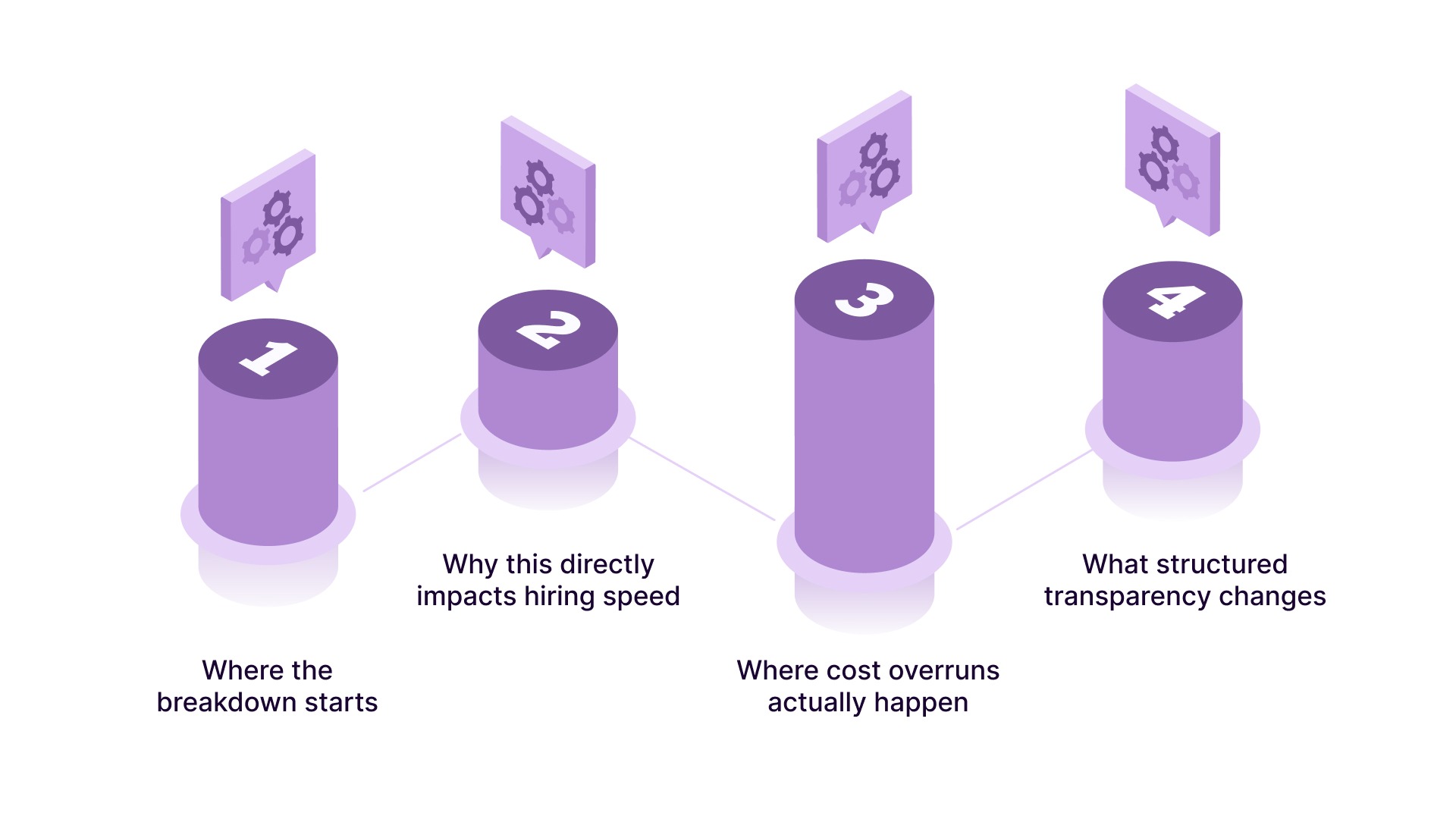
Where the breakdown starts
- Finance teams receive requests without clear cost projections or budget allocation
- HR teams cannot see where a request is stuck or who owns the next step
- Hiring managers submit requests with incomplete context or shifting requirements
In remote setups, this gets amplified. Approvals move across tools, and each handoff creates delay because context is not centralized.
Why does this directly impact hiring speed
Without headcount request transparency, every approval becomes a back-and-forth cycle:
- Finance asks for cost clarification
- HR follows up for missing details
- Hiring managers revise the request
- Leadership reviews incomplete information
Each loop can add days. Across multiple hires, this creates weeks of delay.
Where cost overruns actually happen
The bigger issue is not delay, it’s lack of control over workforce spend.
- Multiple hires get approved without visibility into cumulative cost
- Budget assumptions are not updated in real time
- Hiring decisions are made in isolation instead of against a shared plan
This leads to:
- Hiring ahead of approved budget
- Sudden hiring freezes to correct overspend
- Reactive decision-making instead of planned hiring
What structured transparency changes
Transparent workflows reduce both delay and financial risk when they include:
- Pre-defined request inputs → role, cost, justification, team impact
- Real-time budget visibility → finance sees impact before approval
- Approval stage tracking → HR knows exactly where requests are blocked
- Shared system access → all stakeholders work from the same data
This shifts approvals from reactive coordination to structured decision-making.
For Example:
A hiring manager submits three separate requests over two weeks. Each is approved individually because the cost looks reasonable in isolation.
Without centralized visibility, Finance does not see the combined impact. By the end of the month, hiring exceeds the allocated budget by 15-20%, forcing leadership to pause hiring.
With transparent workflows, all three requests would be evaluated against the same budget view before approval.
Transparency in headcount approvals is not about better communication. It is about making cost, ownership, and status visible at every stage of the workflow.
To build this effectively, you first need to define what headcount request transparency looks like in practice.
Suggested Read: What is Workforce Capacity Planning in 2026
What Headcount Request Transparency Looks Like in Practice
Headcount request transparency is not about sharing more updates. It is about making every hiring decision visible, structured, and tied to business impact.
In practice, transparency means that no stakeholder has to ask, “Where is this request?” or “What does this cost?”
1. Every request starts with complete, decision-ready inputs
Before a request is submitted, it must include:
- Role, level, and team
- Estimated cost (salary + variable components)
- Budget source or allocation
- Clear hiring rationale tied to team goals
If Finance has to ask for missing details, transparency is already broken.
2. Budget impact is visible before approval
Each request should show:
- Cost of the role
- Remaining team budget
- Impact on overall headcount plan
This removes the need for separate financial validation after submission.
3. Approval ownership is clearly defined
Every request follows a fixed path:
- Hiring manager → HR → Finance → leadership
At any point, you should know:
- Who owns the next action
- How long has it been pending
No ambiguity. No parallel conversations.
4. Approval status is visible in real time
Stakeholders should be able to see:
- Pending approvals
- Approved roles
- Rejected or paused requests
This eliminates follow-ups like “any update on this?”
5. All decisions are tracked and auditable
Every request should capture:
- Approval timestamps
- Comments and changes
- Budget adjustments
This helps teams:
- Maintain consistency
- Review past decisions
- Avoid repeated mistakes
For Example:
A hiring manager submits a role with full cost and budget context. Finance reviews it immediately because no additional data is required. HR tracks the request in a shared system, and leadership approves with full visibility into the impact.
The entire process takes hours instead of days.
Headcount request transparency works only when these actions are enforced across every request.
Once this structure is in place, the next challenge is aligning HR and Finance around these decisions.
How Transparent Headcount Workflows Align HR and Finance
Transparency in headcount workflows removes the disconnect between hiring decisions and budget control. It ensures both HR and Finance operate from the same data, at the same time.
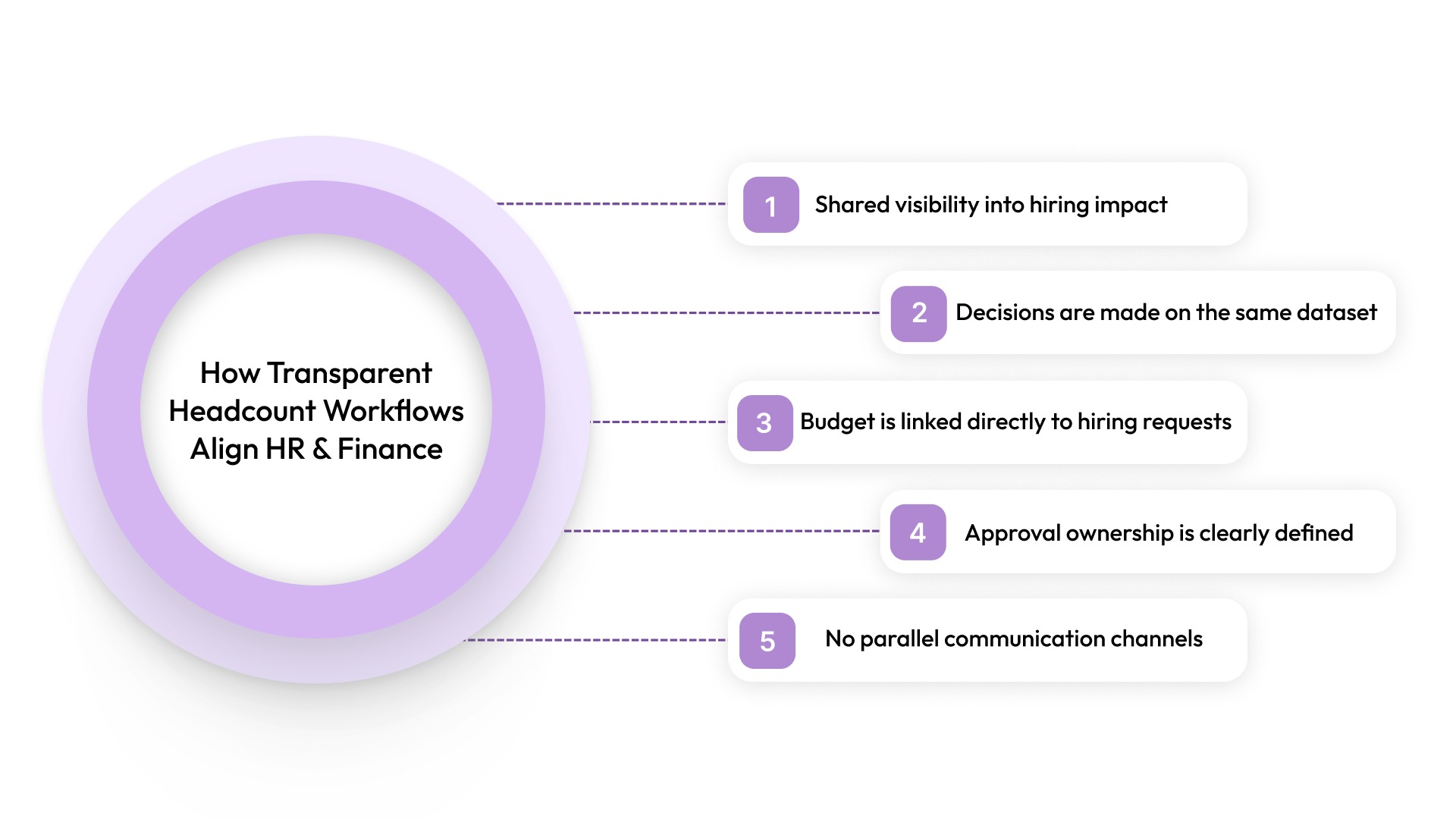
How alignment actually happens:
- Shared visibility into hiring impact: HR sees hiring needs, while Finance sees cost impact. Transparent workflows bring both into one view before approval.
- Decisions are made on the same dataset: HR and Finance no longer rely on separate spreadsheets or assumptions. Every request is evaluated using the same inputs.
- Budget is linked directly to hiring requests: Finance can validate affordability instantly, instead of reviewing cost after approvals are made.
- Approval ownership is clearly defined: Each step in the workflow has a responsible stakeholder, reducing confusion between HR and Finance on who needs to act next.
- No parallel communication channels: All discussions, updates, and approvals happen in one system, eliminating misalignment caused by Slack, email, or offline conversations.
What this prevents
- HR approving roles that Finance later rejects
- Finance is blocking requests due to missing or unclear data
- Hiring plans are drifting away from approved budgets
- Delays caused by repeated back-and-forth between teams
What changes when alignment improves
- Approvals move faster because both teams have full context upfront
- Hiring decisions stay within budget without last-minute corrections
- HR focuses on hiring execution instead of coordination
- Finance shifts from reactive validation to proactive planning
Transparent workflows align HR and Finance by making hiring decisions visible, structured, and tied to financial impact from the start.
Why do headcount approvals still depend on disconnected tools and manual coordination? CandorIQ brings HR and Finance into one system, connecting headcount requests with real-time budget visibility so decisions are faster and more consistent.
Even with alignment in place, small process gaps can still break transparency. The next step is identifying the common mistakes that disrupt hiring approvals.
Common Mistakes That Break Transparency in Hiring Approvals
Headcount request transparency usually breaks due to small process gaps, not major system failures. These mistakes create delays, misalignment, and budget risk over time.
- Treating headcount requests in isolation: Requests are approved individually without checking cumulative hiring impact. This leads to budget overshoot when multiple hires are approved across teams.
- Allowing incomplete requests into approvals: Missing cost, unclear role scope, or weak justification forces Finance and HR to pause decisions and request additional details.
- Splitting approvals across multiple tools: Requests move between Slack, email, and spreadsheets, creating version mismatches and loss of context across stakeholders.
- No real-time visibility into approval status: HR and hiring managers rely on manual follow-ups because there is no system showing where the request is pending.
- Separating hiring decisions from budget tracking: Approvals happen without real-time cost visibility, and budget impact is validated only after decisions are made.
- Lack of a decision audit trail: Teams cannot track who approved what, when, or why, making it difficult to review past decisions or maintain consistency.
These gaps may seem small, but together they break headcount, request transparency and create delays, misalignment, and budget risk.
To fix this at scale, teams need a structured system that connects approvals, visibility, and financial impact in one workflow.
Suggested Read: 7 Essential Metrics for Your Headcount Analytics Dashboard
How CandorIQ Helps Teams Bring Transparency to Headcount Requests?
Headcount request transparency breaks when approvals lack visibility, structure, and budget alignment. This leads to delays, miscommunication, and hiring decisions that drift away from financial plans.
Fixing this requires a system where every request is complete, trackable, and tied to cost from the start.
CandorIQ is a compensation and headcount planning platform built for HR and Finance teams to manage hiring decisions in one place. It replaces fragmented workflows with structured, collaborative systems that connect approvals directly to budget and workforce plans.
How CandorIQ helps:
- Headcount Requests & Approvals → structured, decision-ready workflows: Standardizes every request with required inputs, clear approval paths, and defined ownership to reduce delays.
- Headcount Scenario Planning → real-time budget visibility: Shows hiring impact on team and company budgets before approvals, helping Finance validate decisions instantly.
- Workforce Management → actual vs planned tracking: Tracks open roles, filled positions, and hiring progress against plan to prevent drift from approved headcount.
- Compensation & Payband Builder → consistent cost inputs: Ensures every request uses structured compensation data, avoiding inconsistencies in salary assumptions.
- Compensation Cycle → alignment with pay decisions: Connects hiring approvals with compensation planning, keeping salary decisions consistent across teams.
- AI Agent → faster analysis and decision support: Helps teams evaluate hiring impact, identify gaps, and make informed decisions without manual data checks.
When headcount approvals rely on scattered tools, delays and budget gaps are inevitable. CandorIQ helps teams bring structure, visibility, and alignment into every hiring decision.
.png)
FAQs
1. How long does it take to finalize headcount approvals?
Approval timelines vary based on process maturity. In unstructured workflows, approvals can take weeks due to repeated follow-ups. With clear ownership, predefined steps, and budget visibility, most decisions can be completed within a few days.
2. What data should I use to justify a headcount request?
A strong request includes total cost (salary + variable), team budget impact, expected business outcome, and urgency. Linking the role to measurable goals helps Finance and leadership evaluate the request faster and with more confidence.
3. How can I frame a headcount request effectively?
Start with a clear business need, define the role and scope, and include cost and timing. Avoid vague reasoning. A well-structured request reduces back-and-forth and ensures stakeholders can make a decision without additional inputs.
4. How do you track headcount changes across teams?
Track approvals, open roles, and filled positions against the original hiring plan. A centralized system allows HR and Finance to monitor changes in real time and quickly identify gaps between planned and actual headcount.
5. What are examples of transparency in the workplace?
Examples include shared approval workflows, visible budget impact for decisions, defined ownership at each step, and real-time status tracking. These practices reduce confusion, improve accountability, and speed up decision-making across teams.
Ready to modernize your workforce and compensation strategy?
See how CandorIQ brings workforce planning and compensation together with AI.