

HR and Finance Alignment for Strategic Growth and ROI in 2026
Achieve growth and ROI with HR finance alignment. Overcome barriers, use data to build a strong partnership, and boost financial performance.


Is your headcount plan already outdated by the time Finance signs off on it? According to Deloitte’s 2025 Global Human Capital Trends report, only 29% of HR and Finance leaders say they operate from a shared workforce plan.
That disconnect is not a minor operational inconvenience. It is what drives budget overruns, delayed hiring decisions, and compensation calls that unravel under board scrutiny.
For scaling companies, the gap widens fast. Finance models headcount from last quarter’s assumptions. HR extends offers using pay bands that have not been recalibrated since the prior fiscal year. Recruiting waits on approvals that move through inboxes instead of structured workflows.
This blog unpacks why HR finance alignment repeatedly breaks down, what it truly costs when it does, and the specific operational workflows that actually resolve it.
At a Glance
- HR and finance misalignment is a workflow problem, not a culture or communication problem.
- The three main breakdown points are disconnected headcount data, comp decisions made without budget visibility, and a planning cadence mismatch between Finance and Recruiting.
- Misalignment directly drives payroll overspend, headcount budget blowouts, avoidable attrition, and slower hiring velocity.
- Fixing it requires four operational changes: a shared headcount source of truth, Finance co-owning pay bands, setting merit budgets before comp cycles open, and a written comp exception policy with an SLA.
- CandorIQ connects headcount planning, pay band governance, and compensation cycles in one platform, so HR and Finance stop working from different versions of reality.
.png)
5 Reasons Your HR Finance Alignment Is Breaking Down
Most companies treat HR finance misalignment as a communication issue. They schedule more syncs and hope collaboration improves. In reality, the breakdown is structural. The systems, data sources, and approval workflows each team relies on were built separately and never fully connected. That disconnect shows up in five predictable places.
- You Don’t Share the Same Headcount Source of Truth: HR tracks active employees in the HRIS. Finance models planned headcount in a spreadsheet. When roles open, freeze, or backfill, updates rarely happen simultaneously. By the time reconciliation occurs, decisions have already been made using outdated data.
- Compensation Decisions Precede Budget Visibility: Managers recommend raises, HR consolidates them, and Finance sees the financial impact only after increases are effectively finalized. At that stage, the budget conversation shifts from planning to containment. Without real-time cost visibility, comp cycles become retroactive corrections.
- Planning and Hiring Operate on Different Timelines: Finance approves headcount quarterly, but recruiting adjusts priorities weekly. Roles are deprioritized, added, or re-scoped without immediate updates to the financial model. Recruiting works from stale approvals, while Finance forecasts from stale assumptions.
- Pay Bands Are Not Embedded in Financial Models: HR may use structured pay bands to guide offers, but Finance often builds cost projections using separate salary assumptions. Because the band architecture is not validated inside the budgeting process, discrepancies surface late, usually when an offer is ready to go out.
- Approval Workflows Lack Structure: Headcount requests wait for sign-off. Compensation exceptions route through unclear chains. Offer approvals stall because ownership and thresholds are undefined. These bottlenecks are common in companies scaling from 100 to 1,000 employees, where growth outpaces governance.
Each of these gaps carries a measurable cost in time, budget control, and candidate experience. When combined, they create friction that no additional meeting can solve.
Also Read: The Key Roles of HR and Finance in Effective Headcount Planning
What HR-Finance Misalignment Actually Costs a Scaling Company
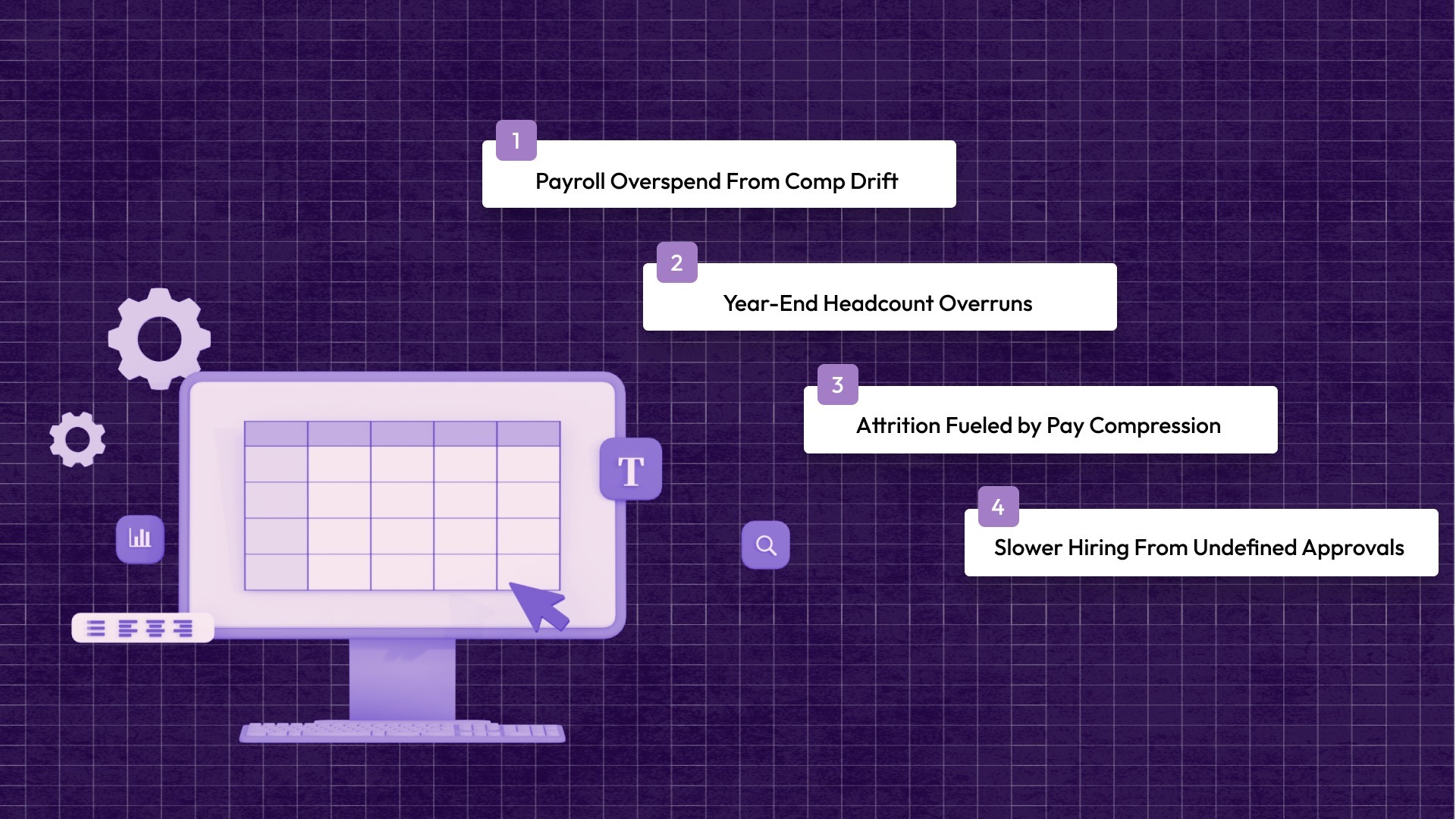
These are not abstract alignment issues. They surface in payroll variance reports, attrition dashboards, and hiring post-mortems. If you’re a CFO wondering why the people budget keeps overrunning, or a CPO explaining slipping time-to-hire, this is where the leakage begins.
1. Payroll Overspend From Comp Drift
When offers move forward without clear band guardrails, exceptions become normalized. Across dozens of hires per quarter, those incremental decisions compound into structural payroll overspend. No single offer breaks the model, but the aggregate quietly pushes actuals above plan.
2. Year-End Headcount Overruns
Many growth-stage companies close the year 10%–20% over approved headcount budgets. The root cause is rarely reckless hiring. It’s untracked backfills, mid-year role additions, and informal approvals that never reconcile against the original plan. By the time the finance team identifies the variance, flexibility is gone.
3. Attrition Fueled by Pay Compression
When compensation data isn’t jointly governed, market adjustments lag. New hires enter at current rates. Tenured employees remain anchored to older bands.
The internal gap widens quietly until a high performer discovers they’re paid below a recent hire. Replacement cost, recruiting fees, ramp time, and lost productivity almost always exceed the adjustment that would have prevented the exit.
4. Slower Hiring From Undefined Approvals
A five-day comp exception review can cost you a candidate. A two-week headcount approval delay erodes recruiting capacity for the quarter.
In competitive markets, speed signals seriousness. The companies that consistently close top talent move from verbal to signed offer in days, because approval paths are predefined, not improvised.
None of these outcomes is unavoidable. They’re the predictable result of disconnected systems and undefined workflows. Fixing the structure, not adding more meetings, is what restores control.
Also Read: A Practical Guide to Headcount Forecasting for High-Growth Teams
How You Make HR Finance Alignment Actually Happen
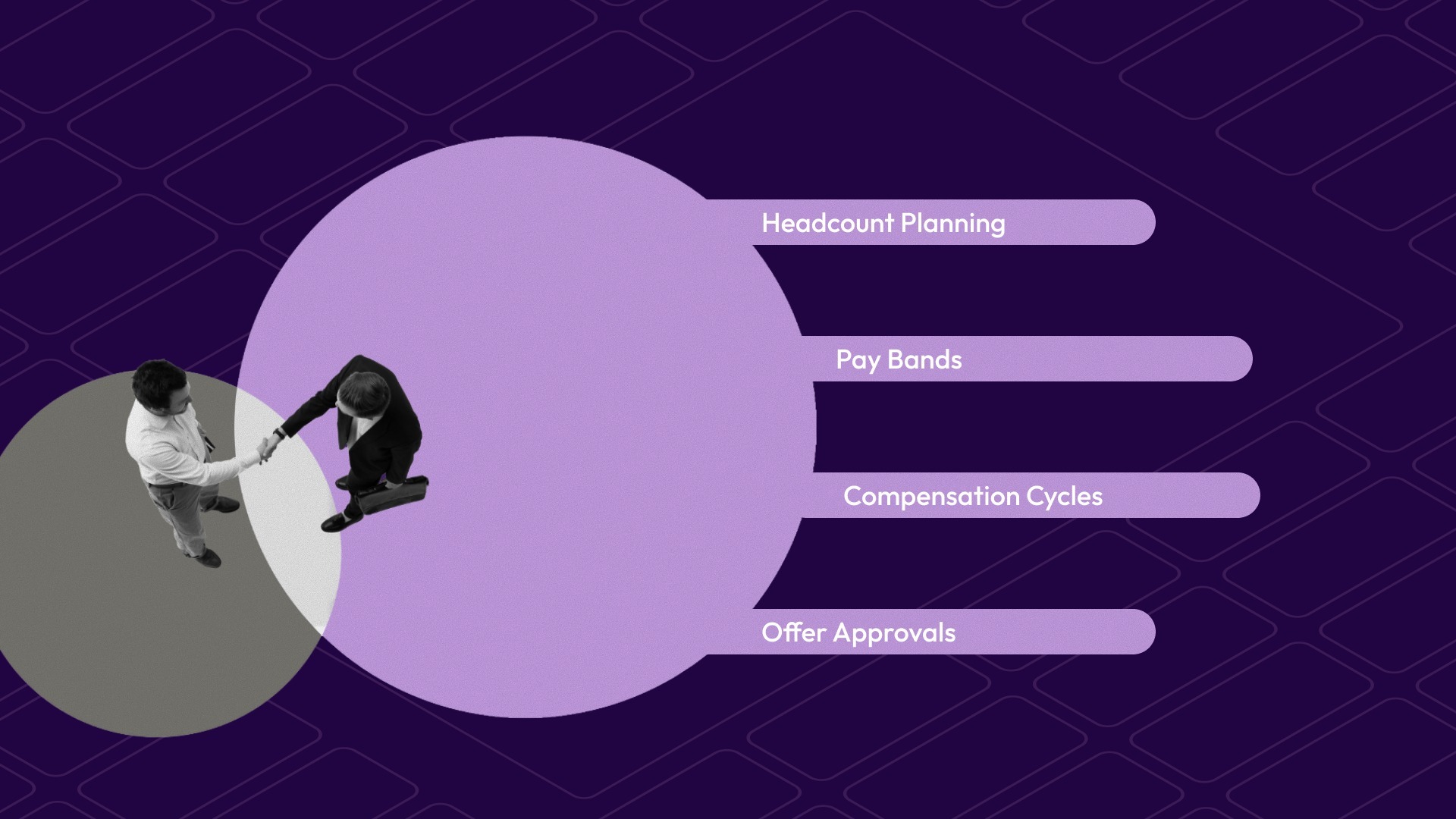
Alignment does not happen because two teams decide to work better together. It happens when the workflows connecting them are clearly defined. Here are the four operational integration points where HR and Finance need shared infrastructure:
1. Headcount Planning: One Plan, One Pipeline
In most companies, finance owns the model, and HR owns the reqs. The two reconcile only when variance appears.
Real alignment means:
- Every open req ties to an approved headcount line, not a verbal agreement.
- Freezes and rescissions update the hiring pipeline immediately.
- Weekly reconciliation replaces year-end surprises.
- Backfills and net-new roles follow the same approval logic.
Ownership is shared. Finance controls the budget guardrails. HR executes the hiring plan. The transition from approved headcount to active requisition should be system-driven, not managed in email threads.
2. Pay Bands: The Shared Cost Contract
Most scaling companies have pay bands. Few govern with them.
Misalignment happens when HR manages ranges that Finance has never validated, while Finance models costs using separate assumptions. Two models for the same role inevitably collide at the offer stage.
Alignment looks like this:
- Bands serve as the agreed cost contract. Finance models at midpoint; HR operates within range.
- Defined exception thresholds trigger structured joint approval.
- Bands are refreshed annually with Finance as a co-owner.
- Full ranges are visible to Finance for scenario modeling.
Pay bands should function as infrastructure, not documentation.
3. Compensation Cycles: Guardrails Before Promises
The annual comp cycle is often backward: managers submit increases, employees are informed, and Finance sees the aggregate impact afterward.
That’s not planning, that’s retroactive reconciliation.
Aligned execution means:
- CFO and CPO agree on the total merit envelope before the cycle opens.
- Department budgets are pre-allocated, so managers operate within limits.
- Finance sees real-time aggregate spend as decisions are made.
- Exceptions follow a structured approval path.
Real-time budget visibility during comp season is governance, not convenience.
4. Offer Approvals: Speed With Structured Oversight
Offer approval is where misalignment becomes visible to candidates. Delays cost talent, but removing Finance isn’t the solution. Structuring involvement is.
Alignment here means:
- Approval triggers are embedded in the workflow, not buried in policy docs.
- Clear SLAs (e.g., 48 hours) govern exception reviews.
- Approvers receive a pay band range, peer comps, and budget impact in one view.
- Within-band offers move forward automatically; Finance engages only on true exceptions.
Oversight should protect the budget without slowing hiring velocity.
When these four workflows are running well, the result is straightforward: better budget predictability, faster hiring, and fewer surprises at board review. Which brings us to what is at stake when you get this right.
6 Benefits of Getting HR Finance Alignment Right
When HR and Finance share data, guardrails, and workflows, the impact goes far beyond operational cleanliness. The business outcomes are measurable.
- Predictable People Spend: Real-time visibility into compensation cycles and headcount changes reduces year-end variance. Instead of discovering overruns during quarterly reconciliations, Finance sees the budget impact as decisions unfold and course-corrects early.
- Faster Hiring, Controlled Costs: Defined approval thresholds and SLAs remove email bottlenecks without removing oversight. Recruiting moves at market speed. Finance stays inside guardrails. Offers go out in days, without blowing the budget.
- Defensible Compensation Decisions: When Finance-validated pay bands feed directly into cost models, HR and Finance operate from the same assumptions. No last-minute budget disputes. No offers that exceed the modeled cost. Decisions are aligned before they’re communicated.
- Stronger Internal Pay Equity: Shared compensation data prevents silent compression gaps. Market adjustments happen systematically, not reactively, reducing attrition risk and exposure as pay transparency requirements expand.
- Real Scenario Planning for Leadership: A single headcount model enables real answers to leadership questions: What does adding 10 engineers cost next quarter? What happens if we delay three backfills? Instead of conflicting spreadsheets, executives get one financial truth.
- Compliance-Ready Pay Transparency: As salary range disclosure laws expand, companies need ranges they can defend, not estimates. Finance-validated, current pay bands ensure posted ranges align with actual offers and internal equity, reducing regulatory and reputational risk.
These outcomes do not require a transformation program. They require shared infrastructure connecting headcount, compensation, and approvals in one system. That’s where CandorIQ comes in.
How CandorIQ Can Ensure Your HR Finance Alignment
Most scaling companies run compensation, headcount planning, and offer approvals across spreadsheets, HRIS exports, and long email threads. Each tool works on its own. Together, they create stale data, untracked comp exceptions, and budget surprises that surface too late to fix.
CandorIQ replaces that fragmented stack with a single platform built for lean HR and Finance teams at growth-stage companies. It connects headcount forecasting, compensation governance, and offer approvals in one system, so both teams operate from the same real-time data.
- Compensation & Pay Band Builder: Create and version-control bands by level, location, and department. Finance co-owns the structure, turning bands into trusted budget inputs, not static HR documents.
- Headcount Scenario Planning: Model future org structures and instantly see cost impact. Compare hiring scenarios against budget thresholds before approving a single req.
- Headcount Requests & Approvals: Submit reqs with embedded budget context and route approvals dynamically. Every decision is documented, traceable, and synced across systems.
- Compensation Cycles: Run merit and bonus reviews with built-in guardrails and live budget tracking. Finance sees spending in real time. Managers operate within defined limits.
- Candidate Offers
Generate calibrated offers with full total compensation visibility, salary, equity, bonus, and benefits, aligned to bands, budget, and approved headcount. - Workforce Management: Track headcount actuals vs. plan, attrition, promotions, and open roles in one view. Executives, Finance, and HR report from the same source of truth.
- AI Agent: Ask natural language questions to surface comp gaps, forecast hiring costs, or model adjustment scenarios, without pulling separate reports.
When HR and Finance share infrastructure instead of spreadsheets, alignment stops being an initiative and becomes the operating model.
Conclusion
HR finance alignment is not a mindset shift or a communication workshop. It is a set of connected workflows: shared headcount data, finance-validated pay bands, jointly governed compensation cycles, and approval chains with defined SLAs.
When those four systems operate together, budget surprises shrink, hiring velocity improves, and leadership stops receiving conflicting answers about people cost.
CandorIQ was built for companies steering this exact inflection point, lean HR and finance teams that are scaling quickly and cannot afford fragile people-cost infrastructure.
If your teams are still reconciling across spreadsheets, the financial impact is already showing up in payroll variance, delayed hires, and missed forecasts.
See how CandorIQ unifies headcount planning, pay band governance, and compensation cycles in one system. Request a demo today.

FAQs
Q. Why is HR finance alignment so difficult to achieve?
The core obstacle is disconnected systems. HR tracks headcount and comp in one place; Finance tracks it in another. Without a shared source of truth, decisions get made on stale data, and reconciliation happens too late to change outcomes.
Q. How do U.S. pay transparency laws affect HR finance alignment?
They make alignment non-optional. Without Finance-approved, current pay bands, companies risk posting salary ranges they cannot honor, creating legal exposure and internal equity complaints simultaneously.
Q. What is the fastest way to reduce comp exceptions during hiring?
Define a clear exception threshold, build the approval trigger into the offer workflow, and set a 48-hour SLA. Most exceptions happen because the process is informal, not because the role is genuinely unusual.
Q. How does CandorIQ support HR finance alignment?
CandorIQ connects headcount planning, pay band management, comp cycles, and offer approvals in one platform, giving HR and Finance shared real-time visibility into people costs instead of separate spreadsheets.
Ready to modernize your workforce and compensation strategy?
See how CandorIQ brings workforce planning and compensation together with AI.