

Proven Strategies for Compensation Budget Planning in 2025
Master compensation budget planning: set clear goals, analyze jobs, ensure compliance, build structures, and involve stakeholders. Click to excel!

Compensation budget planning has become one of the most critical parts of people management. It goes beyond annual salary adjustments and focuses on ensuring fair, competitive, and data-backed pay decisions that support both business goals and employee growth.
The shift toward pay transparency has made structured planning even more important. A SHRM survey found that 70% of organizations that listed pay ranges in job postings received more applications. This shows that transparent and well-planned pay practices attract better talent and build trust in the employer.
A strong compensation budget keeps your pay structure equitable, helps forecast expenses more accurately, and ensures teams stay motivated year-round. When done right, it becomes more than a financial exercise and serves as a key driver of retention and performance.
In this blog, we’ll break down what compensation budget planning involves, why it matters, and how to create a strategy that delivers both fairness and financial control.
Key Takeaways
- Structured planning drives efficiency by ensuring compensation budgets are accurate, timely, and aligned with organizational goals.
- Relying on data such as salary information, market benchmarks, and headcount projections provides a strong foundation for informed decisions.
- Close collaboration between HR and Finance reduces errors, speeds up approvals, and maintains transparency across the organization.
- Scenario planning equips teams to handle uncertainty by modeling different hiring and compensation outcomes, helping adapt to market changes and cost pressures.
Why Compensation Budget Planning Matters in 2025
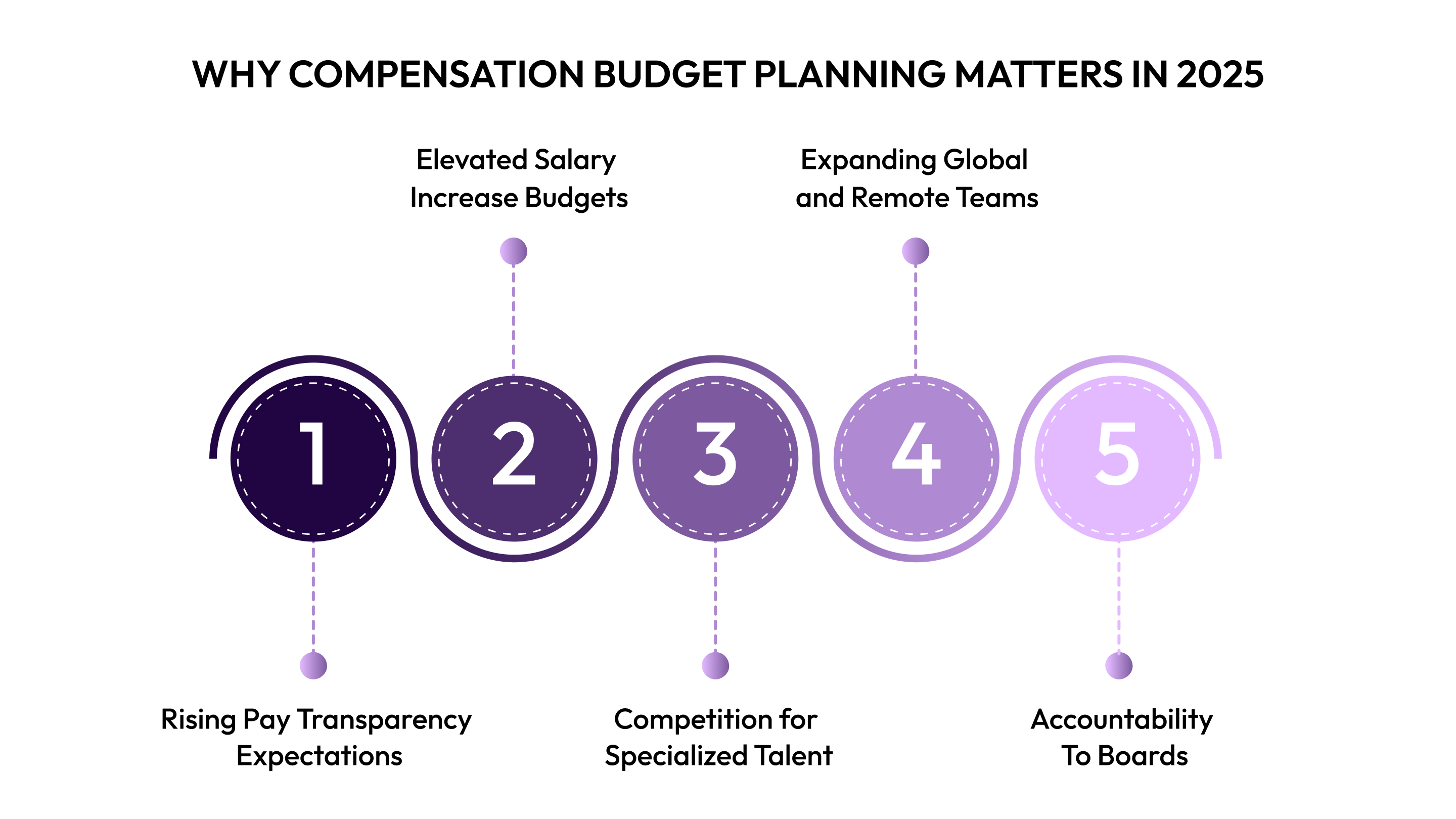
Compensation planning is no longer a yearly HR routine. It is a strategic process that directly influences hiring, retention, and financial performance. In 2025, growing pay transparency, hybrid work models, and skills-based pay are reshaping how organizations plan and allocate their budgets.
1. Rising Pay Transparency Expectations
With more U.S. states enforcing pay range disclosure laws, employees expect clear and data-backed pay structures. This has pushed HR and finance leaders to make compensation decisions that are not only competitive but also defensible.
2. Moderating but Elevated Salary Increase Budgets
Employers in the U.S. plan salary increases of around 3.3% for merit and 3.7% for total compensation in 2025, according to Mercer. While this is slightly lower than the highs of 2023–24, it still reflects a cautious response to inflation and ongoing talent market pressure.
3. Competition for Specialized Talent
SaaS, fintech, and e-commerce companies continue to compete for roles such as engineers, analysts, and product leaders. Static or rigid budgets make it harder to respond quickly to market shifts or counteroffers, putting headcount goals at risk.
4. Expanding Global and Remote Teams
As more organizations hire across geographies, compensation budgets must account for regional cost differences and market benchmarks. Geo-based pay adjustments help maintain fairness without overspending, ensuring consistency across teams.
5. Accountability to Boards and Investors
For CFOs and CHROs, compensation remains one of the largest controllable expenses. Boards expect visibility into workforce costs and data-supported pay decisions. A structured compensation budget helps connect pay practices with business performance, creating financial predictability and stronger governance.
Understanding why compensation budget planning is critical sets the stage for knowing exactly what information and data you need to gather before building your budget.

Also Read: What Is an HRIS? A Complete Guide to Human Resource Information Systems
What You Need Before Creating Your Compensation Budget
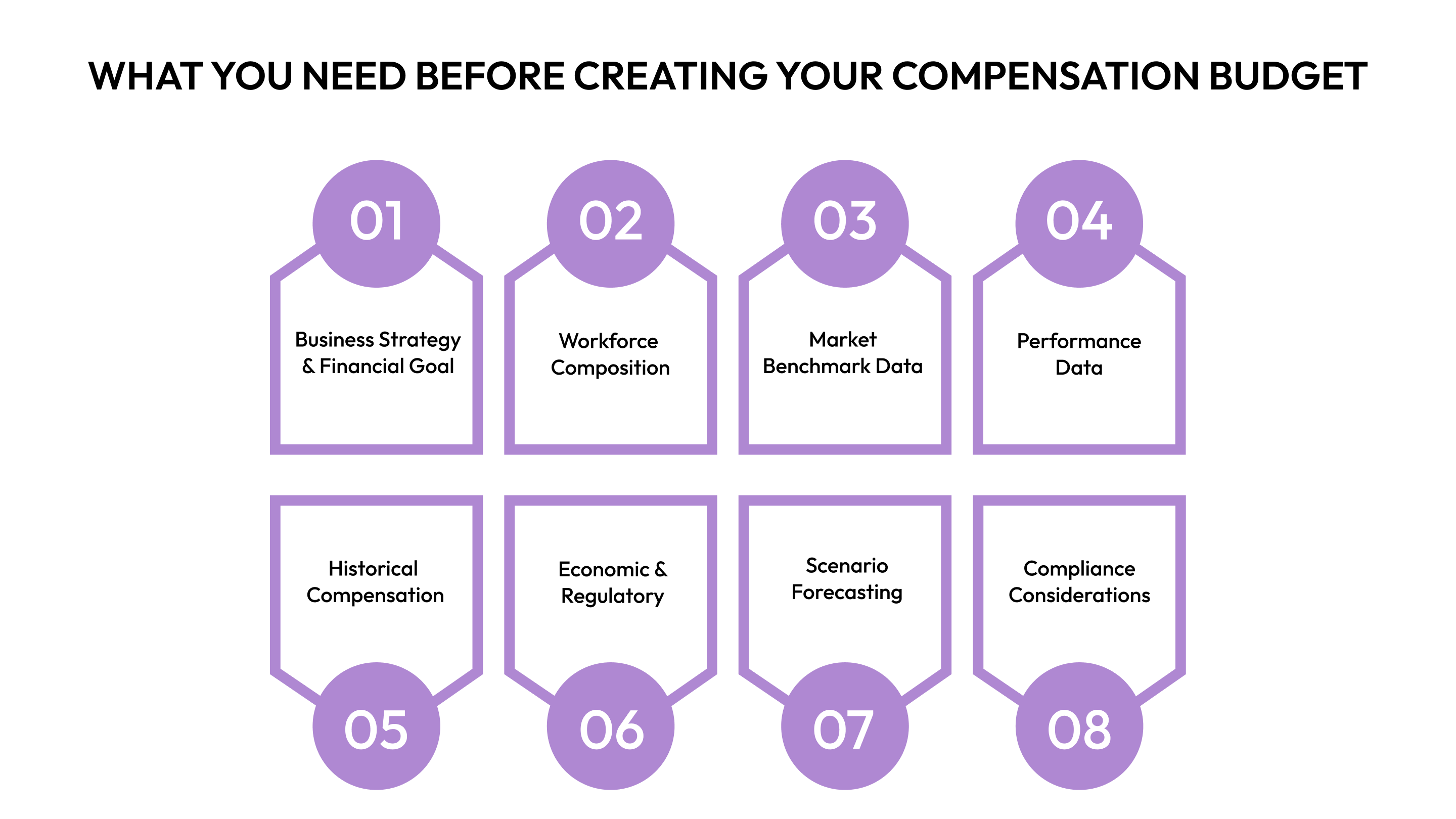
Before setting your compensation budget, it’s essential to gather reliable data and context that reflect both internal and external realities. These inputs form the groundwork for data-backed decisions and ensure your plan aligns with business goals and market conditions.
- Business Strategy and Financial Goal: Understand the company’s short- and long-term objectives. Whether the focus is on growth, cost control, or talent retention, your compensation strategy should directly support these priorities.
- Workforce Composition: Analyze your existing workforce structure, including role types, experience levels, and critical skill areas. This helps determine where you may need to allocate higher budgets. For instance, in retaining niche or high-demand talent.
- Market Benchmark Data: Study current salary benchmarks for each role across relevant industries and regions. This ensures your pay structures remain competitive and reflect current talent market dynamics.
- Performance Data: Review recent performance appraisals and productivity data. Linking rewards to measurable performance outcomes supports a pay-for-performance culture and helps you identify top contributors who should be prioritized in your budget.
- Historical Compensation Trends: Look at previous years’ salary budgets, adjustments, and bonus payouts. Tracking patterns helps anticipate recurring cost cycles and identify opportunities to optimize spending.
- Economic and Regulatory Factors: Account for inflation, living cost adjustments, and any upcoming compliance or taxation changes. These external factors can directly affect salary expectations and overall compensation costs.
- Headcount Plans and Scenario Forecasting: Include projected hires, replacements, and potential restructures in your budget model. Having clear visibility into your headcount pipeline ensures your compensation budget remains scalable and adaptable throughout the year. With CandorIQ, you can model multiple pay scenarios and forecast costs in minutes. This reduces errors, saves hours of administrative work, and ensures your compensation budget stays accurate and adaptable.
- Pay Equity and Compliance Considerations: Before finalizing the budget, conduct a pay equity audit. Review gender, race, and location-based differences to identify gaps. Accounting for equity adjustments upfront reduces compliance risks and supports fair pay practices that build trust.
Having identified the essential inputs, you can now move on to building a detailed budget model that incorporates all components and layers.
Building the Budget Model: Components & Layers
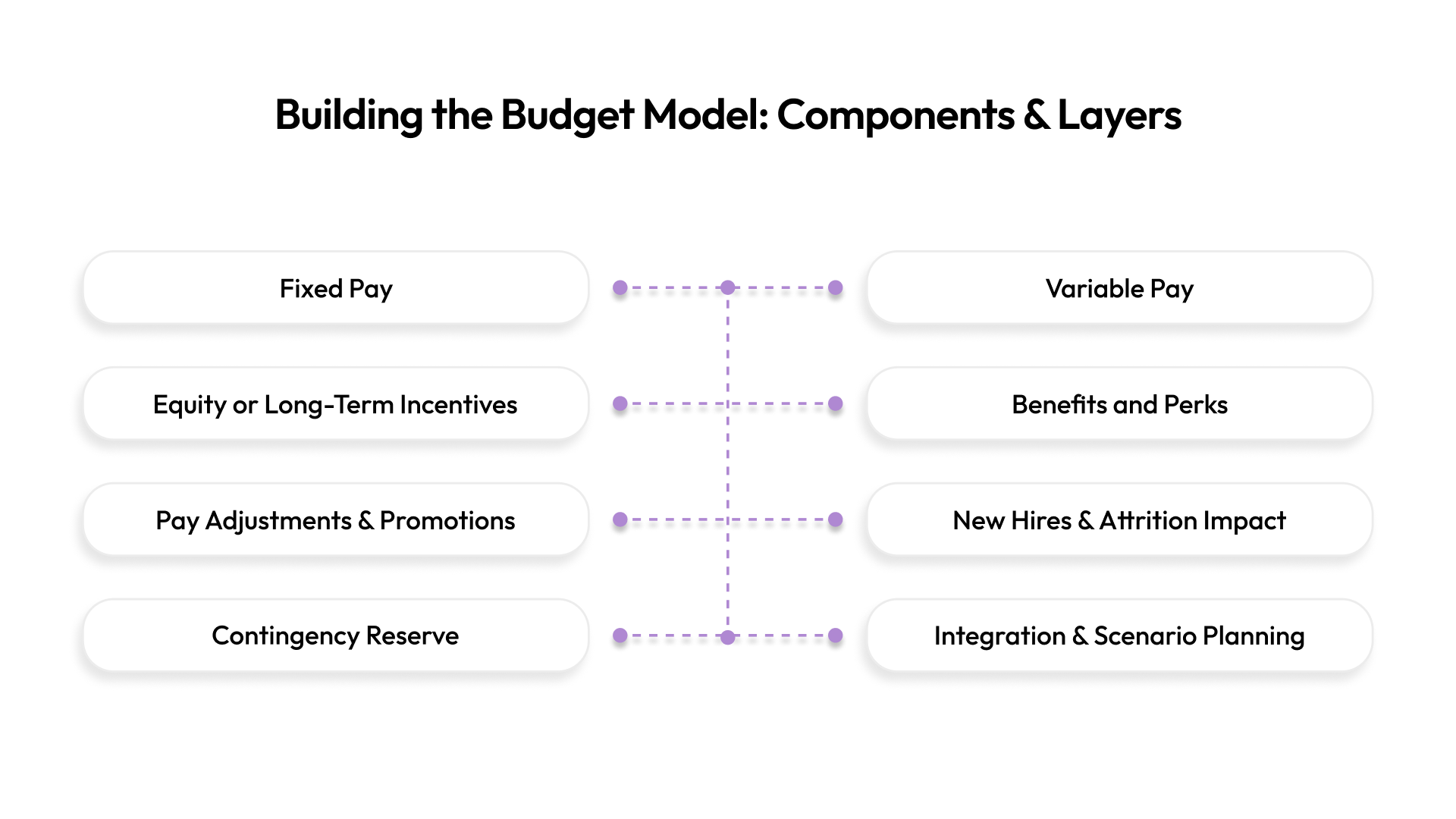
Once the groundwork is ready, the next step is translating your insights into a structured budget model. A well-built compensation budget goes beyond listing pay numbers. It connects business goals, workforce needs, and financial capacity.
Here are the key layers to include when designing your model:
1. Fixed Pay (Base Salary)
This is the most stable and predictable part of your compensation spend.
- Segment your data: Break it down by job role, grade, department, and location.
- Benchmark regularly: Compare against market salary data to maintain competitive pay bands.
- Factor in inflation and market movement: Adjust base salary projections accordingly.
2. Variable Pay (Bonuses and Incentives)
Performance-based pay ties employee motivation to company success.
- Define clear metrics: Link bonuses to measurable business outcomes.
- Set payout limits: Prevent over-allocation during low-performance periods.
- Align with roles: Tailor bonus structures for sales, operations, or leadership teams.
3. Equity or Long-Term Incentives
These programs strengthen retention and reward long-term contributions.
- Select eligible roles: Typically senior leaders, high-impact contributors, or niche specialists.
- Choose the right structure: Stock options, RSUs, or profit-sharing plans.
- Align with business goals: Ensure long-term incentives reinforce company growth objectives.
4. Benefits and Perks
Benefits play a crucial role in total compensation value.
- Include all programs: Health, dental, retirement, life insurance, and wellness benefits.
- Track participation rates: Estimate cost changes based on enrollment trends.
- Review annually: Update offerings to match workforce expectations and budget limits.
5. Pay Adjustments and Promotions
Salary growth within the existing workforce should be forecasted accurately.
- Include merit increases: Account for annual performance-based raises.
- Plan for promotions: Estimate upward movement based on performance cycles.
- Allow correctional room: Keep flexibility for off-cycle or retention adjustments.
6. New Hires and Attrition Impact
Your hiring and turnover rates directly affect total compensation costs.
- Use workforce planning data: Align the budget with expected headcount changes.
- Add hiring buffers: Anticipate delays or overlaps in staffing transitions.
- Model attrition costs: Include recruiting, training, and interim coverage expenses.
7. Contingency Reserve
A small safety margin keeps your budget realistic and adaptable.
- Set aside 2–3%: Allocate a portion for unplanned adjustments.
- Use for retention offers: Helps retain critical employees without disrupting core funds.
- Monitor usage: Review periodically to ensure it’s used strategically.
8. Integration and Scenario Planning
Your budget model should support continuous evaluation.
- Run “what-if” simulations: Test how salary hikes or hiring slowdowns affect overall spend.
- Consolidate data sources: Bring payroll, performance, and finance data into one place.
With the right structure in place, you can now focus on proven strategies that make your compensation budget effective and sustainable throughout 2025.
Also Read: Benefits of Compensation Workflow Automation in HR
Proven Strategies for Compensation Budget Planning in 2025
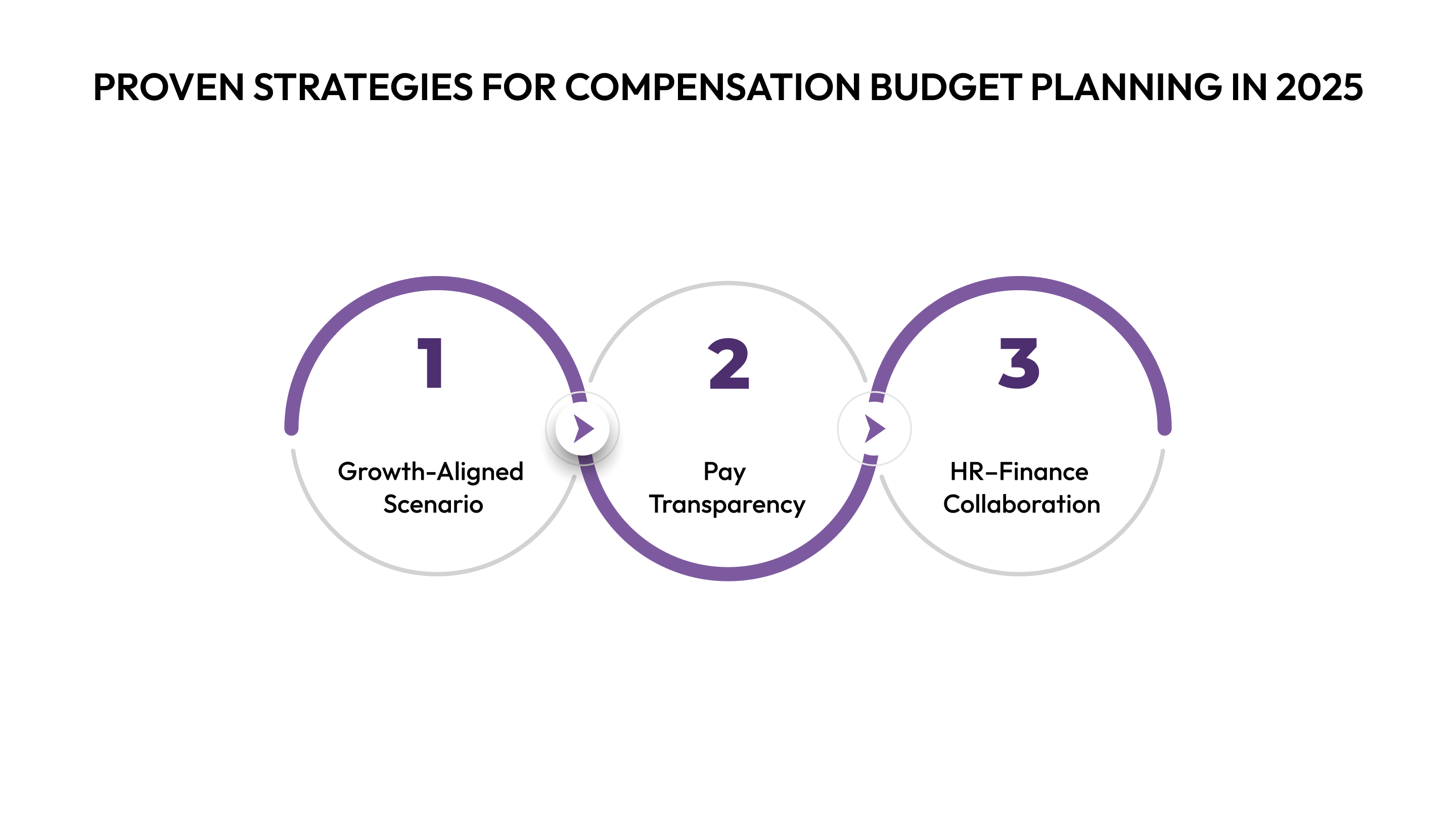
Compensation planning in 2025 demands precision and adaptability. Organizations are entering a year defined by uneven growth, inflation stabilization, and a continued focus on fairness. This helps HR and Finance make faster and more accurate pay and budget decisions. It also saves them hours of admin work each month.
1. Growth-Aligned Scenario Planning
Building multiple compensation models has become essential as business cycles shorten and hiring patterns fluctuate. Leaders no longer rely on a single plan. They create three models: one for rapid growth, one for steady hiring, and one for a temporary freeze. Each model ties to revenue forecasts, productivity goals, and workforce structure.
Key points to consider:
- Use quarterly reviews to adjust merit budgets and variable pay in line with actual growth.
- Track compensation spend as a percentage of revenue to maintain predictability.
- Encourage finance and HR teams to run “what-if” simulations before committing to salary changes.
A flexible, scenario-based plan prevents underfunded raises or overcommitment during uncertain quarters. In 2025, as hiring demand varies across industries, this method allows leaders to make confident adjustments backed by data instead of guesswork.
2. Pay Transparency and Equity Strategy
Pay transparency has moved from a compliance exercise to a credibility factor. With several U.S. states enforcing salary range disclosures, employees now expect clarity and fairness in how pay is determined. Organizations that publish clear pay ranges, conduct internal equity audits, and define geographic differentials attract better talent and reduce turnover.
Key points to consider:
- Keep pay range data updated in all job listings and HR systems.
- Review internal pay equity quarterly to identify and close gaps early.
- Train people managers to discuss compensation philosophy confidently during reviews.
Transparency only works when supported by consistent communication. Many organizations share figures but fail to explain the rationale behind them. This mistake can erode trust. In 2025, the best outcomes come from pairing openness with thoughtful context.
3. Integrated HR–Finance Collaboration
The most effective compensation planning happens when HR and Finance operate on the same data and timelines. Misalignment between these teams leads to version mismatches, delayed approvals, and inaccurate reporting.
Key points to consider:
- Establish shared dashboards where both HR and Finance can view compensation cycles, headcount plans, and spending progress.
- Set weekly or monthly syncs to review budget variances and workforce changes.
- Replace manual spreadsheets with collaborative tools that update in real time.
With CandorIQ, HR and Finance teams can connect all compensation data in one platform. This streamlines approvals, reduces manual effort, and gives leadership instant visibility into workforce costs and future budget projections.
With a clear understanding of proven strategies, the next step is to translate them into a structured budget model that aligns with your organization’s goals and financial constraints.
Also Read: Understanding the Role of Compensation and Benefits Managers
.png)
Approaches to Building a Strong Compensation Budget Model
When planning compensation budgets, companies usually rely on one of three methods. Each approach has its strengths and trade-offs depending on team size, business maturity, and how predictable your growth is.
1. Top-Down Approach
In a top-down plan, the Finance team starts by defining a fixed pool, often a percentage of total payroll or revenue. HR then allocates this pool across departments and roles.
This method helps maintain strict budget control and suits companies that need predictable spending. It works well for stable or cost-sensitive organizations where salary growth follows overall business performance.
2. Bottom-Up Approach
Here, HR builds the budget starting from headcount and hiring forecasts. Each manager estimates salary increases, promotions, and new-hire costs based on market data and team needs. These inputs roll up to Finance for validation.
This approach captures real-world nuances such as talent shortages, promotion cycles, and critical role adjustments, but may lead to cost overruns if not governed properly.
3. Hybrid Approach
The hybrid model combines both methods. Finance sets overall financial limits, while HR and department leaders propose detailed plans within those limits. The two teams reconcile differences through calibration rounds until the final model balances affordability and fairness.
This approach brings alignment between top-level financial goals and bottom-up hiring realities. It is often the most practical for scaling organizations, managing distributed teams and evolving pay structures.
Once the budget model is in place, the next priority is a structured plan to bring it to life across the organization.
Step-by-Step Compensation Budget Implementation Plan
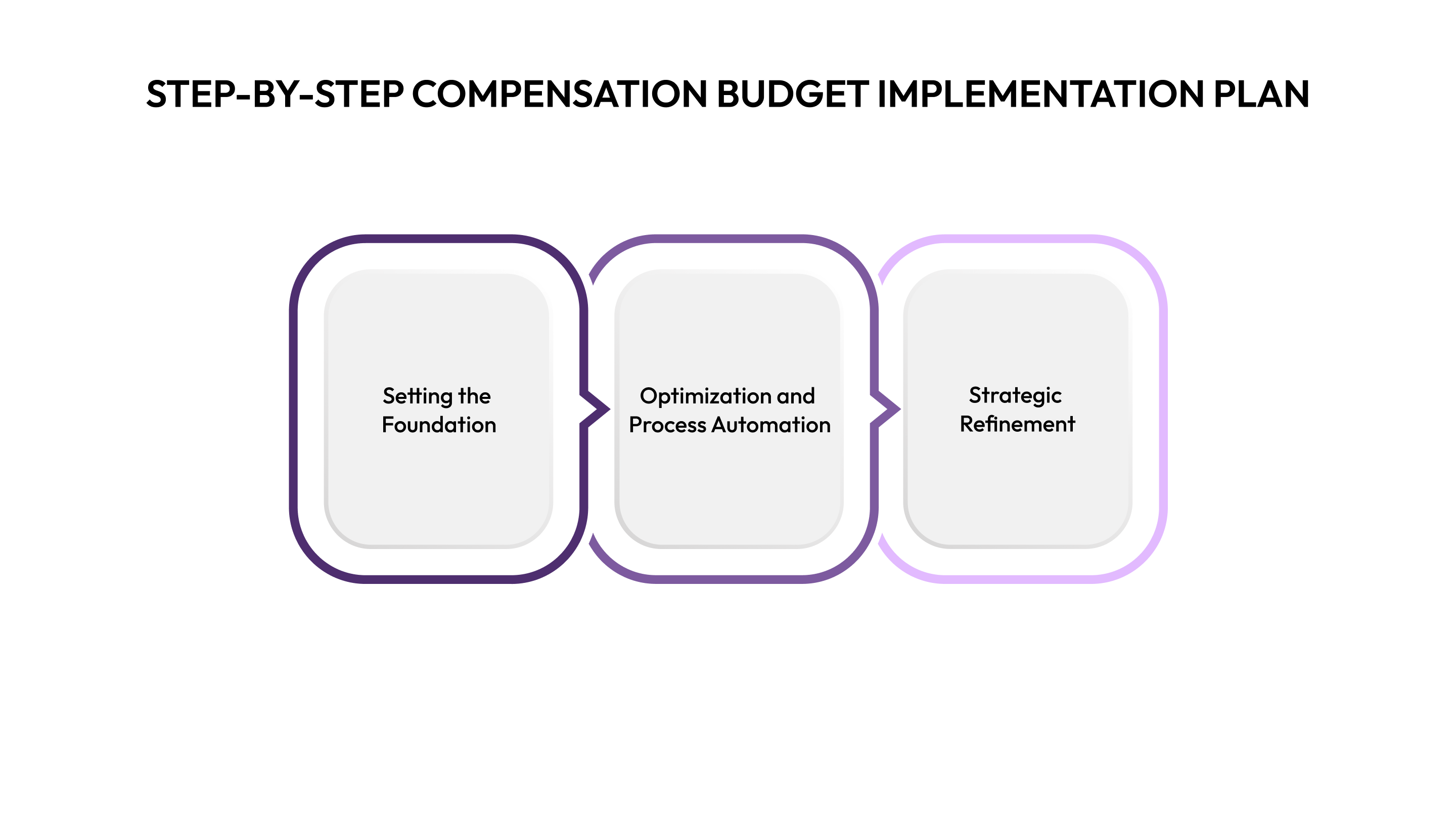
A compensation budget plan only delivers results when executed with structure and accountability. Breaking the implementation into three phases ensures HR and Finance teams stay aligned and data-driven.
Phase 1 (0–90 Days) – Setting the Foundation
Focus: Data audit, alignment, and pay structure standardization.
Key Actions:
- Audit compensation records, historical merit cycles, and job levels.
- Align HR, Finance, and leadership on budget goals, responsibilities, and timelines.
- Standardize job titles, levels, and salary bands to reduce ambiguity.
- Establish initial metrics: headcount cost variance, pay equity ratios, and retention rates.
- Introduce CandorIQ to centralize pay bands, approval workflows, and headcount data.
Measurement: Accuracy of compensation data, stakeholder alignment, and completion of pay structure setup.
Phase 2 (90–180 Days) – Optimization and Process Automation
Focus: Improving efficiency, automation, and early transparency.
Key Actions:
- Automate merit and bonus review cycles with built-in approval logic.
- Implement collaborative dashboards for real-time HR–Finance coordination.
- Refine headcount planning through multiple hiring scenarios to forecast spend.
- Begin communicating pay bands and compensation philosophy internally.
- Conduct initial equity audits to identify gaps and make adjustments.
Measurement: Reduction in approval cycle time, alignment of headcount spending with budget, progress in pay transparency.
Phase 3 (6–12 Months) – Strategic Refinement and Continuous Improvement
Focus: Sustainability, forecasting, and ongoing alignment.
Key Actions:
- Use AI-driven insights to simulate compensation impacts for different growth scenarios.
- Adjust pay ranges based on market benchmarks and geographic differences.
- Conduct quarterly audits for equity, budget adherence, and employee satisfaction.
- Collect feedback from managers and employees to improve communication and processes.
- Ensure HR and Finance operate on a shared, real-time system for faster approvals and decision-making.
Measurement: Forecast accuracy, reduction in budget variance, employee satisfaction with pay transparency, and alignment of compensation with business goals.
Outcome: By the end of 12 months, organizations will have a structured, data-backed compensation process that improves efficiency, ensures equitable pay, and enables confident workforce planning.
Conclusion
Effective compensation budget planning is no longer a reactive exercise. In 2025, organizations need to balance growth, fairness, and predictable costs. They also have to manage distributed teams and changing market conditions. Companies can use structured approaches like scenario planning, pay transparency, and HR–Finance collaboration to control costs and reduce errors. These practices also help build trust with employees.
Implementing a phased roadmap ensures the process is data-driven, scalable, and aligned with business goals. CandorIQ centralizes workflows, tracks pay bands, and provides real-time insights. This helps HR and Finance teams make faster and more accurate pay and budget decisions. It also saves them hours of administrative work each month.
Organizations that implement these strategies can maintain financial discipline, support retention and equity, and build a compensation framework that scales with growth.
Request a demo today to simplify your compensation planning, reduce errors, and save hours of administrative work each month with CandorIQ.
FAQs
1. How does geographic location affect compensation budgeting?
Geographic differences influence salary ranges, benefits costs, and total compensation. Incorporating location-based adjustments ensures fairness and competitiveness across distributed or remote teams.
2. What role does workforce growth play in budget planning?
Rapidly scaling organizations need to model multiple hiring scenarios to align headcount with budget limits and prevent overspending before new hires are onboarded.
3. How can organizations prevent miscommunication between HR and Finance?
Establishing shared dashboards, approval workflows, and regular feedback loops ensures both teams have visibility into budget impacts and reduces errors in compensation decisions.
4. Why is scenario planning critical in 2025?
Scenario planning allows organizations to forecast the impact of different hiring, promotion, or freeze scenarios on budgets, enabling strategic decisions in a volatile economic and talent market.
5. What metrics indicate a successful compensation budget plan?
Key metrics include alignment of actual spend with budget, pay equity ratios, headcount cost variance, employee retention rates, and transparency scores measured through internal feedback.
Ready to modernize your workforce and compensation strategy?
See how CandorIQ brings workforce planning and compensation together with AI.