

7 Essential Tips for Startup Headcount Planning in 2026
Is your headcount plan built to scale? Learn 7 essential tips to align hiring, comp bands, and budget, built for lean HR and Finance teams.

Is your headcount plan actually built to scale? Headcount typically represents 20% to 50% of a startup's total operating expenses. Yet most growth-stage companies still manage hiring decisions through a patchwork of Google Sheets, Slack threads, and gut instinct.
The result? Misaligned budgets, stalled offer approvals, and a finance team that finds out about a new hire after the offer letter is already signed.
If you are scaling, you are expected to move fast, stay within budget, and keep everyone aligned. But the tools and processes most teams use were not designed for that.
This guide covers why headcount planning breaks down at growth-stage startups, what a strong plan actually looks like, and seven practical tips to build a process that holds up when the pace picks up.
At a Glance
- Headcount planning breaks down when HR, Finance, and Recruiting work from different data sources.
- A strong plan includes role-level detail, compensation parameters, and hire prioritization, not just headcount numbers.
- The most expensive mistakes come from skipping comp bands, ignoring attrition, and treating the annual plan as unchangeable.
- Tying every hire to a revenue trigger, not a calendar date, dramatically reduces over-hiring risk.
- CandorIQ connects headcount approvals to comp bands and offers workflows close the gap that spreadsheets leave open.

6 Reasons Why Headcount Planning Breaks Down at Growth-Stage Startups
Before you can fix your headcount process, you need to understand where it actually falls apart. For most startups, the breakdown is about operations, specifically, the gap between how leadership thinks the process works and how it actually plays out on the ground.
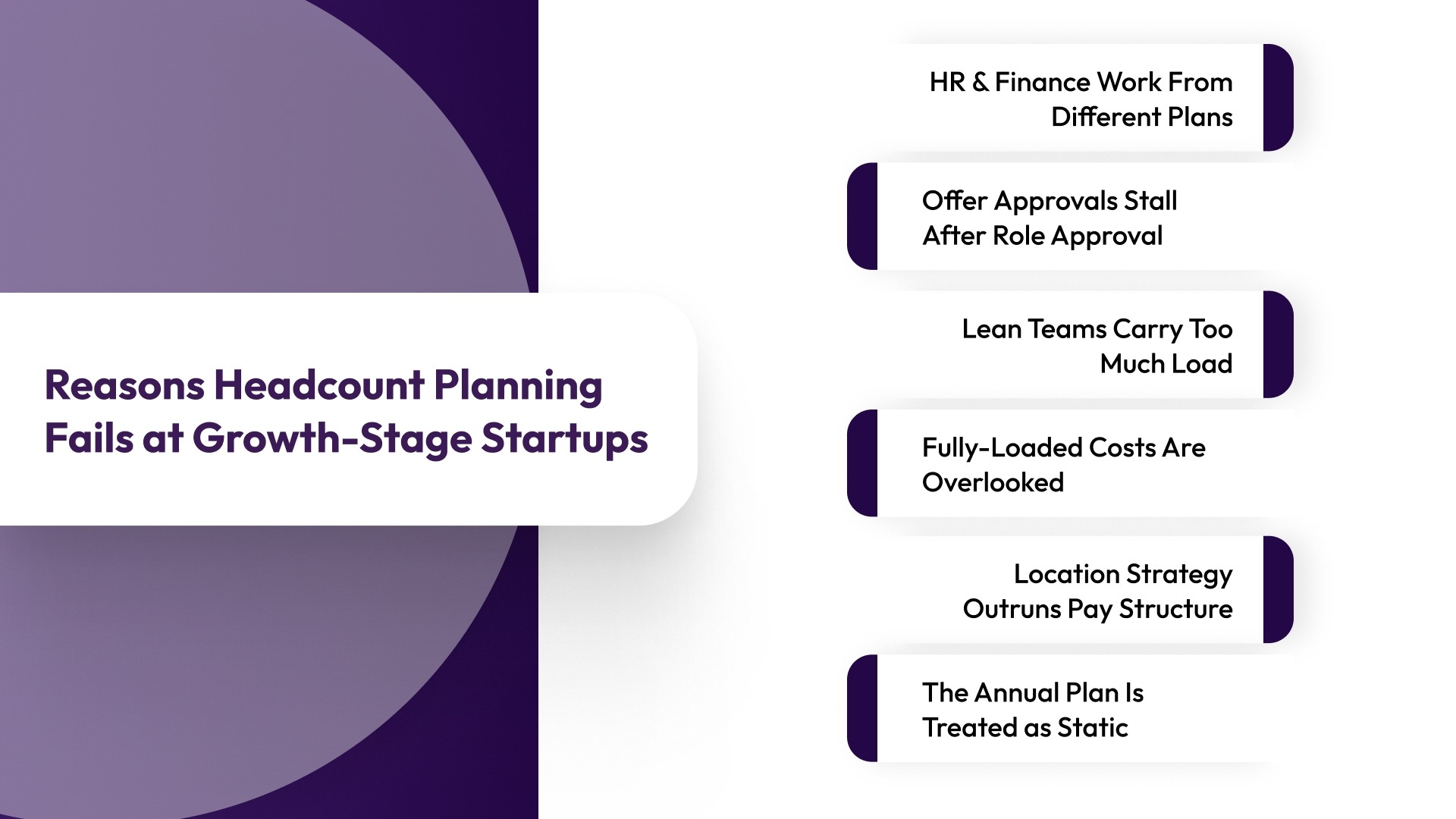
- HR and Finance Work From Different Plans: Finance builds the hiring model in Excel, HR manages a separate org chart, and Recruiting tracks roles in the ATS. Because these systems do not sync in real time, role changes and budget updates quickly create confusion and misalignment.
- Offer Approvals Stall After Role Approval: A role may be approved early in the year, but pay bands or budgets often shift before the offer is finalized. This forces leaders to reopen approvals, creating delays between headcount approval and offer release.
- Lean Teams Carry Too Much Load: In many Series B companies, one person supports both People Ops inputs and Finance review. Compressed timelines and limited bandwidth make it difficult to validate every assumption or cross-check every budget line.
- Fully-Loaded Costs Are Overlooked: Most hiring plans focus primarily on base salary and overlook the additional costs attached to each employee. Payroll taxes, benefits, equity, recruiting fees, and onboarding expenses typically add above salary and explain many mid-year budget variances.
- Location Strategy Outruns Pay Structure: Distributed hiring has become standard practice, but compensation frameworks often lag behind geographic expansion. Hiring across multiple cities without a location-based structure creates equity issues that are costly to fix later.
- The Annual Plan Is Treated as Static: Market conditions, revenue performance, and funding milestones can quickly make an annual hiring plan outdated. Teams that fail to reforecast mid-year often spend months reacting instead of staying ahead.
These failure modes share a common root cause: headcount planning and compensation planning are treated as separate workflows when they are fundamentally the same strategic decision. Here is what a plan looks like when you fix that.
5 Things a Strong Startup Headcount Plan Actually Includes
Most headcount plans answer one question: how many people are we hiring? When HR and Finance rely on the same source of truth, decisions move faster, and budget surprises decrease. A strong plan answers these five.
- Role-Level Detail, Not Just Hiring Targets: Saying “we’re hiring 20 people in Q3” is a target, not a plan. A strong plan defines title, level, department, reporting line, start date, and priority for every role. Without this detail, recruiting struggles to source, Finance cannot model cash flow accurately, and leadership lacks clarity during trade-off decisions.
- Compensation Defined Before Posting: Each role should have a clear pay band, not a rough salary estimate. Ranges must reflect your compensation philosophy and current market benchmarks. Setting bands early prevents budget overruns, rejected offers, and internal equity issues when hiring into existing teams. Tools like CandorIQ allow teams to define pay bands by level and location, giving hiring managers structured guardrails before roles go to market.
- Fully-Loaded Cost Modeling: Every planned hire should include total cost, not just base salary. Factor in bonus targets, benefits, payroll taxes, equity, recruiting expenses, and onboarding costs. For U.S. salaried roles, this typically equals 1.25–1.35x base salary, and ignoring it leads to predictable budget gaps.
- Shared Hire Prioritization: Not all roles carry equal urgency. A tiering system creates clarity: P0 roles are critical and funded, P1 roles are funded but deferrable, and P2 roles depend on business milestones. This structure reduces friction when plans need to adjust mid-cycle.
- Built-In Attrition and Backfill Assumptions: Headcount planning must account for attrition, not just growth. A 300-person company with 15% attrition will backfill about 45 roles annually before adding net new hires. Modeling attrition by function and level improves recruiting forecasts and budget accuracy. Platforms such as CandorIQ help teams track attrition, open roles, and filled seats in one view so workforce plans stay aligned with real organizational changes.
When these five elements are in place, headcount planning becomes operational. The next challenge is ensuring the plan stays aligned as business conditions change.
Also Read: Compensation and Headcount Planning Scenarios Explained
7 Essential Tips for Startup Headcount Planning That Actually Scale
The headcount plan that holds contains the quality of decisions embedded in the process. These seven practices reflect how high-growth US startups align People Ops and Finance.
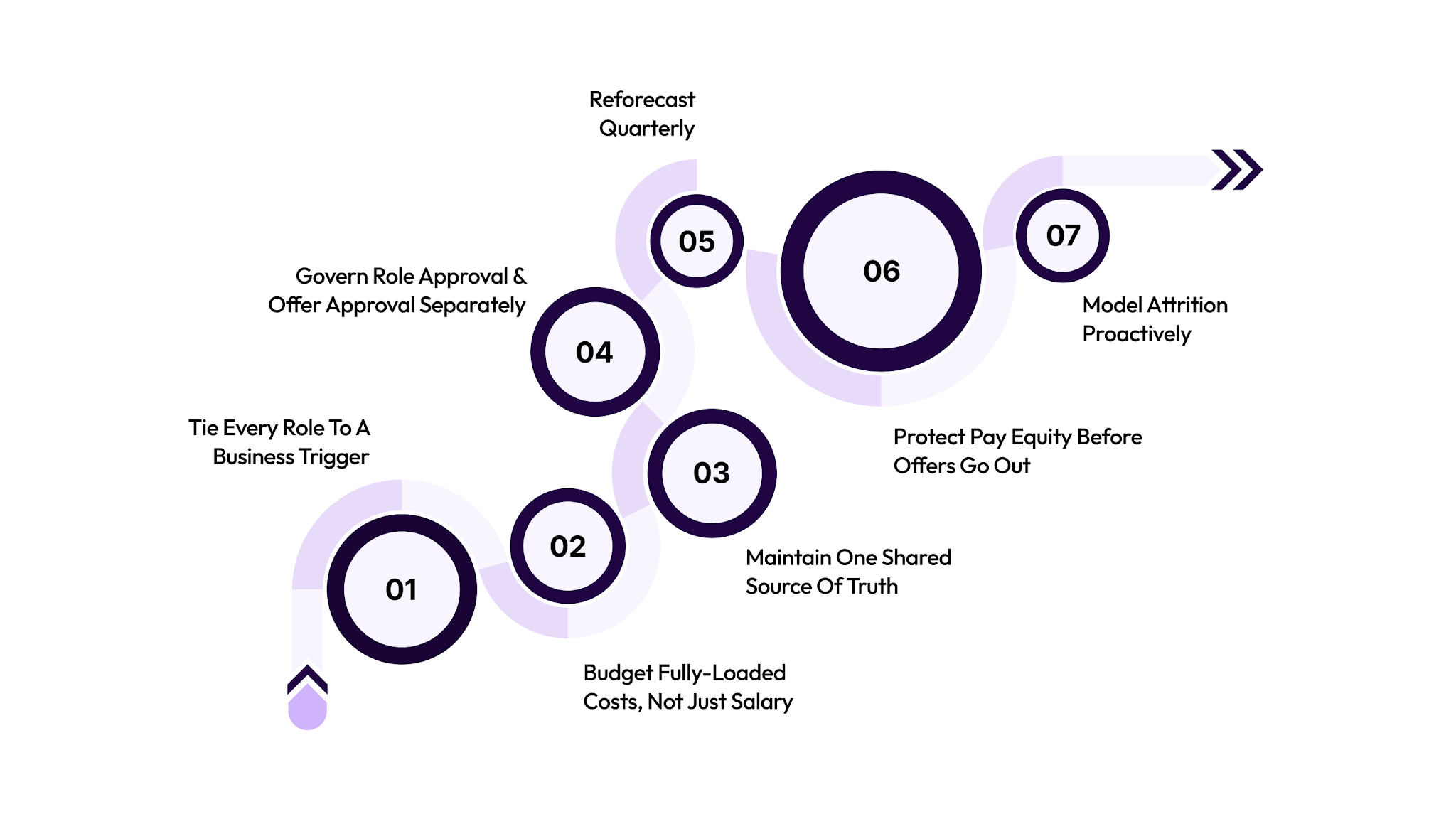
Tip 1: Tie Every Role to a Business Trigger
Calendar-based hiring leads to over-hiring in strong quarters and freezes in weak ones. A stronger approach links each hire to a measurable outcome, such as ARR milestones or team capacity thresholds. This creates a hiring pace that adjusts automatically with performance and gives the board a clear justification for every role.
Tip 2: Budget Fully-Loaded Costs, Not Just Salary
Most headcount variance comes from incomplete cost modeling, not bad forecasting. Benefits, payroll taxes, equity, and recruiting costs typically add 1.25 to 1.4 times above base salary for US hires. Build these assumptions into the plan before board approval, not after offers are extended.
Tip 3: Maintain One Shared Source of Truth
When HR and Finance operate from different versions of the plan, approvals slow, and reconciliation becomes manual. A live headcount register should show role status, compensation bands, start dates, and budget impact in one place. Changes to level or timing must automatically reflect in both compensation and cash flow models.
Tip 4: Govern Role Approval and Offer Approval Separately
Approving a role does not automatically approve the final offer. Budgets, pay bands, and reporting structures often shift between role creation and the offer stage. A clear approval chain, role request, budget confirmation, comp validation, and offer release prevent last-minute surprises and delays.
Tip 5: Reforecast Quarterly
Annual plans become outdated quickly, especially in SaaS, fintech, and e-commerce. Revenue shifts, funding changes, or pipeline gaps can alter hiring priorities within a quarter. A simple quarterly reforecast, review open roles, compare actuals to plan, and reprioritize, keeps hiring aligned with the runway.
Tip 6: Protect Pay Equity Before Offers Go Out
Distributed hiring increases equity risk when managers lack visibility into pay bands and internal ranges. Several states, including Colorado, California, and New York, require pay range transparency, but compliance alone is not enough. Established bands, geo adjustments, and internal visibility should guide every offer decision.
Tip 7: Model Attrition Proactively
Headcount plans often focus on growth while ignoring backfill demand. A 15% attrition rate in a 400-person company requires roughly 60 replacement hires annually. Modeling attrition by function and seniority improves recruiting forecasts and prevents backfill from becoming a budget surprise.
When these seven practices are embedded into the process, headcount planning becomes proactive rather than reactive. However, even strong planning discipline requires the right infrastructure to sustain it.
6 Common Headcount Planning Mistakes to Avoid
Headcount plans rarely fail because of strategy. They fail because of small execution gaps that compound over time. These are the most common ones.
- Budgeting the Headline Salary: If your plan only reflects base pay, your variance is already baked in. The gap shows up later in benefits, equity, and recruiting spend.
- Letting Multiple Versions Circulate: Once HR, Finance, and Recruiting maintain separate files, alignment becomes manual. Manual alignment always breaks under growth pressure.
- Approving the Role but Not the Economics: A headcount slot without a locked comp band invites last-minute negotiation. That delay rarely surfaces until a candidate is ready to sign.
- Skipping Mid-Cycle Checkpoints: Waiting until year-end to revisit hiring assumptions turns small misses into budget problems. Drift compounds quietly each quarter.
- Treating Backfill as Unexpected: Attrition is not a surprise event. When replacement hiring is not modeled upfront, recruiting capacity and budgets tighten unexpectedly.
- Expanding Locations Without Guardrails: Hiring in new markets without a defined pay structure creates inequity first, compliance risk second, and expensive corrections later.
Avoiding these mistakes is less about caution and more about system design. However, a structured process catches these issues early, before they become expensive corrections.
Also Read: Understanding Change Management in HR: Best Practices and Roles
How CandorIQ Strengthens Startup Headcount Planning
In most growth-stage startups, headcount planning breaks at the operational level. When compensation bands are disconnected from hiring workflows, each offer becomes a separate negotiation. When attrition is not modeled, budgets drift quietly off course.
These are not edge cases. They are predictable outcomes of fragmented systems.
CandorIQ is built to unify compensation and headcount planning in one platform. Instead of managing pay bands, hiring approvals, compensation cycles, and workforce reporting across multiple tools, teams operate from a single connected system.
Here’s what we bring to your headcount process:
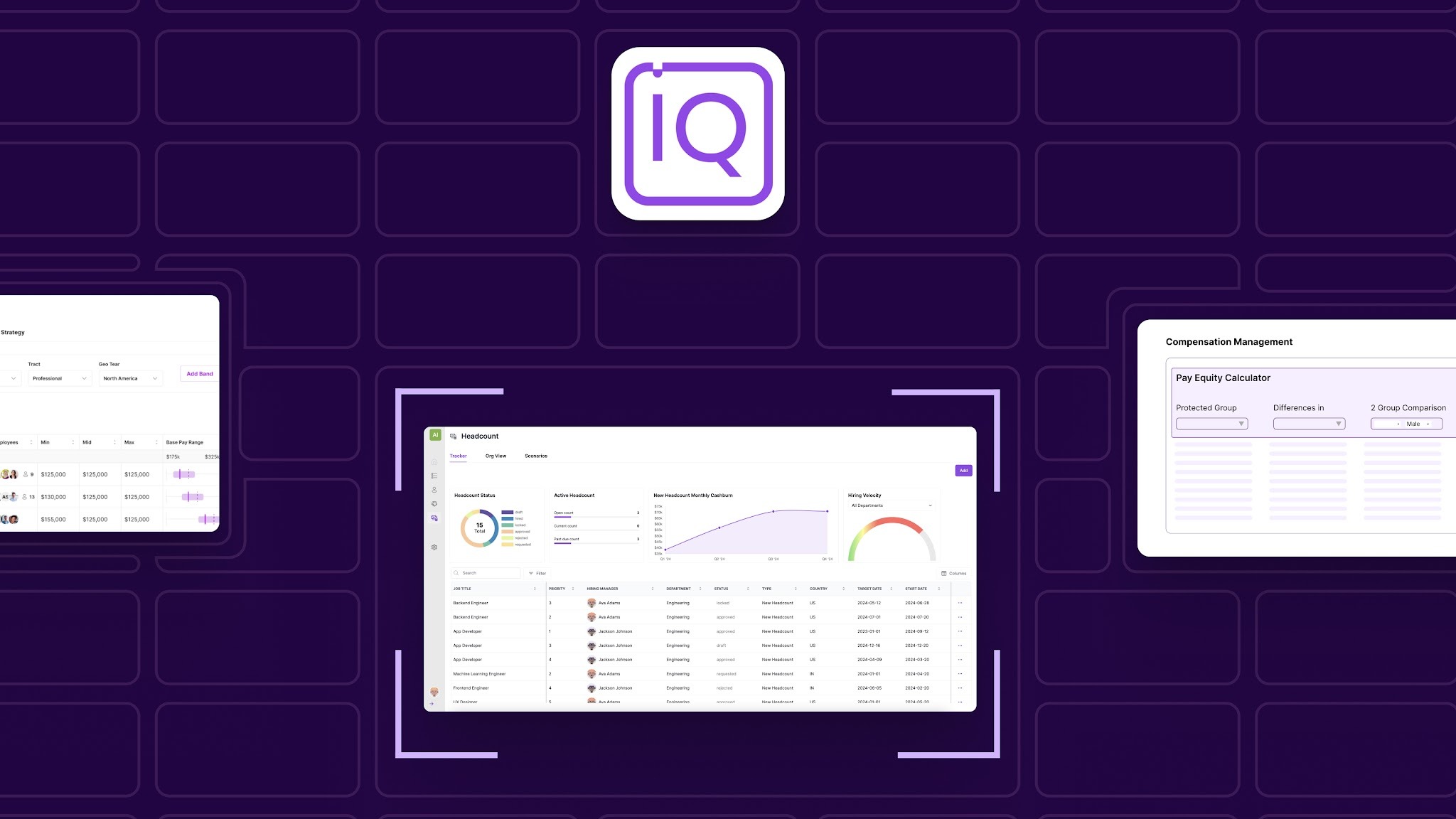
- Compensation & Pay Band Builder: Define pay bands by level, location, and department with geo-adjusted benchmarks. Track version history for auditability and visualize real-time pay distribution. Every offer is generated within an established range, not negotiated from scratch.
- Headcount Scenario Planning: Model future org structures and immediately see financial impact. Compare hiring scenarios against budget thresholds while HR and Finance collaborate inside the same live plan.
- Headcount Requests & Approvals: Create structured hiring requests with embedded compensation logic and budget context. Route approvals dynamically by team, geography, or comp level, and sync directly with ATS and finance systems.
- Compensation Cycle Management: Run merit and bonus cycles with built-in approval workflows and real-time budget tracking. What once required weeks of manual coordination can close in days.
- Workforce Management Dashboard: Track open roles, filled positions, attrition, promotions, and comp variance in one view. Align actuals versus plan, so executives, Finance, and HR operate from the same data.
- AI Agent: Ask natural language questions across your compensation and workforce data. Model hiring scenarios, analyze equity gaps, or forecast budget impact using your organization’s real numbers.
CandorIQ connects the decisions most startups manage separately: headcount forecasting, compensation governance, offer workflows, and pay equity. When these workflows run inside one system, lean teams move faster without sacrificing financial discipline or internal fairness.
Conclusion
Startup headcount planning does not fail because of bad intentions. It fails because the process was never designed to handle the complexity of a distributed team, a lean ops function, and a board expecting accurate numbers every quarter.
If your current process relies on spreadsheets, Slack approvals, and manual reconciliation, the cost is not just efficiency. It is comp equity gaps, budget overruns, and hiring velocity lost to back-and-forth approvals.
You can fix that. Ready to see how CandorIQ connects headcount forecasting, pay bands, and offer workflows in one place? Book a demo and see it built for your team.

FAQs
Q. How often should a startup update its headcount plan?
At a minimum, quarterly. High-growth startups often do informal monthly check-ins and full reforecasts every quarter. The goal is to catch budget drift before it compounds, not to fix it after a board meeting.
Q. What is a reasonable headcount-to-revenue ratio for a SaaS startup?
It varies by stage and business model, but a common benchmark for efficient SaaS companies is $150,000 to $250,000 in ARR per employee. Below that range, it is worth auditing whether headcount is ahead of revenue maturity.
Q. How should we handle headcount planning during a funding round?
Build two scenarios: one based on the current runway, one that models the planned raise closing. Do not build your entire operating plan around a round that has not closed. Keep P0 hires funded either way and defer P1 and P2 until capital is confirmed.
Q. At what company size does headcount planning require dedicated tooling?
Most teams outgrow spreadsheets between 80 and 150 employees, when three or more stakeholders are actively editing the plan, and offer cycles start taking longer than two weeks to close. That is typically the inflection point.
Q. How do US pay transparency laws affect headcount planning?
States including California, New York, Colorado, and Washington now require salary ranges in job postings. This means pay bands need to exist before a role is posted publicly, making comp planning at the headcount stage a legal requirement, not just a best practice.
Ready to modernize your workforce and compensation strategy?
See how CandorIQ brings workforce planning and compensation together with AI.