

Change Management in HRM: Guide for HRBPs and People Ops in 2026
Change management in HRM for HRBPs and People Ops to align headcount, compensation, and approvals without execution delays.
.jpg)

Change management in HRM is the process of planning and executing workforce changes such as restructures, compensation updates, and organizational realignments.
In practice, the breakdown rarely happens at the communication stage. It happens when headcount plans, compensation decisions, and approvals no longer move in sync. The change is announced, but execution lags behind it.
Even today, nearly 70 percent of transformation efforts fail to achieve their intended outcomes. This is where change management in HRM actually makes a difference. It helps HR Business Partners and People Ops teams ensure that workforce decisions are aligned, approved, and executable under real constraints.
This guide breaks down how to align headcount, compensation, and approvals so your change holds up beyond the announcement.
Key Takeaways
- Successful HR change management depends on synchronizing workforce planning, compensation changes, and decision approvals so execution does not stall after planning.
- Finance alignment requires a shared view of workforce costs early, enabling faster decisions and preventing rework caused by inconsistent or outdated data.
- Compensation changes during transitions must follow defined structures to maintain consistency, control costs, and avoid downstream pay gaps or compliance risks.
- Clear ownership of decisions and structured approval flows help reduce delays, improve visibility, and keep complex changes moving within fixed timelines.
- Tracking execution through operational indicators ensures workforce changes are implemented in practice, not just approved or communicated at a planning level.
What Is Change Management in HRM?
It is the structured process of preparing, supporting, and guiding an organization through planned workforce transitions. It sits at the intersection of the people side and the operational side, and as the HR professional responsible for execution, you have to run both at once.
The scope is broader than most communication plans account for:
- Organizational restructures: Roles eliminated, teams consolidated, reporting lines changed.
- Compensation updates: Pay band redesigns, merit cycle adjustments, and equity corrections during org changes.
- Headcount shifts: Hiring freezes, growth sprints, backfill decisions, and reductions in force.
- System or process changes: New HRIS, new approval workflows, new performance management processes.
- Strategic pivots: Market exits, acquisitions, and team integrations.
What separates HR-led change management from generic project management is that you have to align communication, headcount data, and compensation decisions simultaneously, under a timeline that almost never moves.
.png)
The Types of Change You Will Manage Most Often
Not all change is the same. The level of planning required and the frameworks you reach for depend entirely on the type of change in front of you.
Structural and compensatory changes are where you are most likely to lose control of the process. These are the changes where data integrity, approval workflows, and Finance alignment matter most, and where spreadsheets and email threads break down the fastest.
Where Change Management in HRM Actually Breaks Down
Most change management writing focuses on resistance handling and communication strategy. Those matters. But in practice, change fails at the operational layer, not the people layer.
That gap shows up clearly in outcomes. Only 32% of leaders report successfully driving change adoption, which means most change initiatives either fail or underdeliver.
Here are the three breakdown points you are most likely to hit.
1. Headcount Decisions Without a Shared Cost Model
When a restructure is announced, headcount decisions start to move quickly. Roles get eliminated. New ones get created. Teams get realigned. Finance wants to know the cost.
If you are tracking headcount in one tool and Finance is modeling in another, the numbers are never synchronized. You approve a role elimination that appears to be a cost-saving on paper. But the fully loaded impact, including severance, open role carry costs, and backfill timelines, is sitting in a different spreadsheet that Finance has not seen.
The result: decisions get made on partial information. Budget conversations happen after the fact. And someone is always working from a version of the plan that is two updates behind.
- The fix: Work from a single shared headcount model with Finance, where role changes and their cost implications are visible to both teams before any decision is finalized.
2. Compensation Changes Made Without a Pay Band Framework
Every restructure triggers pay decisions. Someone moves into a broader role. A team gets realigned under a different band. A retention adjustment gets approved to keep a flight-risk employee.
Without a structured compensation framework in place before those decisions are made, each one defaults to managerial judgment. One manager gives a 15% increase. Another gives 8% for the same scope change. Neither has a pay band reference. Neither has a documented rationale.
The pay dispersion compounds. By the next comp cycle, you are trying to explain pay gaps that are 12 months old with no record of how they were created.
- The fix: Tie every compensation decision to a defined pay band, with approval logic that logs the rationale and connects to a real-time budget tracker that Finance can see.
3. Approval Workflows That Run Through Email
A headcount reduction needs sign-off from Finance, Legal, and the CHRO. A role redesign needs the hiring manager and department head. A retention package needs the CPO and CFO. These approvals are conducted via email and verbal check-ins.
The problem is not that people are slow. Nobody knows where a decision is in the chain until someone asks. A role sits as approved in a spreadsheet, but has never been formally routed. A compensation change is pending approval from one approver who is traveling. The announcement is scheduled for Thursday. It is Tuesday.
Once trust erodes during a change, rebuilding it mid-transition is extremely difficult. A merit cycle delayed by two weeks because approvals were incomplete is a credibility problem that follows you into the next initiative.
- The fix: approval routing that moves based on defined rules, with automatic escalation when decisions stall, so you can see exactly what is pending, approved, or blocked without chasing anyone.
Change Management Frameworks That Improve Employee Adoption
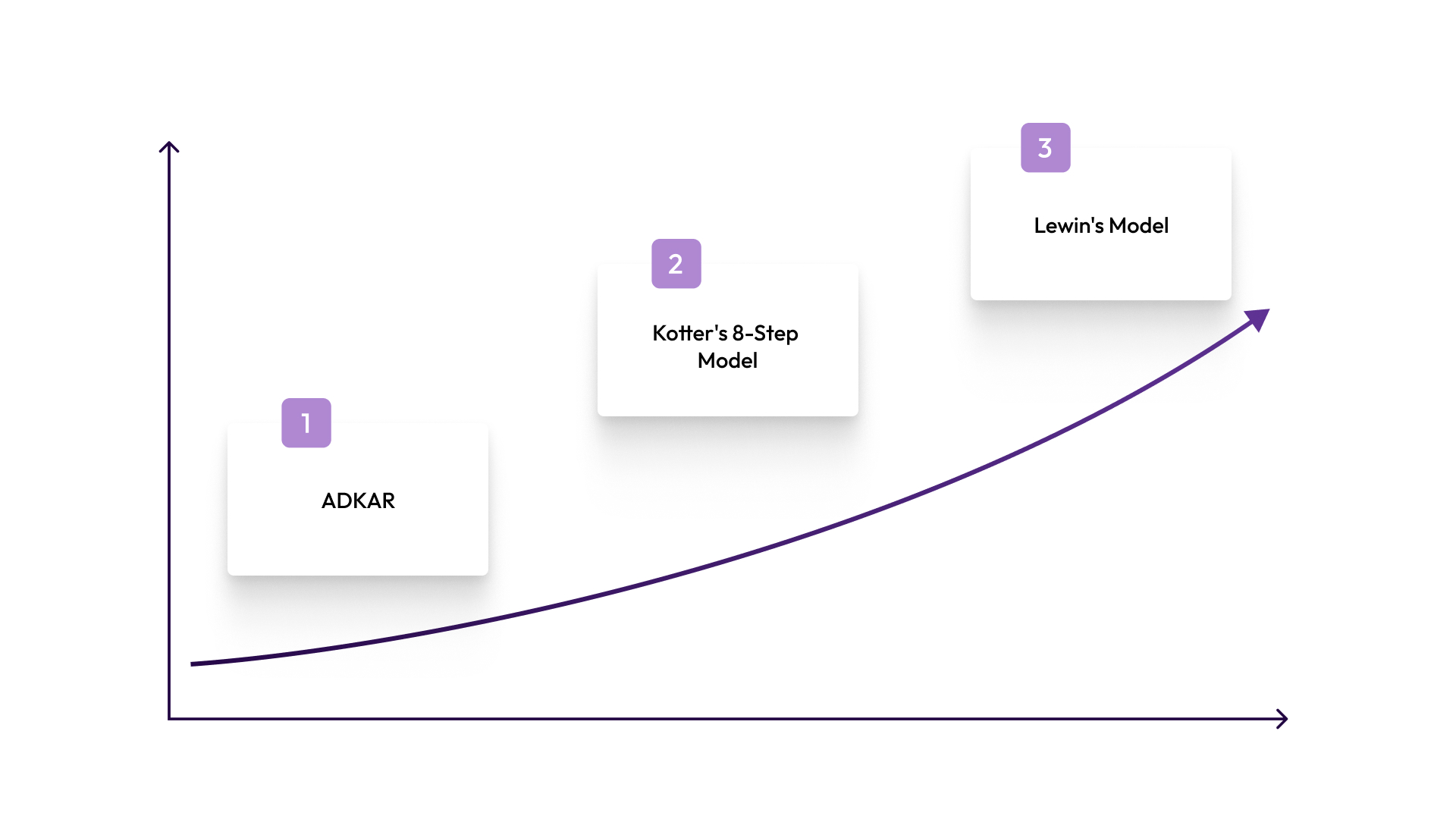
There is no shortage of frameworks. The three you will encounter most are ADKAR, Kotter's 8-Step Model, and Lewin's Change Model. Each has a real use case, but treating any of them as a complete operational system is where teams go wrong.
ADKAR: Best for Individual-Level Adoption
ADKAR stands for Awareness, Desire, Knowledge, Ability, and Reinforcement. It is a people-first framework that tracks where individual employees are in the adoption process. You use it to:
- Identify who is resistant and understand why.
- Design targeted communication and training for each stage of adoption.
- Measure whether individuals have actually moved through the change, not just been informed about it.
When to use it: System rollouts, new process adoptions, and any change that requires individual behavior to shift. It is not designed for planning structural or compensatory change.
Kotter's 8-Step Model: Best for Large-Scale Transformation
Kotter's model focuses on building organizational momentum for change. The steps include creating urgency, forming a guiding coalition, building a vision, communicating it, removing obstacles, generating short-term wins, consolidating gains, and anchoring new behaviors.
It is most useful when the change is large, top-down, and requires broad organizational alignment before execution begins.
You use it to:
- Build alignment across leadership before execution begins.
- Create momentum through visible short-term wins.
- Reinforce change by embedding it into systems and culture.
One important caveat: Kotter's model does not activate execution until Step 5. If your change has a hard deadline, compress this model. Do not follow it linearly if you are working against a quarterly announcement.
When to use it: Large-scale, top-down transformations where alignment and momentum need to be built before execution begins.
Lewin's Model: Best for Understanding the Phases of Change
Lewin's three-phase model, Unfreeze, Change, and Refreeze, is a useful way to explain to leadership why you cannot move directly into a change without preparing the organization first.
When to use it: Early-stage change planning where you need to prepare, transition, and stabilize the organization through clear phases.
You use it to:
- Prepare the organization by clearly communicating why the change is needed.
- Guide teams through the transition phase with structured support.
- Stabilize the change by reinforcing new processes and behaviors.
Unfreeze communicates why the change is necessary. Change manages the transition. Refreeze reinforces the new normal through updated processes, compensation structures, and org design.
A Practical Change Management Process: Step by Step
This is not a generic checklist. It is the sequence that holds up in practice when you are the person responsible for both the people side and the operational side of a change. Each step covers what to do, what to have ready, and where most teams stall.
Step 1: Define the Change and Model the Workforce Impact Before Anything Is Communicated
Before any conversation happens above your level, you need a clear picture of the change. That means building or reviewing a headcount model that shows the org under the proposed structure versus the current one, with budget impact attached.
At a minimum, you need to know:
- Which roles are being eliminated, created, or realigned, and the fully loaded cost of each.
- What compensation changes are triggered by role scope shifts or band realignments?
- What severance and backfill costs look like if the timeline moves.
- What the budget impact looks like under two or three different scenarios, not just the preferred one.
This is the step where you are most likely to arrive underprepared. Leadership calls a planning meeting. You show up with a headcount list. Finance presents a budget model. Neither matches the other. The meeting stalls, and your credibility takes a hit before the change has even started.
Step 2: Map Decision Owners, Not Just Stakeholders
Standard stakeholder mapping tells you who is affected by the change. That is not enough. You need a separate map that tells you who owns each decision type before the process starts.
For a typical structural change, your decision ownership map should cover:
- Headcount approvals: who has authority to approve role eliminations, backfills, and new roles by level and cost threshold.
- Compensation sign-off: who approves retention adjustments, scope-change pay increases, and severance packages.
- Escalation paths: who a stalled approval escalates to automatically, and at what point.
- Communication ownership: who delivers the message to each group, in what format, and in what order.
If this map does not exist before the change starts, you will spend the first week of execution building it under pressure. Every day that decision ownership is unclear is a day the change is not moving.
Build the map. Share it with Finance, Legal, and relevant business leads before any approval routing begins. If a decision owner changes mid-process, update the map, not the email thread.
Step 3: Sequence the Communication, Do Not Just Plan It
A communication plan tells you what messages go out and when. What you need beyond that is sequencing logic: who hears what, in what order, through which channel, and who is responsible for each delivery.
Sequencing errors are the most common source of trust breakdowns during change. If a department head hears about a restructure from a peer before you have briefed them, the narrative is already out of your control.
The sequence that holds up in practice for a structural change:
- Finance and Legal are briefed on the full cost model and legal exposure before any org decisions are finalized.
- Leadership is aligned on the final structure and rationale before managers are briefed.
- People managers are briefed with scripted talking points, a clear FAQ, and an escalation path for questions they cannot answer.
- You confirm compensation decisions and approval status before supporting managers in real time.
- Affected employees are notified in individual conversations, not group announcements, before anything goes org-wide.
- Full organization communication is issued within 24 hours of individual notifications, before the informal network fills the gap.
Each step in that sequence depends on the one before it. If approvals in Step 3 are still running when the manager briefing is scheduled, push the briefing. Communicating before decisions are locked is the single most common reason a change announcement has to be walked back.
Step 4: Lock Every Compensation Decision Before the First Word Goes Out
Every pay decision related to the change must be approved, documented, and reflected in the budget before any communication reaches employees or managers. That includes:
- Retention adjustments for flight-risk employees identified during planning.
- Pay increases for employees whose role scope is expanding as a result of the change.
- Band realignments for roles moving to a different level or function.
- Severance packages for eliminated roles are calculated and signed off on before individual conversations begin.
If even one of these is still pending when the first announcement goes out, you are simultaneously managing a change communication and chasing an open approval. That is when errors happen. A manager is told that a role has been eliminated, but the severance figure has not been approved. The employee asks. The manager does not know. You have to walk it back in a one-on-one, the same day as the announcement.
Run a pre-communication checklist with Finance 48 hours before the first message goes out. If anything is unresolved, delay the communication, not the approval process.
Insider Tip: Build a simple approval tracker tied to the change timeline showing each comp decision, its approver, status, and budget impact. Share it with Finance in real time. When everything shows green, the announcement is cleared. This removes the ambiguity of 'I think we are ready' conversations.
Step 5: Address Resistance With Data, Not Just Empathy
Resistance to change is predictable. Where you lose control of it is when you treat every instance as an emotional problem that needs empathetic handling. Some resistance is legitimate, and the person pushing back has information or context you have not accounted for.
The most common forms of legitimate resistance during a workforce change:
- A manager resisting a headcount freeze may be sitting on a revenue target that cannot be hit without the hire. You need the business case, not a conversation about organizational priorities.
- An employee resisting a comp change may have seen the same pay band applied inconsistently in the previous cycle. You need the band history, not a reassurance that the process is fair.
- A department head resisting a restructure may have operational dependencies in the current structure that the new model breaks. You need the dependency map, not a vision statement.
The way to have these conversations well is to walk in with the data. That means knowing the budget, understanding the pay structure, and having the headcount model current enough to answer real questions on the spot.
The teams that handle resistance well are the ones that can say: here is the constraint, here is why this decision was made, and here is what can and cannot move. That is a data conversation. Both empathy and data matter, but the data have to come first.
Step 6: Track Whether the Change Is Actually Executing, Not Just Whether People Accepted It
Once the change is announced, the work shifts from communication to execution tracking. Most people measure adoption through engagement surveys run four to six weeks after the announcement. By then, the operational damage is already done.
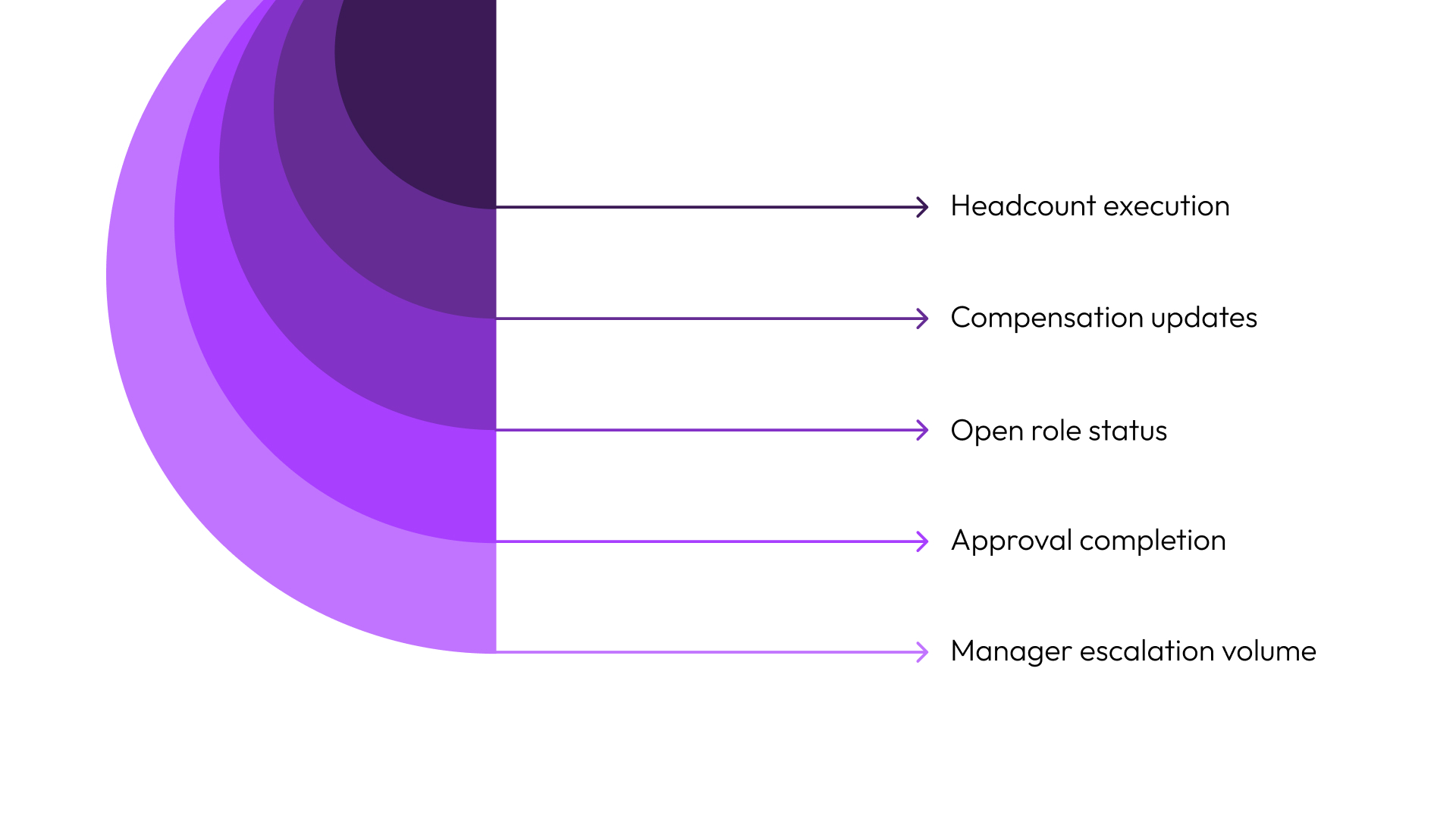
What you need to track in the first two to four weeks after the announcement is whether the change is executing as planned:
- Headcount execution: Whether role eliminations, backfills, and new roles are moving on the approved timeline, or sitting in a queue.
- Compensation updates: Whether approved pay changes are reflected in the HRIS and budget, or are still on a spreadsheet waiting to be processed.
- Open role status: Whether roles created by the restructure are being actioned in the ATS, or aging without movement.
- Approval completion: Whether any decisions approved verbally have never been formally routed and documented.
- Manager escalation volume: How many questions are being escalated from managers, and what they are about; high volume in week one signals the briefing was not sufficient.
This is the step most often skipped. The change is announced, managers have the talking points, and attention moves to the next item on the roadmap. But if headcount changes are not executed and comp updates are not processed, the org is running on the old structure while the new one exists only on a slide deck.
Set a two-week check-in with Finance after every major change announcement. Reconcile actuals against the plan. If there is drift, catch it at two weeks, not at the next quarterly business review.

Three Things That Make Change Management Harder in 2026
The fundamentals of change management do not change. What changes is the expectation of what you bring to the table before a change is announced. In 2026, three specific shifts are raising that bar.
Pay Transparency Is Now a Constraint, Not a Consideration
States including California, New York, Colorado, Illinois, and Washington now require salary ranges to be posted in job postings and, in some cases, disclosed to employees on request. When a restructure creates new roles or realigns existing ones, every new or changed role needs a documented, defensible salary range immediately.
If compensation decisions during a change are made informally, they become a pay transparency problem the moment someone asks what a new role pays. You cannot manage this after the fact. The pay band needs to exist before the role is created.
Finance Alignment Is Now a Precondition, Not a Post-Approval Step
According to Payscale's 2026 compensation priorities report, HR and Finance alignment is no longer optional. Compensation strategy now sits at the intersection of talent, risk, and business growth. If you present a change plan without a modeled cost impact, it is increasingly likely you will be sent back to rework before any decisions get approved.
The practical implication: you need a live headcount model that Finance can interrogate before the leadership conversation happens. Not a slide deck. A working model with toggleable scenarios.
AI Is Entering the Workflow, and You Own the Governance
More organizations are running AI-versus-headcount trade-off analyses before approving roles. If an AI tool can cover a function at a fraction of the cost of a full-time hire, leadership will ask the question. You need to be ready to model both options and present the comparison.
This is a new operational responsibility that did not exist two years ago. You do not need to be an AI expert. But you do need to be the person who brings the comparison to the table rather than being caught off guard when leadership asks the question.
Metrics to Track During a Change Initiative
You cannot wait for a post-change engagement survey to know whether the initiative is working. By the time those results come in, the operational damage is done. Here are the metrics that tell you whether the change is actually executing while it is still happening.
Approval cycle time and open role aging are the two most consistently overlooked metrics. Both are leading indicators. If approvals are stalling, the change is already slipping before the first employee notices. If new roles from the restructure are sitting unactioned two weeks post-announcement, leadership will start questioning whether HR can execute, and that conversation is harder to recover from than the delay itself.
How CandorIQ Helps HRBPs and People Ops Run Change Without Execution Gaps
For HR Business Partners and People Ops teams, change management breaks down when headcount planning, compensation decisions, and approvals are handled in separate systems. The issue is not visibility alone; it is the lack of a shared operational layer where decisions can be modeled, approved, and executed in sync.
CandorIQ addresses this by bringing workforce planning, compensation, and approval workflows into a single system, so HR and Finance are working from the same data before changes are announced.
- Headcount scenario planning: Model workforce changes, compare scenarios, and understand cost impact before finalizing decisions.
- Headcount requests and approvals: Centralize hiring and backfill requests with clear ownership, approval routing, and budget visibility.
- Compensation management (Comp Builder): Maintain pay ranges, job levels, and compensation structures in one place to ensure consistency during role changes.
- Compensation cycle management: Run merit cycles, track budget impact, and manage approvals without relying on disconnected spreadsheets.
Instead of coordinating across spreadsheets, emails, and separate systems, teams can run changes from a single workflow where headcount, compensation, and approvals move together.

FAQs
1. How do you handle last-minute scope changes during a restructure without delaying timelines?
Build scenario buffers into your headcount model and pre-align on cost thresholds so small scope changes can move forward without restarting approvals or reworking the entire plan.
2. What is the fastest way to spot misalignment before a change goes live?
Run a final cross-functional review in which HR and Finance validate headcount, compensation, and approvals together, ensuring every number and decision aligns before any communication is scheduled.
3. How do you keep managers from escalating basic questions during change rollout?
Equip managers with decision-backed FAQs, compensation clarity, and escalation paths so they can confidently handle conversations without routing every question back to HR during rollout.
4. What makes a change plan hold up after the announcement?
Execution readiness determines durability, where approved decisions, updated systems, and aligned stakeholders ensure the organization operates on the new structure immediately after communication.
5. How do you manage multiple change initiatives without losing control?
Centralize planning across initiatives with shared visibility into headcount, budgets, and approvals to prevent overlapping changes from creating conflicting decisions or duplicating work across teams.
Ready to modernize your workforce and compensation strategy?
See how CandorIQ brings workforce planning and compensation together with AI.