

10 Modern Compensation Tools for Fair, Data-Driven Pay Equity in 2026
Explore the top compensation tools for fair & data-driven pay equity in 2026 to close pay gaps and build transparent, defensible comp programs.

Most HR and finance teams are still making compensation decisions in spreadsheets, comparing salary data from outdated surveys, and doing pay equity analysis once a year (if at all).
The core problem is a lack of structure. The result? Pay gaps that quietly compound, employees who feel undervalued, and legal exposure that grows every time a new pay transparency law passes.
If you're an HR leader, total rewards manager, or people ops professional trying to build a fair, data-driven compensation program, the right software makes all the difference.
This blog breaks down the 10 top compensation tools for fair & data-driven pay equity in 2026, what they do, who they're for, and how they help you close gaps before they become problems.
At a Glance
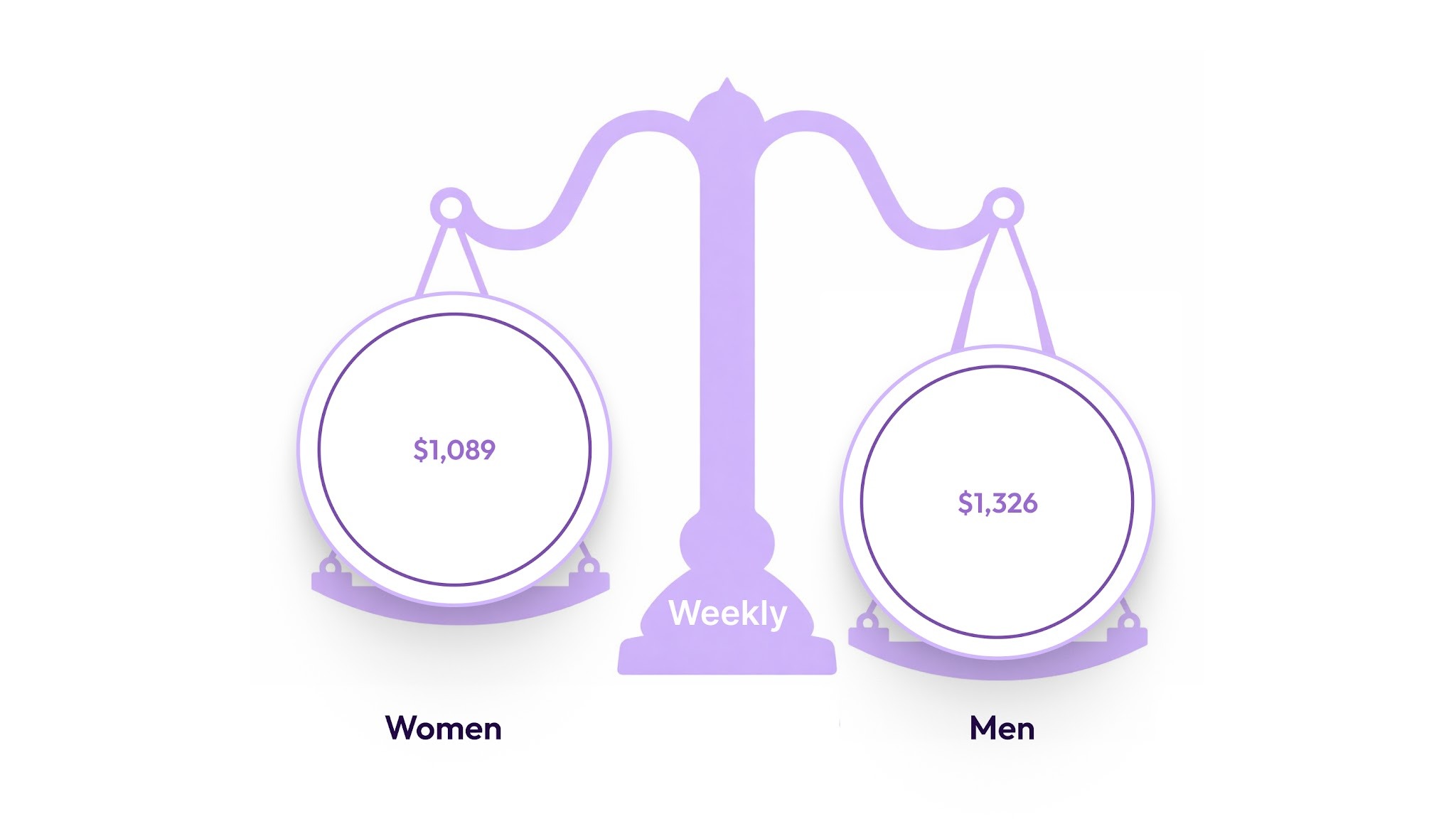
- Pay equity is now a compliance and business imperative. With expanding pay transparency laws and persistent gender and racial wage gaps, compensation decisions must be structured, benchmark-backed, and defensible.
- Data-driven compensation tools prevent silent pay gaps. Modern platforms run ongoing equity analysis, apply geo-adjusted salary bands, and create audit trails that reduce legal risk and trust erosion.
- Not all tools solve the same problem. Some specialize in benchmarking (PayScale, Salary.com), others in statistical equity diagnostics (Syndio), while platforms like CandorIQ unify compensation cycles, pay bands, and headcount planning.
- The right platform depends on company size and complexity. Enterprise tools like Workday and Beqom serve global orgs, while growth-stage companies benefit from systems designed for agility and cross-functional HR–Finance alignment.
- Fair pay requires structure, not intention. Organizations that combine reliable data, clear workflows, and integrated workforce planning close gaps earlier, retain talent longer, and make compensation a strategic advantage.
Why Fair & Data-Driven Pay Equity is Important in 2026
Pay equity has moved from "nice to have" to a board-level priority. Between new legislation, workforce expectations, and the business case for equitable pay, organizations that aren't actively managing this are taking on unnecessary risk.
Here's why it matters more than ever right now:
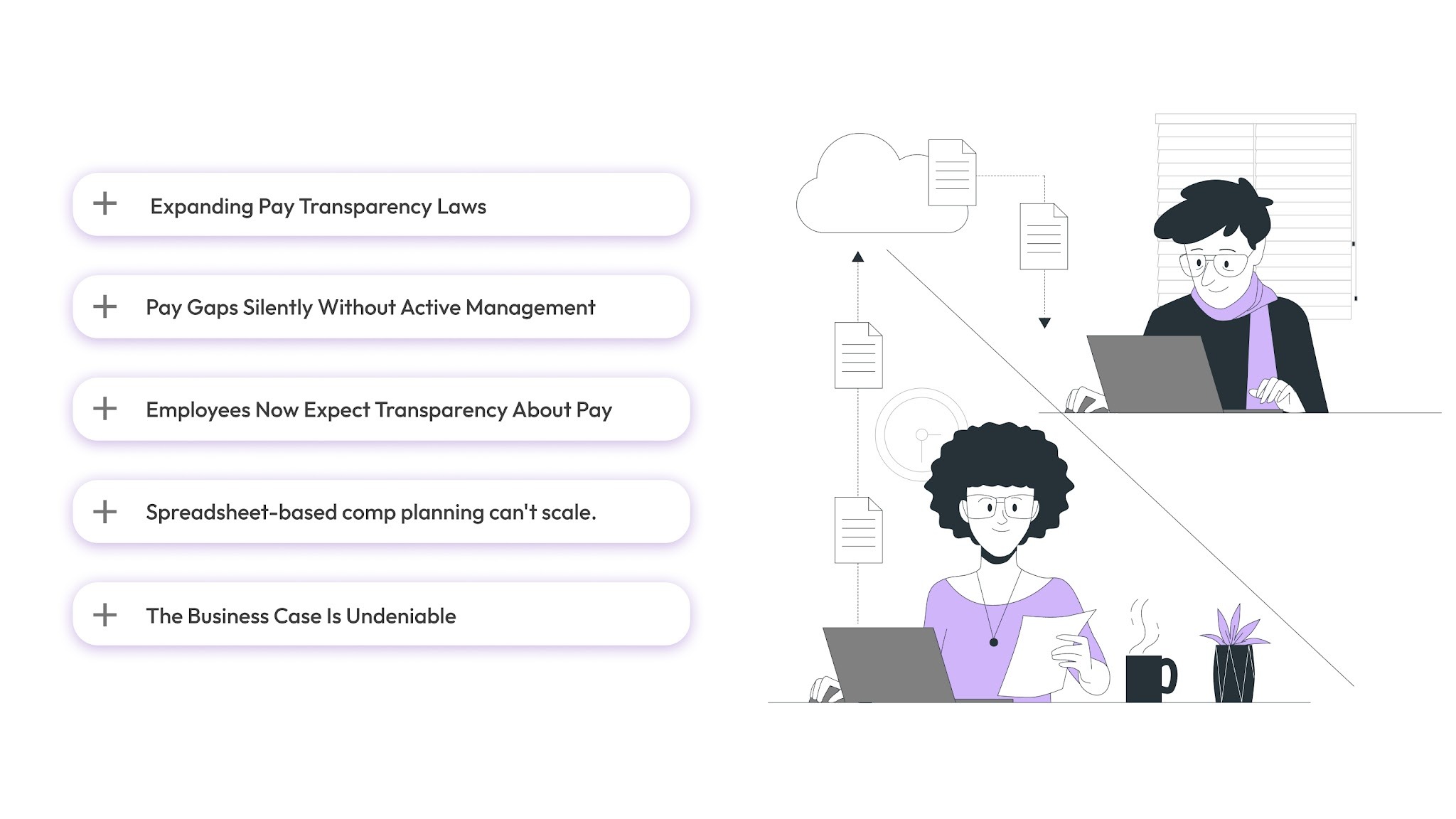
1. Pay Transparency Laws Are Expanding Fast
States like California, Colorado, New York, and Washington now require employers to post salary ranges in job listings. The EU Pay Transparency Directive is pushing similar mandates across Europe.
When employees or regulators ask why someone earns what they earn, your answer needs to be grounded in benchmarks, bands, and a defensible process. Ad-hoc pay decisions made without structure simply won't hold up under scrutiny.
2. Pay Gaps Compound Silently Without Active Management
Pay equity is an ongoing problem that builds over time. McKinsey's research consistently shows that diverse, equitable organizations outperform peers, but that outcome requires active structural intervention, not passive intent.
Without a pay equity software tool running regular gap analysis, you're essentially driving blind. By the time a disparity shows up in an exit interview or a lawsuit, it's already cost you, in talent, in trust, and in legal fees.
3. Employees Now Expect Transparency About Pay
Employees now share compensation data on Glassdoor, LinkedIn, and in Slack channels. Pay and career growth are the top two reasons employees leave. When people don't understand how their pay is determined, they assume the worst.
Pay transparency software helps you communicate compensation structures clearly, not just to comply with laws, but to build the kind of trust that retains people. When employees can see where they fall in a band, how they can grow, and that the system is consistent, that's a material retention advantage.
4. Spreadsheet-Based Comp Planning Doesn't Scale
When you're managing compensation cycles across multiple teams, geographies, and currencies, version control breaks down, errors multiply, and collaboration grinds to a halt.
Modern compensation planning tools replace that chaos with structured workflows, real-time collaboration, and audit trails. They don't just save time, they prevent the kinds of mistakes that create pay inequities in the first place.
5. The Business Case Is Undeniable
Organizations with equitable pay practices see stronger engagement, lower turnover, and better performance outcomes.
When you invest in equal pay analysis software and build proactive pay equity processes, you're directly reducing turnover costs and increasing your employer brand appeal, especially in competitive talent markets.
Data-driven pay equity is now a strategic function. And having the right tools is what separates reactive organizations from those that lead. Let's look at the 10 best data-driven compensation tools that can help you get there.
10 Top Compensation Tools For Fair & Data-Driven Pay Equity in 2026
Not all compensation software is built the same. Some specialize in benchmarking, others in pay equity analytics, and others in full-cycle compensation planning.
Below are 10 tools that stand out for their ability to support fair, data-driven pay decisions, starting with the one that brings all of these dimensions together.
1. CandorIQ
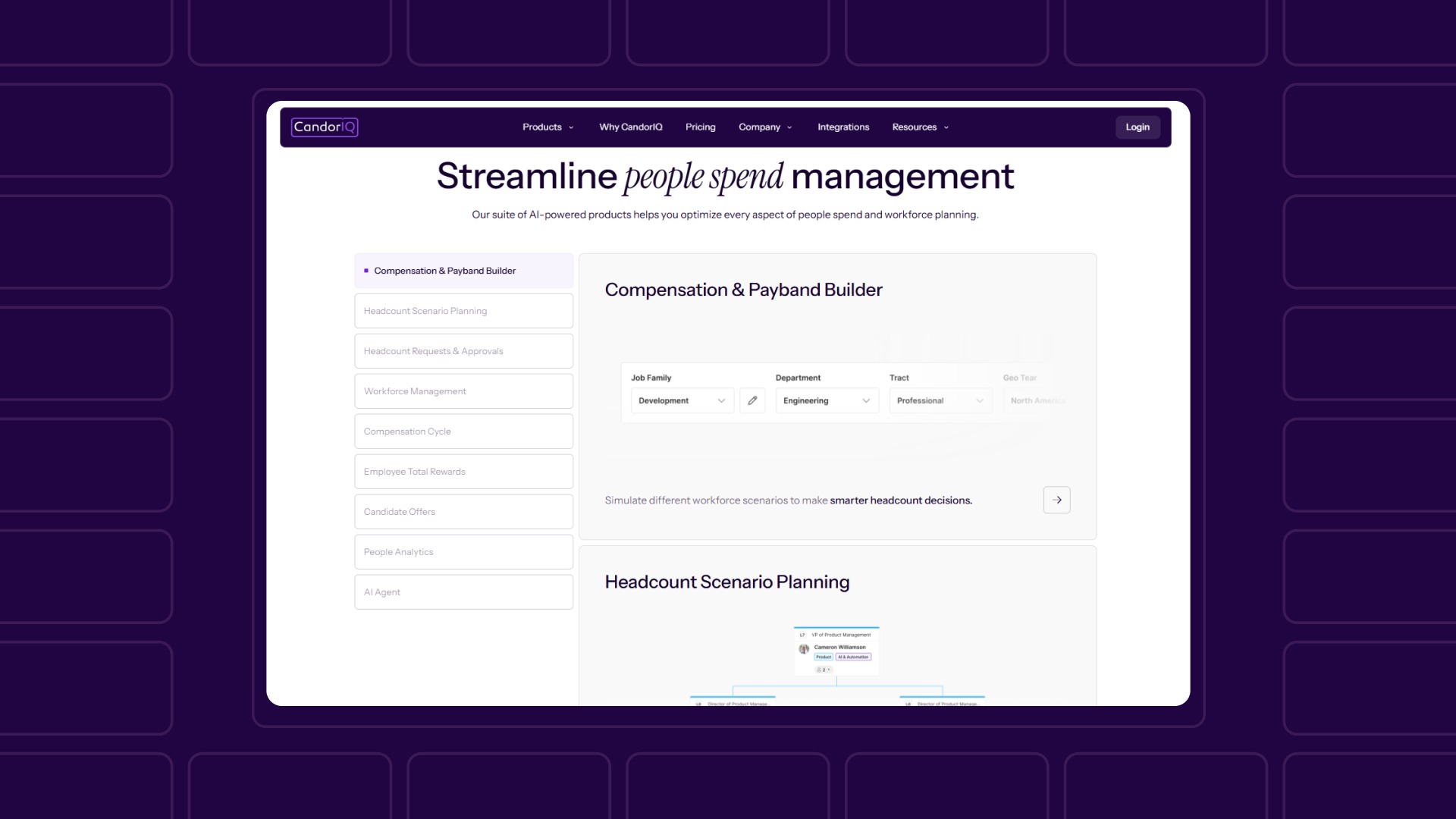
CandorIQ is a unified compensation and headcount planning platform. Its strength lies in connecting compensation strategy, pay band management, and workforce planning in one place, making it especially well-suited for organizations that need their comp decisions to stay in sync with real budget realities.
Standout Features:
- Pay band builder with location-based salary adjustments and version history for auditability. It prevents spreadsheet drift, inconsistent geo adjustments, and undocumented comp changes. So that your HR and Finance get defensible salary architecture and tighter control over pay equity.
- Automated merit and bonus review cycles with built-in budget tracking and approval logic. It replaces fragmented spreadsheets and last-minute finance reconciliations. HR runs faster cycles, Finance prevents overspend early, and leadership sees a clear raise rationale.
- An AI agent that answers natural language questions about gaps, benchmarks, and workforce forecasts. It removes hours of manual spreadsheet analysis. People teams shift from reactive reporting to proactive strategic planning.
- Headcount scenario planning that shows the financial impact of hiring decisions in real time. It stops workforce planning from drifting away from runway and compensation realities. HR and Finance can compare trade-offs before committing to new roles.
- Candidate offer workflows with total comp visualization, including salary, equity, and bonus in one view. It eliminates disconnected approvals and unclear equity modeling. Recruiting moves faster, candidates understand total value, and budgets stay aligned.
- Custom dashboards tracking headcount, attrition, promotions, and compensation spend against plan. It eliminates HR–Finance reporting misalignment. Executives get real-time, board-ready workforce visibility.
- Slack and email integrations to keep comp cycles moving without chasing approvals.
Pros and Tradeoffs
Best For: HR and finance teams at growth-stage SaaS, fintech, or tech companies (50–5,000 employees) that need a single system to manage compensation cycles, pay equity, and headcount planning without stitching together multiple tools.
2. Compport
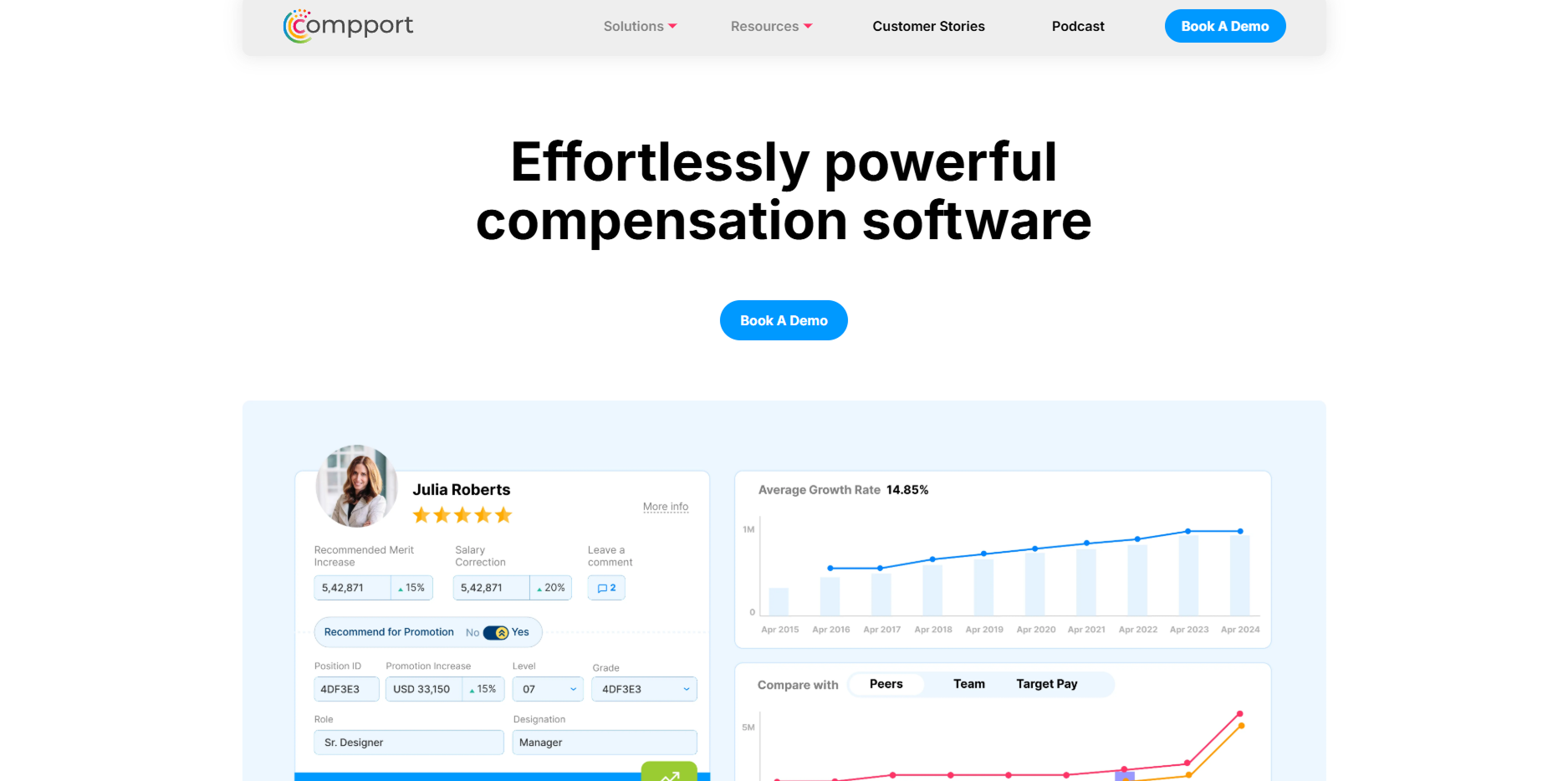
Compport’s pay equity module uses real-time anomaly detection to surface unexplained pay gaps across departments and demographics, making it one of the more analytically rigorous tools in this category.
Standout Features:
- End-to-end compensation planning: merit, bonus, LTI, and sales incentives
- Real-time pay equity analytics with anomaly detection across gender, ethnicity, and role
- Total rewards statements and candidate offer module
- HR analytics dashboards with customizable reporting
Pros and Tradeoffs
Best For: Enterprise HR teams at organizations with 10,000+ employees that need end-to-end compensation management with deep pay equity analytics.
3. Salary.com

Salary.com combines a massive database of compensation data with CompAnalyst, its planning platform, to help HR teams make market-aligned pay decisions and build equitable compensation structures.
Standout Features
- Industry-leading compensation survey database with 8,000+ job titles
- Pay equity analysis with controlled and uncontrolled gap reporting
- Cost of living and geographic pay adjustment tools
- CompAnalyst platform for comp cycle management and scenario modeling
- HRIS and payroll integration capabilities
Pros & Tradeoffs
Best For: Compensation analysts in mid-to-large U.S. enterprises (500+ employees) who prioritize defensible market benchmarking and structured salary architecture.
4. Pave
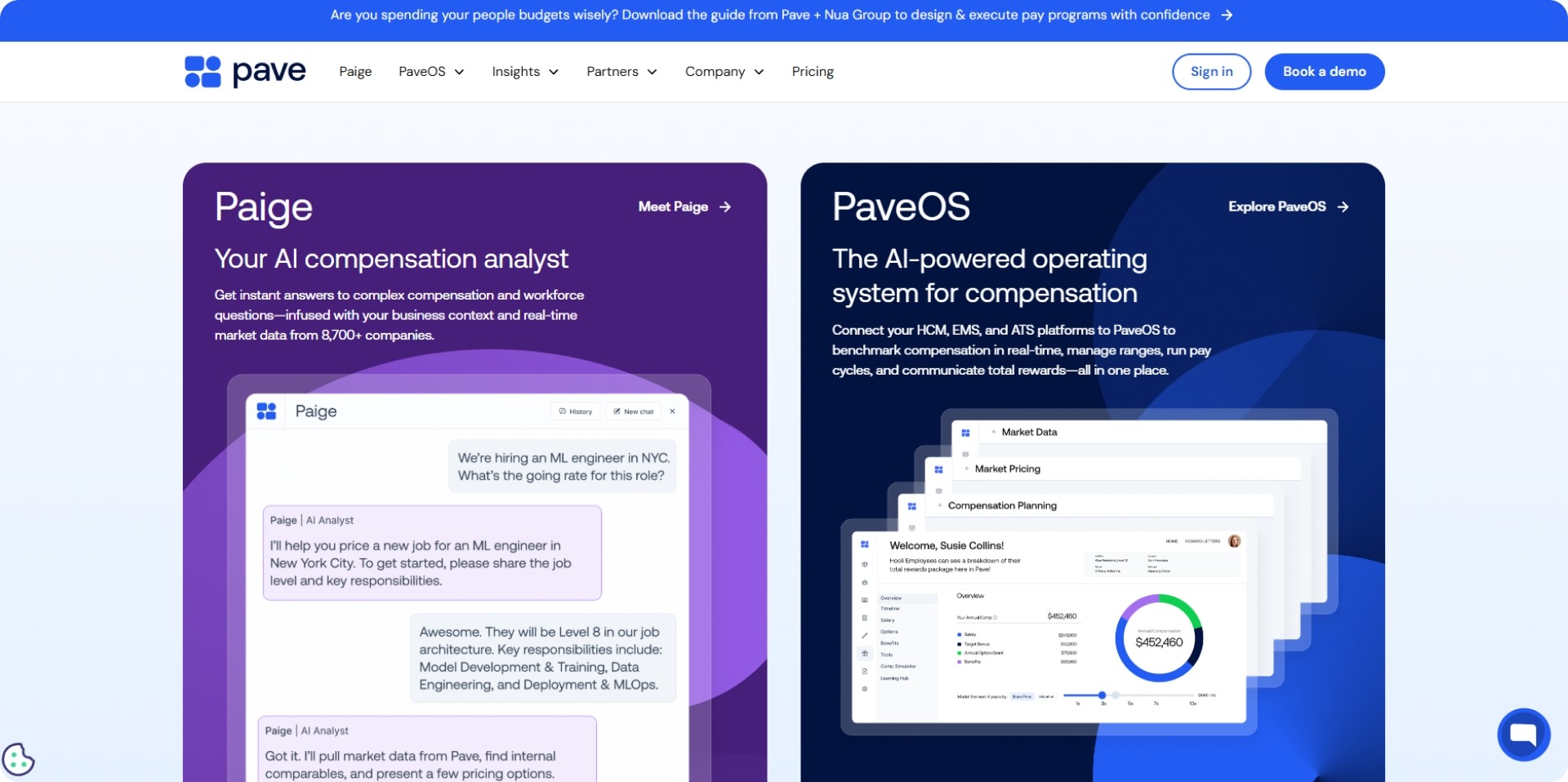
Pave distinguishes itself with real-time market data sourced directly from integrated HRIS and cap table systems. For pay equity, Pave's integration-first approach means your benchmarks are always tied to live data, reducing the lag that typically makes compensation decisions feel disconnected from reality.
Standout Features:
- Real-time benchmarking for cash and equity compensation
- Compensation band management with manager-facing visibility tools
- Pay equity analysis across demographics
- Employee-facing total rewards portal
- Native HRIS, ATS, and cap table integrations
Pros & Tradeoffs
Best For: VC-backed or equity-heavy tech companies that need real-time benchmarking for both cash and equity, with strong manager-facing tools.
5. Lattice
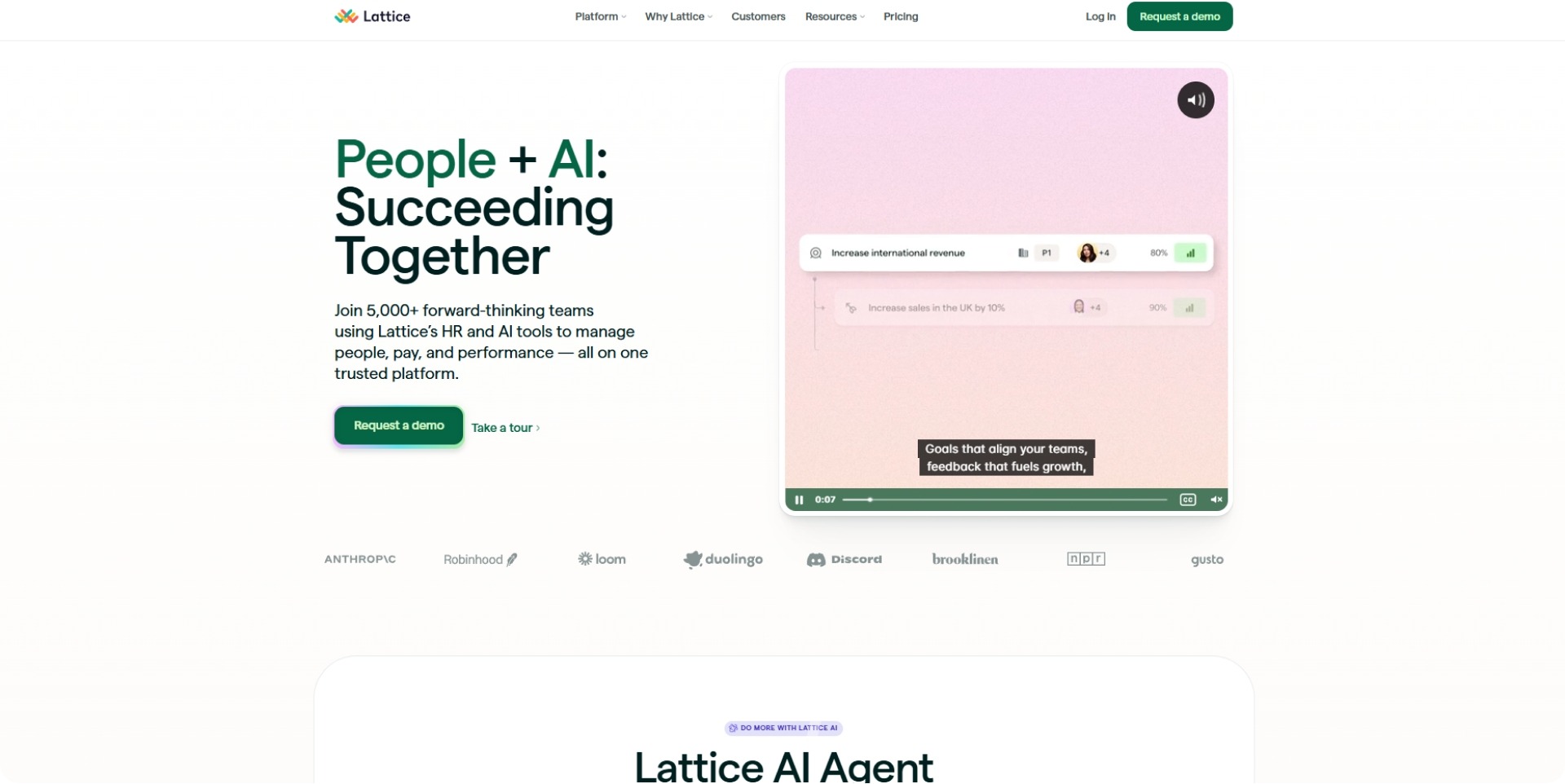
Lattice is best known as a performance management platform, but its compensation module makes it a compelling option for organizations that want to connect pay directly to performance data.
For teams already using Lattice for reviews and goals, adding comp creates a closed loop: performance drives compensation decisions, and those decisions are logged alongside the performance data that justifies them.
Standout Features:
- Compensation cycle management integrated with performance review data
- Pay band management and compa-ratio tracking
- Manager tools for merit recommendations within budget guardrails
- Salary benchmarking via integrations
- Equity and D&I analytics
Pros and Tradeoffs
Best For: Growth-stage companies already using Lattice for performance management that want to close the loop between performance data and compensation decisions.
6. Workday
Workday offers a compensation module within its broader HCM ecosystem. For enterprises managing complex global workforces, its unified HR, payroll, and financial data foundation allows for large-scale compensation modeling and governance.
Standout Features
- Full compensation lifecycle management within the Workday HCM suite
- Advanced pay equity analytics with statistical modeling
- Budget management and compensation modeling for large orgs
- Global compensation support across currencies and regulatory frameworks
- Integration with payroll and financial systems
Pros & Tradeoffs
Best For: Large U.S.-based or multinational enterprises (2,000+ employees) already operating on Workday HCM and requiring integrated global compensation governance.
7. Beqom
Beqom is designed for organizations where the connection between performance and pay is complex. Such as variable comp, long-term incentives, and sales commissions, alongside base salary equity. It's built to handle daily compensation decision-making at scale.
Standout Features:
- Holistic compensation management: base, variable, LTI, and benefits
- Pay equity monitoring integrated into daily comp workflows
- AI-powered recommendations for compensation decisions
- Compliance reporting for global pay transparency requirements
- Strong integration with major HRIS and ERP systems
Pros and Tradeoffs
Best For: Large or global enterprises with complex multi-component compensation structures that need pay equity embedded in daily decision-making workflows.
8. HRSoft
HRSoft has carved out a strong niche in industries with complex workforce structures, particularly healthcare, retail, and manufacturing. It handles merit, bonus, LTI, and milestone bonuses with strong configurability for non-standard comp scenarios.
Standout Features:
- Total compensation management with complex proration and incentive logic
- Pay-for-performance tools with OKR and goal-setting integrations
- LTI management with award lifecycle tracking
- HRSoft Intelligence: AI smart modeling and data cleansing
- International capabilities with multi-currency support
Pros and Cons
Best For: HR teams in healthcare, retail, or manufacturing managing complex, multi-type compensation programs with variable proration and incentive structures.
9. PayScale Insight & CompAnalyst

PayScale has two primary platforms. Insight for SMBs and CompAnalyst for enterprises give organizations access to one of the largest compensation datasets in the market, making it a strong starting point for pay equity analysis grounded in reliable market data.
Standout Features:
- Large proprietary salary database with 54M+ salary profiles
- Pay equity reporting with controlled gap analysis (adjusted vs. unadjusted gaps)
- Pay transparency tools and communication workflows
- Compensation structure design and salary range modeling
- Strong compliance reporting for pay transparency laws
Pros and Cons
Best For: Organizations of all sizes that need access to a large, reliable compensation database as the foundation for pay equity analysis and pay transparency compliance.
10. Syndio
Syndio is built specifically to conduct rigorous statistical pay equity analysis and help organizations identify, explain, and remediate pay gaps at the root cause level. It's not a compensation planning tool; it's an equity diagnostic and analytics platform.
Syndio provides the statistical depth that general compensation platforms can't match.
Standout Features:
- Multi-demographic pay equity analysis (gender, race, ethnicity, intersectionality)
- Statistical regression modeling to isolate unexplained pay gaps
- Root cause analysis to trace gaps to specific decision points (hiring, promotion, merit)
- Global pay equity compliance reporting (EU directive, UK, US state laws)
- Ongoing monitoring rather than point-in-time snapshots
Pros and Cons
Best For: Organizations with 500+ employees that face regulatory scrutiny, are preparing for pay equity audits, or need a legally defensible statistical gap analysis across multiple demographic dimensions.
Also Read: Data-Driven HR Strategies for Effective Payroll Management
Now that you know what's available, the harder question is: which one is right for your organization? Here's how to think through that decision.
7 Tips to Choose Your Top Compensation Tools For Fair & Data-Driven Pay Equity
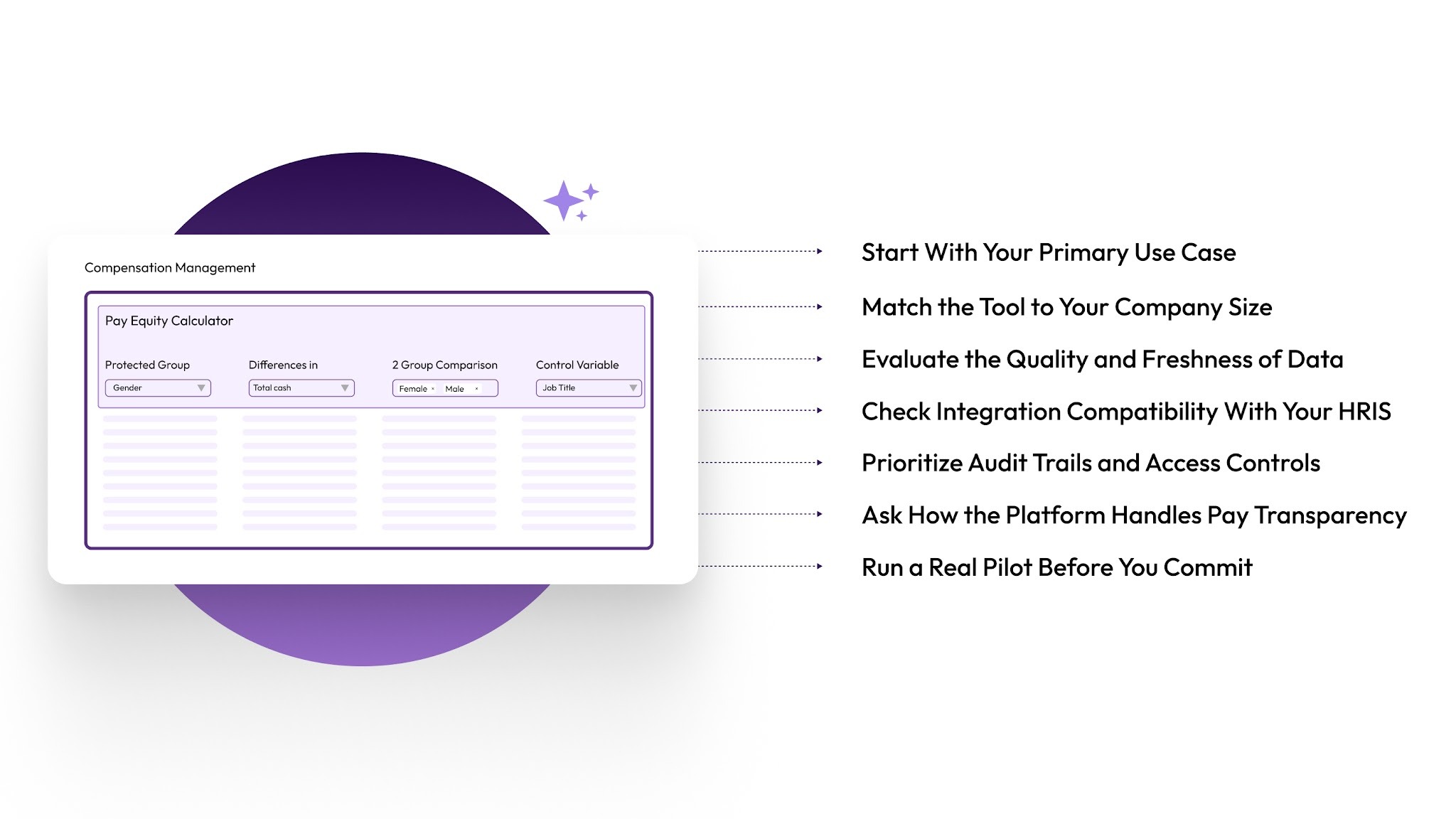
The market is crowded, and every tool will promise to solve your pay equity challenges. Here's a practical framework to cut through the noise and find the right fit for your org:
1. Start With Your Primary Use Case
Are you looking to run better compensation cycles? Do a deeper pay gap analysis? Build defensible salary bands? Or replace spreadsheets entirely? The answer changes everything. Starting with a clear primary job-to-be-done prevents you from buying a platform that's technically capable but not optimized for your actual problem.
2. Match the Tool to Your Company Size
Most compensation tools are built with a specific size range in mind. For example, CandorIQ is optimized for growth-stage and mid-market organizations with a globally distributed team. Using an enterprise tool at a 200-person company is operationally overwhelming.
3. Evaluate the Quality and Freshness of Benchmarking Data
Not all compensation data is equal. Look at how many data points the platform uses, how frequently it updates, and whether it covers your specific industry and geographies. If your workforce is spread across multiple cities or countries, you need geo-adjusted benchmarks.
4. Check Integration Compatibility With Your HRIS
Before shortlisting vendors, confirm they have native or API integrations with the systems you already use, especially your HRIS, ATS, and payroll systems. Data silos between these systems are one of the primary causes of compensation inconsistencies in the first place.
5. Prioritize Audit Trails and Access Controls
Pay equity analysis creates sensitive data. You need a platform that logs every decision, maintains version history, and lets you control who sees what. Features like role-based access, compensation history tracking, and approval audit trails are essential for legal defensibility and internal governance.
6. Ask How the Platform Handles Pay Transparency
If you operate in states or countries with pay transparency requirements, your tool needs to support that workflow. Some tools (like PayScale and Syndio) are built with compliance reporting in mind. Others handle employee-facing total rewards statements well. Know which compliance needs are non-negotiable before you evaluate.
7. Run a Real Pilot Before You Commit
Push for a pilot with real data, ideally a subset of your actual workforce, and have your actual HR or comp team do the work. That's where you'll discover whether the workflows match how your team actually operates, whether the benchmarks are relevant to your roles, and whether the tool saves time or creates more of it.
When you find the right combination of data quality, workflow fit, and integration depth, the investment pays off quickly, both in the time your team gets back and in the comp equity outcomes that follow.
Conclusion
Pay equity doesn't fix itself. Without the right structure, data, and tools, gaps compound quietly over time. The good news is that the compensation management software market in 2026 is better than it's ever been.
Whether you need rigorous equal pay analysis, reliable salary benchmarking tools, or a single platform that connects comp planning to headcount and budget in real time, there's a solution built for your organization.
If you're looking for a place to start, CandorIQ brings together compensation cycle management, pay band design, headcount planning, and AI-powered decision support in one platform. It is purpose-built for the HR and finance teams who are done patching together spreadsheets and disconnected tools.
Ready to see it in action? Book a demo with CandorIQ and see how your compensation and headcount operations can work together.
.png)
FAQs
1. What is the difference between pay equity and pay equality?
Pay equality means everyone earns the same wage for the same job regardless of who they are. Pay equity goes further; it means pay is fair when you account for differences in role, experience, performance, and location.
2. How often should a company run a pay equity analysis?
Best practice is to run pay equity analysis at least annually, but ideally continuously or after major comp events like merit cycles, restructures, or significant hiring surges. SHRM recommends building equity checkpoints into compensation cycle workflows rather than treating them as a one-off audit.
3. What is a controlled vs. uncontrolled pay gap?
An uncontrolled (raw) pay gap compares average salaries across groups without adjusting for factors like role, experience, or seniority. A controlled pay gap adjusts for those factors and isolates the unexplained portion of the gap, the part that can't be justified by legitimate job-related variables.
4. Can small companies benefit from pay equity software, or is it only for large enterprises?
Smaller organizations can absolutely benefit. In fact, catching equity issues early is far less expensive than remediation at scale. Tools like CandorIQ are built for 50–5,000 employee organizations, and PayScale Insight targets SMBs specifically. The key is starting with a platform that matches your operational complexity rather than over-investing in enterprise tools you won't fully utilize.
5. Is pay equity software the same as payroll software?
No, they serve different functions. Payroll software processes and records pay transactions. Pay equity software (and compensation management platforms more broadly) analyzes whether pay decisions are fair, helps build compensation structures, and supports planning workflows. They often integrate, but they're solving different problems.
Ready to modernize your workforce and compensation strategy?
See how CandorIQ brings workforce planning and compensation together with AI.