

Executive Compensation Benchmarking Best Practices for Boards
Explore Executive Compensation Benchmarking Best Practices for Boards of Directors to create fair, competitive, and transparent executive pay decisions.

Setting executive pay is one of the most sensitive and high-impact decisions a board makes. A small change in salary, equity, or incentive structure can influence retention, investor confidence, and long-term stability. Yet many boards still struggle with getting everyone aligned on what “fair and competitive” really means.
It’s similar to building on an uneven foundation. If the base isn’t steady, every decision that follows feels uncertain. Have you ever seen a boardroom debate where everyone had a different idea of what a leader should earn? That tension usually comes from guesswork, outdated benchmarks, or missing structure.
This is where Executive Compensation Benchmarking Best Practices for Boards of Directors become essential. In this blog, you’ll explore what benchmarking includes, the challenges boards often face, and the exact steps needed to build a structured, transparent process that works for organizations of any size. Let’s begin.
Key Features
- Executive Compensation Benchmarking Best Practices for Boards of Directors ensure fair, competitive, and well-structured pay decisions.
- Boards reduce risk and confusion when they use updated market data, geo-adjusted ranges, and total compensation reviews.
- AI improves benchmarking accuracy by offering real-time comparisons, scenario modeling, and equity forecasting.
- Structured approval workflows help HR, Finance, and compensation committees stay aligned throughout executive pay reviews.
- CandorIQ gives boards a clear, unified platform to evaluate compensation, compare scenarios, and approve executive packages confidently.
What Is Executive Compensation Benchmarking?
Executive compensation benchmarking helps boards compare an executive’s pay against trusted market data to confirm fairness and competitiveness. It guides decisions around salary, equity, bonuses, and long-term incentives without relying on assumptions. Boards use it to reduce risk, keep leaders engaged, and support responsible governance.
To help you understand the core elements clearly, here’s a breakdown of what boards typically evaluate during Executive Compensation Benchmarking Best Practices for Boards of Directors.
What benchmarking includes (salary, equity, bonuses, incentives)
Here’s what is usually reviewed while completing Executive Compensation Benchmarking Best Practices for Boards of Directors:
- Base salary ranges: Shows market-aligned fixed pay for similar executive roles.
- Annual bonuses: Clarifies performance-based rewards tied to company and individual goals.
- Equity compensation: Highlights ownership value through stock options or RSUs for long-term alignment.
- Incentive packages: Cover retention tools or milestone-based rewards that support long-term performance.
Why executive benchmarking differs from standard roles
Boards review executive roles differently, and here’s what typically sets them apart:
- Larger impact: Executive decisions influence entire business outcomes, increasing compensation risk.
- Longer time horizons: Pay is tied to multi-year goals, not just short-term tasks.
- Complex pay mix: Executive packages combine salary, equity, and incentives with higher variation.
- Higher scrutiny: Investors, auditors, and regulators expect detailed justification for executive pay.
Before reviewing the common challenges boards face, it helps to understand what executive compensation benchmarking truly involves.

Common Challenges Boards Face in Executive Compensation
Boards often face obstacles when evaluating executive pay because the information is complex and the stakes are high. Even one outdated dataset or a missing financial detail can affect decision quality. These issues make it harder to follow strong Executive Compensation Benchmarking Best Practices for Boards of Directors.
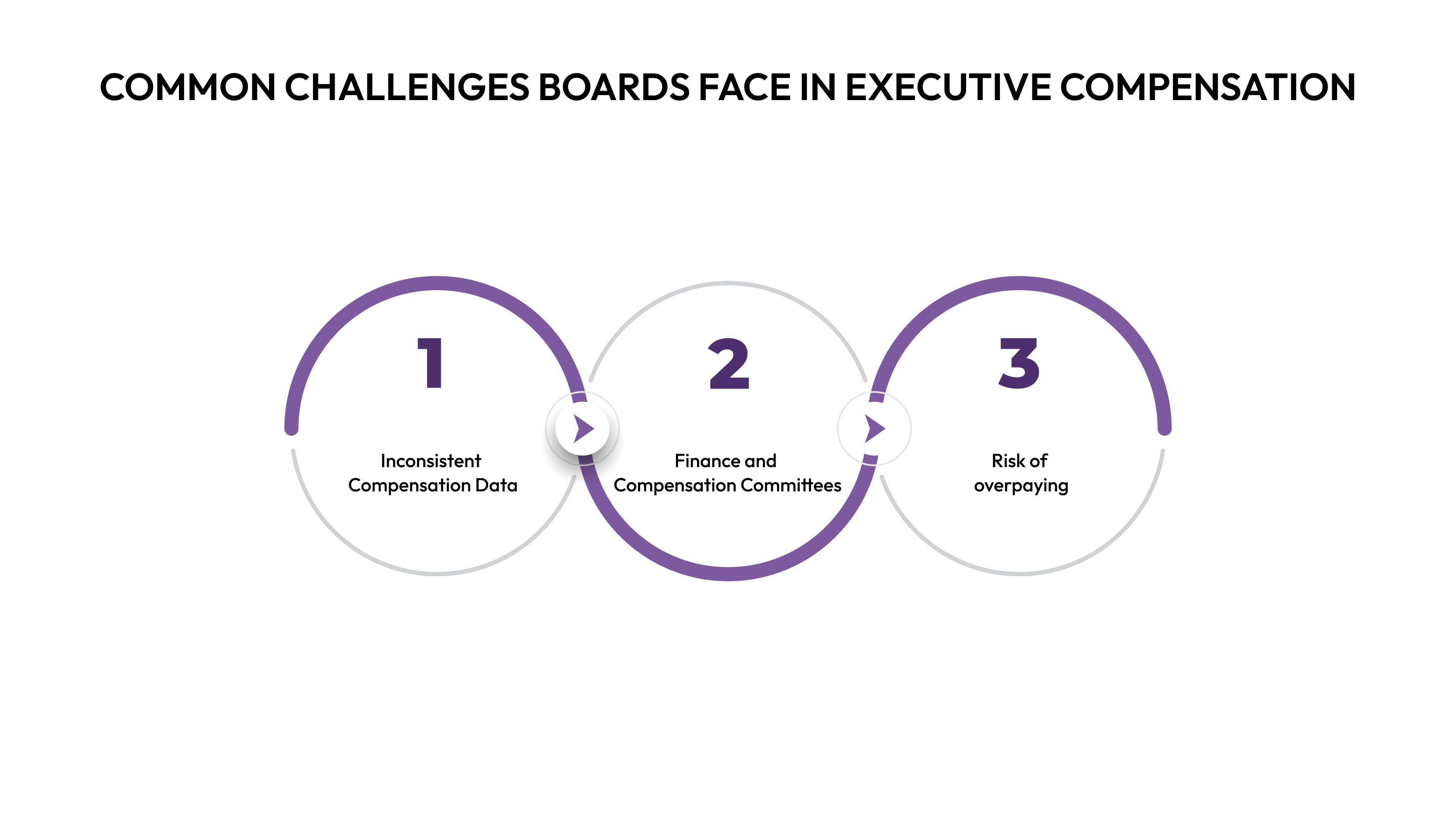
To help you see both the challenges and the most practical ways to solve them, here are the areas boards struggle with most and how to address them.
Outdated or inconsistent compensation data
- Old market reports: Creates inaccurate comparisons when data doesn’t reflect current hiring trends.
- Solution: Use refreshed datasets reviewed at least quarterly.
- Inconsistent sources: Leads to unreliable results when datasets vary in structure or coverage.
- Solution: Standardize all compensation inputs before analysis.
- Limited benchmarks: Restricts visibility when niche roles lack enough data points.
- Solution: Add internal performance and retention signals to support decisions.
Misalignment between HR, Finance, and compensation committees
- Different assumptions: Causes confusion when teams rely on separate worksheets.
- Solution: Align on a shared compensation model before discussions.
- Unclear workflows: Slows approvals when roles and responsibilities are not defined.
- Solution: Create a documented decision path for all executive pay changes.
- Missing context: Reduces accuracy when one team lacks visibility into budgets or market changes.
- Solution: Hold joint review sessions for budgets and pay strategy.
Risk of overpaying or underpaying executives
- Inflated offers: Increases long-term cost commitments when decisions are based on guesswork.
- Solution: Validate every offer against at least two market references.
- Below-market packages: Hurts retention when leadership compensation feels uncompetitive.
- Solution: Compare total rewards instead of only base salary.
- Lack of structure: Raises governance concerns when decisions seem subjective or inconsistent.
- Solution: Use documented pay bands and approval rules for all roles.
Also Read: From EOY Wins to 2026 Momentum: Insights from Top People Leaders
With these challenges in mind, the next step is to apply the best practices that help boards create fair and consistent executive compensation decisions.
Best Practices for Executive Compensation Benchmarking
Strong executive pay decisions come from a clear process, consistent data, and collaboration across teams. Many boards find that a structured approach reduces confusion and supports better judgment. These steps help you maintain strong Executive Compensation Benchmarking Best Practices for Boards of Directors during every review cycle.
To make these best practices simple to follow, here are the most important actions boards should take when evaluating senior leadership compensation.
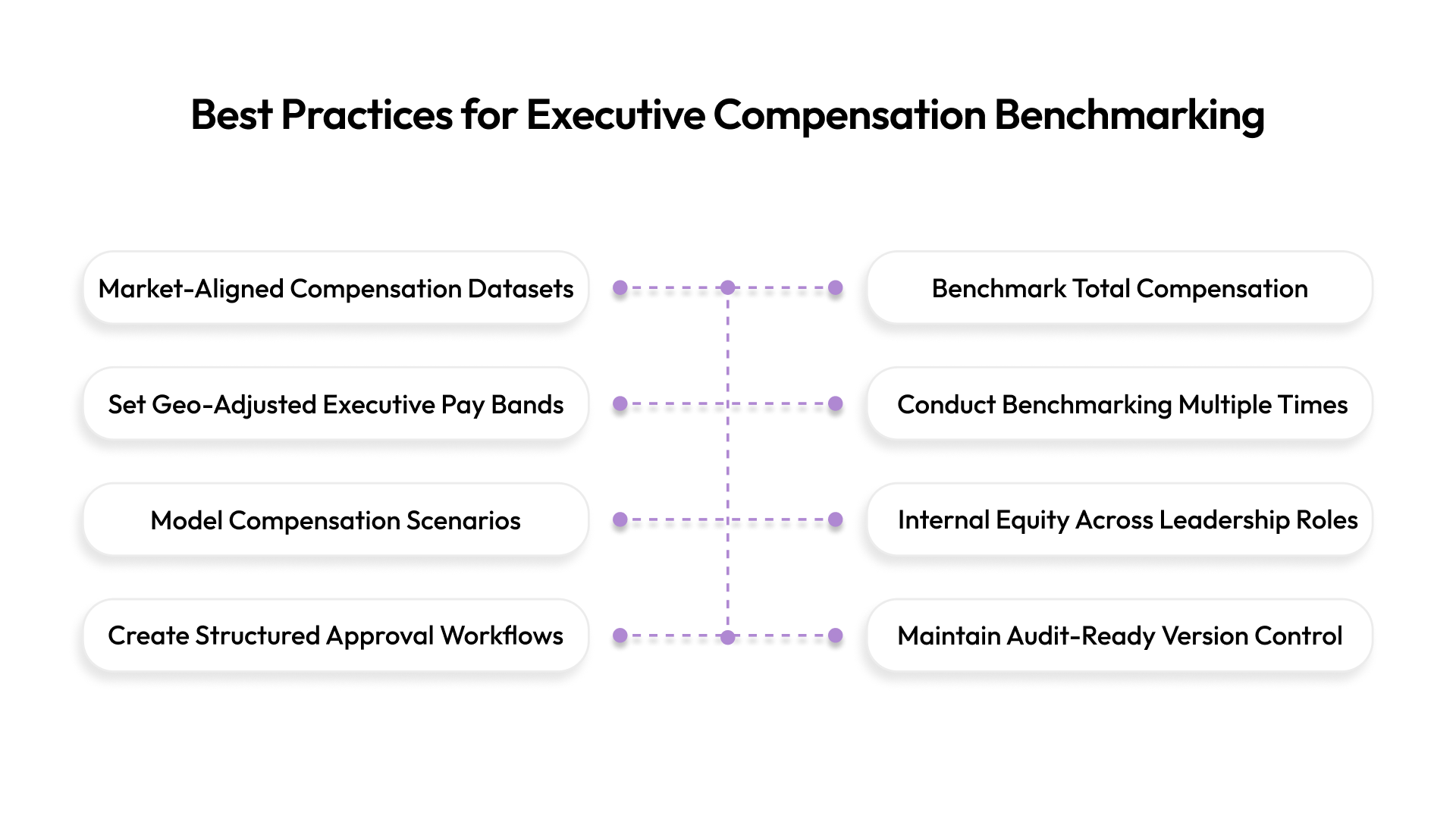
1. Use reliable, market-aligned compensation datasets
Boards often depend on accurate data to decide whether an executive offer makes sense. If the information is outdated or shallow, it can push decisions in the wrong direction. For example, a company may think a CFO role pays far less simply because the dataset used was from a slower hiring year. These gaps can weaken Executive Compensation Benchmarking Best Practices for Boards of Directors.
Here is a simple breakdown to help boards rely on stronger and more consistent compensation data. Teams can review these points to understand what matters most when selecting market datasets for executive benchmarking.
- Verified salary inputs: Uses compensation data reviewed by analysts, so boards avoid numbers based on guesses or surveys.
- Role-matched benchmarks: Offers insights built around similar executive titles, not broad job categories.
- Updated datasets: Refreshes figures every few months to match changing hiring patterns for leadership positions.
- Industry relevance: Aligns compensation ranges with similar business models for stronger comparisons.
- Sample size clarity: Shows how many companies contributed data, helping boards judge reliability.
- Example: A board comparing CEO equity grants with a dataset of only ten companies may reach weaker conclusions than one using 200 companies.
2. Benchmark total compensation, not just salary
Many executive packages look simple at first glance, but their real value often comes from incentives, bonuses, and equity. A board may think an offer is competitive until it compares the full package across similar roles. This is why reviewing total compensation supports stronger Executive Compensation Benchmarking Best Practices for Boards of Directors.
To make this comparison easier, here are the core elements boards should look at when reviewing complete executive packages. These points help you evaluate every part of an offer so no key component is overlooked.
- Salary ranges: Shows foundational pay that anchors the total package.
- Short-term incentives: Reflects bonus potential tied to goals or performance milestones.
- Long-term equity: Represents future value that influences retention and commitment.
- Benefits and perks: Includes extra components like health coverage or executive allowances.
- Retention triggers: Highlights vesting rules or bonus structures that support longer tenure.
- Example: A COO earning a lower salary may still have a higher total package due to strong equity value.
3. Set geo-adjusted executive pay bands
Executive compensation often varies based on where leaders live or operate. A pay package that fits one region may be too low or too high for another. For example, a CTO in a high-cost metro usually receives a different range than one in a smaller city. These adjustments help boards follow stronger Executive Compensation Benchmarking Best Practices for Boards of Directors.
To simplify this process, here are the core elements to consider when setting geo-aligned executive ranges. Use these points to build fair and consistent geographic pay structures for senior roles.
- Location multipliers: Adjusts pay ranges to match cost-of-labor differences across regions.
- Market comparison zones: Groups similar cities to create consistent executive pay categories.
- Role sensitivity: Reviews how each executive position is impacted by location changes.
- Living cost signals: Helps boards understand how real expenses influence expectations.
- Retention stability: Reduces dissatisfaction by offering ranges aligned with local markets.
- Example: A CFO based in New York may receive a higher range than a CFO in Phoenix due to market pay gaps.
4. Conduct benchmarking multiple times per year
Executive compensation shifts quickly when hiring trends change, especially in fast-growing industries. A package that looked competitive six months ago may fall behind new market expectations today. When boards review pay only once a year, they risk missing key signals that affect retention and hiring. Frequent reviews help maintain strong Executive Compensation Benchmarking Best Practices for Boards of Directors.
To help boards stay proactive, here are the key points that make recurring benchmarking more effective. These points guide you in planning consistent review cycles throughout the year.
- Quarterly updates: Captures market shifts before they impact hiring or retention.
- Pre-cycle adjustments: Ensures accuracy before annual reviews and bonus planning.
- Competitive checks: Highlights when leadership packages drift below market averages.
- Budget alignment reviews: Keep pay decisions connected to financial targets.
- Industry pulse checks: Tracks trends that influence executive equity and incentives.
- Example: A board reviewing CTO compensation yearly may overlook a sudden salary spike across similar companies.
5. Model compensation scenarios before approval
Boards often review multiple compensation combinations before finalizing an executive package. Salary shifts, bonus mixes, and equity changes can all impact long-term value. Without clear comparisons, it becomes difficult to understand which option is sustainable. Scenario modeling strengthens Executive Compensation Benchmarking Best Practices for Boards of Directors by giving committees clarity before signing off.
To support more transparent decisions, here are the core elements to include in scenario modeling. These points help you compare different pay structures with clear financial impact.
- Salary vs equity balance: Shows how shifting cash or equity affects future cost.
- Short-term vs long-term incentives: Highlights how reward timing influences retention.
- Dilution impact checks: Reviews how equity offers affect shareholder value.
- Bonus range mapping: Estimates payout possibilities at low, target, and high levels.
- Budget fit comparison: Confirms each scenario meets financial guidelines.
- Example: A board may compare a VP Engineering offer with a higher salary and lower equity against one with balanced cash and stock.
6. Ensure internal equity across leadership roles
Internal equity is a major concern for boards, especially when new executives join with higher expectations than long-serving leaders. Uneven pay can cause friction inside the leadership team and affect performance. Boards that follow strong Executive Compensation Benchmarking Best Practices for Boards of Directors review how each executive package aligns with peers to avoid hidden gaps.
To help boards maintain balance, here are the elements to review when checking internal equity. These points support fair alignment across senior roles without creating unintended pay gaps.
- Role parity checks: Compares similar leadership positions to maintain balanced compensation.
- Tenure impact review: Evaluates how long-serving executives fit within updated ranges.
- Performance tier alignment: Ensures pay differences match contribution levels, not assumptions.
- Responsibility scope mapping: Accounts for variations in team size, budgets, and decision power.
- Retention sensitivity checks: Identify where pay gaps may increase turnover risk.
- Example: A new CRO offering a strong equity plan may require a review of the CMO and CFO packages to keep alignment.
7. Create structured approval workflows
Executive compensation decisions often pass through multiple groups, including HR, Finance, and the compensation committee. When workflows are unclear, delays and misunderstandings appear, especially during hiring or promotion cycles. Structured workflows help boards maintain stronger Executive Compensation Benchmarking Best Practices for Boards of Directors by ensuring decisions move smoothly with full alignment.
To make this process more dependable, here are the key elements every board should include. These points help maintain clarity and consistency throughout all approval steps.
- Defined review stages: Outlines each group involved and their responsibilities in sequence.
- Clear documentation trails: Keeps approvals organized to avoid confusion across teams.
- Pre-approval data checks: Ensures all compensation inputs are accurate before review begins.
- Committee scheduling windows: Prevents delays by setting predictable approval timelines.
- Cross-team communication cues: Helps HR, Finance, and Legal stay aligned throughout the process.
- Example: A board that requires HR analysis first, Finance validation next, and committee signoff last reduces last-minute changes.
8. Maintain audit-ready version control for compliance
Executive compensation packages often go through several revisions, especially when salary, equity, and incentive structures change during negotiation. Without a clean history of updates, boards risk compliance issues, reporting gaps, and confusion about which version was approved.
Strong version control supports Executive Compensation Benchmarking Best Practices for Boards of Directors by preserving accuracy and transparency for audits or regulatory reviews.
To keep compensation records organized and compliant, here are the essentials boards should use. These points ensure every update is tracked clearly and can be retrieved whenever required.
- Centralized document history: Stores all revisions in one place so teams avoid mismatched files.
- Timestamped updates: Records when each change was made to support compliance checks.
- Role-based edit controls: Prevent unauthorized modifications during review cycles.
- Approval-tagged versions: Marks which version each committee approved to eliminate uncertainty.
- Secure audit logs: Creates reliable evidence of how compensation decisions were finalized.
- Example: During an annual audit, a company quickly retrieves all VP-level comp changes from the past year without searching through spreadsheets.
Also Read: From Fire Drills to Forecasts, Webinar with Talent Leader Katie Wagner and Haris Ikram
After understanding these best practices, it becomes easier to see how AI adds speed, clarity, and accuracy to executive compensation benchmarking.
How AI Strengthens Executive Compensation Benchmarking
AI is helping boards review executive pay with greater accuracy, especially when salaries, equity refreshers, and incentive structures shift throughout the year. Instead of relying on static reports, boards can view updated market signals, compare internal ranges, and test different pay packages in seconds.
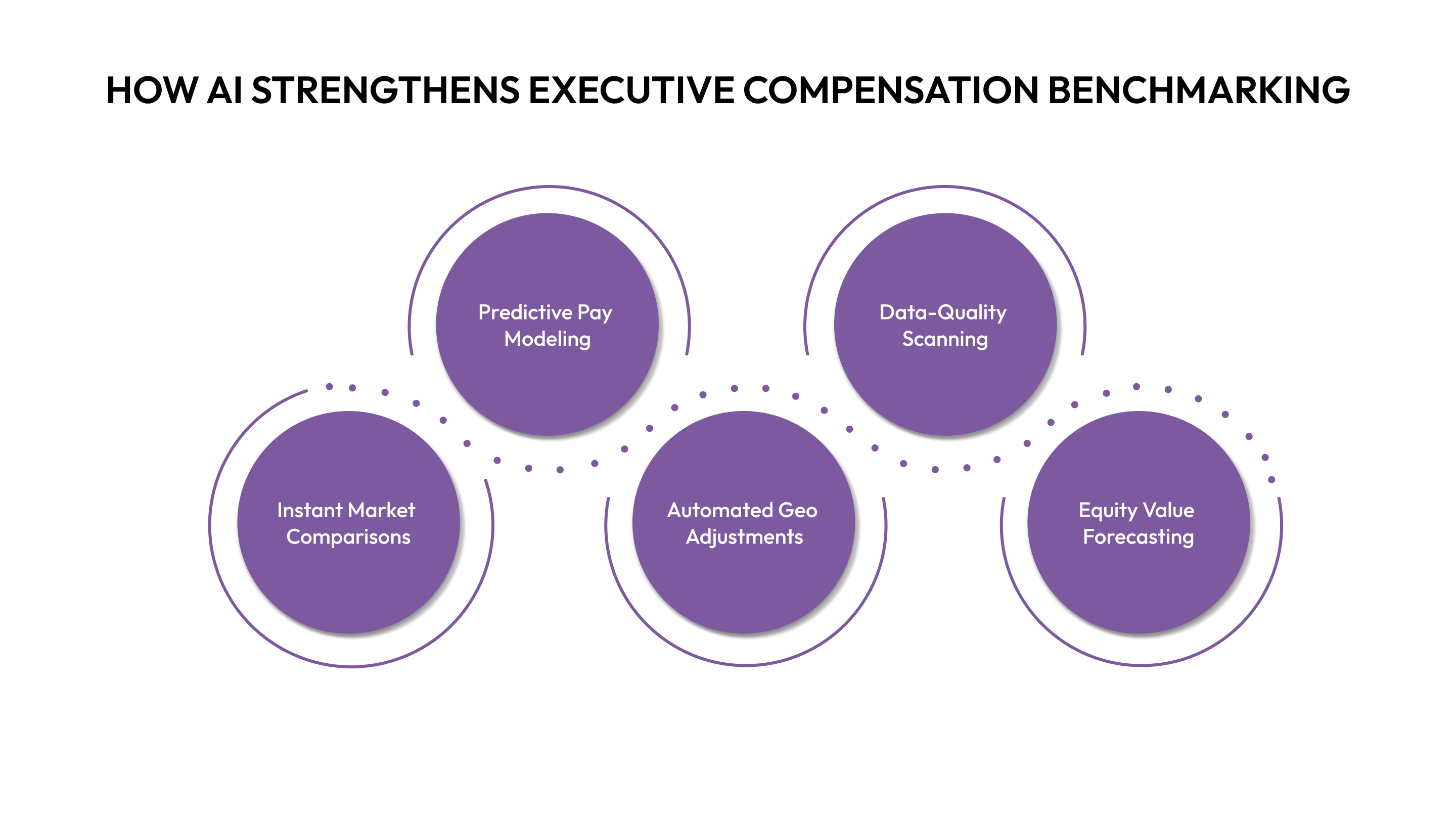
Below are the key ways AI improves speed, clarity, and confidence in board-level compensation reviews.
- Instant market comparisons: Highlights current compensation trends so boards avoid outdated benchmarks.
- Predictive pay modeling: Estimates how salary, bonus, and equity changes may affect retention and competitiveness.
- Automated geo adjustments: Applies accurate location-based pay ranges for executive roles.
- Data-quality scanning: Flags inconsistent inputs that could distort compensation decisions.
- Equity value forecasting: Helps boards understand long-term value outcomes for new grants.
- Example: A board preparing a CFO offer uses AI projections to compare three comp structures and selects the one with the strongest retention outlook.
Once you see how AI improves the process, you can apply a few practical tips to strengthen executive pay decisions before final approval.
Practical Tips for Boards Before Approving Executive Pay
Boards often make final compensation decisions under tight timelines, especially when hiring senior leaders or completing annual reviews. A structured checklist helps avoid rushed choices and ensures each package is fair, competitive, and aligned with company goals.
When boards follow consistent steps, they strengthen Executive Compensation Benchmarking Best Practices for Boards of Directors and reduce the chance of errors or misalignment.
Here are practical actions boards can take to review and approve executive compensation with clarity and confidence.
- Validate market ranges: Confirms that the proposed package aligns with current compensation benchmarks.
- Review total compensation mix: Ensures salary, bonus, and equity reflect the role’s impact and expectations.
- Check internal equity: Compares the offer with other executives to avoid unintentional pay gaps.
- Confirm budget impact: Helps Finance verify long-term salary and equity obligations.
- Assess performance alignment: Reviews whether incentives match measurable outcomes for the role.
- Example: Before approving a CRO package, the board checks equity burn impact and ensures the bonus plan supports revenue goals.
To bring these tips into focus, here is a clear example of how a board might benchmark a VP of Engineering's compensation package.
Example Scenario: Benchmarking a VP of Engineering Package
Boards often face complex decisions when evaluating compensation for technical leadership roles. A VP of Engineering may require a competitive mix of salary, equity, and performance incentives to attract strong talent in a tight market. By applying structured steps, boards can follow Executive Compensation Benchmarking Best Practices for Boards of Directors and ensure the package is both appealing and financially responsible.
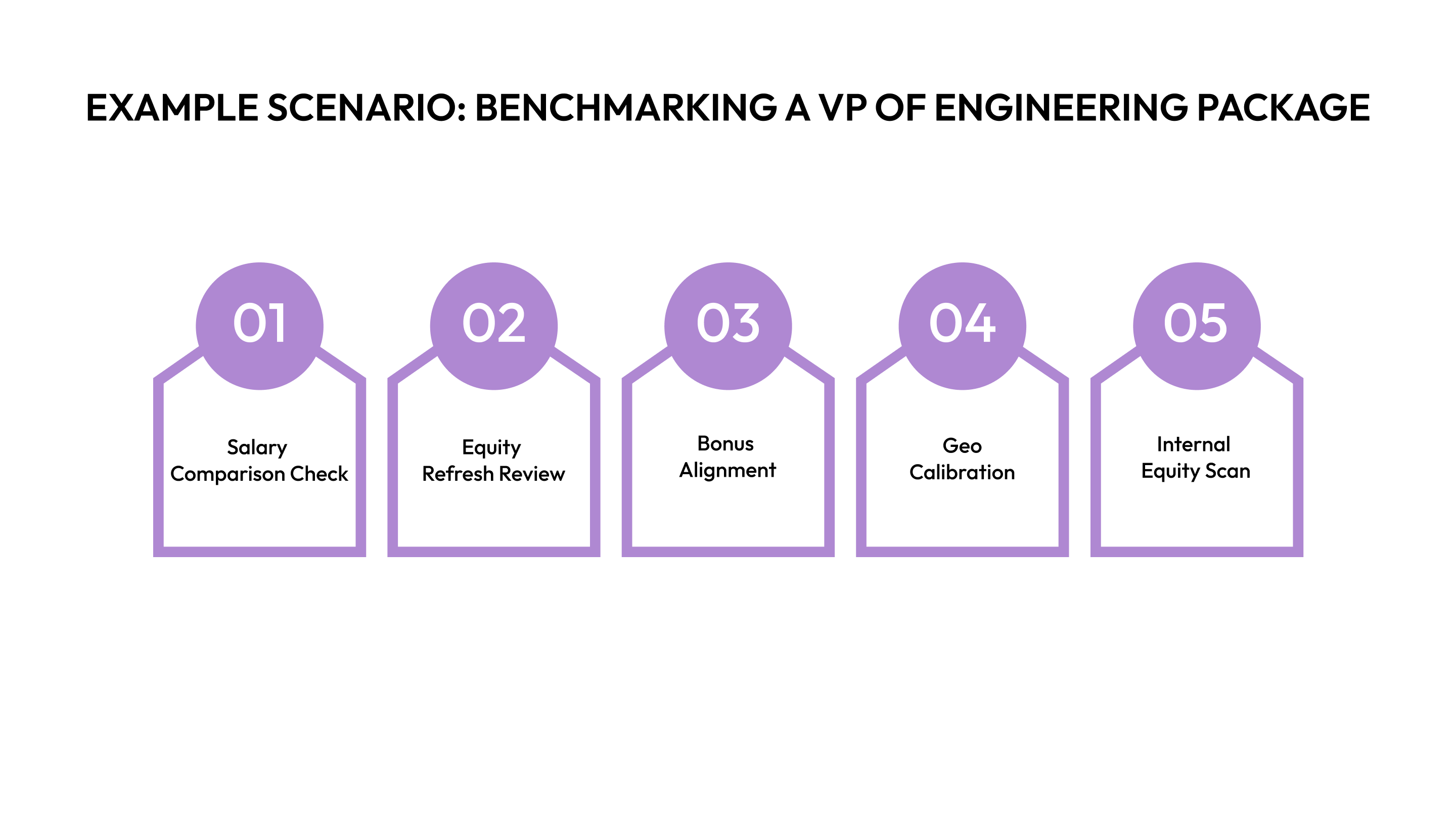
Here is a simple example that shows how a board can review and refine a VP of Engineering compensation proposal.
- Salary comparison check: Confirms the proposed base salary matches current market data for similar company sizes.
- Equity refresh review: Evaluates whether the equity grant aligns with expected dilution and future value.
- Bonus alignment: Ensures performance metrics match engineering priorities such as delivery timelines or product stability.
- Geo calibration: Adjusts compensation if the candidate lives in a high or moderate-cost region.
- Internal equity scan: Checks that the new offer does not exceed existing CTO or VP-level ranges.
- Example: When hiring a VP of Engineering, a board chooses a slightly higher equity grant and a performance bonus tied to team expansion targets.
Also Read: The AI-Powered Evolution of Total Rewards
After reviewing this example, it becomes easier to see how CandorIQ supports boards in completing executive compensation benchmarking with confidence.

How CandorIQ Helps Boards Benchmark Executive Compensation
Boards often need clear, updated, and structured information to make confident pay decisions for senior leaders. CandorIQ brings all compensation, planning, and approval workflows into one platform, helping boards apply Executive Compensation Benchmarking Best Practices for Boards of Directors without relying on scattered spreadsheets or outdated data. This gives compensation committees a simple and transparent way to review executive pay.
Below is how CandorIQ supports boards in building fair, competitive, and defensible executive compensation packages.
- Real-time pay band creation: Builds accurate executive pay bands with geo-adjustments and version tracking for a clean audit history.
- Scenario planning for salary and equity: Models salary, bonus, and equity combinations so boards can compare multiple options in minutes.
- AI-driven benchmarking recommendations: Highlights competitive ranges and patterns to support informed decision-making.
- Total compensation modeling: Shows salary, equity value, vesting, bonus, and benefits in a clear and easy-to-read view.
- Structured approval workflows: Routes proposals to HR, Finance, and compensation committees with full transparency and fewer delays.
With these capabilities in mind, the conclusion brings everything together to reinforce a clear and strategic approach to executive compensation.
Conclusion
Building fair and competitive executive pay becomes difficult when data is scattered or decisions depend on spreadsheets. Using Executive Compensation Benchmarking Best Practices for Boards of Directors helps boards support company goals, attract strong leaders, and maintain trust across the organization.
A consistent process also improves alignment between HR, Finance, and the compensation committee. With CandorIQ, boards get a clear and structured way to compare roles, review total compensation, and approve packages confidently. This turns executive pay decisions into a strategic and steady process that supports long-term growth.
If your board wants clearer data, easier reviews, and stronger decisions using Executive Compensation Benchmarking Best Practices for Boards of Directors, CandorIQ can help. Book a demo today to see how CandorIQ simplifies executive compensation planning for boards.
FAQs
1. How should boards handle executive compensation during economic uncertainty?
Boards should review compensation ranges more frequently when markets shift quickly. Using flexible benchmarking models helps adjust salary, bonus, and equity without creating long-term imbalance. Clear communication with executives prevents confusion during these changes.
2. What role does performance measurement play in executive compensation benchmarking?
Performance metrics help boards connect pay to company results and long-term goals. Benchmarks offer a baseline, but performance indicators guide final decisions. This balance helps prevent misalignment between pay and outcomes.
3. How do boards compare executive compensation across different industries?
Boards should use market data from similar growth stages and business models rather than relying only on industry labels. Comparing revenue size, employee count, and funding stage gives more accurate results. This approach prevents misleading or inflated pay ranges.
4. Can benchmarking help prevent executive turnover?
Yes, competitive benchmarks help boards identify when pay packages fall below market expectations. Updating ranges regularly reduces the risk of losing key leaders to better offers. Strong benchmarking also supports transparent retention strategies.
5. What should boards document during the executive pay review process?
Boards should keep records of data sources, pay ranges, rationale, and final decisions. Clear documentation supports compliance reviews and investor communication. It also protects the board when compensation decisions are questioned later.
Ready to modernize your workforce and compensation strategy?
See how CandorIQ brings workforce planning and compensation together with AI.