

8 Proven Compensation Planning Best Practices for Fast-Growing US Companies in 2026
Scale fair pay across growing teams. These 8 compensation planning best practices help HR and Finance align, cut cycle time, and reduce attrition.

In 2026, most companies are running their workforces on 2015 compensation processes. The annual cycles, disconnected spreadsheets, and pay bands were built on instinct rather than data.
The result? Pay inequity compounds quietly, top performers leave without warning, and HR teams spend weeks on admin instead of strategy. Nearly 68% of employees think that they are being underpaid.
Compensation planning is the process of designing, managing, and reviewing how you pay your people, across base salary, equity, bonuses, and benefits. Done well, it aligns your workforce costs with business goals and keeps your best people around. Done poorly, it bleeds budget and talent simultaneously.
In this article, we cover the 8 compensation planning best practices that fast-growing US companies need in 2026.
Key Takeaways
- Most compensation planning failures are systems problems, not intent problems, and scaling companies feel this the hardest.
- Pay equity is a financial risk. Replacing one employee costs 1.5–2x their salary. Poor pay practices quietly drive this cost up.
- HR and Finance must plan compensation together, in real time, not in separate cycles that collide at the end of the quarter.
- Headcount planning without compensation modeling is just an org chart wish list. Scenario planning before roles are approved prevents budget overruns.
- CandorIQ consolidates pay bands, merit cycles, headcount planning, and offer workflows into one platform, so lean HR teams can plan like a much bigger team.
What is Compensation Planning?
Compensation planning is how companies decide what to pay people, how to structure those decisions, and how to keep them fair and consistent over time. It covers base salary, equity, bonuses, and benefits, and maps those against job levels, market data, and business budgets.
For scaling US companies, good compensation planning is what keeps pay decisions from becoming ad hoc.
If your pay decisions are inconsistent, reactive, or locked in a spreadsheet, that's not a compensation plan.
Why Compensation Planning is Broken for Scaling Distributed Teams in 2026?
Most companies know their comp process isn't working. They just don't know why. Here are the six reasons that actually explain it.
- Annual cycles can't keep up with talent markets. Salaries move monthly. If you only benchmark once a year, you're always behind. By the time you correct, you've already lost people.
- Spreadsheets break under scale. A 50-person company can manage comp in Excel. A 300-person distributed team cannot. Version conflicts, manual errors, and missing audit trails pile up fast.
- Pay bands get built on gut, not data. Without reliable benchmarks matched to your company size, industry, and geography, your bands are guesses dressed up as structure.
- HR and Finance work in separate lanes. Finance approves headcount without full comp context. HR runs merit cycles without real-time budget data. The result is misalignment that shows up as overruns, offer inconsistencies, and delayed approvals.
- Geo-adjusted pay is still treated as optional. For distributed US teams, paying everyone on a national average creates underpayment in high-cost markets and overpayment in others. Neither is sustainable.
- Compensation data sits in reports, not decisions. Most HR teams track comp metrics. Very few use them to forecast attrition risk, model merit scenarios, or guide headcount choices. Data that isn't acted on is just noise.
Also Read: Incorporating Forecast Accuracy in Financial Compensation Planning
These aren't isolated problems. They compound. And for companies scaling past 100 people, they compound fast. Here's how to fix them.
8 Compensation Planning Best Practices for Scaling Distributed Teams in 2026
These eight practices don't require a large HR team or a big budget. They require structure, the right data, and a single source of truth for your compensation decisions. Start here.
1. Build Your Compensation Philosophy First
Most companies treat the total rewards philosophy as a checkbox. That's the wrong approach.
Your philosophy is the foundation every downstream decision rests on. If your philosophy isn't clear, your decisions on bandwidth, merit percentages, and equity splits get made ad hoc. That's exactly how pay equity gaps start.
3 questions your philosophy must answer before you benchmark:
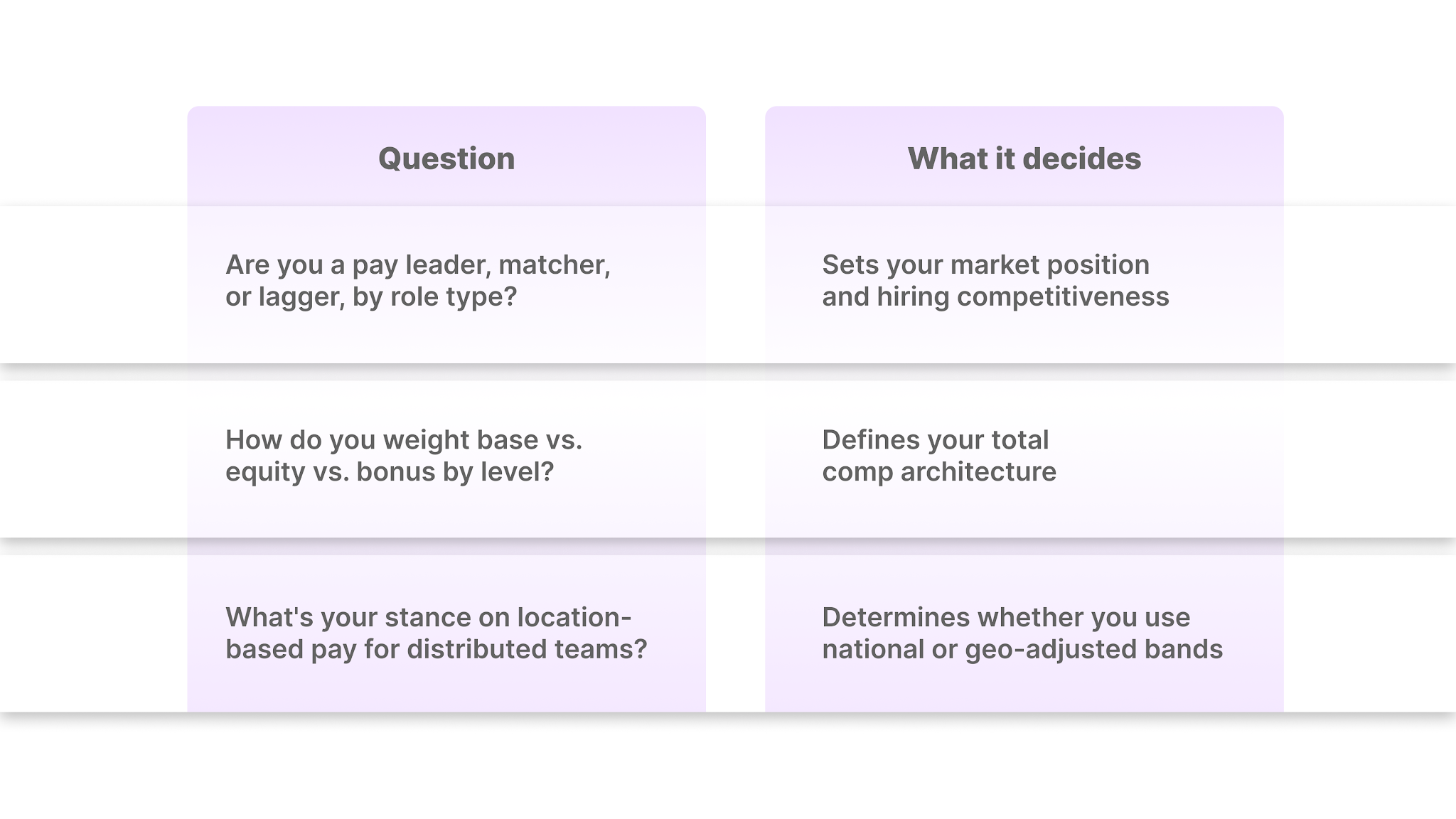
Answer these three before you touch any benchmark data. Everything else builds on them. Once your philosophy is locked, the next step is making sure the numbers behind your bands actually reflect your market.
2. Use Market Benchmarking Data to Set Pay Bands
Not all benchmark data is equal. If your benchmark doesn't match your industry, funding stage, company size, and geography, it's giving you the wrong answer to your problem. This is benchmark hygiene, matching your data source to your actual peer group before you trust the numbers.
US companies with distributed teams need to choose location-adjusted bands because they reflect real market conditions. They help avoid underpaying in high-cost areas and keep compensation consistent across the organization. For remote-first companies, this directly affects retention.
Once teams set the right bands, the next step is to make sure they apply them consistently across the workforce.
3. Treat Pay Equity as a Financial Risk
31% of talent loss ties directly to perceived pay unfairness. Even a small percentage of attrition caused by inequity can translate into millions in replacement costs, making it a clear P&L impact.
Here’s how to run a pay equity audit that actually changes something:
- Benchmark actuals against your current pay bands by level and department.
- Identify outliers, broken out by gender, tenure, and location.
- Model the correction cost against the projected attrition cost if left unaddressed.
Most competitors say "conduct regular audits." This is what that actually looks like in practice. And once you've corrected the gaps, the goal is to make sure your annual review process doesn't quietly re-create them.
4. Automate Your Merit Review Cycle Before It Slows You Down
When merit cycles take too long and lack differentiation, high performers disengage, and the time spent on manual work directly leads to poorer compensation outcomes.
Here’s a repeatable 4-step merit cycle framework for you:
- Set department budget guardrails before the cycle opens. Managers work within known constraints, not open-ended requests.
- Enable manager self-service with pay band context embedded. Every decision is made with market data visible.
- Capture rationale in-platform. Every raise decision has a documented reason, creating an audit trail and reducing bias.
- Run a live exec budget view before approvals close. Finance sees impact in real time, not after the fact.
This framework cuts cycle time and produces fairer, more defensible outcomes. CandorIQ's Compensation Cycle module runs exactly this workflow, with built-in approval logic, rationale logging, and a live exec budget view.
But even a fast, well-run merit cycle breaks down when HR and Finance aren't working from the same plan.
5. Get HR and Finance Aligned on Compensation
When teams don’t work from the same real-time data, decisions drift out of sync, leading to off-band offers and comp issues that compound over time.
5 data points HR and Finance must see simultaneously:
- Headcount plan vs. actuals
- Compensation budget utilization by department
- Open roles and their band implications
- Pending approvals and their cost impact
- Attrition rate by pay band quartile
When both teams see this together, the conversation shifts from reconciliation to planning. That's where the value is.
CandorIQ's Workforce Management dashboard gives HR and Finance a shared real-time view of headcount, comp budget, and attrition, in one place, without reconciling spreadsheets.
However, after aligning on the current data, the next step is to model what comes next.
6. Use Headcount Scenario Planning to Spend Smarter
When you approve roles before calculating full costs, they lock in hiring decisions without understanding the financial impact.
The smarter approach is scenario planning before approval. Toggle between options and see the burn impact of each before a single offer goes out.
Here’s how to build a simple 3-scenario headcount model:
Take a 200-person SaaS company planning Q3 hiring for their engineering team:
- Plan A: Hire 10 full-time engineers — full comp + benefits + equity
- Plan B: Hire 6 full-time + 4 contractors — lower equity burn, higher flexibility
- Plan C: Promote 3 internal engineers + hire 4 externally — lowest new comp spend, strongest retention signal
Each scenario has a different burn threshold, the point where new comp spend hits a departmental budget cap. Knowing that before you post, the roles change every decision downstream.
Once your headcount decisions are sound, the next lever is how you present compensation to the candidates you're bringing in.
7. Make Pay Transparency a Competitive Advantage
Most companies treat pay transparency as a legal requirement or a cultural value. The sharper argument: transparency closes candidates faster.
In 2026, 49% of organizations are moving toward full public pay transparency. Companies that have made this shift report better offer acceptance rates and fewer repetitive HR questions from candidates. For recruiting managers, that's an argument about conversion rates.
A total comp offer framework that wins candidates:
The best offers don't just show a salary number. They show the full picture:
- Base salary + annual bonus target
- Equity value with future-growth modeling
- Benefits value in dollar terms
- Growth trajectory by level
- FAQs built in, answering the 5 questions candidates always ask
When candidates clearly understand their full compensation, salary, equity, and benefits, they make faster, more confident decisions, which improves offer conversion.
Once your offers are winning, the final practice is to make sure your comp data is driving decisions, not just sitting in dashboards.
8. Turn Compensation Data Into Strategic Decisions With AI
Most HR teams track comp metrics reactively, after something breaks. Strategic teams use the same data to forecast what's about to break.
The 5 compensation metrics everyone should track:
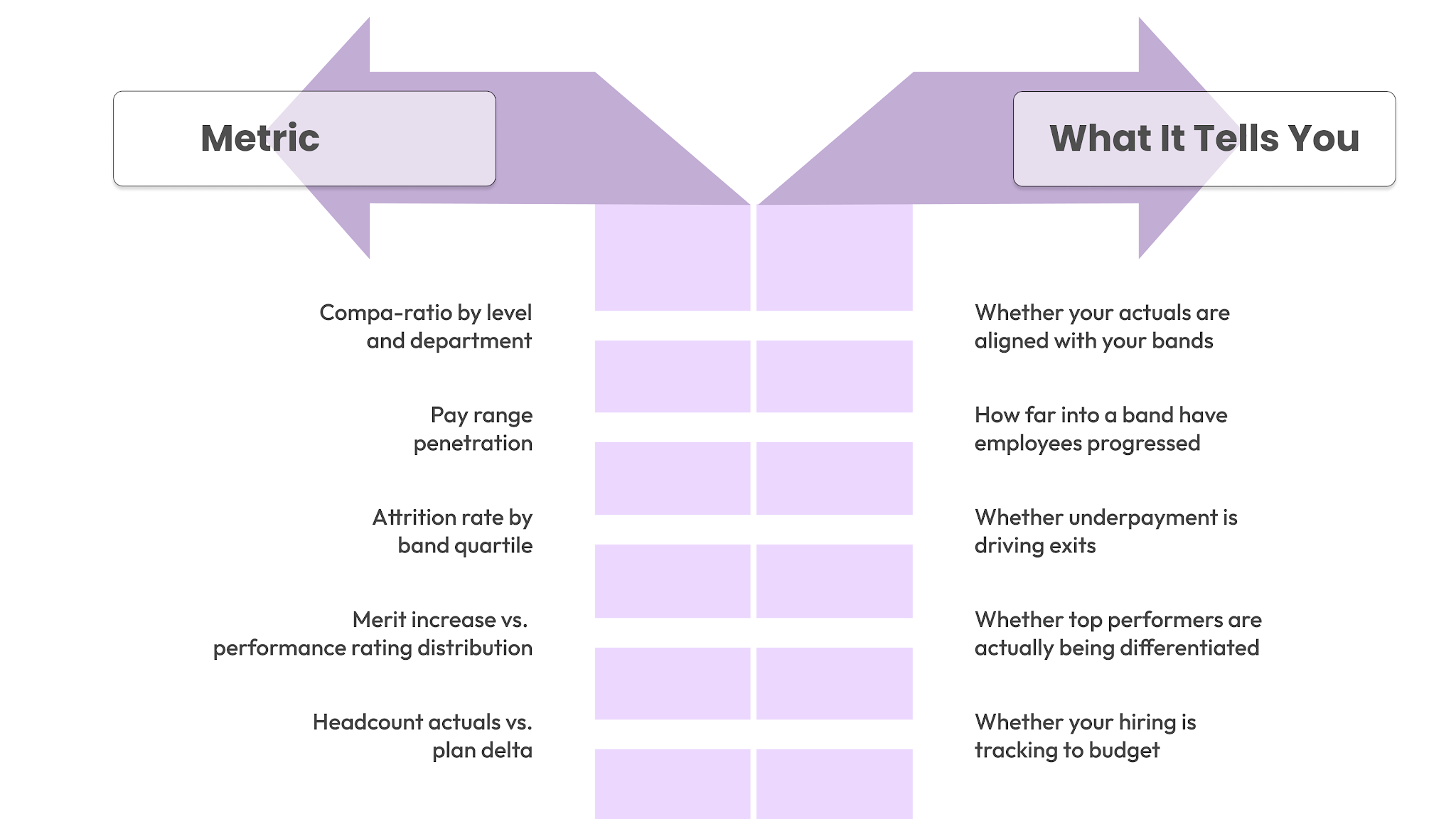
AI doesn’t replace judgment in compensation planning. It helps small HR teams do deeper analysis without spending hours on reports and spreadsheets. Instead of building models manually, teams can ask simple questions like how a 3% merit increase might affect attrition in engineering and get a clear answer quickly.
It helps teams test different scenarios, spot pay gaps early, and make compensation decisions based on past data and market benchmarks. Teams that start using these tools now will plan faster and make more informed decisions than those that don’t.
CandorIQ's AI Agent does exactly this, letting HR teams ask plain-language questions and get actionable answers without building a single report.
Also Read: How AI Agents are Transforming HR Operations
Apply these eight practices consistently, and you'll avoid most of what slows comp teams down. But knowing the mistakes is just as important.
5 Common Compensation Planning Mistakes To Avoid
Even well-intentioned compensation planning best practices fall into the same traps. Here are the five that cost companies the most:
- Building pay bands without defining philosophy first. Bands without philosophy are arbitrary. They'll be challenged and overridden constantly, usually by whoever has the most seniority in the room.
- Using the wrong benchmark peer group. Pulling industry-average data without filtering for company size, stage, and geography gives you a number that fits no one. This is one of the most common and least-discussed mistakes in compensation planning.
- Running merit cycles manually at scale. Manual cycles produce flat increases, bias, and documentation gaps. They also take weeks longer than they should, which costs you retention risk on top of the admin cost.
- Treating headcount planning and compensation planning as separate processes. They're not. A new hire is a compensation decision. Approving headcount without comp modeling means Finance is flying blind on burn.
- Communicating comp outcomes without context. Telling an employee their raise is 3.5% means nothing without context. Showing them where they sit in the band, how that compares to the market, and what growth looks like, that's what builds trust.
Most of these mistakes share a common root. Comp decisions are made in isolation, without a connected system holding the data together. That's exactly the problem CandorIQ is built to solve.
Stop Managing Compensation Across Five Different Tools
Growing HR teams deal with the same problem: comp data lives everywhere. Pay bands in one spreadsheet. Merit cycles in another. Headcount requests in email threads. Offer letters in a separate doc. By the time you reconcile everything, the data is already outdated.
CandorIQ brings it all into one place. It's built specifically for HR and Finance teams at companies scaling from 50 to 5,000 employees, replacing the fragmented stack with a single connected platform.
- Compensation & Pay Band Builder: Define bands by level, location, and department with version control and real-time distribution visibility
- Compensation Cycle: Automate merit and bonus reviews with built-in approval logic, rationale logging, and exec budget views
- Headcount Scenario Planning: Model org changes and hiring scenarios with live budget impact before approvals go out
- Headcount Requests & Approvals: Route new hire requests dynamically and sync with ATS and finance systems
- Candidate Offers: Give candidates a full total comp view with equity modeling and embedded FAQs
- Workforce Management: Track open roles, attrition, and promotion rates in one dashboard
- AI Agent: Ask natural language questions, get comp recommendations, and forecast workforce needs without building a single report
CandorIQ doesn't just organize your comp data. It turns it into decisions.
Conclusion
Compensation planning best practices are an ongoing system, and for fast-growing US companies, the quality of that system directly affects hiring velocity, retention, and budget predictability.
If your team is ready to move beyond spreadsheets, CandorIQ gives you the infrastructure to run comp planning the way it should be run: connected, real-time, and built for scale.
Ready to see it in action? Get in touch with the CandorIQ team today.

FAQs
1. How often should a company review its compensation plan?
At a minimum, annually. But for fast-scaling companies, a quarterly review of pay band health and benchmarking data is more realistic. Talent markets move faster than annual cycles can track.
2. What's the difference between a compensation plan and a compensation strategy?
A compensation strategy defines your philosophy and market position, what you want to pay, and why. A compensation plan is the operational document, the actual bands, structures, and review processes that execute that strategy.
3. How do you calculate the ROI of fixing pay inequity?
Start with your average replacement cost (1.5–2x annual salary). Estimate the percentage of attrition linked to pay dissatisfaction (Payscale puts this at 31%). Multiply by your current annual attrition count. Compare that cost against the cost of correcting pay gaps. The correction almost always costs less.
4. What data do you need to start building pay bands?
You need three things: a job architecture (levels and roles clearly defined), a reliable benchmark dataset matched to your peer group, and a clear philosophy on where you want to position against the market.
5. How do distributed US companies handle pay for different locations?
Most are moving toward location-adjusted pay bands, grouping cities or states into geo-tiers and adjusting base salary ranges accordingly. This approach is more defensible than a flat national rate and better for both recruiting and retention across high- and low-cost markets.
Ready to modernize your workforce and compensation strategy?
See how CandorIQ brings workforce planning and compensation together with AI.