

How to Create an Effective Merit Matrix
Craft an effective merit matrix by aligning pay with performance, collecting data, and testing scenarios. Ensure compliance and optimize salary reviews now!


In 2024, U.S. employers reported an average merit increase of 3.3%, slightly below the projected 3.5%. This trend underscores the importance of strategically aligning compensation with performance to attract and retain top talent. A merit matrix serves as a structured tool to achieve this alignment, ensuring that salary adjustments are both fair and performance-driven.
However, designing an effective merit matrix involves more than just assigning percentages. It requires a thoughtful approach that considers various factors, including performance ratings, salary ranges, and organizational goals.
In this blog, we’ll take you through the steps to create an effective merit matrix that not only helps you reward performance but also strengthens your organization’s culture of fairness, transparency, and growth.
Key Takeaways
- A merit matrix is a structured tool that links employee performance directly to salary increases, ensuring fairness and transparency in compensation decisions.
- There are various types of merit matrices, including simple, tiered, point-based, and dynamic, each catering to different organizational needs.
- Creating an effective merit matrix involves defining performance rating scales, establishing salary ranges, and linking performance to pay increases.
- Equity—both internal and external—is critical to avoid pay disparities and ensure competitiveness within the job market.
- Clear communication of the merit matrix helps employees understand how their performance influences their compensation, promoting engagement and motivation.
What is a Merit Matrix?
A merit matrix is a structured tool used by organizations to determine how employee performance influences salary increases, bonuses, and other forms of compensation. It provides a clear, consistent, and objective way to link pay adjustments with performance ratings, ensuring that top performers are rewarded in a way that is both fair and aligned with company goals.
The merit matrix combines two critical components:
- Performance Rating: This is the evaluation of an employee's job performance over a specific period, typically measured during performance reviews. It reflects how well the employee has met or exceeded their targets and job expectations.
- Compensation Range: The salary or bonus range within which an employee's pay falls for their particular role. This range is typically determined by factors such as market trends, industry standards, and internal pay structures.
In practice, the merit matrix ensures that compensation decisions are objective and transparent, eliminating subjective biases and aligning pay increases with measurable performance. By doing so, it supports a culture of meritocracy, where employees are motivated to perform at their best, knowing their efforts will be fairly rewarded.
Suggested read: Understanding Merit Bonuses: Key Differences and Benefits

With a better understanding of what a merit matrix is, let's explore the various types of merit matrices organizations can use to suit their specific needs and structures.
Types of Merit Matrix
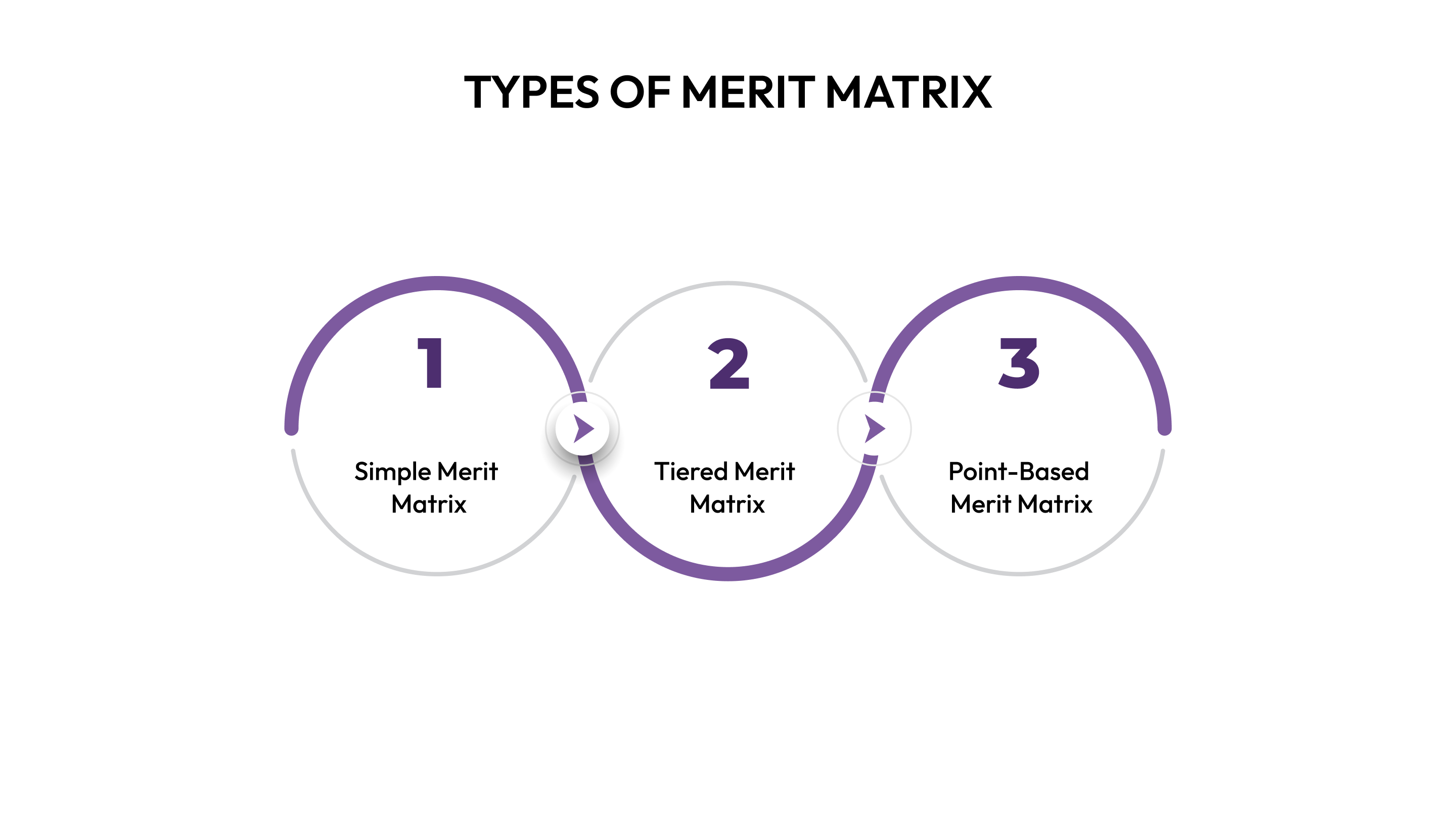
A merit matrix can take various formats depending on an organization’s goals, performance evaluation systems, and compensation strategies. The structure of a merit matrix often depends on how performance is assessed and how compensation adjustments are distributed. Understanding the different types of merit matrices can help organizations choose the one that best aligns with their business needs and culture.
1. Simple Merit Matrix
A simple merit matrix links performance ratings directly with percentage increases or bonus amounts within a pre-determined salary range. This matrix typically uses a basic structure with performance ratings on one axis and pay adjustments on the other.
For example, an employee who receives an "outstanding" performance rating might be eligible for a higher percentage increase than one who receives a "meets expectations" rating.
How it works:
- Performance Ratings: Typically ranges from “Below Expectations” to “Outstanding.”
- Compensation Adjustments: Pre-set percentage increases or bonuses based on performance ratings.
When to use:
- Small organizations or those with straightforward compensation structures.
- When simplicity and transparency are the primary goals.
2. Tiered Merit Matrix
A graduated merit matrix is a more detailed version of the simple matrix, providing multiple tiers within each performance rating level. It’s often used in larger organizations to accommodate employees with different levels of performance within the same rating category.
For example, an employee who exceeds expectations by a small margin might receive a lower increase than someone who exceeds expectations by a larger margin.
How it works:
- Performance Ratings: Multiple sub-categories within each performance rating, such as “Meets Expectations” and “Meets Expectations – Exceeds.”
- Compensation Adjustments: Graduated increases within each performance rating category based on the sub-category.
When to use:
- Larger organizations with a more diverse range of performance outcomes.
- When there is a need to differentiate pay increases more finely within each performance rating.
3. Point-Based Merit Matrix
A point factor merit matrix assigns point values to various performance criteria (e.g., leadership, productivity, collaboration) and uses those points to determine compensation increases. This method allows for a highly customized and precise approach, as employees are evaluated across multiple competencies that are weighted according to importance.
For example, an employee who excels in leadership and project management might earn more points and, thus, receive a higher pay increase than someone excelling in a single area.
How it works:
- Performance Criteria: Various categories or competencies are assigned point values.
- Point System: Employees are awarded points based on how they meet the criteria, and the total score determines the merit increase.
When to use:
- In organizations where employees have varied responsibilities and skills that need to be measured across multiple dimensions.
- When fairness and transparency in evaluating different performance metrics are crucial.
Also read: Understanding Merit-Based Pay: Benefits and Implementation
Having seen the different types of merit matrices, let’s now look at the steps involved in creating an effective merit matrix tailored to your organization’s unique needs.
Steps to Create an Effective Merit Matrix
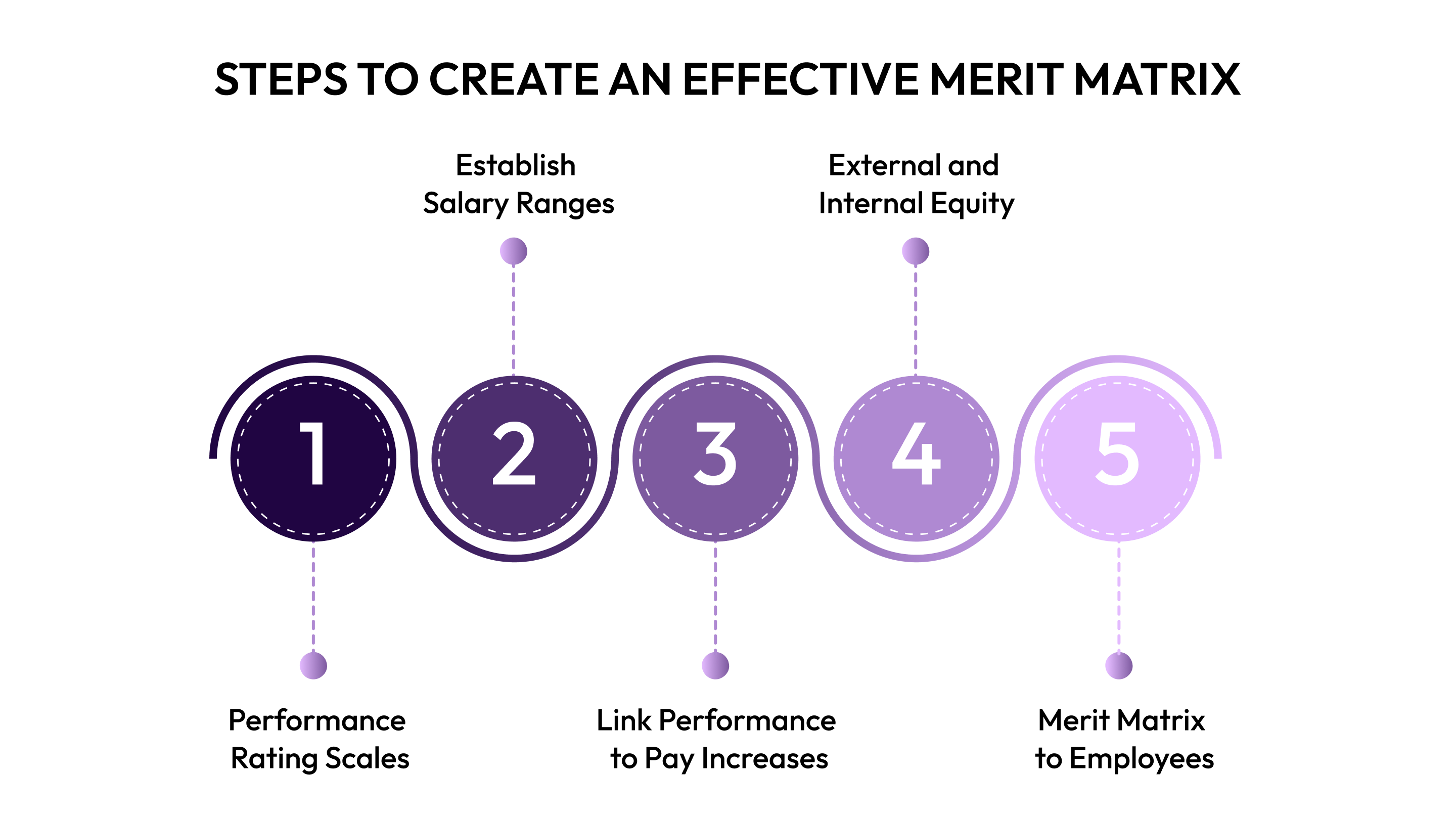
Creating an effective merit matrix involves several key steps that align employee performance with compensation adjustments. By following a structured approach, organizations can ensure that high-performing employees are rewarded equitably while maintaining internal consistency and external competitiveness:
1. Define Performance Rating Scales
The first and most important step in creating a merit matrix is to define a clear and consistent performance rating system. This system will be used to evaluate employees and determine their eligibility for salary increases.
A well-defined rating scale ensures fairness and clarity for all employees, so they know what is expected of them and how their performance will be assessed.
Typical performance rating scales might include:
- Below Expectations: Performance falls short of basic job requirements.
- Meets Expectations: Performance meets the core requirements of the role.
- Exceeds Expectations: Performance surpasses the basic job requirements with significant contributions.
- Outstanding: Exceptional performance that adds considerable value to the organization.
These ratings should be based on clearly defined criteria tied to organizational goals, such as productivity, collaboration, leadership, and skill development.
Where it’s applied:
- Used during annual or semi-annual performance reviews to assess employee contributions.
- Helps ensure fairness and transparency in pay adjustments, avoiding subjective decision-making.
By using a standardized performance rating system, organizations ensure that employees are evaluated consistently, making the merit matrix more objective and fair.
2. Establish Salary Ranges and Budget Constraints
Once the performance ratings are defined, the next step is to establish clear salary ranges for each role within the organization. These salary ranges should reflect market competitiveness, internal equity, and the organization’s budget constraints. A typical salary range includes:
- Minimum Salary: The lowest amount an employee can earn in that role.
- Midpoint: The average salary for the role, typically reflecting the market rate.
- Maximum Salary: The highest pay level for the role, generally reserved for top performers or those with significant experience.
Salary ranges should be informed by industry standards and market trends, making sure that the company remains competitive while staying within budget limits.
Where it’s applied:
- Salary ranges help determine how much an employee can earn within their role and ensure equitable pay across the organization.
- Allows for structured compensation planning that stays aligned with financial goals.
By defining salary ranges, compensation decisions become more transparent and aligned with market standards, ensuring fair pay and helping to attract and retain top talent.
3. Link Performance to Pay Increases
The core of the merit matrix lies in connecting performance ratings to pay increases. For each performance level, determine the percentage increase in salary based on the employee’s rating and position within the salary range. This ensures that top performers are rewarded appropriately while maintaining fairness across all levels of performance.
Where it’s applied:
- This grid serves as a guide to determining salary increases, ensuring consistency in how pay raises are awarded.
- Helps maintain fairness by ensuring that employees with similar performance levels receive similar increases.
By linking pay increases to performance ratings, organizations can ensure that employees are fairly compensated based on their contributions, aligning compensation with business goals.
4. Factor in External and Internal Equity
External equity ensures that the company’s compensation packages are competitive within the market, while internal equity ensures that employees in same roles are paid fairly in comparison to one another. Both are critical to preventing pay disparities and maintaining employee morale.
- External equity: Salary ranges should be benchmarked against industry standards to ensure the company’s pay offerings are competitive.
- Internal equity: Salary decisions should consider the organization’s pay structure, ensuring that employees performing similar tasks at similar levels receive comparable compensation.
Where it’s applied:
- Market surveys and benchmarking are used to adjust pay ranges to remain competitive.
- Internal pay audits help identify and address pay disparities within the organization.
Considering both external and internal equity ensures that the merit matrix is not only competitive in the market but also fair and consistent across the organization.
5. Communicate the Merit Matrix to Employees
For the merit matrix to be effective, it’s essential to clearly communicate the process and criteria to employees. Employees should understand how their performance is being evaluated, how it impacts their compensation, and what they can do to improve. Transparent communication about how the merit matrix works helps build trust and encourages employees to engage in the performance review process.
Where it’s applied:
- Communicate the merit matrix through employee handbooks, training sessions, or one-on-one meetings with managers.
- Regularly update employees on changes to the merit matrix or performance expectations.
Clear communication helps employees feel more motivated and engaged, as they understand the direct link between their performance and compensation.
Now that we know how to create a merit matrix, let’s look at some alternatives to the merit matrix that can also help manage pay increases and bonuses in a fair and strategic way.
.png)
Alternatives to the Merit Matrix
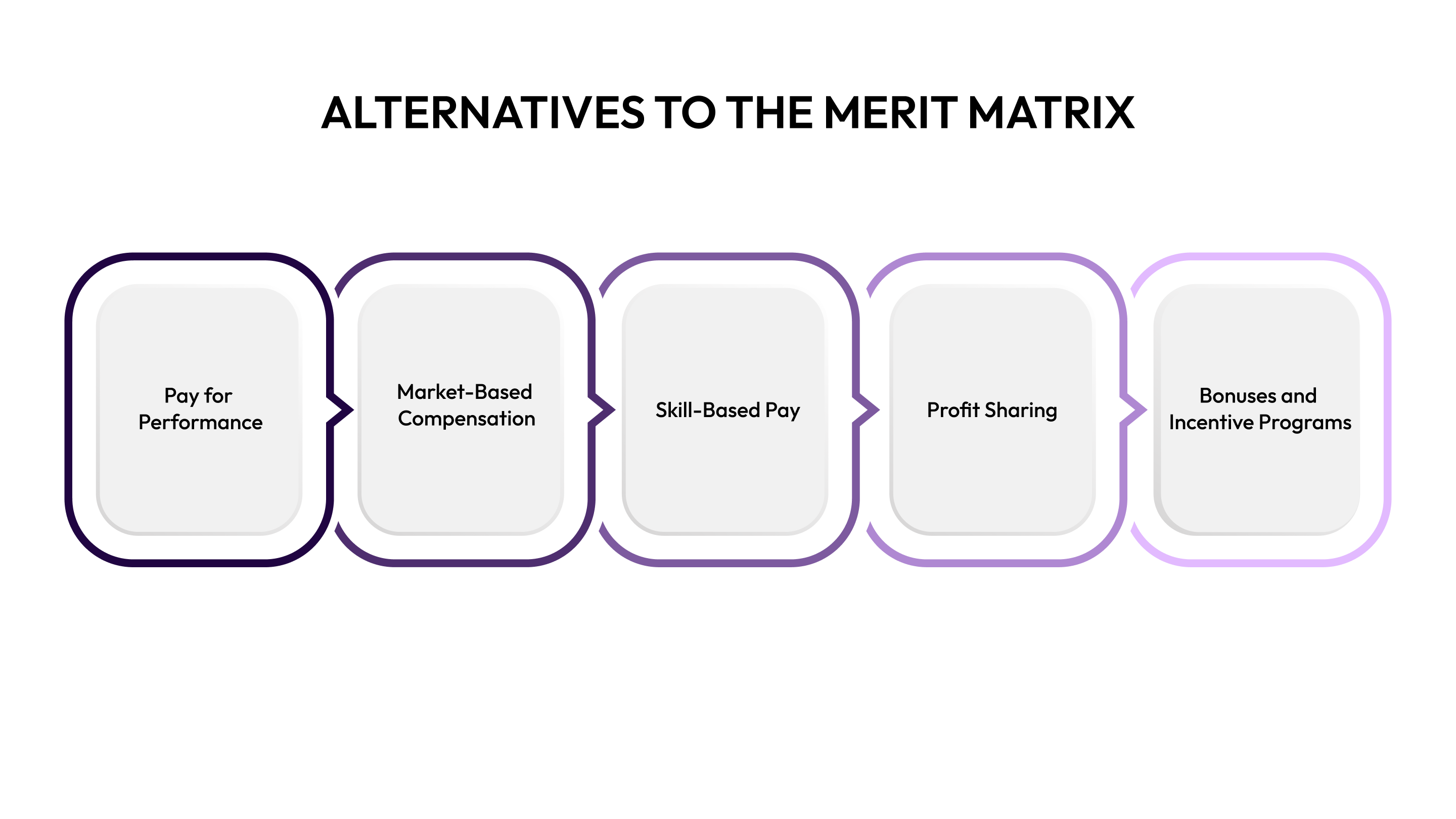
While a merit matrix is a widely used tool for linking performance to compensation, it may not always be the best fit for every organization or situation. Some companies may find the merit matrix too rigid, too complex, or not aligned with their unique performance evaluation systems.
Fortunately, there are several alternatives that can also help organizations manage pay increases and bonuses in a fair and effective way. Below are some of the most common alternatives:
1. Pay for Performance System
In a pay for performance system, compensation is directly tied to the achievement of due performance targets or business goals, rather than using a predefined matrix. Employees earn pay increases, bonuses, or incentives based on their individual achievements or the company’s performance as a whole.
Pros:
- Directly links compensation to individual or team performance.
- Highly flexible and must be changed to meet specific business objectives or sales targets.
Cons:
- Can lead to unhealthy competition or focus on short-term goals over long-term strategy.
- Difficult to implement effectively without clear, measurable goals.
2. Market-Based Compensation Approach
Rather than linking salary increases to performance directly, the market-based compensation approach adjusts compensation based on market trends and the industry’s salary benchmarks. This method is often used in companies that want to stay competitive with external salary trends and ensure that employees are compensated according to industry standards.
Pros:
- Ensures compensation is aligned with industry standards, making the organization more attractive to potential talent.
- Easier to manage when the focus is on staying competitive rather than rewarding individual performance.
Cons:
- May not sufficiently reward top performers within the organization.
- Can lead to less differentiation in compensation between high and low performers.
3. Skill-Based Pay
The skill-based pay system ties compensation to an employee’s skill level and proficiency rather than performance alone. Employees receive pay increases when they develop new skills or certifications that are valuable to the company.
Pros:
- Encourages continuous skill development and learning among employees.
- Provides a clear and objective basis for pay increases based on measurable skills.
Cons:
- Can be difficult to track or standardize skills across diverse roles.
- May not always be aligned with the company’s immediate business objectives.
4. Profit Sharing
In a profit-sharing system, employees receive a share of the company's profits based on the organization’s financial performance. This alternative to the merit matrix ties compensation to the success of the company rather than individual or team performance.
Pros:
- Strong incentive for employees to contribute to the company’s success and overall performance.
- Can be a highly motivating factor, especially in profit-driven industries.
Cons:
- Profit-sharing can be less predictable for employees, especially in years where profits are low.
- May not reward individual contributions as effectively as a merit-based approach.
5. Bonuses and Incentive Programs
Rather than making regular salary adjustments, some companies choose to offer bonuses and incentive programs. These programs provide one-time payouts based on achieving specific goals or milestones, rather than adjusting base salaries.
Pros:
- Provides an immediate reward for achieving specific goals.
- Flexible and can be tailored to specific team or individual goals.
Cons:
- Bonuses do not provide long-term motivation or stability, as they are not part of the employee’s regular pay.
- Can be seen as less reliable or less motivating if the targets are unrealistic or infrequent.
After discussing alternative methods, it’s clear that compensation strategies are evolving.
Conclusion
Creating an effective merit matrix is a critical step in developing a fair, transparent, and performance-driven compensation system. By linking compensation to measurable performance outcomes, you not only motivate your employees but also ensure that your pay structures are aligned with organizational goals.
At CandorIQ, we provide the tools to streamline the creation and management of merit-based compensation programs. Our platform enables you to design compensation strategies that are data-driven, in alignment with business goals, and easily adjustable based on performance metrics.
Book a demo today to discover how CandorIQ can optimize your merit matrix and drive business success through strategic compensation management.
FAQs
1. How does a merit matrix ensure fairness in compensation?
A merit matrix ensures fairness by linking compensation directly to objective performance ratings, reducing bias in pay decisions. It aligns rewards with the value employees bring to the organization.
2. How frequently should a merit matrix be updated?
A merit matrix should be updated regularly—ideally annually or during major performance review cycles—to reflect changes in market compensation data, organizational goals, and internal equity.
3. Can a merit matrix be used for non-financial rewards?
Yes, while merit matrices are often used for salary increases, they can also be applied to determine non-financial rewards like recognition, bonuses, or additional benefits based on performance.
4. What challenges might organizations face when implementing a merit matrix?
Organizations may struggle with defining clear performance criteria, maintaining internal equity, or ensuring market competitiveness. Additionally, overcomplicating the matrix can make it harder for employees to understand.
5. How do merit matrices align with organizational goals?
A merit matrix links pay increases to performance ratings that are directly tied to the organization’s strategic objectives, ensuring that compensation supports business growth and performance targets.
Ready to modernize your workforce and compensation strategy?
See how CandorIQ brings workforce planning and compensation together with AI.