

6 Layoff Impacts on Compensation in 2026 You Must Solve Before Rebuilding
Layoff impact on compensation goes beyond severance. See how a RIF breaks pay bands, budgets, and retention and what lean HR teams must fix.


Layoffs are no longer a last resort. In 2026, we saw 58% more layoffs in the U.S than in 2024, with economic uncertainty and AI adoption leading the charge. Most leadership teams exhale the moment a Reduction In Force (RIF) closes. From the outside, it looks like the compensation story ended with the cuts. It didn't.
For lean, growing teams, a layoff doesn't just remove salaries from the budget. It breaks the entire compensation infrastructure, the pay bands, the budget models, the retention levers, the offer ranges, remaining team runs on. And because these teams are lean, there's no dedicated comp team standing by to catch the damage before it compounds.
This blog explores the six ways a layoff impacts compensation at a lean, growing company, and what HR and Finance leaders need to know to get ahead of each one.
At a Glance
- Layoff breaks your pay bands before you even finish the RIF announcement, and why every comp decision built on stale bands will misfire.
- RIF quietly distorts your comp budget, and why the savings number Finance presented to the board rarely lands as projected.
- Your highest performers become your biggest retention risk the moment a layoff closes, and how to run a proactive retention review before attrition forces your hand.
- Layoffs quietly create pay equity gaps that compound over time, especially in states with active pay transparency laws.
- CandorIQ's unified compensation and headcount planning platform is built for exactly this moment, connecting pay bands, budget visibility, and offer workflows in one place.

Why Your Compensation Structure Breaks After a Layoff or RIF
Compensation structures are designed around a specific organizational shape, defined levels, role distribution, team sizes, and geographic mix. A layoff reshapes that structure overnight. The bands, however, do not adjust automatically. They remain calibrated to a structure that no longer exists.
For lean teams, this breaks faster and more visibly than most expect. Here's why.
- Your Bands Were Built for a Different Org Design: Pay bands reflect a planned distribution of levels and functions. When a RIF removes a tier, merges responsibilities, or exits a geography, that distribution changes. The band architecture may no longer align with the actual scope or reporting structure. Without a formal review, outdated bands persist until they distort a promotion, an offer, or a retention decision.
- Compa-Ratio Data Becomes Skewed: Compa-ratio analysis depends on balanced level distribution. If a mid-level tier is eliminated, remaining senior employees may appear artificially high within their bands. That distortion weakens the credibility of comp cycle recommendations and complicates manager conversations. Running compensation reviews on skewed data produces outcomes that are difficult to defend internally.
- Market Benchmarks Continue Moving: Comp markets in SaaS and fintech adjust quickly, particularly during industry-wide restructuring cycles. Median data from even six to eight months ago may no longer reflect current hiring pressure or talent supply. If compensation bands are not refreshed post-RIF, your stated market positioning drifts from reality, even if your intent has not changed.
With that context established, here are the six specific ways a layoff impacts compensation at a lean, growing team, and why each one matters.
6 Layoff Impacts on Compensation for Lean, Growing Teams in 2026
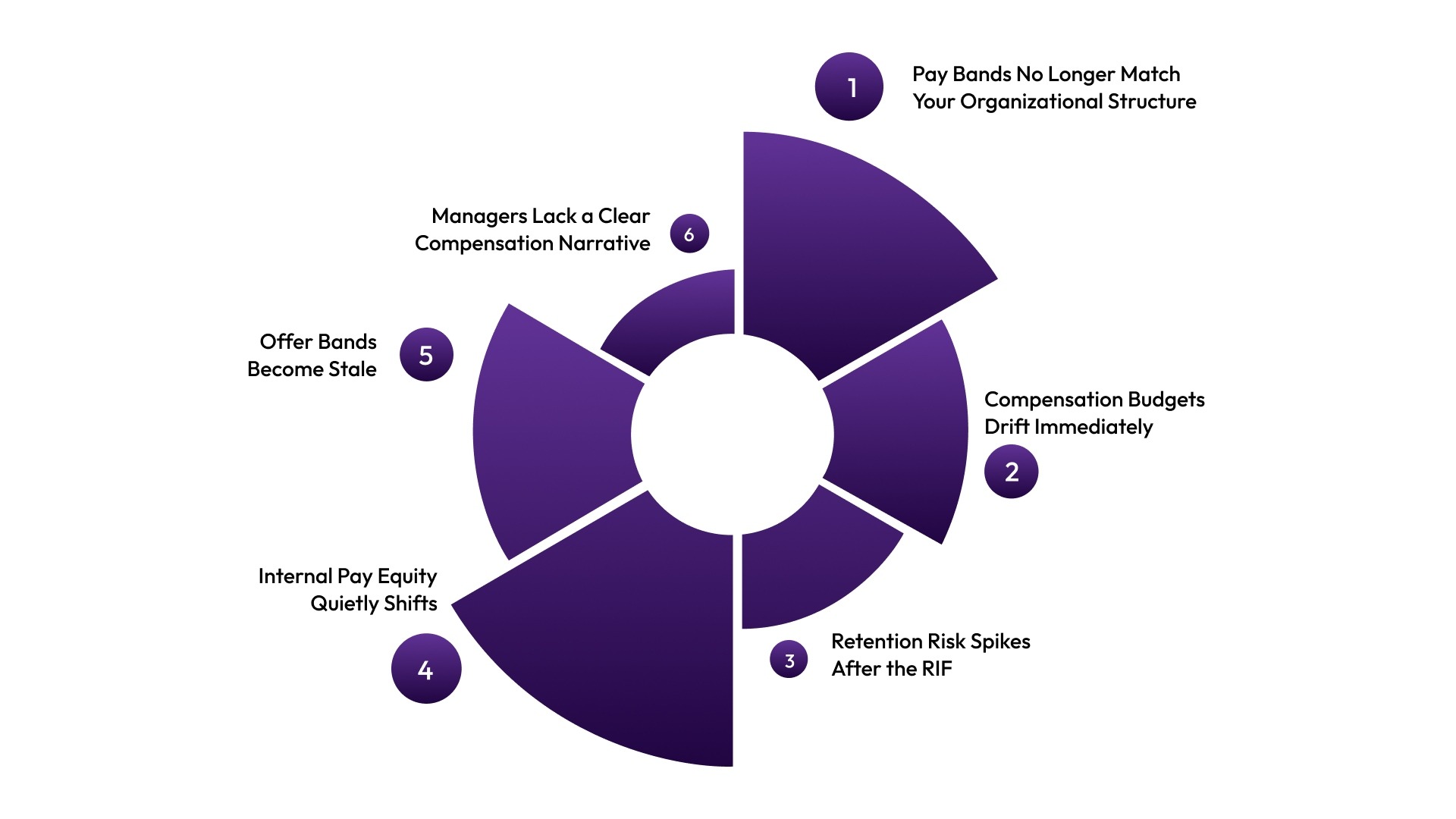
Layoffs reshape more than headcount. They distort compensation structures, budgets, and retention risk in ways that compound over time. For lean teams without a dedicated compensation function, these shifts often go undetected until they become expensive.
1. Pay Bands No Longer Match Your Organizational Structure
A layoff collapses levels, removes roles mid-band, and restructures functions. Your salary bands, however, do not automatically recalibrate. They continue reflecting an org design that no longer exists.
When levels compress, or roles expand in scope, compa-ratios shift, and responsibilities outgrow the band definition. Without active review, every raise, promotion, or retention adjustment gets made against outdated parameters.
Downstream effect: Your compensation decisions rely on structures that no longer reflect reality.
2. Compensation Budgets Drift Immediately
Projected savings from an RIF rarely equal realized savings. Severance, WARN obligations, unemployment insurance changes, and transition costs reduce the expected runway extension.
At the same time, salary forecasts and hiring models often remain unchanged. HR and Finance may operate from different post-RIF assumptions, creating misalignment in board reporting and hiring approvals.
Downstream effect: Retention investments and backfills get approved against inaccurate financial models.
Also Read: How to Implement Total Rewards for Employee Well-Being & Retention
3. Retention Risk Spikes After the RIF
Remaining employees absorb the expanded scope while reassessing their own market value. Voluntary attrition typically increases within 6–12 months following layoffs.
Lean teams are especially vulnerable because they lack redundancy. High performers with expanded responsibilities become attractive external targets, and without proactive comp review, risk signals surface only when resignations occur.
Downstream effect: Cost-saving layoffs trigger secondary talent loss.
4. Internal Pay Equity Quietly Shifts
Layoffs rarely affect the organization evenly. They often concentrate within specific functions, levels, or geographies, reshaping pay distribution in subtle ways.
In states with pay transparency laws, such as California, New York, Colorado, and Washington, external job postings and internal ranges are easier to compare. Without analysis, post-RIF equity gaps can persist unnoticed.
Downstream effect: Equity distortions compound and grow more expensive to correct over time.
5. Offer Bands Become Stale
Hiring typically resumes within months of a restructuring. Many teams reuse pre-RIF salary ranges without recalibrating for scope changes, market movement, or new org design.
This creates friction when new hires enter at ranges misaligned with existing employees, especially those who remained through the RIF. Without structured guardrails, exceptions increase, and budget discipline weakens.
Downstream effect: The recovery hiring phase introduces new instability in compensation.
6. Managers Lack a Clear Compensation Narrative
After layoffs, employees ask direct questions about pay competitiveness, job security, and fairness. These are compensation governance questions, not just morale concerns.
If bands are outdated and positioning is unclear, managers improvise answers. Inconsistent messaging erodes trust and increases perceived inequity, especially in a pay transparency environment.
Downstream effect: confidence in compensation decisions weakens, even if the underlying intent was sound.
These impacts are interconnected. Outdated bands distort budgets. Budget drift delays retention adjustments. Delayed adjustments increase attrition. Attrition pressures rushed rehiring with stale ranges. Stale offers create new equity gaps.
However, most of this damage is preventable, but only if compensation and headcount structures are recalibrated immediately after organizational change, not months later.
Also Read: Executive Compensation Benchmarking Best Practices for Boards
5 Strategies to Retain Talent and Promote Pay Equity After a Layoff

You cannot always prevent a layoff. You can control what happens to your compensation infrastructure immediately after. These five strategies directly address the risks that surface post-RIF, and each is practical for a lean HR and Finance team.
1. Audit Pay Bands First
Recalibrating bands is the foundation for every downstream decision. Remove eliminated roles, account for collapsed levels, and refresh market benchmarks for all remaining positions. Retention adjustments, offer ranges, and budget forecasts depend on this baseline being correct. Complete this review within the first two weeks, not after inconsistencies appear.
2. Run a 60-Day Retention Review
This is an event-driven review, not a standard comp cycle. Identify employees whose scope expanded after the RIF and assess their compa-ratio against updated benchmarks. Flag expanded roles paid below market median and build a targeted adjustment plan with Finance approval. Proactive corrections are significantly less costly than reactive counteroffers.
3. Reconcile Budget to Reality
Do not rely on projected savings. Reconcile severance, WARN obligations, and insurance impacts against actual figures before making new hiring or compensation commitments. Update the headcount model to reflect the new org structure and align HR and Finance on a single, validated forecast.
4. Reset Offer Governance Before Hiring Resumes
Refresh salary bands for roles in the return-to-hire plan and define approval thresholds in advance. Clarify which decisions recruiters, managers, People leadership, or Finance can authorize. Without defined guardrails, exceptions multiply, and internal equity risk resurfaces quickly.
5. Equip Managers With a Clear Compensation Narrative
After a layoff, compensation questions intensify. Provide managers with structured guidance on updated bands, market positioning, and the rationale behind retention or non-adjustments. In a pay transparency environment, clarity reduces both morale risk and compliance exposure.
Executing these steps quickly with a lean team is operationally demanding, especially when compensation data, headcount models, and approvals live in separate systems. That is where integrated platform infrastructure becomes critical to restoring stability.
How CandorIQ Helps You Manage Compensation and Headcount Planning to Reduce Layoff Risk
Lean HR and Finance teams face a structural challenge after a layoff. Band recalibration, retention reviews, budget reforecasting, and offer governance all depend on data that typically lives in separate systems.

CandorIQ unifies compensation and headcount planning into a single system. Pay bands, comp cycles, headcount forecasts, and offer workflows operate from one source of truth, allowing lean teams to move quickly without sacrificing control.
Here’s how we can help you:
- Compensation & Pay Band Builder: Define, update, and version-control bands by level, location, and function. Visualize real-time pay distribution so structural changes are reflected immediately, not deferred to the next review cycle.
- Compensation Cycle Management: Run event-driven reviews alongside annual cycles. Automate approvals, track departmental budgets in real time, and close cycles in days rather than weeks.
- Headcount Scenario Planning: Model post-RIF org structures and assess financial impact before committing. Compare hiring scenarios against runway and budget thresholds while HR and Finance collaborate inside the same live plan.
- Candidate Offers & Governance: Reset offer guardrails before recruiting resumes. Route approvals dynamically and ensure every offer aligns with validated bands and budget parameters.
- Workforce Management Dashboard: Track open roles, attrition, and headcount actuals versus plan in one unified view. Eliminate reconciliation work between HR and Finance.
- AI Agent: Ask natural language questions to analyze pay gaps, forecast hiring needs, or model retention adjustments using your organization’s live data.
Companies using CandorIQ do not just stabilize faster after a RIF. They build infrastructure that absorbs organizational change instead of breaking under it.
Also Read: Top Compensation Management Strategies for Employee Retention
Conclusion
For a lean, growing team, a RIF creates a second wave of compensation damage that compounds quietly, through broken bands, stale budgets, vulnerable survivors, distorted equity, misaligned offers, and managers who have no story to tell their teams.
None of these problems is inevitable. But they're almost certain to happen if your compensation infrastructure doesn't recover as fast as your org needs to move. The teams that get this right treat post-layoff comp recovery as a structured, sequenced discipline, not a set of reactive fires to put out one at a time.
CandorIQ gives lean HR and Finance teams the platform to do exactly that, in one place, with full visibility, and without rebuilding everything in spreadsheets after every restructure.
Ready to see how CandorIQ handles post-RIF compensation planning? Book a demo and see how leading growth-stage teams are rebuilding comp infrastructure faster, with less risk, and without the spreadsheet chaos.

Frequently Asked Questions
Q. What is the impact of a layoff on the compensation structure?
A layoff breaks your pay bands, distorts budget models, and skews compa-ratio data. The org your bands were built for no longer exists, making every comp decision downstream, raises, promotions, and offers less reliable until bands are recalibrated.
Q. How do layoffs affect employee retention and compensation?
Survivors absorb expanded scope without additional pay and immediately recalibrate their market value. Voluntary attrition spikes 6–12 months post-RIF. Proactive retention comp reviews in the first 60 days are significantly cheaper than reactive raises after a resignation.
Q. What should HR teams do immediately after a reduction in force (RIF)?
Audit and rebuild pay bands first. Then run a targeted retention review, reconcile the comp budget with actual severance costs, refresh offer bands, and give managers a clear comp framework, all before hiring restarts.
Q. How do layoffs create pay equity issues?
RIFs concentrate cuts in specific levels, functions, or geographies, reshaping pay distribution and potentially widening equity gaps. In pay transparency states like CA, NY, and CO, these distortions become visible faster and are harder to correct retroactively.
Q. How long does it take to rebuild compensation infrastructure after a layoff?
For lean teams using manual processes, months. For teams with a unified platform like CandorIQ, the core work, band audit, retention review, and budget reforecast can be completed in 30–60 days, well ahead of the return-to-hire timeline.
Q. Can a company avoid layoffs through compensation adjustments?
Pay cuts as a layoff alternative are rarely executed at scale. SHRM research shows that only 3% of workers were offered a salary reduction to avoid a RIF, despite 60% saying they would have accepted a 5% cut. Complexity and morale risk make this difficult for most employers.
Ready to modernize your workforce and compensation strategy?
See how CandorIQ brings workforce planning and compensation together with AI.