

A Practical Guide to Headcount Budget Planning for Lean Teams in 2026
Learn how to build a headcount budget that reflects real hiring costs, aligns HR and Finance, and prevents budget overruns at your growing company.


What if your headcount plan is approved, your hiring is on track, and you're still over budget by Q2? That's exactly the trap most growing companies commonly fall into. According to Gartner, headcount growth expectations have collapsed from 6% in 2025 to just 2% in 2026, with only 21% of CFOs planning staff increases of 4% to 9%.
Every hire carries more financial weight now, and yet most HR and Finance teams still plan headcount without modeling what it actually costs to execute. The result? Budget surprises that show up mid-year, not during planning.
This guide walks you through how to build a real headcount budget, keep it accurate throughout the year, and avoid the governance breakdowns that quietly blow up even well-intentioned plans.
At a Glance
- A headcount plan tells you who you're hiring. A headcount budget tells you what it actually costs, base pay, total cash, benefits load, and ramp time included.
- Building a real headcount budget requires aligning Finance's envelope with HR's role-level assumptions before a single req goes live.
- Budget governance, approval workflows, offer guardrails, and comp band compliance are what keep the budget intact between planning season and actual offers.
- The metrics that matter most areoffer-to-band compliance rate, loaded cost per hire vs. plan, and budget attainment by cost center.
- CandorIQ unifies headcount forecasting, pay band management, offer workflows, and comp cycles in one platform, so HR and Finance work from the same numbers, not different spreadsheets.
What is Headcount Budget Planning?
Headcount budget planning is the process of translating your hiring plan into a fully loaded financial model. It's not just about how many people you want to hire. It's also about what each hire actually costs the company across salary, equity, bonus, benefits, employer taxes, recruiting fees, and the productivity gap while someone ramps.

The Four Numbers Your Budget Needs to Capture Per Hire
Most companies build a headcount plan. Far fewer build a real headcount budget. That gap is where budget overruns quietly happen.

Here’s what you need to capture per hire:
- Base comp: The agreed salary. This is the number everyone anchors on, and it's consistently the smallest part of actual cost.
- Total cash comp: Base salary plus target bonus. For quota-carrying roles and senior leaders, this number can be 20–40% higher than base.
- Total rewards cost (benefits load): Total cash plus benefits burden, such as health insurance, 401(k) match, payroll taxes, PTO accrual, and any other employer-side costs
- Cost-to-productivity: The real cost of a hire includes the ramp period, typically 30 to 90 days for individual contributors, three to six months for managers, during which you're paying full comp for partial output. Budget for this explicitly, or it will show up as a variance.
However, before that, you need to understand how the headcount plan is different from the headcount budget.
The Difference Between a Headcount Plan and a Headcount Budget
Most teams confuse these two. Here's the distinction that matters:
Now that you understand what a headcount budget is and what it isn't, let's walk through how to actually build one for your organization.
Also Read: How to Develop an Effective Human Resources Budget Plan
How Do You Create A Headcount Budget in 2026: A Step-By-Step Process
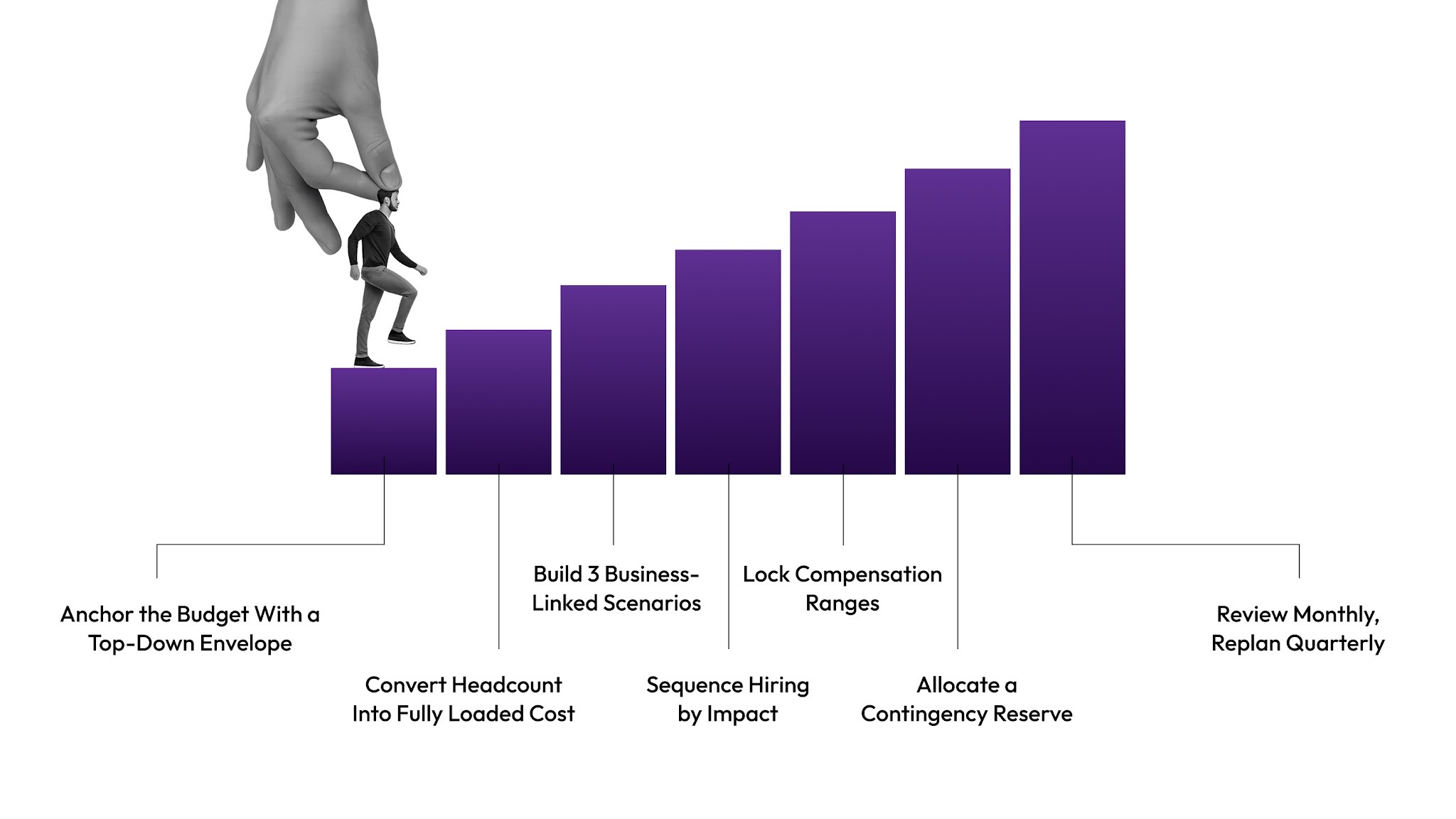
Building a headcount budget is not a single meeting. For a lean HR and Finance team at a 200–800 person company, it is a structured, cross-functional process that typically spans four to six weeks. Here is how to build one that holds up, without drowning in spreadsheets.
Step 1: Anchor the Budget With a Top-Down Envelope
Start with Finance. Define the total labor spend for the year based on revenue targets, cash position, and burn goals. This becomes the compensation envelope.
Without that ceiling, every hiring conversation is theoretical. Finance sets the constraint. HR pressure-tests it against what the business must deliver. Alignment starts here, not after hiring requests start piling up.
Many teams centralize this planning in tools like CandorIQ, so Finance and HR can work from the same budget assumptions instead of separate spreadsheets.
Step 2: Convert Headcount Into Fully Loaded Cost
A role is not “one head.” It is a layered cost. For every proposed hire, map to an approved pay band and calculate:
- Base salary
- Total Reward (base + bonus target)
- Fully loaded employer cost (total cash + 25–30% benefits burden)
- Ramp cost and time to productivity
For example, a $100K base salary role often translates to $135K–$145K in total annual employer spend. Seeing the true number forces department leaders to prioritize more sharply.
Step 3: Build Three Business-Linked Scenarios
Avoid a single static plan. Model scenarios tied to revenue milestones, not optimism.
- If ARR hits target by Q2 → activate X roles
- If growth trails by 15% → pause Y roles
- If growth exceeds plan → unlock stretch hires
This gives the CFO and board confidence, and gives HR a framework to adjust mid-year without restarting the entire planning process.
Step 4: Sequence Hiring by Impact and Cash Timing
Headcount planning is also cash flow planning. A January hire carries 12 months of cost. A September hire carries four.
Map hires month by month against the runway. Prioritize revenue-generating and critical roles early. Align support roles to team growth. This also keeps recruiting capacity realistic. A lean team cannot onboard 20 hires in a single month without operational strain.
Step 5: Lock Compensation Ranges Before Opening Reqs
Before a requisition goes live, the compensation range must be approved and documented.
Hiring manager, HR, and Finance should agree on the band and likely offer positioning in advance. If you negotiate comp after a candidate reaches the offer stage, you are negotiating against urgency, and urgency inflates cost.
Step 6: Allocate a Contingency Reserve
No plan survives the year untouched. Build a 5%–8% reserve into the total headcount budget. This covers:
- Unexpected backfills
- Above-band hires for critical roles
- Attrition spikes
Define governance rules for when the reserve can be accessed. It protects both teams from reactive budget surprises.
Step 7: Review Monthly, Replan Quarterly
A headcount budget cannot sit untouched for six months.
Establish:
- Monthly reviews of actual vs. planned headcount
- Offer-to-band compliance checks
- Cost-center spend tracking
Run a structured replan each quarter to adjust for attrition, hiring pace, and business shifts. Monthly reviews catch drift early. Quarterly replans keep the model aligned with reality.
Platforms like CandorIQ to track planned vs. actual headcount, compensation spend, and attrition in one place so HR and Finance stay aligned as hiring accelerates.
Once your budget is built, the real challenge begins. It is to keep it intact while hiring accelerates. That requires workflow governance.
Also Read: A Practical Guide to Headcount Forecasting for High-Growth Teams
5 Tips to Build Budget Governance Into Your Hiring Workflow
Budget governance works when budget controls are built into the hiring process itself. So that decisions are made with real-time budget visibility, not fixed after the offer is already sent.
- Lock comp ranges at req creation, not at offer stage: Every requisition should include an approved salary range tied to a current pay band before it reaches Recruiting. This forces alignment between HR, the hiring manager, and Finance early, when trade-offs are easier, and pressure is lower.
- Create a structured exception path for above-band offers: Exceptions will happen. The key is requiring documented approval, not silent escalation. Route above-band requests through a defined workflow with CPO and CFO visibility. Accountability preserves flexibility without turning exceptions into routine practice.
- Sync offer approvals to the live budget model: The moment an offer is approved, the headcount budget should update automatically. If finance teams reconcile days or weeks later, variance builds quietly. Real-time visibility prevents end-of-quarter surprises.
- Treat backfills as fresh investment decisions: Backfills are rarely cost-neutral. Market rates shift, and replacement hires often land higher in the band. Run every backfill through the same approval and benchmarking process as a net-new role to prevent budget drift.
- Refresh pay bands before governance breaks: Stale bands undermine enforcement. If market comp has moved 10%–15% and your ranges haven’t, every negotiation will exceed band, and the control system collapses. Review bands at least annually and ideally before each planning cycle.
Strong governance keeps your spending predictable. The next question is whether your controls are actually working, and that requires measurement.
Also Read: High-Impact Equity Compensation Benchmarking for Stronger Strategy
The Metrics That Tell You If Your Headcount Budget Is Working
A headcount budget needs a few clear metrics to stay reliable. These four show whether governance is working or quietly breaking down.

- Offer-to-Band Compliance Rate: Percentage of offers within the approved pay band. If most offers go above band, your ranges are misaligned with the market.
- Loaded Cost Per Hire vs. Plan: Compare the budgeted cost to the actual fully loaded cost. Consistent variance means your cost assumptions need correction.
- Budget Attainment by Cost Center: Track spend versus budget by department. Company-wide averages hide where overspend is actually happening.
- Time-to-Fill vs. Planned Start Date: Measure planned versus actual start dates. Delayed hires distort cash forecasts and create a false budget surplus.
Metrics tell you where the budget has already drifted. But some problems are predictable and worth preventing before they happen. Here are the most common ones at growth-stage companies.
6 Common Mistakes That Break Headcount Budgets at Growth-Stage Companies
Headcount budgets rarely fail all at once. They erode through small, repeated decisions that compound over time. These six mistakes show up most often in companies scaling:
- Approving headcount without locking comp ranges: When a req is approved without a defined salary band, compensation gets negotiated under pressure. By the time a candidate reaches the offer stage, budget discipline is already compromised.
- Running comp cycles and headcount planning separately: Merit increases directly impact the total people spend. If compensation reviews and headcount planning are not modeled together, mid-year budget gaps surface quickly.
- Using outdated benchmark data: Relying on last year’s market data leads to below-market offers, longer hiring cycles, and eventual above-band exceptions that cost more than refreshed benchmarks would have.
- No shared source of headcount data: When HR, Finance, and leadership report different headcount numbers, planning starts with reconciliation instead of decision-making, and budgets drift on stale data.
- Treating backfills as cost-neutral: Market shifts mean replacements often cost more than departing employees. Without reapproval at current rates, backfills create a silent budget variance.
- Setting the budget and never replanning: An annual budget without a quarterly review cannot adapt to hiring pace, attrition changes, or new business priorities. Governance requires regular recalibration.
Avoiding these mistakes requires more than good intent. It requires the right processes and tools working together. Here's where CandorIQ fits into that picture.
Also Read: Employee Compensation Challenges and Influential Factors
How CandorIQ Helps You Build Your Headcount Budget Planning
For most lean HR and Finance teams, headcount budgeting still runs on disconnected systems. Every planning cycle begins with reconciling numbers instead of making decisions, and budget governance depends on someone manually catching discrepancies.
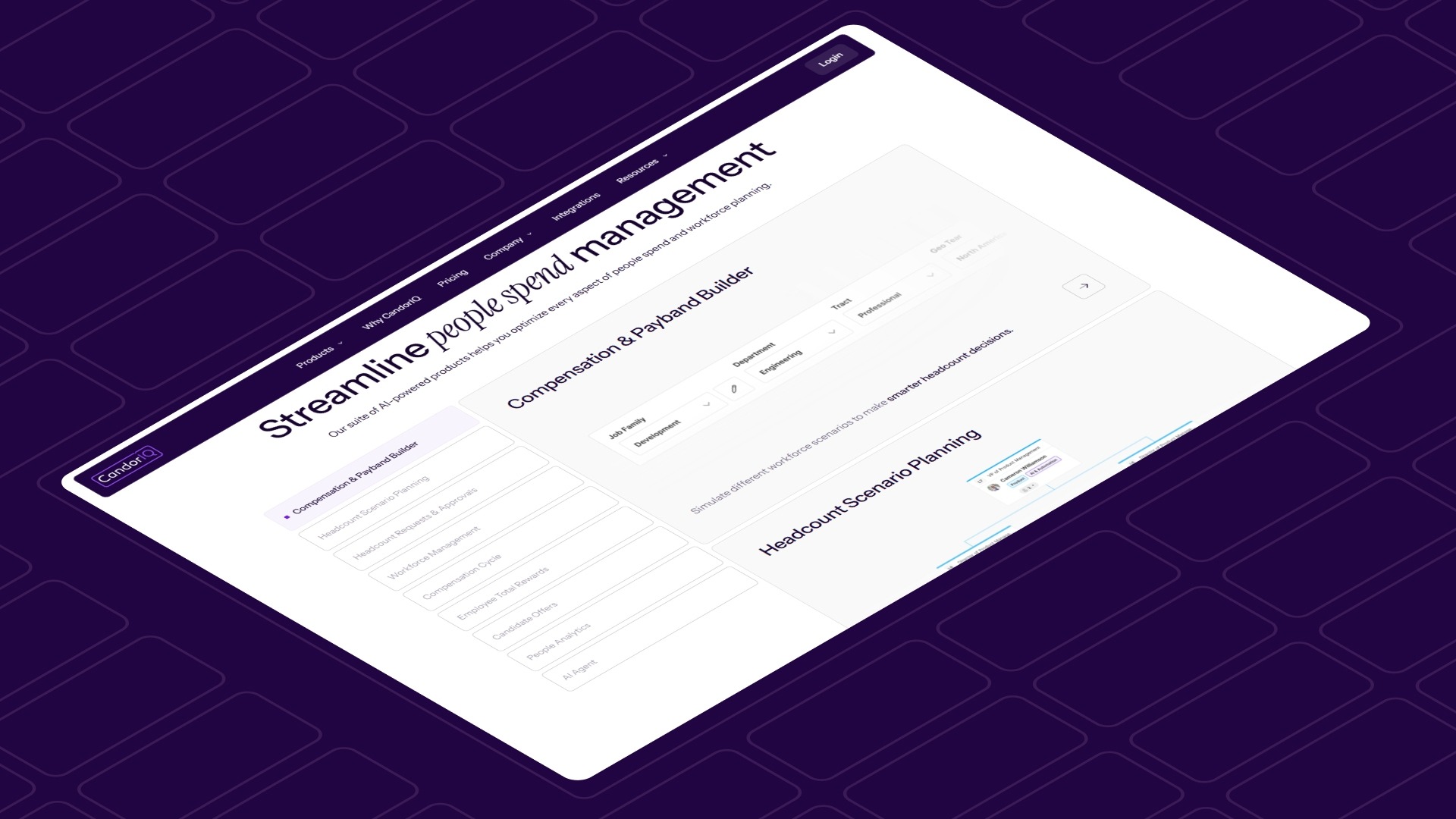
CandorIQ replaces that fragmentation with a unified platform that lets you operate on the same real-time headcount and compensation data. Pay bands, hiring requests, offer approvals, comp cycles, and workforce reporting live in one connected system, so governance happens inside the workflow rather than after the fact.
We offer:
- Compensation & Pay Band Builder: Create and manage pay bands by level, location, and department with built-in version control. View pay distribution in real time and maintain audit-ready records across planning cycles.
- Headcount Scenario Planning: Model future org structures and instantly see their financial impact. Compare multiple hiring scenarios against budget thresholds before approving a single role.
- Headcount Requests & Approvals: Launch new hire requests with embedded comp ranges and projected budget impact. Route approvals automatically based on predefined rules and sync with ATS and finance systems.
- Candidate Offer Workflows: Generate offers within approved pay bands using structured guardrails. Provide full visibility into salary, equity, bonus, and benefits while keeping offers aligned to plan.
- Compensation Cycle Management: Run merit and bonus reviews with automated approval logic and real-time budget tracking by department. Keep cycles moving with built-in notifications and visibility.
- Workforce Management: Track open roles, filled positions, attrition, and promotions against plan in one dashboard. Align headcount and compensation actuals with financial targets.
- AI Agent: Ask natural language questions to analyze compensation gaps, forecast hiring needs, and model budget scenarios using your actual workforce data.
CandorIQ is built for growth-stage companies that need disciplined budget governance without building a large FP&A function to manage it.
Conclusion
Headcount budgeting is where hiring ambition meets financial discipline. For growth-stage companies, the gap between planned hires and actual employer cost isn’t minor. It compounds every quarter in payroll, equity spend, and cash flow.
Teams that manage this well don’t rely on more spreadsheets. They embed compensation ranges into req approvals, keep pay bands current, model fully loaded costs upfront, and review spend monthly instead of waiting for year-end surprises.
If your HR and Finance teams are working from different numbers, offers are approved in email threads, and budget variance only shows up after the close. That’s not a communication issue. It’s a systems issue.
CandorIQ brings headcount planning, pay band governance, offer workflows, and compensation cycles into one connected platform. Book a demo to see how we work for your team.
.png)
FAQs
Q. How do you calculate the loaded cost of a hire?
Add base salary, target bonus, employer payroll taxes, benefits costs (typically 20–30% of base), and any recruiting fees. For complete accuracy, factor in ramp-period productivity loss for the first 30–90 days on the role.
Q. When should headcount budget planning start?
For most U.S. companies, headcount budget planning should begin in Q3, gathering workforce gap analysis, department requests, and scenario models, with a locked plan and board alignment completed before Q4 ends.
Q. What are common mistakes in headcount budget planning?
The most common: approving roles without locked comp ranges, running comp cycles on separate timelines from headcount planning, using outdated salary benchmarks, treating backfills as cost-neutral, and never replanning mid-year.
Q. How do pay bands relate to headcount budgeting?
Pay bands function as budget guardrails. When bands are current, they constrain offers to modeled ranges. When bands are stale, above-band offers become routine, and the budget loses predictability with each hire.
Q. What metrics should I track to monitor headcount budget health?
Track offer-to-band compliance rate, loaded cost per hire vs. plan, budget attainment by cost center, and variance between planned vs. actual start dates. These four metrics surface most budget drift before it becomes a major overrun.
Ready to modernize your workforce and compensation strategy?
See how CandorIQ brings workforce planning and compensation together with AI.