

Employee Compensation Challenges and Influential Factors
Explore key employee compensation challenges and the factors that influence HR decisions. Understand how to tackle these hurdles for fair and effective compensation. Learn more!

You just hired a new engineer for $180,000. Two weeks later, you realize your senior engineer, who’s been with you for three years, only makes $165,000. Now the senior engineer feels undervalued, and you're facing a retention crisis.
These are the challenges of hypergrowth compensation management.
For scaling companies, compensation isn't just an HR task. It's a strategic imperative that directly impacts your runway, hiring velocity, and team stability. Yet most growth-stage organizations tackle it with spreadsheets, gut feelings, and reactive fire-fighting.
This guide breaks down the eight most critical compensation challenges facing distributed, rapidly scaling teams, and gives you practical frameworks to solve them.
At a glance
- Competitive compensation reduces time-to-hire and turnover, while pay equity is now a legal requirement in many states.
- Compensation complexity grows exponentially with team size. A structured, consistent approach is essential to avoid costly mistakes like compression and compliance issues.
- Build compensation infrastructure early to free up HR resources for strategic work and avoid firefighting. Focus on core tasks like salary bands, approval workflows, and pay equity analysis in your first 90 days.
- When managing 100+ employees, move beyond spreadsheets to specialized tools. Opt for Stage 2-3 transparency, offering salary bands and a clear compensation philosophy, to maintain fairness without overwhelming your team.
The Strategic Value of Compensation Management
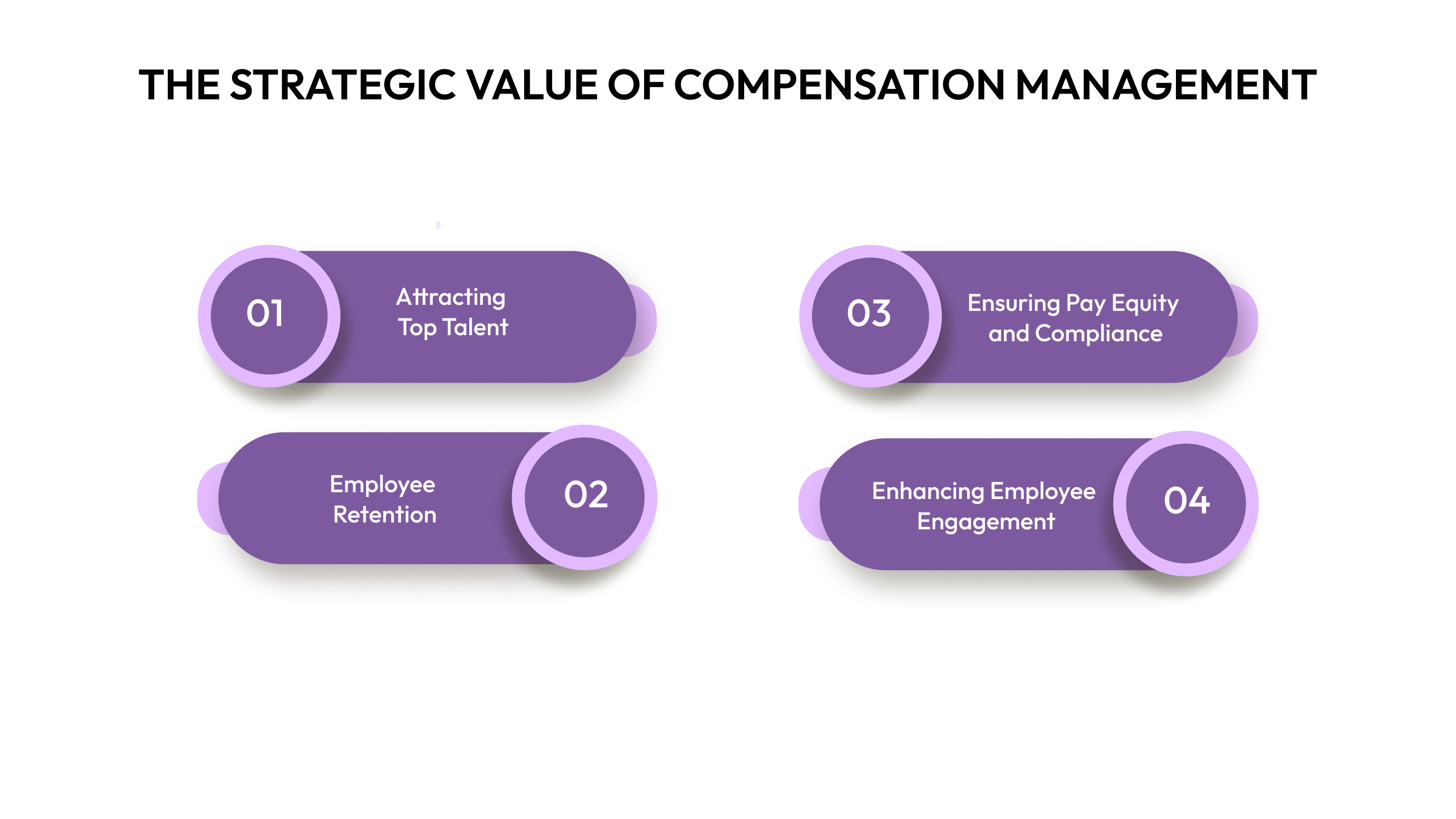
Before we dive into challenges, let's establish why getting compensation right matters beyond "keeping employees happy." Getting compensation right is about more than keeping employees happy; it’s key to your company’s success.
- Attracting Top Talent: A strong compensation structure helps you stand out in the competitive talent market. In 2025, candidates will compare offers based on market data and total rewards packages. A clear, fair framework speeds up hiring, reduces salary negotiations, and showcases your company’s maturity.
- Employee Retention: Compensation dissatisfaction can drive employees away. While money isn't the only reason people leave, feeling undervalued often is. Replacing a mid-level employee costs 100-150% of their salary, and senior roles can be even more expensive.
- Ensuring Pay Equity and Compliance: Pay equity is not just ethical; it's becoming a legal requirement. States and countries like the EU mandate pay transparency and regular gap reporting. Non-compliance risks legal trouble and damages trust within your company.
- Enhancing Employee Engagement and Productivity: Fair pay fosters trust and engagement. When employees know they're paid fairly, they focus on their work, not salary comparisons. Research shows that pay fairness impacts engagement more than pay itself. A transparent compensation structure is a powerful tool for boosting morale and productivity.
But, here’s the reality about hypergrowth: compensation complexity doesn’t scale smoothly; it explodes.

Also Read: Comprehensive Guide to Salary Benchmarking Compensation
The Unique Compensation Landscape for Scaling Organizations
When your company has about 20 people, there are only a few job types and one office. Decisions about pay are quick and usually made in a small group. But when you grow to 200 people, things change. You now have dozens of roles spread across many locations, each with different pay levels, benefits, and budgets.
Even a company with 10 job types in 5 places faces 50 different pay setups. If you add seniority levels and equity options, those combinations can easily jump to more than 500.
The cost of getting it wrong during growth hits you in three ways:
- Compression and Inequities: Fixing pay issues can be expensive. One Series B company spent $2.3M fixing compression problems created during an 18-month hiring sprint.
- Bad Hires and Retention Loss: Overpaying early burns through runway, while underpaying in competitive markets costs you top talent and the employees you’ve already trained.
- Opportunity Cost: CFOs and CPOs spending 20 hours a week on compensation spreadsheets aren’t focusing on the strategic initiatives that drive growth.
As a result, compensation complexity grows quickly. Read on to understand the challenges in compensation management.
8 Compensation Challenges Unique to Distributed Hypergrowth Teams
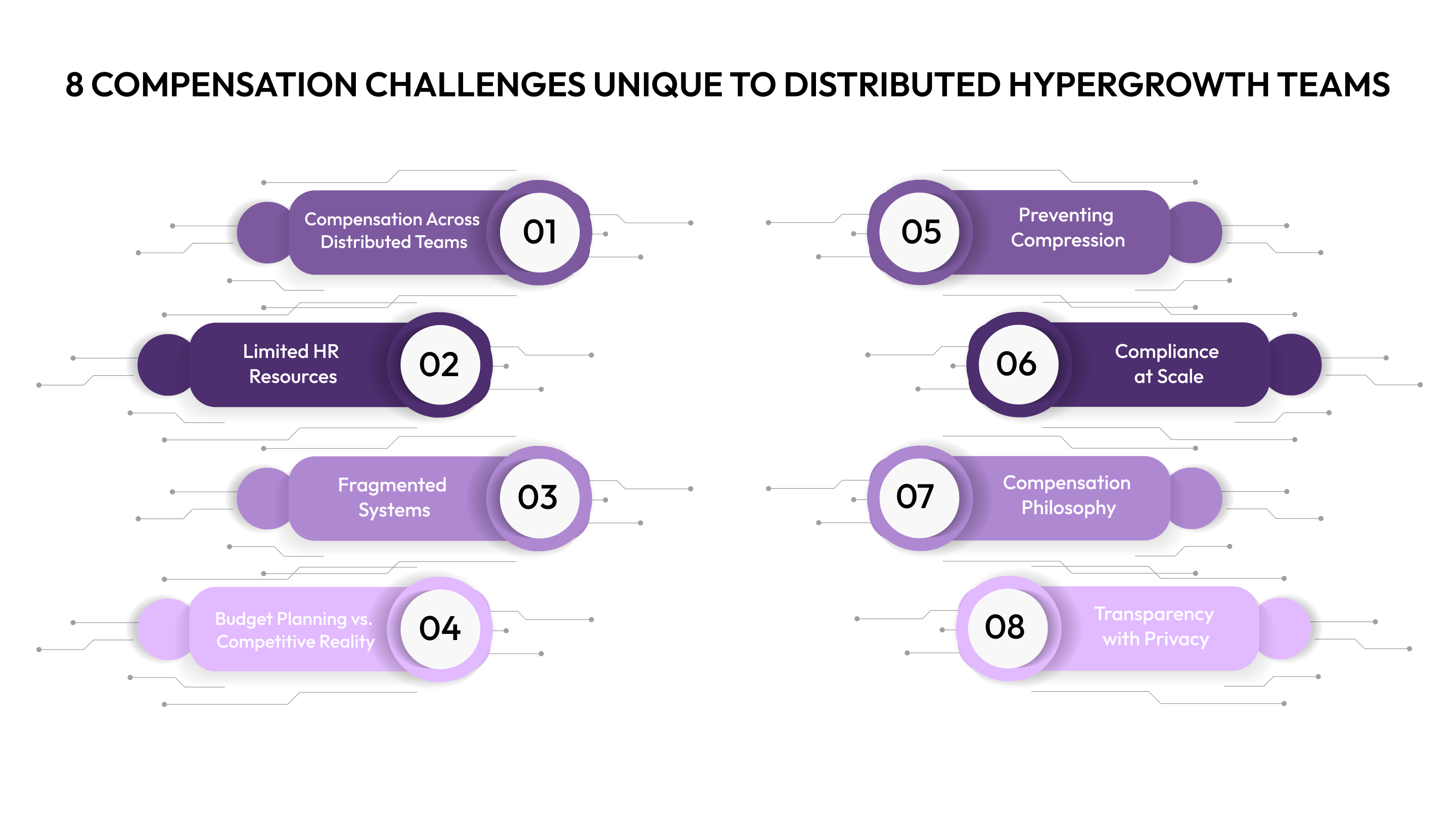
As your organization scales and expands across locations, managing compensation becomes more complex. What worked for 50 employees may no longer suit 200. Here are the unique compensation challenges scaling organizations face and how to navigate them.
Challenge 1: Managing Compensation Across Distributed Teams
As remote work grows, the question arises: Should a worker in Austin earn less than one in San Francisco for the same role? Companies split into three camps:
- Location-based pay adjusts salaries based on geography, prioritizing cost efficiency but risking inequity.
- Role-based pay offers the same salary across locations, simplifying decisions but potentially overpaying or underpaying in certain areas.
- Hybrid models combine both approaches, using role-based bands with geographic multipliers.
The key: pick a consistent approach and apply it transparently. Inconsistency leads to more issues than any one model. Platforms like CandorIQ can automate these geographic adjustments across your entire compensation structure, saving hours of manual calculation while maintaining consistency.
Challenge 2: Limited HR Resources, Unlimited Compensation Decisions
With a small HR team and a growing company, compensation decisions can quickly overwhelm. Each new hire requires market research, and every promotion needs approval. Your team gets bogged down with time-consuming processes.
To manage and prioritize compensation initiatives:
- Must-have (do now): Core compensation bands for top roles, offer approval workflows, and compliance basics.
- Should-have (within 6 months): Promotion frameworks, annual reviews, and compression monitoring.
- Nice-to-have (defer): Advanced analytics and complex incentive structures.
Build internal frameworks, buy external tools for market data, and defer complicated systems until you can scale.
Challenge 3: Fragmented Systems and Spreadsheet Chaos
Compensation data is often scattered across ATS, HRIS, finance systems, and spreadsheets, leading to wasted time and poor decision-making. Reconciliation alone can take hours each month.
To fix this, centralize compensation data. Use a simple database with workflows that track approvals, promotions, and equity grants. This reduces spreadsheet chaos by 80%. CandorIQ's unified platform connects directly to your existing HRIS and ATS, creating that single source of truth without requiring data migration or system overhauls.
Challenge 4: Budget Planning vs. Competitive Reality
Compensation budgets are often set months in advance, but market conditions can change quickly. Finance thinks in fixed terms, while talent markets shift quarterly.
Fix this by modeling three compensation scenarios:
- Conservative: 80% confidence, based on current market rates.
- Expected: Adds buffer for market movement.
- Aggressive: Accounts for talent scarcity or high competition.
Reserve 5-10% of your budget for market adjustments.
Challenge 5: Preventing Compression from Rapid Hiring
Rapid hiring can lead to pay compression, where new hires make more than longer-tenured employees in similar roles.
Prevent it by:
- Setting non-negotiable salary bands.
- Flagging offers that create more than 10% compression.
- Conducting quarterly audits to compare new hires to existing employees.
Correct issues early to avoid retention crises.
Challenge 6: Compliance at Scale
As you scale across states or countries, compliance with pay transparency laws and equal pay requirements becomes more complex.
Stay prepared by:
- Documenting your compensation philosophy.
- Keeping accurate records of compensation decisions and rationale.
- Maintaining compliance tracking for each location’s specific requirements.
Have your audit trail ready at all times.
Challenge 7: Getting Executive Alignment on Compensation Philosophy
Without alignment, compensation decisions become inconsistent. Executives may have different priorities: the CPO wants to be competitive, the CFO focuses on the budget.
Frame compensation as a strategic investment by showing how it affects hiring speed, turnover, and offer acceptance rates. Demonstrate cost-saving benefits by comparing the cost of losing talent vs. paying them fairly.
Challenge 8: Balancing Transparency with Privacy
Compensation transparency is a spectrum. Start with Stage 2 transparency which mean share salary bands and your compensation philosophy. Avoid full transparency (Stage 4) unless your systems are mature.
When communicating changes, explain:
- Why: Why the new framework is necessary.
- How: The methodology behind salary bands.
- What: The impact on employees' growth and next steps.
Prepare managers to handle questions about pay equity, and encourage a focus on growth rather than comparisons.
Managing compensation in hypergrowth isn’t easy, but with the right systems and a consistent approach, it can become a strategic asset.
In the next section, we will discuss a compensation framework suitable for you.
Also Read: A Comprehensive Guide to Conducting Compensation Analysis
.png)
A Practical Framework: Your First 90 Days of Compensation Governance
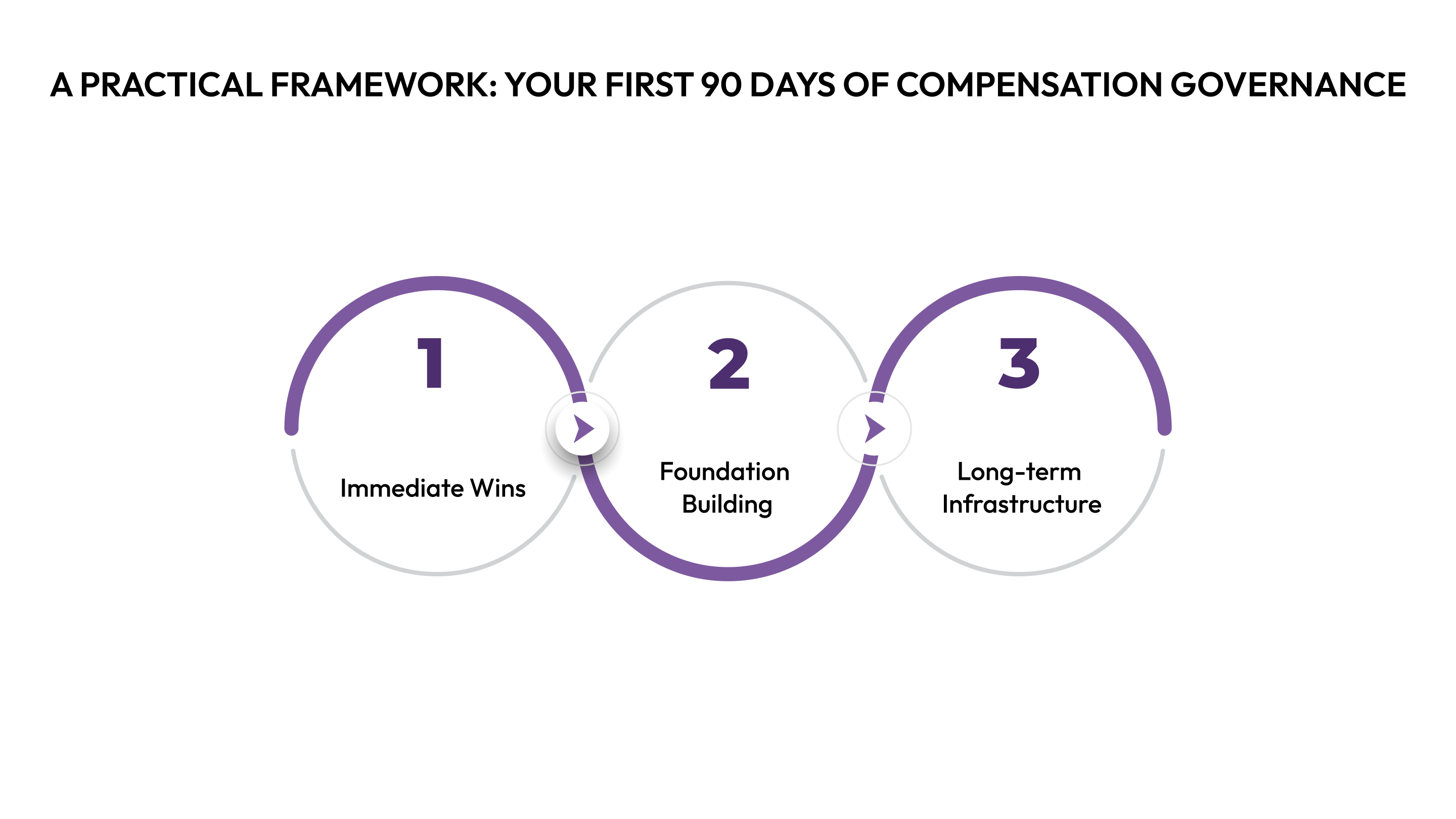
You've inherited compensation chaos. Where do you start? Here's a phased approach that creates quick wins while building sustainable infrastructure.
Immediate Wins (Week 1-4)
- Audit: Review current salaries, titles, and agreements. Don’t fix yet—just understand the reality.
- Prioritize: Focus on the top 5-10 roles by headcount and hiring priority.
- Market Data: Gather data for those key roles using multiple sources (e.g., Radford, Mercer).
- Salary Bands: Create simple salary ranges for key roles (minimum, midpoint, maximum).
- Offer Approval: Set up a basic approval workflow, and ensure that at least two people review each offer.
Foundation Building (Month 2-3)
- Expand Bands: Extend salary bands to cover all roles.
- Compensation Philosophy: Document your approach to market positioning, geographic strategy, equity, and decision-making.
- Pay Equity Analysis: Identify gaps and compression issues (don’t fix yet).
- Correction Budget: Quantify costs for fixing identified issues and get executive approval.
- Regular Checkpoints: Set monthly reviews for new hires, quarterly compression audits, and annual reviews.
Long-term Infrastructure (Month 4+)
- Compensation Tools: Evaluate tools based on your pain points.
- Promotion Frameworks: Define clear criteria for role advancement.
- Communication Materials: Create manager training, employee resources, and FAQs.
- Market Monitoring: Set up quarterly market data refreshes.
- Forecasting Models: Link compensation planning to headcount projections for budgeting.
The goal isn't perfection in 90 days. It's moving from reactive chaos to proactive management with clear frameworks and data-driven decisions.
Also Read: Effective Compensation Strategies for Workforce Optimization
Tips to Roll Out a New Compensation Framework Without Causing Chaos
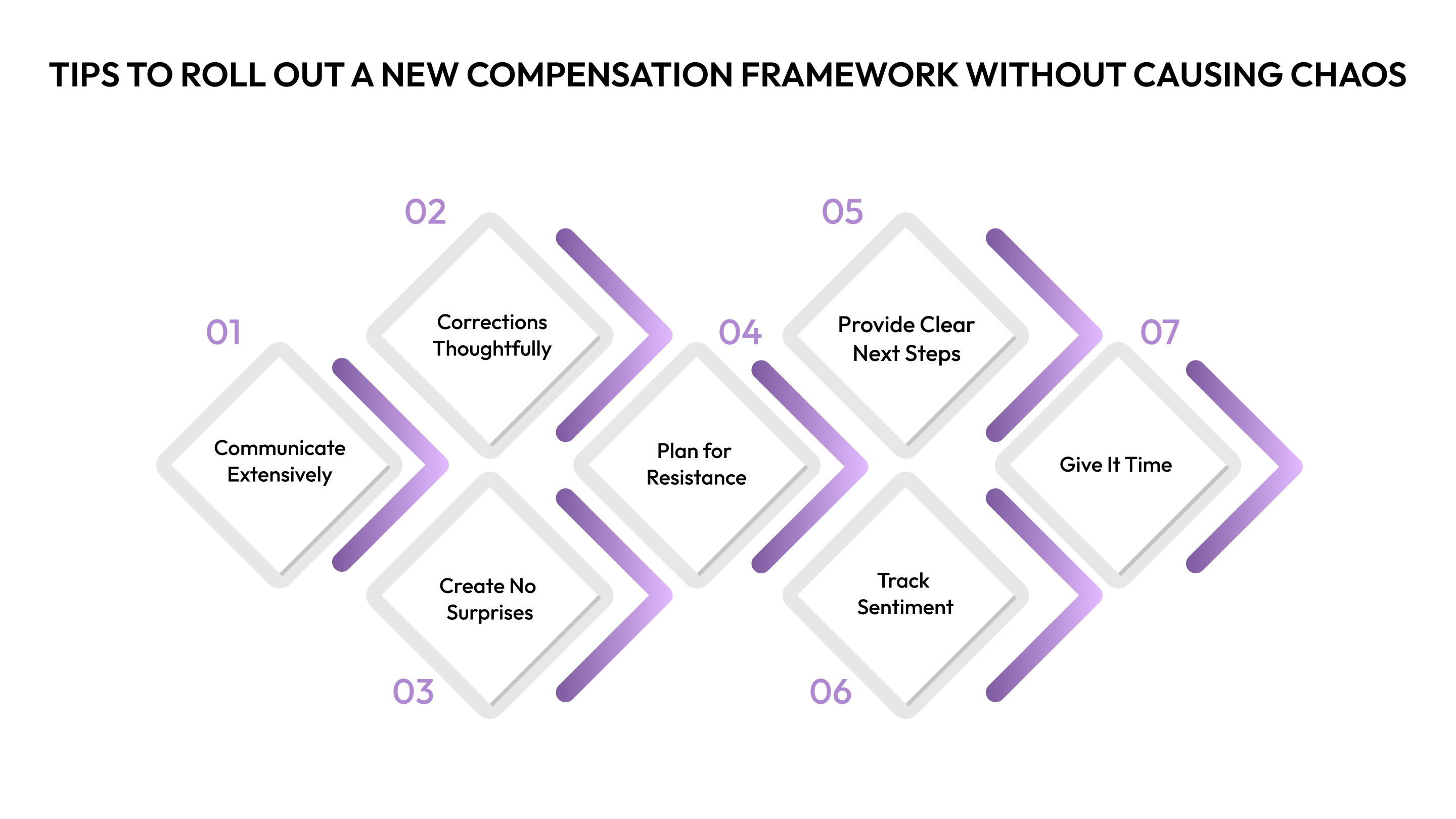
A well-designed compensation framework can fail if not implemented correctly. Here’s how to roll it out smoothly and avoid creating chaos.
- Tip 1: Communicate Extensively: Announce the change with a clear rationale. Explain what’s changing, why, and what employees can expect. Share FAQ resources before questions arise. Hold manager training sessions first, they’ll be the front line for employee inquiries.
- Tip 2: Phase Corrections Thoughtfully: If 40% of employees need adjustments, don’t fix everything at once. Prioritize the most significant inequities and critical roles. Address compression issues in retention-risk positions first, and save others for the next review cycle.
- Tip 3: Create No Surprises: Every affected employee should hear about the changes from their manager before any company-wide announcement. Prepare talking points and role-play difficult conversations to help managers handle tough discussions.
- Tip 4: Expect and Plan for Resistance: Some employees may feel disappointed by where they land in the new bands. Prepare managers to address concerns with empathy: "I understand this isn’t what you hoped. Let’s talk about your growth path and what advancement looks like."
- Tip 5: Provide Clear Next Steps: Show employees how they can progress. If someone’s at the 40th percentile, explain how to reach the 60th or 75th. Make progression criteria transparent and attainable. CandorIQ lets you control what compensation details each employee sees, from full band visibility to just their own positioning, aligned with your chosen transparency stage.
- Tip 6: Track Sentiment: Monitor engagement, attrition, and feedback after implementation. Check if new issues are arising and be ready to adjust accordingly.
- Tip 7: Give It Time: Compensation changes take time to show results. Don’t panic after two weeks of questions. It can take 6-12 months to properly assess the impact. Stay patient and adjust as necessary.
So where does this leave you? Let's bring everything together with a clear path forward.
Also Read: Compensation Management Software Guide for HR Teams in 2025
Conclusion
Compensation done poorly leads to chaos: unwanted turnover, costly fixes, executive conflicts, and employee resentment. But when done well, it becomes invisible infrastructure. Hiring moves faster with consistent offers, retention improves with trust, and budgeting becomes predictable. Executive discussions shift from firefighting to strategy.
The real challenge is implementing this while dealing with day-to-day compensation decisions. Infrastructure is needed most when there’s the least capacity to build it.
This is where purpose-built compensation platforms like CandorIQ come in. We address the specific challenges of managing distributed compensation, connecting fragmented data, and running automatic compression audits.
If you’re spending more than 10 hours a week managing compensation, facing compression issues, or struggling to provide accurate budget projections, it’s time to consider specialized tools. See how CandorIQ can help you transition from spreadsheet chaos to strategic compensation management.
Frequently Asked Questions
1. How do we handle compensation with only 1-2 HR people?
Focus on building systems, not relying on manual decisions. Start with salary bands for key roles and clear approval workflows. Use tools for workflow automation—offer approval software, compensation planning tools, or automated databases. Defer complex initiatives until you have more capacity. Aim for 80% coverage with 20% effort through structured processes.
2. What's the first compensation metric we should track?
Start with compa-ratio: the ratio of actual salary to the midpoint of your salary band. This metric shows if you’re paying above or below target and helps spot compression early. Track it by role, department, and tenure. Add offer acceptance rate as a secondary metric to gage market competitiveness.
3. How do we prevent new hire compression?
Implement pre-offer compression checks as part of your workflow. Compare proposed salaries against current employees in similar roles and flag offers that create more than 10% compression. Set aside 2-3% of your salary budget for compression corrections and run quarterly audits to catch issues early.
4. When should we move from spreadsheets to software?
Make the switch if you’re spending 10+ hours reconciling data, making errors from outdated information, or struggling to answer basic questions about salary commitments. Also, consider it when managing compensation for 100+ employees or operating across multiple states. At that point, spreadsheet risks outweigh software costs.
5. How transparent should we be about compensation?
Start with Stage 2 transparency: share salary bands, your compensation philosophy, and decision criteria. This addresses fairness concerns without compromising individual privacy. Avoid total secrecy (Stage 0) and consider full transparency (Stage 4) once your systems are mature enough.
Ready to modernize your workforce and compensation strategy?
See how CandorIQ brings workforce planning and compensation together with AI.