

Compensation Model Optimization: The Proven 2026 Guide
Stop losing top talent to broken pay structures. Learn proven strategies for compensation model optimization, built for US HR and Finance teams scaling fast.
Compensation is one of the largest line items in any company's budget. Yet most organizations manage it reactively, adjusting pay when someone threatens to leave, benchmarking salaries once a year, and running merit cycles in spreadsheets. That's administration, not optimization.
61% of US employers say economic uncertainty is directly impacting their pay decisions in 2026. Yet most still lack the structured model to respond quickly. That's a systems problem.
Compensation model optimization turns compensation from a reactive expense into a proactive business tool.
In this article, you'll get a practical breakdown of why compensation models break, a proven 5-step optimization framework, how AI is changing the game in 2026, and how to choose the right platform to make it stick.
Key Takeaways
- Most US compensation models break down not because of budget limits, but because pay structure, equity, and headcount planning are managed in silos.
- Compensation model optimization is a continuous process, not an annual event, that requires HR and Finance to work from the same data.
- Companies that connect pay band decisions to headcount scenarios reduce budget overruns before they happen, not after.
- AI-powered tools now identify flight-risk employees based on comp gaps, not just flag underpaid roles after the fact.
- CandorIQ consolidates pay bands, compensation cycles, headcount planning, and AI-driven insights into one platform, built specifically for scaling US teams.
What is Compensation Model Optimization?
Compensation model optimization means proactively building and maintaining a pay system that holds up under pressure, when you're scaling fast, when market rates shift, and when Finance asks hard questions about headcount costs.
The 3 Pillars: Structure, Equity, and Budget Fit
Every compensation model rests on three pillars. When they work together, your model is defensible, fair, and financially predictable.
Pillar 1: Internal Pay Band Structure: Define roles, levels, and pay ranges upfront. Without this structure, teams negotiate every offer and promotion from scratch, which leads to inconsistency.
Pillar 2: Pay Equity: Ensure employees in similar roles and levels fall within a fair pay range. With 14 US states now requiring salary range disclosures in job postings, pay equity gaps now create legal risk, not just cultural issues.
Pillar 3: Budget Alignment: Tie compensation decisions to the company’s financial plan. If your salary bands and headcount forecasting are not connected, budget gaps show up later. Aligning early prevents surprises.
However, most companies handle only one of these at a time. That approach breaks down quickly as the company grows.
Now, understand whether you are actually optimizing or just keeping the lights on.

Optimization vs. Administration: Know the Difference
Most HR teams are in administration mode because they are under-resourced and overstretched. But there's a real cost to staying there.
Here's how administration and optimization differ:
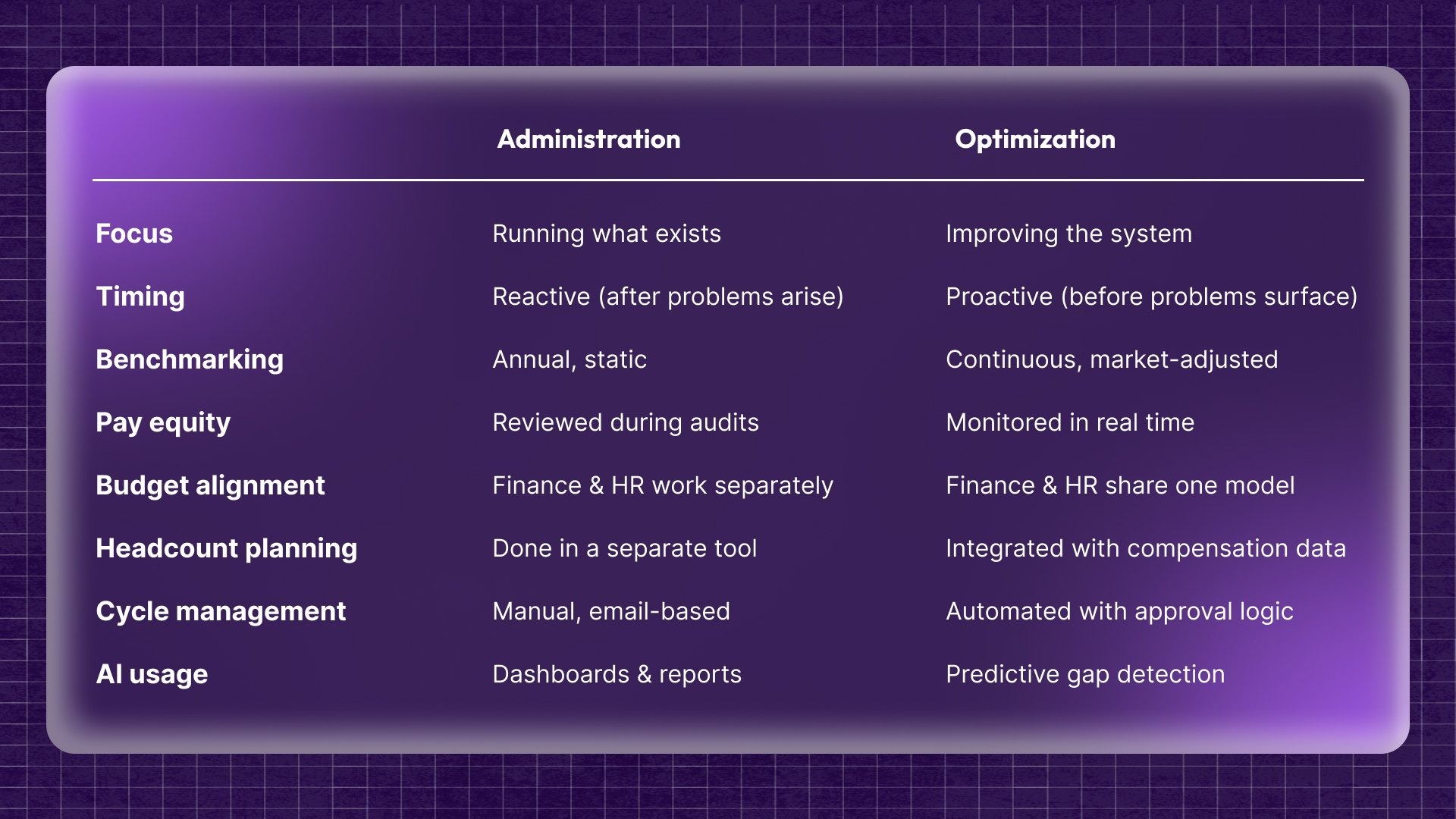
So, optimizing compensation models will help you get over manual processes and compensation breakdowns.
Also Read: 5 Core Functions of Human Resources to Optimize
And that leads directly to the question most teams avoid: why do compensation models break in the first place?
Why Most Compensation Models Break at Scale in 2026
Companies don’t struggle with compensation because they ignore it. They struggle because their process can’t keep up with growth. Here’s where it breaks:
- Pay bands don’t evolve with growth: Teams design pay bands for a smaller company and don’t update them as roles and structures change. Over time, exceptions pile up and create larger gaps.
- Market data becomes outdated: Many companies benchmark salaries once a year, but hiring markets shift faster. Using old data leads to offers that miss the mark.
- HR and Finance use different data: HR and Finance track compensation and headcount separately. This disconnect leads to budget surprises and misaligned hiring plans.
- Compensation cycles move too slowly: Long review cycles frustrate employees. Delays signal poor planning and increase the risk of losing top performers during the process.
- Pay decisions lack clear records: Without tracking changes and exceptions, teams can’t explain past decisions. This makes audits, reviews, and planning harder.
- Teams manage location-based pay manually: Handling different pay levels across locations in spreadsheets leads to errors and unnoticed pay gaps.
Understanding these gaps is the first step. The next step is knowing how to fix them in the right order.
5 Proven Steps to Optimize Your Compensation Model in 2026
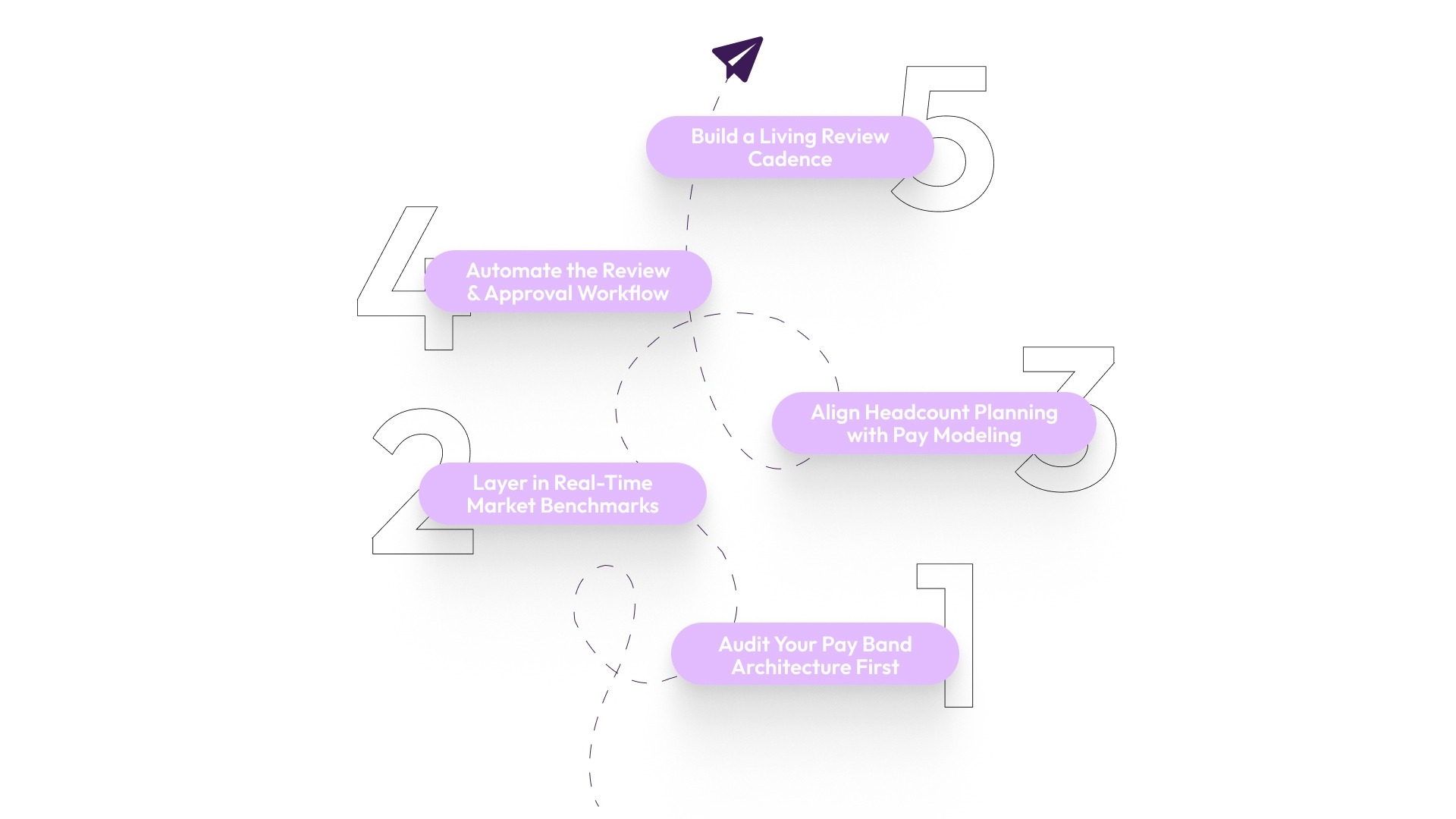
This isn't a list of best practices you've already heard. These are the specific actions, in order, that turn a fragmented pay process into a system that holds up under growth.
Step 1: Audit Your Pay Band Architecture First
Before you benchmark or automate anything, you need to know what you actually have.
Start by asking:
- Are your pay bands geo-adjusted for your distributed workforce?
- When were they last benchmarked against current market data?
- Who owns the bands, and is there a version history?
- Can you explain every exception made in the last 12 months?
Most pay audits check for fairness, whether people seem to be paid fairly relative to each other. The better audit checks for structural defensibility. Can every band decision survive a candidate negotiation? Fix the structure before you do anything else. Everything downstream depends on it.
Step 2: Layer in Real-Time Market Benchmarks
Static benchmarks create lag. For US companies with distributed teams, location-based pay adjustments are now non-negotiable. Getting this wrong costs you either talent (because you're underpaying) or budget (because you're overpaying without realizing it).
Fast-growth SaaS and fintech companies hiring across time zones need geo-adjusted bands that update dynamically, just like the compensation and payband builder of CandorIQ. Real-time benchmarking data, integrated directly into your pay bands, is what separates a defensible offer from an educated guess.
Not sure if your pay bands are built to scale? Your architecture needs a review before your next hire. See how CandorIQ's Pay Band Builder works.
Step 3: Align Headcount Planning with Pay Modeling
Every new hire changes your compensation model. They set precedents for their level, their location, and their function. If those decisions aren't connected to your existing band structure and your live budget, you're building equity risk with every offer letter.
Scenario planning closes this loop. When you can model the financial impact of a hiring plan before approvals are made, Finance and People Ops can align on realities.
Step 4: Automate the Review and Approval Workflow
Manual approval chains are one of the most underrated risks in compensation management. When comp decisions travel through email or Slack, they leave no clean audit trail, create inconsistency, and slow down merit cycles.
Automated approval logic, with built-in rationale logging, creates both speed and accountability. Every decision has a record. Every exception has an explanation. And the cycle doesn't stall because someone forgot to reply to an email.
Step 5: Build a Living Review Cadence, Not a Calendar Event
The optimization mindset treats compensation as a continuous signal. You check in quarterly. You track market drift in real time. You catch the underpaid high performer before they get a competing offer.
This is exactly where AI-assisted monitoring shifts compensation from reactive to predictive. Instead of waiting for a problem to show up in an exit interview, you see it coming weeks in advance. Which brings us to the change that's making the biggest difference in 2026.
Also Read: Understanding Merit-Based Pay: Benefits and Implementation
How AI Is Reshaping Compensation Optimization in 2026
AI is quietly dismantling one of the most fundamental assumptions in compensation: that roles determine pay. Instead, companies are starting to price real-time contribution, and AI is making that shift operational.
Here’s what’s actually changing:
1. Real-Time Benchmarking Makes Pay More Adaptive
AI can scan live job market signals and recommend salary ranges based on role, skills, and location, instantly.
Instead of relying on static, outdated benchmarks, companies can now:
- Stay aligned with evolving market conditions
- Respond faster to talent demand shifts
- Maintain external competitiveness without long lag cycles
Real-time data enables compensation strategies to keep pace with the market.
2. Predictive Analytics Enables Proactive Decisions
AI models can identify retention risks and recommend pay adjustments using performance trends, engagement signals, and historical data. This shifts compensation from reactive to proactive.
Organizations can:
- Anticipate attrition risks before they escalate
- Allocate compensation budgets more strategically
- Align rewards with emerging performance patterns
While no model is perfect, these insights provide a stronger starting point than intuition alone.
3. Pay Equity Monitoring Strengthens Fairness and Transparency
AI enables continuous monitoring of pay gaps across roles and demographics. This creates an opportunity to move beyond periodic audits toward ongoing accountability.
With better visibility, companies can:
- Identify disparities earlier
- Take timely corrective action
- Build more transparent and defensible pay structures
Equity becomes a continuous process, not a one-time initiative.
4. Scenario Modeling Improves Decision Confidence
Modern platforms allow teams to simulate “what-if” compensation scenarios for promotions, restructures, and rewards. This allows you to evaluate decisions before committing to them.
The result:
- More informed trade-offs between cost and impact
- Better alignment between compensation and business strategy
- Increased confidence in high-stakes decisions
Scenario modeling doesn’t replace judgment. It strengthens it.
5. Performance-Linked Pay Creates Stronger Alignment
AI makes it easier to connect pay with measurable contribution, including output, impact, and performance signals. This enables a shift toward more merit-driven systems.
Organizations can:
- Reward high-impact work more precisely
- Align incentives with business outcomes
- Create clearer links between performance and pay
When designed thoughtfully, this approach can reinforce accountability while still recognizing diverse forms of contribution.
AI is transforming compensation from a periodic process into a continuous one. This creates greater agility and responsiveness across the organization. It also introduces the ability to evolve compensation strategies in real time as business needs change.
Also Read: AI in HR — Key Compliance & Risk Management Strategies
Want to see AI-assisted compensation analysis in action? CandorIQ's AI Agent lets you ask natural language questions about your pay data and get answers in seconds. Explore CandorIQ's AI Agent →
However, the right platform will not only automate what you already do, but it will also solve your workflow issues.
Choose the Right Platform for Optimizing Your Compensation Model
Growing US companies face a hard reality: their compensation model was never designed for the scale they're at now. Pay band exceptions pile up. HR and Finance work from different data. Comp cycles drag on. And every quarter, the gap between what was planned and what was spent gets harder to explain.
CandorIQ is built to close that gap. It brings pay bands, compensation cycles, headcount planning, and AI-driven insights into one connected platform, so HR and Finance finally work from the same numbers.
Here's what that looks like in practice:
- Compensation & Pay Band Builder: Define geo-adjusted pay bands by level, location, and department. Visualize pay distribution in real time. Track every change with built-in version control.
- Compensation Cycle Automation: Run merit and bonus cycles with automated approval logic, rationale logging, and real-time budget tracking, without the email chains.
- Headcount Scenario Planning: Model the financial impact of hiring plans before approvals happen. Finance and People Ops align on what's realistic, not just what's aspirational.
- AI Agent: Ask natural language questions about your comp data, detect pay gaps proactively, and get recommendations based on benchmarks and performance data.
- Candidate Offer Tools: Show candidates total compensation, salary, equity, bonus, and benefits, in a clear, interactive format that builds trust and closes faster.
CandorIQ helps lean HR teams at scaling US companies replace fragmented processes with a single system that's built for the way modern People and Finance teams actually work.
Conclusion
Compensation model optimization isn't about paying people more. It's about building a system where every pay decision is defensible, every cycle runs cleanly, and Finance and HR are never working from different data at the same time.
CandorIQ gives HR and Finance teams one connected platform to manage pay bands, run compensation cycles, plan headcount scenarios, and leverage AI-powered insights, all without the spreadsheets and disconnected processes that slow growing companies down.
Ready to see how it works for your team? Get in touch with CandorIQ today.

FAQs
Q: How often should a company review its compensation model?
At a minimum, quarterly check-ins on pay band alignment and market drift. A full structural review, including band architecture and equity analysis, should happen at least twice a year for companies growing headcount by more than 20% annually.
Q: What's the difference between a pay band and a salary range?
A salary range is the minimum-to-maximum for a specific role. A pay band is a broader framework that groups multiple roles or levels under one structured range, with defined midpoints and progression logic. Pay bands are the architecture; salary ranges are applied within them.
Q: How do US pay transparency laws affect compensation optimization?
With 14 states now requiring salary range disclosures in job postings, your pay bands need to be legally defensible and publicly communicable. Companies without structured bands face a harder compliance burden and a higher risk of internal equity complaints when ranges become visible to employees.
Q: Can small HR teams realistically run compensation model optimization?
Yes, and that's exactly who benefits most. A 2–3 person HR team managing pay for 300+ employees can't do this manually. Automation and AI-assisted tools make optimization achievable without adding headcount to the HR function itself.
Q: What's the first sign that a compensation model needs optimization?
The clearest signal is unexplained pay variation, two people in the same role, same level, same location, earning 15–20% differently with no documented rationale. If you can't explain a pay gap clearly and quickly, the model needs work.
Ready to modernize your workforce and compensation strategy?
See how CandorIQ brings workforce planning and compensation together with AI.