

Merit Pay: How to Design a Fair and Scalable System in 2026
Stop running merit cycles on spreadsheets. Learn how to build a structured, defensible merit pay system with real examples and a proven framework.


Merit pay directly impacts base salary, making it one of the most consequential decisions in a compensation cycle.
For People Ops leaders and HRBPs, merit cycles often appear straightforward until execution begins. Spreadsheets move across teams, manager recommendations vary widely, and budget alignment happens too late. Employees receive increases without a clear explanation, and inconsistencies get locked into payroll.
These challenges are not caused by the concept itself, but by the lack of a structured system to manage ratings, budgets, and approvals together.
This guide explains how merit pay works, why most systems break down as companies scale, and how to design a process that stays consistent, defensible, and aligned.
Key Takeaways
- Merit pay increases base salary based on performance and creates a recurring impact on payroll costs.
- A structured merit matrix using performance ratings and compa-ratio keeps pay decisions consistent and defensible.
- Merit budget allocation must be planned carefully, typically at 3 to 4 percent of payroll, and distributed based on performance mix.
- Calibration before budget distribution is critical to avoid inconsistent ratings and unfair salary increases.
- Manual merit cycles lead to delays and errors, while structured workflows improve visibility, speed, and alignment.
What Is Merit Pay and What Are Its Benefits?
Merit pay is a compensation strategy where salary increases are tied directly to individual performance. Employees who perform at a higher level receive a larger increase. Those who fall below expectations may receive no increase at all. It is also referred to as merit-based pay, merit-based compensation, and merit salary adjustment.
Unlike a one-time bonus, merit pay is a permanent increase to base salary. A 4% merit increase on an $80,000 salary raises the base to $83,200. That figure becomes the starting point for every future increase, which is why merit pay decisions carry greater long-term costs and consequences than bonuses.
When the system behind it is structured correctly, merit pay delivers six measurable benefits for People Ops teams:
While the model is straightforward, execution rarely is. As organizations scale, gaps in ratings, budgets, and approvals begin to surface. The following section outlines the most common failure points in merit pay systems.
Why Most Merit Pay Systems Break Down as Companies Scale?
Merit pay does not fail because the concept is flawed. It breaks down when People Ops teams try to run it without the structure needed to keep ratings, budgets, and approvals aligned. The four problems below account for most merit cycle failures at growing companies.
The Manager's Consistency Problem
When managers rate performance without a shared standard, the same output gets rated differently across teams. One manager rates a strong contributor 4 out of 5. Another rates an equivalent employee 3. Both enter the merit cycle with different ratings and walk away with different increases for the same work. The inconsistency gets baked in before a single budget number is distributed.
The Budget Visibility Gap
Finance and HR often do not work from the same numbers until the very end of a cycle. The People Ops team collects recommendations from managers. Finance reviews the total against the budget only after submissions are in. By that point, departments are over, retroactive adjustments are needed, and salary effective dates get pushed back. According to WorldatWork, the average US merit increase budget was held at 3.5% in 2025. Even a modest pool is difficult to manage fairly without real-time visibility.
The Approval Chain Bottleneck
In organizations still running merit cycles through email chains and spreadsheets, approvals move slowly. A single delayed response from a department head holds up increases for an entire team. A well-run merit cycle takes six to eight weeks from rating finalization to salary effective date. Without structured workflows, that timeline stretches to three or four months.
The Equity Blind Spot
Even well-intentioned merit systems can reveal pay equity issues when no one reviews the aggregate data. Are employees in the same role receiving meaningfully different increases based on factors other than performance? These patterns are nearly impossible to detect when merit data is scattered across managers' separate spreadsheets.
These four problems share a common root cause: People Ops teams operating without a shared system that aligns with Finance.
Disadvantages of Merit Pay (and How to Address Them)
Even well-designed merit pay programs introduce trade-offs that People Ops teams need to actively manage. These risks tend to surface during the compensation cycle, especially when ratings, budgets, and approvals are not tightly aligned.
These limitations highlight the need for careful design and alignment in merit pay, especially as organizations scale.
Suggested Read: Understanding Performance-Based Compensation: Pros and Cons
What Is the Difference Between Merit Pay and Incentive Pay?
The distinction matters for how compensation budgets are built and forecast. Merit pay and incentive pay are often used interchangeably. Still, they operate very differently, and that difference directly impacts payroll costs.
Merit Pay vs Incentive Pay: Key Differences
Merit pay raises the base salary floor permanently. A 4% merit increase on a $100,000 salary becomes the new base from which next year's increase is calculated. A $4,000 bonus does not change base salary and creates no compounding payroll cost.
Companies that want to reward top performance without permanently raising fixed payroll costs often combine a modest merit increase for all eligible employees with a larger one-time bonus for high performers. This keeps base payroll growth predictable while still creating meaningful differentiation at the top of the distribution.
Suggested Read: Top Employee Incentive Ideas to Boost Engagement
How to Build and Apply a Merit Matrix for Consistent and Defensible Pay?
A merit matrix is a grid that crosses an employee's performance rating with their compa-ratio to produce a recommended merit increase range. It is the most effective tool for removing inconsistency from manager recommendations and keeping budget utilization predictable.
The compa-ratio measures where an employee's current salary sits relative to the midpoint of their pay band:
Compa-Ratio = Current Salary / Pay Band Midpoint
An employee earning $90,000 in a role with a $100,000 midpoint has a compa-ratio of 0.90. The matrix gives that employee a larger increase to move them toward the market rate faster. An exceptional performer already paid at 1.15 of their midpoint receives a smaller increase because their pay is already at or above market. This is how the matrix protects both pay equity and budget simultaneously.
Sample Merit Matrix
How to put this into practice: Before the cycle opens, calculate the compa-ratio for every merit-eligible employee. Load these into the manager submission template alongside performance ratings. Managers look up the intersection of rating and compa-ratio band to find their recommended increase range. Any submission outside that range requires a written rationale, which the compensation team reviews before approving.
How to customize it: If your merit pool is tighter than 3.5%, scale the percentages down proportionally across the grid. For roles in high-competition markets such as engineering or data science, apply a market adjustment separately rather than inflating the whole matrix. This keeps the main framework consistent while accounting for roles where market rates have moved faster.
Steps to Run a Merit Cycle Without Delays or Misalignment
A merit cycle runs in five steps. The first two are setup decisions that must be made before manager submissions open. The last three are the execution sequence. Getting the order right is what prevents the most common cycle failures.
Step 1: Set the Foundations Before the Cycle Opens
Three things need to be in place before a merit cycle can run fairly. Address these before submissions open, not during the cycle.
- Pay bands by level, location, and function. Without defined ranges, there is no midpoint to calculate ratios against, and the matrix cannot be used. Use current compensation survey data for your industry and geography to set midpoints. Calculate every employee's compa-ratio once bands are set.
- Performance criteria should be shared with managers and employees at the start of the review period, not when ratings are due. Criteria defined retroactively let managers fill gaps with subjective judgment, which is what creates rating inconsistency.
- A single communication date is set for the whole organization before submissions open. Managers should know from day one when they can talk to employees about increases, and that this date is contingent on final approval.
Step 2: Set the Merit Pool and Calibrate Ratings
Work with Finance to confirm the total merit pool as a percentage of base payroll. Most US companies budgeted between 3% and 3.5% of base payroll for merit increases in 2025, according to WorldatWork, and that range remains the working benchmark for most organizations in 2026. Technology and financial services companies often budget above the national average for merit increases, reflecting tighter labor markets and higher competition for talent.
Before distributing any budgets:
- Run calibration sessions across managers by function or level.
- Review rating distributions across comparable teams
- Identify managers whose ratings are significantly higher or lower than their peers'.
- Adjust ratings before budgets are assigned.
Once a manager knows their budget, recalibrating ratings requires reopening the cycle. Most organizations cannot do that without pushing back salary effective dates.
When allocating the merit pool:
- Weight distribution by performance mix, not just headcount
- Allocate more budget to teams with higher performance ratings.
- Avoid flat per-head distribution across departments.
Set aside a buffer:
- Hold back 5% to 10% of the total pool.
- Use this for:
- retention-risk cases
- equity corrections
- justified outliers
Before finalizing departmental budgets:
- Run the combined payroll impact of:
- merit increases
- planned hiring
- Validate assumptions with Finance to avoid approval-stage surprises
Step 3: Managers Submit Recommendations Using the Matrix
Send each manager their departmental budget, the merit matrix, and the submission deadline simultaneously. Managers cross-reference each employee's performance rating with their compa-ratio to find the recommended increase range. They should also factor in retention risk and internal equity relative to peers in the same role.
Recommendations outside the matrix range must include a written rationale in the submission template. This documentation matters when the compensation team reviews for outliers and when pay equity questions surface later.
Step 4: Compensation Team Reviews for Consistency and Equity
Once submissions are in, run three checks before anything goes to leadership.
Run these checks:
- Outliers: Flag recommendations more than one percentage point above the matrix ceiling
- Equity: Review increases by gender, ethnicity, and department at the same performance rating
- Budget: Check total utilization by department against allocated budgets
This step ensures equity gaps are caught early and keeps the cycle within budget.
When issues are found:
- Request revised submissions from managers who are materially over budget.
- Review justifications for increases outside matrix ranges before escalation.
Maintain visibility during this stage:
- HR and Finance should both have access to real-time budget tracking.
- Avoid relying on end-of-cycle reporting to identify issues
Step 5: Lock Approvals, then Communicate
Get written sign-off from Finance and leadership on the final budget utilization before any increases are communicated. Once approval is confirmed, managers brief employees privately on the performance rating, the matrix recommendation, and the final increase. Never communicate a number before the cycle is fully approved. If a number changes after an employee has been told, the conversation is very hard to recover from.
Suggested Read: Understanding Merit Bonuses: Key Differences and Benefits
.png)
Merit Pay Examples: How Companies Structure Salary Increases
The same framework applies differently depending on company size, industry, and the structure of the review cycle. These examples show how it works in practice.
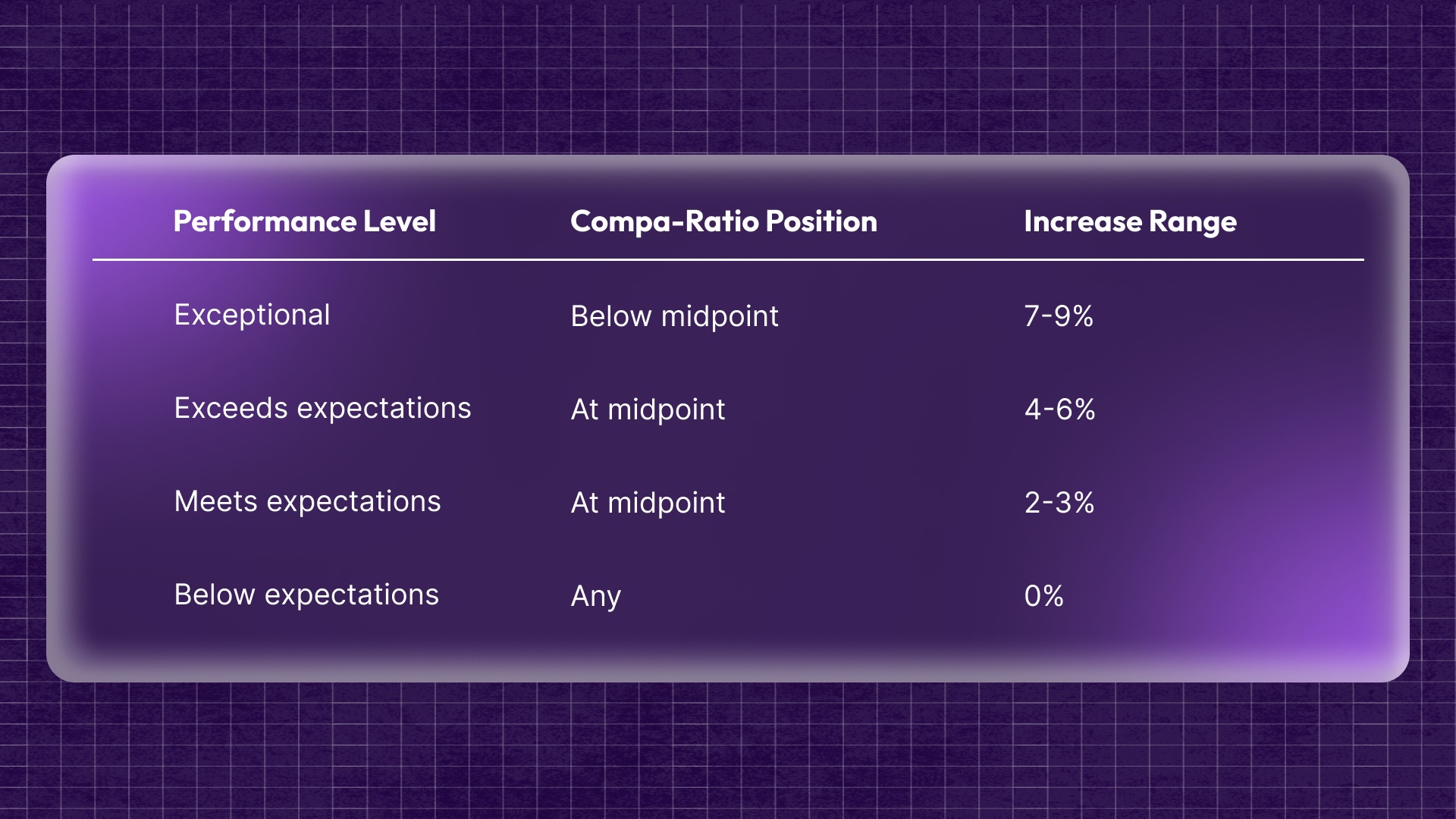
Example 1: SaaS company with a 3.5% merit pool
Company context

How increases are structured
Outcome
- High performers receive meaningful differentiation from average performers.
- Budget stays within departmental allocation.
- Finance has a clear view of spending before the cycle closes.
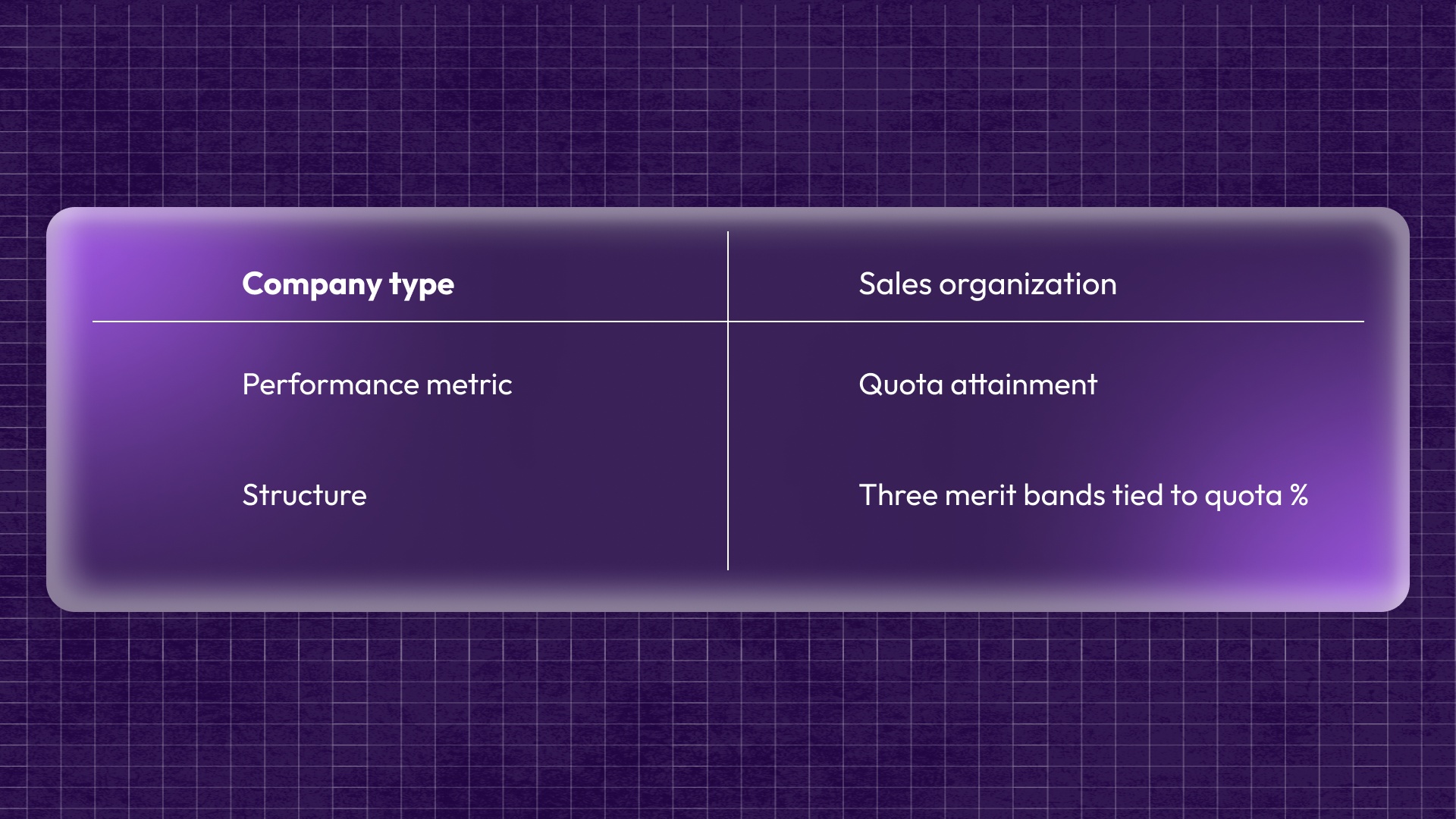
Example 2: Sales team with quota-tied merit tiers
Company context
How increases are structured
.jpg)
Outcome
- Removes subjectivity from manager ratings for objectively measurable roles
- Rating disputes get resolved by numbers, not negotiation.
- Faster cycle because performance tiers are pre-defined
Example 3: Mid-size company introducing merit structure for the first time
Company context

How increases are structured
Outcome
- The first structured cycle revealed that two departments had consistently underpaid high performers.
- Pay gaps that had existed for years became visible and addressable.
- Managers gained a clear framework for explaining raise decisions to employees.
Suggested Read: How to Calculate Merit Increase: Proven Methods and Best Tips

Merit Pay Mistakes That Lead to Pay Gaps and How to Fix Them
The mistakes below show up repeatedly in compensation cycles at growing companies. Each one has a specific fix that can be built into the process before the next cycle starts.
1. Distributing Budgets Before Ratings are Calibrated
When managers receive their merit budget before calibration sessions are complete, they build recommendations around uncalibrated ratings. By the time the inconsistency is visible, the cycle is already closed.
- Fix: Budget distribution cannot go out until the calibration session for each function is signed off by the relevant HRBP. Build this as a process gate, not a reminder.
2. Applying a Single Percentage to All High Performers
Giving every employee in the top performance band the same percentage ignores where they sit in their pay band. A high performer already paid above the midpoint does not need the same increase as someone who is underpaid at their level.
- Fix: The merit matrix with compa-ratio bands automatically handles this. If your process currently applies a flat percentage per rating tier, the matrix is the direct replacement.
3. Communicating Increases Before Approvals are Final
When managers tell employees their increase before the compensation team and Finance have completed the review, any subsequent adjustment creates a damaging conversation.
- Fix: Set a single communication date at the start of the cycle. Add a confirmation step to the approval workflow so managers get the green light only after sign-off is complete.
4. Using Last Year's Matrix without Refreshing It
Market rates shift year over year. A matrix built on benchmarks from two or three years ago will produce recommendations that lag the market in roles where salaries have moved significantly.
- Fix: Before each cycle opens, refresh pay band midpoints using current compensation survey data. Recalculate every employee's compa-ratio against the updated midpoints, then check whether the matrix ranges still produce competitive outcomes.
5. Cutting Calibration to Save Time
Calibration is the step most likely to be skipped when a cycle runs behind schedule. The time saved creates pay equity gaps that surface months later when employees raise concerns that are difficult to answer.
- Fix: Schedule calibration before the performance review window closes, not after. Treat it as a fixed milestone. If it must be shortened, focus on the roles and levels where rating inconsistency is most likely to occur.
Situations Where Merit Pay Is Not the Right Approach
Merit pay works for organizations with a defined pay structure, calibrated performance standards, and a repeatable review process. Where those foundations are missing, a merit cycle will produce inconsistent outcomes. Three situations where a different compensation approach makes more sense:
The Pay Structure Has Not Been Defined Yet
Without defined pay bands, compa-ratios cannot be calculated, and the merit matrix cannot be used. Merit decisions without a pay band reference point are discretionary raises by another name. Build a compensation structure first.
Individual Performance Is Difficult to Isolate
Some roles are inherently collaborative, and the output is a team result rather than an individual one. Applying individual merit ratings to these roles requires highly subjective judgment and can create friction among people whose effectiveness depends on working closely together.
The Organization Is in Rapid Restructuring
When roles, levels, and reporting structures change frequently, merit cycles can lag behind organizational reality. An employee promoted mid-year may be assessed against criteria that no longer match their current responsibilities. In these periods, a targeted market or equity adjustment is more appropriate than a full merit cycle.
Suggested Read: Effective Salary Increase Guidelines for Managers
How CandorIQ Helps People Ops Teams Run Structured Merit Cycles?
Managing merit pay manually across spreadsheets, email approvals, and disconnected planning tools creates the problems described throughout this guide: rating inconsistency, budget overruns, slow approvals, and a Finance team that only sees the full picture after the cycle is already closed.
CandorIQ is a compensation and headcount planning platform designed to manage compensation at scale. It brings the merit cycle into a single structured system, allowing both teams to work from the same data throughout the process.
Compensation and Payband Builder
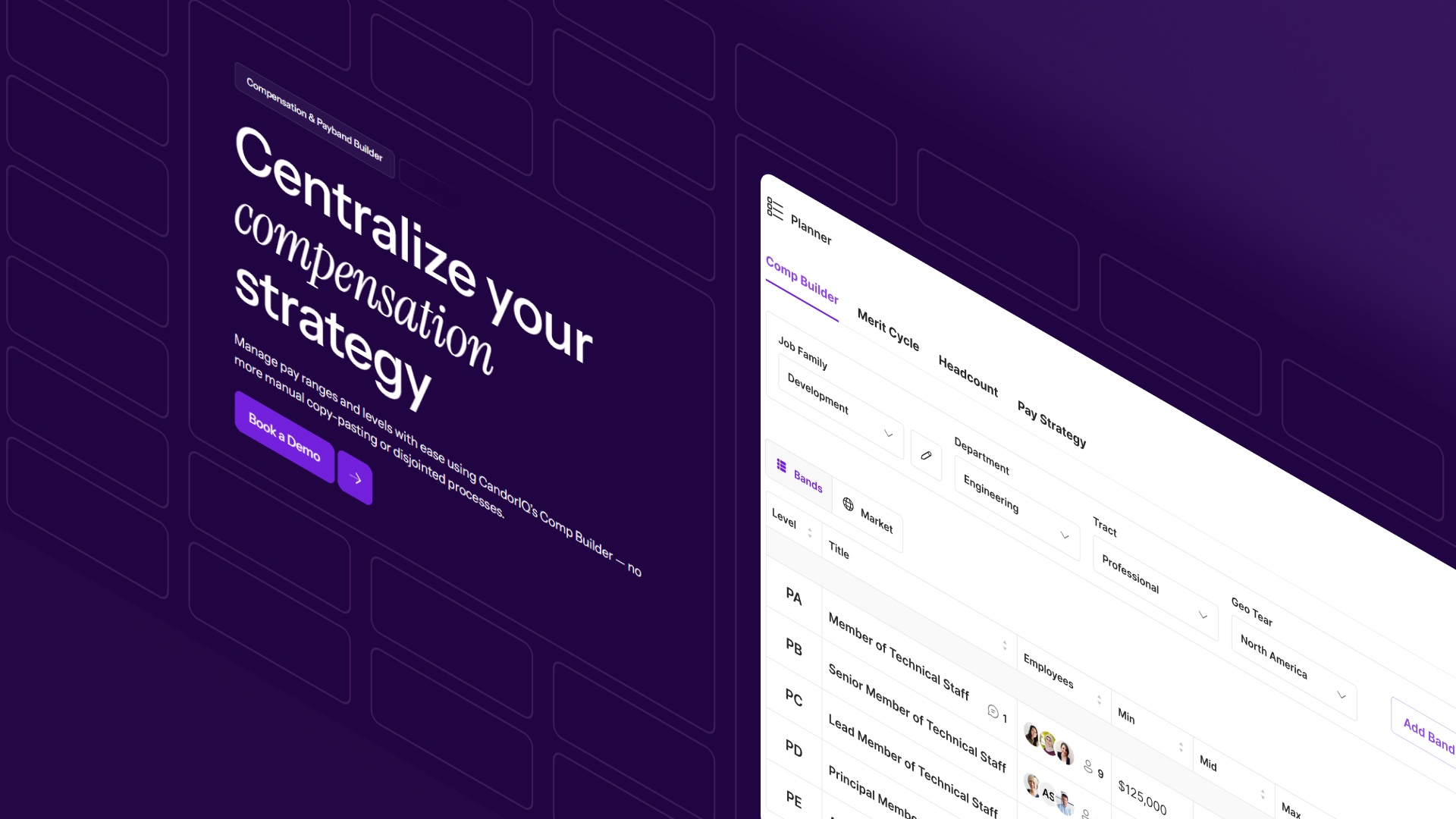
Define pay bands by level, location, and department before the cycle opens. Compa-ratios are calculated automatically, so the merit matrix always works with accurate, current data.
Compensation Cycle

Manage merit reviews, manager recommendations, and approval workflows in one place. Budget utilization is tracked in real time by department. Managers see their allocation, submit recommendations within guardrails, and receive automated reminders. Finance sees the budget impact without waiting for the People Ops team to compile a report.
Headcount Scenario Planning

Model the combined payroll impact of merit increases and planned hiring before approvals are finalized. People Ops teams can run scenarios and align with Finance on a plan that stays within budget before commitments are made.
Workforce Management

You can plan and track headcount, roles, and spend across departments and geographies, giving you and Finance a shared view of the workforce structure that underpins your merit‑cycle decisions. This shared view helps you align on future‑state org design and people‑spend guardrails before the next cycle begins.
For People Ops teams running merit cycles across distributed organizations, moving these workflows into a single system reduces cycle time and gives Finance the visibility it needs throughout the process. Book a demo today to see how CandorIQ supports merit cycle management from pay band setup to final approval.
FAQs
1. How often should merit pay be reviewed?
Merit pay should be reviewed annually in compensation cycles, but midyear adjustments may be needed for promotions, market shifts, or retention risks to maintain competitiveness and fairness.
2. Can merit pay create pay inequity?
Yes, merit pay can widen pay gaps if ratings are inconsistent or biases exist, which is why calibration, compa-ratio use, and equity reviews are essential safeguards.
3. How should managers communicate merit increases to employees?
Managers explain merit increases by linking performance outcomes to criteria, referencing the merit matrix range, and clarifying how compa-ratio and budget constraints influenced the final percentage.
4. What data is required to run an effective merit cycle?
Core inputs include calibrated performance ratings, current salaries, pay band midpoints, compa-ratios, approved merit pool, and headcount plans, enabling accurate allocations, tracking, and defensible approvals.
5. How do promotions interact with merit pay decisions?
Promotions are handled separately from merit increases, with the new salary set within the higher band first, then merit applied if policy allows, preventing double-counting.
6. What is the key to a successful merit pay system?
Clarity, consistency, and alignment. When criteria are transparent and processes are structured, merit pay becomes a powerful tool rather than a source of conflict.
Ready to modernize your workforce and compensation strategy?
See how CandorIQ brings workforce planning and compensation together with AI.