

How AI Agents Are Transforming HR Productivity in 2026
AI agents for HR productivity are reshaping how People and Finance teams work in 2026. See how leading US companies boost output without growing their teams.


AI agents for HR productivity have crossed the threshold from experiment to infrastructure in 2026. According to Salesforce research, CHROs expect AI agent adoption to grow by 327% within their organizations by 2027. Those already deploying AI agents are reporting an average 30% productivity gain per employee.
But most of them are still catching up. The biggest wins aren't coming from automating recruiting pipelines or answering benefits FAQs. They're coming from teams that have used AI agents to close the strategic gap between HR and Finance.
This guide covers how that shift is happening, what it means for growing US companies, and what the highest-impact use cases actually look like in practice.
At a Glance
- AI agents for HR productivity go beyond task automation. The biggest wins come from aligning comp, headcount, and Finance in one connected workflow, something no spreadsheet can do.
- Most US HR teams at growth-stage companies still manage compensation cycles and headcount requests manually. That gap costs weeks per cycle and real budget accuracy.
- AI agents in HR save time not just by doing tasks faster, but by eliminating the coordination overhead between HR, Finance, and leadership entirely.
- CandorIQ is built specifically for this gap: one platform for compensation management, headcount planning, and pay equity, designed for lean People teams at US companies scaling fast.
- The companies that will lead in 2026 are not those with the biggest HR teams. They are the ones that give small teams the tools to operate with strategic precision.
What are AI Agents?
An AI agent handles multi-step workflows on its own, without someone guiding each step. It can take a goal, like processing a merit cycle, and execute every step: pulling employee data, applying merit logic, routing approvals, tracking budget impact, and flagging outliers, all without manual coordination.
Here are six ways we use AI agents for HR productivity gains in 2026:
- Fewer admin hours per week: AI agents handle repetitive coordination tasks like scheduling, chasing approvals, and consolidating data in less time.
- Faster cycle times: Compensation reviews and headcount approvals that take 4–6 weeks manually can be completed in days when AI agents manage the workflow.
- Fewer errors in critical data: Manual data entry across disconnected tools creates comp and headcount errors that surface at the worst times, board reviews, offer letters, and audits. Agents reduce those touchpoints.
- Better HR-Finance alignment: AI agents that pull from shared data give HR and Finance the same numbers in real time, so conversations shift from reconciling data to making decisions.
- More consistent employee experience: Whether it's an offer letter or a compensation review, AI agents apply the same logic every time. No manager favoritism, no process gaps.
- Strategic visibility for leadership: When agents handle execution, HR leaders get dashboards instead of spreadsheets, giving CPOs and CFOs the real-time workforce view they need.
Now, when you are taking a smart adoption decision, it is important to understand how AI agents differ from traditional automation.
AI Agents vs. Traditional Automation in HR in 2026
Most HR teams already use some form of automation. For example, an ATS that moves candidates through stages, an HRIS that triggers onboarding tasks, and a payroll system that runs on a schedule. That automation is valuable. But it's built for predictable processes with fixed steps.
AI agents are built for the opposite: complex, variable processes that require judgment. The difference isn't cosmetic. It determines which problems each approach can actually solve.
The table below lays out where each one wins, and more importantly, where traditional automation hits a ceiling that only AI agents can clear.
The most effective HR teams in 2026 don't choose between automation and AI agents. They use both. Automation handles what's predictable. Agents handle what requires judgment. Together, they deliver the output of a much larger HR team.
Also Read: The Future of HR in the Age of AI
8 Proven Use Cases of AI Agents for HR Productivity in 2026
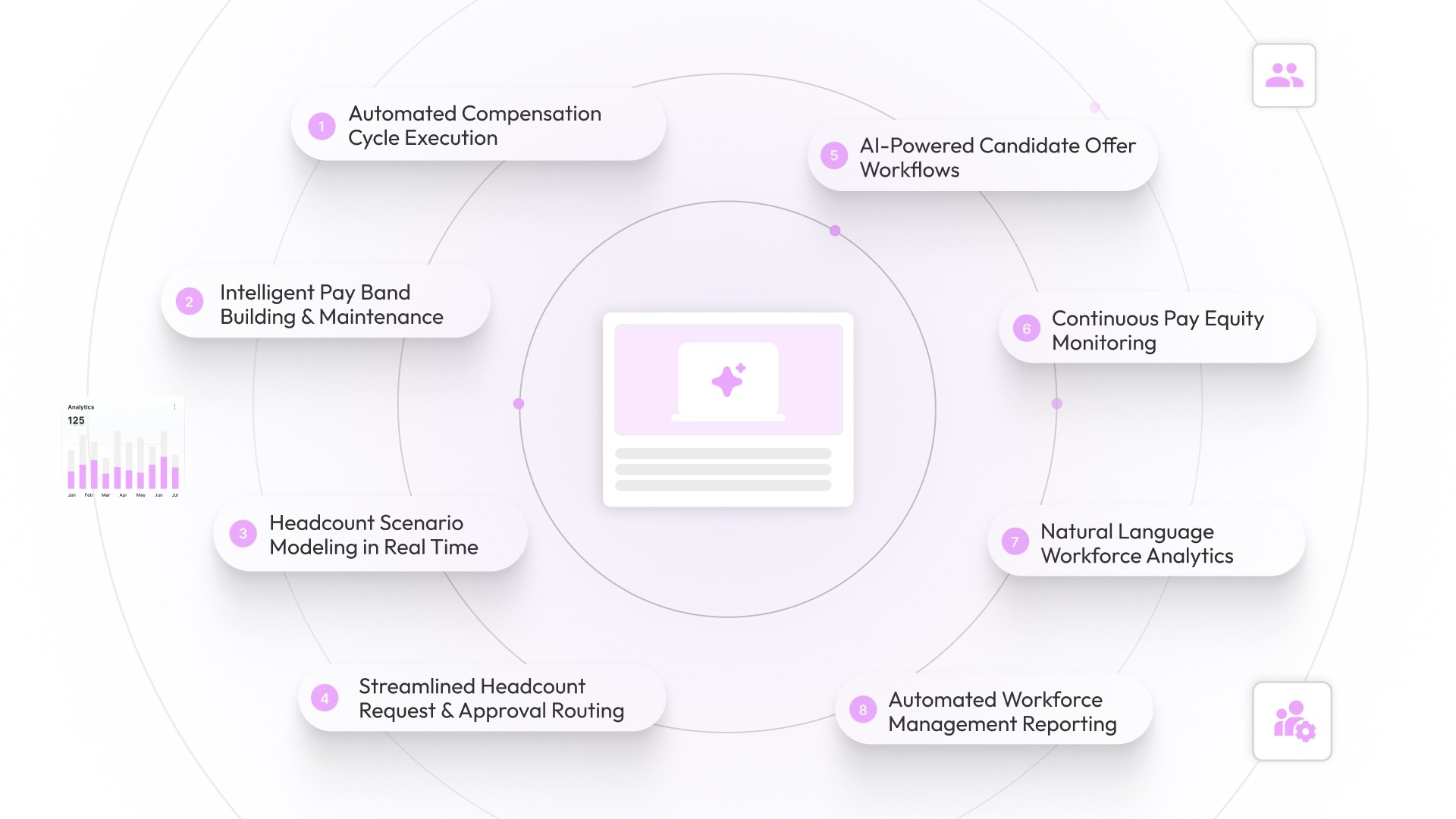
Not every AI agent use case is equal. Some save a few hours. Others change how HR teams operate at a structural level. The eight below are the ones that consistently deliver the highest impact, especially for US companies scaling headcount quickly with lean People teams.
1. Automated Compensation Cycle Execution
A compensation cycle touches every employee, every manager, every HRBP, and Finance, often simultaneously.
AI agents handle the entire orchestration layer. Pulling employee records, applying merit logic, routing proposals to the right approvers, sending reminders, logging every decision with rationale, and updating budget trackers in real time.
The result is a faster cycle that produces a clean audit trail, which matters a lot as pay transparency requirements expand across US states.
For example, CandorIQ combines AI-powered comp recommendations with built-in approval logic, real-time budget tracking, and direct stakeholder collaboration.
2. Intelligent Pay Band Building and Maintenance
Pay bands are supposed to be living documents. But, in most companies, they're annual PDFs. AI agents change that by continuously benchmarking internal salary ranges against market data, by level, role, and geography, and flagging when positions drift outside the band.
For distributed and remote-first US teams, geo-adjusted compensation is especially complex to maintain manually. An agent that applies location factors automatically and surfaces budget impact in real time removes a major source of both inequity and administrative effort.
When pay bands are accurate and current, hiring decisions, promotion decisions, and offer conversations all become more consistent.
3. Headcount Scenario Modeling in Real Time
Traditional headcount planning is slow and reactive. Requests move between HR and Finance, models take time to build, and by the time discussions happen, the data is already outdated.
AI agents shift this to real-time collaboration. HR and Finance can model workforce scenarios together on a shared platform, instantly evaluating trade-offs like hiring volume, role mix, or cost impact.
These are core planning decisions for any growth-stage company. When the analysis happens instantly, decision-making moves from delayed follow-ups to immediate, informed action.
4. Streamlined Headcount Request and Approval Routing
A single headcount request often passes through multiple approvers, creating delays and fragmented context across tools.
AI agents own the routing logic entirely. They pull the relevant budget data, check whether the role falls within the approved headcount plan, trigger the right approvers in the right sequence, and sync the final approval into the ATS, without any human coordination overhead.
The impact goes beyond speed. Every step is logged, decisions are fully visible, and ownership is clear, strengthening accountability across the process.
5. AI-Powered Candidate Offer Workflows
Offer conversations slow down because they pass through multiple reviews, and candidates often receive numbers without clear context, leading to extended negotiations.
AI agents can transform this. They pull the candidate’s expected range, benchmark it against internal and market data, evaluate its position within the pay band, and generate a structured offer breakdown covering salary, equity, bonus, and benefits.
This gives hiring managers clarity to present offers confidently, speeds up recruiter workflows, and ensures consistency. For fast-growing teams, it improves offer turnaround time and strengthens competitiveness in closing candidates.
6. Continuous Pay Equity Monitoring
Most companies treat pay equity as an annual exercise, identify gaps, fix a few, and revisit the issue a year later.
AI agents shift this to continuous monitoring. They track compensation data in real time, flagging issues as they emerge, such as pay compression from new hires, misaligned promotion increases, or outdated geo-based benchmarks.
Addressing these gaps early improves consistency and reduces cost. Proactive adjustments are far less expensive than reactive fixes triggered by employee complaints or compliance risks.
7. Natural Language Workforce Analytics
Most HR analytics tools produce dashboards, but People teams need direct answers.
AI agents enable HR and Finance leaders to ask questions in natural language, about comp gaps, time-to-hire, or market benchmarks, and get immediate, data-backed responses.
The agent retrieves the relevant data, runs the analysis, and presents clear answers with full visibility into the underlying numbers. This allows lean teams to operate with the confidence of dedicated analysts in leadership discussions.
8. Automated Workforce Management Reporting
Quarterly workforce reports take days to compile when data sits across multiple systems, covering open roles, attrition, headcount vs. plan, and compensation vs. budget.
AI agents automate this process. They pull from live data sources and generate reports tailored to each audience: a board-level summary for the CFO, detailed views for department leaders, and pay equity insights for the CPO.
This shift reduces time spent on manual reporting and increases time spent on decision-making. HR moves from assembling data to acting on it.
Also Read: How AI Agents are Transforming HR Operations
However, it is equally important to know what to look for in a platform that can consistently deliver on these capabilities.
5 Abilities to Look for in an HR AI Agent Platform in 2026
When you are focusing on AI agents for HR productivity, most platforms specialize in a single function. But for CPOs and CFOs focused on HR–Finance alignment, these solutions don’t solve the core problem.
Here’s how to evaluate platforms that actually deliver impact:
1. It Connects Comp, Headcount, and Finance in One Place
The biggest source of HR inefficiency isn't broken workflows. It's disconnected ones. If your AI platform handles comp cycles but doesn't connect to your headcount plan, you haven't fixed the root problem.
A platform must unify compensation, headcount, and budget data into a single system, not separate modules with occasional syncs. This is exactly what CandorIQ does for you. When these datasets connect in real time, HR and Finance eliminate manual handoffs and operate from the same foundation.
2. It Executes Workflows, Not Just Generates Insights
Platforms should do more than surface recommendations. They should run the process. AI agents should handle approvals, update budgets, log decisions, and trigger actions automatically. Execution, not just insight, drives measurable outcomes for lean teams.
3. It's Built for Your Company's Stage and Size
Companies between 50 and 5,000 employees need fast implementation, intuitive design, and flexibility, not enterprise-grade complexity. The right platform needs to be fast to configure, intuitive for non-technical users, and flexible enough to grow with you. That's a fundamentally different product than what the enterprise market is selling.
4. It Supports Real Collaboration Between HR and Finance
The best workforce decisions happen when HR and Finance are working from the same data at the same time. Teams should work from shared data in real time. Platforms must allow Finance to review headcount scenarios, assess budget impact, and provide input directly, without relying on HR to translate data into reports. This creates true alignment, not parallel workflows.
5. It Has Auditability Built In
Pay transparency and pay equity compliance are no longer optional considerations in the US market. California, New York, Colorado, Washington, and a growing number of states now require a documented compensation rationale.
So, platforms should automatically log approvals, document rationale, and show alignment to pay bands. Built-in auditability ensures compliance, supports pay transparency, and reduces future risk.
Also Read: Ultimate HR Guide to Fair & Transparent Financial Compensation
Now let's look at how those capabilities come together as a unified solution.
How CandorIQ Closes the HR-Finance Productivity Gap
Most growing US companies face the same three issues: slow compensation cycles, disconnected headcount planning, and pay equity reviewed only once a year. They stem from fragmented systems. When comp, headcount, and budget data sit in separate tools, HR ends up stitching everything together, often manually.
CandorIQ brings these workflows into a single platform. It unifies compensation management, headcount planning, and workforce analytics, giving lean HR and Finance teams enterprise-level capability without added complexity.
What this enables in practice:
- Compensation & Pay Band Builder: Define pay bands by role, level, and location, apply geo-adjusted benchmarks, and track pay distribution in real time with full version control.
- Compensation Cycle Automation: Run merit and bonus cycles with structured approvals, in-platform collaboration, and real-time budget tracking by department.
- Headcount Scenario Planning: Model org structures and instantly assess financial impact, allowing HR and Finance to align on hiring decisions.
- Headcount Requests & Approvals: Create structured requests with embedded context and automate approval routing, with direct integration into ATS and finance systems.
- AI Agent for Strategic Analysis: Query comp gaps, forecast hiring needs, and model decisions using natural language, with outputs grounded in real data.
- Workforce Management Dashboards: Monitor hiring, attrition, promotions, and plan vs. actuals in one unified view, tailored for different stakeholders.
- Candidate Offer Experience: Present complete compensation breakdowns with projections, improving clarity, acceptance rates, and hiring outcomes.
With a unified system, HR shifts from reconciling data to driving decisions—playing a direct role in shaping business outcomes.
Conclusion
AI agents for HR productivity are already defining how leading teams operate in 2026. The gap is widening between teams relying on manual, disconnected workflows and those using AI-driven infrastructure.
Teams that close this gap don’t add more headcount. They upgrade how their teams operate. They run compensation cycles, headcount planning, and pay equity processes with the speed, accuracy, and financial discipline the business expects.
If your team is still managing these workflows across spreadsheets and email threads, now is the time to change that
See how CandorIQ helps lean HR and Finance teams run faster comp cycles, better headcount plans, and stronger pay equity, all in one platform.
.png)
FAQs
Q. How long does it take to implement an AI agent for HR?
Most modern HR AI platforms take 2–6 weeks to implement, depending on how many integrations you need. Platforms purpose-built for mid-market teams, like CandorIQ, are designed for fast onboarding without an IT-heavy setup.
Q. Are AI agents in HR safe to use with sensitive employee data?
Yes, if the platform follows enterprise security standards: SOC 2 compliance, role-based access control, and data encryption at rest and in transit. Always verify the vendor's data handling policy before connecting employee compensation or HR data.
Q. Do small HR teams (under 10 people) actually benefit from AI agents?
Small HR teams benefit the most. A 3-person team running AI-assisted comp cycles and headcount approvals can operate with the output of a team twice that size. The productivity multiplier is higher when there are fewer people absorbing manual work.
Q. Can AI agents replace HR professionals?
No. AI agents handle coordination, data processing, and workflow execution. The tasks that prevent HR professionals from doing strategic work. They free up human judgment for what matters: complex decisions, employee relationships, and business strategy.
Q. What's the difference between an HR AI agent and an HR chatbot?
An HR chatbot answers questions. An AI agent executes workflows. A chatbot tells you what the PTO policy is. An AI agent can process a PTO request, update the HRIS, notify the manager, and adjust the team's headcount tracker, automatically.
Q. How do AI agents handle exceptions in HR workflows?
Unlike traditional automation that breaks on exceptions, AI agents route them intelligently, flagging edge cases, escalating to the right approver, or prompting HR for input when the situation falls outside configured parameters. Exceptions get handled faster, not stalled.
Ready to modernize your workforce and compensation strategy?
See how CandorIQ brings workforce planning and compensation together with AI.