
10 Best Compensation Cycle Management Platforms for Scaling HR Teams in 2026
Compare the 10 best compensation cycle management platforms for HR teams to help you choose the right tool for your growing company.

Are your compensation cycles still running on spreadsheets that break every time you add a new hire? You're not alone. Most HR teams at growth-stage companies spend weeks coordinating merit reviews across departments, only to discover budget overruns or pay equity gaps after the fact.
This blog walks you through the 10 best compensation cycle management platforms built for teams like yours. You'll learn what these tools actually do, when you need one, and how to choose the right platform based on your team size, growth rate, and workflow complexity.
Key Takeaways
- Compensation cycle management software automates merit reviews, bonus planning, and pay equity tracking to replace manual spreadsheets and reduce review cycles from weeks to days.
- Growth-stage companies scaling 2x-3x annually need these platforms to maintain pay equity, forecast workforce costs accurately, and align HR and Finance teams.
- CandorIQ stands out for HR-Finance collaboration with real-time budget tracking, location-based pay adjustments, and headcount scenario planning built specifically for distributed teams.
- The right platform depends on your use case: startups with equity-heavy comp need different tools than global enterprises managing complex bonus structures.
- Key features to evaluate include real-time budget visibility, manager self-service, pay equity analytics, and implementation speed to ensure the platform fits your team's workflow.
What is Compensation Cycle Management Software? And Why It Matters for Scaling Teams?
Compensation cycle management software automates how you plan, approve, and execute pay changes across your organization. Instead of emailing spreadsheets back and forth, you run merit cycles, bonus reviews, and promotion planning in one central platform.
Why it matters for scaling teams:
- Eliminates version control chaos when multiple managers edit comp plans simultaneously
- Prevents budget overruns by tracking spend against forecasts in real time
- Maintains pay equity as you scale across locations, departments, and job levels
- Shortens review cycles from 4-6 weeks down to days with automated workflows
- Aligns HR and Finance so both teams work from the same headcount and budget data
- Creates audit trails for compliance, board reporting, and historical comp analysis
Also Read: Compensation Management Benefits: A Strategic Guide
As your company grows past 50 employees, manual processes start breaking down. You need a system that scales with your team.

5 Signs Your HR Team Needs Compensation Cycle Management Software Now
If you're still running comp cycles in spreadsheets, you're probably hitting these pain points. Here's when it's time to make the switch.
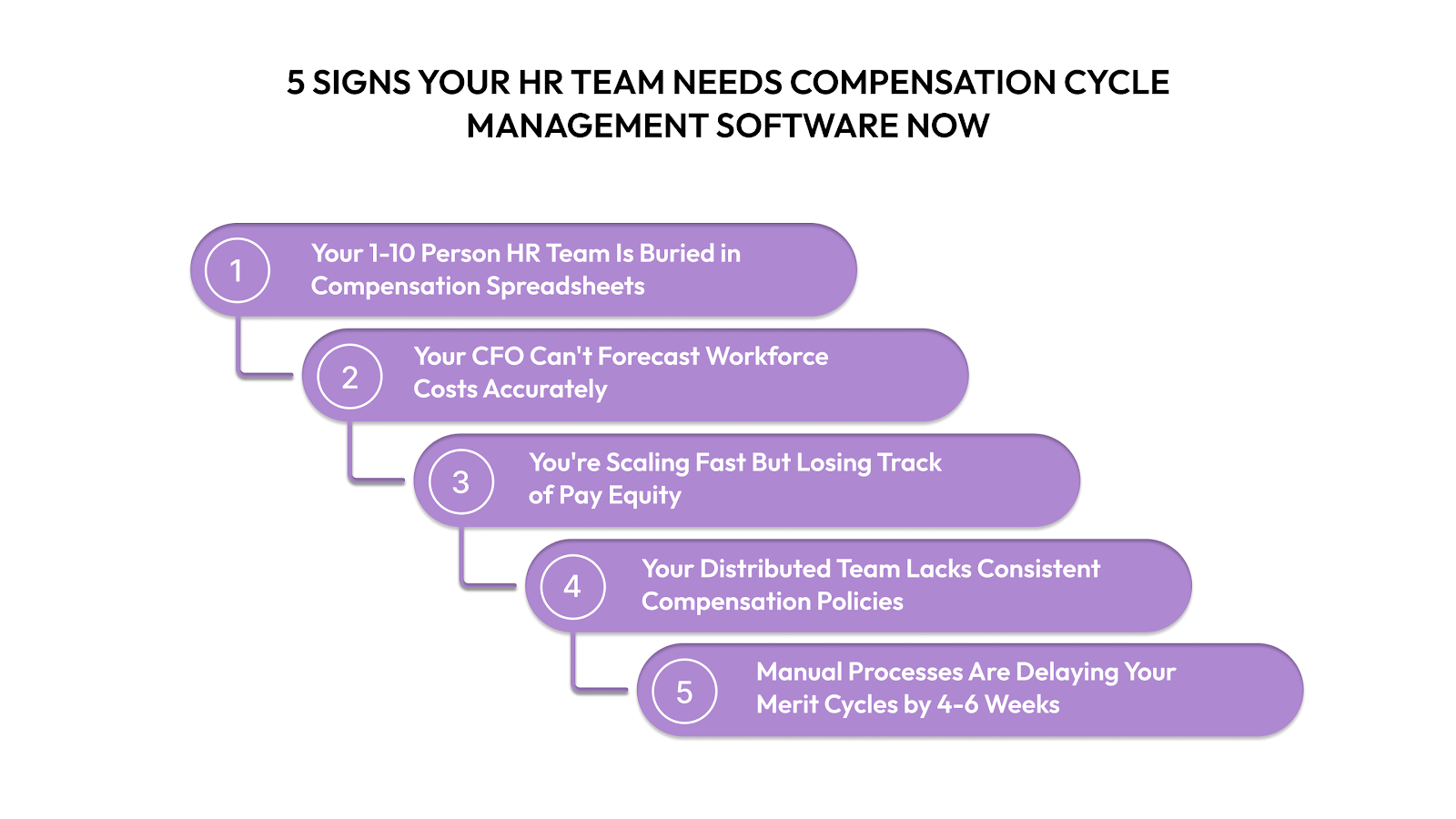
- Your 1-10 Person HR Team Is Buried in Compensation Spreadsheets: Your HR team spends weeks chasing managers for merit recommendations, fixing broken formulas, and reconciling budget discrepancies. Every comp cycle feels like starting from scratch.
- Your CFO Can't Forecast Workforce Costs Accurately: Finance asks for headcount projections, but your data lives in multiple spreadsheets. You can't model hiring scenarios or show how raises impact runway without manual work.
- You're Scaling Fast But Losing Track of Pay Equity: You've doubled headcount this year, but now you have salary gaps across teams. You can't quickly identify who's underpaid or see if new hires match your pay bands.
- Your Distributed Team Lacks Consistent Compensation Policies: You're hiring in five states or three countries, but you don't have location-based pay structures. Every offer becomes a negotiation instead of following a clear framework.
- Manual Processes Are Delaying Your Merit Cycles by 4-6 Weeks: You send spreadsheets to managers, wait for responses, consolidate feedback, send for approvals, and repeat. By the time merit increases go live, you've missed your target date.
If two or more of these signs sound familiar, it's time to evaluate dedicated compensation software.
Top 10 Compensation Cycle Management Platforms for HR Teams
Not all compensation platforms solve the same problems. Some focus on benchmarking, others on enterprise customization, and a few specifically target growth-stage companies. Here's how the top 10 stack up.
1. CandorIQ
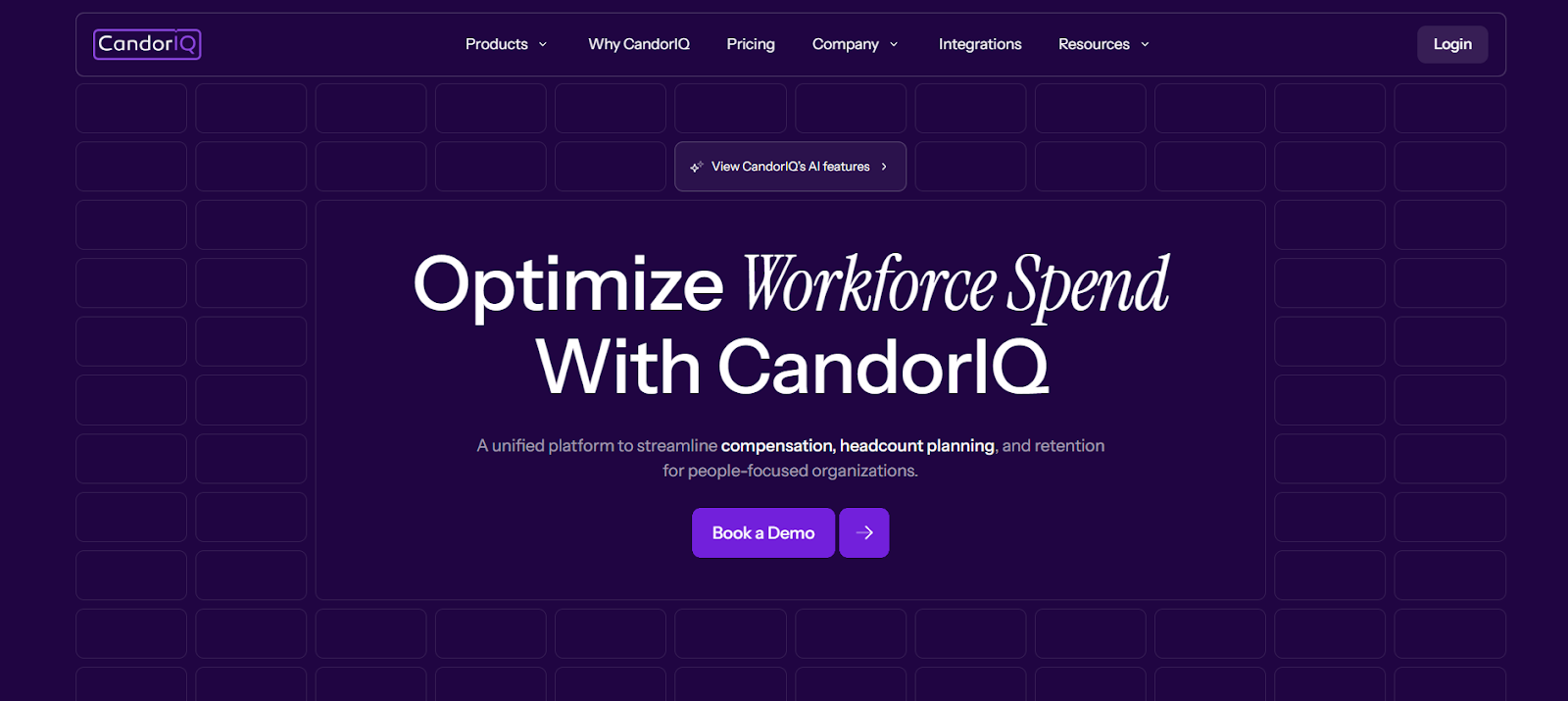
CandorIQ consolidates compensation cycles, pay band management, and headcount planning into one platform built for distributed teams. It eliminates the disconnect between HR's comp plans and Finance's budget models by syncing data in real time.
Ideal For: Companies with 50-5,000 employees, distributed teams, lean HR departments (1-10 people), and CFOs who need workforce cost predictability.
Key Features:
- Real-time budget tracking during merit and bonus cycles
- Location-based pay adjustments with benchmark data
- Headcount scenario planning with financial impact modeling
- Manager self-service with embedded approval workflows
- Pay equity dashboards by department, level, and geography
- Slack and email integrations for approvals and reminders
Standout Capability: CandorIQ's headcount scenario planning lets you model multiple hiring plans and see their budget impact before committing. HR and Finance collaborate in the same tool instead of reconciling spreadsheets after the fact.
Pricing: Custom pricing based on company size and features. Contact for a demo.
2. Pave
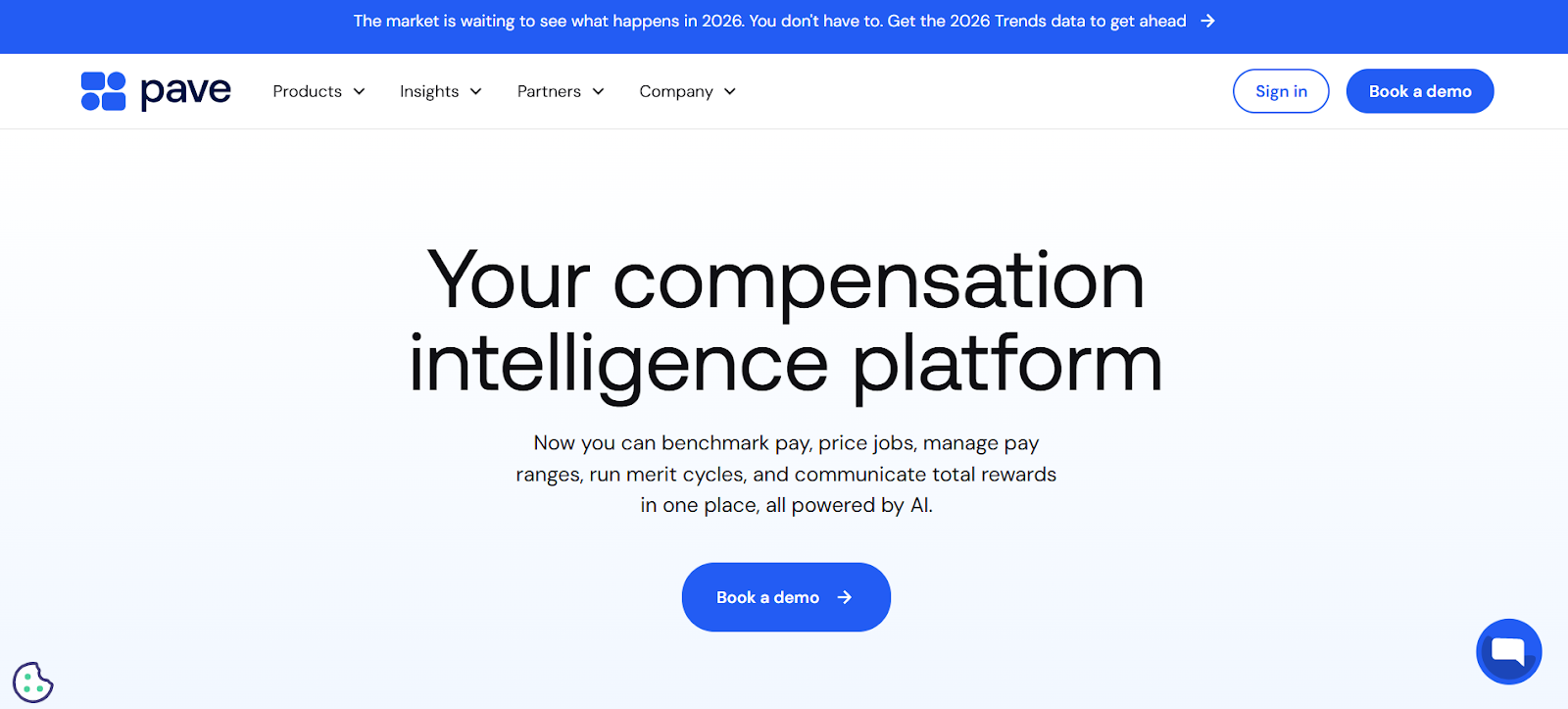
Pave specializes in total compensation visibility, including cash, equity, and benefits. It pulls real-time market data from peer companies to help startups stay competitive on comp packages.
Ideal For: Tech startups with 20-500 employees offering significant equity, companies competing for engineering talent, and teams prioritizing benchmarking.
Key Features:
- Real-time compensation benchmarking from peer companies
- Equity grant modeling and vesting schedules
- Integration with cap table tools like Carta
- Employee-facing total comp statements
- Market pricing recommendations for new roles
Standout Capability: Pave's peer benchmarking data updates continuously, so you always know how your offers compare to similar-stage startups.
Considerations: Best suited for tech companies. Less robust for global teams managing multiple currencies or complex bonus structures.
Pricing: Starts around $12,000 annually. Contact for custom pricing.
3. Comprehensive
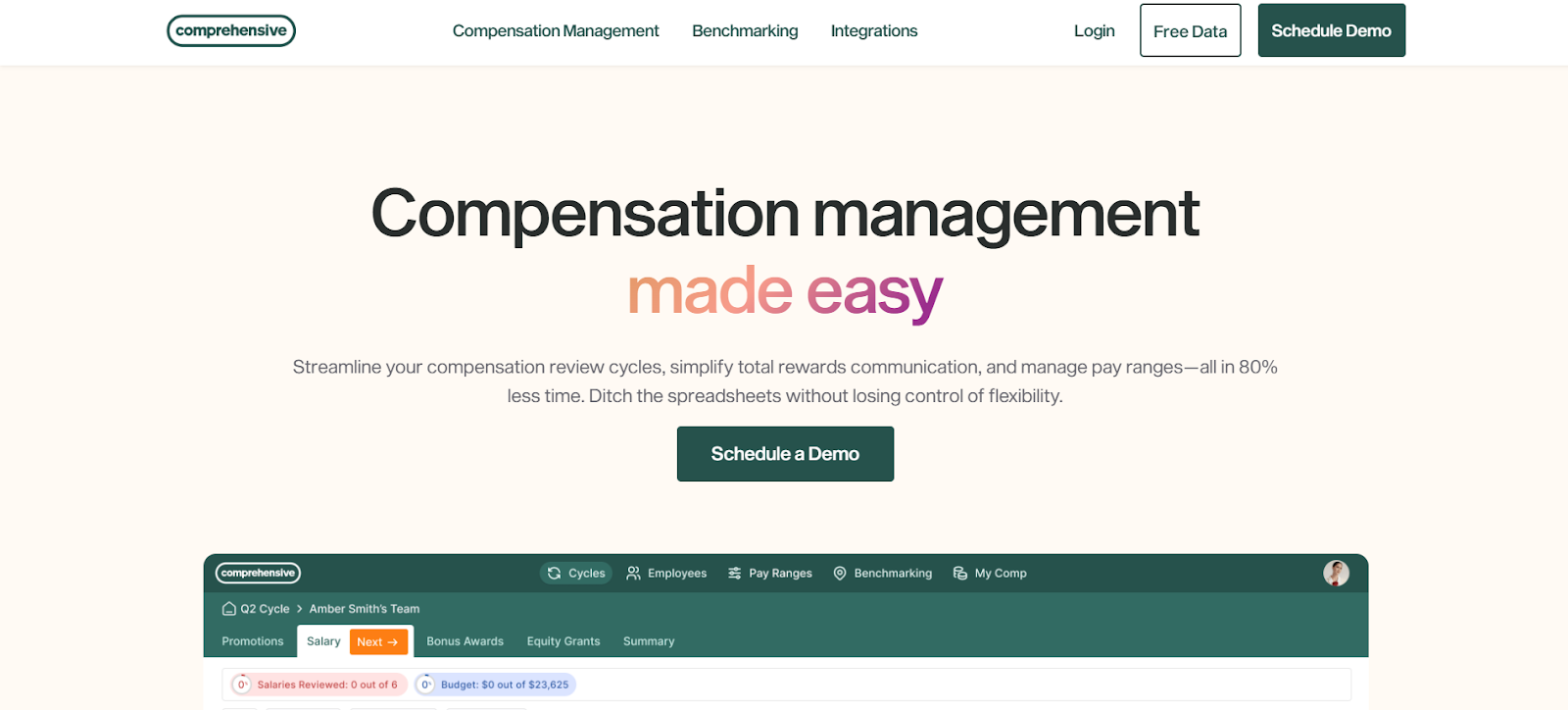
Comprehensive helps teams transition from spreadsheets to structured comp planning with minimal setup time. It focuses on making merit cycles faster without requiring months of implementation.
Ideal For: Companies with 100-1,000 employees, teams currently running comp in Excel or Google Sheets, and HR teams needing a quick win.
Key Features:
- Spreadsheet import for fast data migration
- Manager-friendly interface for merit recommendations
- Budget allocation and tracking by department
- Approval workflows with comments and rationale logging
- Pay equity analysis and gap identification
Standout Capability: Comprehensive's fast implementation means you can run your next comp cycle in the platform within weeks, not months.
Considerations: Fewer advanced features, like headcount planning or scenario modeling, compared to enterprise platforms.
Pricing: Custom pricing. Contact for details.
4. Lattice
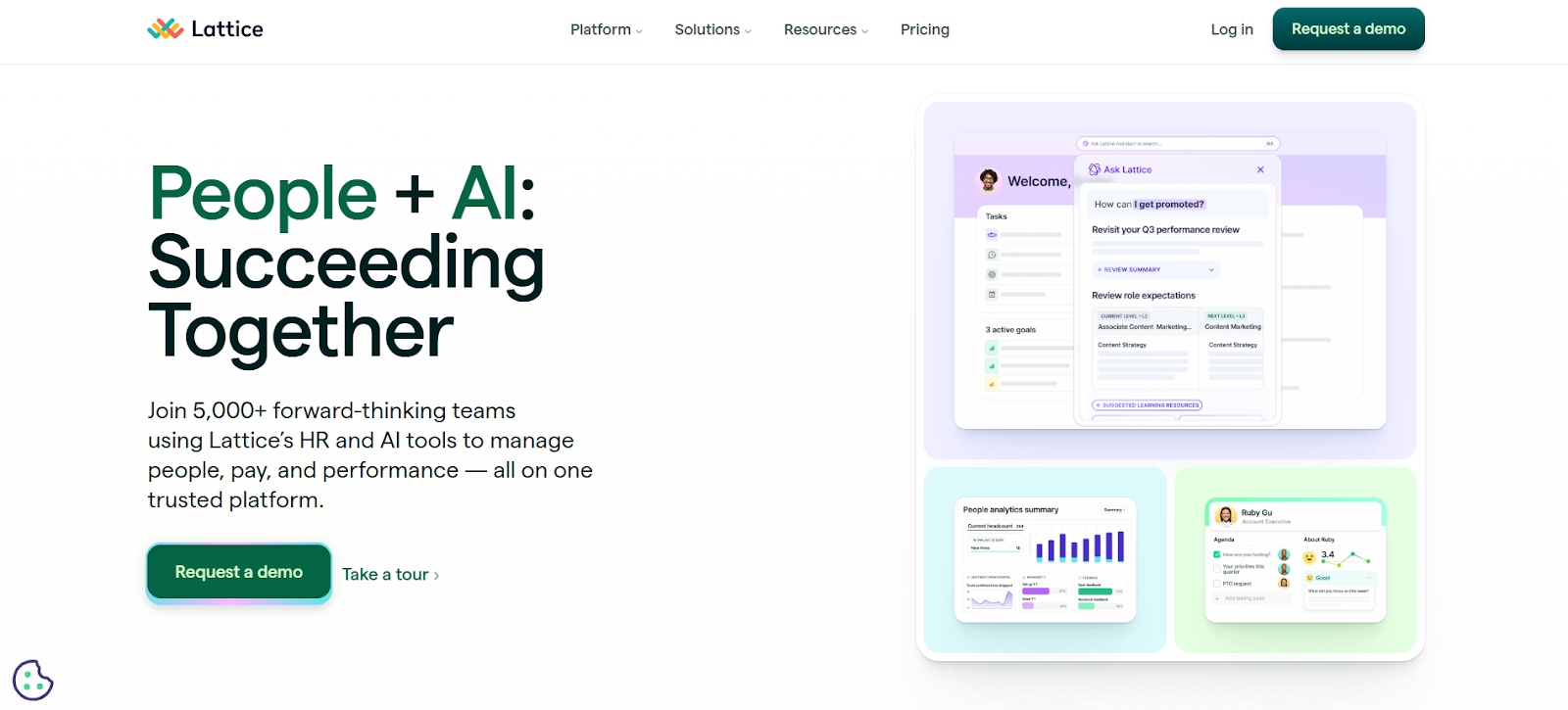
Lattice connects performance reviews, goal tracking, and compensation planning in one platform. If you run continuous feedback or OKR programs, Lattice integrates comp decisions with performance data.
Ideal For: Companies with 50-5,000 employees, teams using Lattice for performance management, and organizations linking raises to performance ratings.
Key Features:
- Performance review integration for merit recommendations
- Compensation cycle workflows with approval chains
- Manager guidelines and budget guardrails
- Pay equity reporting by performance rating
- Integration with HRIS systems like BambooHR and Workday
Standout Capability: Lattice automatically surfaces performance ratings when managers submit comp recommendations, making it easier to tie raises to individual contributions.
Considerations: Works best if you're already using Lattice for performance management. Standalone comp features are less robust than dedicated tools.
Pricing: Starts at $11 per person per month. Contact for compensation module pricing.
5. Ravio
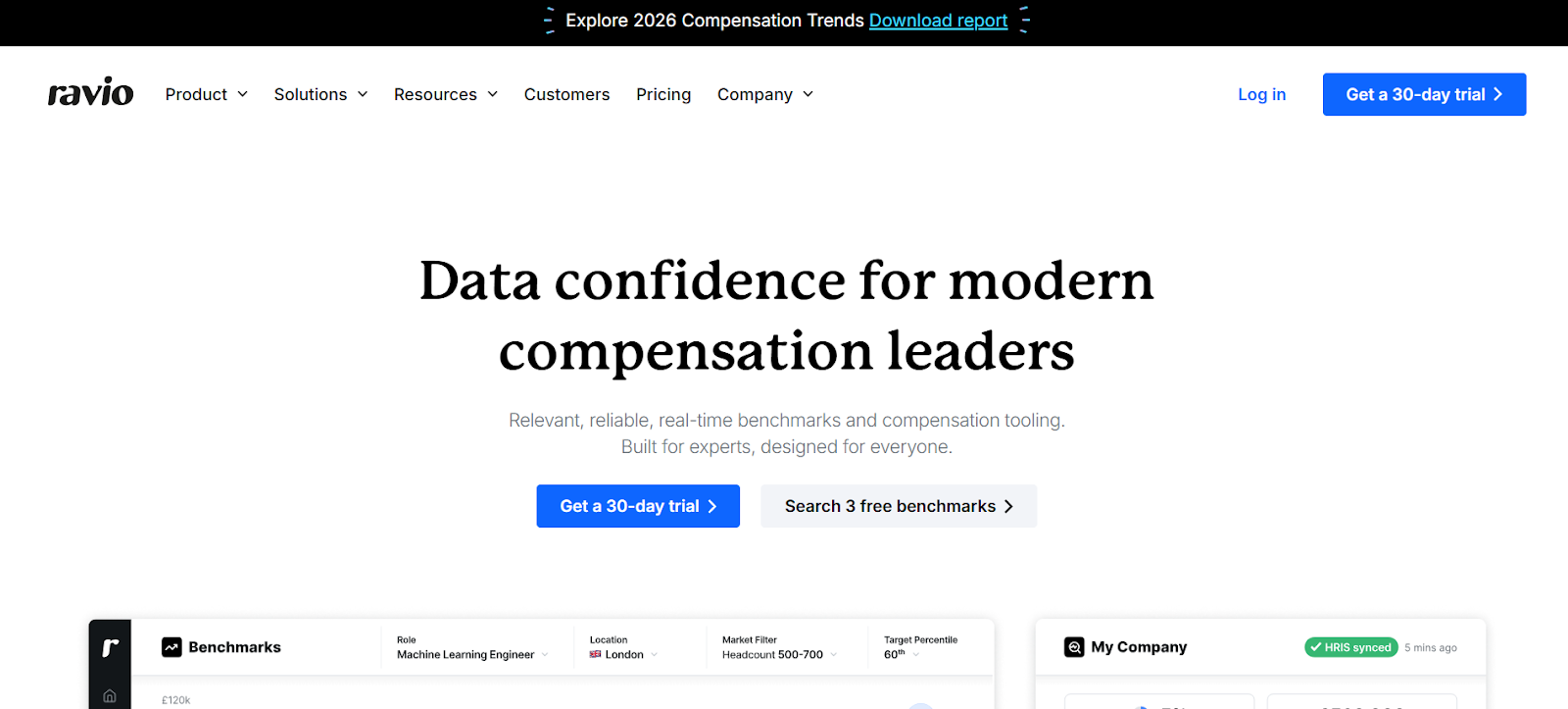
Ravio provides market salary data focused on European tech hubs and helps teams build fair pay structures across multiple countries. It's designed for startups and scale-ups hiring across Europe.
Ideal For: European tech companies with 20-500 employees, teams hiring across the UK, Germany, France, and Nordics, and companies prioritizing local market data.
Key Features:
- European salary benchmarking by city and role
- Pay band recommendations based on funding stage
- Compensation cycle tools for merit and bonus reviews
- Pay equity analysis across teams and locations
- Integration with European payroll providers
Standout Capability: Ravio's benchmarking data focuses specifically on European tech companies, giving you more relevant comparisons than US-centric platforms.
Considerations: Limited functionality for US-based teams or companies operating outside Europe.
Pricing: Custom pricing. Contact for details.
6. ChartHop
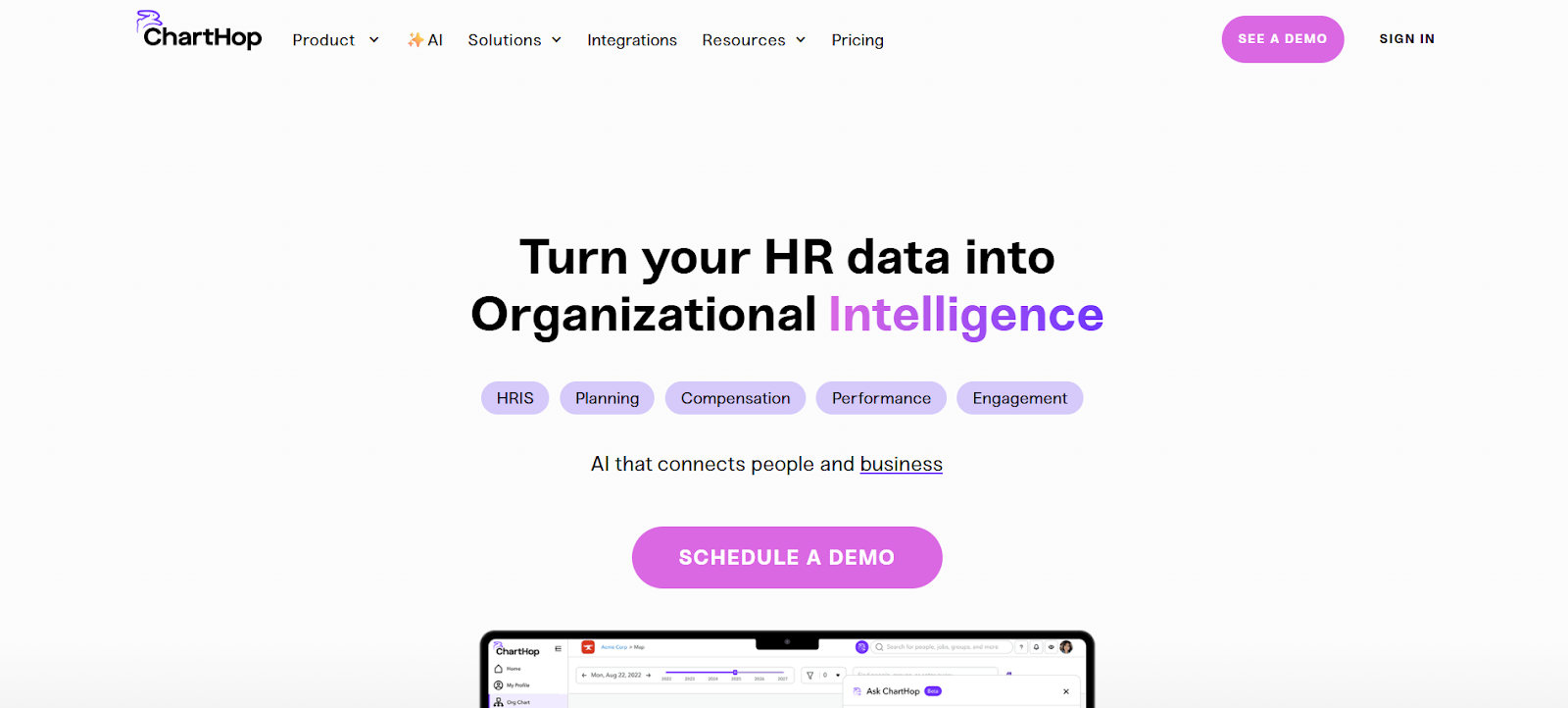
ChartHop combines org chart visualization, headcount planning, and compensation management in one platform. You can model future org structures and see their financial impact in real time.
Ideal For: Companies with 100-5,000 employees, teams managing complex org structures, and CFOs who need workforce cost forecasting.
Key Features:
- Interactive org charts with comp data overlay
- Headcount scenario planning with budget impact
- Compensation cycle workflows with approval tracking
- Manager self-service for promotions and raises
- Integration with HRIS, payroll, and ATS systems
Standout Capability: ChartHop's visual org planning lets you drag and drop future hires, see updated org charts, and calculate the budget impact instantly.
Considerations: Feature-rich platform with a steeper learning curve. Implementation typically takes 6-8 weeks.
Pricing: Custom pricing based on company size. Contact for a demo.
7. Kamsa
Kamsa combines compensation software with expert advisory services. You get market data, comp planning tools, and access to compensation consultants who help you build strategies.
Ideal For: Companies with 200-2,000 employees, teams expanding into new markets, and organizations needing compensation strategy guidance.
Key Features:
- Global salary benchmarking across 100+ countries
- Compensation cycle management with budget controls
- Pay equity analysis and reporting
- Expert consulting for pay structure design
- Integration with major HRIS platforms
Standout Capability: Kamsa's combination of software and expert services helps teams build compensation strategies they couldn't develop internally.
Considerations: Higher price point due to bundled consulting services. Best for companies prioritizing strategic guidance over self-service tools.
Pricing: Custom pricing. Contact for details.
8. Pequity
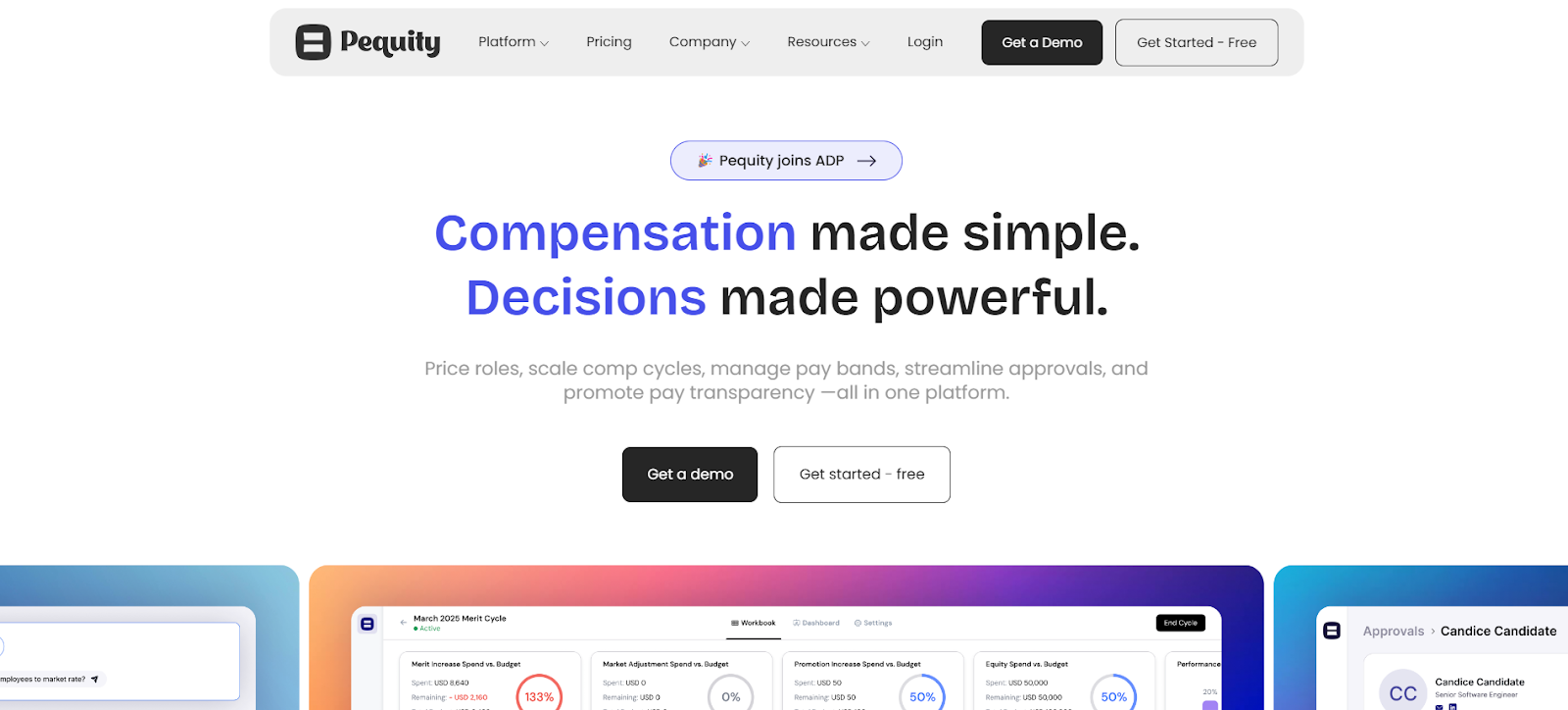
Pequity handles complex compensation structures across large, global organizations. It supports custom workflows, multi-tiered approvals, and integration with enterprise systems.
Ideal For: Companies with 1,000+ employees, global enterprises managing complex bonus plans, and teams requiring deep customization.
Key Features:
- Highly configurable workflows for comp cycles
- Multi-currency support with exchange rate management
- Advanced pay equity analytics and reporting
- Integration with Workday, SAP SuccessFactors, and Oracle HCM
- Custom dashboards for different stakeholder groups
Standout Capability: Pequity's enterprise-grade customization handles virtually any comp structure, from sales commissions to executive bonus plans.
Considerations: Built for enterprise complexity. Overkill for companies under 500 employees. Implementation takes 3-6 months.
Pricing: Custom enterprise pricing. Contact for details.
9. Beqom
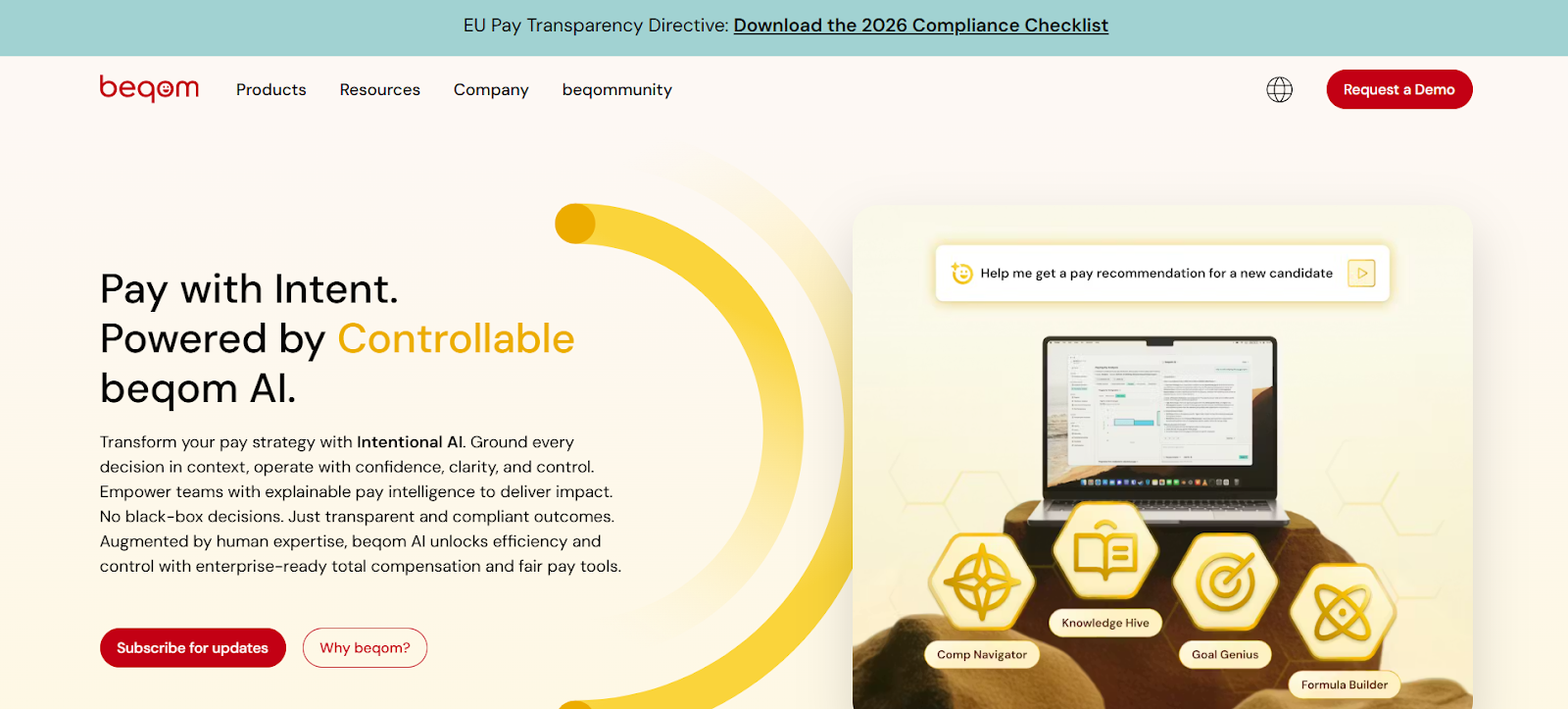
Beqom specializes in total compensation management for multinational corporations. It handles salary, bonus, commissions, stock options, and benefits across dozens of countries.
Ideal For: Global enterprises with 5,000+ employees, companies in finance or pharmaceuticals with complex comp structures, and teams managing variable pay at scale.
Key Features:
- Global compensation management across 150+ countries
- Variable pay and commission calculation engines
- Long-term incentive plan management
- Pay equity analytics with regulatory compliance reporting
- Integration with SAP, Workday, and Oracle
Standout Capability: Beqom's variable pay engine calculates complex commission structures, bonuses, and incentives that other platforms can't handle.
Considerations: Enterprise pricing and complexity. Not suitable for companies under 1,000 employees. Expect 6-12 month implementations.
Pricing: Custom enterprise pricing. Contact for details.
10. CompAnalyst by Salary.com
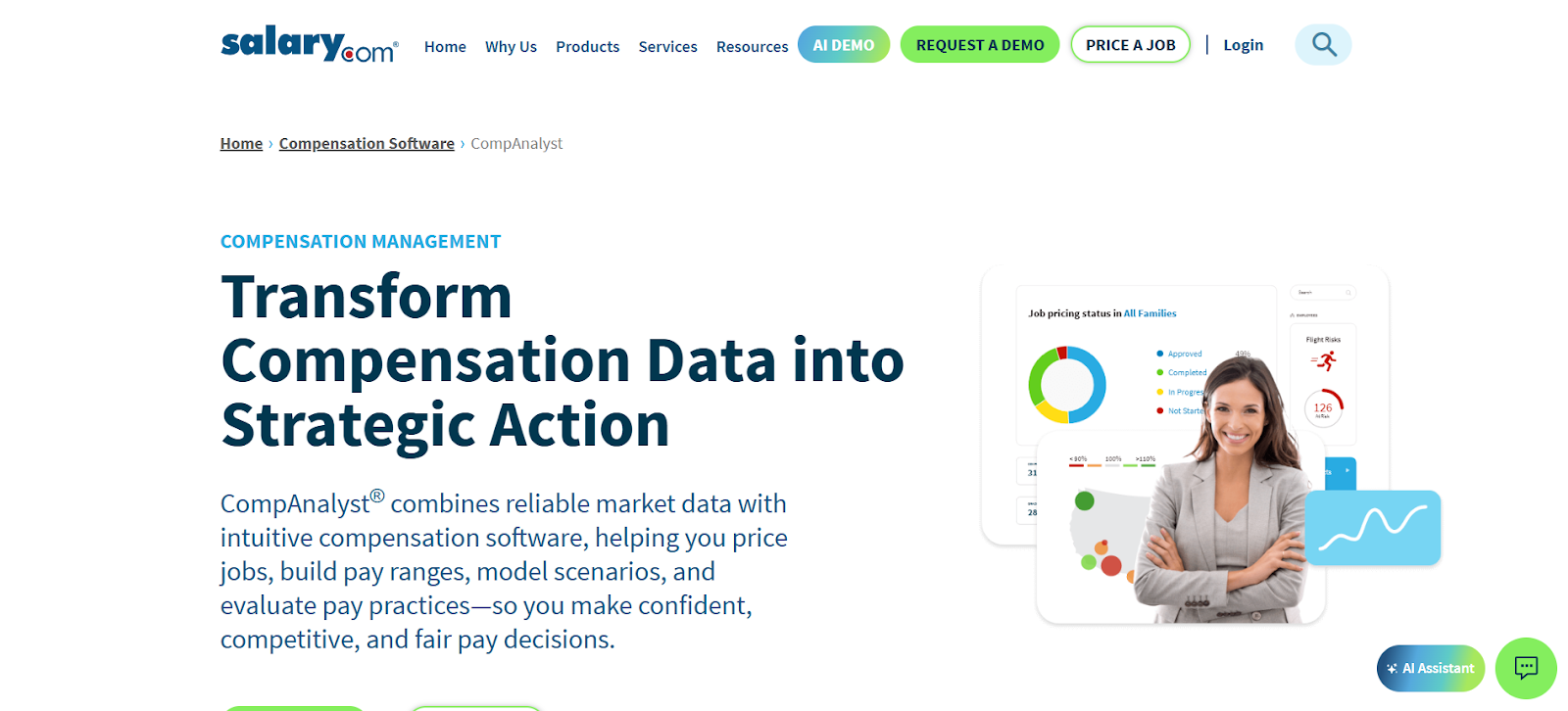
CompAnalyst focuses on salary benchmarking and pay structure design. It provides extensive market data and job-matching tools to help you price roles accurately.
Ideal For: Companies with 100-5,000 employees, teams building pay bands from scratch, and HR professionals prioritizing benchmarking data.
Key Features:
- Salary survey data from millions of data points
- Job matching tools for accurate role comparisons
- Pay range recommendations by location and industry
- Compensation cycle management with basic workflows
- Integration with major HRIS platforms
Standout Capability: CompAnalyst's extensive benchmarking database helps you price roles accurately when entering new markets or creating new positions.
Considerations: Benchmarking features are stronger than workflow automation. Less robust for manager self-service or complex approval chains.
Pricing: Custom pricing based on company size. Contact for details.
Now that you've seen how these platforms compare, the next step is identifying which features matter most for your workflow.
Also Read: How to Develop a Comprehensive Compensation Strategy: Practical Guide
How to Choose Compensation Management Software: 7 Must-Have Features for 2026
The right compensation platform depends on your team's specific needs. Here are seven critical features to evaluate during your selection process.
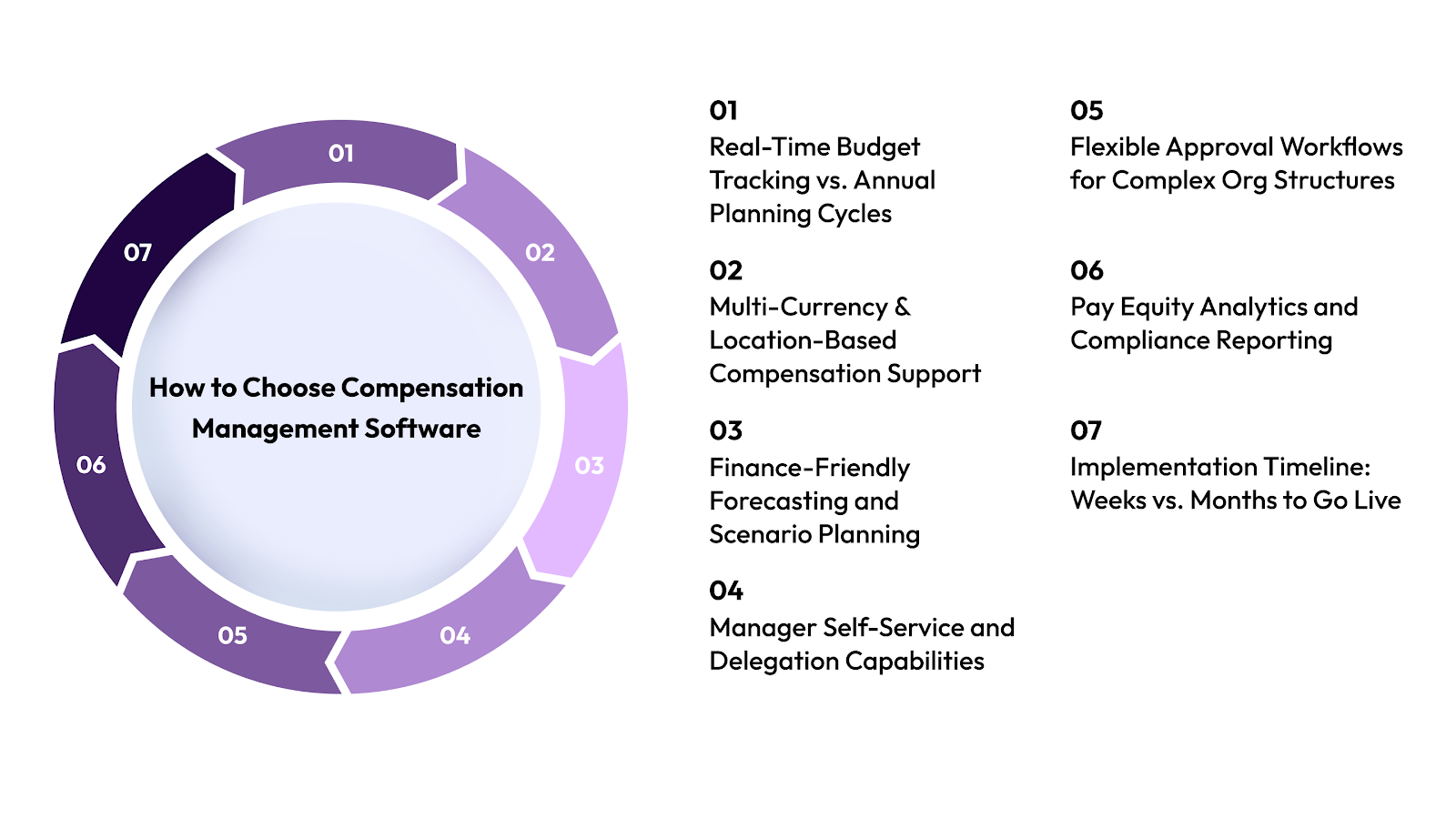
- Real-Time Budget Tracking vs. Annual Planning Cycles: Some platforms only help you plan once a year. Others track budget utilization in real time as managers submit comp changes. If your CFO needs continuous visibility into workforce spend, prioritize real-time tracking.
- Multi-Currency & Location-Based Compensation Support: Distributed teams need location-based pay adjustments. Look for platforms that automatically apply geo-adjustments and handle multi-currency payments without manual conversion.
- Finance-Friendly Forecasting and Scenario Planning: Your CFO wants to model hiring scenarios before approving headcount. Choose platforms that let you build multiple workforce plans and compare their budget impact side by side.
- Manager Self-Service and Delegation Capabilities: Managers should submit merit recommendations, promotion requests, and rationale without HR mediating every change. Self-service tools reduce HR workload and speed up cycles.
- Flexible Approval Workflows for Complex Org Structures: Your approval chains vary by compensation amount, department, and location. Make sure the platform supports dynamic routing based on your actual org structure.
- Pay Equity Analytics and Compliance Reporting: You need dashboards that surface pay gaps by gender, race, department, and level. Compliance reporting should be automated, not a manual data export and analysis project.
- Implementation Timeline: Weeks vs. Months to Go Live: Enterprise platforms take 3-6 months to implement. Growth-stage tools launch in 2-4 weeks. Match the implementation timeline to your urgency and resources.
Also Read: How to Measure Compensation Effectiveness for HR Management
CandorIQ covers all seven essentials, real-time budget tracking, location-based pay, headcount scenarios, manager self-service, flexible approvals, pay equity insights, and quick implementation. Want to see if it fits your compensation workflow? Let’s talk before your next cycle.
Conclusion
Your compensation cycles shouldn't take six weeks and three rounds of spreadsheet edits. Growth-stage companies choose CandorIQ because it eliminates the gap between HR's comp plans and Finance's budget reality. You get real-time visibility, automated workflows, and headcount planning in one platform.
Your CFO sees workforce costs before they happen. Your managers submit merit recommendations without emailing spreadsheets. Your HR team runs cycles in days instead of weeks.
Book a demo with CandorIQ to see how companies like yours have cut their compensation cycle time in half while improving pay equity and budget accuracy.
FAQs
What's the difference between compensation management and HRIS?
Your HRIS stores employee data like hire dates, salaries, and job titles. Compensation management software uses that data to plan, approve, and execute pay changes. Most compensation platforms integrate with your HRIS but add workflows, budget tracking, and analytics specifically for comp planning.
Can compensation software integrate with my cap table (Carta, Shareworks)?
Yes. Platforms like Pave and CandorIQ integrate with cap table tools to include equity grants in total compensation planning. This lets you model equity-heavy offers and show employees their total comp value including unvested shares.
What's the difference between real-time benchmarking and survey data?
Survey data comes from annual compensation surveys conducted by vendors like Radford or Mercer. Real-time benchmarking pulls data continuously from peer companies using the same platform. Real-time data reflects current market conditions, while survey data can lag by 6-12 months.
Do small companies (50-200 employees) really need compensation software?
It depends on your growth rate and team structure. If you're scaling fast, hiring across locations, or running merit cycles more than once a year, compensation software saves significant time and prevents budget overruns. If you're growing slowly with a simple comp structure, spreadsheets might work until you hit 200 employees.
Can I use compensation software for global/distributed teams?
Yes, but not all platforms handle global teams equally well. Look for multi-currency support, location-based pay adjustments, and international benchmarking data. Platforms like CandorIQ and Kamsa specifically support distributed teams, while some tools focus primarily on the US markets.
Ready to modernize your workforce and compensation strategy?
See how CandorIQ brings workforce planning and compensation together with AI.