

What is Headcount Management? Complete Guide for 2026
Discover what headcount management is, why it matters, and how to implement it effectively. Learn best practices, key metrics, and tools to optimize your workforce in 2026.

When was the last time your headcount numbers actually matched across systems?
For many scaling companies, headcount still lives in spreadsheets, pulled from HRIS, ATS, payroll, and finance tools, then stitched together by hand. One update breaks another. Numbers drift. Approvals stall. Hiring decisions get made on data that’s already out of date.
That’s risky. According to Gartner, workforce costs are now increasing by 4%, yet most teams still lack a clear, real-time view of how hiring affects budgets.
This is where headcount management comes in. In this guide, we’ll break down what is headcount management, why it matters, and how modern teams manage headcount more effectively in 2026.
At a glance
- Headcount management tracks and aligns workforce numbers with business goals and budgets in real time.
- Proper management prevents overspending, boosts planning accuracy, and supports data-driven decisions.
- Track core metrics like FTE, turnover, ramp time, and cost per employee for workforce clarity.
- CandorIQ unifies headcount, compensation, and approvals, making scaling simpler, accurate, and strategic.
What Is Headcount Management? Why It Matters for Scaling Companies
Headcount management is the ongoing practice of tracking, monitoring, and adjusting employee numbers so hiring decisions stay aligned with business goals and budgets.
It’s not a static report. Headcount management is continuous. Instead of approving a new role based on a stale spreadsheet, teams can see, immediately, how that hire affects payroll, burn rate, and runway before an offer ever goes out.
Why Headcount Management Matters
Poor headcount management comes at a real cost. Budgets get blown by surprise hires. Roles sit open because approvals bounce between teams. Leaders lose confidence in the numbers. In some cases, compliance and reporting risks creep in because no one is sure which data is correct.
Done right, headcount management delivers measurable benefits:
- Lower cost volatility: Companies with structured headcount controls reduce workforce cost variance.
- Stronger workforce planning: Hiring decisions are tied directly to approved budgets and growth priorities.
- Improved agility: Teams can model scenarios and adjust hiring plans as conditions change.
- Data-driven decisions: Real-time headcount and cost visibility replace guesswork.
- Enhanced collaboration: HR, Finance, and leadership operate from a single source of truth.
As organizations grow, headcount management stops being busywork. It becomes a discipline, one that determines how confidently and sustainably a company can scale.

Headcount Management vs Workforce Planning: What’s the Difference?
These two terms are often used interchangeably. But while headcount management and workforce planning are closely related, they solve different problems and operate at different levels of the organization.
A clear side-by-side comparison:
Workforce planning defines where the company needs to go. Headcount management determines how fast you can get there, without breaking the budget.
For example, workforce planning might identify a need to build a larger data or revenue team over the next 18 months. Headcount management then answers the practical follow-ups:
- How many roles can we open this quarter?
- What’s the fully loaded cost of each hire?
- What happens to the burn rate if hiring accelerates or slows?
Without headcount management, workforce plans stay theoretical. Without workforce planning, headcount decisions become reactive.
Next, let’s break down the core building blocks of effective headcount management, starting with what you need to track and where most teams go wrong.
5 Core Components of Headcount Management
Effective headcount management is a set of connected practices that work together. When even one breaks, teams fall back into spreadsheets, guesswork, and slow approvals.
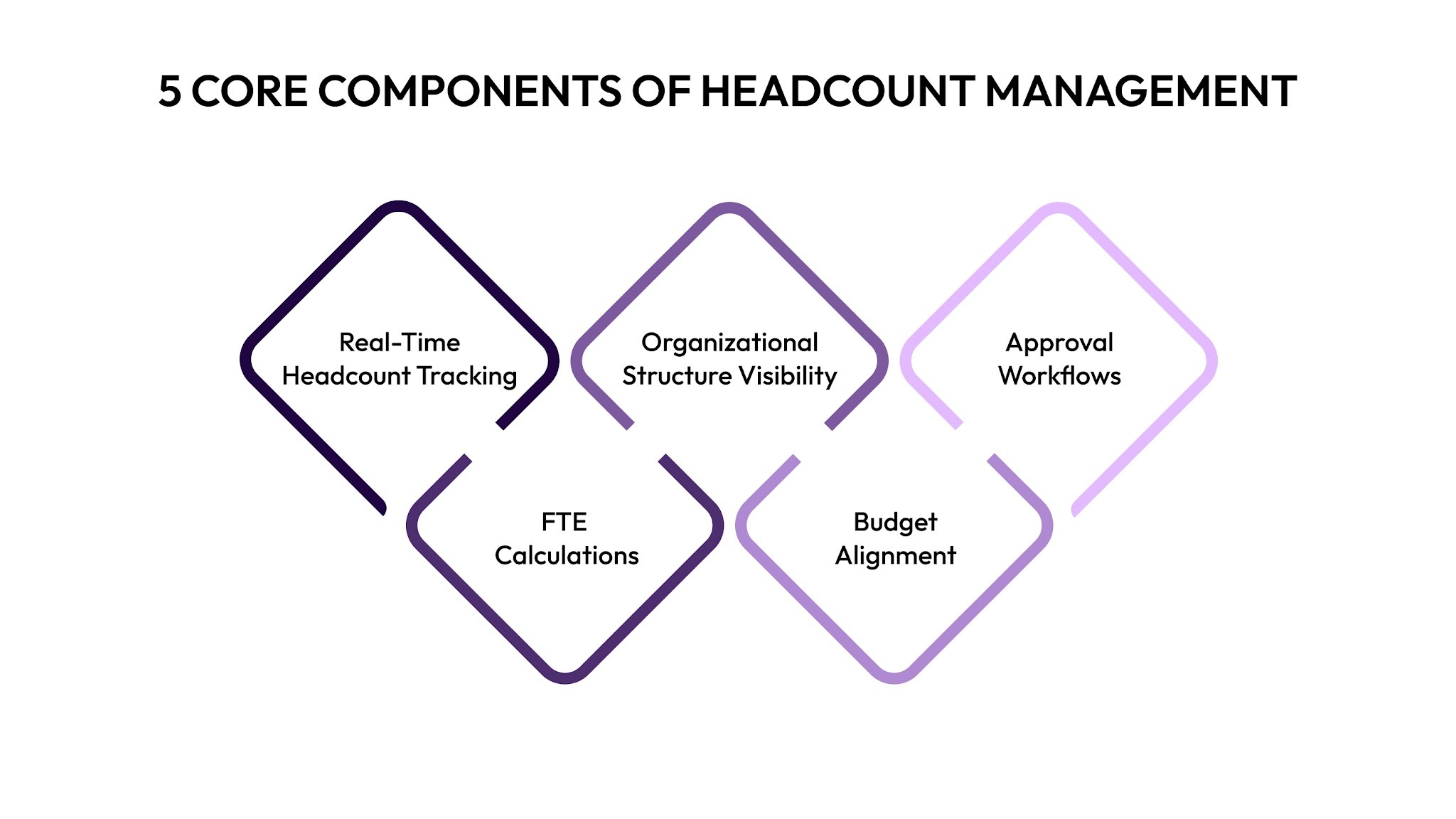
Here are the five components that matter most.
1. Real-Time Headcount Tracking
Real-time headcount tracking gives teams an up-to-date view of:
- Filled roles and open positions
- New hires, exits, and backfills
- Approved vs. unapproved headcount
To do this well, headcount data needs to stay in sync across:
- HRIS (employee records)
- ATS (open roles and hiring progress)
- Payroll systems (who is actually being paid)
When these systems drift out of alignment, headcount numbers stop being trustworthy. Real-time tracking keeps everyone working from the same facts.
2. FTE (Full-Time Equivalent) Calculations
Headcount alone doesn’t tell the full story. A team with 100 employees may not represent 100 full-time workloads. That’s why FTE matters.
FTE helps teams:
- Compare workload capacity accurately
- Account for part-time, seasonal, and contract workers
- Model costs more precisely
Clear FTE logic prevents overestimating capacity or underestimating cost.
3. Organizational Structure Visibility
Headcount isn’t just a number. Strong headcount management provides visibility into:
- Department and team breakdowns
- Reporting hierarchies and spans of control
- Location-based and remote distribution
This makes it easier to spot issues early, like overloaded managers, uneven team growth, or departments scaling faster than planned.
When organizational structure is visible, headcount decisions stop being isolated and start making sense in context.
4. Budget Alignment
This is where most headcount plans fall apart. Every role should be tied to:
- A defined compensation range
- A cost center or department budget
- A forecasted impact on payroll and burn
Budget alignment means comparing:
- Planned headcount vs. actual headcount
- Forecasted costs vs. real spend
When teams track this continuously, they catch overruns early, before they turn into end-of-quarter surprises.
5. Approval Workflows
Even the best plans fail without clear approvals. Effective headcount management includes:
- Standardized hiring and backfill requests
- Multi-level approvals based on role, cost, or location
- Clear documentation for why a role exists and how it’s funded
Strong approval workflows reduce delays, prevent shadow hiring, and create accountability, without slowing the business down.
Together, these five components form the foundation of headcount management. With them in place, teams can move from reactive hiring to deliberate, well-governed growth.
Also Read: The 7 Best Headcount Planning Strategies to Scale Smarter
Next, we’ll look at the essential headcount management metrics every HR and Finance team should track, and what each one actually tells you.
8 Essential Headcount Management Metrics You Should Track
Good headcount management runs on a small set of reliable metrics. Not vanity numbers. Not dashboards packed with noise. Just the signals that tell you whether hiring, costs, and capacity are moving in the right direction.
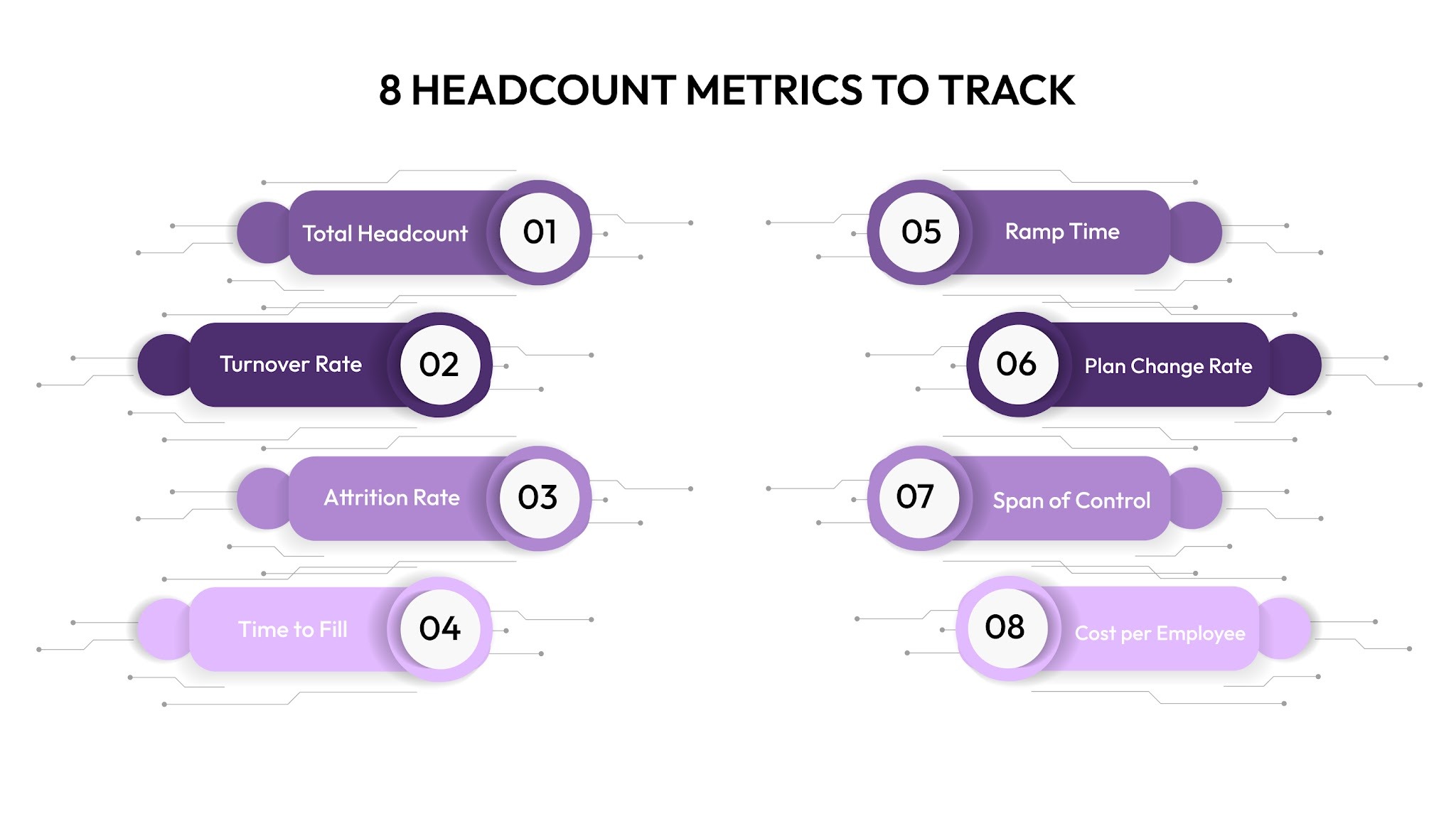
Here are the eight metrics that matter most and what each one actually tells you.
1. Total Headcount
This is the simplest number and the easiest to misread. A basic headcount is a raw employee count. On its own, it’s useful for reporting. But it doesn’t account for part-time workers, contractors, or workload capacity.
That’s why headcount should always be viewed alongside FTE, not in isolation.
2. Turnover Rate
Turnover shows how quickly employees are leaving the organization.
Formula: (Number of departures ÷ Average headcount) × 100
High turnover increases hiring costs, slows execution, and creates hidden productivity losses. Tracking it by department or role helps teams identify where growth is breaking down.
3. Attrition Rate (Voluntary vs. Involuntary)
Attrition becomes more useful when you split it into two.
- Voluntary attrition points to engagement, compensation, or growth issues
- Involuntary attrition reflects performance management or restructuring
Lumping them together hides the real story. Separating them reveals where intervention is actually needed.
4. Time to Fill
This metric measures how long it takes to close an open role. Long time-to-fill numbers often signal:
- Approval bottlenecks
- Misaligned budgets
- Overloaded recruiting teams
Tracking this over time shows whether hiring plans are realistic or quietly stalling execution.
5. Ramp Time
Hiring doesn’t create value on day one. Ramp time measures how long it takes for a new hire to reach full productivity. Long ramp periods affect capacity planning and can distort headcount forecasts if they’re ignored.
For fast-growing teams, ramp time is the difference between hiring growth and feeling growth.
6. Plan Change Rate
This metric tracks how often headcount plans change after approval. Frequent plan changes usually indicate:
- Weak upfront planning
- Poor cross-functional alignment
- Budget assumptions that don’t hold up in reality
A high plan change rate is a signal that headcount governance needs tightening.
7. Span of Control
Span of control looks at the ratio of managers to individual contributors. Too wide, and managers burn out. Too narrow, and costs rise without improving output. Monitoring this metric helps organizations scale teams without breaking management capacity.
8. Cost per Employee
This metric connects headcount directly to financial reality.
Formula: Total workforce cost ÷ Total headcount (or FTE)
Cost per employee makes it easier to:
- Compare departments fairly
- Track the impact of compensation changes
- Forecast payroll growth accurately
It’s one of the clearest signals Finance teams rely on when evaluating hiring plans.
When these metrics are linked to real-time headcount and compensation data, they become decision-making tools. That’s why modern teams increasingly manage these metrics in a single system that HR and Finance can both rely on.
Also Read: The Ultimate Guide to Headcount Analysis and Workforce Planning
Next, we’ll look at the most common headcount management challenges organizations face, and how teams overcome them as they scale.
6 Common Headcount Management Challenges and How to Overcome Them
Headcount management challenges typically arise gradually due to fragmented systems, manual processes, and unclear ownership. Over time, these issues erode budget control, planning accuracy, and leadership confidence in workforce data.
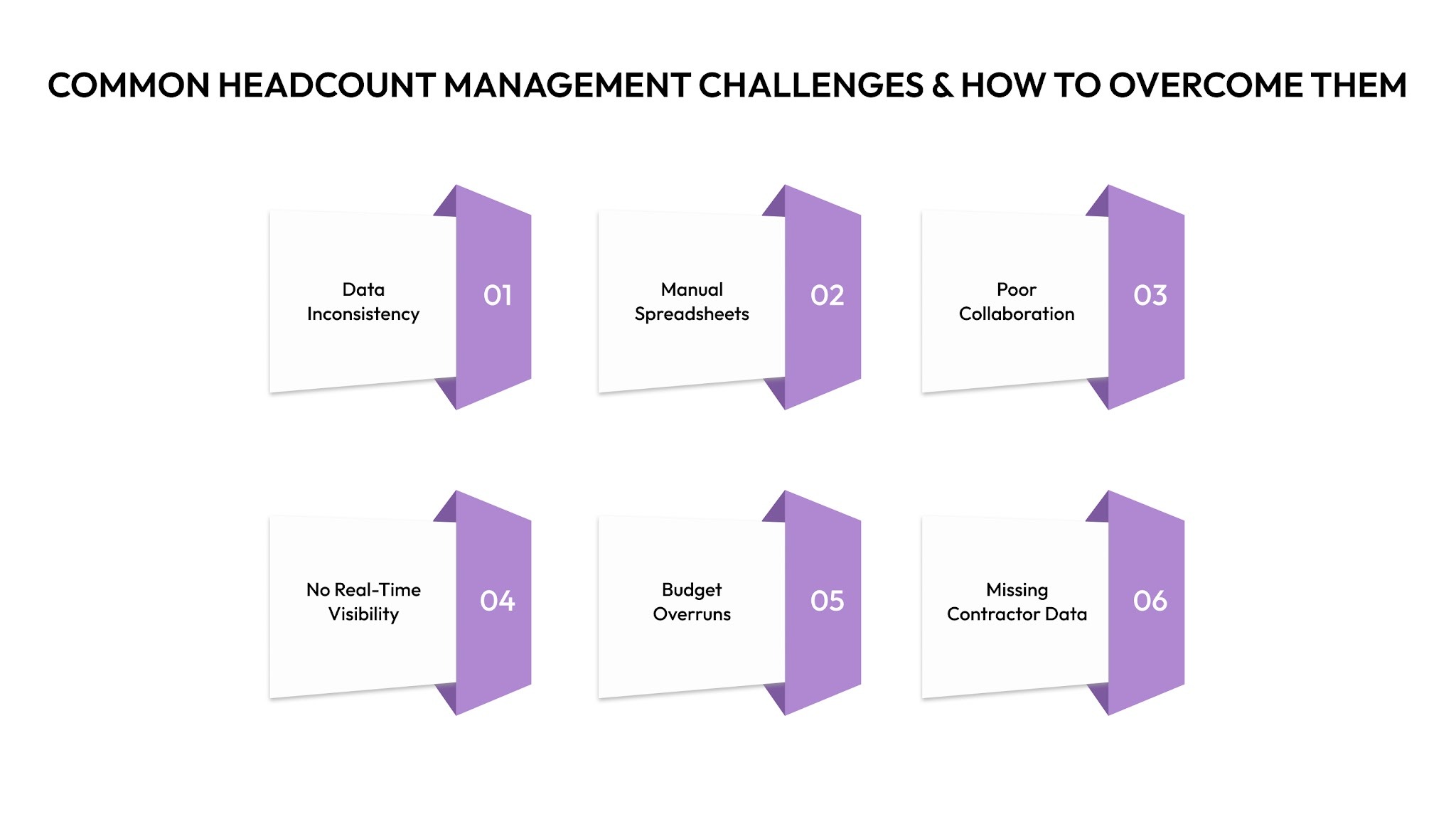
Here are the key challenges organizations face as they scale, along with proven solutions to tackle them.
1. Data Inconsistency Across Systems
In many organizations, headcount data is spread across multiple systems, including HRIS, ATS, payroll, and finance tools. Each system may reflect a different version of reality, leading to confusion and time-consuming reconciliation.
How to address it: Establish a centralized headcount model that integrates data from core workforce systems. A single source of truth ensures consistency across teams and enables informed decision-making.
2. Overreliance on Spreadsheets and Manual Processes
While spreadsheets offer flexibility, they do not scale effectively. Manual updates, version control issues, and formula errors reduce data reliability and slow down planning cycles.
How to address it: Move from static spreadsheets to systems designed for continuous headcount tracking. Automation reduces errors, and real-time updates eliminate the scramble before leadership reviews.
3. Limited Cross-Functional Collaboration
Headcount decisions require coordination across HR, Finance, recruiting, and executive leadership. When planning occurs in silos, approvals are delayed, and assumptions conflict.
How to address it: Create shared visibility into headcount plans, budgets, and scenarios. When all stakeholders see the same data, alignment happens earlier, before decisions are locked in.
4. Lack of Real-Time Headcount Visibility
Quarterly reports don’t reflect reality. By the time leadership reviews headcount, hires have already been made or missed. This lag creates blind spots around burn rate, capacity, and risk.
How to address it: Adopt real-time tracking that reflects hires, exits, and approvals as they happen. This allows teams to course-correct before small gaps turn into big surprises.
5. Budget Overruns from Unplanned or Misaligned Hires
Urgent business needs often drive unplanned hiring decisions. Without clear governance, these hires can push payroll costs beyond approved limits.
How to address it: Link every role to an approved budget and require financial validation before hiring begins. Scenario modeling helps teams understand trade-offs and maintain cost discipline without sacrificing speed.
6. Incomplete Tracking of Contractors and Contingent Workers
Contractors, freelancers, and seasonal workers are frequently excluded from headcount reporting, despite representing a meaningful share of workforce spend.
How to address it: Include contingent labor in headcount models using FTE and cost-based tracking. This provides a comprehensive view of workforce capacity and total labor costs.
Also Read: Proven Strategies for Compensation Budget Planning in 2025
Addressing these challenges does not require additional complexity. It requires clearer ownership, better data integration, and systems designed to support scale.
How CandorIQ Simplifies Headcount Management at Scale
As organizations grow, headcount management becomes more complex. Fragmented systems, spreadsheets, and delayed approvals hinder accurate workforce visibility and budget control, forcing leadership to make decisions with outdated data.
CandorIQ solves this by centralizing headcount, compensation, and workforce planning in a single platform. Tailored for scaling organizations with lean HR and finance teams, it enables leaders to align hiring decisions with financial plans and real-time workforce data.
Key capabilities include:
- Real-time headcount visibility across departments, roles, locations, and employment types.
- Integrated compensation and budget tracking, linking every role to approved spend and cost centers.
- Scenario modeling and workforce forecasting to assess the impact of hiring, backfills, and organizational changes.
- Structured approval workflows that align HR, Finance, and leadership on headcount decisions.
- System integrations with HRIS, ATS, and payroll tools to maintain a single source of truth.
With CandorIQ, headcount management becomes a strategic, data-driven process, providing the clarity and control organizations need to scale responsibly and sustainably.
Conclusion
Headcount management is crucial for fast-growing organizations, impacting cash flow, hiring, and scalability. When workforce data is scattered in spreadsheets or systems, visibility fades, budgets slip, and decisions are delayed.
A modern approach aligns headcount, compensation, and budgets in real time, enabling proactive planning. HR and Finance stay in sync, and leaders can assess the cost and impact of every hiring decision before it's made, driving intentional growth.
CandorIQ brings this clarity into one place. By unifying headcount planning, compensation, approvals, and forecasting, it gives teams a shared, accurate view of their workforce. The result is fewer surprises, faster decisions, and a planning process that keeps pace with the business.
To see how CandorIQ supports structured, scalable headcount management, book a personalized demo and explore the platform in action.

FAQs
Q1: What is the difference between headcount and FTE?
A: Headcount is the total number of employees. FTE converts part-time, seasonal, and contract roles into full-time equivalents for accurate capacity and cost.
Q2: How often should headcount be reviewed?
A: Ideally, in real time or at least monthly to ensure budgets, approvals, and hiring plans are current.
Q3: Who is responsible for headcount management?
A: HR maintains data and approvals, Finance ensures budget alignment, and leadership reviews strategic decisions. Collaboration is key.
Q4: What’s the ROI of headcount management software?
A: It can reduce workforce cost variance by 10–15%, cut reconciliation time by 50%, accelerate approvals, and improve hiring visibility.
Q5: How do you calculate FTE?
A: FTE = Total hours worked ÷ Standard full-time hours. Example: 20 hours/week in a 40-hour schedule = 0.5 FTE.
Q6: What systems integrate with headcount management tools?
A: HRIS, ATS, payroll, and finance/ERP systems. Integration ensures accurate, real-time workforce and budget visibility.
Ready to modernize your workforce and compensation strategy?
See how CandorIQ brings workforce planning and compensation together with AI.