

Strategic Workforce Planning Guide for Professionals in 2026
Explore this workforce planning guide for professionals to align hiring, forecast costs, and improve strategic HR and finance decision-making. Get insights now.

Most finance leaders struggle to see how hiring decisions affect the budget until the impact is already visible in reports. Headcount grows, compensation shifts, and suddenly, workforce costs exceed expectations. This disconnect often comes from planning processes that rely on spreadsheets, delayed updates, and limited collaboration between HR and Finance.
In fact, McKinsey estimates that 87% of executives are already experiencing workforce gaps, highlighting how widespread the challenge has become.
Strategic workforce planning changes that approach. Instead of reacting to hiring needs, it gives you a structured way to forecast roles, model costs, and align hiring decisions with financial goals. When done well, it connects headcount planning with compensation strategy, giving you a clearer view of workforce spend before decisions are finalized.
This guide explores how strategic workforce planning works in practice, why it matters for financial control, and how professionals can build a structured approach.
At a Glance:
- Workforce planning is a structured approach to forecasting talent needs by linking business goals with hiring and compensation decisions, helping improve cost visibility, budgeting, and financial alignment across HR and Finance.
- A modern framework combines headcount forecasting, compensation planning, scenario modeling, cross-functional collaboration, approval workflows, and centralized data to create a unified view of workforce decisions.
- The planning process typically includes aligning with business strategy, assessing current workforce capacity, forecasting future needs, identifying gaps, testing scenarios, and continuously tracking execution.
- Different models, such as demand-based, scenario-based, capacity-based, skills-based, and hybrid approaches, help organizations adapt workforce planning to growth, cost constraints, and evolving skill requirements.
- Common challenges like spreadsheet dependency, misaligned teams, and limited cost visibility are addressed through better collaboration, standardized processes, key workforce metrics, and consistent planning practices.
What is Workforce Planning and Why It Matters?
Workforce planning is the process of analyzing current workforce capacity and forecasting future needs based on business strategy. It answers critical questions such as how many employees are needed, what skills are required, and how much those decisions will cost.
In practice, this means linking hiring plans with compensation structures and making sure every workforce decision stays aligned with financial goals.
Here’s why it matters:
- Cost visibility: Gives finance teams a clear view of how hiring and compensation decisions affect the overall budget before commitments are made.
- Better forecasting: Helps predict headcount needs based on business goals, reducing last-minute hiring decisions and planning gaps.
- Budget control: Aligns hiring plans with financial constraints, making it easier to manage and control workforce spend.
- Team alignment: Creates a shared framework where HR and Finance evaluate hiring decisions using the same data and assumptions.
- Decision clarity: Provides structured insights that help leaders assess trade-offs between hiring, compensation, and cost.
- Proactive planning: Allows teams to anticipate workforce needs and financial impact instead of reacting after issues arise.
For CFOs and FP&A leaders, workforce planning is not just about filling roles. It is about understanding how each hire affects cost structure, cash flow, and long-term financial performance.

Core Components of a Modern Workforce Planning Framework
A modern workforce planning framework combines multiple elements to create a clear and structured planning process. Each component plays a role in improving visibility into headcount and compensation decisions.
- Headcount Forecasting: Predicts future hiring needs based on business goals, attrition trends, and team expansion plans. It helps finance teams estimate workforce size and align hiring with budget expectations.
- Compensation Planning: Defines salary ranges, bonuses, and equity structures across roles, levels, and locations. When linked with headcount plans, it provides a more accurate view of total workforce costs.
- Scenario Modeling: Allows teams to test multiple hiring strategies and compare their financial impact before making decisions. This supports better trade-off analysis between growth plans and budget constraints.
- Cross-Functional Collaboration: Ensures both teams collaborate on planning decisions using shared data and assumptions. This reduces miscommunication and improves consistency in hiring and compensation strategies.
- Approval and Workflow Structure: Standardizes how hiring requests and compensation changes move through approvals. It helps reduce delays, improve accountability, and keep planning aligned with financial goals.
- Data Centralization: Bring workforce, compensation, and planning data into one system for consistent access. This reduces errors from fragmented tools and improves decision-making accuracy.
These components work together to create a system where HR and Finance operate with shared visibility and aligned goals.
Also Read: What is Workforce Capacity Planning in 2026
Step-by-Step Process to Build a Strategic Workforce Plan
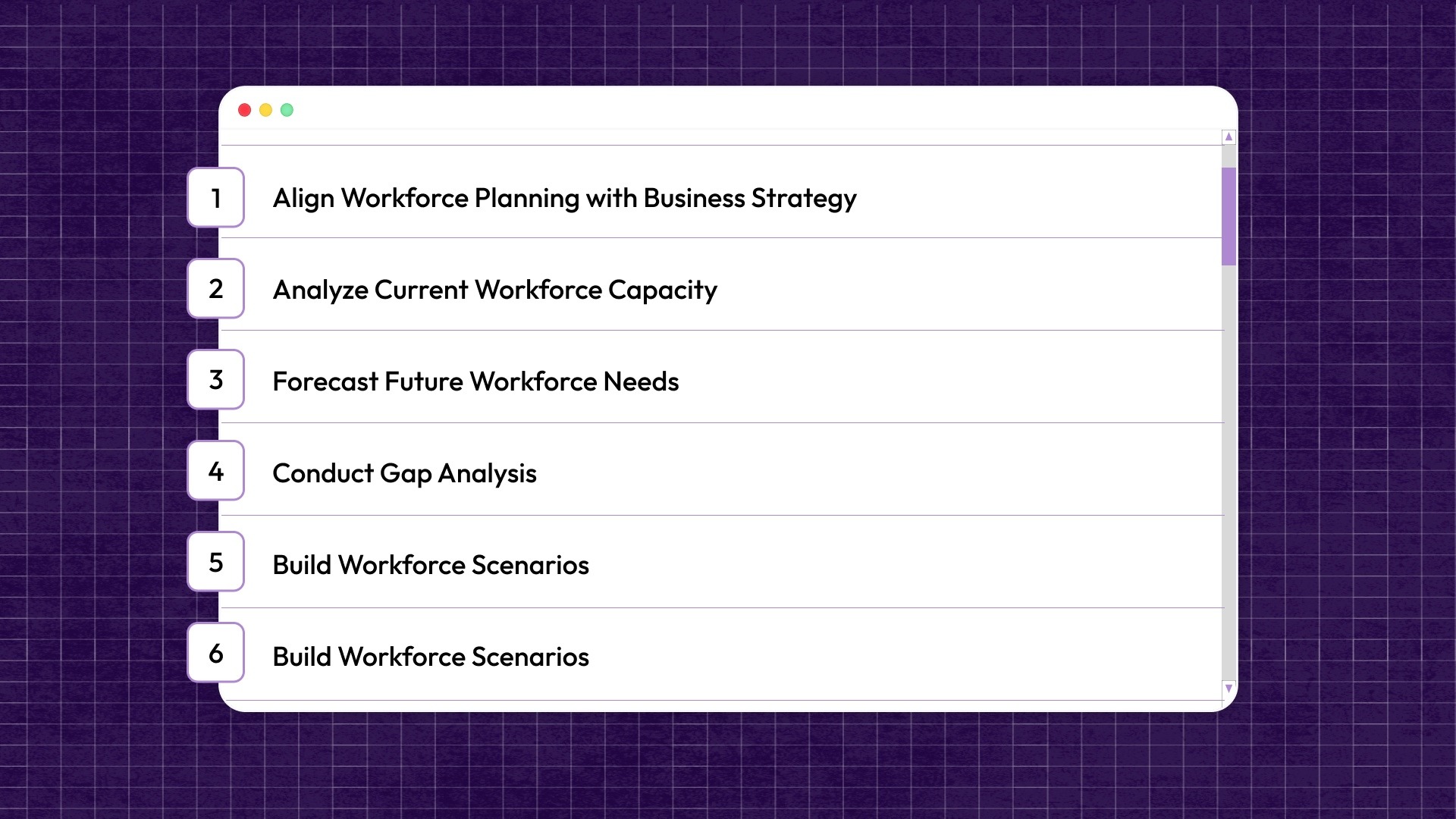
Building a workforce plan requires a structured approach that connects hiring needs with financial evaluation. Each step focuses on improving visibility and reducing uncertainty.
Step 1: Align Workforce Planning with Business Strategy
Workforce planning should begin with the business direction, not with open roles. Before you forecast headcount, define what the company is trying to achieve over the planning period.
This step gives the plan context. A growth target, product launch, market expansion, or cost reduction goal each creates a different workforce need.
Focus on:
- Business goals for the next quarter, half-year, or year
- Expected growth areas and cost pressure points
- Functions that need to scale first
- Strategic priorities that may change hiring volume or timing
When this step is clear, the rest of the process becomes easier to structure. You are no longer asking, “What roles do we need?” You are asking, “What workforce supports the plan we are trying to execute?”
Step 2: Analyze Current Workforce Capacity
Once you know where the business is going, review the workforce you already have. This means looking at headcount, skills, compensation, and capacity across teams.
The goal is to understand what is available today before adding new demand. Some teams may already be stretched. Others may have capacity that can be used more efficiently. For workforce planning, that difference matters because it affects hiring timing and budget use.
Review:
- Open roles, filled roles, and expected attrition
- Team capacity and workload concentration
- Current pay bands and compensation spread
- Roles that are critical, duplicate, or underused
- Internal mobility or promotion possibilities
This step helps you avoid overhiring in one area while missing gaps in another. It also gives you a baseline for cost planning, since current compensation is part of future workforce spend.
Step 3: Forecast Future Workforce Needs
After reviewing current capacity, estimate the workforce the business will need to meet its goals. This forecast should reflect both role demand and timing.
A good forecast is not just a list of jobs. It shows when each role is needed, why it is needed, and what it is likely to cost. That gives HR and Finance a shared view of upcoming workforce demand.
Forecast by considering:
- Revenue or growth targets
- Project timelines and launch dates
- Replacement hiring from expected attrition
- Skill needs tied to new initiatives
- Location-based compensation differences
This step works best when it is specific. Instead of saying “more engineers,” define the number, level, function, and expected start window. That level of detail improves budget accuracy and gives decision-makers more confidence.
Step 4: Conduct Gap Analysis
Gap analysis compares your current workforce with your future needs. It shows where the business is short on capacity, skills, or budget support.
This is often the most useful part of the process because it turns planning into action. You can see which gaps need hiring, which can be handled through redeployment, and which may require compensation adjustments or timing changes.
Look for gaps in:
- Headcount
- Skills and experience
- Team capacity
- Compensation alignment
- Budget availability
Not every gap requires a new hire. Some can be solved through role redesign, promotion, internal movement, or delayed hiring. That is why this step matters. It helps teams choose the right response instead of defaulting to immediate recruitment.
Step 5: Build Workforce Scenarios
Once the gaps are clear, test different workforce scenarios. This step helps you compare possible approaches before locking in a plan.
Scenario building is useful when budget pressure, hiring uncertainty, or changing business priorities make one fixed plan too risky. It lets Finance and HR evaluate trade-offs in a structured way.
Common scenarios include:
- Base case: planned hiring based on current targets
- Growth case: faster expansion with added roles
- Constraint case: slower hiring due to budget limits
- Replacement case: only critical backfills and essential growth roles
For professionals responsible for cost control, this step creates stronger decision support. It shows what changes if hiring is delayed, accelerated, or restructured.
Step 6: Execute and Monitor
A workforce plan only works if it is tracked after approval. Execution is where plans often break down, especially when updates live in separate spreadsheets or disconnected systems.
Monitoring keeps the plan connected to reality. It helps teams see whether hiring is on track, whether costs are staying within budget, and whether assumptions still hold.
Track:
- Actual headcount vs planned headcount
- Open roles vs approved roles
- Compensation changes against the forecast
- Hiring pace and approval delays
- Budget variance by team or function
This step should be ongoing, not occasional. A structured execution improves collaboration. HR, Finance, and leadership can review the same data, work from the same assumptions, and make faster adjustments when conditions change.
Modern Workforce Planning Models Professionals Should Know
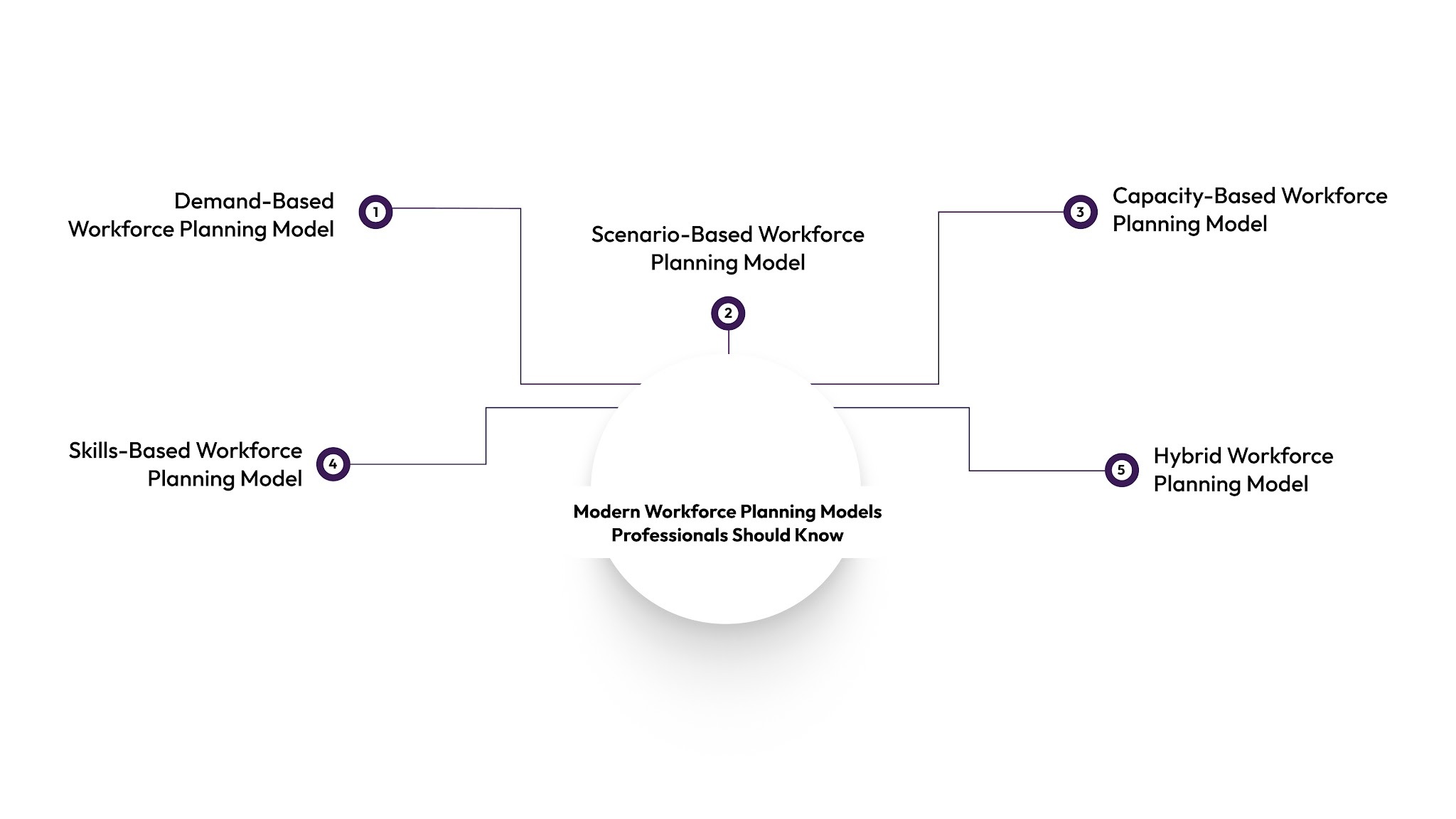
Different workforce planning models help teams approach planning in structured ways. These models provide frameworks for making decisions and evaluating tradeoffs.
1. Demand-Based Workforce Planning Model
This model aligns workforce needs directly with business demand, such as revenue growth, product expansion, or market entry. It translates business goals into hiring requirements and helps estimate how many people are needed in each function.
Finance leaders typically use this model when planning budgets tied to revenue forecasts, since it connects workforce expansion with measurable business output.
Best For: Fast-growing organizations with predictable demand patterns and revenue-linked hiring plans.
2. Scenario-Based Workforce Planning Model
This model focuses on building multiple workforce scenarios to evaluate different hiring strategies. Each scenario reflects a different business condition, such as aggressive growth, conservative hiring, or budget-constrained expansion.
It helps decision-makers compare cost implications across scenarios before committing to a hiring plan, improving financial control and reducing risk.
Best For: CFOs and FP&A teams operating in uncertain markets or managing fluctuating budgets.
3. Capacity-Based Workforce Planning Model
Capacity-based planning evaluates how much work the current workforce can handle and identifies when additional hiring is required. It focuses on workload distribution, utilization rates, and productivity thresholds.
This model is useful for avoiding both over-hiring and under-staffing by keeping workforce size aligned with operational demand.
Best For: Operations-heavy organizations where workload balance and efficiency directly impact performance.
4. Skills-Based Workforce Planning Model
Instead of focusing only on headcount, this model prioritizes the skills required to achieve business goals. It maps current employee capabilities against future skill needs and identifies gaps that must be filled through hiring or upskilling.
This approach is especially important in industries where roles evolve quickly and skill requirements change frequently.
Best For: Companies undergoing digital transformation or facing rapid skill shifts in their industry.
5. Hybrid Workforce Planning Model
The hybrid model combines elements of demand-based, scenario-based, and skills-based planning. It provides a more flexible framework that adapts to different planning needs within the same organization.
Teams use this model when no single approach is sufficient to capture both financial constraints and evolving talent requirements.
Best For: Mid-to-large organizations with complex structures and multiple planning priorities across departments.
Understanding these models allows professionals to choose the right approach based on their organization’s needs.
Also Read: 5 Proven Agile Workforce Management Strategies for Growing U.S. Teams (2026)
Common Challenges in Workforce Planning
Even with a structured approach, workforce planning presents several challenges that can limit effectiveness. Understanding these issues helps finance leaders identify where improvements are needed.
- Spreadsheet Dependency: Many organizations rely on spreadsheets to manage workforce data. This creates version control issues, delays updates, and increases the risk of errors.
- Limited Cost Visibility: Without integrated planning, it is difficult to see how hiring decisions affect the overall budget. This leads to reactive adjustments instead of proactive planning.
- Misalignment Between HR and Finance: When HR and Finance operate separately, decisions lack coordination. This results in inconsistent hiring plans and unclear cost implications.
- Slow Approval Processes: Manual workflows slow down approvals and create bottlenecks. This affects hiring timelines and reduces planning efficiency.
- Inconsistent Compensation Decisions: Without structured compensation planning, similar roles may have different pay levels, leading to internal inequities.
Addressing these challenges requires both process improvements and better systems for collaboration.
Metrics for Measuring Workforce Planning Success
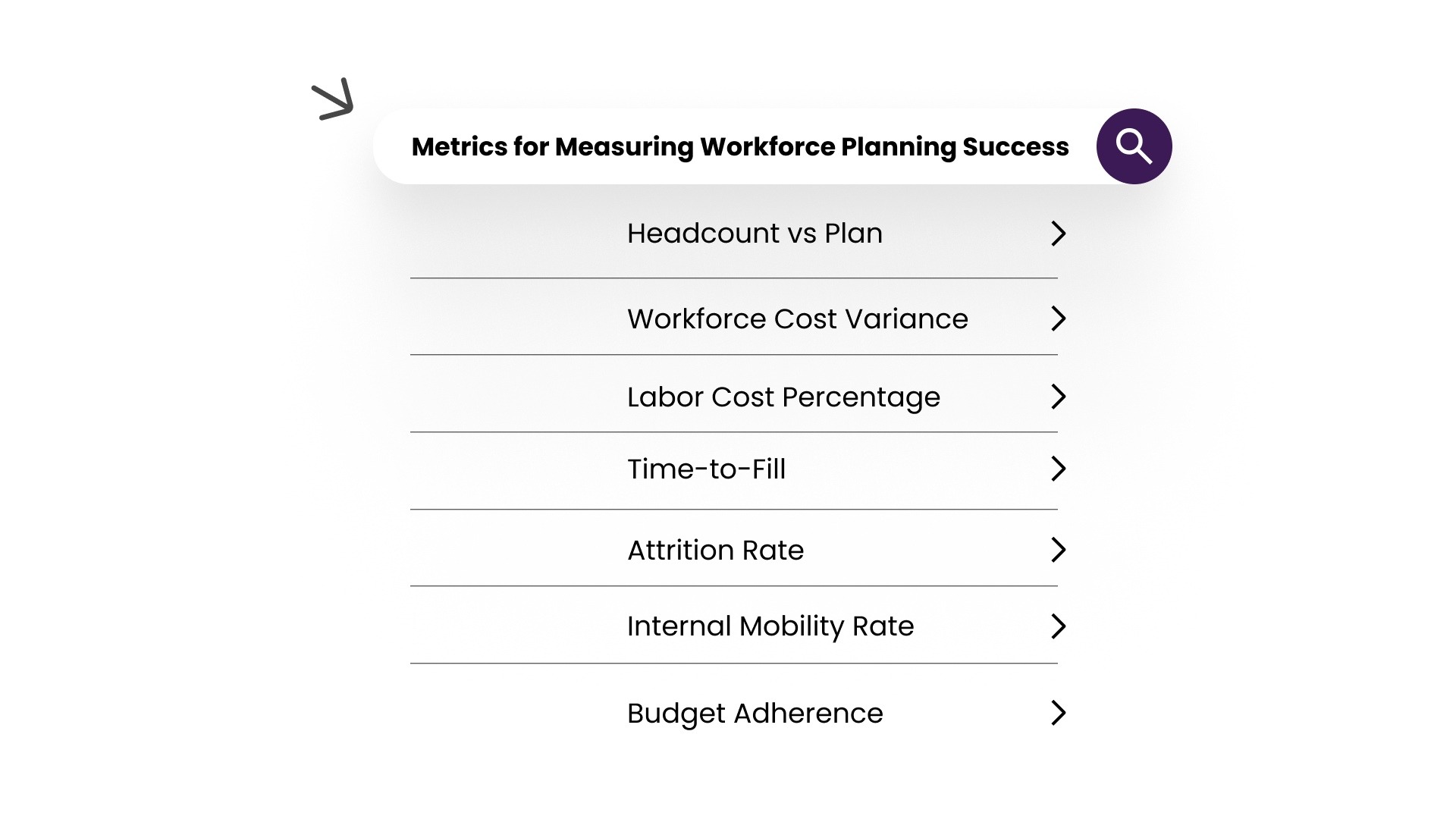
Measuring workforce planning effectiveness requires tracking the right metrics. These metrics provide insights into both workforce health and planning accuracy.
1. Headcount vs Plan
This metric compares planned headcount with actual hiring outcomes over a given period. It helps you understand whether hiring is on track or deviating from the original workforce plan.
It is especially useful for identifying gaps in hiring execution or over-hiring risks that may affect budget alignment.
Example: A company plans for 200 employees by Q2 but reaches 230 due to faster-than-expected hiring in engineering. This signals a planning mismatch that needs adjustment in future forecasts.
2. Workforce Cost Variance
Workforce cost variance measures the difference between projected workforce costs and actual spending. It highlights whether compensation, hiring mix, or timing has impacted budget accuracy.
For finance teams, this is a key indicator of forecasting precision.
Example: A finance team forecasts $5M in quarterly workforce costs but spends $5.6M due to higher-than-expected senior-level hires. The $600K gap reflects cost variance.
3. Labor Cost Percentage
This metric shows how much of the total revenue or operating expense is spent on employee compensation. It helps evaluate whether workforce costs are proportionate to business performance.
It is commonly used by CFOs to maintain cost discipline during scaling.
Example: If a company earns $10M in revenue and spends $3M on workforce costs, the labor cost percentage is 30%.
4. Time-to-Fill
Time-to-fill measures how long it takes to close an open role from approval to hiring. It reflects hiring efficiency and planning readiness.
Long time-to-fill cycles often indicate bottlenecks in approvals or unclear role definitions.
Example: A role takes 45 days to fill instead of the planned 25 days, delaying product delivery timelines and increasing workload pressure on existing teams.
5. Attrition Rate
Attrition rate tracks how many employees leave the organization over a specific period. It helps forecast replacement hiring needs and assess workforce stability.
High attrition can significantly disrupt workforce planning accuracy.
Example: If 10 employees leave out of a 200-person workforce in a quarter, the attrition rate is 5%.
6. Internal Mobility Rate
This metric measures how often employees move internally across roles, teams, or levels. It reflects how effectively the organization is utilizing internal talent.
Higher mobility often reduces external hiring needs and improves retention.
Example: If 15 employees move into new roles within a 300-person company, the internal mobility rate is 5%.
7. Budget Adherence
Budget adherence tracks how closely workforce spending aligns with the approved budget. It is one of the most critical metrics for CFOs managing headcount and compensation costs.
It helps keep workforce expansion within financial limits.
Example: If a department is allocated $2M for hiring but spends $2.1M due to unplanned hires, budget adherence is slightly off-track, signaling the need for tighter approval controls.
Tracking these metrics helps organizations refine their workforce strategies and improve decision-making over time.
Best Practices for Successful Workforce Planning
Successful workforce planning requires consistent practices that support clarity, alignment, and execution.
- Align HR and Finance Early: Collaboration between HR and Finance should begin at the planning stage. This helps to ensure hiring decisions reflect both talent needs and financial constraints.
- Use Data Instead of Assumptions: Decisions should be based on data rather than intuition. Workforce analytics provides the insights needed for accurate forecasting.
- Standardize Compensation Structures: Clear pay bands and compensation frameworks reduce inconsistencies and improve transparency.
- Use Scenario Modeling Regularly: Regular scenario modeling helps teams adapt to changing conditions. It supports better decision-making in uncertain environments.
- Establish Clear Approval Workflows: Structured approval workflows help streamline decision-making and reduce delays. Clear roles and responsibilities improve accountability.
These practices help organizations maintain control while adapting to changing business conditions.
How CandorIQ Can Help Optimize Strategic Workforce Planning
Strategic workforce planning becomes difficult when compensation, headcount, and approvals are managed in disconnected systems. CandorIQ brings these workflows into one platform so HR and Finance teams can plan with shared visibility and consistent data.
- Compensation & Payband Builder: Defines structured pay bands by role, level, and geography. This keeps compensation planning consistent and aligned with workforce cost assumptions.
- Compensation Cycle: Streamlines merit and bonus cycles with structured approvals and collaboration. Finance teams gain visibility into compensation changes and budget impact.
- Headcount Scenario Planning: Models different hiring scenarios and compares cost impact. Helps CFOs and FP&A leaders evaluate workforce costs before approving plans.
- Workforce Management: Offers a single view of actual vs planned headcount, including hires, attrition, and promotions. Helps identify gaps between plans and execution.
- Headcount Requests & Approvals: Standardizes hiring requests with structured workflows and routing logic. Improves accountability and reduces approval delays.
- Candidate Offers: Provides clear total compensation views, including salary, equity, and bonuses. Improves offer clarity and speeds up hiring decisions.
- Employee Total Rewards: Gives employees visibility into full compensation packages, including benefits and equity. Strengthens transparency and supports retention.
- AI Agent: Enables fast analysis of compensation and workforce data using natural language queries. Reduces manual effort and supports quicker planning decisions.
If you are looking to improve how your team plans and manages workforce decisions, contact us today.

FAQs
1. What tools and technologies best support strategic workforce planning in 2026?
Modern strategic workforce planning relies on AI-enabled HRIS platforms, people analytics tools, workforce management systems, and scenario modeling software. Integration with ATS and ERP systems helps forecast talent needs, costs, and skills gaps more accurately.
2. How does strategic workforce planning integrate with diversity, equity, and inclusion (DEI) initiatives?
Strategic workforce planning supports DEI by tracking representation gaps, reducing hiring bias through structured analytics, and aligning talent pipelines with inclusive hiring goals. It also enables monitoring of pay equity and promotion fairness across diverse employee groups.
3. How has remote and hybrid work changed strategic workforce planning strategies?
Remote and hybrid work have expanded talent pools beyond geography, requiring workforce planning to focus on skills-based hiring, distributed team structures, productivity measurement, and flexible capacity planning across time zones and collaboration models.
4. What legal and compliance considerations apply to workforce planning?
Workforce planning in the U.S. must align with federal laws such as Title VII, the Equal Pay Act, the ADA, ADEA, FLSA, FMLA, and OSHA regulations. These govern equal pay, discrimination, wages, leave, and workplace safety. Employers must also follow evolving state and local pay transparency laws across the U.S.
5. How can SMEs implement strategic workforce planning on a limited budget?
SMEs can start strategic workforce planning using simple spreadsheets or low-cost HRIS tools, focusing on critical roles first, leveraging cloud-based analytics, and adopting phased planning approaches to scale gradually without heavy upfront investment.
Ready to modernize your workforce and compensation strategy?
See how CandorIQ brings workforce planning and compensation together with AI.