

5 Proven Agile Workforce Management Strategies for Growing U.S. Teams (2026)
Explore agile workforce management with 5 proven strategies, built for lean HR teams scaling fast in the US. Covers planning, comp bands & offers. Read More.
.jpg)

Every day a compensation band sits outdated, you are either overpaying to close candidates or losing them to a faster competitor.
According to Gartner, only 15% of organizations engage in truly strategic workforce planning, leaving most reactive to crises such as skills gaps and fluctuating demand.
However, the root cause is rarely a talent shortage, but a planning infrastructure problem. Disconnected compensation tools, stale pay bands, and offer workflows that move too slowly to compete are quietly costing US companies their best candidates and their budget discipline.
This blog explores five proven agile workforce management strategies that address these operational breakdowns.
At a Glance
- Most HR teams are slow, not because of effort, but because their planning tools haven't scaled with the business.
- Annual workforce plans can't keep up with the pace of change. Rolling 90-day planning, live comp bands, and fast offer workflows are the fix.
- The biggest breakdown in scaling companies is the HR–Finance coordination gap that delays every headcount and pay decision.
- CandorIQ brings pay bands, compensation cycles, headcount planning, and offer approvals into one platform, so HR and Finance finally work from the same data.
- Companies using agile workforce planning make faster offers, reduce budget overruns, and free up HR teams to focus on strategy instead of spreadsheets.
What Is Agile Workforce Management?
Agile workforce management is the continuous practice of aligning headcount, compensation, and talent decisions to real-time business needs. It replaces fixed annual plans with rolling, data-driven cycles, so HR and Finance can respond together as priorities shift.
Why Agile Workforce Management Matters More in 2026
The pressure on US HR and Finance teams to plan faster and make better talent decisions has only increased. Here's what's driving it:
- US salary benchmarks move fast. An annual comp review leaves you making offers against benchmarks that are already months out of date.
- Pay transparency laws are raising the stakes. California, Colorado, New York, and Illinois now require salary ranges in job postings. Without current, defensible pay bands, you face legal exposure and lose candidate trust before the first interview.
- Headcount decisions happen faster than planning cycles allow. Boards approve strategic hires, pivot roadmaps, and trigger reorgs quarterly. A headcount plan with no update mechanism leaves HR and Finance operating on stale data for months.
- Distributed teams create multi-market complexity. A team spread across San Francisco, Austin, and New York operates in three different salary markets. Without geo-adjusted pay bands and a unified workflow, you build pay inequity into the organization from day one.
- Lean HR teams can't absorb manual coordination overhead. A small HR team running compensation cycles, headcount requests, and offer approvals via spreadsheets and email is structurally broken.
- Reactive hiring has a measurable cost. Companies that always backfill instead of planning ahead, consistently overpay on offers, move slower than competitors, and burn out the HR team in the process.
Now that you know why it matter it is equally important to understand why it breaks down.
Why Workforce Planning Breaks Down at the Growth Stage
Most growing US companies are still using a workforce planning process designed for 60 employees, not 300. That gap starts to show as the company scales. Here are the five most common breakdowns:
- No single source of truth: There’s no single, reliable view of headcount or compensation. Teams spend more time aligning numbers than actually making decisions.
- HR and Finance operate on different timelines: Finance works in fixed cycles, while hiring needs change constantly. When a new role comes up mid-cycle, things slow down, and hiring managers feel the delay.
- Pay bands quickly become outdated: Compensation benchmarks set early in the year don’t keep up with the market. Offers become less competitive, and acceptance rates start to drop.
- Offer approvals are slow and manual: Finalizing an offer takes multiple approvals, often across email. The process drags on for days, and candidates don’t always wait.
- No clear approval structure for decisions: Simple hiring decisions go through the same process as critical roles. Time and attention get spread thin across everything.
- Too much admin, not enough strategy: HR teams spend most of their time coordinating and fixing data. That leaves little room for planning ahead or working strategically.
With the problems clearly defined, the next step is fixing them, one operational improvement at a time.
Also Read: Key Considerations for Workforce Management Dashboards
5 Proven Agile Workforce Management Strategies
Each of these strategies is not a big cultural shift. They’re practical, operational changes a lean HR team can start implementing this quarter.
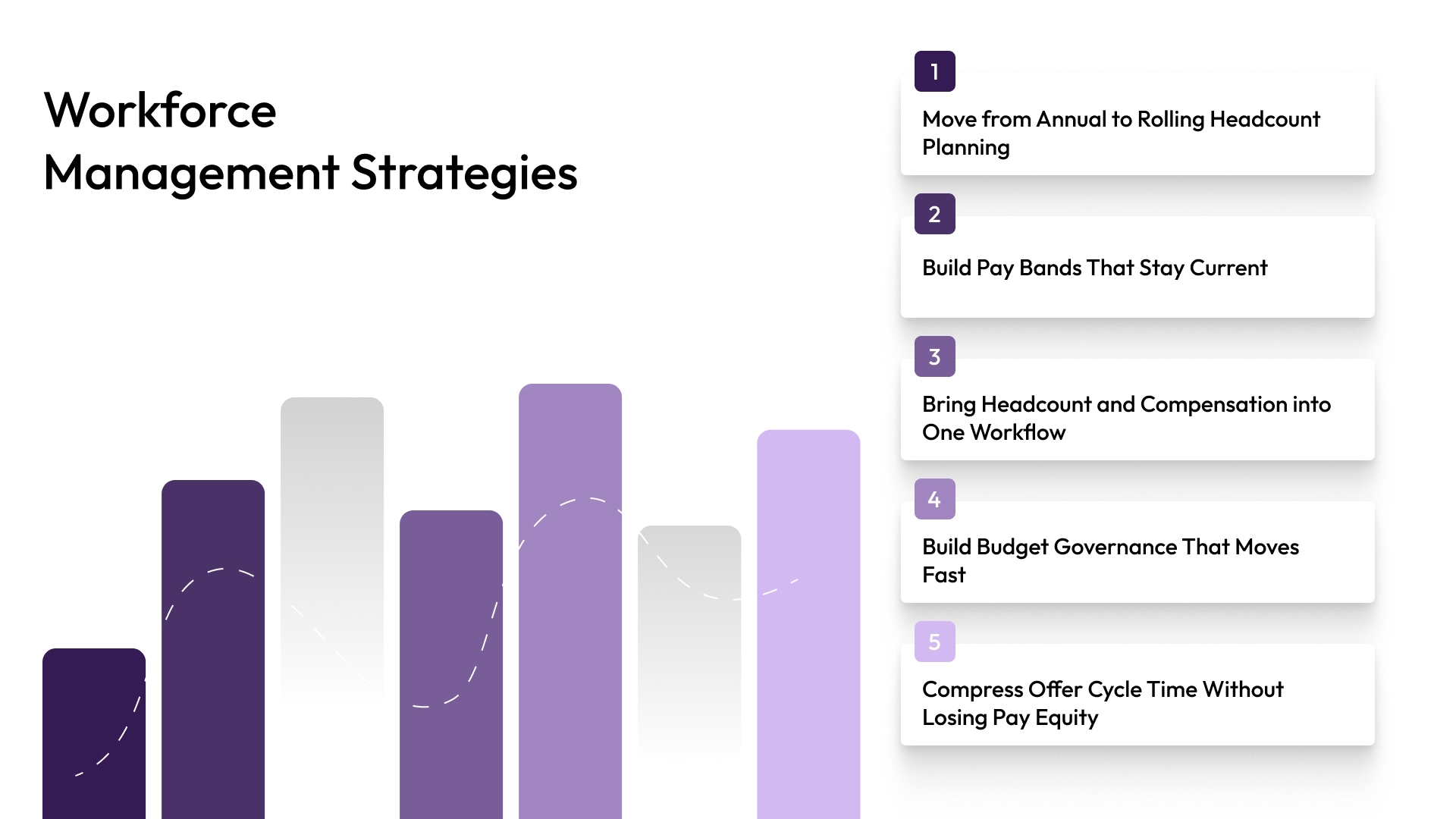
Strategy 1: Move from Annual to Rolling Headcount Planning
Annual plans don’t hold up in a fast-moving business. The moment priorities change, those plans lose relevance.
A rolling approach works better because it keeps updating as the business evolves.
- Instead of planning once a year, teams align regularly using a shared, live headcount view.
- Monthly check-ins between HR and Finance ensure everyone is working with the same assumptions.
- The focus stays on the next 90 days, while also keeping a 6-month view for scenario planning.
This approach makes a big difference in day-to-day decisions. Teams can see budget impact immediately, compare hiring timelines before committing, and avoid delays when backfills are needed.
Once planning becomes dynamic, the next challenge is making sure compensation keeps up.
Strategy 2: Build Pay Bands That Stay Current
Outdated pay bands create silent problems. They lead to weak offers, higher drop-offs, and pay gaps that grow over time. To stay competitive, compensation needs to move with the market.
- Agile compensation means treating pay bands as living data.
- Instead of reviewing them once a year, they’re checked regularly against real market benchmarks.
- If the market shifts meaningfully, bands are updated, even mid-cycle. It also means being more precise.
- Pay ranges should reflect role level, location, and function, not a single company-wide number. This ensures offers are realistic across different hiring markets.
When hiring managers can see and trust these ranges, decisions become faster and more accurate. This is what enables speed. When compensation is already current and approved, offers don’t get stuck in validation loops.
But fast decisions also depend on how systems work together, which leads to the next fix.
Strategy 3: Bring Headcount and Compensation into One Workflow
Most delays don’t come from bad decisions. They come from disconnected systems. When headcount and compensation are managed separately, every hiring decision turns into a coordination exercise.
Bringing both into a single workflow removes that friction.
- When a role is approved, the compensation range is already defined.
- There’s no need to look it up or validate it separately. Budget impact is visible upfront, so Finance isn’t reacting after the fact.
- Approvals follow a clear path instead of scattered messages across email or chat.
- Just as important, every decision is documented with context. This creates a clean audit trail, which is critical for compliance and pay equity reviews later.
The difference becomes most obvious during offer approvals.
With a unified system like CandorIQ, that same offer can be generated and sent the same day, as long as it falls within the approved range. Exceptions are flagged automatically, without slowing everything else down.
This shift removes internal friction. But to keep things moving, governance also needs to evolve.
Strategy 4: Build Budget Governance That Moves Fast
Speed doesn’t mean removing controls. It means applying them where they actually matter.
- A tiered approval model helps balance both. Routine decisions move quickly, while higher-impact ones still get the right level of scrutiny.
- For example, backfills within approved ranges can move forward automatically once a departure is confirmed. There’s no need to escalate something that was already budgeted.
- New roles that fit within the plan can go through a fast-track approval with a clear turnaround time.
- And only the most critical decisions, like senior hires or above-range offers, require a full review.
This structure keeps finance in control of the budget without slowing down everyday hiring. It also creates clarity, so managers know exactly what to expect instead of navigating unclear approval paths.
With governance in place, the final piece is improving what candidates actually experience.
Strategy 5: Compress Offer Cycle Time Without Losing Pay Equity
One of the most overlooked bottlenecks in hiring is the time between a verbal offer and the final letter. Improving this doesn’t require major changes, just better preparation and visibility.
- When salary ranges are pre-approved, offers within those ranges can be generated instantly.
- Standardized templates remove the need to create documents from scratch.
- And for exceptions, having a separate fast-track path ensures they don’t slow down the entire process.
- Giving recruiters access to compensation ranges also makes a big difference. It allows them to set the right expectations early, reducing back-and-forth later.
- Tracking this timeline as a metric is equally important. Once teams can see how long offers take, delays become easier to identify and fix.
Structured, in-band offers reduce the risk of inconsistent negotiations, which is a key factor in preventing pay gaps across gender, geography, or other groups. As pay transparency laws expand in the U.S., this becomes not just a fairness issue, but a compliance one.
Here's a quick look at what changes when you shift from traditional to agile planning, so you know exactly what you're building toward.
These strategies work best when they’re measured consistently. Now let's look at how the right platform makes all of this possible, without adding headcount to HR.
Also Read: Best All-in-One Workforce Management Software 2025
How CandorIQ Makes Agile Workforce Management Efficient For You
.jpg)
Most scaling U.S. companies don’t lack ambition. They lack the infrastructure to support it. There’s no consistent view of headcount or compensation, and key decisions depend on fragmented, outdated information.
That’s exactly the gap CandorIQ is built to address. It brings headcount planning, compensation data, and offer workflows into one unified system, so HR and Finance operate from the same numbers in real time.
With shared visibility, location-aware pay insights, and built-in intelligence for quick workforce analysis, it helps teams move faster while staying consistent and compliant.
- Compensation & Pay Band Builder: Define pay bands by level, location, and department. Apply location-based salary adjustments using benchmark datasets. Visualize pay distribution in real time. Version-control every band change for auditability and compliance.
- Compensation Cycle: Automate merit and bonus reviews with built-in approval logic and real-time budget tracking. Managers log rationale in-platform. Reminders and approvals route through email or Slack, no chasing required.
- Candidate Offers: Let candidates see their full compensation picture, salary, equity, bonus, and benefits, with future-value equity modeling and interactive FAQs that reduce back-and-forth at the offer stage.
- Headcount Scenario Planning: Model future organizational structures and view their direct financial impact. Toggle multiple hiring scenarios. Compare them against budget thresholds before opening a single requisition.
- Headcount Requests & Approvals: Create hire requests with embedded job details, rationale, and budget context. Route approvals dynamically by team, location, or comp level. Sync directly with ATS and Finance systems.
- Workforce Management: Track open roles, filled seats, attrition, and promotion rates in one view. Align actuals vs. plan on headcount and comp spend. Build dashboards for exec, Finance, or HRBP audiences.
- AI Agent: Ask any workforce or compensation question in plain language and get answers instantly. Analyze pay equity gaps, forecast headcount needs, and model budget impact with analyst-level precision and none of the manual prep work.
For lean teams managing rapid growth, CandorIQ removes the coordination overhead that slows every talent decision and replaces it with a system where pay equity, budget alignment, and workforce visibility are the default, not the exception.
Conclusion
Agile workforce management comes down to one question: can your headcount planning, compensation structure, and hiring workflows keep pace with how your business is changing?
For a CPO managing 250 employees with a small HR team, infrastructure is a priority. And infrastructure problems need practical fixes: planning that updates regularly, compensation that stays current, workflows that don’t slow decisions down, and governance that enables speed without losing financial control.
If your current setup is slowing you down, it may be time to rethink the infrastructure behind your workforce decisions. Platforms like CandorIQ are designed to bring headcount planning, compensation, and approvals into one system, so your team can move faster without losing control.
Book a demo to see how it works in practice.
FAQs
Q: What is the difference between agile and traditional workforce planning?
Traditional planning is annual and static. Headcount and comp bands are set once and rarely revisited. Agile planning is continuous: quarterly plan updates, live market benchmarking, and tiered approval workflows. The practical difference is whether HR and Finance can adjust mid-quarter or must wait for next year's budget cycle.
Q: How do you implement agile workforce management with a lean HR team?
Start with three changes: (1) Shift to rolling 90-day headcount planning with monthly HR–Finance syncs. (2) Build pay bands benchmarked to live US data, reviewed quarterly. (3) Consolidate offer and headcount approvals into a single tiered workflow with pre-approved tracks for backfills. Better infrastructure, not more staff, is the answer.
Q: What metrics measure workforce agility?
Track: time to update the headcount plan after a business change, offer cycle time from verbal to signed letter, percentage of offers within approved bands, and the Workforce Flexibility Ratio, reactive backfills vs. proactive strategic hires. A ratio above 70% reactive signals a team in firefighting mode.
Q: How does the US pay transparency law affect workforce planning?
Laws in California, Colorado, New York, and Illinois require the disclosure of salary ranges in job postings. This means your pay bands must be current and defensible before a role is posted. Agile comp planning, with bands reviewed quarterly against live benchmarks, makes it possible to post confidently and compete on offers without scrambling.
Q: What is the biggest obstacle to agile workforce planning at growth-stage companies?
Fragmented tooling and disconnected HR–Finance workflows. When headcount lives in FP&A, comp bands live in HR, and offer approvals happen via email, there's no shared view and no fast decision path. Consolidating these workflows into one system is the single highest-leverage change most scaling companies can make.
Q: How often should pay bands be reviewed?
At a minimum, quarterly, with off-cycle reviews when market data shifts more than 5%–8% in a target range. Annual reviews are insufficient for volatile US talent markets, particularly in software engineering, data, product, and senior go-to-market roles, where salary movement is most pronounced.
Ready to modernize your workforce and compensation strategy?
See how CandorIQ brings workforce planning and compensation together with AI.