

Merit Planning Trends in 2026: What’s Changing and Why
Merit planning trends in 2026 show flat budgets and targeted raises. Learn how to allocate increases, manage retention, and align compensation with budgets.


Introduction
How do you decide who gets a raise when budgets are tight and expectations are rising? For most Chief People Officers, merit planning is no longer a predictable cycle. It has become a high-stakes decision that directly impacts retention, fairness, and financial control.
The challenge is sharper in 2026. Average merit increases are holding steady at around 3-3.5%, leaving very little room to reward performance while still staying within budget. That means every allocation decision carries more weight than before.
This is where merit planning trends matter. They show how companies are reallocating budgets, redefining performance, and rethinking compensation decisions. In this article, you’ll see what’s changing and what it means for how you plan merit increases.
In a nutshell
- Merit budgets in 2026 remain flat at ~3-3.5%, forcing teams to prioritize allocation instead of distributing increases evenly
- Companies are shifting toward targeted raises based on role impact, performance, and retention risk rather than uniform increases
- Merit planning is no longer standalone, it is combined with bonuses, equity, and off-cycle adjustments to manage outcomes
- Retention, internal equity, and budget control now directly influence how merit decisions are made across teams
- CandorIQ helps teams run structured merit cycles, track budget impact in real time, and align compensation decisions with headcount planning
Why Merit Planning Feels Less Predictable Than Before
Merit planning no longer follows a predictable cycle. What used to be a structured, budget-driven process now involves constant trade-offs between performance, retention, and cost control. For HR leaders, the margin for error has narrowed, making each decision more visible and more scrutinized.
This shift is not accidental. It is driven by multiple external and internal changes that have reshaped how compensation decisions are made.
- Flat budgets increase pressure on allocation decisions: With merit increases holding around 3-3.5%, teams must decide where a limited budget creates the most impact, rather than distributing it evenly.
- Uneven talent demand forces role-based differentiation: High-impact roles require above-average increases, while others remain at baseline, creating internal complexity in how raises are justified.
- Retention risk is harder to predict and manage: Lower attrition does not eliminate risk, it shifts it, making it harder to identify which employees require targeted compensation adjustments.
- Performance signals are more nuanced and harder to standardize: Managers must evaluate contribution beyond ratings, including business impact, skill scarcity, and future potential.
- HR and Finance alignment is now critical to avoid budget drift: Without real-time visibility into compensation impact, even small decisions can lead to misalignment between hiring plans and available budget.
These factors have transformed merit planning into a decision-heavy process that requires more structure, clarity, and coordination.
This growing complexity becomes clearer when you look at how merit budgets themselves are growing.

Why Merit Budgets Are Flat, but Decisions Are More Complex
Merit budgets may look stable, but the way they are used has changed significantly. Holding budgets steady does not simplify planning. It increases the pressure to allocate every percentage point with intent.
This is where most teams struggle. A fixed budget forces trade-offs, and without clear allocation logic, decisions quickly become inconsistent.
- Limited budget creates zero margin for broad increases: With most companies operating within a 3-3.5% range, even small misallocations can reduce the impact of raises across the organization
- Equal distribution no longer supports business priorities: Spreading increases evenly dilutes impact, especially when certain roles drive disproportionate value
- Allocation decisions now directly affect retention and performance: Under-rewarding high performers or critical roles can lead to disengagement or attrition, even if overall budgets remain competitive
- Budget visibility is often delayed or incomplete: Many teams finalize merit decisions before fully understanding how they affect total compensation spend
- Finance expectations have shifted toward measurable ROI: Compensation budgets are now evaluated like investments, requiring justification for where and why increases are applied
This is why current merit planning trends are not about increasing budgets, but about improving how those budgets are allocated.
As allocation becomes more important than budget size, companies are moving away from equal raises toward more targeted strategies.
Also Read: How to Create an Effective Merit Matrix
How Merit Planning Is Shifting from Equal Raises to Targeted Allocation
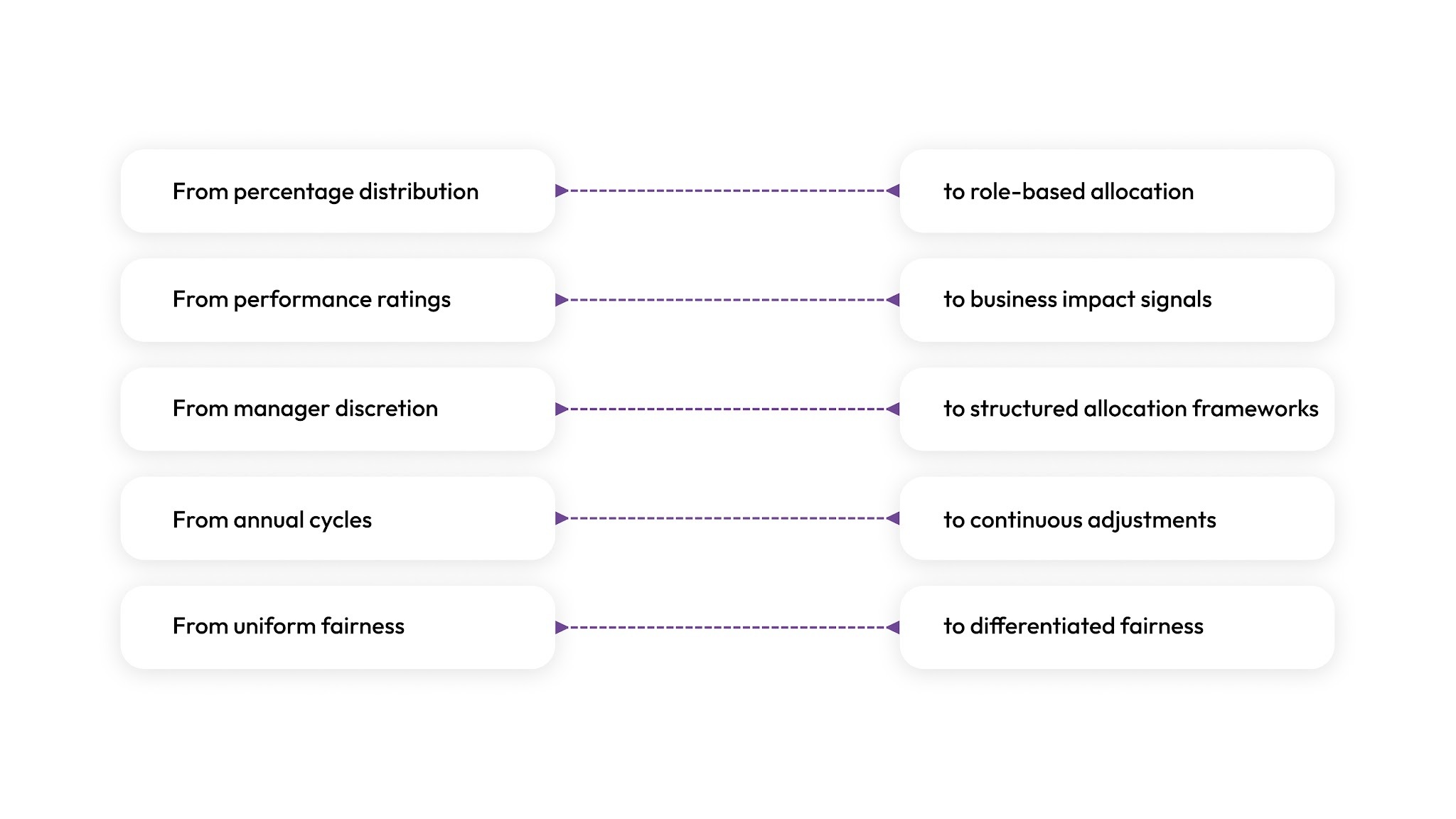
Equal raises are breaking down because they no longer match how value is created inside companies. When budgets are fixed, distributing increases evenly reduces their effectiveness and creates misalignment between pay and impact.
The shift toward targeted allocation is not just a preference. It is a structural change in how merit budgets are used.
Here’s how that shift is happening in practice:
1. From percentage distribution → to role-based allocation
Earlier, teams applied a standard increase range across employees. Now, budgets are first segmented by role criticality before being distributed.
- Critical or revenue-driving roles receive above-range increases
- Support or stable roles remain closer to baseline
- Budget is allocated in tiers, not spread evenly
2. From performance ratings → to business impact signals
Traditional ratings alone are no longer enough to decide increases. Companies are layering additional signals.
- Contribution to key projects or revenue outcomes
- Skill scarcity and replacement cost
- Future role importance, not just past performance
3. From manager discretion → to structured allocation frameworks
Managers previously decided on increases within a range. This created inconsistencies across teams.
Now, companies are introducing:
- Pre-defined allocation guidelines
- Budget guardrails by team or function
- Calibration processes across managers
4. From annual cycles → to continuous adjustments
Annual merit cycles are still common, but they are no longer the only mechanism.
- Off-cycle adjustments are used for retention or corrections
- Mid-cycle changes address market shifts or internal gaps
- Merit planning is becoming a continuous process, not a one-time event
5. From uniform fairness → to differentiated fairness
Fairness is being redefined. Equal increases are no longer seen as fair if they ignore performance and role impact.
- Employees expect clarity on why increases differ
- Transparency is becoming critical to support differentiated decisions
- Communication is now part of the allocation strategy
This shift defines current merit planning trends. The focus is no longer on distributing budgets, but on directing them where they create measurable impact.
As allocation becomes more precise, companies are also realizing that merit increases alone cannot support all compensation needs.
Why Merit Planning Alone Is No Longer Enough
Merit increases are no longer sufficient to manage compensation outcomes on their own. With tight budgets and higher expectations, relying only on annual raises limits how effectively you can reward performance and retain key talent.
This is one of the most practical merit planning trends in 2026. Companies are separating base salary decisions from performance rewards and using multiple levers instead of relying on a single cycle.
Here’s how that shift shows up in execution:
- Base salary increases are being tightly controlled: Merit budgets are used to maintain pay positioning, not to fully reward performance or retention risk
- Variable compensation is taking a larger role: Bonuses and short-term incentives are used to recognize impact without increasing fixed salary costs
- Equity is being used more selectively for retention: Instead of broad grants, companies are issuing targeted equity refreshes to critical roles or high performers
- Off-cycle adjustments are filling gaps left by merit cycles: Teams are correcting pay inequities or addressing retention risks outside the annual review cycle
- Total rewards strategy is becoming more segmented: Different employee groups are rewarded differently based on role, impact, and market demand
The implication is clear. Merit planning is now one part of a broader compensation system. Decisions about raises must be coordinated with other reward mechanisms to achieve the desired outcome.
Without this coordination, companies either overspend on fixed costs or fail to retain critical talent.
This shift toward multiple compensation levers is closely linked to another trend, the growing focus on retention and internal optimization.
How Retention and Internal Optimization Are Reshaping Merit Decisions
Merit planning is now driven less by external hiring pressure and more by internal workforce stability. As hiring slows and employees stay longer, compensation decisions are shifting toward retention, equity, and long-term value.
This is one of the most important merit planning trends because it directly changes how budgets are used and how raises are justified.
Here’s how this shift is influencing merit decisions:
- Merit increases are being used to prevent attrition, not just reward performance: Teams are identifying roles where turnover would disrupt operations or delay outcomes, and allocating higher increases to reduce that risk.
- Budget is moving toward high-risk and high-impact employee segments: Instead of spreading increases evenly, companies are concentrating spend on roles that are harder to replace or critical to execution.
- Promotion slowdowns are increasing reliance on merit increases: With fewer promotions available, merit cycles are now expected to reflect growth within the same role, increasing pressure on how increases are distributed.
- Internal pay gaps are being actively corrected during merit cycles: Companies are using merit planning to fix inconsistencies between employees in similar roles, especially as pay transparency expectations rise.
- Retention decisions are becoming more data-driven and less reactive: Instead of responding to resignations or counteroffers, teams are proactively identifying where compensation adjustments are needed.
- Employee expectations are shifting toward transparency and consistency: Employees now expect clear reasoning behind increases, making communication and structure as important as the raise itself
The outcome is clear. Merit planning is no longer just about annual adjustments. It is a tool for managing retention, maintaining equity, and stabilizing the workforce.
These changing priorities become difficult to manage without structure, which is where many merit planning processes start to break down.
Also Read: How to Calculate Merit Increase: Proven Methods and Best Tips 2025
Where Merit Planning Breaks Without Structure
As merit decisions become more targeted and retention-driven, the process itself becomes harder to manage. Many teams still rely on spreadsheets, emails, and disconnected systems that were designed for simpler cycles, not for the complexity seen in current merit planning trends.
Budget allocation often happens without full visibility into total compensation impact, which leads to last-minute adjustments or overspending.
At the same time, managers apply different logic across teams due to the lack of a consistent framework, resulting in similar roles being treated differently. The disconnect between HR and Finance makes it harder to align compensation decisions with actual budgets, while approval delays and late identification of pay gaps slow down the entire cycle.
The result is inconsistent outcomes, delayed decisions, and reduced confidence in the process.
To manage this complexity effectively, organizations are moving toward more structured and integrated approaches to merit planning.
What Strong Merit Planning Looks Like in 2026
Strong merit planning in 2026 is not about completing a cycle. It is about running a structured system that connects compensation decisions to performance, budget, and business priorities. Teams that do this well are not reacting during the cycle. They are planning decisions before the cycle begins.
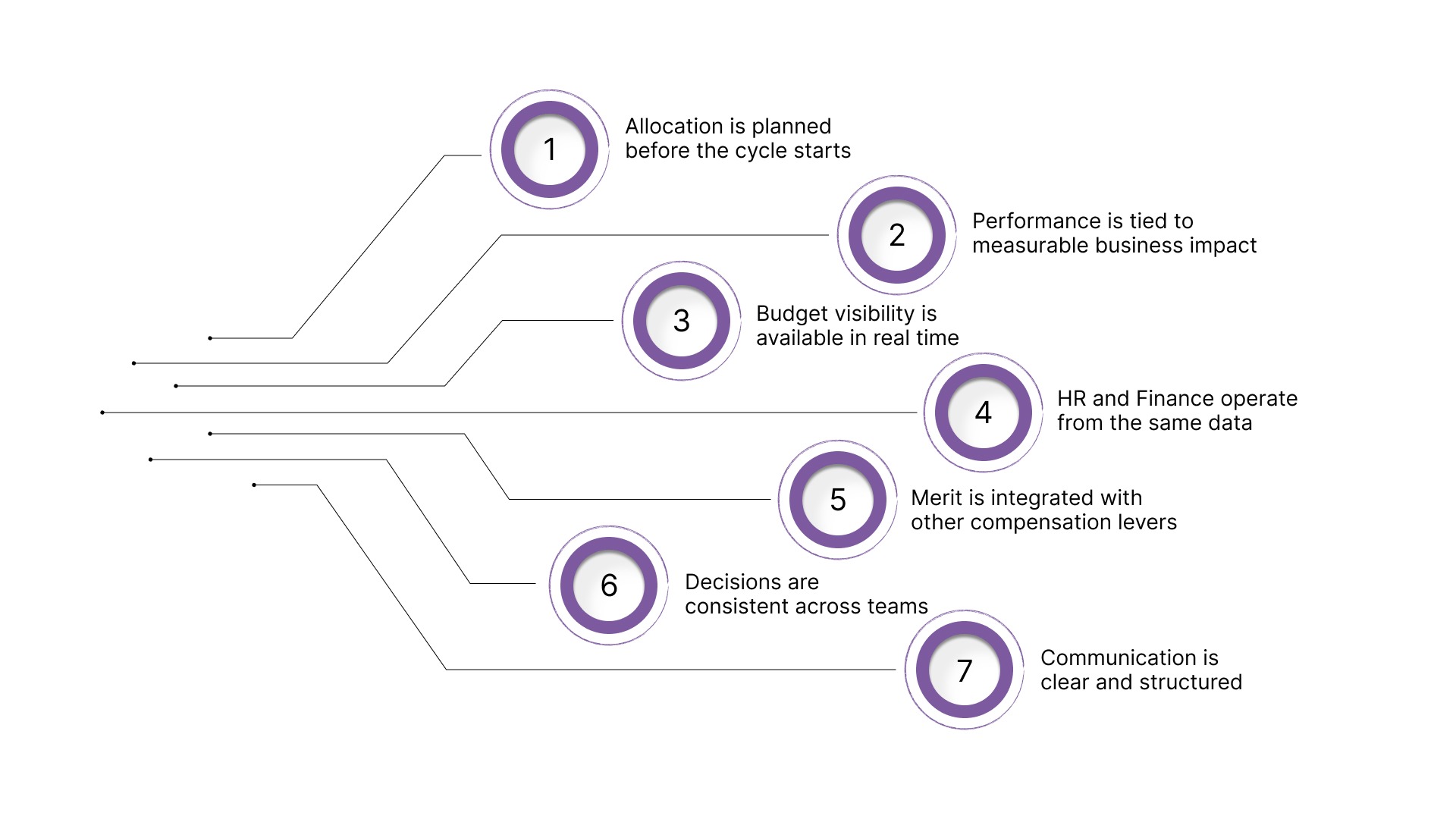
Here’s what effective merit planning looks like in practice:
1. Allocation is planned before the cycle starts
Teams define how budgets will be distributed before managers start assigning increases.
- Budget split by role criticality and function
- Clear ranges for top, average, and low performers
- Pre-defined guardrails to avoid over-allocation
2. Performance is tied to measurable business impact
Merit decisions go beyond ratings and include real contribution signals.
- Impact on revenue, delivery, or key projects
- Skill scarcity and replacement difficulty
- Future role importance, not just past output
3. Budget visibility is available in real time
Teams can see how every decision affects total compensation spend.
- Live tracking of allocated vs remaining budget
- Department-level and org-level visibility
- Early detection of budget overruns
4. HR and Finance operate from the same data
Compensation decisions and budget planning are no longer separate processes.
- Shared view of headcount and compensation impact
- Alignment between hiring plans and merit increases
- Fewer last-minute corrections during approvals
5. Merit is integrated with other compensation levers
Merit increases are used alongside bonuses, equity, and off-cycle adjustments.
- Base salary used for positioning and stability
- Variable pay used for performance and retention
- Clear separation between fixed and flexible rewards
6. Decisions are consistent across teams
Managers follow a structured framework instead of relying on individual judgment.
- Standardized allocation guidelines
- Cross-team calibration to reduce bias
- Documented rationale for each decision
7. Communication is clear and structured
Employees understand how and why decisions are made.
- Defined criteria for increases
- Transparent explanation of differences
- Alignment between manager messaging and HR policy
This is what current merit planning trends are moving toward. A system where decisions are proactive, structured, and aligned with both workforce and financial goals.
Building this level of structure requires moving beyond manual processes to systems that connect compensation, headcount, and budget decisions.
How to Bring Structure to Merit Planning Decisions?
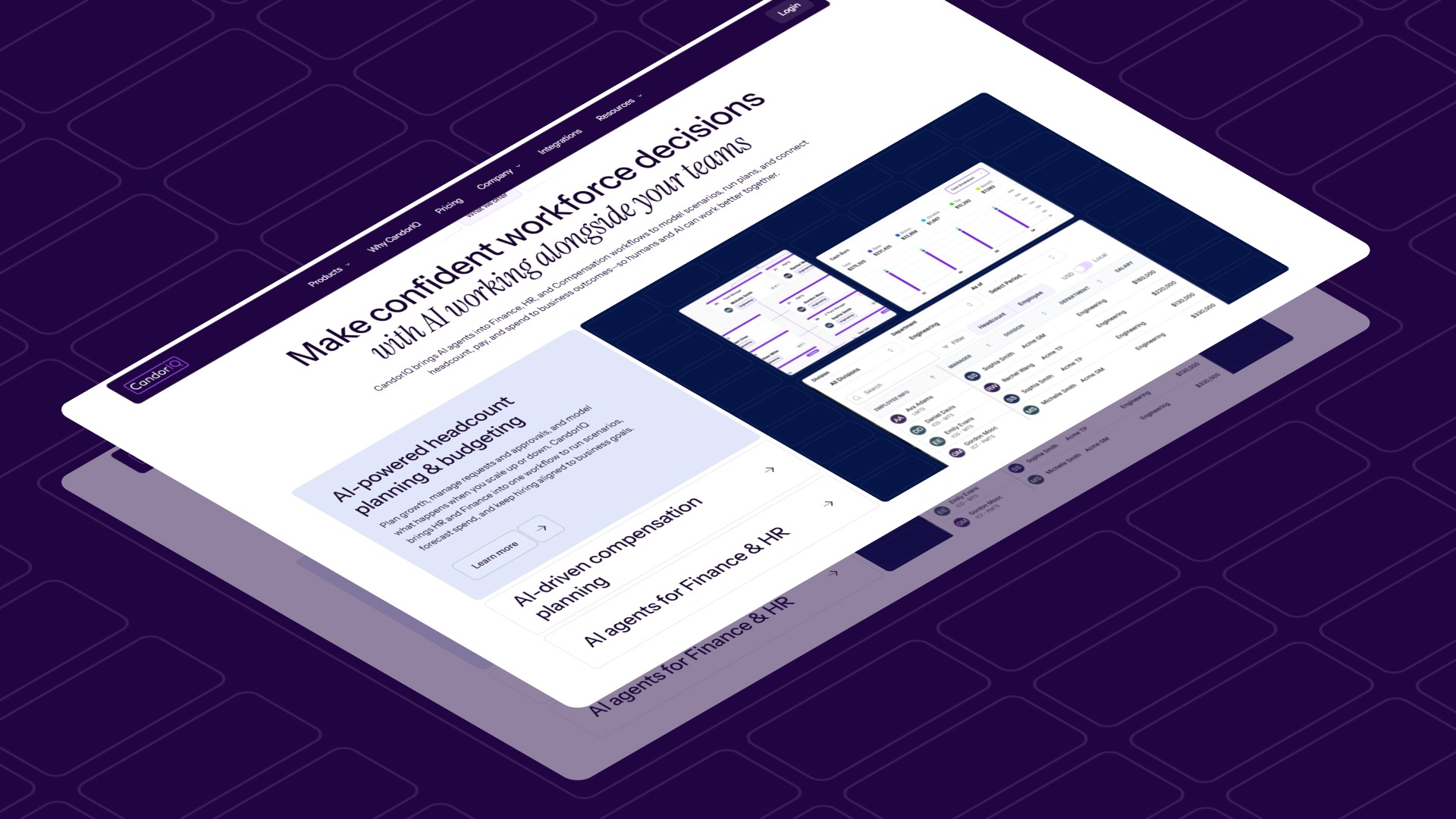
Managing merit planning manually often leads to visibility gaps, inconsistent allocation, and delayed decisions. As merit planning trends shift toward targeted, data-driven allocation, teams need a system that connects compensation decisions with budget and headcount planning.
CandorIQ helps HR and Finance teams bring structure to merit planning by centralizing workflows, improving visibility, and enabling more consistent decision-making.
How CandorIQ supports merit planning:
- Compensation Cycle: Manage merit reviews and approvals within a structured workflow instead of relying on spreadsheets and fragmented coordination
- Payband Builder: Define and maintain salary structures so increases stay aligned with role, level, and market positioning
- Headcount Scenario Planning: Evaluate how merit decisions impact overall workforce cost before finalizing allocations
- Workforce Management: Track planned versus actual compensation outcomes across teams in real time
- AI Agent: Analyze allocation gaps, model scenarios, and support decisions with data-backed insights
This approach helps teams move from reactive adjustments to structured, forward-looking merit planning.
Book a demo to plan merit allocations with full budget visibility, align HR and Finance decisions, and run compensation cycles without delays or inconsistencies.

FAQs
1. Is a 3% raise in 2026 good?
A 3% raise is considered standard in 2026, as most companies are maintaining flat merit budgets. Whether it’s “good” depends on your performance, role demand, and how your pay compares internally and to the market.
2. How do companies handle merit increases across different roles?
Companies no longer apply uniform increases across all roles. They allocate higher raises to critical or high-demand roles, while maintaining baseline increases for stable roles to balance cost and impact.
3. How do companies determine merit increases?
Merit increases are typically based on performance ratings, role impact, market benchmarks, and available budget. Many organizations also factor in retention risk and internal pay equity when finalizing decisions.
4. What is the average percentage for merit raises for top performers?
Top performers usually receive higher increases than the average range of 3-3.5%, often between 4-6%. The exact percentage depends on how aggressively a company differentiates performance and prioritizes key roles.
5. Is it normal for managers to not have full control over merit increases?
Yes, most companies use centralized guidelines, budget limits, and calibration processes to ensure consistency. Managers provide input, but final decisions are often reviewed across teams to avoid bias and misalignment.
Ready to modernize your workforce and compensation strategy?
See how CandorIQ brings workforce planning and compensation together with AI.