

10 Tips for HR Merit Planning Solution in 2026
Learn how to run a structured HR merit planning cycle, from budget governance to pay band management, built for lean teams at high-growth companies.


When was the last time your merit cycle finished on time and left everyone feeling good about it? Now companies are planning a median merit increase of 3.2% for 2026. But over 83% plan to distribute that budget equally across the board, regardless of performance.
For scaling companies managing distributed teams, the problem runs deeper. HR and finance work from separate tools, managers make recommendations without pay band context, and nobody sees the full picture until payroll closes. A strong HR merit planning solution fixes the cross-functional breakdown underneath it.
This blog covers 10 practical tips to help lean HR and finance teams build a merit cycle that's structured, equitable, and scalable.
At a Glance
- A strong HR merit planning solution starts with updated pay bands, a co-built budget, and a merit matrix that accounts for both performance and pay band position.
- Remote teams face unique merit cycle challenges, manager variance, geo-differentials, and headcount-merit collisions that generic compensation guides ignore.
- Finance must be a real participant in the merit cycle, not just a final approver.
- Post-cycle analytics are where most companies leave value on the table, but they're also where your next cycle gets better.
- CandorIQ is the unified platform built for scaling teams that brings pay bands, merit cycles, headcount forecasting, and offer workflows into one real-time system. So HR and finance stop reconciling spreadsheets and start making decisions together.
What is Merit Planning? How It Benefits Your Team
Merit planning is the structured process of evaluating employee performance, comparing compensation against pay bands, and determining salary adjustments, typically on an annual or semi-annual cycle.
Unlike a cost-of-living raise, which goes to everyone regardless of contribution, merit increases are tied to individual performance and where an employee sits within their pay range.
A well-run HR merit planning solution delivers real organizational benefits:
- Pay equity you can defend. When merit decisions are tied to pay bands and compa-ratios, you can explain every increase and audit them for bias.
- Retention of top performers. Employees who feel their pay reflects their contribution stay longer. Mercer data shows 91% of companies factor band midpoint positioning into promotion decisions — the same logic should drive merit.
- Finance-HR alignment. Merit planning forces both teams to agree on budget, eligibility, and priorities before the cycle opens, not during it.
- Manager accountability. When managers work within defined budget envelopes and a merit matrix, recommendations become more consistent and defensible.
- A scalable system, not a one-off event. Done right, each cycle builds on the last, with better data, cleaner bands, and faster approvals.
Once you understand what merit planning is and why it matters, the next question is, what does a well-run cycle actually look like from start to finish?
What are the Steps in a Merit Cycle?
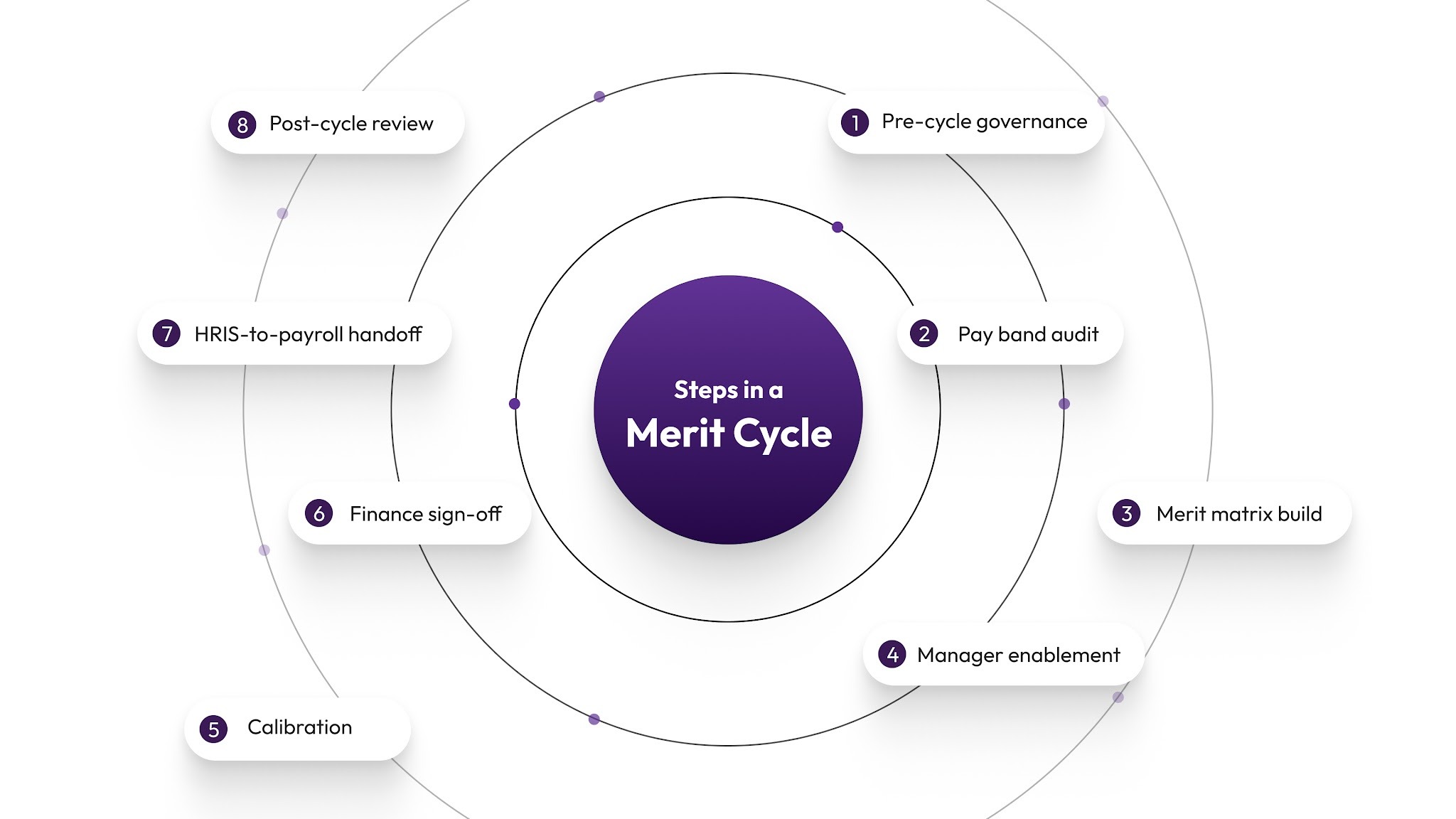
Most HR merit planning solutions fail not because of bad intentions but because there's no agreed-upon process. Here's a clear sequence that works for lean, scaling teams:
- Step 1: Pre-cycle governance (6–8 weeks out): HR and finance co-build three merit budget scenarios, conservative, target, and performance-differentiated, before a single manager opens a tool. Eligibility criteria (tenure thresholds, PIP status, recent promotions) are locked in writing.
- Step 2: Pay band audit: Before the cycle launches, verify that band midpoints reflect current market data. Stale bands mean every compa-ratio in the cycle is calculated against the wrong number.
- Step 3: Merit matrix build: Map performance ratings against compa-ratio ranges to produce a recommended increase range for each combination. This is what separates a merit increase from an across-the-board raise.
- Step 4: Manager enablement: Publish each manager's budget allocation and their team's compa-ratio and performance data in one view, not separate systems. Give them context, not just guidelines.
- Step 5: Calibration: Run structured sessions to normalize performance rating distributions across departments and time zones. Document every exception with a written rationale.
- Step 6: Finance sign-off: Finance reviews and approves staged budget consumption in real time, not a summary PDF at cycle close.
- Step 7: HRIS-to-payroll handoff: Map the exact data flow from approval to payroll before Day 1. Define effective dates. Require two-person validation on every export.
- Step 8: Post-cycle review: Pull budget adherence, performance-to-merit distribution, and 90-day retention data. Use it to improve the next cycle.
Now that the merit cycle process is clear, it's worth addressing why this sequence is harder for remote and distributed teams, because the challenges are specific, and most HR merit planning solution guides skip them entirely.

Why Merit Planning is Harder for Remote Teams?
Running a merit cycle with a colocated team is hard. Running one across a distributed workforce introduces a different category of problem:
- Manager variance compounds in remote environments. Without hallway calibration, high-advocate managers consistently produce performance distributions that skew higher than peers. Over multiple cycles, this creates pay inequity between teams. This is because there's no structural check on the variance.
- Geo-differentials make standard matrices misleading. A 4% increase for a top performer in San Francisco means something very different than a 4% increase for the same role in Nashville. When your merit matrix doesn't account for location-adjusted band midpoints, compa-ratio calculations are systematically off. Compensation platforms such as CandorIQ help address this by supporting location-based pay bands and real-time visibility into pay distribution across geographies.
- Time zone friction slows calibration. The calibration sessions that office-based teams run informally over two days take two weeks to organize asynchronously. Most remote teams skip calibration entirely, which is exactly the wrong trade-off.
- Finance can't see what's happening in real time. In distributed orgs, HR and finance are rarely in the same building, let alone the same tool. By the time finance sees the consolidated numbers, commitments have already been made informally.
- Headcount changes collide with an open cycle. Backfills, promotions, and new hires during the merit window interact with the merit pool in real time. If those costs aren't modeled together, budget surprises land at payroll close.
None of these are unsolvable, but they don't fix themselves with a better spreadsheet. They fix with a better process. So let's get into exactly what that looks like with 10 tips built specifically for remote, scaling teams.
Also Read: Understanding Merit-Based Pay: Benefits and Implementation
10 Tips and Strategies for Effective Merit Planning for Scaling Remote Teams
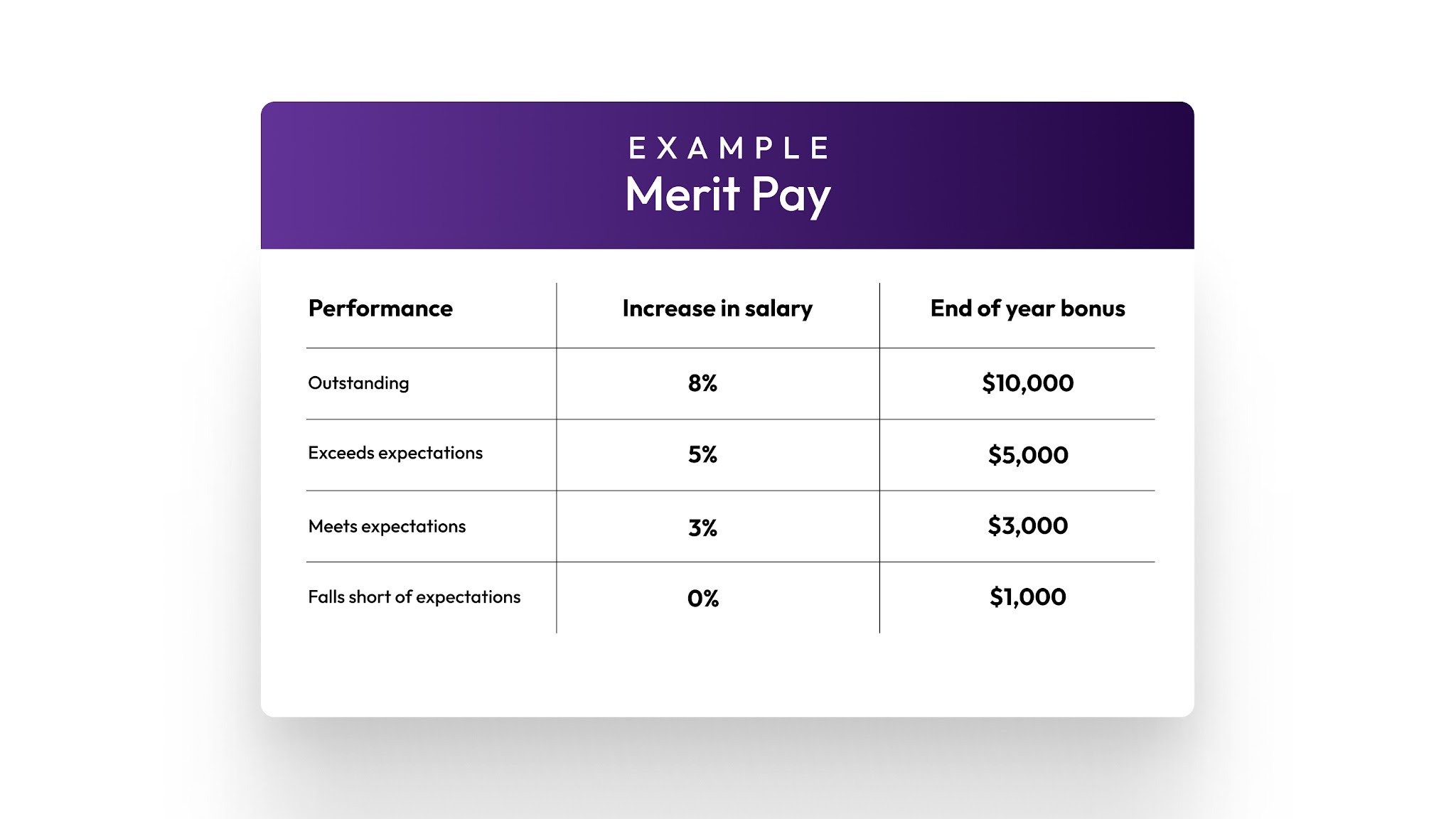
Building a reliable HR merit planning solution takes more than a checklist. It takes a process that holds up under distributed team complexity, lean staffing, and real-time finance pressure. Here's what actually works.
Tip 1: Audit Pay Bands Before The Cycle Opens, Not After
Pull current market benchmarks 4–6 weeks before launch. Flag employees above the band maximum early. They require a different conversation than standard merit guidance, and catching them mid-cycle breaks the process.
Tip 2: Co-Build The Budget With Finance
Bring retention risk data, compa-ratio distribution, and the last cycle's actuals to the first finance meeting. Present three scenarios. Let the CFO choose, rather than submitting a single number for approval and waiting. And separate the promotion budget from the merit budget explicitly. Conflating them is the most common cause of budget overrun at scaling companies.
Tip 3: Build A Merit Matrix That Uses Compa-Ratio, Not Just Performance
A two-variable matrix, performance rating vs. compa-ratio range, produces increasing ranges, not single percentages. An employee rated "Exceeds Expectations" at 80% of the band midpoint should receive a higher increase than an equally strong performer already at 110%. Without this variable, your merit cycle is distributing rather than differentiating.
Tip 4: Give Managers Budget Visibility Before They Make Recommendations
Show each manager their team's budget envelope, compa-ratios, and performance ratings in a single view, before they submit anything. Managers who see their team's full compensation context make better decisions than managers working from a percentage guideline alone.
Tip 5: Redesign Calibration For Distributed Teams
Run pre-calibration async: distribute anonymized performance distributions by department and ask managers to flag outliers with a written rationale before any live session. The synchronous session should cover escalations only, not full team reviews. Every exception gets documented. This is your equity audit trail.
Tip 6: Compress The Finance Approval Loop With Scenario Modeling
Present three budget scenarios before the cycle opens, not after managers have already made recommendations. Add staged budget gates. For example, department allocations confirmed → manager submissions received → HR review → finance sign-off. So that finance teams can monitor consumption in real time rather than reacting to a summary at the end.
Tip 7: Model Headcount And Merit Costs Together
If you're backfilling roles or running promotions during an active cycle, those costs interact with your merit pool. Budget surprises at payroll close are almost always a headcount-merit collision problem. You require a headcount plan sign-off before the merit cycle launches.
Tip 8: Build A Documented Protocol For Off-Cycle Adjustments
Pre-approve a retention reserve of 0.25%–0.5% of the merit pool before the cycle opens. Define the escalation criteria in writing, like what qualifies, who approves, and how it gets documented. Unstructured off-cycle adjustments are among the leading causes of pay inequity at scaling companies.
Tip 9: Design the HRIS-to-Payroll Handoff Before Day 1
Map the exact five-step flow: who exports, from what system, in what format, who validates, who loads. Confirm effective dates are tied to pay periods, not approval dates. Require a two-person review on every payroll export. This 20-minute step prevents corrections that take weeks.
Tip 10: Run A Post-Cycle Review Every Time
Pull five metrics: budget adherence by department, performance-to-merit distribution, promotion rate as a percentage of headcount, 90-day retention by merit tier, and equity distribution by demographic. This is where your HR merit planning solution gets smarter each year. So, don't skip it because the cycle felt exhausting.
With these tips in place, the next question is: what tool actually supports all of this without adding more administrative overhead?
Also Read: How to Effectively Plan Merit Increases and Bonuses in a Tight Budget Environment
Your Merit Cycle Is Only as Good as the System Behind It
Most scaling companies don't have a merit planning problem. They have a systems problem. HR is in spreadsheets, finance approves via email, managers enter recommendations in one tool while pay bands live in another, and nobody has a real-time view of total compensation impact until it's too late.
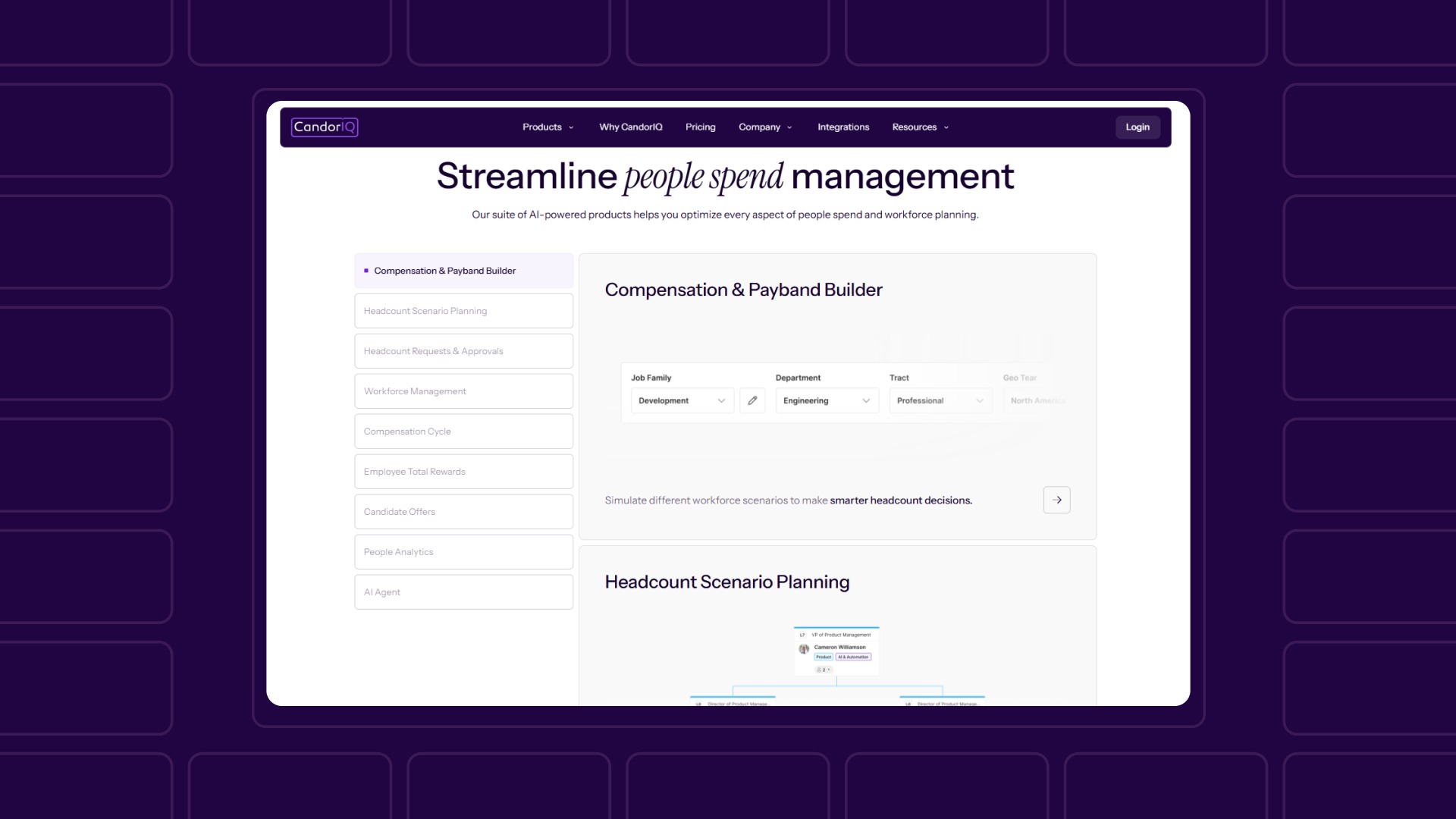
CandorIQ is a unified compensation and headcount planning platform built for HR and finance teams at high-growth, distributed organizations. It replaces the fragmented stack, spreadsheets, disconnected HRIS exports, and manual approval chains with a single system where merit cycles, pay bands, headcount forecasting, and offer workflows all live together.
Here's how we help you build pay equity and budget governance into your compensation infrastructure:
- Compensation & Pay Band Builder: Define and maintain pay bands by level, location, and department with version control and real-time workforce distribution visualization. Bands stay current, so every compa-ratio in your merit cycle is calculated against accurate data.
- Compensation Cycle: Automate merit and bonus reviews with built-in approval logic, budget tracking by team, and in-platform collaboration. Finance gets real-time visibility into budget utilization.
- Headcount Scenario Planning: Model hiring, promotions, and backfills alongside your merit pool in the same budget view. Headcount and merit costs finally live together, so end-of-cycle budget surprises stop happening.
- Headcount Requests & Approvals: Route new hire requests dynamically through finance and people approvals, synced directly with your ATS. Headcount governance stays connected to compensation governance.
- Workforce Management: Track actuals vs. plan across headcount, compensation, attrition, and promotion rates with dashboards built for HR, finance, and exec teams.
- AI Agent: Ask natural language questions to model comp gaps, forecast headcount impact, or analyze merit distribution, without waiting for a data team to pull the report.
CandorIQ gives lean teams the structure to run merit cycles that are faster, more equitable, and fully governed, without adding headcount to do it.
Conclusion
Merit planning is the operational foundation for how your company retains top talent, governs budgets, and builds trust with employees at every level. For scaling remote teams, the stakes are higher, and the margin for process failure is smaller.
The ten tips in this guide give you a practical HR merit planning solution that works without a full compensation team. Start with your pay bands, align with finance before the cycle opens, build a matrix that differentiates, and close every cycle with data that makes the next one better.
Ready to see what a unified merit planning process looks like in practice? Book a demo with CandorIQ.

FAQs
Q. What is Post-Merit Planning?
Post-merit planning is the review process after a merit cycle closes. It involves analyzing budget adherence, performance-to-merit distribution, retention outcomes, and pay equity data to improve the next cycle.
Q. What is a Merit Matrix?
A merit matrix maps performance ratings against an employee's position within their pay band (compa-ratio) to produce a recommended salary increase range, ensuring increases are tied to both contribution and market equity.
Q. What is Compa-Ratio in Merit Planning?
Compa-ratio is an employee's current salary divided by the midpoint of their pay band. A ratio below 1.0 means they earn below the midpoint. Above 1.0 means above. It guides how much of the merit budget should go to each employee.
Q. How do You Connect Headcount Planning to Merit Planning?
By modeling promotions, backfills, and new hires in the same budget view as merit increases. When the two plans are separate, budget surprises land at payroll close. When they're unified, finance and HR can scenario-plan before commitments are made.
Q. What Should I Look for In Merit Planning Software?
Look for real-time budget visibility for both HR and finance, geo-adjusted pay band management, staged approval routing that includes finance, headcount-merit cost modeling in one view, and post-cycle analytics out of the box.
Ready to modernize your workforce and compensation strategy?
See how CandorIQ brings workforce planning and compensation together with AI.