

Why Pay Gap Analysis is Your Most Important Retention Tool in 2026
Learn how to run a pay gap analysis that actually closes equity gaps in 2026, and how lean HR teams operationalize it. Built for scaling companies.


Is your company paying people fairly, or just assuming it is? According to a 2025 Pew Research study, women in the US still earn about 85% for every dollar men earn, and that gap widens significantly when race enters the picture.
For scaling companies managing distributed teams, fast hiring cycles, and lean HR, pay gaps don't usually happen because someone made a bad decision. They happen because no one built guardrails to prevent them.
If you're a CPO, HRBP, or Finance leader steering rapid growth, you've likely felt the pressure to "get ahead" of compensation equity, but without a clear path to do it.
This guide walks you through exactly what a pay gap analysis is, how to run one, and what it takes to build pay equity into your compensation infrastructure for the long term.

Quick Snippets
- A pay gap analysis examines whether employees in comparable roles are paid equitably across gender, race, and other protected characteristics.
- The adjusted pay gap, which controls for job level, tenure, and performance, is what actually drives operational decisions.
- Most pay gaps in scaling companies start at the offer stage, compound through annual comp cycles, and go undetected because data lives in too many places.
- Running an effective analysis requires clean job architecture, documented pay factors, and structured comp data before you ever run a number.
- CandorIQ gives HR and Finance teams the infrastructure to prevent gaps from forming, not just find them after the fact.
What Is a Pay Gap Analysis?
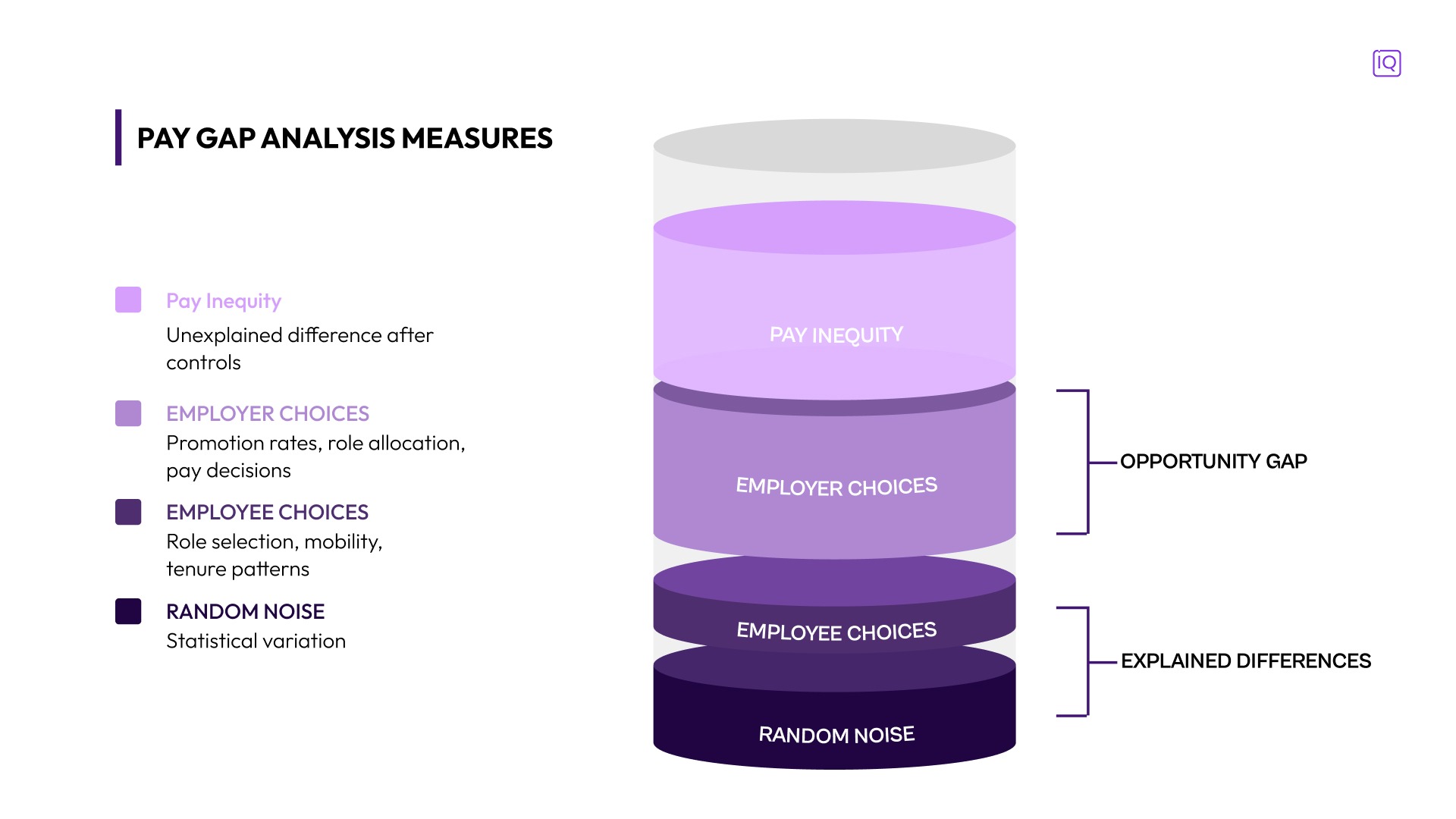
A pay gap analysis is a structured review of compensation data to identify whether employees in comparable roles are paid equitably across gender, race, and other protected characteristics.
It differs from a simple pay gap calculation by examining both the raw disparity and the adjusted gap after controlling for legitimate pay factors like job level, tenure, and performance.
The Difference Between a Pay Gap and a Pay Equity Problem
These two terms get used interchangeably, but they're solving for different things.
A pay gap is what you measure. A pay equity problem occurs when the gap can't be explained by legitimate business factors and keeps recurring across cycles. Knowing which one you're dealing with changes everything about how you respond.
Unadjusted vs. Adjusted Pay Gap: What Each One Tells You
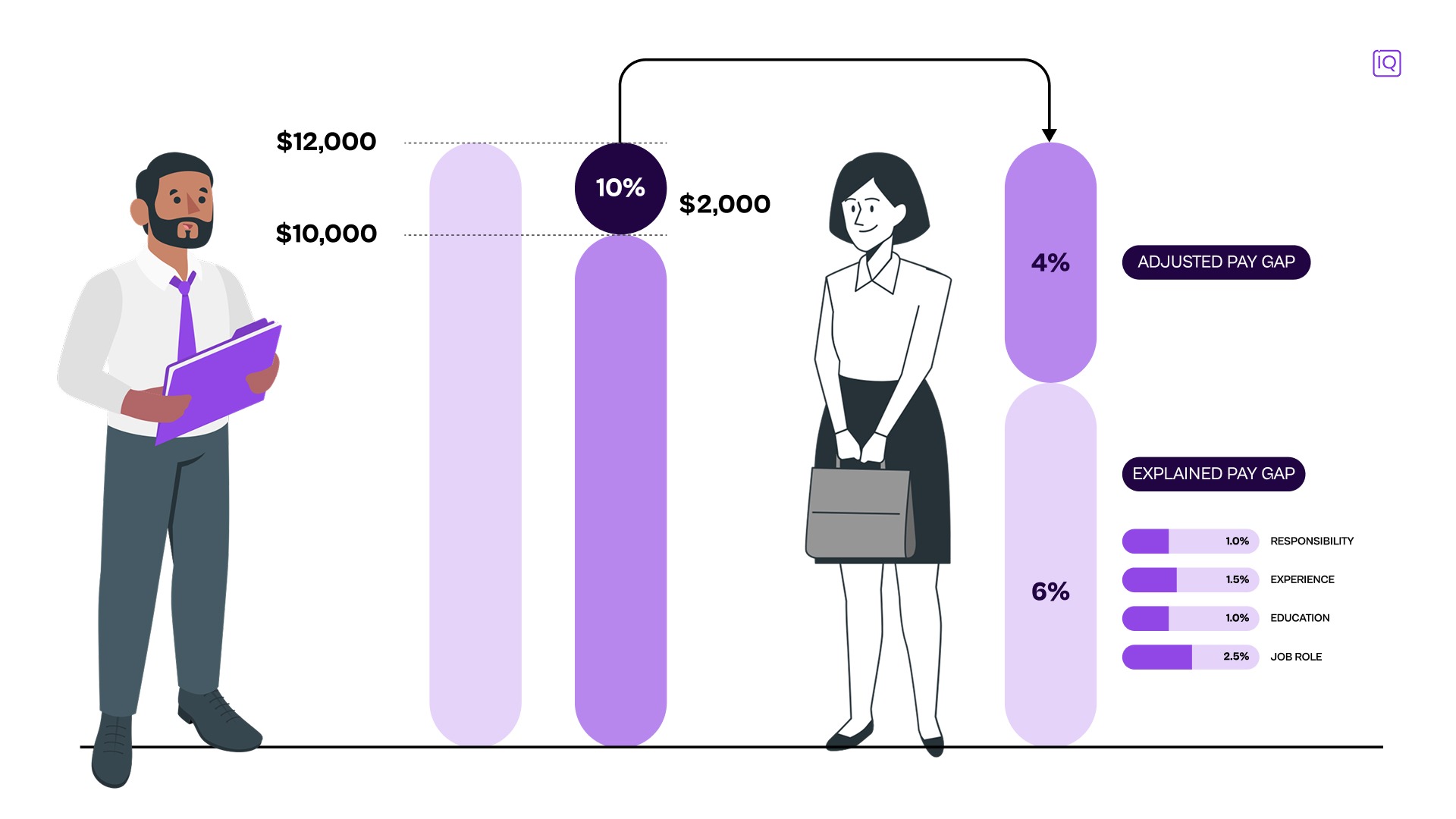
You'll encounter both metrics in any serious pay gap analysis. Here's how to use each one correctly.
The critical insight here is that a company can have a large unadjusted gap and a small adjusted gap. That doesn't mean there's no problem. It means the problem is in representation and opportunity, not the pay rate itself.
Both gaps matter. But they require different interventions, and mixing them up leads to solutions that don't fix the actual issue.
How to Run a Pay Gap Analysis: A Step-by-Step Framework Built for Lean HR Teams
Running a pay gap analysis when you're a 2-person People team managing 400 employees across five states is a different exercise than what most audit frameworks assume. Here's a process built for that reality:
Step 1: Establish Clean Job Architecture Before You Touch Compensation Data
Before you run a single number, you need a consistent framework for grouping comparable employees. That means documenting defined job families, levels, and grade bands.
The most common mistake here is using manager-assigned titles from the ATS as the job grouping variable. If you group them together, your cohort analysis is meaningless.
If your leveling framework doesn't exist yet, build a lightweight version before you proceed. Even a simple 4-level structure per function is enough to produce meaningful analysis.
Step 2: Define Your Pay Factors and Document Why They're Legitimate
Before you run the analysis, write down the factors you're using to explain pay differences, and document the business rationale for each one.
Approved factors typically include:
- Job Level or Grade
- Time In Role
- Performance Rating
- Geo-Tier
- Employment Type
Prior compensation history is illegal to use as a pay determinant in California, New York, Massachusetts, Illinois, and several other states. Also, negotiation outcomes are legally defensible in some contexts but can introduce bias.
If a factor is in your model and you can't explain why it's objective and job-related, remove it. This will protect you legally if you ever face a U.S. Equal Employment Opportunity Commission (EEOC) inquiry or litigation.
Step 3: Pull and Clean Your Compensation Dataset
Sludgy data produces misleading analysis.
- Your minimum viable dataset needs these fields: employee ID, gender, race/ethnicity, job level, department, location, base salary, hire date, last promotion date, and performance rating.
- What to include beyond base salary: equity grant value, variable comp, and total cash.
- What to watch for during cleaning: part-time employees that need pro-ration, contractor vs. Full Time Equivalent (FTE) categorization errors, and recent promotions that haven't yet been reflected in the HRIS.
This will help you create a clean compensation dataset.
Step 4: Run Your Adjusted Pay Gap Analysis
For teams with statistical resources, a multivariate regression controlling for your approved pay factors is the most defensible method.
For lean HR teams, the cohort comparison method works well. Group employees into peer cohorts by level, function, and location. Calculate the median and mean within each cohort and identify outliers.
However, cohorts with fewer than five employees aren't large enough to produce meaningful results. Flag those employees for individual review rather than including them in cohort-level analysis.
Step 5: Identify Root Cause by Gap Type
For every gap you find, trace it to its origin.
- Offer-stage gaps show up when you compare starting salaries within a cohort at the time of hire.
- Promo velocity gaps appear when you compare promotion rates and timelines by demographic group at the same job level.
- Merit increase gaps surface when you compare the annual increase percentages applied by the manager and the department.
The root cause determines the fix. Offer-stage gaps require offer governance changes. Promo velocity gaps require calibration process changes. Merit increase gaps require compensation cycle process changes.
Step 6: Triage, Remediate, and Set a Governance Cadence
Not every gap requires immediate action. Triage by statistical significance first, then dollar magnitude.
- Critical outliers, statistically significant gaps above a meaningful threshold, should be addressed off-cycle if necessary.
- Smaller gaps should be factored into the next planned compensation cycle.
- Most importantly, set a remediation budget during headcount planning, before the audit is complete.
When Finance doesn't know a remediation budget exists until HR brings findings, the delay costs you months and sometimes key employees.
Platforms like CandorIQ make this easier by allowing HR and Finance to model potential pay equity adjustments alongside headcount plans, so remediation funding is anticipated rather than negotiated after the audit results surface.
4 Reasons Why Pay Gaps Form that Cause Audit Gaps
Understanding what causes pay gaps in the first place is how you stop them from coming back after each audit.
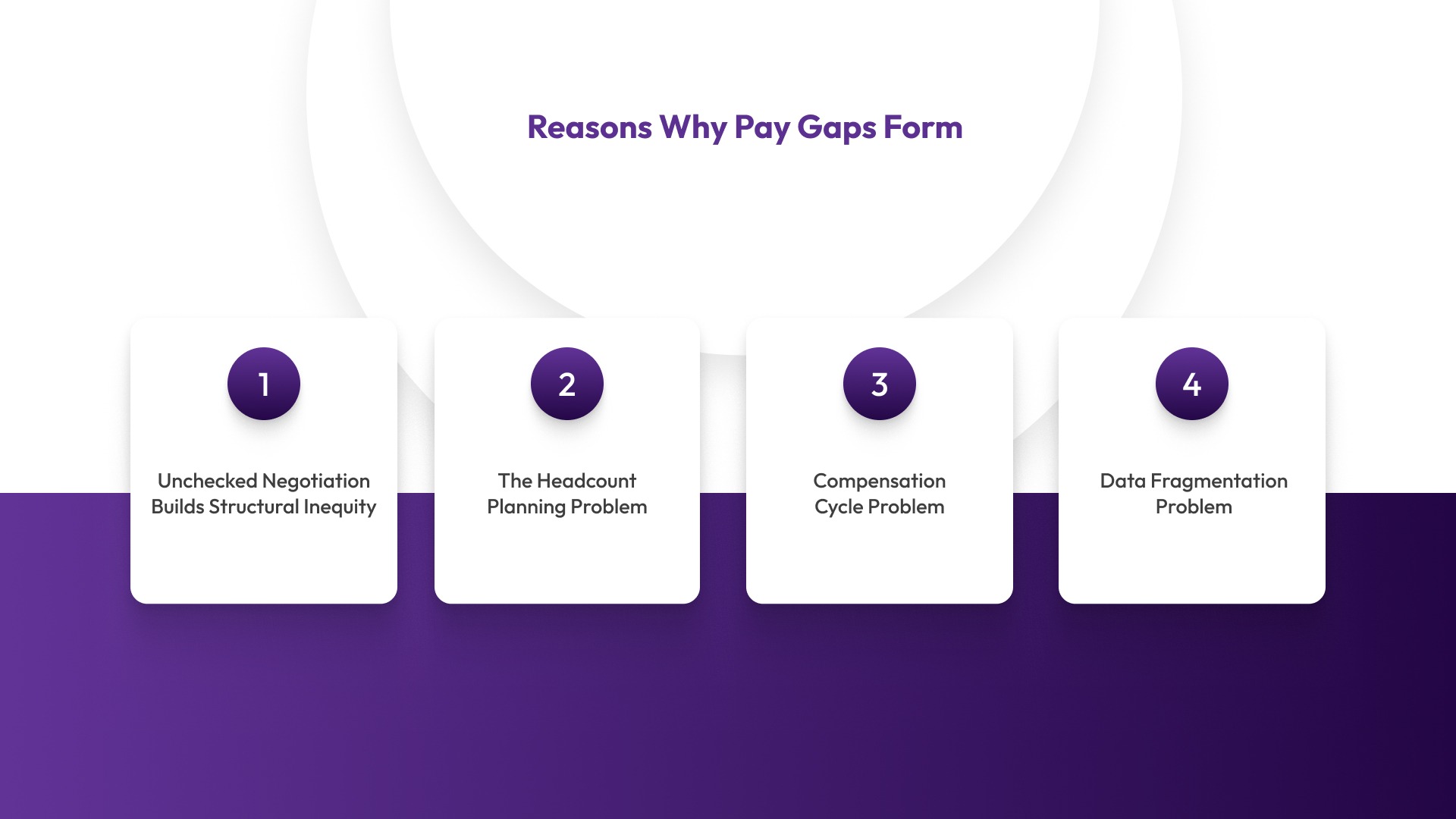
- Unchecked Negotiation Builds Structural Inequity: When offers go out without pay band guardrails, every negotiation is a potential source of inequity. A candidate who negotiates aggressively starts at a higher base than a comparable hire who doesn't.
- The Headcount Planning Problem: A hiring plan approved without band governance creates conditions for a manager to make any offer they choose within that range. Pay equity starts upstream in the headcount plan, not in the offer letter. When Finance and HR aren't aligned on a role's compensation parameters before it opens, the window for inequitable offers is wide open.
- The Compensation Cycle Problem: When you distribute merit pools without clear manager guidance, you create compounding pay drift. If you underpay a strong performer in year one, future percentage increases build on that lower base and widen the gap in years two and three. Without visibility into band position during merit cycles, you make decisions in isolation and allow inequities to grow quietly.
- The Data Fragmentation Problem: HRIS holds employee records. Spreadsheets hold comp decisions. ATS holds offer data. Finance holds headcount budgets. When these systems don't connect, any pay gap analysis you run is incomplete and always lagging behind reality.
So you need to make sure the way you conduct your analysis doesn't introduce its own set of blind spots.
7 Common Pay Gap Analysis Mistakes
Even well-intentioned teams make these errors. Knowing them in advance saves you from producing analyzes that mislead rather than inform.
- Analyzing total comp without separating base, variable, and equity components: A gap in total compensation can look different depending on whether it's driven by base salary, bonus structure, or equity allocation. Each requires a different intervention.
- Using job titles instead of job levels as the comparison unit: Two people with the title "Product Manager" can be doing L3 and L5 work. Grouping them together produces meaningless comparisons.
- Running the audit after the comp cycle closes: By the time findings come back, the budget is spent, and corrections require off-cycle adjustments. The audit should be conducted before the cycle opens, not after it closes.
- Flagging gaps without diagnosing the root cause: A list of pay discrepancies without an explanation of why they exist doesn't give you a path to fix them. Root cause analysis is not optional.
- Making individual pay decisions based on small, statistically insignificant cohorts: Cohorts under five people don't produce reliable statistical conclusions. Handle those cases individually rather than drawing group-level inferences.
- Failing to document the methodology: Undocumented analysis is a legal liability. If you can't explain what factors you controlled for and why, your audit is weak.
- Treating the audit as a one-time exercise: A pay equity audit that runs once is a diagnostic without a treatment plan. Gaps that aren't governed actively will re-emerge in the near future.
Avoiding these mistakes gets you a more credible analysis. But how do you build a compensation system that doesn't keep producing the same gaps?
How CandorIQ Helps Build Pay Equity Into Your Compensation Infrastructure
The challenge most scaling companies face is a lack of infrastructure to act on it. By the time you run a pay gap analysis, you are sifting through data from a scattered set of systems.
CandorIQ is built to replace that fragmentation with a unified system for managing compensation and headcount, so pay equity becomes a structural outcome, not an annual scramble.
Here's how we connect directly to closing and preventing pay gaps:
- Compensation & Pay Band Builder: Define pay bands by level, location, and department. See every employee’s real-time position within their band. Version-controlled history ensures auditability and proof of consistent application.
- Compensation Cycle: Run merit and bonus reviews with built-in approval workflows and manager guidance. Managers see the band position before recommending increases. Track budgets in real time by department so HR and Finance align before decisions are finalized.
- Candidate Offers: Generate offers using live pay band data. Guardrails flag out-of-band decisions before they’re sent. This prevents offer-stage compression.
- Headcount Scenario Planning: Model hiring plans with attached financial impact. Align Finance and People Ops early so compensation parameters are set during planning, not negotiated ad hoc.
- Headcount Requests & Approvals: Submit new hire requests with embedded compensation rationale. Route approvals by role, location, and band to ensure compliance before posting.
- AI Agent: Ask natural language questions across compensation data to surface gaps, model remediation costs, and forecast cycle impact, giving lean People teams the power of a dedicated comp analyst.
When your compensation decisions, from headcount planning to offer generation to merit review, all happen within a governed, connected system, pay equity stops being something you find and fix. It becomes something you build and maintain.
Conclusion
A pay gap analysis is a diagnostic problem. The companies that consistently maintain pay equity are not only running better audits but also running better comp processes. They have pay bands that govern offers. They have compensation cycles with built-in visibility. They have headcount plans that connect to compensation parameters before a requisition ever opens.
If you're ready to move from a reactive audit cycle to a proactive compensation infrastructure, CandorIQ can help you get there.
Book a demo and see how we can help your People and Finance teams manage pay bands, comp cycles, and headcount planning in one unified platform.

FAQs
Does a pay gap analysis create legal liability if we find a gap?
Finding a gap through a proactive, attorney-client privileged audit generally strengthens your legal position. The risk is greater when gaps are found by regulators before you find them yourself. Document your methodology and remediation plan.
What data do I need to start a pay gap analysis?
At minimum: employee ID, gender, race/ethnicity, job level, department, location, base salary, hire date, last promotion date, and performance rating. Include variable comp and equity grant values for a complete picture.
How do I explain pay gap findings to employees?
Be factual, not defensive. Explain what you found, what caused it, and what you're doing to fix it. Vague communications erode trust faster than the gap itself. Employees respect transparency about imperfect data more than polished silence.
What is a statistically significant pay gap?
Most analysts treat a gap as statistically significant when it's unlikely to have occurred by chance, typically a p-value below 0.05. In practical terms, focus first on gaps that are both statistically significant and above 5% in dollar magnitude.
Can a small HR team run a pay gap analysis without an outside consultant?
Yes, with the right data infrastructure and a structured framework. The cohort comparison method outlined in this guide is designed for lean teams. A compensation platform with built-in analytics makes this executable without a dedicated analyst.
Ready to modernize your workforce and compensation strategy?
See how CandorIQ brings workforce planning and compensation together with AI.