

Design an Employee Rewards Strategy That Boost Retention
Build an employee rewards strategy that actually drives retention and performance. The data-backed, step-by-step framework built for scaling US teams in 2026.

Most employee rewards strategies don't fail because companies stop caring. They fail because the strategy was built for the wrong problem. Today's workforce expects rewards to reflect their actual contribution and their real cost of living, not a generic benefits package designed for a different era.
In a distributed, multi-generational US workforce, the gap between what companies offer and what employees actually value has real financial consequences.
According to Gallup's 2025 report, low employee engagement costs the US economy an estimated $10 trillion in lost productivity annually. For scaling companies carrying open headcount, that number compounds fast.
A well-structured employee rewards strategy doesn't just make people feel valued. It connects compensation, recognition, career development, and culture into one coherent system that drives retention and performance at the same time.
This guide breaks that system down, what employee rewards strategy actually should look like, and how to design and manage it at scale in 2026.
Key Takeaways
- A rewards strategy is a business system, not an HR program. Compensation, benefits, recognition, career development, and culture need to work together to drive measurable retention and performance outcomes.
- What employees value has shifted. Benchmark competitiveness, transparency, hyper-personalization, and well-being are now strategic priorities.
- Sequence matters. Recognition doesn't move retention metrics if compensation isn't trusted first. Building rewards on an inequitable comp foundation accelerates disengagement instead of reducing it.
- AI is changing how rewards can be personalized. Scaling US teams can now use AI-driven tools to model total compensation, flag equity gaps in real time, and tailor reward mixes by role, tenure, and life stage.
- CandorIQ gives HR and Finance teams the comp intelligence to build this right. From pay band design and comp cycle automation to headcount scenario planning and an AI agent that answers complex workforce questions in seconds, it connects the data layer your rewards strategy depends on.
.png)
What a Performance-linked Rewrads Strategy Actually Commits You To?
Total rewards are everything an employee receives in exchange for their work, compensation, yes, but also benefits, career development, recognition, culture, and flexibility. The strategy is how you design that entire system deliberately, with your workforce's actual needs and your business goals in the same frame.
However, most conflate total rewards with total compensation. But they are not the same.
The distinction matters because it changes what you measure. One influence on whether someone accepts an offer. The other determines whether they stay.
When you link your rewards strategy to performance, you're making five specific commitments, and each one has operational implications:
- Pay will reflect contribution, not just tenure. Automatic tenure-based increases will share space with performance-linked compensation that actually rewards output.
- Comp benchmarks will be current. Not two years old or not national averages that obscure regional variance, current data for your specific roles and markets.
- Recognition will be meaningful. Not performative. Built on a compensation foundation that employees already trust.
- Growth paths will be visible and consistently applied. Promotion criteria that employees can see and managers can explain without hedging.
- The strategy will be measured. Against retention rates, engagement scores, pay equity metrics, and offer acceptance, not just against whether the program launched.
That level of commitment requires real data, consistent frameworks, manager enablement, and a system that can adapt as your headcount scales. That's exactly what the next sections are designed to help you build.
The 5 Core Components of Employee Rewards Strategy
Employee rewards strategy only works when its components reinforce each other. Here's what each component needs to do, and what it needs from the others.
Compensation: The Foundation Your Entire Rewards Strategy Depends On
Everything else in your rewards strategy is built on top of compensation. If pay isn't competitive, recognition feels hollow, benefits feel like a consolation prize, and career development starts to look like a reason to leave for more money somewhere else.
Benefits: How to Design for What Employees Value, Not What's Cheapest to Offer
Standard benefits like health, dental, vision, and 401(k) are table stakes, not differentiators. What moves retention metrics in 2026 is benefits design that maps to how your workforce actually lives.
That means mental health coverage, parental leave that applies equitably across roles and genders, and financial wellness tools. For distributed teams, it also means location-aware benefits that account for cost-of-living variance across your US workforce.
Recognition: Why It Only Moves Retention Metrics When Comp Is Trusted First
Recognition programs are often the first thing leadership reaches for when retention starts slipping. They're rarely the right lever to pull first. Public recognition, spot bonuses, and peer shout-outs do reinforce positive behavior and build team culture, but only when employees already trust that their base compensation is fair.
Career Development: The Component with the Longest Retention Half-Life
Compensation earns loyalty in the short term. Career development takes years. Employees who see a clear growth path within your company, with real skills investment, transparent and consistently applied promotion criteria, are significantly less likely to look externally, even when competitors make overtures.
Culture and Flexibility: What Distributed US Teams Need You to Actually Deliver
Flexibility matters, but it has to be genuinely equitable. For distributed teams, it's the sum of how people experience their daily work, whether they feel included in decisions, whether async communication actually works, and whether remote employees have the same visibility and sponsorship as in-office staff.
Getting these five components working together is what separates a rewards strategy that retains people. But before you can design that system, you need to know what your employees actually value in 2026.
Before You Design Your Employee Rewards Strategy, Know What 5 Things Your Employees Actually Value
Designing a rewards strategy without understanding what your specific workforce values is how you end up with programs people don't use and budgets that don't move retention. Before you build, audit the gap between what you currently offer and what employees actually prioritize.
These five areas are where that gap most often lives:
1. Benchmark Competitiveness
Benchmark competitiveness isn't just about base salary. It includes total compensation, including equity, bonuses, and benefits, measured against the specific markets where your people live and work.
Employees know, or can quickly find out, what the market pays for their role. Glassdoor, LinkedIn Salary, and Levels.fyi have made comp transparency the default. If your pay is below market and you don't know it, your employees probably do.
2. The Perception Gap
A well-designed employee rewards strategy only works if employees understand and believe it. The perception gap, the distance between what HR communicates and what employees actually internalize, is where most programs lose their value.
This gap typically shows up in two ways: employees don't know the full value of what they receive, or they don't trust that the comp framework is applied consistently. Both are fixable, but only if you first acknowledge they exist.
3. Hyper-Personalization
A pay band employee doesn't have the same financial priorities. Hyper-personalization means building reward options that match different life stages and preferences. Flexible benefits accounts, choice in how equity is structured, leave policies that reflect different caregiving realities, and financial wellness support that spans student loan repayment to retirement planning.
4. Well-Being as a Strategic Asset
Employee well-being, physical, mental, and financial, has a direct line to productivity, absenteeism, and retention. Companies that treat it as a strategic input rather than a compliance checkbox see measurable returns.
In practice, total rewards for employee well-being means mental health benefits that employees can access without stigma or friction, financial wellness programs that address real stressors, and workload norms that don't systematically burn out your highest performers.
5. Transparency and Trust
Transparency doesn't mean publishing everyone's salary. It means clearly communicating your comp philosophy, how pay bands are set, what drives promotion decisions, and how equity is distributed. That clarity builds the trust that makes the rest of your rewards strategy credible.
With a clear picture of what your employees actually value, you have the raw strategy to build a strategy that closes the right gaps. The next section shows you how to do that, step by step.
Also Read: A Guide to Use Total Rewards Benchmarking Data in 2026
How to Build Your Employee Rewards Strategy Step-by-Step to Drive Performance
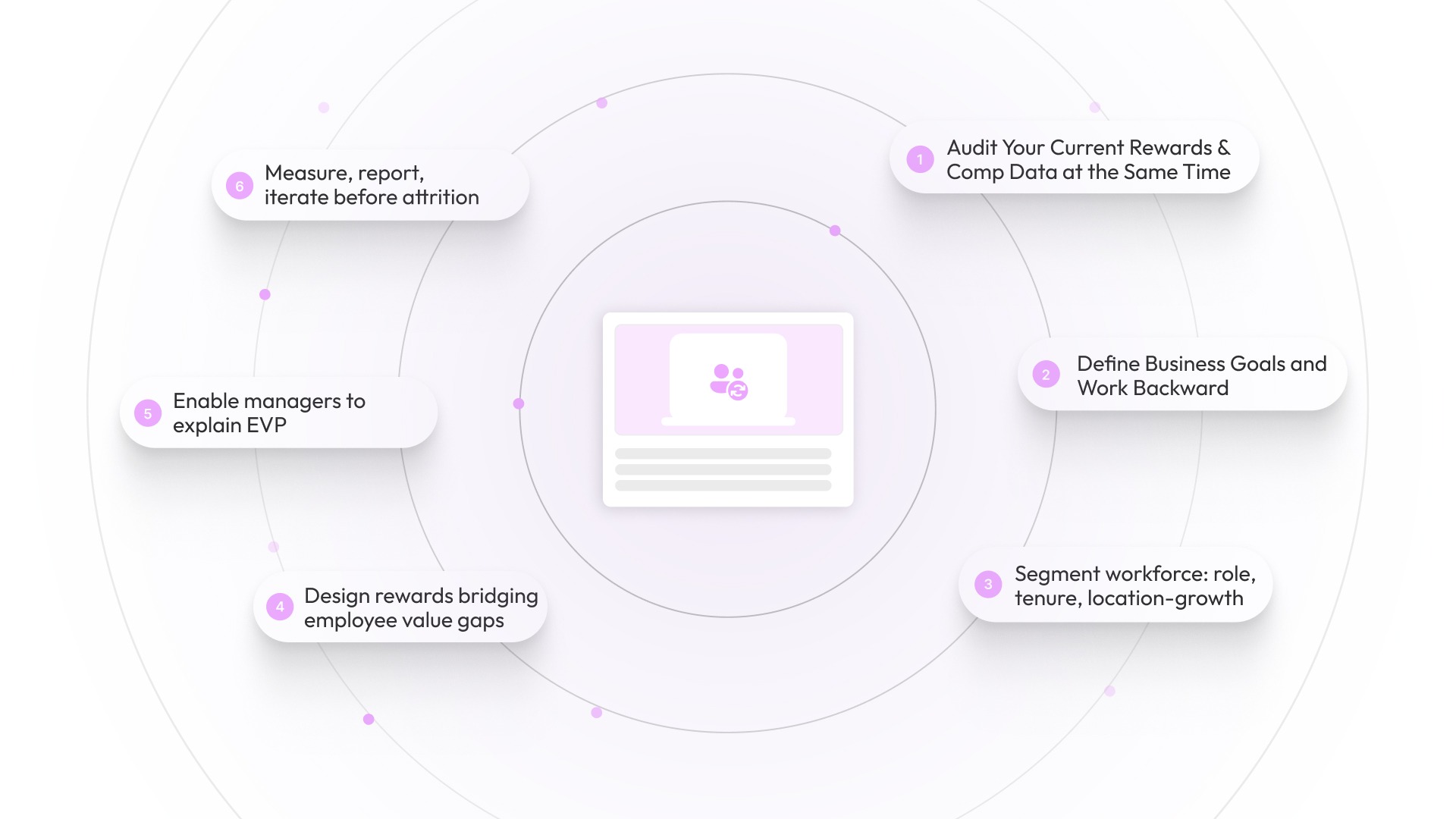
A rewards strategy that drives performance isn't built in a planning session. It's built from real data, tested against business goals, and iterated based on what it actually produces. Here's the sequence that works.
Step 1: Audit Your Current Rewards and Comp Data at the Same Time
Start with an honest inventory. What do you currently offer across compensation, benefits, recognition, development, and flexibility? Then layer in your comp data: where are you relative to market by role, level, and location? Where do you have pay equity gaps? What's your offer acceptance rate and voluntary turnover telling you? You can't design for the gap until you know where the gap is.
Step 2: Define Business Goals and Work Backward
Are you trying to reduce voluntary turnover in a specific function? Improve offer acceptance rates in a competitive talent market? Scale headcount without degrading comp equity? Each goal has a different reward lever. Define the goal first, then design the strategy to hit it, not the other way around.
Step 3: Segment Your Workforce by Role, Tenure, Location, and Growth Trajectory
Every employee of a distributed team has different comp expectations, different benefit priorities, and different growth timelines. Segmenting your workforce before you design the reward mix lets you target each group effectively instead of building a strategy that no one finds particularly relevant.
Step 4: Design the Reward Mix That Closes the Gap Between What You Offer and What They Value
Using your audit findings and employee data, build a reward mix for each segment that closes the specific gaps you've identified. This might mean adjusting base salary bands in high-cost markets, adding mental health benefits, creating clearer promotion tracks, or building in more flexibility for roles where it's operationally feasible.
Prioritize changes that will have the highest impact on your defined business goals. Avoid redesigning everything at once.
Step 5: Communicate It So Every Manager Can Explain Your EVP in One Sentence
Your employee value proposition fails if only HR can articulate it. Managers are the primary channel through which employees experience your rewards strategy. If they can't clearly explain how pay is set, what career growth looks like, or what the company actually offers beyond salary, the strategy stops working at the team level. Invest in manager enablement as part of rollout, not as an afterthought.
Step 6: Measure, Report to Leadership, and Iterate Before Attrition Tells You To
Build a measurement framework from the start. Track voluntary turnover by segment, offer acceptance rates, internal promotion rates, engagement scores, and pay equity metrics. Report these to leadership quarterly. Review comp benchmarks at least annually. The companies that wait for an attrition spike to revisit their rewards strategy are always a quarter behind the problem.
Also Read: 6 Effective Communication Strategies for Total Rewards
However, in 2026, AI is helping to build a rewards strategy with less effort and maximum effectiveness.
How AI Is Changing Rewards Personalization And What Scaling U.S Teams Can Use Today
AI isn't replacing the judgment behind a rewards strategy. It's removing the manual bottlenecks that made personalization impossible at scale. The five use cases below reflect what scaling US teams are actually deploying in 2026 — not future-state thinking.
1. Real-Time Compensation Benchmarking
AI-powered compensation tools can now pull and analyze market data continuously, not just during annual review cycles. That means pay bands can reflect what the market is doing now. For companies scaling quickly, this closes the gap between when roles are created and when they're priced correctly.
2. Pay Equity Monitoring
Instead of running pay equity audits once a year, AI can flag emerging equity gaps in real time, by gender, race, role, tenure, or location, before they compound into legal or cultural problems. It also reduces the analytical burden on HR teams who are already stretched.
3. Personalized Total Compensation Modeling
AI enables employees to model their own total compensation, seeing the value of equity, benefits, bonuses, and salary in one place, and to run scenarios based on different elections or vesting timelines. That transparency directly addresses the perception gap most companies struggle with.
4. Predictive Attrition Signals
Machine learning models can identify patterns in engagement, performance, and compensation data that predict attrition risk at the individual or team level, before it shows up as a resignation. That gives HR and managers a window to intervene with targeted retention actions, not just generic programs.
5. Reward Mix Optimization by Segment
AI can analyze which reward elements are driving the most value for specific workforce segments, and which ones aren't, so you can reallocate budget toward higher-impact interventions. That's especially useful for distributed teams where one-size-fits-all reward mixes consistently underperform.
Also Read: Creating a Total Rewards Strategy for a Multigenerational Workforce
These capabilities are available today. Tools like CandorIQ are making them accessible to HR and Finance teams without requiring a data science team to manage them, which is exactly what the next section covers.
How to Build a Performance-Driven Employee Rewards Strategy with CandorIQ in 2026?
CandorIQ is a comprehensive compensation and headcount planning platform built for modern HR and Finance teams. It consolidates the tools most companies manage in disconnected spreadsheets, pay bands, compensation cycles, headcount forecasting, and offer workflows into a single, unified system.
Here's what the platform includes and how each product connects to your rewards strategy:
As a result, you get a rewards strategy that's grounded in real data, consistently communicated, and built to scale without losing the equity and transparency that make it more effective.
If your rewards strategy is only as good as the data behind it, this is where you start. Book a personalized demo →

FAQs
1. What are the main categories of employee rewards?
Employee rewards fall into five core categories: monetary (salary, bonuses), non-monetary (recognition, awards), benefits (health, retirement, leave), career (growth and development), and work environment (flexibility, culture). Strong strategies use a mix of all five.
2. What does a total rewards framework typically include?
A total rewards framework includes compensation, benefits, recognition, career development, and workplace culture. It works best when these elements are designed to reinforce each other, not operate in silos.
3. What are meaningful ways to reward employees beyond bonuses?
The most effective rewards are specific and relevant: timely recognition, extra PTO after major efforts, funding for learning, flexible work options, and opportunities to lead meaningful projects. These often outperform generic cash incentives in long-term impact.
4. How should managers recognize employees effectively?
Recognition should be timely, specific, and tied to real impact. Generic praise fades quickly. Managers should vary the format: sometimes public (team meetings, Slack shoutouts), sometimes private (a direct conversation or written note). They should also calibrate to the individual; some employees value visibility, others find it uncomfortable. Peer recognition programs work well as a complement.
5. Why do intrinsic rewards matter in a rewards strategy?
Intrinsic rewards, the sense of purpose, mastery, and autonomy employees get from the work itself, are what sustain high performance over time. Compensation can attract talent, but meaningful work and ownership are what keep employees engaged over time.
Ready to modernize your workforce and compensation strategy?
See how CandorIQ brings workforce planning and compensation together with AI.