
10 Types of Compensation and Benefits Plans in HR You Should Know in 2026
Discover what type of plan HR develops for benefits and bonuses and explore the top 10 compensation and benefits plans shaping HR strategy in 2026.


Compensation has become a strategic priority for scaling organizations. HR leaders are increasingly asked what type of plan HR assists in developing that deals with benefits and bonuses, and how it supports pay equity, compliance, and budget control.
In 2026, compensation extends beyond base pay to include structured benefits, bonuses, and incentives. With distributed teams across regions and tightening pay transparency regulations, legacy, office-first models no longer work.
Organizations now need clearly defined compensation and benefits plans that are scalable, compliant, and defensible. This guide outlines 10 essential compensation and benefits plans HR teams help design to support a global workforce.
At a glance:
- Compensation planning demands balancing location-based pay, performance incentives, and cross-border benefits while protecting internal equity and market competitiveness.
- Strong compensation strategies blend base pay and bonuses with benefits like insurance, retirement matching, home-office support, and flexibility to deliver compelling total rewards.
- Effective distributed compensation programs emphasize pay transparency, frequent market benchmarking, and close People Ops–Finance collaboration to avoid budget issues and stay competitive.
- Modern compensation packages must address remote-specific needs—home-office allowances, coworking stipends, mental health support, and global compliance gaps traditional benefits miss.
- CandorIQ’s unified platform replaces spreadsheet chaos, enables transparent location-adjusted pay bands, and keeps budgets aligned for distributed teams in real time.
What is a Compensation Plan for Remote Teams?
A compensation plan is your organization’s strategic framework for how you pay and reward employees across locations. It defines base salaries, variable pay, equity, benefits, and perks that form your total rewards offering.
Key remote-work factors influencing compensation include:
- Cost-of-living differences that can create 40–50% pay gaps for identical roles
- State and country-specific rules for minimum wage, overtime, and mandatory benefits
- Currency fluctuations and global payment infrastructure
- Multi-jurisdiction tax implications
- Cultural expectations for benefits and work arrangements
The challenge for People Ops and Finance is building a compensation system that feels fair, stays financially sustainable, and meets legal requirements across every location where you employ talent. Let’s see why it matters for distributed teams.
Why Compensation Planning Matters for Distributed Workforces
The global talent market has fundamentally shifted the competitive landscape. High-growth companies scaling from 100 to 500 employees need compensation frameworks that support rapid hiring without creating internal inequities.
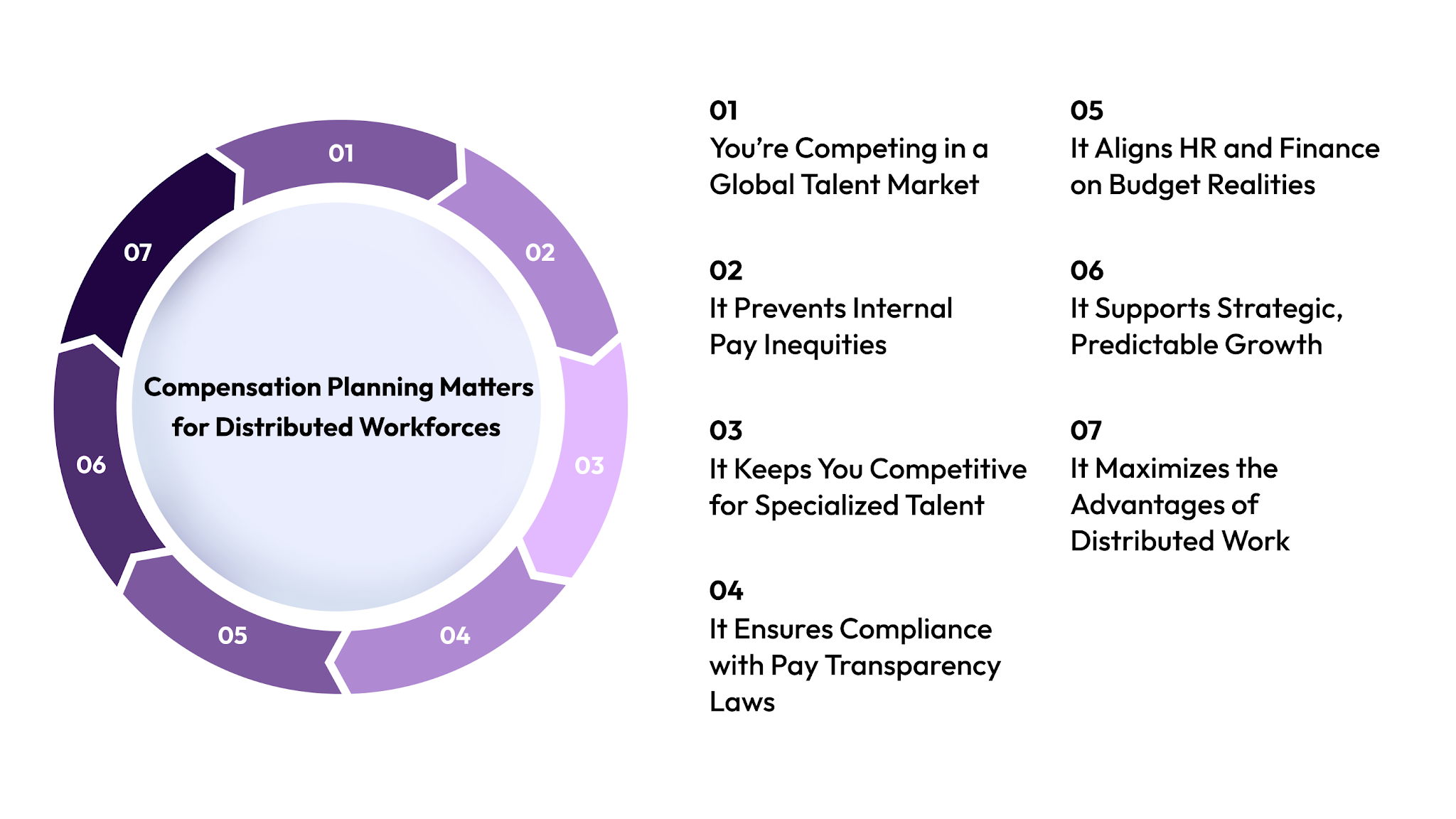
Here’s why compensation planning is important for distributed workforces:
- You’re Competing in a Global Talent Market: Remote work means you’re no longer hiring locally, you’re competing with remote-first unicorns, tech giants offering $300K packages, and international companies recruiting at their own market rates. Strong compensation planning is essential to stay competitive.
- It Prevents Internal Pay Inequities: Fast scaling often leads to inconsistent pay decisions, creating gaps between employees doing identical work in the same location. A clear compensation framework eliminates inequities and protects retention.
- It Keeps You Competitive for Specialized Talent: A global candidate pool intensifies competition for niche roles. Candidates compare offers across borders, and top performers push for stronger salary, equity, and benefits. Structured compensation ensures you can meet these expectations sustainably.
- It Ensures Compliance with Pay Transparency Laws: Salary range disclosures are now mandatory in many regions across the US and EU. Thoughtful compensation planning ensures compliance and reduces regulatory and reputational risk.
- It Aligns HR and Finance on Budget Realities: Without a shared system, HR may extend offers beyond approved budgets while Finance tries to control rising headcount costs. Compensation planning aligns both teams and prevents overspending.
- It Supports Strategic, Predictable Growth: Unified planning tools enable Finance and People Ops to model hiring scenarios, track real-time budget impact, and agree on compensation ranges before offers go out. CandorIQ’s Headcount Scenario Planning gives a single view of workforce costs, helping model hiring plans, track budget impact instantly, and lock in compensation ranges before offers go out.
- It Maximizes the Advantages of Distributed Work: Distributed teams offer access to diverse talent at varied price points, but only with intentional compensation planning. The right framework helps you leverage global hiring without creating pay gaps or compliance issues.
Hence, you should focus on creating new opportunities to access talent at different price points and build more diverse teams. Below are 10 ways you can do it.
Also Read: Proven Job Tier-Based Compensation Method for Fair Pay in 2026
10 Types of Compensation and Benefits Plans in HR
HR teams must balance financial sustainability with employee expectations, offering a mix of pay, perks, and protections that support both performance and well-being.
Below are 10 core types of compensation and benefits plans every modern organization should consider.
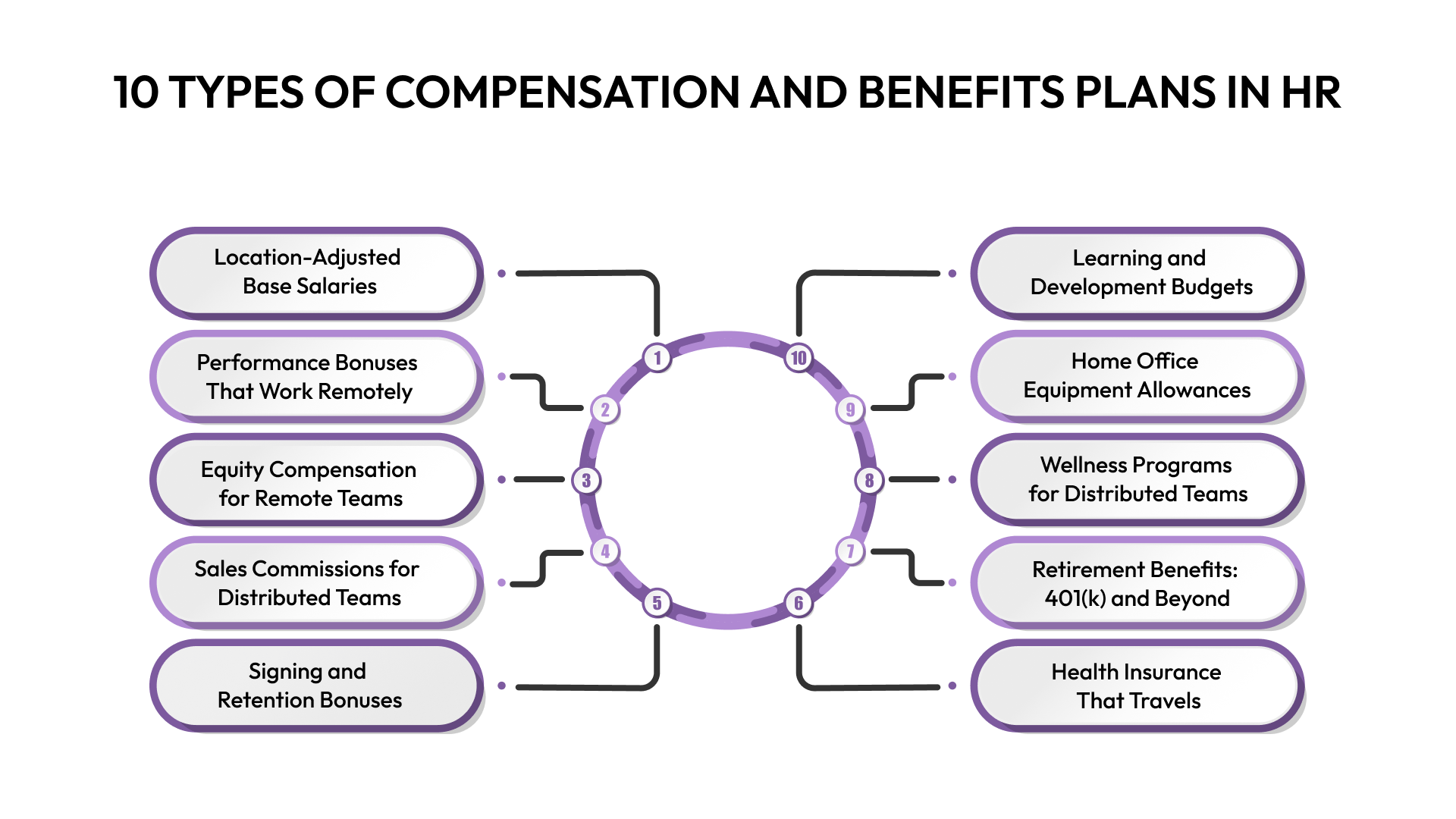
1. Location-Adjusted Base Salaries
Base salary remains the core of any compensation plan, but geography now shapes how companies structure pay. Companies must decide whether to pay for the role (same pay everywhere) or pay for the location (adjust based on local market rates and cost of living).
To structure geo-based pay effectively:
- Create 3–5 location tiers based on cost-of-living indices and market benchmarks
- Define clear geographic zones and the adjustment factor for each
- Communicate your compensation philosophy early and transparently
- Review and update location multipliers annually
For example, Buffer’s public salary formula outlines how role, experience, and location shape pay. This level of openness may not suit every company, but it shows how clarity around location adjustments can build trust.
To stay competitive without overspending, use salary bands and real-time benchmarking tools such as CandorIQ. Traditional salary surveys often miss the nuance of remote-first compensation, making accurate, dynamic data essential for scaling teams.
2. Performance Bonuses That Work Remotely
Performance bonuses reward results beyond core responsibilities, but remote teams need structures that feel fair without daily in-person oversight. OKR (Objectives and Key Results)-linked incentives work well because they set clear, measurable criteria. The key is calibrating OKRs to be ambitious yet achievable.
Many companies use a hybrid bonus model: 60–70% tied to individual goals and 30–40% to team or company performance.
Transparent bonus criteria are:
- Set exact metrics and targets upfront
- Document measurement methods and decision-makers
- Share progress regularly
- Pay bonuses promptly after evaluation
Remote work shifts focus to outcomes, making bonuses fairer when implemented well.
3. Equity Compensation for Remote Teams
Equity gives employees ownership in your company’s growth and serves as a strong long-term retention tool. For startups, it’s often the most valuable part of early compensation. Companies typically use stock options or RSUs, each offering different benefits for distributed teams.
Options vs. RSUs for remote teams:
- Stock options require cash to exercise and may create tax events
- RSUs are simpler, require no upfront investment, and retain value even if the stock price stays flat
- International employees often face complex tax rules with options
- RSUs are generally easier to administer globally
Standard vesting structure:
- Four-year vesting with a one-year cliff
- 25% vests at year one; the remaining 75% vests monthly or quarterly
Broad-based equity can be transformative. For example, Airbnb granted equity widely, enabling employees across functions to see meaningful wealth at IPO. Tools like CandorIQ’s Compensation & Payband Builder help teams create level- and location-aligned equity grants.
4. Sales Commissions for Distributed Teams
Sales commissions link pay directly to revenue, but remote teams need plans that work without in-office energy or peer pressure. Location-independent structures are key. Divide territories by account size, industry, or product line instead of geography to ensure fairness.
Best practices for remote commissions:
- Use CRM systems integrated with compensation platforms for automated calculations
- Provide real-time dashboards for quota tracking
- Document commission rules, payment timing, and dispute resolution
- Automate approval workflows for exceptions
Remote setups can improve fairness by forcing objective success criteria, rewarding results over perceived effort, and reducing manager bias.
5. Signing and Retention Bonuses
Signing bonuses help close candidates who are choosing between multiple offers or taking a risk by leaving secure positions. Signing bonuses help close candidates weighing multiple offers or leaving secure roles. Retention bonuses keep key employees during transitions like acquisitions or leadership changes.
Best practices:
- Use signing bonuses to bridge compensation gaps or accelerate start dates
- Calculate ROI for retention bonuses vs. replacement costs
- Include clawback provisions to protect your investment
- Adjust bonuses for location differences to equalize total first-year compensation across markets
Well-structured bonuses boost hiring success and retention while maintaining fairness in distributed teams.
6. Health Insurance That Travels
Health insurance is one of the most valued benefits for US employees, but it becomes complex when teams work across states or internationally.
Domestic Coverage:
- PPO plans with national networks to accommodate remote employees
- Multiple plan tiers offering choices between lower premiums/higher deductibles or higher premiums/better coverage
International Coverage:
- Approaches vary: contractors, Employer of Record, or local legal entities
- Options include stipends for local insurance or global coverage via international brokers
Mental Health Support:
- Therapy coverage and teletherapy for remote workers
- Mental wellness apps for meditation, sleep, and stress management
- Generous session limits beyond the traditional 6–8 per year
- Coverage for treatment and preventive wellness
However, the challenge for distributed teams is ensuring equitable access when some locations have robust mental health infrastructure while others have limited options. Teletherapy helps bridge these gaps.
7. Retirement Benefits: 401(k) and Beyond
Retirement benefits help employees build long-term financial security and offer tax advantages for both employers and employees.
- The 401(k) remains standard in the US, while international employees often use their country’s statutory pension systems.
- Employer matching typically ranges from 50% to 100% of employee contributions, up to 4%–6% of salary.
- Auto-enrollment is increasingly common, with default contribution rates of 3%–6%, boosting participation while allowing employees to opt out or adjust contributions.
- The SECURE 2.0 Act will require auto-enrollment for most new US 401(k) plans.
- Global retirement strategies vary: some countries require employer pension contributions, while others allow private accounts.
- Your approach depends on whether you establish entities, use an EOR, or hire contractors.
For distributed teams, ensure your 401(k) provider supports all 50 states and offers online account management, letting employees adjust contributions, change investments, and access educational resources remotely.
8. Wellness Programs for Distributed Teams
Wellness programs support employee physical and mental health through various initiatives and benefits. Traditional office wellness programs included on-site gyms or yoga classes, but distributed teams need different approaches.
You can offer:
- Online fitness classes, meditation apps, nutrition counseling, and health coaching via video
- Subscriptions to platforms like Peloton, ClassPass, or wellness apps
- Fitness and mental health apps ($50–$150 per employee annually)
- Gym membership reimbursements or monthly wellness stipends ($50–$100)
- Childcare or eldercare resources, backup services, and concierge assistance
- Mental health app subscriptions for all employees
- Virtual fitness classes across time zones
- Wellness challenges to foster team connection and healthy habits
Remote work can be isolating and sedentary. Wellness programs that address both physical and mental health demonstrate that you're investing in your employees' whole lives, not just their work output.
9. Home Office Equipment Allowances
Home office equipment allowances are now a standard benefit as remote work becomes permanent.
- Initial setup: $1,000–$2,500 for desk, ergonomic chair, monitor, keyboard, mouse, and lighting
- Annual refresh: $500–$1,000 for upgrades or replacements
- You may provide equipment directly rather than reimbursing to reduce costs.
- Company-owned equipment: generally not taxable
- Direct allowances/stipends: typically taxable.
Some companies also provide monthly internet stipends of $50 to $100 to offset the cost of home internet service used for work purposes.
CandorIQ helps you incorporate home office allowances into total compensation statements so employees understand the full value of their compensation package, not just their base salary and benefits.
10. Learning and Development Budgets
Professional development budgets give employees resources to grow skills and advance careers. For distributed teams, they replace informal learning from office proximity.
Budget & Usage:
- Typical annual stipend: $1,000–$3,000 per employee
- Covers online courses, certifications, conferences, books, or coaching
- Some companies allow accumulation for larger investments, like degrees
Conference & Networking Support:
- Virtual and in-person conferences build skills and networks
- A separate travel budget may be provided
Best Practices for Remote Teams:
- Flexible spending within approved programs
- Pre-approval for faster reimbursement
- Internal channels to share learning
- Group enrollments to build shared knowledge
Investing in L&D ensures remote employees continue growing despite distance from mentors and peers.
However, selecting which elements to include in your compensation package requires balancing multiple factors.
Also Read: Compensation Management: Guide and Examples to Develop Strategies
How to Choose the Right Compensation Mix
Creating a competitive compensation mix means balancing market benchmarks, budget realities, compliance, and what your employees actually value.
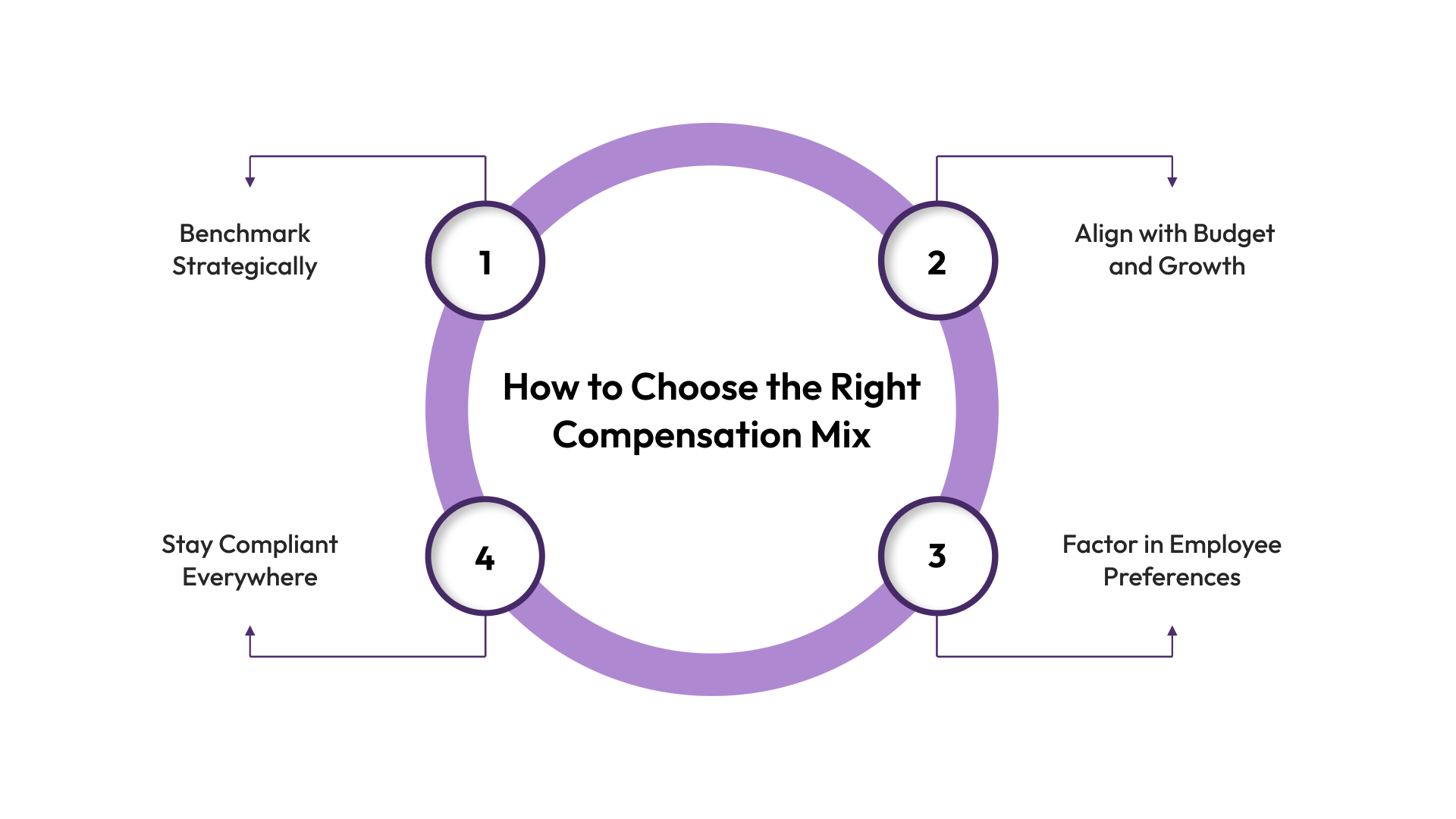
- Benchmark Strategically: Focus on your true peer group, companies of similar size, stage, funding, and location. A 50-person Series A startup competes differently from a 5,000-person public SaaS company. Use:
- Survey platforms (Radford, Mercer, Pave)
- Peer networks via investors or industry groups
- Transparent salary data (Buffer, GitLab, Basecamp)
- Recruiting insights
- Align with Budget and Growth: Finance and HR must agree on headcount, role-level compensation, and total rewards. Many SaaS companies allocate 55–70% of revenue to fully loaded people costs, but this varies by growth stage and business model.
- Factor in Employee Preferences: Surveys reveal what your team values, such as salary, equity, flexibility, or enhanced benefits. Employees may trade for better coverage or work-life balance. Check preferences annually.
- Stay Compliant Everywhere: Minimum wage, overtime, benefits, and tax rules differ by location. International hiring adds complexity. Each country has its own requirements.
The goal is delivering a compensation mix that is competitive, strategic, meaningful to employees, and sustainable as you scale. This is where CandorIQ shines.
Also Read: Advantages of Pay Grade Systems in Employee Compensation
Streamline Your Compensation Planning with CandorIQ
Managing compensation across distributed teams no longer requires drowning in spreadsheets. CandorIQ offers a unified platform for HR and Finance to collaborate on strategy, execution, and governance in real time.
Key CandorIQ Capabilities:
- Compensation & Payband Builder: Define pay bands by level, department, and location with data-driven adjustments.
- Access Controls: Manage visibility by job family or geography to protect sensitive information.
- Real-Time Collaboration: HR, Finance, and department heads can work on the same data with instant updates.
- Comments & Audit Trails: Log rationale for decisions to simplify reviews and compliance audits.
- Compliance & Transparency: Geo-adjusted compensation ensures pay equity and regulatory adherence.
- Historical Tracking: Monitor compensation changes over time for documentation and reporting.
- AI-Powered Recommendations: Ask questions like “What’s the cost to hire three senior engineers in Poland?” and get instant insights.
CandorIQ helps distributed teams scale hiring efficiently while maintaining fairness, budget control, and transparency.
Conclusion
Modern compensation planning goes beyond competitive salaries. It requires strategies that cover the full spectrum of employee rewards, including base pay, bonuses, benefits, perks, and recognition. Managing compensation across locations, roles, and regulatory environments makes spreadsheet-based approaches risky. Misalignment between HR and Finance, version control issues, and limited budget visibility only grow as teams scale.
CandorIQ provides the infrastructure that People and Finance teams need to collaborate effectively, implement transparent and equitable pay practices, and maintain budget discipline while managing distributed workforces.
Transform your compensation planning from reactive and chaotic to strategic and controlled. Request a demo to see how CandorIQ can help.
.png)
Frequently Asked Questions
1. How to pay remote employees in different states?
Register for payroll tax withholding and unemployment insurance in each state where employees work. Use multi-state payroll providers (Rippling, Gusto, ADP) to automate tax filings, deductions, and compliance. Follow each state's rules for taxes, minimum wage, and overtime.
2. Should remote workers get paid differently based on location?
Location-based pay is optional. Many companies adjust salaries (often 80–120%) based on the cost of living and local market rates. Others use national/role-based pay for fairness and simplicity. Choose a model aligned with your talent strategy.
3. How to ensure pay equity across locations?
Audit compensation regularly, comparing similar roles and experience levels. Apply location adjustments consistently, document your method, and use comp software to flag disparities. Test changes for unintended gaps before rollout.
4. What is the difference between total compensation and base salary?
Base salary is fixed pay. Total compensation includes base salary plus bonuses, equity, benefits, retirement contributions, insurance, and paid time off value.
5. How often should you review and update compensation plans?
Most companies review compensation annually. Fast-growing or competitive markets may require quarterly or mid-year adjustments. Monitor offer acceptance rates, attrition, and market trends to decide if earlier updates are needed.
Ready to modernize your workforce and compensation strategy?
See how CandorIQ brings workforce planning and compensation together with AI.