

How to Modernize Compensation Without Creating Chaos, With Tailscale's VP of People
Watch the recording
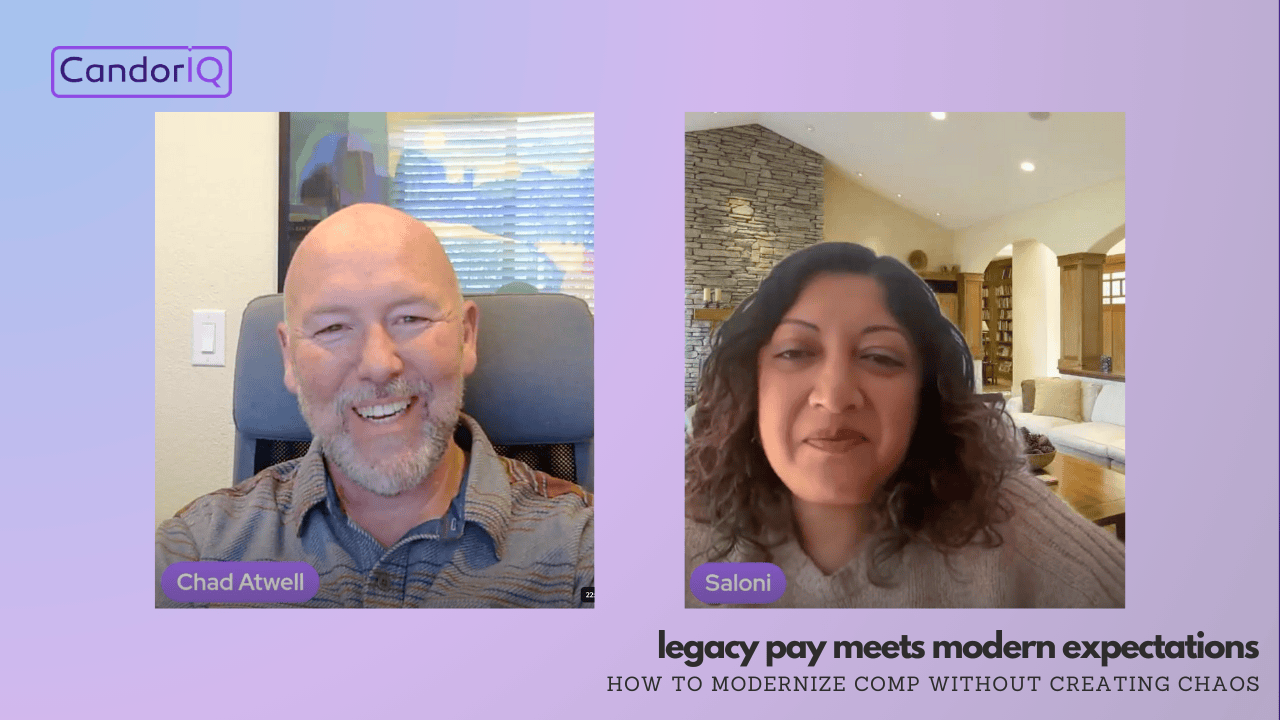
In this CandorIQ webinar, Chad Atwell, Head of Customer Success & Advisory at CandorIQ, sat down with Saloni Dudziak, VP of People at Tailscale and CandorIQ Customer Advisory Board member, to unpack what it really takes to modernize compensation without disrupting employees, managers, or the business. Drawing on Saloni’s experience stepping into organizations with legacy pay structures—and Chad’s work advising companies across stages—the conversation focused on practical frameworks, common pitfalls, and how to move forward thoughtfully.
See the full episode here.
Read the recap blog here.
What the conversation covers
Start with the decision history, not the numbers
Saloni's first move on inheriting a pay structure is to reconstruct why it was built the way it was: who made the calls, whether those people are still there, and whether the market conditions behind the decisions still hold. She sorts legacy problems into two buckets. Either the philosophy was set early and never iterated, so it has drifted behind market, or it has been through several rounds of revision by people who were not compensation specialists, leaving bands that look disconnected from the market. Jump to this section
Reading the signal: reset or refresh
There is no hard rule for whether a company needs a full overhaul or just a band refresh, but the indicators are readable. Offers declined on compensation grounds, or exit interviews that keep surfacing pay, point to bands that are not competitive and a deeper reset. Saloni also makes the less obvious argument in the other direction: a very high offer acceptance rate can mean bands are set too aggressively to be sustainable. Jump to this section
Job architecture is the layer underneath the bands
Before pay bands can be fixed, leveling has to be right. Saloni describes redesigning career ladders and matrices at Tailscale, and notes that internal levels frequently fail to map to how the market levels the same roles. She presents options to leadership as a Goldilocks framework: three risk tolerances, each modelled for its effect on current employees and external candidates, with manager feedback folded in before anything is decided. Jump to this section
Grandfathering, and the headline test
Both agree that carve-outs are sometimes defensible, and both are wary of them. Saloni frames the analysis around a person's growth path and whether bonus or equity structures can bridge the gap instead. Chad applies what he calls the headline test: if the exception became public, what would it do to the credibility of the change you just rolled out. His view is that credibility is the thing a new leader can least afford to spend. Jump to this section
Silence is what causes the chaos
Saloni's position is that the disruption rarely comes from the change itself. It comes from not explaining it. She uses a waterfall: align leadership on the philosophy first, then brief people managers on the rubric and the reasoning so they can answer questions on their own teams, then go wide. Chad adds the most common failure he sees in compensation teams, which is going too deep into the data when employees only want to know what changed and how it affects them. Jump to this section
Full transcript
00:02 Chad Atwell, CandorIQ
There we go. Okay. Hi, everybody. Chad Atwell. Appreciate your patience in getting the webcast started here on the different platforms and LinkedIn integrations and everything happening, but we're here now and appreciate it if you're able to join us live. Really, thanks for tuning in or if you're tuning in on the recording in the future, feel free to connect with either Saloni or myself and we'll definitely follow up with any questions that you might have. But just to kick us off, I'm Chad Atwell based out of the Colorado area. I work with CandorIQ as their head of customer success and advisory services, which means my background is mostly in the compensation and total reward space, mostly in consulting, but I've worked with a fair number of tech solutions out there as well. And CandorIQ, I started advising with them a couple of years ago and now I'm on full-time leading customer success, helping customers get onboarded onto all of our products. But from an advisory perspective, helping them build out job architectures and salary structures, other things that oftentimes many of our small startup customers don't have. So I've been doing that now since about April of earlier this year. And oddly enough, Saloni is one of our customers and is working with CandorIQ today. So Saloni, why don't you do your intro.
01:25 Saloni Dudziak, Tailscale
Sure. Thanks, Chad. Super excited to be here. I have been working in Bay Area tech, almost exclusively in startups for the past couple of decades. Currently, I'm VP of People at Tailscale, and I've been at Tailscale for about four months now. I started out my early career on the finance side of the house, have worked with companies, bootstrap all the way through post-IPO companies, have helped companies through M&As, and have been the first finance and people person several times. I've built out compensation philosophy and strategy from scratch, and I've also come into companies that have some established legacy comp and iterated on that and reinvented that. I think working in finance has been a huge asset to my current work in leading people teams, tying out compensation philosophy into company culture and how you kind of plan for growth. And this topic is actually very timely for me right now. It's one of my high-priority projects for Q4 in modernizing our comp structures without causing complete chaos.
02:31 Chad Atwell, CandorIQ
Absolutely. Yeah. And thank you so much for giving your time for us today. And we'll definitely dive into the professional content here quickly. But on a personal level, we're coming up to the holidays. Anything you're looking forward to, just some time off from work.
02:47 Saloni Dudziak, Tailscale
Yeah, we give everybody about a week off during the break. And so I think that's a nice quiet time for me to spend time with family, to go do some day trips around the Bay Area. It's quiet enough that you can actually move around without too much traffic. And then also, I'll probably be getting a little bit of work done because my days won't be full with meetings. So I can tackle these big rocks that I need to kick off for the new year. But just generally very excited to rejuvenate and get ready for the following year. How about you, Chad?
03:21 Chad Atwell, CandorIQ
Yeah, same, not traveling or doing anything like that. Although we would love to have a little bit more snow here in the Rocky Mountains to go skiing, but that's not going to happen, unfortunately. So it'll be another one of those years where we end up not going skiing probably until January. And hopefully the snow will just get better by then. We'll be able to enjoy it. As a native Coloradan, it's one of those things where it's like the snow has to be just right before I decide to actually go and invest like an entire weekend for it.
03:49 Saloni Dudziak, Tailscale
Yeah, very fair.
03:51 Chad Atwell, CandorIQ
Well, so you and I, I mean, we've both been in this situation where you've kind of come into a new organization. I've done it mostly from a consulting perspective, where you're kind of just really getting a lay of the land. You're kind of understanding what this company does already from a comp or total rewards perspective, certainly leftover legacy type strategies, policies, programs, that sort of thing. And I always think of it as, you know, what are your first 30-day, you know, your checklist items or your first 90-day checklist items. What are the things that you're sort of mentally going through to kind of get the inventory, understand the lay of the land in the organization, but then the things that you potentially want to now start working on, the things potentially that you want to have an impact on right away. So tell us a little bit about how you approach that, maybe for Tailscale, but any organization really, like what are the things that you try to understand better when you're first joining?
04:48 Saloni Dudziak, Tailscale
Yeah. When I approach evaluating this inherited comp philosophy, I always start with the history. What were the deciding factors that went into this philosophy? Who took part in it? Who made the decisions? Are they still timely? Are they relevant? Has there been a turnover of the executive team that might disagree on the comp philosophy currently? Because it was set at some point in the historical past and people have come and gone since then. And are there factors in the market or the business that have changed over time that should influence how our philosophy might be changing as well? And I always run into these legacy kind of problems and they tend to fall into two buckets. One bucket is it was set really early on when one approach or methodology worked for that kind of early stage company, but it hasn't necessarily evolved or been iterated on over time to help meet the needs of the different stages of the business. So maybe it's a bit stagnant, maybe it's a bit behind market and that's having trickle down effects across the org from either hiring and retention standpoint. On the other hand, I've also come into companies where there's been several rounds of iteration, but it's been passed through various hands and it's not always people who are experts in compensation planning, strategy, benchmarking and using data to guide that philosophy. So it might be a little messy and sometimes comp bands might seem a little disassociated with what you're seeing in the market right now.
06:29 Chad Atwell, CandorIQ
Sure. Yeah. And I think especially on the topic of philosophy, it's so important for the company to kind of get that right first. And I don't know, I think a lot of organizations kind of underestimate the importance of having that in place, especially at a level where it is sort of tailor-made for your organization. You want to have your own sort of spin on things, your branding, other things that really fit your overall sort of company culture and sort of your strategies and what you're trying to achieve in the coming year. But it's a big rock. Like you said, it's one of those big things that's really hard to kind of get people to agree on. I mean, is it worth the squeeze to kind of go back to a comp philosophy when you're first joining and try to get people aligned around that?
07:18 Saloni Dudziak, Tailscale
Yeah, I definitely think it is, right? I think one mistake I see is when people treat policies like they're permanent, right? What worked early on might not be the right approach for where the company is currently at. And understanding what is important to the business is very critical when you're making those type of changes to your strategy. I think that you can, if you haven't changed your comp philosophy over time, you can find issues that compound in a few different ways, right? So sometimes it's having a lack of point of view or philosophy of how the company wants to be competitive within the market. Maybe they've let candidates negotiate for what they think is right without using appropriate pay bands that have been thoughtfully set with data points. Sometimes a company might use benchmarks to set their comp bands, but they're not necessarily the right benchmark data sets. So, you know, I'll use an example of like using benchmark data from larger companies likely isn't going to be the right data set for an early stage startup that's just getting started, right? Or a company that has challenges in hiring strong candidates, they might need to start out by using, for example, a higher median percentile for their bands versus a company that's more established, they're well known, they're highly sought after, they can get away with using a slightly different percentile. And I think with legacy comp, there's always this inevitable challenge in changing comp bands and looking at how that impacts the current people at the company. If it's going to throw things out of whack, you really want to take a more phased approach over time, you're probably not going to try and fix everything at once. I'm curious, actually, when you work with companies in this situation, how do you help them figure out what's noise versus what's structural?
09:09 Chad Atwell, CandorIQ
Oh, yeah, it's, you know, we work with a lot of small companies now. And I think, oftentimes, the idea of an actual total rewards philosophy or compensation philosophy, really just isn't something that a lot of heads of HR have done previously, or they've seen some really good examples, they've essentially tried to mimic those. And it really is a very important first step to make sure that they know that this is something that you are authoring on behalf of the organization. And it's so important, because I think we'll probably talk about this more towards the end of the conversation. But almost everything you do, from a compensation communication perspective, and everything should come back to that philosophy, it should fit with whatever those policies and principles are that you're putting in place. So I tend to start with what is it that you're trying to do competitively? Who do you compare yourselves to, the things that are really easy, sort of tangible handholds for a lot of companies, because typically, that's what a lot of people think of when they think of philosophy, they think about competitiveness, where are we in the market, where do we want to be, those sorts of things. But then I broaden it to what is the general experience that employees need to have when it comes to total rewards in your organization. We talk about transparency and clarity and other things that are not so external focused, but very internal focused. And you've got a lot more control over those things. And organizations are on big swings as far as how transparent they are with different areas, depending on where they're located and just regulations in those areas. But there's a variety of different things that I go through with them. And so it's a whole model that I've constructed where we kind of walk through different steps that way.
11:01 Saloni Dudziak, Tailscale
Yeah, I think that's an important corner. I think there is a blend of philosophy meeting data, right? And using some of the data to tell that story and guide your philosophy. The data isn't going to necessarily be the deciding factor. It is great to help inform the decisions that you're making on how you pay people and giving you some data points on what other companies might be doing. But you really want to make sure that you're bringing in the leaders across the organization when you're designing your strategy. I've run into many battles with leaders who come from big companies and they have very different ideals and opinions on how comp should be set. And again, you know, going back to the analogy of like, hey, what works with a 4,000 person company is not going to be relevant or work for a 50 person or 200 person or even 500 person company. So when I think about the right approach, this is probably going to differ quite philosophically depending on the leader. And so I try and pull in a multitude of factors, right? What stage of growth are we in right now? Where do we want to be in the next like couple of years time? You know, what's the revenue year over year? You need to be very comfortable with numbers and very comfortable with tying what you're doing to what the business needs you to do over time. How competitive are you in the industry or your market? And very importantly to me, I think what kind of behaviors do you want to reward? You know, if you're hiring people that really care about compensation and that's your hook that's going to get people in, I don't fundamentally believe that's going to keep people around for a long period of time. You really need to have obviously very competitive compensation, but I think that philosophically you really want to make sure everyone's aligned on how they're thinking about rewarding people and how they want people to think about what they get out of the value of the organization. That's not just compensation itself.
13:05 Chad Atwell, CandorIQ
Yeah, no, that's great perspective. Yeah, I equate this just because I teach the WorldatWork courses. And we always talk about comp philosophy as sort of a starting point for a lot of this. And what you're touching on is the exact same sort of foundational elements that we teach in those courses is just being able to talk about where the company is versus where it wants to be, the idea of like individual versus team-oriented cultures and how you construct different types of reward programs around that, like all of those things come into play. I mean, not every organization necessarily, just because you're joining the organization for the first time doesn't mean you have to upend everything, right? And completely start over. But what are some things that you sort of listen for, the signals that give you the ability to understand, you know, maybe you need to dive in a little deeper here and actually start with a comp philosophy change or, you know, other components of the foundation.
14:05 Saloni Dudziak, Tailscale
Yeah, I think it depends on whether you're trying to do a reset and kind of really overhaul compensation or you're just trying to refresh the bands and make sure that you're fairly in line with market and you're being competitive in the ways that you want to. I don't think that there's a hard and fast rule, but you can see some strong indicators that you might need to go one way or the other. So, if you're seeing a lot of folks who are turning down offers for compensation and they've said, hey, I got better offers somewhere else and it's compensation related. Or you're seeing an uptick in attrition in your company that people, as you're going through exit interviews, you're going through talking to employees that you're finding is comp related. This could be a pretty strong signal that your bands aren't competitive enough and you do need a bigger reset and you need to deep dive into how those bands came about, but also what's going to be the delta that it's going to take to make yourself competitive enough in the industry. On the flip side, if comp is really an issue with offers being accepted, you've got a high offer acceptance rate, which on one hand is really great, but sometimes I think this is probably actually a controversial take. Maybe your bands are too competitive or aggressive and they actually need to be pulled in a little bit so that you are not going above and beyond what the general market is showing you and overpaying people to a degree that won't allow you to be sustainable long term as a business.
15:49 Chad Atwell, CandorIQ
Sure. Yeah. No, that's big time trying to understand exactly like get that internal feedback loop happening, which unfortunately I find quite a few heads of total rewards or compensation that for whatever reason, they're just so focused on external competitiveness that they don't seem to have time to collect that internal feedback. And it's such an important part. And I've talked about this for years. It's like it is such a core skill set of a compensation team. We already have all of these analytical skills, the ability to like digest all this data and turn it around and try to understand it. You just have to change the focus just from external to internal and just try to gather some of that content. And I think there's a lot of hesitancy if a company hasn't done it before or resetting expectations or the employees expecting something just because we're asking the question, and you can do things in a way that doesn't set those expectations. It's just worth it. Even from the recruiter's perspective, like you said, just finding out like what's the status of the average offer that's going out and what's happening with that. We've talked about pay bands quite a few times and that's certainly a big piece of getting the foundation right. But under that is even a more foundational element of just job architecture. And so do you spend a lot of time with job architecture when you're kind of joining an organization to begin with? Like what do you focus on or how do you get other leaders or executives to kind of focus on job architecture changes?
17:23 Saloni Dudziak, Tailscale
Yeah, I definitely do. And I think there's always a bit of tension when you're building the architecture of compensation and taking into account stage appropriateness into the rules. I like to frame it as a problem statement and a solutions orientated approach, right? So I want to talk through what do these jobs encompass? What are the core responsibilities for them? Have we set up our leveling appropriately? A lot of times, and I'm going through this at Tailscale right now as well, of kind of redesigning some of our career ladders and matrices, is making sure that your leveling structure has been built out appropriately. A lot of times I come into companies and I see that our levels are mapped in a certain way but they don't necessarily reflect how the market has mapped levels, and if you go to websites like Levels FYI and public data, you can see Microsoft has one version of leveling. Apple has one version of leveling. Everyone's kind of doing their own thing but there is a standardized approach. And I've used this approach at multiple companies and then once you've built in the standardized approach, you kind of hand it off to different departments to help them build back into how they're thinking about career paths, growth. So there's definitely aspects of it that's nuanced. I think there's also legal aspects of it especially when you've got pay parity laws in recent years. You have to be very mindful where legal also intersects with building compensation philosophy and strategy and, you know, we're a fairly global company and with the ever-growing globalization of the workforce, it's really crucial that leaders understand how to factor this in when they're making comp decisions. I try and do a lot of back-end analysis as well on like how do our decisions impact our current employees, right? How could it cap or expand their ability to grow in their level and their career path with us to make sure we're internally equitable. And when I'm going through an options approach, I like to present like a Goldilocks framework. Here's three different risk and tolerance levels, outline how each one could impact us over a longer term both for current employees and for external candidates, and gauge from leaders and managers what their feedback is so that I can incorporate that so we find something that is palatable for everyone.
20:10 Chad Atwell, CandorIQ
Is there just real tangibly, is there a certain tool or what do you use to gather all of that input and everything? It can get pretty unmanageable once everything starts to come in. Everybody has an opinion about careers and compensation and all that stuff. How do you keep it all organized?
20:26 Saloni Dudziak, Tailscale
Yeah. I mean, back in my day, it was dozens and dozens of spreadsheets. And then companies like CandorIQ came along and had an internal tool that we could integrate with our HRIS, we could integrate with our equity platform, pulls everything into one place and gives you a really nice streamlined view of where everybody sits in their compensation bands, how you do organizational planning for future headcount. How would that impact your business and your forecasting and your financial model? If you made certain changes to your comp bands, where would people now sit from a comp ratio standpoint in their bands? So I am really grateful for CandorIQ and compensation planning tools, because going from historically legacy, 50 spreadsheets that I'm trying to manage between sharing with leaders and managers and permissions and, oh, now this manager's left, I have to transfer it to somebody else. And data integrity, making sure that data rolls forward, removing a lot of that and putting it into CandorIQ has been huge for us. I won't lie, I'm still a spreadsheet person. I still love tinkering in that. I'll still export stuff and do more analysis on the back end that maybe tools can't always do, right? But it's definitely eliminated 70% of that manual work that is hours and hours and hours and sometimes weeks of time suck.
22:03 Chad Atwell, CandorIQ
Well, that's amazing. Yeah, no, thank you for that. Yeah, it's one of those things. I think, you know, worksheets are always going to be part of it, just like finance or compensation, anything that's just heavy, heavy numbers driven sort of discipline within an organization. And we'll see if AI has the ability to impact that anymore. But I think, yeah, we're always going to fall back on a lot of our spreadsheets that we used in different roles and everything.
22:30 Saloni Dudziak, Tailscale
Oh, no, I will just also add that I love this. I used to work for an AI machine learning company and we were in the real-time business. And I think with CandorIQ, having access to real-time data and benchmark data is often half of the battle, right? Like historically you'd need to pay tens of thousands of dollars to get outdated, often lagging benchmark data, and then you're trying to make sense of it and keep up with what's happening in real time. And so I think having real-time live data sets drastically reduces a lot of that back and forth as well.
23:11 Chad Atwell, CandorIQ
Yeah, definitely a big change in at least those of us that have been in total rewards for the last 10 years or more. It's certainly changed as far as the amount of data that's out there. Well, we're talking about changing from legacy systems to now actually making a change, having an impact on an organization. Maybe you're rolling out a new job architecture, refreshed pay bands, any of those things. I always find there's some unique situation. Someone comes up with an excuse to say, well, yeah, that's all good to go for the majority of the organization. But I have this special circumstance where somebody needs to be grandfathered or there's a situation where it just would be detrimental to change this person and potentially downgrade them a level or do something like that. Do you run into those situations? How do you evaluate sort of like grandfathered type opportunities like that?
24:11 Saloni Dudziak, Tailscale
Yeah. Definitely have run into those situations. I think that, you know, you really have to work closely with legal on that situation, because different states, different countries have rules around that. And, you know, I know there are companies who are like, we don't really care about the rules, we're just going to do what we want, or companies that take an approach where it's like, we're just going to expand our bands by hundreds of thousands of dollars so we never have to deal with this. Those are approaches that you can take. I don't recommend them, because I think that they don't do your business and your philosophy justice. I think it's okay if we can grandfather in some folks for some period of time, right? And you have some tolerance level around that. And you have to spend some time understanding, hey, what is this person's path for growth? Is this person close to moving to the next level? Are they going to be growing into a different type of role that requires a different type of compensation, makeup, or structure? And you want to be able to understand what are the risks of doing something like this? And what are the rewards? You know, you can choose to rip the band-aid off and decide that we're going to be very strict on how we use compensation bands. That's going to have a different set of risks and rewards. But I think it really involves a lot of the back-end analysis on how it's going to impact folks, how it's going to help them grow in their roles or hinder them in their roles, and really working closely with managers to understand the conversations that they've been having. Because it's not just about numbers, right? It's about how you value a human, how this person wants to continue being at your business long-term, and is committed. Are there other compensation structures you can employ, right? Is this time for us to bake in some kind of bonus plan? Is equity valuable enough to make up for potential changes in compensation? So I think you can get creative where it's not just about the bands themselves, but I do think you have to factor in like tenure and value. And does it make sense to have a slightly different policy where you've got grandfathered in folks, where over time that starts to come together and now you've got a phased approach.
26:41 Chad Atwell, CandorIQ
Right. Yeah. I've talked before about, you know, there's kind of the smell test or the headline test. Like, if this were to be public information, how damaging potentially could it be to the organization? Not necessarily just from a legal or compliance perspective, but just culturally, you're rolling out whatever change you're rolling out. And ideally, you're having some level of behavior expectation, performance expectations. There's something that you're hoping to kind of impact culturally within the organization. And all of a sudden, somebody gets wind of the fact that you've made an exception, and so-and-so doesn't have to play by the same rules. And all of a sudden, the credibility kind of goes out the window, which is really, I mean, that's one of the biggest risks of being a new leader with a company is you just want to be able to maintain that level of credibility. We're doing this for the right reasons. You've got all the leadership alignment on that. And so, I really tend to dig in my heels around any sort of grandfather scenarios like that. Understandably, there are going to be the occasional ones that come together, or none of these changes have to happen over the course of just a month or two, right? Many of these changes can roll out sometimes over multiple years. I've worked with organizations where we find out market analysis-wise, you're just way behind where you think you should be from a market data perspective. And so, that's not going to change just in a single year. We're going to have to do this over the course of multiple years and sort of watch where the market data goes. But you're also going to be making those internal sort of leveling changes as well, which will impact that level of competitiveness that you have for sure.
28:25 Chad Atwell, CandorIQ
I mean, leaders always want to go to bat for their people and everything. Is there anything that you sort of put together or you try to get leaders to understand, you know, not grandfathering someone really is the best overall impact for the business.
28:40 Saloni Dudziak, Tailscale
Yeah, I definitely think that the biggest source of chaos is usually when there's silence around the change. It's not necessarily the change itself, but we haven't said enough, to your point of the transparency. I think you have to be fairly transparent in the modernization process. What's the logic and rules you're using to get to what you're rolling out? What's the strategy to employ? Why are you doing this now versus some other point in time? I find that I've worked mostly in engineering-heavy organizations, and engineers really want to know all the details and all the ins and outs. I'm happy to walk folks through that. Once you do that, I love for them to ask me all the questions, poke the holes, make sure we have a solid answer for how we made these decisions and trade-offs. I think communicating with managers who are your make or break channel and frontline leaders is really important. I use a waterfall approach where at the leadership level, we've aligned, we've come up with this compensation philosophy, our bands, however we've decided to kind of rejig them. Then you move over to the people leaders where I prepare them with sharing the philosophy. What's the rules rubric? How did I build it behind the scenes? What were the discussions? What's the data science behind this so it's clear to them and it makes sense, and give them that opportunity to ask all of those questions because they're going to be the ones having the conversations with the people on their teams. Those teams are going to be coming to them with questions. They're not coming to me necessarily or even like execs. Once you've gone through that exercise and you've equipped them with the knowledge to answer the questions, you're kind of halfway there. Not everyone is going to agree, you're going to ruffle some feathers. This is a big part of growing pains and decision-making and hard decision-making but I think if you can answer those questions upfront and you get 80, 90 percent alignment and you're showing people that you've designed something that is both for the long-term business and growth and where the business wants to go and also in thinking about people and human first approaches, that's where you'll build trust and kind of solidify why you're doing what you're doing and why it's now.
31:15 Chad Atwell, CandorIQ
No, I like that. I like that a lot. People first, human centered, all those things definitely factor into not just the design portion of it, but the actual execution of rolling something out. And I say it, I think sometimes we say it sort of tongue in cheek, but we are trying to treat people like adults and give them the ability to understand the situation. And people will always find reasons to resist. But at the end of the day, if they understand why the change is being made, even if they don't necessarily agree with it, at least they understand it. And understanding is so much of just getting people to sort of get behind a solution or be able to kind of say, no, it wasn't exactly for me, maybe this organization isn't going the right direction that I thought it was, that sort of thing. At the end of the day, people vote with their feet. And that comes down to the numbers in compensation, but as much as it is just sort of the way things are delivered sometimes, and just helping people kind of, you know, not everyone's going to be involved in the decision process, but they are going to be somehow communicated what the justification is, and why the company's doing what it's doing, for sure.
32:29 Saloni Dudziak, Tailscale
Is there a communication mistake that you've seen repeatedly that you would tell companies like you don't do this or do this differently?
32:39 Chad Atwell, CandorIQ
I definitely talk to compensation and total rewards teams, and I say, you know, your key skill set very often is not communication. People who get into these roles, I've seen some really great ones. I've seen some folks that really know how to communicate, and they can present to an entire room of executives or board members or anything like that, and they do really well. But you put them in front of a group of employees, and all of a sudden, they get stage fright. They're just not exactly sure how to message things and put things together, and they end up getting really deep into the weeds, which is not necessarily where employees want to go. Employees want to know what's important to them, right? Just keep it simple and help me understand how this impacts me. Those are the two big things that employees want to understand when any kind of a change comes up. And sometimes compensation people will just get a little bit more focused on numbers and data and those sorts of things. So, not every organization, of course, has the luxury of a dedicated communications professional for all of their HR programs. Occasionally there is one, and it's amazing to see what companies can do when you actually have really talented communications people in place. But for the most part, I lean back on what you were saying. Utilize managers and leadership to the best of your ability. It signifies a lot of things. One, it really signifies to the employees that the leadership is bought in on this approach, that they've been included in the decision-making process. This is not an HR policy that's being pushed down on the entire organization. It really is a business solution or a business problem that we're trying to solve. So there's a variety of different ways to kind of phrase things there, but ultimately the mouthpiece should be someone that the company is already very comfortable with, someone that they respect from a leadership perspective. And I come across certain leaders in different businesses, and I think sometimes I can just tell that they have an appreciation for the human resource side of things, the way the people management function needs to work. And there's certainly some that are disconnected from it. And so just kind of having that level of discernment between who's going to be a better sort of mouthpiece for this message that we're putting together just really comes down to how comfortable is a manager or a leader being able to communicate that information. And then you equip them with all the other tools, right? We have to have FAQs and a variety of other sort of tools and documents and policies and all kinds of other things that back it up. At the end of the day, employees want to understand it, but they also want to have some of their own kind of self-service resources that they can go to, that sort of thing.
35:45 Chad Atwell, CandorIQ
So bringing it back just to kind of forward planning, we're in year end. We've talked a lot about just sort of your initial experience joining an organization, some of the things that you're focusing on when you first start with a brand new organization. But what's your idea of modernizing compensation, total rewards right now as you kind of go into year end? What are some of the different things that you're thinking about, you're trying to understand, especially at Tailscale, but just in general, like future trends or anything else that you're trying to move to?
36:03 Saloni Dudziak, Tailscale
Yeah, I think it's actually been really challenging because we are in a very unique period of time, I think, and have been over the last year, a couple of years, where you've got AI being the biggest thing that people are talking about, and AI companies being the biggest thing that people are talking about. And so there's definitely some competitiveness there. I think when we think about the type of people we hire, we have a very particular set of people who care about the product that we're working on. And so that tends to be less of a problem. I think for me and my teams, it is very much about how can we use AI to help us in our historically tedious scorching of the earth type research and to help us find out what is best in class? What are best in class companies doing? How are we benchmarking things like benefits and perks as a part of total rewards? It's not just compensation. We do a lot of other things for employees. And so how are we pulling that together as a holistic strategy? And AI has actually given us a lot of tools that historically would involve like days of work, you're searching the internet on figuring out what other companies are doing. And now you've got these tools at your fingertips that obviously aren't a given, and you don't just trust blindly, but reduce the amount of research hours into potentially minutes or a half hour of research. And you know exactly what the top 10 companies are doing in the Bay Area that are in the 100 million to 200 million funding range, et cetera. So I do think that bringing in modern tools and tech into your strategy and your research and your philosophy is really important. And then training people internally on how to do that effectively and not blindly trusting things that they're seeing being shown to them. I think that's kind of like where I'm thinking about the next year or so.
38:19 Chad Atwell, CandorIQ
So much of the training in this space goes not just to training people on tools but training them on what to do with the tools, right? What is like just evaluating when it makes sense to use an AI tool for certain situations can be just part of a fundamental kind of how do we get people to start thinking more critically about why they're using the tools, not just that it's the automatic go-to but they actually have a process or some sort of criteria that they have in place for why we use these tools in the first place.
38:51 Saloni Dudziak, Tailscale
Yeah. And you still want to gut check, right? Whatever tool you're using, you want to be able to validate that it is accurate, it is giving you the right type of information, it is sending you in the right direction. Because if it's not, then you need to kind of scrap it and move on to something else.
39:08 Chad Atwell, CandorIQ
Yeah, I see AI results very much as similar to the way we treat market data. Market data is one input and very often you're getting it, it's giving you one set of reality, right? It's giving you something that you've asked for, you're kind of looking at different options, maybe you're getting several different perspectives, but it really does not have to be just a copy and paste into your organization. Your organization still is an independent entity, has the ability to sort of take that information and flex and do things differently. And I still just to this day, over the course of my career, those organizations that really sort of personalized things in the total rewards space are the ones that succeed. They're the ones that really give employees the feeling of this was a program that was created specifically because employees asked for it, it's a new benefits program, or the ability to kind of grow their career within the business, like they're given the tools back to the employees to be able to do that. And at the end of the day, then that's what the employees are really looking for is that sort of autonomy over total rewards and their own career and all of those things as well.
40:21 Chad Atwell, CandorIQ
What do you see kind of just going into the next year, any other sort of big topics or other things that you're looking to change or try to maybe even experiment with within the organization?
40:33 Saloni Dudziak, Tailscale
Yeah, I think from an experimentation standpoint, it is very much about thinking about how our employee population is changing and growing. I think as we build out our policies, philosophies, approaches on how we grow the business, I like to understand what is our population makeup? Who are all the people at the company? What are their lives like? What stage of their lives are they in? And that really helps us decide or inform how we build out our different philosophies and policies. And so, kind of marrying that with using AI to get a little bit more creative if you don't have a lot of creativity within the team of like, hey, I've got this very diverse employee population ranging from this age group, this age group or this set of life stages. I want to be really comprehensive in my philosophy and my policies. How do I build that up? What are the creative things I can do? Because I think I see a lot of like one size fits all approach that oftentimes companies try and employ and they're like, here's your this stipend, here's your this stipend, here's health benefits, but they don't really understand the nuances of how diverse people's lives can be. And you can create really interesting packages based off of that, that don't have to be super expensive, you could just unlock a few things that might serve a small population, but goes a long way. So I think about employer branding, that's a big part on my mind of like, how do we make sure we continue to be a great place to work that people want to come to and be like, I love being here. I love the people I work with. I appreciate all the things that I get from this employer. And I want to tell people about it.
42:35 Chad Atwell, CandorIQ
Well, I like to kind of end conversations like this just with any feedback or recommendations you can give to people who are sort of entering this really crazy world of total rewards and compensation. Do you have any sort of just fundamental recommendations to young professionals who are coming into this?
42:55 Saloni Dudziak, Tailscale
Yeah, I think I always start with like, don't try to solve everything at once, because otherwise it's going to be a beast. I like to start with clarity of like a problem statement, what's the thing that you see as being the issue, and what is the ultimate outcome that you want to have, and that's going to help you guide your approach. Obviously, communication is really important. Get feedback from your leadership, get feedback from your execs, understand what is important to your employee population so that you have the right set of data that's not just numbers and benchmarks, to figure out what you're building and how to solve for it. And then finally, communication, use the waterfall approach so that as you're rolling it out to the rest of the company, you've ironed out the weak spots, the leaders and managers are on board, they understand the approach very clearly, and when they get the questions, they're not going to be stuck, and they're not going to be wondering, oh, do I even understand this?
44:06 Chad Atwell, CandorIQ
Great advice. Well, really appreciate your time today, Saloni, and thank you again for not just being a customer, but also being a willing participant in one of our events. I love it.
44:18 Saloni Dudziak, Tailscale
I'm a geek at heart, so I love talking about all these topics.
44:23 Chad Atwell, CandorIQ
We are too. Yeah, it's one of the main reasons I joined CandorIQ and I just feel like there's such a unique approach and just the way that compensation, headcount, planning, everything is kind of handled in one space and total rewards, communication, everything else, it kind of folds into it. So really hitting on a lot of the things that we've talked about. Well, have a very happy holidays, best wishes to you and your family. Have a wonderful new year and we'll be talking more soon.
44:50 Saloni Dudziak, Tailscale
Thank you. Likewise, and I hope you get some snow in January.
44:56 Chad Atwell, CandorIQ
Very good. Thank you very much. Take care.
44:58 Saloni Dudziak, Tailscale
Thank you.
Ready to modernize your workforce and compensation strategy?
See how CandorIQ brings workforce planning and compensation together with AI.