

Legacy Pay Meets Modern Expectations: How to Modernize Compensation Without Creating Chaos
Webinar Recap: How to evaluate, update, and communicate compensation changes without chaos
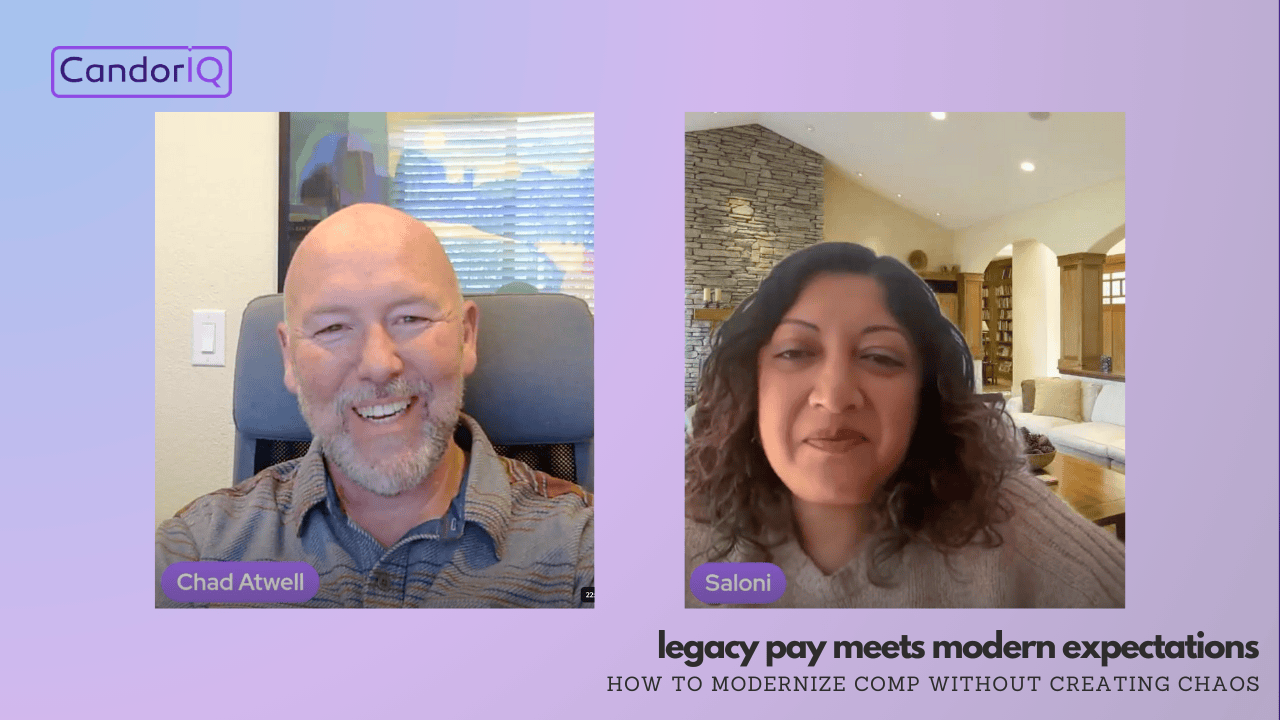

As companies head into 2026, many HR and Total Rewards leaders are facing a familiar but uncomfortable reality: compensation philosophies that were built for a different stage of the business—and haven’t evolved with it.
In this CandorIQ webinar, Chad Atwell, Head of Customer Success & Advisory at CandorIQ, sat down with Saloni Dudziak, VP of People at Tailscale and CandorIQ Customer Advisory Board member, to unpack what it really takes to modernize compensation without disrupting employees, managers, or the business. Drawing on Saloni’s experience stepping into organizations with legacy pay structures—and Chad’s work advising companies across stages—the conversation focused on practical frameworks, common pitfalls, and how to move forward thoughtfully.
Start With the History—Not the Fix
When evaluating an inherited compensation philosophy, Saloni emphasized the importance of understanding how it came to be before attempting to change it.
She shared that she always begins by asking questions like: What decisions shaped the philosophy? Who made them? Are those assumptions still relevant today? What has changed in the business, the market, or the leadership team since then?
From there, she noted two legacy issues she consistently encounters: philosophies that were set early and never updated, and philosophies that have been iterated on repeatedly—but without clear expertise—leading to confusion and inconsistency. Left unchecked, both scenarios can compound over time, creating challenges in hiring, retention, and internal equity.
As Chad put it, many smaller or scaling companies underestimate the role a compensation philosophy plays—yet nearly every pay decision should ultimately tie back to it.
Is Updating Your Comp Philosophy “Worth the Squeeze”?
A recurring question throughout the session was whether revisiting a compensation philosophy is worth the effort—especially when teams are already stretched thin.
Saloni’s answer was clear: yes. Treating comp policies as permanent is a mistake. What worked at an early stage may no longer support the company’s current goals, talent needs, or competitive landscape. Without intentional updates, misalignment grows—often quietly—until it becomes much harder to fix.
Chad added that a clear philosophy provides a critical anchor. It helps organizations make consistent decisions, align leaders, and communicate changes with confidence—especially during periods of growth or transition.
Reset or Refresh? How to Read the Signals
Not every legacy issue requires a full overhaul. Saloni explained that the key is knowing which signals to watch.
High offer declines or comp-related attrition can point to bands that are no longer competitive. On the flip side, unusually high offer acceptance rates may indicate that compensation is overly aggressive and unsustainable long-term. In both cases, the right response depends on the data,
Both speakers emphasized the importance of pairing external benchmarking with strong internal feedback loops—listening closely to recruiters, managers, and employees to understand how pay decisions are landing inside the organization.
From Spreadsheets to Strategy: Modeling the Impact of Change
When Chad asked how Saloni manages the volume of data and input required for comp redesigns, she reflected on how dramatically the tooling landscape has changed.
What once required dozens of spreadsheets can now be centralized in platforms like CandorIQ—integrating HRIS, equity data, and real-time benchmarking to model scenarios and understand how changes will impact individuals and teams. Having access to live data, she noted, often removes half the friction in compensation planning.
Still, both speakers agreed that tools are only part of the equation. Data should inform decisions—not replace judgment—and leaders must validate outputs before acting on them.
Grandfathering, Fairness, and the “Smell Test”
Few topics create more tension than grandfathering employees during compensation changes. Saloni stressed that these decisions require close collaboration with legal, a clear understanding of employee impact, and often a phased approach rather than an immediate reset.
Compensation, she reminded attendees, is never just about numbers—it’s about people, tenure, value, and long-term growth.
Chad introduced what he calls the “smell test”: if an exception became public knowledge, how damaging would it be culturally? Maintaining credibility and consistency, especially as a new leader, is critical.
Communication Is Where Most Teams Go Wrong
If there was one theme that resonated most strongly, it was communication.
Saloni warned that silence around compensation changes is often more dangerous than the change itself. Transparency—about the why, the logic, and the trade-offs—builds trust, even when decisions are difficult.
Chad echoed this, noting that Total Rewards teams frequently get too deep into the weeds. Employees want clarity on two things: what’s changing, and how it affects them. Managers, when properly equipped, are the most effective channel for delivering that message.
Looking Ahead: Modern Tools, Human Judgment
As the conversation turned toward the future, both speakers reflected on how AI is reshaping Total Rewards—not by replacing expertise, but by accelerating research, modeling, and insight generation.
The real opportunity, Chad noted, lies not just in using AI tools—but in knowing why and when to use them. Saloni added that gut-checking outputs and validating accuracy remains essential.
The most effective compensation strategies, they agreed, are still the ones that feel intentional, personalized, and aligned with the company’s people and culture.
Final Takeaway
Modernizing compensation doesn’t require fixing everything at once. It requires clarity, strong foundations, thoughtful sequencing, and honest communication.
As Saloni shared in closing: start with a clear problem statement, engage leadership early, listen to your workforce, and move forward with intention. Done well, compensation modernization becomes less about chaos—and more about trust, alignment, and long-term growth.
➜ Watch the full episode here.
Ready to modernize your workforce and compensation strategy?
See how CandorIQ brings workforce planning and compensation together with AI.