

Workforce Planning Challenges Every CPO Needs to Solve in 2026
Workforce planning failing your strategy? See the top 8 challenges CPOs must solve in 2026 to control costs, hiring, and decision-making.

You are in a leadership meeting, and a simple question comes up: What does our workforce actually cost right now?
Finance has one number. Your team has another. And you cannot reconcile them fast enough to answer with confidence. So the decision moves on without you.
This is where most CPOs feel it. Not in planning cycles, but in the moments that define influence. When hiring plans cannot be defended, when cost scenarios take days to model, and when Finance builds the numbers instead.
And you are not alone. Only 12% of HR leaders say they do strategic workforce planning with a three-year horizon.
This is not a capability gap. It is a system gap. In this blog, we break down where workforce planning fails and what it takes to fix it.
Key Takeaways
- Workforce planning challenges are structural and lead to inaccurate workforce costs, forecast variance, and weak decision-making.
- Misalignment between HR and Finance creates unreliable headcount data and shifts control of workforce decisions away from CPOs.
- Static planning and slow approvals delay revenue-generating hires and drive budget misallocation.
- Lack of pay structure, real-time data, and attrition modeling creates compounding financial and compliance risk.
- A connected system across headcount, compensation, and budget is required to control cost, improve forecasting, and influence strategy.
What Workforce Planning Is and Why It Fails?
Workforce planning is how you decide who to hire, what to pay, and how that fits into your budget and growth plans. It breaks when those decisions are made across different systems that do not connect. HR tracks roles, and Finance tracks costs, but neither reflects what is actually happening in real time.
That gap shows up in missed forecasts, slow hiring, and decisions made without clear numbers. The issue is not planning. It is that the system behind it is fragmented. Every challenge below is a symptom of that structural failure. The fix is not a better process for each one. The fix is building workforce planning as a connected system that actually works.
8 Workforce Planning Challenges That Undermine Control and Tips to Address Them
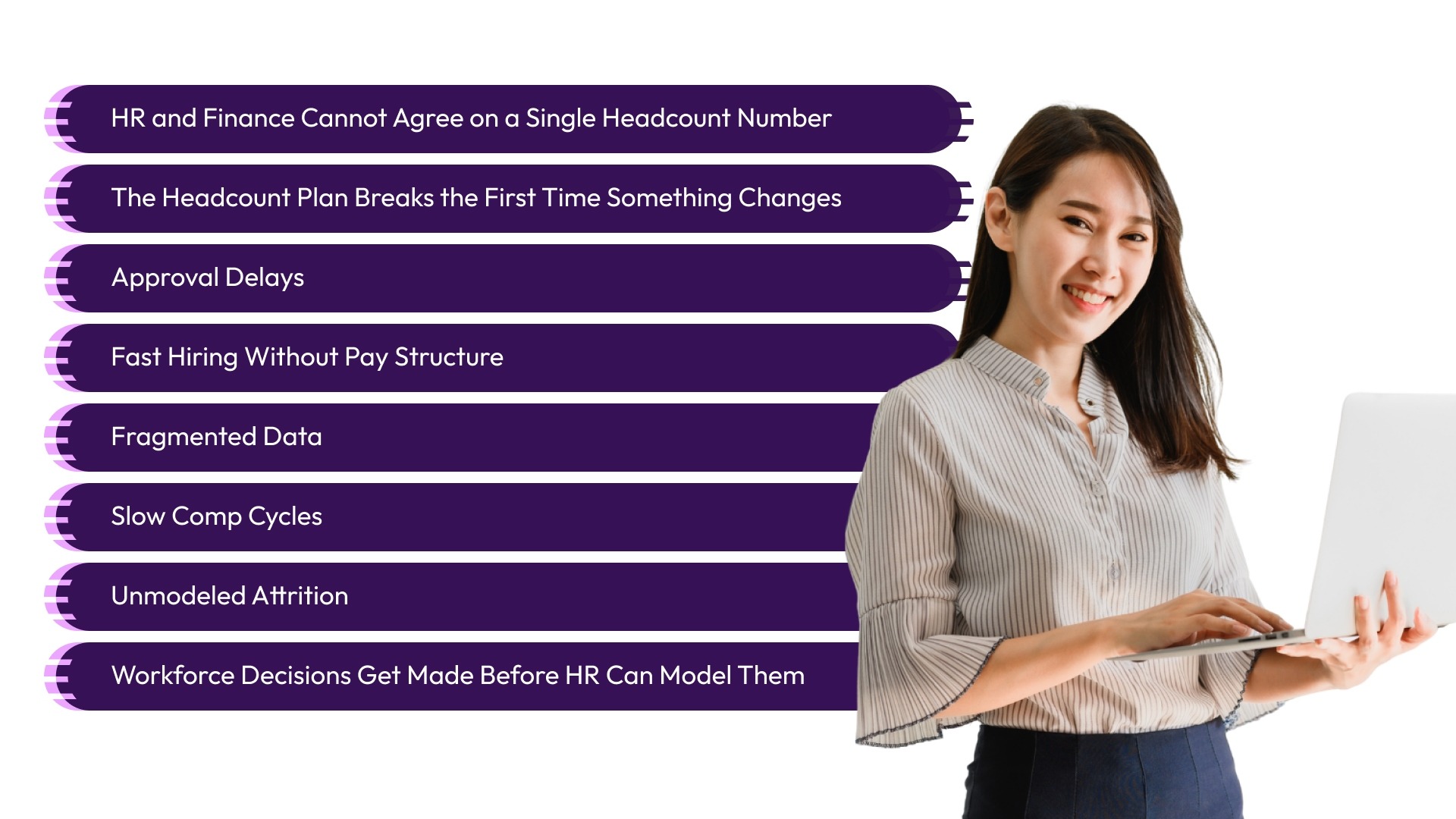
These eight challenges appear most consistently at companies where the people function is trying to operate strategically, but the underlying infrastructure cannot support it. Each one has a measurable business cost. Taken together, they represent the gap between informing decisions and shaping them.
1. HR and Finance Cannot Agree on a Single Headcount Number
When Finance builds its burn forecast from one model, and HR runs approvals from another, leadership gets two different answers to the same question. You lose the argument by default, not because your data is wrong, but because it cannot be reconciled fast enough to matter.
Some practitioners describe this pattern as the ‘Stitching Tax’, the hidden cost that accumulates when managers manually piece together HR and Finance data before every headcount decision. It is not just time lost; it is forecast variance built into every budget cycle. As Kyle Holm, VP of Compensation Advisory at Sequoia, has observed, when companies consistently hire at the top of the comp range, Finance often does not see the overrun until the budget is already gone.
The business cost is specific. Inaccurate headcount data produces inaccurate burn forecasts. Inaccurate burn forecasts lead to poor runway decisions. And when Finance stops trusting the HR model, they stop asking HR before they act. That is how you lose influence over workforce strategy, not through conflict, but through irrelevance.
What You Should Control
- Require that headcount approvals and budget impact be in the same system and updated in real time. The CFO should never have a more current view of workforce cost than you do.
- Force alignment on definitions across functions. Headcount, FTE, backfill, and vacancy mean different things to Finance and HR. That language gap is the source of most reconciliation failures, not the data itself.
- Make time-to-fill a financial variable, not a recruiting metric. Finance budgets for immediate hires. When roles take 60 to 90 days to fill, every open position is a variance in personnel costs. Whoever quantifies that gap owns the budget conversation.
The data misalignment problem is not a Finance problem or an HR problem. It is a system problem. And it will persist until the system is built to prevent it.
2. The Headcount Plan Breaks the First Time Something Changes
Most headcount plans are designed to survive the budget approval process, not to guide decisions made in February or July when something changes. The moment a market shifts, a launch accelerates, or a hiring freeze hits, the plan stops being useful, and you start improvising.
Research suggests that only a small fraction of HR leaders say their planning looks three or more years ahead. Most are running static documents that reflect Q4 assumptions against a Q3 reality. When conditions change mid-year, and you cannot quickly model the cost impact, Finance builds its own workforce projection. That model, built without you, drives the decision.
The cost is not just a bad quarter. Off-cycle headcount requests without a budget pathway cause approval delays that push revenue-generating hires back by weeks. Departments overhire in one segment and cut in another because no one modeled both outcomes simultaneously. Budget misallocation compounds every time the plan is not updated, and the gap between what was planned and what actually happened widens.
What You Should Control
- Own a live planning model, not an annual document that becomes a liability the moment conditions shift. Three active scenarios reviewed quarterly means you always have an answer when leadership asks.
- Pre-model the decisions leadership asks most: accelerated hiring, a freeze, a reorg, a market expansion. When those questions arrive in a board meeting, the answer should already exist, not be pending.
- Set the thresholds that move you between scenarios before a crisis forces the decision. Reactive modeling under pressure takes days and produces the wrong answer. Pre-built scenarios take minutes to activate.
A static plan is not a planning system. It is a document that describes what you intended before reality intervened.
Suggested Read: AI and the New Era of Workforce Management
3. Approval Delays
When headcount approvals take six weeks for a role that needed to be filled in three, the business does not just lose a candidate. It loses the output that hire was supposed to generate. For a revenue-generating role, that delay has a direct cost. For an engineering role, it delays a product timeline. If you cannot control approval velocity, you are losing business impact every cycle.
The pattern that produces this failure is consistent: verbal go-aheads are issued because the formal process is too slow; recruiters start searches on unapproved roles; Finance sees the headcount model; the numbers are wrong; the offer goes out in week seven; and the candidate accepted something else in week five. Each step is someone trying to work around a broken system. The workaround is the problem.
What You Should Control
- Make it a non-negotiable that no role enters recruiting without a budget line, a level, a rationale, and Finance visibility into the cost. Decisions made before that context exists are decisions made in the dark.
- Remove discretion from routing entirely. The path a request takes should be determined by the role, not by relationships or availability. When routing varies by person, governance is inconsistent by design.
- Hold the line on informal approvals. Every verbal go-ahead that bypasses the system is a headcount error, a budget variance, and a governance gap you will eventually have to explain. The tolerance for workarounds sets the standard for the whole process.
Approval delays are not a recruiter's problem. They are evidence that the hiring system lacks a structure that the business actually trusts.
4. Fast Hiring Without Pay Structure
Every undocumented pay decision made during a hiring surge is a liability you will answer for later. Not because the decisions were necessarily wrong, but because they cannot be explained. When two people at the same level are paid 18% apart and the only record of why is a recruiter's email from eight months ago, you cannot defend the pay structure to leadership, legal, or employees.
In 2026, that liability has a regulatory dimension. Colorado, California, New York, Washington, and Illinois require salary ranges to be included in job postings. Publishing salary ranges without a documented band structure means publishing a number with no defensible basis. When employees compare offers to those postings and find inconsistencies, attrition starts before the next comp cycle can address it. The cost is retention loss compounding on top of an already undefended pay structure.
What You Should Control
- Treat pay bands as a financial control, not an HR project. Every offer decision the company makes should be governed by a documented structure that exists before the hire, not justified after it.
- Set band compliance as a hard requirement. Every exception needs a documented rationale at the time of the decision. The audit position you accept will be the standard by which your team operates.
- Run pay distribution reviews by team twice a year as a standard governance item. Catching drift before it becomes a retention event or compliance exposure is cheaper and faster than addressing it after the fact.
- Pay inconsistency at scale is not a failure of recruiting. It is what happens when pay decisions are made outside a system that enforces consistency.
5. Fragmented Data
Making workforce decisions based on data that is four systems old and manually merged is not operating on accurate information. You are operating with the best available approximation of accurate information. That distinction matters enormously when the decisions involve budget allocations, hiring freezes, or restructuring.
The operational symptom is familiar: pull exports, merge in spreadsheets, resolve discrepancies, circulate a report that is already partially stale. The strategic consequence is less visible but more costly. Attrition spikes in a department before Finance registers the budget impact. A freeze is called without visibility into which roles are mid-process, stranding candidates, and wasting recruiter time. Comp cycle data and headcount data never sync, so you are managing budget variance that you cannot fully see until the cycle closes.
What You Should Control
- Treat data fragmentation as a financial risk, not an IT inconvenience. Every workforce decision made on delayed or incomplete data carries implicit forecast variance. Quantify that variance, and you have a business case for fixing the infrastructure that is hard to argue with.
- Establish a real-time workforce view that leadership can rely on without asking you to validate it first. Headcount actuals versus plan, open roles by stage, compensation spend versus budget, visible without a manual export step.
- Stop accepting reconciliation as evidence that the system is working. A weekly sync call to agree on headcount means the system is broken. The fix is not a better cadence. It is eliminating the need for one.
Fragmented data does not slow down reporting. It slows down every decision that depends on it.
6. Slow Comp Cycles
A merit cycle that runs six to eight weeks instead of two to three is not a scheduling inconvenience. It is a budget management failure. Every week the cycle is open is a week when Finance plans against compensation estimates instead of actuals. Every decision locked into a spreadsheet without a real-time budget view may need to be reversed after the cycle closes.
The audit trail problem compounds the financial one. When a pay decision is questioned months later, and the rationale lives in a cell comment that has since been overwritten, you cannot reconstruct the governance behind the cycle. That is not a documentation gap. It is a liability borne by the function that owns the process.
What You Should Control
- Own the comp cycle as a financial governance process. The standard should be accurate budget totals visible in real time throughout, not estimates that reconcile at close and surprise Finance.
- Require budget visibility to be active before any manager submits a recommendation. A decision made without knowing current utilization is a financial decision made without a financial context. You will explain the variance it produces.
- Set an uneditable, timestamped audit trail as the default for every cycle. The ability to produce a complete record of every recommendation, approval, and exception for any cycle in the last three years is not an administrative nicety. It is what governance looks like.
A comp cycle that cannot be traced and a budget only accurate at close are not process gaps. They are the outputs of a system that was never designed for financial governance.
7. Unmodeled Attrition
When attrition is not modeled as a line item, it does not disappear from the budget. It appears as unplanned recruiting costs, extended ramp time for backfills, and productivity gaps on understaffed teams while roles are open. Not modeling attrition does not make the cost disappear. It just means you cannot see it coming.
SHRM research shows nearly 70% of US organizations reported difficulty filling full-time positions in 2025. Replacing a mid-level employee costs between 50% and 200% of their annual salary. For a company with 300 employees and 15% annual attrition, that is a meaningful and predictable cost that belongs in the workforce plan. When it is not there, you consistently underforecast workforce spend and surprise the CFO with the delta.
The signals that predict attrition are visible in advance. A role where internal pay has not been benchmarked in 18 months, while the external market has moved up 12%. A team where promotion timelines have stretched because the org structure did not scale with headcount. A department where tenure clusters at 12 to 18 months, which typically indicates high performers hitting a ceiling.
What You Should Control
- Make attrition an explicit cost in every scenario, not a background assumption buried in headcount totals. If a department is tracking toward 20% attrition against a 10% base, that is a budget and hiring impact leadership should see in the workforce plan, not discover in a quarterly review.
- Track compensation versus market benchmark by department and level on a fixed schedule. Identifying a gap six months before it drives attrition gives you time to act on it. Finding it in an exit survey means the decision has already been made for you.
- Use tenure distribution as an early warning system. Clustering at 12 to 18 months in a specific team is not an engagement observation. It is a workforce risk that belongs in the planning conversation.
Attrition surprises do not come from nowhere. They come from signals that the system was not built to surface in time.
8. Workforce Decisions Get Made Before HR Can Model Them
Workforce planning fails as a strategic function when you cannot model a decision at the speed at which leadership makes it. When a CEO asks what accelerating enterprise hiring will cost this quarter, that question needs an answer in the meeting, not in a follow-up email next week. If you cannot produce that answer in real time, you are not operating as a strategic partner. You are operating as a reporter of past decisions.
The structural reason is the same across all organizations where this happens: headcount, compensation, and budget data are not in the same place. You cannot model a scenario because the inputs are in three systems that do not connect. So Finance builds the model instead, using their own assumptions. And once Finance owns that model, the decisions it drives move out of your hands.
The WEF Chief People Officers Outlook identifies this as the primary barrier people leaders face in being treated as strategic partners rather than operational functions. It is not a perception problem. It is an infrastructure problem. And it is solvable.
What You Should Control
- Own the workforce model outright. When Finance produces headcount cost projections, it sets the assumptions that drive the decisions. The model should live in your function, connected to compensation and budget data, and ready to produce scenarios before leadership asks.
- Make scenario modeling a standard part of every leadership presentation. Arriving at a strategy meeting with three pre-built scenarios and full budget impact for each is not presenting data. It is setting the terms of the decision.
- Measure how long it takes your team to answer a workforce cost question from leadership. If the answer is more than a day, that is the infrastructure gap to close first, before anything else.
Strategic influence in workforce planning is not earned through effort. It is earned by being the person in the room with a connected system behind every answer.
Suggested Read: Key Considerations for Workforce Management Dashboards
These eight challenges are symptoms of the same structural failure: workforce planning that is not built as a system. Use the checklist below to identify specifically where your infrastructure breaks down.
Ready to Use Workforce Planning Health Checklist
Work through this against your current setup. The areas where you answer no are not failures of effort. They are the structural gaps that are costing you influence, accuracy, and speed in every leadership conversation.
Data and Visibility
Planning Cadence and Scenario Modeling
Headcount Approvals
Compensation Structure
Compensation Cycles
Retention and Attrition
If several of these are currently a no, the underlying issue is consistent: workforce planning is not built as a connected system. Below is how CandorIQ helps you close those gaps.
Suggested Read: Workforce Optimization Strategies to Maximize Productivity
Get Your Workforce Planning Under Control With CandorIQ
CandorIQ is a compensation and headcount planning platform built for people leaders and their teams at mid-size and growth-stage companies. It connects to your existing HRIS and ATS without replacing them, giving HR and Finance the connected system they need for workforce planning.
- Headcount Scenario Planning: Model conservative, base, and growth scenarios with full budget impact before approvals are routed. When conditions shift, adjust the active scenario rather than rebuilding the model.
- Compensation and Payband Builder: Define and document pay bands by level, location, and department so every offer decision is grounded in a defensible structure. Version control keeps every historical band traceable.
- Headcount Requests and Approvals: Every role enters the system with a complete financial context and routes automatically by compensation level, team, and location. Status is visible to all stakeholders from submission through sign-off.
- Compensation Cycle: Automate merit and bonus reviews with real-time budget tracking. Managers see utilization as they recommend. Cycles close faster with accurate totals throughout and a complete audit trail built in.
- Workforce Management: Track headcount and actual compensation versus plan in a single shared view. HR and Finance are aligned by default, not through a weekly reconciliation call.
Suggested Read: Best All-in-One Workforce Management Software 2025
The Bottom Line
At some point, you stop blaming the process. If every headcount decision takes too long, if Finance has a different number, if you cannot answer basic cost questions in the moment, that is not a workflow issue. It is the system.
The teams that actually drive workforce strategy are not doing more work. They just are not fighting their tools every time something changes.
That is the gap.
CandorIQ is one way to close it. It brings headcount, compensation, and budget into one place, so decisions stop getting rebuilt every time. If this sounds familiar, book a demo and see what it looks like when it actually works.
.png)
FAQs
1. What is the difference between workforce planning and headcount planning?
Headcount planning focuses on how many people you need and their cost today. Workforce planning connects hiring, skills, and cost to long-term business goals and growth.
2. How often should a workforce plan be updated?
A workforce plan should be updated at least quarterly. Annual planning alone creates gaps as hiring, attrition, and business conditions change throughout the year.
3. What metrics matter most in workforce planning?
Key metrics include headcount versus plan, time to fill, attrition by department, compensation spend versus budget, and open role age to track gaps early.
4. Who should own workforce planning in a company?
The people function should lead workforce planning, with Finance closely involved in budgeting and modeling. Shared ownership ensures decisions reflect both talent needs and financial reality.
5. What is the biggest sign that workforce planning is not working?
A clear sign is when leadership relies on Finance for workforce numbers rather than HR, indicating a loss of trust in the planning model and data accuracy.
Ready to modernize your workforce and compensation strategy?
See how CandorIQ brings workforce planning and compensation together with AI.