

7 Proven Strategies for Total Rewards Management in 2026
Explore 7 proven total rewards management strategies to align compensation, headcount planning, and budgets in scaling teams.

Most scaling companies have a compensation philosophy. Very few have a total rewards management system. The gap shows up between your approved headcount plan and the offer a candidate actually receives, where budget leaks and inconsistencies quietly grow.
That gap is not theoretical. It is measurable. For 2026, companies project average salary increases of about 3.5%, yet many still struggle to execute those decisions consistently across teams and locations.
This is where most strategic total rewards efforts fail. The issue is not design. It is managing what happens between planning and execution, where decisions break down across fragmented workflows.
In this guide, you will learn how to run effective total rewards assessments, apply total rewards modelling, and build a scalable total rewards solution.
At a Glance
- Total rewards management is not just about pay design, it’s about execution. The real challenge lies in connecting pay bands, hiring plans, approvals, and budgets into one consistent system.
- Most breakdowns happen between planning and execution. Without structured workflows, teams face budget drift, inconsistent pay decisions, and slower hiring cycles.
- A strong system starts with a total rewards assessment and modelling. These help identify gaps, test scenarios, and ensure compensation decisions stay aligned as teams scale.
- The right metrics drive control and clarity. Tracking budget variance, pay band adherence, and approval speed helps teams maintain consistency and avoid costly misalignment.
- Platforms like CandorIQ unify fragmented workflows. By bringing compensation, headcount planning, and approvals into one system, teams gain visibility, speed, and better decision control.
What is Total Rewards Management?
Total rewards management is the system used to plan, deliver, and control compensation, benefits, and incentives in alignment with hiring plans and budget limits.
It goes beyond designing pay structures. It focuses on how decisions actually happen across the entire workflow.
At a practical level, it answers:
- How do we set pay ranges for each role?
- How do we ensure offers stay within those ranges?
- How do we track total rewards spend as hiring scales?
- How do we maintain consistency across teams and locations?
In growing teams, these decisions rarely happen in one place. They move across tools, approvals, and stakeholders, which creates delays and inconsistencies.
That is why strong total rewards management is not just about structure. It is about control, visibility, and alignment across every step. To understand this better, it helps to separate it from a commonly confused concept, “total compensation”.

How is Total Rewards Different Than Total Compensation?
Many teams use total rewards and total compensation interchangeably, but they solve very different problems.
One is broader and strategic. The other is narrower and focused only on pay.
Here’s a clear breakdown:
In simple terms, total compensation is one part of total rewards. It focuses only on pay, while total rewards cover the full experience offered to employees.
But here’s the important shift. Even total rewards, by itself, is still just a framework. It defines what to offer, not how to manage it.
That’s where total rewards management comes in. It connects all these components into a system that works in real hiring and budgeting conditions.
To understand that system better, let’s break down the core components of total rewards next.
The 5 Core Components of Total Rewards
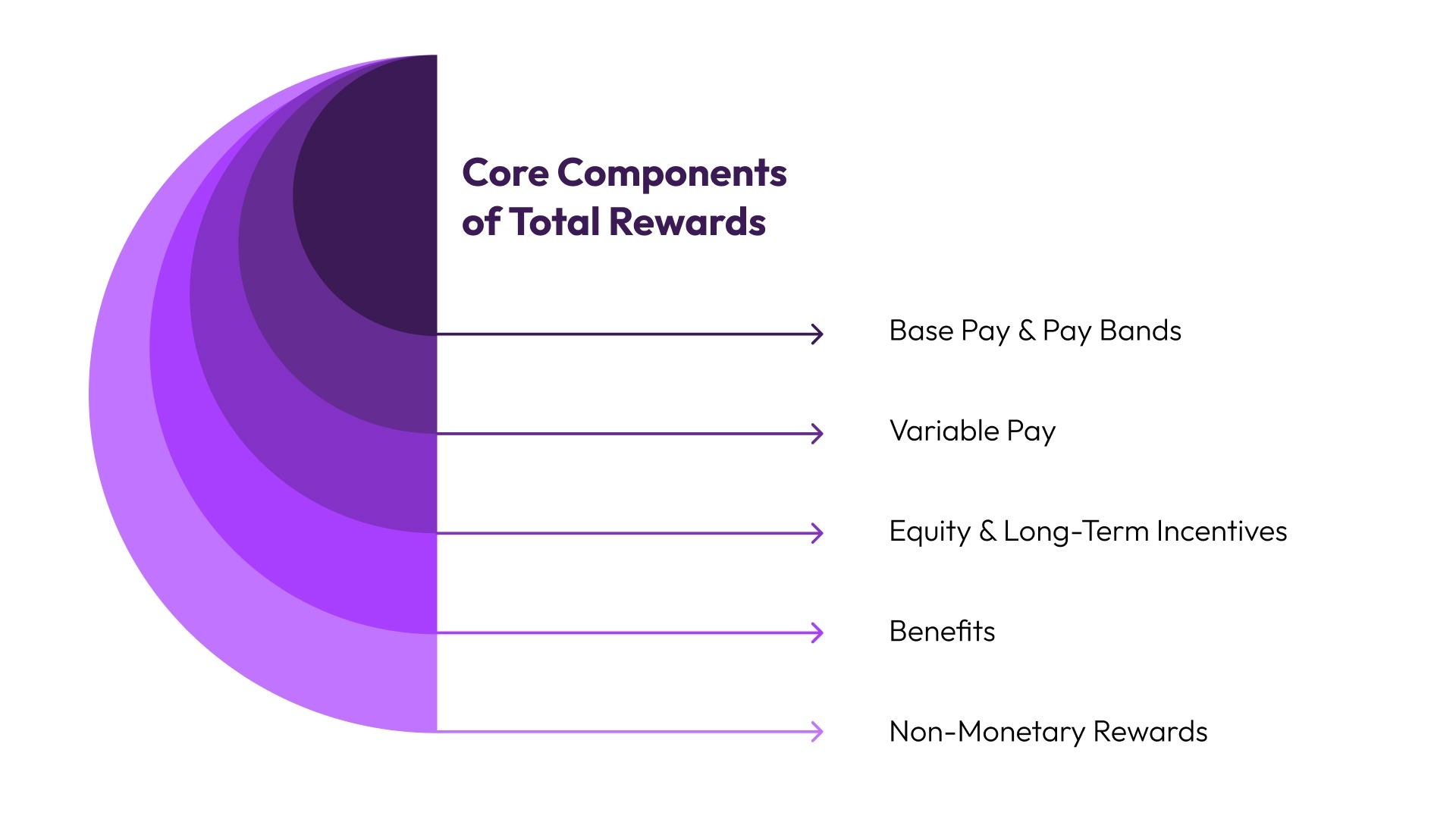
Total rewards include both financial and non-financial components, but not all of them are managed the same way. In practice, only a few components require tight operational control. These are the ones that directly impact hiring, budgets, and compensation cycles.
Let’s break them down:
- Base Pay & Pay Bands: Base pay forms the foundation of compensation. Pay bands define the acceptable range for each role, level, and location. When managed well, pay bands ensure consistency and prevent over- or under-paying during hiring and promotions.
- Variable Pay (Bonuses & Incentives): Variable pay includes performance bonuses, commissions, and short-term incentives. It ties compensation to outcomes and business performance. Without clear rules and visibility, variable pay can quickly become inconsistent and difficult to track across teams.
- Equity & Long-Term Incentives (LTI): Equity and long-term incentives reward employees over time. They play a key role in retention, especially in high-growth environments. These decisions require careful planning since they directly impact long-term cost and ownership distribution.
- Benefits: Benefits include healthcare, retirement plans, and insurance. They support employee well-being but are usually managed through external providers. While important, they are less tied to day-to-day compensation decisions and hiring workflows.
- Non-Monetary Rewards: This includes recognition programs, flexibility, and career growth opportunities. These elements shape employee experience and engagement. They are harder to standardize and are typically managed outside core compensation systems.
Base pay, variable pay, and equity are where most operational complexity is. These are the areas that need structure, visibility, and control as your team grows. Once these are aligned, the rest of your total rewards strategy becomes easier to manage.
Now the question is, how well is your current system handling these components? Let’s evaluate that next.
How to Conduct a Total Rewards Assessment
A total rewards assessment is a structured way to evaluate how compensation decisions move from planning to execution. It does not just review pay ranges or benefits. It looks at how decisions flow across hiring, approvals, and budget checks.
The 6-Question Assessment Framework for Scaling Companies
Instead of reviewing everything at once, this framework helps you isolate where your system is breaking. Each question focuses on a critical point where decisions often drift.
1. Are Pay Bands Clearly Defined And Consistently Followed?
Start by looking at how pay bands are used in practice, not how they are documented. Many teams create structured pay ranges early on. But as hiring speeds up, exceptions become common. When this happens, pay bands lose their purpose.
A healthy system ensures that:
- Pay bands are updated regularly
- Exceptions are tracked and justified
- Most offers stay within defined ranges
If you cannot rely on your pay bands, you cannot maintain consistency as you scale.
2. Do Compensation Decisions Align With Approved Budgets?
Next, look at how closely compensation decisions match your hiring and budget plans.
In many cases, hiring plans are approved at a high level, but individual offers are made without checking their cumulative impact. Each decision seems small on its own, but together they create significant budget drift.
This gap usually appears when:
- Hiring teams move faster than budget tracking
- Compensation decisions happen without real-time visibility
- Budget ownership is unclear
A strong system ensures that every offer connects back to an approved plan. Without that link, financial control weakens quickly.
3. Can Offers And Raises Move Through Approvals Quickly?
Speed matters, especially in hiring. But speed without structure creates risk.
If approvals take too long, candidates drop off and hiring slows down. On the other hand, if approvals are rushed or skipped, inconsistencies increase.
The goal is not just faster approvals. It is structured speed.
Look for signs like:
- Multiple back-and-forth steps before approval
- Lack of clarity on who needs to approve what
- Delays caused by missing data or context
An effective system creates clear approval paths while keeping decisions aligned with pay bands and budgets.
4. Do You Have Visibility Into Total Rewards Spend?
Visibility is often where total rewards systems break down. Without a unified view, decisions rely on partial information.
This leads to:
- Reactive planning instead of proactive control
- Difficulty tracking actual vs planned spend
- Limited confidence in decision-making
A strong system gives you a clear, real-time view of total rewards across roles, teams, and locations. This visibility is what enables better planning.
5. Are Equity And Variable Pay Decisions Structured Or Ad Hoc?
Equity and bonuses often receive less structure than base pay, but they carry long-term impact.
When these decisions are made case by case, small inconsistencies build up. Over time, this creates an imbalance across similar roles and levels.
You should look for:
- Clear guidelines for equity allocation
- Defined bonus structures linked to performance
- Consistent application across teams
If these elements are not structured, your total rewards system becomes harder to manage as complexity grows.
6. Can Your System Handle Growth Without Adding Complexity?
Finally, step back and look at the system as a whole. In many growing teams, each additional hire adds more coordination, more approvals, and more manual steps. What worked at a smaller scale starts to slow everything down.
A scalable system should:
- Handle increased hiring without extra friction
- Maintain consistency across teams
- Keep decisions aligned without constant intervention
If growth makes your system harder to manage, it is a clear signal that changes are needed.
These six questions give you a practical way to evaluate your system. But the real insight comes from recognizing patterns in the answers. Those patterns often show up as clear warning signs.
Red Flags That Signal Your Total Rewards System Needs an Overhaul
Assessment results usually translate into visible problems. They are symptoms of a system that is no longer connected end to end. Let’s break down what these red flags actually mean in practice.
- Offers Require Multiple Revisions Before Approval: This often happens when pay bands, budgets, and approvals are not aligned. This slows down hiring and creates a poor candidate experience.
- Similar Roles Receive Noticeably Different Pay: Inconsistency usually signals weak enforcement of pay structures. It may start with a few exceptions, but over time, it creates visible gaps between employees in similar roles. This leads to confusion and questions about fairness.
- Hiring Decisions Move Forward Without Clear Budget Checks: When compensation decisions are not tied to budgets, costs drift quietly. Teams may hit hiring targets but exceed planned spend. The issue often becomes visible only during quarterly reviews.
- Compensation Cycles Take Longer Than Expected: Delayed compensation cycles often point to manual coordination and unclear workflows. This slows down decision-making and reduces confidence in the process.
- Teams Lack A Single, Reliable View Of Rewards Data: When data lives across multiple systems, it becomes difficult to trust any single source. This leads to conflicting numbers, delays in reconciling data, and slower decision-making.
These red flags rarely appear overnight. They build gradually as teams grow and processes stretch beyond their limits.
Also Read: How to Strengthen Your Employee Value Proposition and Total Rewards
Once you recognize them, you need a structured approach to rebuild your total rewards management strategy so it can scale without losing control.
How to Build a Scalable Total Rewards Management Strategy (Step-by-Step)
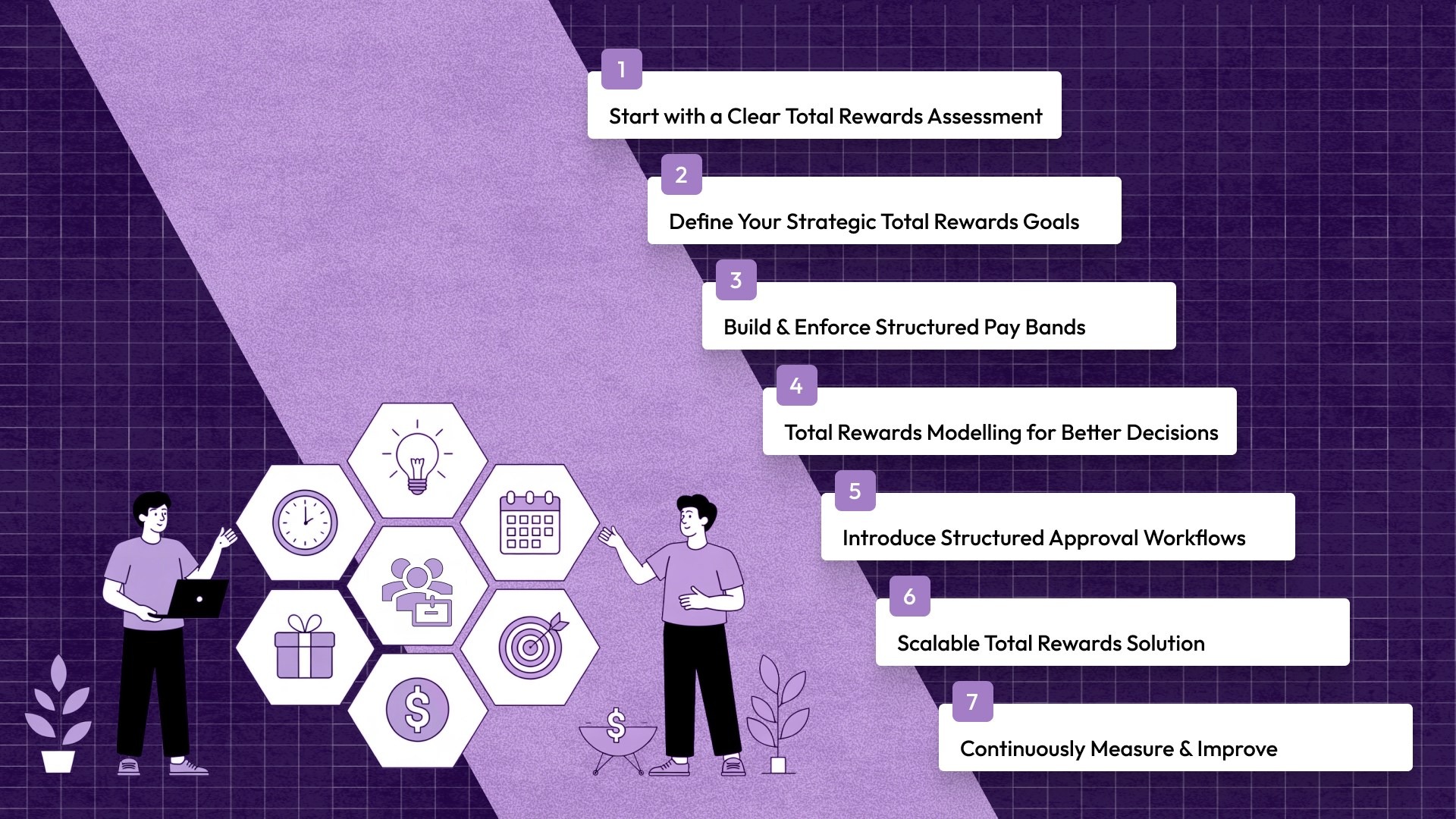
A strong total rewards management strategy does not rely on isolated decisions. It connects planning, execution, and control into one continuous system.
The goal is simple. Every compensation decision should align with pay bands, hiring plans, and budget limits, without slowing teams down.
Here’s how to build that system step by step.
Step 1: Start with a Clear Total Rewards Assessment
Begin with the insights from your total rewards assessment. This gives you a baseline of where inconsistencies, delays, and budget gaps exist.
Focus on:
- Where pay bands are not followed
- Where approvals slow down decisions
- Where budgets and hiring plans are misaligned
This step ensures you are solving the right problems, not just adding more structure on top of broken workflows.
Step 2: Define Your Strategic Total Rewards Goals
Next, set clear goals for what your system needs to achieve. This is where strategic total rewards come into play.
Your goals should connect directly to business outcomes, such as:
- Hiring at planned speed without delays.
- Maintaining pay consistency across roles.
- Staying within approved budget ranges.
Without defined goals, it becomes difficult to measure whether your system is actually improving.
Step 3: Build and Enforce Structured Pay Bands
Pay bands are the backbone of your compensation system. But they only work if they are actively enforced.
To make them effective:
- Define ranges by role, level, and location.
- Update them regularly based on market changes.
- Track exceptions and understand why they happen.
When pay bands guide decisions consistently, compensation becomes predictable and easier to manage.
Step 4: Use Total Rewards Modelling for Better Decisions
As hiring grows, decisions cannot rely on intuition alone. This is where total rewards modelling becomes critical.
Modelling allows you to:
- Test hiring scenarios before execution.
- Estimate the cost impact of promotions or raises.
- Understand how compensation changes affect overall budgets.
This shifts your system from reactive decisions to planned outcomes.
Step 5: Introduce Structured Approval Workflows
Approvals are where many systems break down. Either they are too slow, or they lack proper checks.
A strong workflow ensures:
- Every offer follows a defined approval path
- Budget and pay band checks happen automatically
- Decisions move quickly without losing control
The goal is to create consistency without adding friction.
Step 6: Move Toward a Scalable Total Rewards Solution
As complexity increases, manual coordination becomes harder to manage. This is where a scalable total rewards solution like CandorIQ becomes important.
Instead of managing separate processes, bring key elements together:
- Pay band management
- Hiring and headcount planning
- Compensation cycles and approvals
This creates a single system where decisions stay aligned from start to finish.
Step 7: Continuously Measure and Improve
Finally, treat total rewards management as an ongoing system, not a one-time setup.
Track performance regularly:
- Are offers staying within pay bands?
- Are hiring costs aligned with budgets?
- Are decisions moving at the right speed?
Use these insights to refine your approach over time.
When these steps work together, total rewards management becomes predictable, scalable, and easier to control.
Also Read: How to Build and Implement an Effective Total Rewards Strategy?
The next step is understanding how to measure success more precisely, using the right metrics that actually reflect performance.
7 Metrics in Total Rewards Management That Actually Matter in 2026
The goal of total rewards management is not just to run processes. It is to keep compensation aligned with hiring plans and budgets as the organization grows.
To do that, you need metrics that reflect real decisions, not just outcomes. Here are the ones that matter most.
- Compensation as a Percentage of Revenue: This metric shows how sustainable your compensation structure is over time. If this number increases without a clear reason, it often signals that hiring or salary decisions are drifting away from plan. On the other hand, a stable ratio indicates better control and alignment.
- Budget Variance per Hire: This measures the difference between planned and actual costs for each hire. A small variance means your system is working as expected. A large variance usually points to weak budget checks or inconsistent offer decisions. Platforms like CandorIQ help track this in real time by connecting hiring plans directly with compensation decisions.
- Pay Band Adherence Rate: This shows how often compensation decisions stay within defined pay ranges. Low adherence means pay bands are not being followed or enforced. Over time, this leads to internal pay gaps and makes future decisions harder. A high adherence rate reflects consistency and stronger control.
- Offer Approval Time: This metric tracks how long it takes to move an offer from creation to final approval. Long approval times slow down hiring and create friction for candidates. Very short times, without structure, can lead to rushed decisions.
- Compensation Cycle Completion Time: This measures how efficiently you run salary reviews, promotions, and adjustments. If cycles take too long, it usually means coordination is manual and workflows are unclear. Faster cycles, with structured processes, improve both efficiency and confidence in decisions.
- Retention Linked to Compensation: This metric helps you understand whether compensation is influencing attrition. Look at patterns where employees leave due to pay gaps or inconsistent increases. This insight connects rewards decisions directly to long-term outcomes.
- Total Rewards Spend Visibility: This is not a single number but a capability. It reflects how easily you can see total compensation across teams, roles, and locations. Limited visibility makes planning reactive. Clear visibility allows proactive adjustments and better decision-making.
These metrics do more than track performance. They highlight where your system is holding up and where it needs adjustment.
Once you start measuring consistently, the next challenge becomes clear. You need the right platform to support these insights and keep everything connected as you scale.
Simplify Your Total Rewards Management with CandorIQ
As your teams grow, total rewards management becomes harder to control. Pay decisions spread across disconnected systems, approvals slow down, and budget alignment becomes difficult to maintain. What starts as a structured process gradually turns into fragmented workflows that are hard to track and scale.
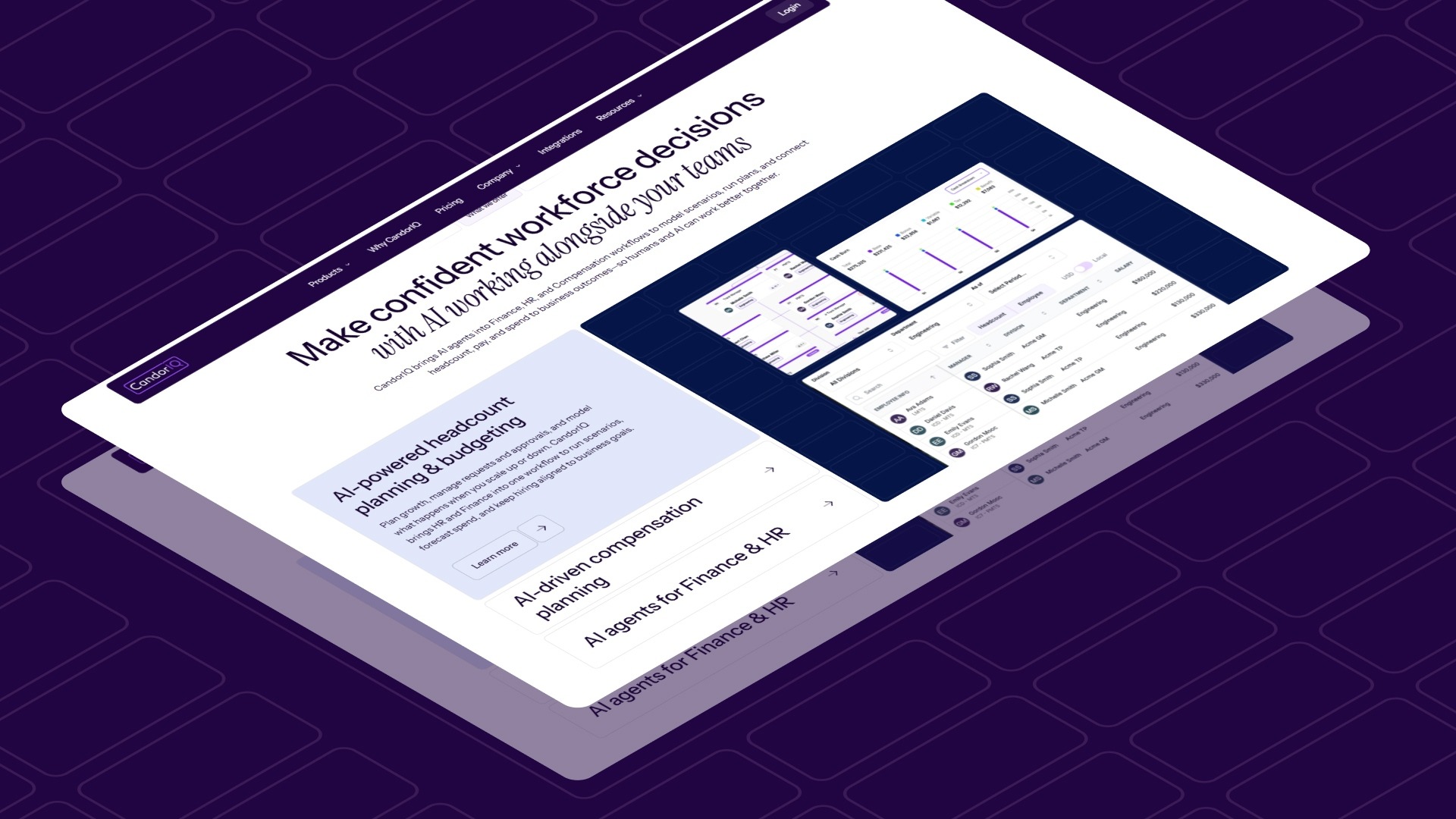
This is where CandorIQ brings everything together. It provides a unified system to manage compensation, headcount planning, and offer workflows with structure, visibility, and real-time alignment.
Here’s how we support scalable total rewards management:
- Compensation & Payband Builder: Define and manage pay bands by role, level, and location with real-time visibility and built-in structure.
- Compensation Cycle Management: Run merit increases and bonus cycles with automated workflows, clear approvals, and live budget tracking.
- Candidate Offers Management: Create structured offers with full compensation visibility, including salary, equity, and bonuses.
- Headcount Scenario Planning: Model hiring plans and instantly understand their financial impact before making decisions.
- Headcount Requests & Approvals: Standardize hiring requests with clear workflows that connect directly to budgets and role requirements.
- Workforce Management Dashboard: Track hiring progress, compensation, and workforce changes in one unified view.
- AI-Powered Decision Support: Get compensation insights, forecasts, and recommendations based on real data and historical trends.
When these workflows operate in one system, total rewards management becomes faster, more consistent, and easier to control as your team scales.
Conclusion
Total rewards management is no longer just about designing compensation. It is about controlling how every pay decision connects to hiring plans and budgets as your team grows.
When these decisions run through fragmented workflows, inconsistencies and delays become unavoidable. But with the right system like CandorIQ, rewards become structured, predictable, and aligned with business goals.
If you want to see how this works in practice, explore how we can bring clarity and control to total rewards management.
Book a demo to see how you can simplify compensation, headcount planning, and offer workflows in one unified system.
.png)
FAQs
1. What is the difference between total rewards management and a compensation strategy?
A compensation strategy defines how you plan to pay employees. Total rewards management ensures those plans are executed consistently across hiring, promotions, and budgets without creating gaps or delays.
2. What role does total rewards modelling play in decision-making?
Total rewards modelling helps teams test hiring, promotion, and compensation scenarios before executing them. It allows better planning by showing the financial impact of decisions in advance, reducing the risk of overspending or misalignment.
3. How can companies maintain pay consistency across locations?
Companies maintain consistency by using location-based pay bands and structured approval workflows. This ensures that compensation reflects market differences while still aligning with internal equity and overall budget constraints.
4. What challenges do distributed teams face in total rewards management?
Distributed teams often struggle with inconsistent pay decisions, limited visibility into rewards data, and slower approvals. These challenges arise when compensation, hiring, and budget workflows are not connected within a single system.
5. How can companies improve transparency in total rewards?
Transparency improves when teams clearly define pay bands, document compensation decisions, and provide visibility into total rewards components. Structured systems help ensure that employees understand how pay decisions are made and applied.
Ready to modernize your workforce and compensation strategy?
See how CandorIQ brings workforce planning and compensation together with AI.