
Top 8 Dayforce Alternatives for Pay Modeling & People Analytics
Explore top Ceridian Dayforce alternatives for pay modeling and people analytics with advanced compensation planning and real-time HR insights.

Is your HCM platform holding your compensation strategy hostage? Many HR and finance teams choose Dayforce for its payroll and workforce management strengths. The platform handles time tracking and benefits administration well.
But when compensation cycles arrive, or CFOs demand workforce cost forecasts, teams often hit a wall. Dayforce's analytics feel rigid. Pay modeling requires workarounds. Real-time collaboration between HR and finance remains difficult. This creates friction exactly when strategic decisions matter most.
This guide examines eight alternatives built specifically for advanced pay modeling and people analytics. You'll discover platforms that treat compensation planning as a strategic function, not an afterthought.
Key Takeaways
- Dayforce is strong in payroll and time tracking, but falls short on strategic compensation planning and real-time workforce forecasting.
- Alternatives like CandorIQ, Workday HCM, and ChartHop deliver deeper capabilities for pay band modeling, scenario planning, and collaborative comp cycles integrated with existing systems.
- The right platform depends on the company stage. Fast-scaling teams need agility, while mature enterprises require scale and governance.
- Implementation speed and HRIS fit matter. Some tools deliver value in weeks, others take months, and still rely on spreadsheets.
- CandorIQ is ideal for mid-market companies, offering AI-driven compensation insights, real-time budget visibility, and seamless HR–finance collaboration without enterprise complexity.
What Makes a Great Ceridian Dayforce Alternative for Pay Modeling & People Analytics?
Switching compensation platforms isn't about finding a slightly better version of what you have. The best alternatives share specific characteristics that transform how HR and finance teams work together on workforce planning.

1. Advanced Pay Modeling & Strategic Compensation Planning
Great platforms let you build, test, and version pay bands without exporting to Excel. You should model location-based adjustments instantly. Visualize how proposed changes affect the budget and equity across departments. Run merit increase scenarios before your compensation cycle begins.
2. Real-Time Analytics That Actually Inform Decisions
Analytics should answer questions before executives ask them. How does our current compensation structure compare to market rates? What happens to our burn rate if we fill open positions at the 75th percentile? Which departments show the highest risk for compression issues? Dashboards need to surface insights, not just data.
3. Seamless HRIS Integration Without the Headaches
Your compensation platform should connect to your existing HR tech stack without middleware or custom development. Data flows automatically from your HRIS, ATS, and payroll systems. Changes sync bidirectionally. No one maintains parallel databases or reconciles mismatched employee records at month-end.
4. Built for How Finance & HR Teams Actually Work
Compensation planning involves multiple stakeholders with different needs. Finance wants budget control. HR needs flexibility for special cases. Hiring managers require visibility into their team's comp structure. Department heads want approval workflows that don't bottleneck hiring. The platform must serve all these users simultaneously.
5. Implementation Speed and Growth-Ready Architecture
Enterprise software shouldn't require enterprise timelines. The best alternatives deliver value within weeks, not quarters. They scale as you grow from 100 to 1,000 employees without requiring re-implementation. Configuration happens through intuitive interfaces, not professional services engagements.
With these criteria established, let's examine the platforms that meet them.
8 Leading Alternatives to Dayforce for Compensation & Analytics Teams
Finding the right compensation platform requires understanding what each tool actually delivers. These ten alternatives represent different approaches to pay modeling and people analytics.
1. CandorIQ

CandorIQ brings compensation planning, headcount forecasting, and offer management into a single platform designed for how modern HR and finance teams actually work together. Instead of treating compensation as a secondary module, as most traditional HCM systems do, CandorIQ makes it the core of workforce decision-making.
What Sets CandorIQ Apart for Pay Modeling and People Analytics
- Built-In Pay Band Intelligence: Create and manage pay bands with location-based adjustments applied automatically using integrated benchmark data. Every change is version-controlled, making audits, board reviews, and historical comparisons simple and reliable.
- Real-Time Compensation Visibility: As you adjust pay bands or offers, live visualizations update instantly. You can immediately spot pay compression, outliers, and equity gaps, before they turn into retention or compliance issues, not months later in static reports.
- No More Spreadsheet Workarounds: CandorIQ removes the need to export data into Excel. You can build, adjust, and test pay bands directly in the platform, apply location modifiers instantly, and run merit increase scenarios ahead of compensation cycles—all in one place.
- AI-Driven Compensation Insights: Ask natural-language questions and receive insights powered by historical data and market benchmarks. Identify pay gaps, predict future needs, and surface risks without manual analysis or complex queries.
- A Unified View of Your Workforce: Track open roles, filled positions, and attrition in a single dashboard. Executives get high-level strategic trends, while HRBPs see team-level metrics, bringing together data that typically lives across multiple disconnected systems.
- Advanced Scenario Planning for Confident Decisions: Model organizational changes before committing to them. Compare multiple workforce scenarios side by side, understand budget impact instantly, and align hiring and compensation decisions with real business constraints, before overspending becomes a problem.
Best For
- Mid-sized to growth-stage companies (50-5,000 employees)
- Distributed or remote-first teams
- Organizations scaling headcount 2-3x annually
- Lean HR teams (1-10 people) seeking strategic leverage
CandorIQ connects to major HRIS, ATS, and payroll providers without custom development, so data syncs automatically, eliminating duplicate data.
2. Workday HCM
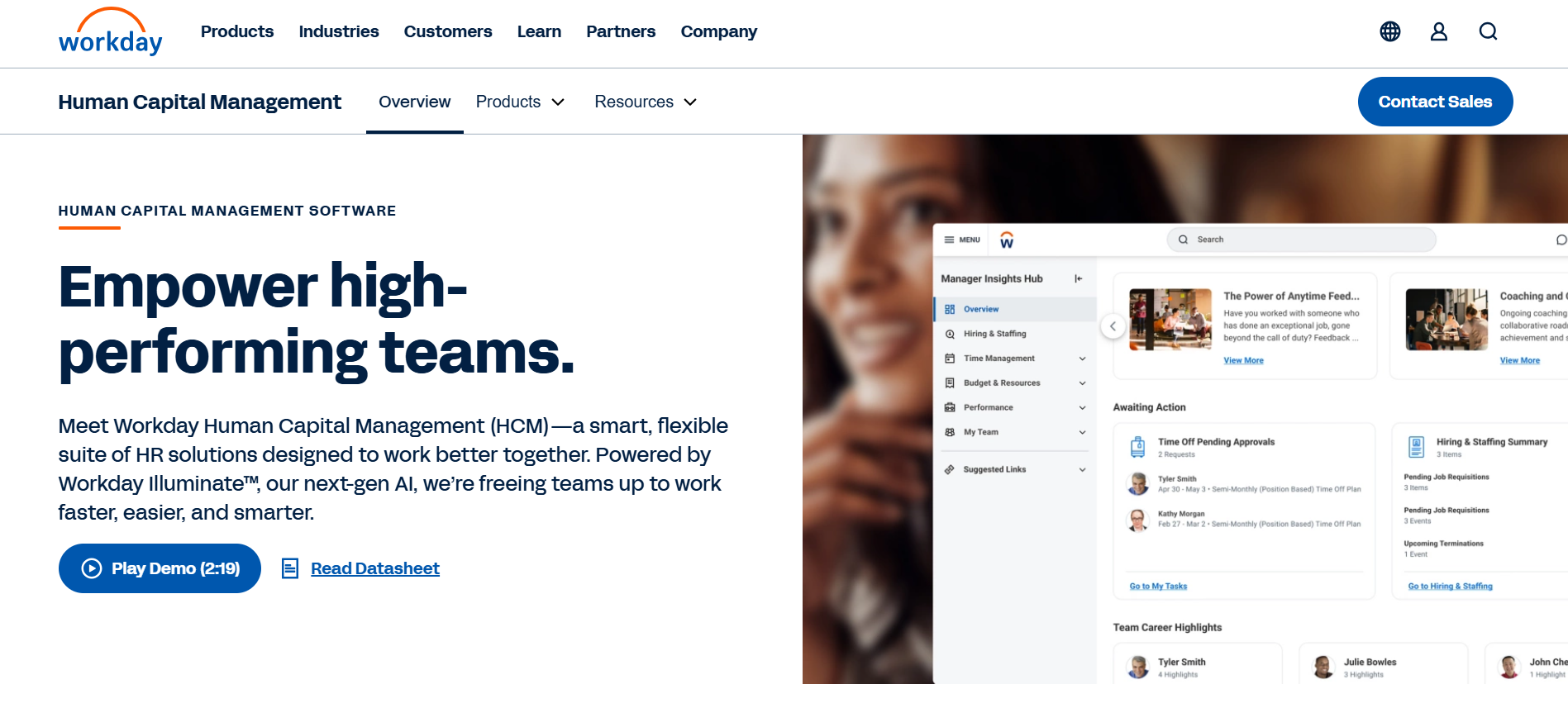
Workday HCM is an enterprise-grade platform that unifies HR, finance, and workforce planning. Compensation is deeply embedded into its talent and financial management framework, making it ideal for large, global organizations.
Key Features
- Global Compensation Management: Manages complex, multi-country pay structures, including base pay, bonuses, equity, and long-term incentives, while accounting for local regulations and currencies.
- Matrix-Based Budget Allocation: Allocates compensation budgets across departments, locations, and job families simultaneously, with automated rollups and eligibility enforcement.
- Advanced Eligibility Controls: Applies compensation policies consistently by excluding recent hires, differentiating PIP employees, and enforcing merit and bonus rules automatically.
- Integrated People & Pay Analytics: Connects compensation data with performance, retention, and financial outcomes using Workday Prism Analytics.
- Pre-Built & Custom Reporting: Provides pay equity, compa-ratio, and market positioning reports, with deep customization for advanced analysis.
- Predictive Retention Signals: Identifies employees at flight risk when compensation falls below market benchmarks, with real-time dashboard updates.
Best For
- Large enterprises with 5,000+ employees
- Global organizations requiring multi-currency and multi-country support
- Companies consolidating multiple legacy HR systems
- Organizations with strong technical and implementation resources
Workday functions as the system of record, with integrations flowing inward from payroll, benefits, and recruiting platforms.
3. SAP SuccessFactors

SAP SuccessFactors is a cloud-based enterprise HCM platform designed for global workforce complexity. It is particularly strong in managing region-specific compensation requirements with centralized oversight.
Key Features
- Localized Global Compensation Management: Supports different compensation philosophies across regions while maintaining corporate control. Handles country-specific requirements such as works councils, seniority-based pay, and localized compliance workflows.
- Variable Pay Administration: Manages commissions, bonuses, and long-term incentives tied to performance and business results. Enables teams to model compensation costs before approving merit cycles.
- Collaborative Compensation Planning: Enables HR, managers, and finance to collaborate through approval workflows. Managers see real-time budget usage, helping prevent overspending before it happens.
- Holistic People & Pay Analytics: Combines compensation data with recruiting, learning, and performance insights to reveal how pay strategies impact business outcomes.
- Market Benchmarking & Pay Equity Reporting: Compares compensation against market data, highlights lagging roles, and supports equity analysis using built-in reporting templates.
Best For
- Global enterprises with complex regional compensation needs
- Organizations already using SAP ERP or S/4HANA
- Manufacturing, industrial, and multinational companies
- Teams with dedicated HRIS and technical resources
SAP integrates natively with the SAP ecosystem; non-SAP integrations typically require middleware or partner support.
4. Oracle HCM Cloud

Oracle HCM Cloud delivers enterprise-grade HCM tightly integrated with finance and operations. It is built for organizations managing highly complex, global compensation structures.
Key Features
- Advanced Compensation Workbench: Guides managers through merit and bonus planning with budget visibility, comp ratios, and automated outlier detection.
- Total Rewards Transparency: Consolidates base pay, variable compensation, equity, and benefits into a single total rewards view to support retention and differentiation.
- Global Compensation Complexity Handling: Manages geo-differentials, expatriate pay, and multi-currency administration across 50+ countries.
- Embedded Predictive Analytics: Uses machine learning to identify compensation drivers linked to performance and retention, offering prescriptive pay recommendations.
- Self-Service Analytics for HRBPs: Drag-and-drop reporting enables faster insights without IT dependency, once teams are trained.
Best For
- Large enterprises with existing Oracle ERP investments
- Organizations prioritizing unified finance and HR data
- Companies with complex global compensation requirements
- Healthcare systems, government agencies, and multinational manufacturers
Oracle integrates seamlessly with Oracle ERP Cloud. So, third-party integrations require Oracle Integration Cloud and technical configuration.
5. UKG Pro

UKG Pro combines HCM, payroll, and workforce management in a single database, making it a strong choice for organizations balancing payroll accuracy with strategic compensation planning.
Key Features
- Manager-Guided Compensation Planning: Supports merit cycles with clear budget visibility, distribution curves, and performance-based recommendations.
- Flexible Pay Band Structures: Handles multiple compensation philosophies within one organization, including market-based and step-and-grade structures.
- Payroll-Integrated Pay Calculations: Supports shift differentials, geographic premiums, and skill-based pay, feeding approvals directly into payroll.
- Built-In Compensation Analytics: Tracks budget usage, merit distribution, and pay equity with pre-built dashboards designed for fast insights.
- Pay Equity & Compliance Reporting: Analyzes compensation across protected classes and supports audit-ready reporting.
Best For
- Mid-market organizations with 1,000–10,000 employees
- Companies prioritizing payroll accuracy and HR consolidation
- Healthcare, hospitality, retail, and service-based organizations
- Teams needing less technical complexity than enterprise HCMs
UKG’s single-database architecture reduces integration overhead and accelerates time to value.
6. ADP Workforce Now
ADP Workforce Now is designed for small to mid-sized businesses seeking reliable payroll with essential compensation planning capabilities.
Key Features
- Streamlined Merit Management: Provides simple workflows with budget visibility and HR review controls for high-impact changes.
- Multi-Component Compensation Support: Manages base pay, bonuses, and equity while presenting total compensation views to employees.
- Integrated Market Pricing: Uses ADP DataCloud benchmarks filtered by role, location, and industry to guide informed pay decisions.
- Standard Compensation & Equity Reporting: Offers quick access to merit trends, comp ratios, and equity analysis without heavy configuration.
- Workforce Analytics Integration: Connects pay data with turnover and headcount metrics to support targeted retention strategies.
Best For
- SMBs with 50–1,000 employees
- Organizations prioritizing payroll accuracy and ease of use
- Teams without dedicated HRIS administrators
- Professional services, hospitality, and regional retail businesses
ADP offers fast implementation (6–12 weeks) with strong native payroll and benefits integrations.
7. BambooHR

BambooHR is a user-friendly HR platform built for small teams that value simplicity, visibility, and employee experience over deep configurability.
Key Features
- Simple Pay Range Management: Defines salary bands by role and location, with visibility into where employees fall within ranges.
- Lightweight Merit Planning: Guides managers through compensation reviews with budget context and HR oversight.
- Accessible Compensation Reporting: Tracks average salaries, merit distributions, and comp ratios with fast report generation.
- Basic Pay Equity Monitoring: Helps small teams identify potential pay gaps across roles and demographics.
- Proactive Compensation Dashboards: Surface key pay insights like budget usage and upcoming review dates directly in the HR dashboard.
Best For
- Small businesses with 50–500 employees
- Startups implementing their first HR platform
- Lean HR teams prioritizing ease of use
- Tech startups, agencies, and professional services firms
BambooHR integrates via marketplace partners and offers fast implementation (4–6 weeks).
8. Personio

Personio is an all-in-one HR platform built specifically for European SMBs, with strong support for local pay practices and compliance.
Key Features
- European Compensation Structure Support: Handles country-specific salary components, statutory benefits, allowances, and 13th-month pay.
- Structured Salary Review Cycles: Guides managers through budget-controlled pay reviews with approval workflows and historical tracking.
- European-Focused Total Rewards Views: Shows full compensation packages including statutory benefits and allowances, improving transparency.
- Pay Transparency & Equity Compliance: Supports analysis aligned with European pay transparency regulations and GDPR requirements.
- Integrated HR Analytics: Connects compensation data with recruiting, performance, and absence metrics.
Best For
- European businesses with 50–2,000 employees
- Companies operating across multiple EU countries
- Organizations consolidating HR, payroll, and recruiting
- Regulated industries requiring GDPR and local compliance
Personio integrates natively with European payroll and compliance providers and offers fast onboarding (6–10 weeks).
Also Read: Comprehensive Guide to HR Analytics and Reporting
However, with the eight tools described above, you may be wondering which is best for your organization.
How to Choose Your Dayforce Alternative: A Decision Framework
Selecting a compensation platform requires matching capabilities to your organization's specific needs. Generic feature comparisons miss what matters most. Consider these factors to find your best fit.

- Assess your organization's complexity level. Companies with 50-500 employees need different tools than enterprises with 10,000 employees across 50 countries. Specialized platforms like CandorIQ deliver sophisticated compensation management without enterprise overhead.
- Evaluate your team's technical resources. Platforms requiring dedicated administrators, technical integrations, and ongoing optimization suit organizations with HR tech teams. Smaller organizations benefit from platforms like CandorIQ that deliver value without requiring technical expertise.
- Clarify your primary use case. Need deep compensation planning with scenario modeling and real-time collaboration? CandorIQ prioritizes these capabilities. Seeking a comprehensive HCM with compensation as one component? Workday and UKG Pro provide breadth. Connecting pay to performance? Lattice integrates these processes naturally.
- Consider finance-HR collaboration needs. If your CFO demands real-time headcount cost visibility and scenario planning, choose platforms built for cross-functional collaboration. CandorIQ excels here as well. If HR owns compensation largely independently, other factors matter more.
- Test integration compatibility. Review your current tech stack. Some platforms integrate easily with your existing HRIS, payroll, and ATS. Others require custom development or middleware. Request specific integration details during vendor evaluation. Seamless data flow prevents the spreadsheet chaos you're trying to escape.
The right platform makes compensation planning strategic rather than administrative. Choose based on where your organization is today and where it's heading tomorrow.
Also Read: The Ultimate Guide to Payroll Forecasting for HR and Finance Teams
Ready to Upgrade Your Compensation Tech Stack?
Modern compensation management requires purpose-built tools. Dayforce alternatives exist for every organizational profile and priority. CandorIQ delivers enterprise-grade compensation planning without enterprise complexity. Mid-market and growth-stage companies gain strategic leverage through real-time collaboration, AI-powered insights, and seamless integration.
Stop losing days to spreadsheet-based compensation cycles. Eliminate the miscommunication between finance and HR that delays hiring decisions. Gain the visibility executives demand without creating a reporting burden for your team.
Schedule a demo to see how CandorIQ transforms compensation planning from a periodic headache into a strategic advantage. Discover how fast-growing companies make smarter pay decisions with better data.
FAQs
1. Does Dayforce offer built-in compensation benchmarking data?
Dayforce provides market pricing capabilities but relies on third-party data integrations for comprehensive benchmarking. Organizations often supplement with standalone market data subscriptions. Alternatives like CandorIQ and ADP include integrated benchmark datasets that update automatically without additional vendor relationships.
2. Can I migrate historical compensation data when switching from Dayforce?
Yes, most alternatives support historical data migration through CSV exports and API integrations. Implementation teams typically extract compensation history, pay band changes, and merit cycle data from Dayforce. Migration timelines range from one to four weeks, depending on data complexity and volume.
3. What happens to my compensation data if I cancel my subscription?
Most vendors provide data export capabilities before contract termination. You receive CSV files or database exports containing compensation history, pay bands, and employee records. Review data retention policies during contract negotiations. Some platforms like BambooHR and CandorIQ offer extended read-only access periods post-cancellation for audit purposes.
4. Can I run compensation cycles for different employee groups simultaneously?
Yes, platforms like CandorIQ, Workday, and Oracle support segmented compensation cycles by department, location, or employee classification. You can run annual merit reviews for corporate staff while conducting quarterly commission cycles for sales teams. Different workflows, budgets, and timelines operate independently within the same platform.
5. How do these platforms handle off-cycle compensation changes like promotions or market adjustments?
All platforms support ad-hoc compensation changes outside formal merit cycles. CandorIQ, UKG Pro, and Workday include workflows for promotion requests, retention adjustments, and equity refreshes with appropriate approval routing. Changes flow directly to payroll systems without manual intervention. Audit trails document rationale and approval chain for compliance purposes.
Ready to modernize your workforce and compensation strategy?
See how CandorIQ brings workforce planning and compensation together with AI.