

Rewards and Recognition Planning for CPOs to Drive Retention in 2026
Increase employee engagement with effective rewards and recognition planning. Discover how to design impactful programs. Start optimizing today!

Most organizations have some version of a rewards and recognition program. Few have one that holds up at scale.
When recognition runs on manager discretion alone, with no shared criteria, no budget governance, and no link to compensation data, employees notice. And when they do, they start looking elsewhere. Research from Bersin and Deloitte shows that organizations with strong recognition programs see 31% lower voluntary turnover. That is a significant difference for any CPO managing retention in a competitive labor market.
This guide walks you through building a structured, equitable rewards-and-recognition program aligned with your broader compensation strategy. You will find frameworks, real-world examples, a step-by-step build guide, and a launch audit, covering everything from recognition philosophy through rewards and recognition planning that scales with your headcount.
Key Takeaways
- Rewards and recognition planning only works when it is aligned with compensation, pay bands, and equity checks.
- Most rewards and recognition planning fails due to a lack of structure, unclear criteria, and no budget governance.
- Effective rewards and recognition planning requires clear systems for philosophy, budget allocation, program delivery, and data tracking.
- Rewards and recognition planning should use recognition data to inform retention, performance, and compensation decisions.
- Strong rewards and recognition planning are aligned with the compensation cycle to avoid mixed signals and credibility gaps.

What Does a Rewards and Recognition Program Actually Cover?
A rewards and recognition program is your organization's structured approach to acknowledging employee contributions. It spans both monetary rewards and non-monetary recognition, and it should connect directly to how you manage compensation.
The distinction most CPOs overlook when building for the first time: rewards and recognition are related but not the same thing. Rewards are tangible, such as bonuses, equity, and gift cards. Recognition is the acknowledgment of contribution, often without a monetary component. Rewards reinforce outcomes. Recognition reinforces behavior and culture. Both need to work together, and both need to be consistent with your compensation structure, or one will quietly undermine the other.
Both need to work together, and both need to reflect your compensation structure.
The problem is that most organizations run these in parallel with no shared logic. A manager gives out a spot bonus the same week HR freezes comp cycles. An employee is publicly recognized but receives no pay adjustment despite sitting below the band midpoint. For a CPO, the goal is to connect these two streams so that recognition never contradicts what your compensation structure already communicates.
Why Most Rewards and Recognition Programs Underdeliver?
Before you build or rebuild, it helps to understand the actual failure points. The issues are predictable and show up the same way across organizations.
Recognition is left entirely to the manager's discretion.
When recognition depends on individual managers with no shared criteria, some employees get acknowledged frequently, and others go entire quarters without it. A 2025 HR.com retention study found that only 45% of organizations used structured recognition programs as a deliberate retention tactic. The majority still rely on informal, manager-driven approaches with no standardization.
The result is perceived inequity. And perceived inequity is as damaging to retention as actual inequity.
The program has no link to pay data.
Recognizing someone for outstanding performance while their pay sits below the midpoint of their band sends a contradictory message. Employees can tell when recognition is theatrical. In a market where pay transparency tools give employees fast access to salary benchmarks, the gap between recognition and compensation is increasingly hard to hide.
Recognition layered on top of a pay equity problem does not fix the problem. It signals the organization either does not know or does not care.
The budget is set once and never revisited.
SHRM recommends allocating at least 1% of total payroll to recognition budgets, separate from merit and bonus pools. Most organizations either undershoot this or set a flat number that does not account for headcount growth or rising attrition. The program runs out of budget mid-year, or loses credibility when teams that need recognition most receive the least.
Equity tracking is absent.
Without data on who receives recognition and how frequently, organizations cannot tell whether their programs are fair. Remote employees, underrepresented groups, and behind-the-scenes contributors in ops or finance roles are consistently under-recognized in programs that rely on informal or manager-only channels. A program without equity tracking is essentially a program run on whoever managers happen to notice.
Suggested Read: A Guide to Use Total Rewards Benchmarking Data in 2026
Types of Rewards and Recognition Programs Worth Knowing
Not every recognition model fits every organization. The right design depends on your headcount, growth stage, and workforce distribution. Below are the six main program types, what makes each one work, and where each one typically breaks down.
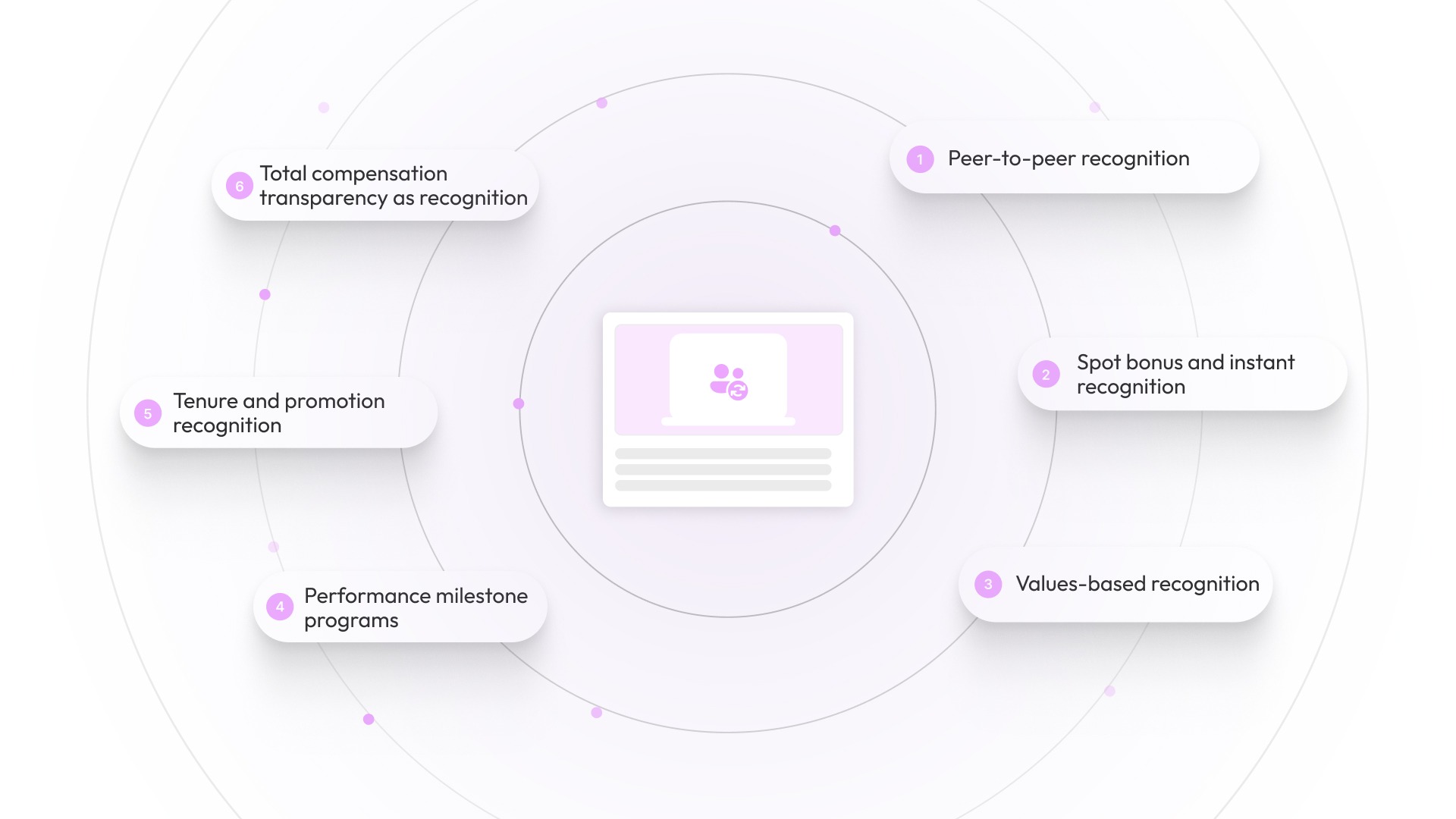
1. Peer-to-peer recognition
Peer recognition allows employees to acknowledge each other's contributions directly. It surfaces work that managers cannot always see, including behind-the-scenes contributions in ops, engineering, or support functions.
- Best for: Teams of 50+ where managers cannot maintain full visibility.
- Typical format: Nomination portals, in-Slack or in-Teams kudos, points systems.
- Watch out for: Recognition cliques, where the same employees nominate each other repeatedly.
Example: Google's gThanks program lets any employee send a peer bonus when they notice above-and-beyond work. Managers approve nominations within an internal tool, and the awards process is scheduled for the next payroll cycle. The program's strength is immediacy and low friction, two things most peer programs sacrifice in the name of governance.
2. Spot bonus and instant recognition
Spot bonuses deliver a small monetary reward immediately after an employee demonstrates a behavior or achieves an outcome worth recognizing. Unlike annual bonuses, spot awards are tied to a specific moment, which makes the connection between action and reward direct and memorable.
- Best for: High-output environments where performance milestones happen frequently.
- Typical format: Manager-approved monetary awards, typically between $50 and $500.
- Watch out for: Inconsistency across teams if the award criteria are not defined centrally.
Example: Microsoft uses spot awards within its recognition ecosystem, letting managers give real‑time monetary recognition outside the formal review cycle. IBM’s Blue Points system lets employees earn points from peers and managers that they can redeem for products or experiences. American Express runs a similar instant‑recognition program called Bravo!, where managers award employees for specific, exemplary behaviors. In each case, recognition follows defined criteria, but managers still decide whom to recognize and how often.
3. Values-based recognition
Values-based programs tie recognition to specific company behaviors rather than output alone. Employees nominate peers who demonstrated a company value in a concrete situation. The nomination includes a description of what happened and which value it reflects.
- Best for: Organizations going through culture-building or post-merger alignment.
- Typical format: Monthly or quarterly cycles, reviewed by HR, with public acknowledgment and a small award.
- Watch out for: Company values that are too vague to generate specific, concrete nominations.
Example: Salesforce runs the V2MOM Awards, where employees nominate colleagues for going above and beyond across five categories tied to the company’s V2MOM framework: vision, values, methods, obstacles, and measures. Winners receive a trophy and a monetary reward and are celebrated at a company‑wide event, reinforcing collaboration and alignment with Salesforce’s operating language.
4. Performance milestone programs
Milestone programs recognize employees for hitting defined performance outcomes. Award criteria are set at the start of a project, quarter, or review cycle, thereby removing ambiguity and reducing perceived favoritism.
- Best for: Product, engineering, and sales teams where outcomes are measurable.
- Typical format: Predetermined award tied to a specific deliverable or metric.
- Watch out for: Excluding non-quantitative roles where impact is real but harder to measure.
Example: Adobe's recognition program awards employees points from both managers and peers for skill acquisition and innovation, not just output. The approach was designed for a fast-moving industry where learning and effort need recognition alongside finished results. This makes the program relevant for roles where success does not always show up in a quarterly number.
Tip: Build milestone criteria for non-quantitative roles explicitly before launch. If your ops or HR team cannot see a path to recognition, the program will feel irrelevant to them from day one.
5. Tenure and promotion recognition
Tenure milestones and promotion recognition signal that the organization tracks growth over time. The strongest versions of this program pair public acknowledgment with a compensation review, so recognition is backed by a real investment.
- Best for: Retaining mid-career employees who often feel invisible between hire and senior leadership.
- Typical format: Anniversary awards at 1, 3, 5, and 10 years; promotion announcements with comp review.
- Watch out for: Tenure awards with no compensation review attached, which feel hollow to employees who already know their market value.
Tip: Use tenure milestones as a trigger for a pay band review. If an employee has been recognized annually for three years but their pay has not moved relative to their band midpoint, the recognition will eventually read as performative.
6. Total compensation transparency as recognition
Increasingly, organizations treat total compensation visibility as a form of recognition. When employees can see their full picture, including salary, equity value, bonus target, and benefits, in one place, they understand the complete investment the organization is making in them.
- Best for: Organizations with equity programs or complex total comp structures.
- Typical format: Annual total comp statements at review time, vesting events, or promotion milestones.
- Watch out for: Statements that read like legal fine print rather than a genuine communication of value.
Example: Employees who focus primarily on base salary often undervalue their equity or benefits. A structured total‑comp statement, delivered at vesting events or during annual reviews, reframes the conversation around the full value of their package. Emerging WorldatWork commentary and industry trends show that AI‑enabled pay‑transparency tools are accelerating this shift, prompting total rewards teams to communicate compensation more accurately and more clearly.
Remote and distributed team recognition
Remote employees typically receive fewer informal recognition moments. They miss the hallway conversation, the all-hands shoutout, and the spontaneous manager acknowledgment that in-office employees get without anyone thinking about it. In a distributed organization, recognition gaps form silently and show up later in attrition data, often after the CPO has already lost the employee.
For CPOs managing geographically spread headcount, building a recognition approach specifically for remote and distributed employees is not optional. It is a structural requirement of the program design.
- Best for: Organizations with 30%+ of their headcount remote or distributed.
- Typical format: Digital-first peer recognition channels, async kudos boards inside Slack or Teams, virtual milestone acknowledgments, surprise care packages for tenure or performance moments.
- Watch out for: Applying in-office program formats to remote employees without adjustment. The same program that works in a shared office often fails silently in a distributed context because the delivery mechanism does not match how remote employees actually communicate.
Example: Organizations with a high remote headcount are building dedicated async recognition channels in Slack or Teams, with structured weekly acknowledgment prompts, separate from general communication channels. This creates a consistent visibility layer for remote contributors that does not depend on a manager noticing their work during a scheduled one-on-one.
Suggested Read: Total Rewards Automation: The 2026 Guide for Fast-Growing US Companies
How to Build a Rewards and Recognition Program That Holds Up?
Now that you know what types exist, here is how to build the one that fits your organization. A structured program requires four components to work together: a philosophy, a budget model, a delivery structure, and a data loop. Missing any one of them produces a program that looks complete at launch and falls apart within two cycles.
Step 1: Define your recognition philosophy
Start with what you want to reinforce with recognition. Is it performance output, collaboration, company values, or tenure? Each answer points to a different program design. Three questions to ground your philosophy before anything else:
- What behaviors do you want to see more of across the organization?
- Who decides what gets recognized, and based on what criteria?
- How does recognition connect to your compensation structure and total rewards strategy?
Your answers will determine whether you need a peer-driven system, a manager-approval workflow, an HR-led formal program, or a combination of all three. Document this before you select tools or set budgets.
Step 2: Set a realistic budget
Use payroll percentage as your baseline. The SHRM benchmark is at least 1% of total payroll for recognition budgets, kept separate from merit and bonus pools. Break it down by recognition type so the budget is not exhausted on a single channel:
Revisit this allocation quarterly. If attrition is climbing in specific teams or certain groups are chronically under-recognized, reallocate before the program loses credibility with the people it most needs to reach.
When making the budget case, frame recognition as a cost-avoidance investment rather than an HR cost. Replacing an employee costs between 50% and 200% of their annual salary, depending on seniority and role complexity. For a 300-person organization with a 15% annual attrition rate, that is 45 departures per year. A recognition program that prevents even a third of those saves costs far less than it saves.
Turnover Cost Formula: Turnover Cost = (Average Replacement Cost per Role) x (Annual Voluntary Departures)
If your average replacement cost is $25,000 and you have 45 voluntary departures annually, your baseline turnover cost is $1.125 million. A recognition program that prevents 15 of those departures saves $375,000, likely 5 to 10 times the program's annual cost. That is the number that makes recognition a line item Finance supports rather than questions.
Step 3: Build the delivery structure
Decide who can recognize whom and through what channel. The most effective programs layer three sources of recognition, and each serves a different purpose.
- Peer recognition: Builds culture and surfaces contributions managers cannot see.
- Manager-led recognition: Ties performance to business outcomes with more context.
- Leadership recognition: Signals organizational priority and raises the program's visibility.
Peer recognition, in particular, has gained formal weight in 2026. More organizations are using peer data to identify emerging leaders, inform promotion decisions, and flag early attrition risk in teams with low peer engagement. Building it into your formal program with equity guardrails and data capture is a structural decision, not a culture perk.
Step 4: Track the right data
Recognition without a data loop becomes invisible. Track at minimum:
- Recognition frequency by department, team, and demographic.
- Correlation between recognition frequency and retention or performance metrics.
- Budget utilization against current headcount and attrition rates.
- Pay band positioning of frequently recognized employees relative to midpoints.
That last metric is the one most programs skip. If your most-recognized employees are sitting below their pay band midpoints, you have a structural compensation problem that recognition alone will not fix. The program becomes noise. The fix requires a compensation review, not a better recognition platform.
>> Does your compensation structure support your recognition goals? CandorIQ helps CPOs connect compensation cycles, pay band visibility, and headcount data in one place. Contact us.
Suggested Read: How to Build and Implement an Effective Total Rewards Strategy?
Rewards and Recognition Planning: Connecting to Your Compensation Cycle
This is the section most recognition guides skip entirely. Your rewards and recognition planning should align with your compensation cycle in terms of calendar, data layer, and governance structure. When these run in parallel with no coordination, managers make contradictory decisions, and employees receive mixed signals about what the organization actually values.
Here is what connected planning looks like in practice.
Align your recognition calendar to your comp cycle
If your merit cycle runs in Q1, annual recognition awards should not run at the same time. Employees conflate the two, and managers struggle to separate recognition rationale from compensation rationale. A practical calendar that avoids this:
- Q4: Run recognition reviews, milestone awards, and tenure acknowledgments.
- Q1: Run merit and bonus cycles, informed by Q4 recognition data.
- Ongoing: Run spot recognition and peer programs continuously throughout the year.
As you hire and the headcount grows, the recognition budget per employee shrinks unless you revise the total allocation. Trigger a budget review when headcount grows by more than 20% in a single quarter, and flag teams with rising attrition for additional recognition investment in the period before you lose people.
Use recognition data to inform merit decisions.
Managers who submit merit recommendations without visibility into who has been recognized, and how frequently, make inconsistent decisions. Recognition data should surface during compensation planning reviews so managers get a fuller picture of performance and contribution before they submit their recommendations.
This matters most for employees in non-visible roles. The ops manager who kept a system running quietly for six months, the finance analyst who fixed a forecasting error before it became a budget problem, these contributions rarely surface without a structured recognition data layer feeding into comp conversations.
Run a pay equity check before recognition cycles close.
Before finalizing any monetary recognition awards, run a pay equity check. If a group of employees scheduled for awards is sitting below band midpoints relative to peers at the same level and location, address the compensation gap alongside the award, or the award will read as a substitute for a real investment. Annual or biannual equity analyses give CPOs the data to catch these gaps before they become retention events.
Assign clear ownership before launch.
Rewards and recognition planning without clear ownership fails quickly. Every layer of the program needs a named owner and a defined review cadence before you go live.
Build for scale from day one
If you are at 200 employees today and expect to reach 500 within 18 months, design the program for 500. Programs built for the current headcount require a full rebuild when the organization scales, typically when CPO’s capacity is most stretched.
- Choose a recognition infrastructure that does not require manual processing at scale.
- Document the criteria and budget allocation so any new HRBP can run the program without institutional knowledge.
- Create a manager enablement guide before launch, so new managers understand the program before their first team member is eligible.
Suggested Read: Creating a Total Rewards Strategy for a Multigenerational Workforce
What to Audit Before You Launch or Rebuild
If you are launching a new rewards and recognition program or fixing one that has lost momentum, run this audit before finalizing your design. The issues it surfaces are exactly the ones that create problems in the first live cycle.
This is also where platforms like CandorIQ become operationally relevant. When pay band data, compensation cycle workflows, and headcount visibility live in one system, you can run a full recognition audit without pulling data from five different tools.
Suggested Read: Customized Employee Reward Strategies for Motivation
How CandorIQ Supports Rewards and Recognition Program Management?
Managing a rewards and recognition program well requires data that most HR teams do not have in one place. Pay band positioning, compensation cycle history, headcount changes, and attrition patterns are typically scattered across HRIS systems, spreadsheets, and finance tools. The result is a recognition program that runs on guesswork at exactly the moments when it needs to be grounded in data.
CandorIQ is a compensation and headcount planning platform designed for CPOs. It connects pay band management, compensation cycle workflows, and workforce analytics into a unified system, giving you the data layer they need to run equitable, budget-governed recognition programs that are structurally tied to how you manage compensation.
Key capabilities relevant to recognition program management:
- Compensation and Payband Builder: Build and maintain pay bands by level, location, and department to check pay positioning before recognition awards go out.
- Compensation Cycle: Run merit and bonus cycles with built-in budget tracking and approval workflows, kept separate from recognition spend.
- Workforce Management: Track headcount, attrition, and promotion data to calibrate recognition budget allocation each quarter.
- Headcount Scenario Planning: Model how headcount changes affect recognition budget and total compensation costs before hiring decisions are made.
- AI Agent: Surface compensation benchmarks and equity gaps before they affect the credibility of your recognition program.
Ready to connect your recognition program to a compensation structure that supports it? Contact us to see how CandorIQ helps CPOs run compensation cycles, track headcount, and close pay equity gaps.
.png)
FAQs
1. How often should rewards and recognition planning be reviewed?
At a minimum, quarterly. Review budget usage, recognition distribution, and gaps across teams before issues turn into retention problems.
2. How do you scale rewards and recognition planning as headcount grows?
Shift from manager-led recognition to structured systems with clear criteria, shared budgets, and automated tracking to maintain consistency across teams.
3. How can rewards and recognition planning support remote and distributed teams?
Build dedicated peer recognition channels and ensure visibility across teams so remote employees are not overlooked in informal recognition moments.
4. When should you rebuild your rewards and recognition planning framework?
When you see uneven recognition across teams, budget exhaustion mid-cycle, or a disconnect between recognition and employee retention outcomes, it's time to act.
Ready to modernize your workforce and compensation strategy?
See how CandorIQ brings workforce planning and compensation together with AI.