

Employee Compensation Benchmarking: Importance and Steps
Learn how employee compensation benchmarking improves pay equity, boosts retention, and ensures competitive salaries using structured, market-based data.

Most People Ops leaders struggle with compensation decisions because the data they rely on is outdated or fragmented. Salary surveys come in once a year, internal spreadsheets tell a different story, and hiring managers push for exceptions. The result is inconsistent pay, internal equity gaps, and limited visibility into workforce costs.
Employee compensation benchmarking changes this by turning compensation into a continuous, data-driven process. In the U.S., AI adoption in HR tasks climbed to 43% in 2025, according to SHRM.
That shift reflects a move away from reactive pay decisions and towards systems that align compensation with real-time market conditions and internal structures. The result is a more competitive, fair, and budget-aware approach to pay.
This guide breaks down what compensation benchmarking involves, why it matters, and how to implement it in a structured and practical way.
In a nutshell
- Employee compensation benchmarking helps replace fragmented pay data with a continuous, structured approach that aligns salaries with US market conditions and internal pay structures.
- Several factors shape accurate benchmarking, including role clarity, location, industry context, data quality, internal pay alignment, and employee experience levels.
- It plays a key role in maintaining market competitiveness, strengthening internal pay equity, improving budget predictability, reducing turnover risk, and enabling faster compensation decisions.
- Organizations use different benchmarking approaches, such as market-based, internal, peer group, and geographic benchmarking, often combining them for better accuracy.
- A structured process includes defining goals, selecting roles, gathering and matching data, analyzing gaps, building pay bands, and addressing challenges like outdated data, role mismatches, and inconsistent methods.

What is Employee Compensation Benchmarking?
Employee compensation benchmarking is the process of comparing your internal pay data with external market data to understand how competitive your compensation is. It helps you identify where you are overpaying, underpaying, or aligned with the market.
In practical terms, benchmarking gives you a clear view of how your pay structures compare to similar roles in the market. It moves compensation decisions away from guesswork and toward structured, data-backed analysis.
Key Factors That Influence Employee Compensation Benchmarking
Several factors shape how benchmarking is conducted and how accurate the results will be. These inputs determine whether your compensation decisions reflect the US market or create gaps over time.
- Job role clarity and structure: Clearly defined roles, responsibilities, and levels help match positions accurately with market benchmarks and avoid inconsistencies.
- Geographic location differences: In the U.S., compensation varies by region, state, and metro area, and BLS wage data is available by nation, region, state, and many metropolitan areas.
- Industry and company stage: Pay benchmarks differ across industries and growth stages, so context matters when comparing compensation data.
- Quality of data sources: Using updated and relevant compensation data improves accuracy and reduces misalignment in pay decisions.
- Internal pay alignment: External benchmarks must align with existing pay bands to maintain consistency across roles and teams.
- Employee level and experience: Job seniority and experience directly impact compensation ranges and must be accurately mapped during benchmarking.
When these factors are clear, benchmarking becomes easier to trust. It also becomes easier to repeat during merit cycles, promotions, offers, and planning reviews.
Why Employee Compensation Benchmarking Is Important
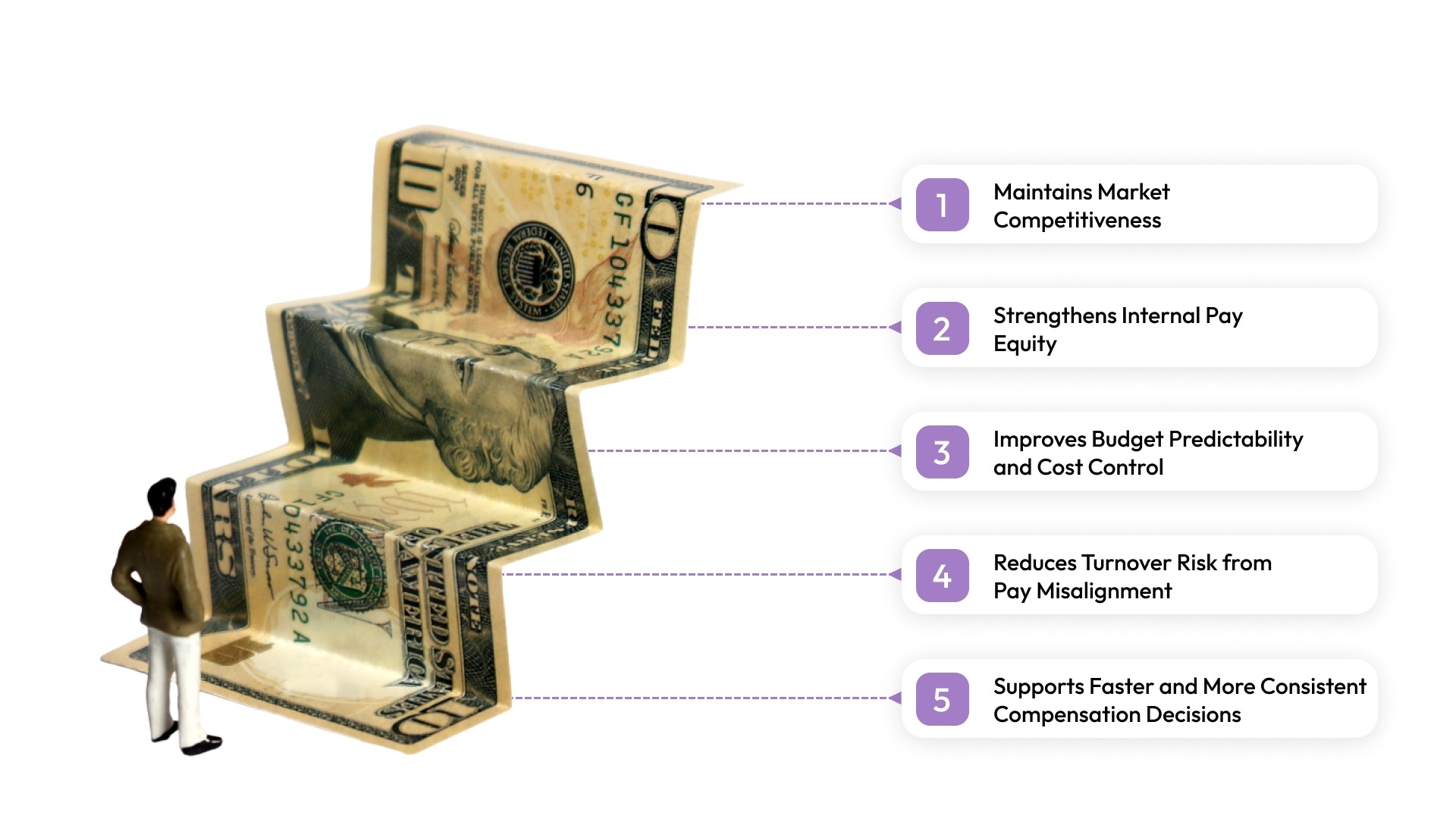
Compensation benchmarking matters because pay is one of the clearest signals a company sends to current and future employees.
If pay is inconsistent, unclear, or far from market expectations, the impact spreads quickly. It affects hiring speed, retention, trust, and budget performance.
1. Maintains Market Competitiveness
Staying competitive in the job market requires continuous alignment with external pay trends in the U.S. Compensation that falls behind often leads to hiring delays or loss of strong candidates.
In practice, this means:
- Salary ranges stay aligned with current market expectations for similar roles
- Offer decisions reflect real-time talent competition in the US labor market.
- Teams avoid over-reliance on outdated compensation surveys or static datasets
When benchmarking is updated regularly, HR teams can respond faster to market shifts instead of reacting after talent is already lost. This helps maintain consistency in hiring quality and speed.
2. Strengthens Internal Pay Equity
Internal equity becomes difficult to manage when compensation decisions are made in isolation. Benchmarking introduces structure by anchoring roles to consistent market references.
This improves equity by:
- Reducing unexplained pay differences across similar roles within the organization
- Aligning compensation with role scope, not just negotiation outcomes
- Supporting fair promotion and making decisions based on consistent market benchmarks
Instead of relying on manager-level discretion, HR teams can standardize pay decisions using defined benchmarks. This reduces friction in compensation reviews and improves trust in the system.
3. Improves Budget Predictability and Cost Control
For Finance teams, compensation is one of the largest and least predictable cost drivers. Benchmarking brings structure to how workforce costs are planned and adjusted.
It helps organizations:
- Forecast compensation costs more accurately during hiring cycles
- Avoid unexpected budget overruns from inconsistent or unstructured pay decisions
- Connect salary decisions directly to headcount planning assumptions
When compensation data is aligned with market benchmarks, workforce planning becomes more stable and easier to model across different hiring scenarios.
4. Reduces Turnover Risk from Pay Misalignment
Employees often compare their compensation with external market rates. When internal pay significantly lags behind the market, retention risk increases.
Benchmarking helps by:
- Identifying roles that are under market pressure or misaligned with current rates
- Supporting proactive salary adjustments before attrition occurs
- Improving confidence in compensation fairness
Instead of reacting to resignations, HR teams can use benchmarking data to anticipate retention risks and adjust compensation structures early.
5. Supports Faster and More Consistent Compensation Decisions
Without benchmarking, compensation decisions often depend on manual comparisons, outdated spreadsheets, or individual judgment. This slows down compensation cycles and creates inconsistencies.
Benchmarking improves decision-making by:
- Providing a clear reference point for all roles
- Reducing back-and-forth between HR and Finance
- Standardizing how compensation changes are evaluated
This leads to faster approvals and more consistent outcomes across teams, especially during compensation cycles and hiring surges.
Also Read: Effective Compensation Benchmarking for HR Teams in 2025
Types of Employee Compensation Benchmarking Approaches
There is no single benchmarking method that fits every role or company. Different approaches work better depending on the size of the team, the maturity of the job architecture, and the purpose of the decision.
The most common approaches include:
- Market-Based Benchmarking: This approach compares your compensation with external market data from salary surveys and benchmarking platforms. It helps you understand how competitive your pay is compared with peers.
- Internal Benchmarking: Internal benchmarking focuses on comparing roles within your organization. It helps maintain consistency and fairness across teams and departments.
- Peer Group Benchmarking: This method compares your compensation with a selected group of similar companies, such as competitors or companies at a similar growth stage.
- Geographic Benchmarking: This approach adjusts compensation based on location-specific market conditions. It is especially relevant for distributed or remote teams.
Choosing the right approach depends on your compensation philosophy and operational needs. Most organizations benefit from combining multiple methods to get a complete view of compensation positioning.
Step-by-Step Process for Effective Employee Compensation Benchmarking
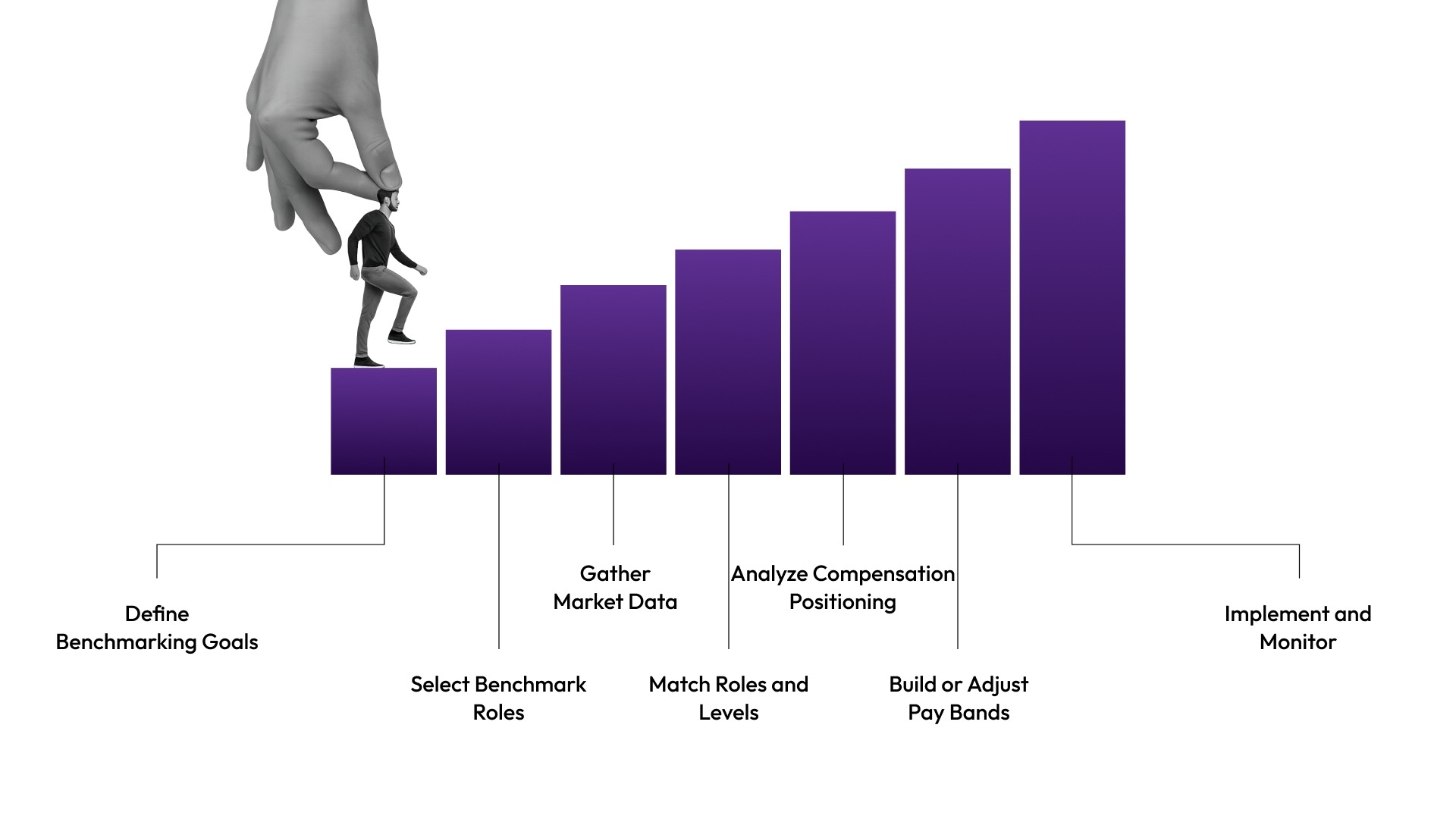
A useful benchmarking process should be repeatable. If the steps change every time, the results will change too. A structured process helps HR and Finance move from raw data to a clearer pay decision.
Step 1: Define Benchmarking Goals
Start by identifying what you want to achieve. This could include improving pay equity, aligning salaries with market rates, or supporting hiring decisions.
Clear goals help determine which roles to benchmark and what data to prioritize.
Step 2: Select Benchmark Roles
Focus on roles that are critical to your organization or represent a large portion of your workforce. These roles provide the most impact when benchmarking.
Step 3: Gather Market Data
Collect compensation data from reliable sources such as salary surveys, benchmarking platforms, and industry reports. Having accurate data is critical for meaningful analysis.
Step 4: Match Roles and Levels
Map your internal roles to external market data. This step requires aligning responsibilities and seniority levels rather than relying on job titles alone.
Step 5: Analyze Compensation Positioning
Compare internal pay with market benchmarks to identify gaps. Use metrics like salary ranges and midpoints to understand where each role stands.
Step 6: Build or Adjust Pay Bands
Use benchmarking insights to create or refine pay bands. Define minimum, midpoint, and maximum ranges for each role.
Step 7: Implement and Monitor
Apply changes through compensation cycles and monitor results regularly. Benchmarking should be continuous, not a one-time exercise.
A solid benchmarking process turns compensation from a reactive task into a managed planning workflow. That shift matters when teams need speed without losing structure.
Also Read: Executive Compensation Benchmarking Best Practices for Boards
Common Challenges in Employee Compensation Benchmarking
Despite its benefits, compensation benchmarking comes with several challenges. These challenges often prevent teams from fully realizing its value.
- Outdated market data: Salary surveys and reports are often not updated in real time, leading to benchmarks that don’t reflect current market conditions.
- Poor role matching: Similar job titles can represent very different responsibilities, resulting in inaccurate comparisons and misaligned pay ranges.
- Inconsistent benchmarking methods: Different teams using different data sources or logic leads to misaligned compensation decisions.
- Internal pay equity gaps: Even with correct market data, internal inconsistencies between similar roles can create fairness issues.
- Budget vs. market tension: Market-aligned pay may exceed budget limits, making it harder to align HR and Finance decisions.
- Lack of process ownership: Without a clear owner, benchmarking becomes fragmented across HR, Finance, and Recruiting.
- Slow action on insights: Teams often struggle to turn benchmarking data into updated pay structures or decisions quickly.
Addressing these challenges requires better systems, structured workflows, and faster access to reliable data for decision-making.
How CandorIQ Supports Smarter Employee Compensation Benchmarking
Managing compensation benchmarking manually often leads to inconsistent data, slow workflows, and limited visibility into pay decisions.
CandorIQ helps teams centralize compensation and headcount planning, making benchmarking more structured and actionable.
- Compensation & Payband Builder: Creates structured pay bands using role, level, and geography data. Benchmark insights translate into consistent salary ranges, improving equity and reducing ad-hoc decisions.
- Compensation Cycle: Links merit and bonus cycles to budgets and approvals. Benchmark data is applied consistently across reviews instead of being handled manually.
- Employee Total Rewards: Shows full compensation, including salary, bonus, equity, and benefits. Helps benchmark total rewards for a more complete market comparison.
- Headcount Scenario Planning: Models hiring and compensation scenarios and their cost impact. HR and Finance can assess benchmark changes before final decisions.
- Headcount Requests & Approvals: Standardizes approval workflows for new roles and compensation. Ensures benchmark-aligned offers move through faster and more consistently.
- Workforce Management: Tracks actual vs planned headcount and compensation in one view. Helps compare benchmark-based plans with real spend and adjust quickly.
- Candidate Offers: Aligns offer decisions with benchmarking data across salary, equity, and bonuses. Improves hiring consistency and market competitiveness.
- AI Agent: Analyzes compensation data and highlights benchmark gaps using natural language queries. Reduces manual effort and speeds up decision-making.
By connecting benchmarking with real-time data and workflows, CandorIQ gives teams a clearer view of how pay decisions affect both employees and budgets.
Contact us to explore how you can build a more aligned and data-driven compensation strategy.
.png)
FAQs
1. How do you identify relevant market data sources for benchmarking?
Relevant sources include the U.S. Bureau of Labor Statistics National Compensation Survey, BLS wage tables, industry salary surveys, compensation databases, recruiter insights, and peer company reports. The best source depends on role match, geography, company size, and data reliability.
2. How often should organizations update their compensation benchmarks?
Most organizations update compensation benchmarks annually to reflect market shifts. In the U.S., SHRM notes that many companies review salary structures annually, while some review critical jobs semi-annually.
3. What key metrics and percentiles are used in compensation analysis?
Common metrics include base salary, total compensation, compa-ratio, and pay ranges. Percentiles like 25th, 50th (median), 75th, and 90th help compare market positioning and ensure salaries remain competitive and internally equitable.
4. What legal considerations apply to compensation benchmarking in US?
In the U.S., benchmarking should align with the Equal Pay Act, Title VII, the ADEA, and the ADA, which prohibit compensation discrimination on protected bases. Employers should also check applicable state and local pay transparency rules, since those requirements vary by location.
5. How does benchmarking support diversity, equity, and inclusion (DEI) initiatives?
Benchmarking helps identify pay gaps across gender, ethnicity, or roles, enabling fair adjustments. It promotes transparent salary structures, reduces unconscious bias in pay decisions, and ensures equitable compensation practices that support an inclusive workplace culture.
Ready to modernize your workforce and compensation strategy?
See how CandorIQ brings workforce planning and compensation together with AI.