

The First Step in Designing an Effective Compensation System
Learn what the first step is in designing an effective compensation system. Get actionable tips for pay bands, market benchmarking, and HR-Finance alignment.

Scaling from 50 to 150 employees in just a few months? Suddenly, compensation decisions can feel like a gamble. Top performers may start leaving, budgets spiral out of control, and offer letters get delayed.
But here’s the thing: the first step in designing an effective compensation system isn't about choosing the right software or benchmarking salaries. It’s about building the strategic foundation that turns compensation from an administrative headache into a powerful competitive advantage.
In this guide, we’ll show you exactly how to lay that foundation, setting your growing company up for fair, predictable, and market-aligned pay that supports your goals.
At a glance:
- The first step in designing an effective compensation system is defining your compensation philosophy before touching any salary data. This answers why you pay the way you do and aligns HR and Finance.
- A strategic compensation system requires job architecture that creates clear levels and career paths before you set any pay bands.
- Market benchmarking only works when you know your positioning strategy: will you lead, match, or lag the market?
- Growing companies need systems that handle complexity like geo-adjusted pay, multiple approval layers, and real-time budget impact modeling.
- CandorIQ consolidates pay band management, headcount planning, and approval workflows so HR and Finance speak the same language.

What Makes a Compensation System "Strategic"?
Your breaking point is when you can't answer "How much should we pay this new hire?" without checking five different Google Sheets, texting three managers, and hoping no one notices the inconsistencies. So, what makes it strategic?
Strategic compensation goes beyond "What do we pay people?" It answers why you pay what you pay, how that supports your business goals, and what trade-offs you're willing to make.
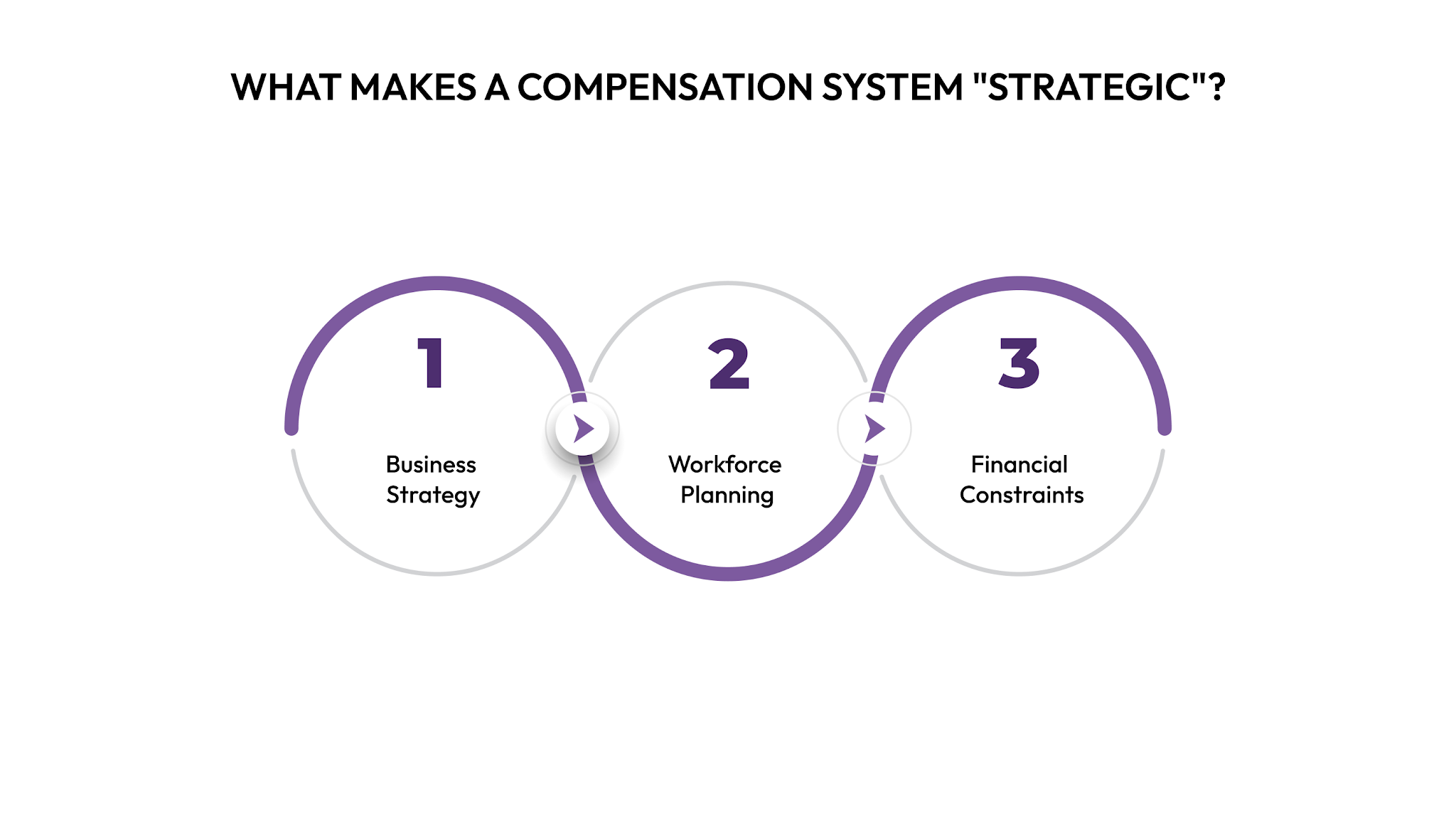
A strategic system connects three critical elements:
- Business strategy: If you're competing on innovation, you might pay top-of-market for engineering and product roles. If you're optimizing for efficiency, you might offer market-median salaries with aggressive performance bonuses.
- Workforce planning: Your compensation decisions directly impact how many people you can hire. Paying everyone at the 75th percentile means you hire fewer people. Paying at the 50th percentile means you can build a larger team.
- Financial constraints: Your compensation philosophy must work within your budget reality. A Series A startup can't pay like Google, but it can compete through equity, growth opportunities, and meaningful work.
The difference between tactical and strategic? Tactical compensation reacts to market pressure with one-off raises. Strategic compensation builds a system that scales, creates internal equity, and gives you language to explain your decisions.
This is where HR and Finance alignment becomes critical. When both teams share the same framework, compensation planning shifts from conflict to collaboration.
But strategic thinking requires understanding your options. Different compensation approaches work for different business models and growth stages.
Different Types of Compensation Strategies
Your compensation strategy determines how you structure pay across your organization. The right approach depends on your business model, cash position, and talent competition.
Understanding these models helps you make intentional choices rather than accidentally inheriting a system that doesn't fit your needs.
1. Market-Based Compensation
This approach anchors all pay decisions to external market data. You pick a percentile (50th, 65th, 75th, or 90th) and pay everyone at that level relative to the market.
When this works:
- You compete directly with tech giants or well-funded competitors
- Your roles have clear market comparables
- You have budget flexibility to adjust as markets shift
However, markets change constantly. You need continuous benchmarking and regular adjustments to stay competitive.
2. Performance-Based Compensation
This model ties significant portions of pay to individual or company performance. Base salaries might sit at market median, but high performers can earn well above market through bonuses and variable pay.
Typical structure:
- Base salary: 70% to 80% of total target compensation
- Performance bonus: 15% to 20% at target
- Equity or profit sharing: 5% to 10%
When this works:
- Your business has measurable performance metrics
- You need to differentiate compensation between average and exceptional performers
- Cash is tight, but you can afford to pay more when results justify it
Variable pay creates income uncertainty for employees. Some candidates will walk away if they can't count on consistent take-home pay. You also need robust performance management to make this fair.
3. Equity-Heavy Compensation
Startups often use this model when cash is constrained, but growth potential is high. Base salaries sit below market (often 20% to 30% below), but equity packages compensate for the gap.
Typical splits:
- Base salary: Below market median
- Equity: Significant grants (0.1% to 2%+ depending on role and stage)
- Benefits: Often minimal to conserve cash
When this works:
- You're pre-revenue or pre-Series A with a limited cash runway
- You're hiring people who believe in your mission and accept risk
- Your equity has realistic upside (not every company can promise this honestly)
Not everyone can afford below-market salaries, which limits your talent pool. You also need to communicate equity value clearly because most candidates don't understand strike prices, dilution, or liquidation preferences.
4. Hybrid Compensation Models
Most growing companies land here. You combine elements of market-based pay, performance incentives, and equity to create a balanced approach.
A typical hybrid might include:
- Base salary at the 55th to 65th percentile
- Annual performance bonus (5% to 15% of base)
- Equity grants that are refreshed based on performance
- Competitive benefits package
When this works:
- You're past the survival stage, but not printing money
- You need to compete for talent without matching FAANG salaries
- You want to reward performance, but can't afford pure variable models
This model gives you flexibility. You can pay competitively for critical roles while using performance incentives and equity to differentiate without blowing your budget.
5. Geographic Compensation Strategies
As remote work expands, your geographic approach becomes its own strategic decision.
Three models dominate here:
1. Location-adjusted compensation: Pay varies by where employees live, typically using cost of labor or cost of living data. An engineer in San Francisco makes more than the same level in Austin.
- Advantage: Controls costs and reflects local markets
- Disadvantage: Creates internal equity tensions
2. Zone-based compensation: Group locations into 3 to 4 zones with different pay scales (Tier 1: Major metros, Tier 2: Secondary cities, Tier 3: Remote/low cost areas).
- Advantage: Simpler than individual location adjustments
- Disadvantage: Still creates some internal equity questions
3. Location-independent compensation: Pay the same regardless of location, usually benchmarked to a major market like San Francisco or New York at a specific percentile.
- Advantage: Simple and feels fair
- Disadvantage: Can strain budgets if everyone moves to high-cost areas or stays in low-cost areas, expecting top-market pay
There's no perfect model. Pick the approach that aligns with your values and budget, then communicate the reasoning clearly. Now that you understand your strategic options, you're ready to build your system. But first, you need the right preparation.
Building a Foundation for Effective Compensation
Building a compensation system requires more than good intentions. You need executive alignment, cross-functional buy-in, and realistic expectations about time and resources.
Start by getting your executive team on the same page about three questions:
- Where do we want to position ourselves in the market (lead, match, or lag)?
- What's our budget reality for the next 12 months?
- What problems are we trying to solve with this system?
Next, assemble your cross-functional team. At a minimum, you need HR, Finance, and representatives from your largest departments. These stakeholders will help you build job leveling, validate market data, and pressure-test your assumptions.
Finally, audit your current state. Gather every piece of compensation data you have:
- Current salaries by role, level, and location
- Equity grants and vesting schedules
- Benefits costs per employee
- Recent offers (both accepted and declined)
- Exit interview feedback about compensation
This baseline data reveals your biggest pain points. You might discover salary compression where senior people make barely more than junior hires. Or geographic inconsistencies where remote workers in low-cost areas earn the same as those in expensive cities.
Now, block time to build the compensation system step by step.
Also Read: Effective Compensation Strategies for Workforce Optimization
Step-by-Step: Building Your Compensation System
Let's walk through the seven steps that transform compensation from reactive to strategic. Each step builds on the previous one, so resist the urge to skip ahead.
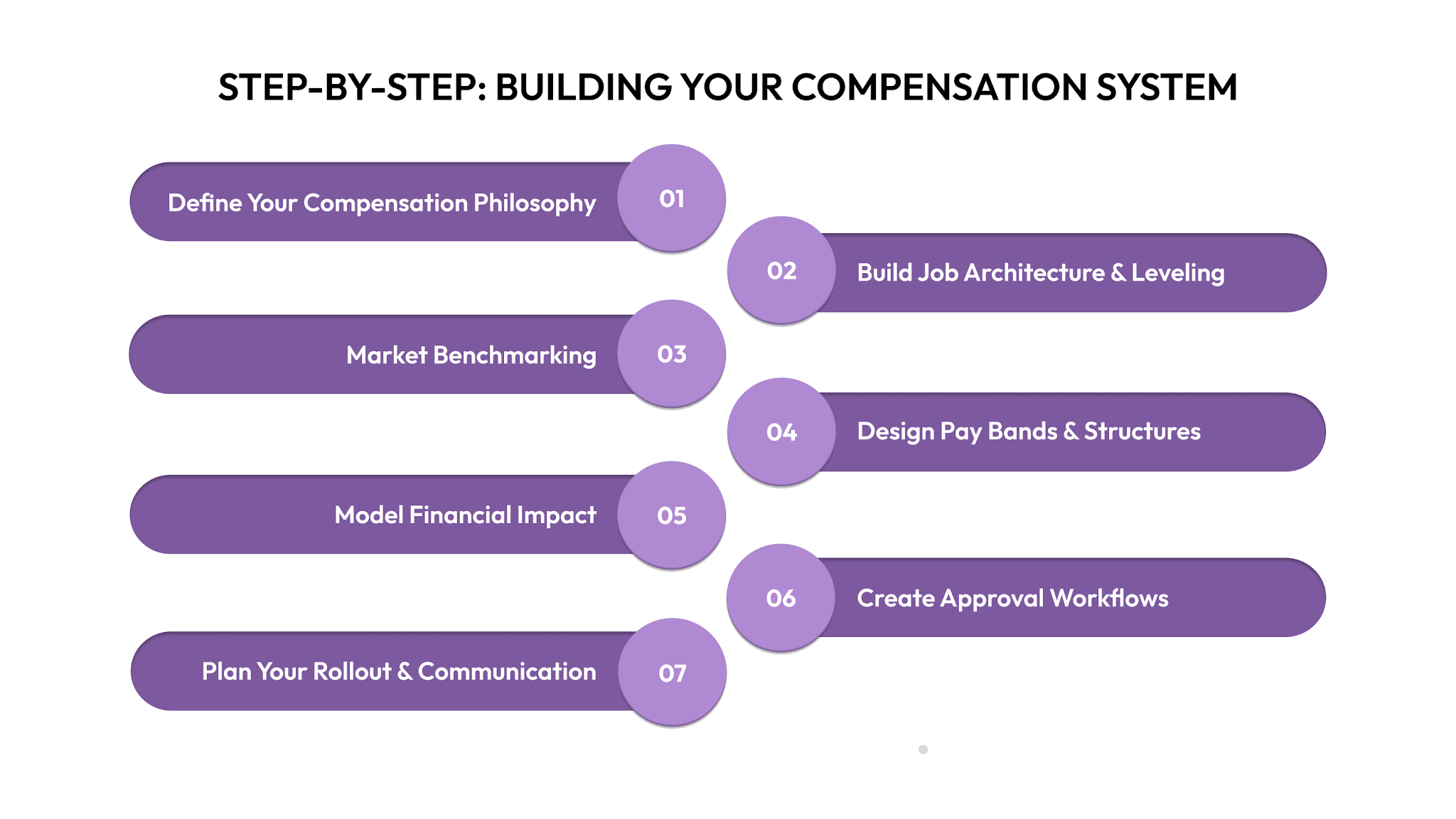
Step 1: Define Your Compensation Philosophy
Your compensation philosophy is the "why" behind every pay decision. It's a written document that explains your approach to market positioning, internal equity, performance differentiation, and transparency.
A strong philosophy addresses four core questions:
- Market positioning: Will you pay at the 50th, 75th, or 90th percentile of market rates?
- Internal equity: How will you balance external competitiveness with internal fairness?
- Performance: How much will high performance influence compensation decisions?
- Transparency: What will you share about pay ranges and how decisions get made?
For example, your philosophy might state: "We pay at the 65th percentile of market rates for technical roles in our primary markets. We prioritize internal equity and will not exceed a 20% spread between employees at the same level. High performers receive differentiated compensation through our annual bonus program."
This gives you a decision-making framework. So, get executive sign-off on your philosophy before moving forward.
Step 2: Build Job Architecture and Leveling
Job architecture creates the structure for everything else. It defines how roles relate to each other, what differentiates a Level 2 from a Level 3, and what progression looks like.
Start by grouping roles into job families. Common families include:
- Engineering (Frontend, Backend, DevOps, Data)
- Product (Product Management, Design, Research)
- Go-to-Market (Sales, Marketing, Customer Success)
- Operations (Finance, HR, Legal, IT)
Within each family, define career levels. Most companies use 4 to 6 levels for individual contributors and separate tracks for management.
For each level, document:
- Scope of impact: What size problems does this person solve?
- Autonomy: How much supervision do they need?
- Technical complexity: What skills or expertise does the role require?
- Leadership influence: Do they mentor others or drive team decisions?
The key is consistency.
Step 3: Market Benchmarking
Market data only helps if you're comparing apples to apples. Too many companies benchmark "Software Engineer" without specifying whether that's a new grad or someone with 10 years of experience.
Use your job leveling from Step 2 to match roles precisely. Look for data that shows:
- Base salary ranges by level (25th, 50th, 75th, 90th percentile)
- Total cash compensation (base plus bonus)
- Equity packages for similar stage companies
- Benefits benchmarks for your industry
Geographic considerations matter more than ever.
You can apply:
- Location-based pay: Adjust salaries based on local market rates or cost of labor
- Zone-based pay: Group locations into 3 to 4 zones (Metro, Secondary, Remote)
- Location-independent: Pay the same regardless of where someone lives
Each approach has trade-offs. Location-based pay controls costs but creates internal equity questions. Location-independent pay feels fair but might strain budgets if everyone relocates to high-cost areas.
CandorIQ integrates market data directly into our platform, so you can see real-time benchmarks while building pay bands. No more juggling multiple spreadsheets or outdated salary surveys.
Step 4: Design Pay Bands and Structures
Pay bands translate your market research into actual salary ranges. Each band should have a minimum, midpoint, and maximum that reflect your market positioning and progression philosophy.
How to build your first bands:
Start with your benchmark data. Add range spread. This gives you room for performance differentiation and tenure increases without jumping levels.
Critical decisions:
- Band overlap: Should your bands overlap between levels? Overlap lets high performers earn more than low performers at the next level up.
- Bandwidth: Wider bands (40% to 50%) give more flexibility but can lead to compression. Narrower bands (20% to 30%) provide clearer progression signals.
- Band count: Start with one band per level. You can add specialization later as complexity demands.
Document your bands in a central system. When a hiring manager asks about salary for a new role, they should find the answer in seconds, not days.
CandorIQ’s pay band builder lets you create, visualize, and adjust bands while seeing real-time budget impact. You can model scenarios like "What happens if we increase all bands by 5%?" before committing.
Step 5: Model Financial Impact
Every compensation decision affects your budget. Strategic systems model this impact before implementation, not after.
Build scenarios that answer:
- If we implement these new bands, how many employees fall below the minimum?
- What does it cost to bring everyone to their band minimum?
- If we give 3% merit increases, what's the total budget impact?
- How many new hires can we afford if we pay at these levels?
This is where HR and Finance collaboration becomes critical. Finance needs to see how compensation connects to headcount planning. HR needs to understand budget constraints to make realistic recommendations.
Step 6: Create Approval Workflows
Who approves what matters as much as the amounts themselves. Clear workflows prevent bottlenecks, reduce errors, and create audit trails. Define approval authority by decision type.
Document these workflows and communicate them clearly. When a manager knows exactly what requires approval, they stop asking for permission on routine decisions.
Pro tip: Track all exceptions. If you're regularly approving above-band offers for specific roles, your bands might be too low.
Step 7: Plan Your Rollout and Communication
The best compensation system fails if people don't understand it. Plan your communication strategy before you announce anything. Transparency builds trust, but it also invites questions. Prepare for employees to ask why their band is where it is, why their peer makes more, and when they'll get raises.
The key is consistency. Every manager should give the same explanation for how the system works. CandorIQ's all-in-one dashboard lets HR and Finance share context with managers, track who's been trained, and maintain consistent messaging across your organization.
Even with the best plans, obstacles are inevitable, but a clear strategy and deliberate action make them manageable.
Also Read: How to Develop a Comprehensive Compensation Strategy
Common Challenges and How to Overcome Them
You will face several challenges while designing your compensation systems, especially if your team is distributed. Here's how to navigate the most common ones:
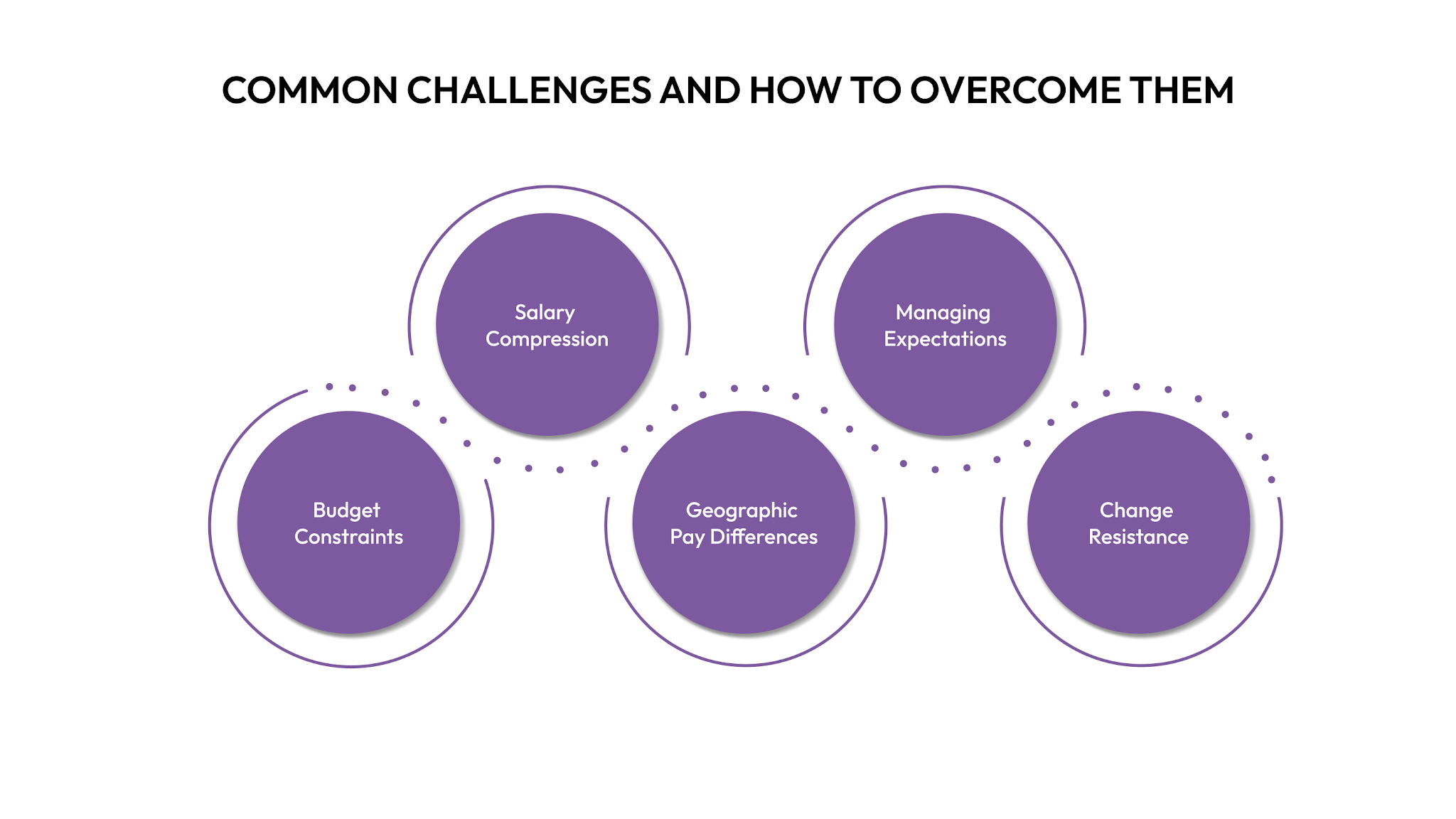
- Budget constraints: Not every company can afford market rates. Focus on roles critical to your business and pay competitively where it matters most. Use equity, growth opportunities, and flexibility to compete where cash falls short.
- Salary compression: When new hires make more than tenured employees, compression creates resentment. Address this proactively by bringing tenured employees to band minimums before implementing your new system.
- Geographic pay differences: Remote work complicates compensation. Make a clear decision about your approach and communicate the reasoning. Inconsistency hurts more than any specific model.
- Managing expectations: Some employees will be disappointed by their level or band. Prepare managers to have honest conversations about performance, market realities, and what it takes to progress.
- Change resistance: People fear change, especially around money. Involve skeptics early, address concerns transparently, and show how the new system benefits everyone through fairness and clarity.
CandorIQ's compensation cycle management brings all of this together. Run your entire merit cycle in one platform, from manager inputs to final approvals, with real-time budget tracking throughout.
Also Read: Employee Compensation Challenges and Influential Factors
How CandorIQ Makes Compensation Designing Easier
Building a strategic compensation system shouldn't require 15 spreadsheets and 47 meetings. CandorIQ consolidates the entire workflow into one platform where HR and Finance collaborate in real time.
CandorIQ is purpose-built for growing companies that need more than just payroll. We handle the strategic work: pay bands, market data, headcount planning, approval workflows, and compensation cycles.
Key features that transform compensation design:
- Pay Band Builder: Create and visualize salary structures with real-time market data integration
- Job Leveling Framework: Map employees to consistent levels across departments and locations
- Scenario Planning: Model different compensation strategies and see instant budget impact
- Approval Workflows: Route decisions automatically based on your authority matrix
- Market Benchmarking: Access current salary data without juggling multiple vendors
- Geo-Adjustment Tools: Set location-based pay policies and apply them consistently
- Budget Tracking: See real-time spending against plan during compensation cycles
- Collaboration Hub: Let HR and Finance work together in one system with shared context
The difference? Instead of spending 60 days building compensation infrastructure in spreadsheets, you're operational in 2 weeks. Instead of fighting over budget in siloed tools, HR and Finance see the same data and make aligned decisions.
Conclusion
The first step in designing an effective compensation system is strategic thinking, not tactical execution. Define your philosophy, build solid job architecture, and create approval workflows before you touch salary numbers.
Most importantly, recognize that compensation is a partnership between HR and Finance. When both teams collaborate in a system built for strategic decisions, compensation transforms from an administrative burden to a competitive advantage.
Ready to move beyond spreadsheets? Book a demo with CandorIQ to see how we help growing companies design and scale their compensation systems without the chaos.
.png)
Frequently Asked Questions
1. How long does it take to design a compensation system from scratch?
Most companies need 8 to 12 weeks to build their first formal compensation system. This includes defining philosophy (2 weeks), creating job architecture (3 weeks), benchmarking (2 weeks), designing bands (2 weeks), and planning rollout (2 weeks). The timeline compresses significantly if you use a platform like CandorIQ that handles technical infrastructure.
2. Should I hire a compensation consultant or build internally?
Companies under 200 employees can usually build internally with the right tools. Between 200 and 500, consider a consultant for initial design, then manage internally. Above 500, you likely need dedicated compensation expertise. CandorIQ bridges this gap by providing expert frameworks and automation that replace some consulting needs.
3. What's the biggest mistake companies make when designing compensation systems?
Starting with salary numbers instead of philosophy. Companies benchmark market data and create pay bands without defining why they're paying what they're paying. This leads to inconsistent decisions and constant exceptions. Build your philosophical foundation first, then let data inform your structure.
4. How do I handle employees who are paid above their new band maximum?
Red-circle these employees, meaning they keep their current salary but receive no increases until either the band rises to meet them or they get promoted. Communicate this clearly and give them a path forward through promotion criteria. Never cut someone's salary to fit a new band.
5. Can I use the same compensation system for different countries?
You need localized benchmarking and compliance for each country, but your core philosophy and job architecture can remain consistent globally. Use zone-based or location-adjusted bands to account for market differences. CandorIQ supports geo-adjusted compensation across 150+ countries while maintaining your strategic framework.
Ready to modernize your workforce and compensation strategy?
See how CandorIQ brings workforce planning and compensation together with AI.