

Compensation Scenario Planning and Strategies for Success
Explore compensation scenario planning strategies to model pay outcomes, control budgets, and improve decisions for scalable, data-driven workforce planning.

Compensation planning has become harder to manage as teams scale, budgets tighten, and pay expectations shift quickly. Static salary reviews once worked for smaller teams, but they fall short when compensation decisions must reflect changing market benchmarks, distributed teams, and evolving business priorities.
This is where scenario-based compensation planning becomes critical. With 2026 salary increase budgets in the U.S. projected to stay around 3.2–3.5%, according to recent compensation forecasts, even small planning gaps can significantly impact overall spend.
Instead of reacting to changes after they happen, you model different outcomes in advance and understand their impact. This approach helps you make clearer decisions around pay, promotions, and hiring while staying aligned with budget constraints.
This blog breaks down how compensation scenario planning works, what influences it, and how you can apply structured strategies to improve outcomes.
Key Highlights:
- Compensation planning uses scenario-based modeling to evaluate different pay, hiring, and promotion outcomes before decisions are finalized.
- It relies on key inputs like US market benchmarks, pay structures, budgets, hiring plans, and retention signals.
- Organizations prepare for scenarios such as rapid hiring, budget constraints, promotions, market salary shifts, and retention risks to manage workforce costs effectively.
- Effective strategies include structured pay bands, scenario modeling practices, cross-functional collaboration, pay equity focus, and real-time visibility into compensation data.
- Modern compensation planning is supported by analytics and AI, but still requires human judgment, and is often strengthened through integrated workforce planning systems.
What is Compensation Scenario Planning and Why It Matters?
Compensation scenario planning is the process of modeling different pay and workforce situations before making decisions. Instead of committing to one plan, you evaluate multiple possibilities and compare outcomes based on cost, equity, and business priorities.
Here’s why it matters:
- Improves visibility into compensation impact: You can clearly see how salary changes, promotions, and hiring decisions affect overall workforce costs before committing to them.
- Supports better budget control: Scenario modeling helps you compare different compensation strategies and choose options that align with financial constraints.
- Reduces inconsistent pay decisions: Structured planning based on defined scenarios creates more consistency across teams, roles, and locations.
- Strengthens HR and Finance alignment: Both teams can evaluate the same scenarios and make decisions based on shared data and assumptions.
- Helps prepare for uncertainty: You can model different outcomes, such as hiring slowdowns or market-driven salary changes, without reacting at the last minute.
- Improves decision confidence: Having multiple scenarios makes it easier to justify compensation decisions with clear data and rationale.
- Supports scalable compensation planning: As your workforce grows, scenario planning helps maintain structure without relying on manual or fragmented processes.

Core Elements Influencing Compensation Planning Scenarios
Compensation scenario planning depends on a combination of internal data and external market signals. Understanding these elements helps HR leaders build realistic and actionable planning models.
- Market Benchmarking: Salary benchmarks from US industry datasets such as Bureau of Labor Statistics (BLS), Mercer, and Willis Towers Watson (WTW) help define competitive pay ranges.
- Internal Pay Structures: Pay bands, job levels, and role architecture create a consistent framework for compensation decisions. They help maintain internal equity and support structured salary changes and promotions across the organization.
- Budget Constraints: Compensation planning must stay within financial limits set by Finance teams. Scenario planning helps evaluate different pay and hiring options while staying aligned with overall budget goals.
- Headcount Planning Inputs: Hiring plans directly influence total compensation spend across teams. Any change in hiring volume or timing can significantly affect workforce cost projections in scenario models.
- Promotion and Career Progression Data: Promotion cycles and role changes introduce variation in compensation outcomes. These inputs help HR teams estimate salary increases and support fairness across career paths.
- Retention and Attrition Signals: Employee turnover trends influence compensation strategy, especially in high-risk roles. Scenario planning uses this data to prepare for potential salary adjustments and retention-driven decisions.
Together, these elements form the foundation of effective compensation scenario planning. When they are aligned, teams can build realistic scenarios and make decisions with greater confidence.
Key Compensation Planning Scenarios Organizations Must Prepare For
Different business situations require different compensation strategies. Scenario planning helps HR leaders prepare for these situations in advance and respond with clarity.
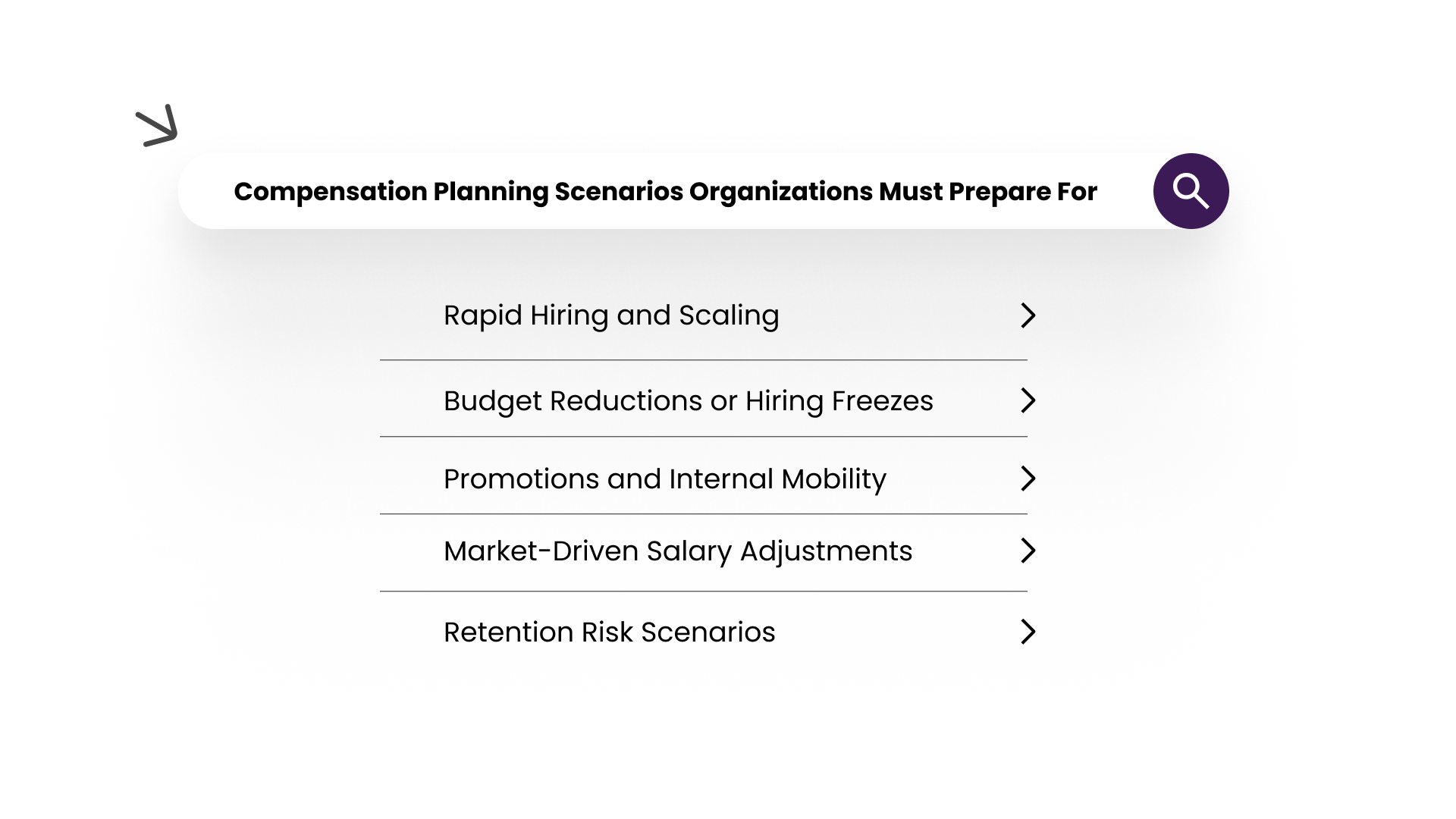
1. Rapid Hiring and Scaling
When organizations grow quickly, compensation decisions need to keep pace with hiring demands. This scenario focuses on maintaining consistency in offers while controlling rising workforce costs.
In fast-scaling environments, multiple hires happen across teams and locations at the same time. Without structured compensation planning, salary variations can create internal pay gaps and budget misalignment. Scenario planning helps define clear compensation ranges before hiring accelerates.
Example: A SaaS company hiring 50 engineers in one quarter models different salary bands for senior and mid-level roles to understand the total compensation impact before launching recruitment.
2. Budget Reductions or Hiring Freezes
Economic pressure or internal cost controls often force organizations to slow down hiring or reduce compensation increases. This scenario helps teams decide how to manage workforce costs without affecting critical operations.
HR and Finance teams need to evaluate where to reduce spend while minimizing disruption. Compensation scenario planning helps compare options like delaying hires, reducing bonus pools, or adjusting merit increases.
Example: A fintech company facing budget constraints models a hiring freeze for non-critical roles while limiting compensation increases to high-retention risk employees.
3. Promotions and Internal Mobility
Internal promotions and role changes directly impact compensation structures and pay equity. This scenario ensures that internal growth does not create inconsistencies across teams.
Scenario planning helps evaluate how promotions affect salary distribution and whether internal candidates remain aligned with external market benchmarks. It also helps maintain fairness across similar roles.
Example: A product company models salary adjustments for 10 internal promotions across engineering and product teams to ensure pay equity with external hiring benchmarks.
4. Market-Driven Salary Adjustments
Shifts in talent demand or competitive pressure often require compensation adjustments for specific roles. This scenario helps organizations respond without disrupting overall pay structures.
Instead of increasing salaries broadly, scenario planning helps isolate roles that require adjustments due to market shortages or retention risks.
Example: A tech company evaluates whether to increase compensation for data scientists after benchmark data shows rising market rates, while keeping other roles unchanged.
5. Retention Risk Scenarios
High-performing employees may leave if compensation does not align with market expectations. This scenario focuses on identifying and retaining critical talent before attrition happens.
Scenario planning helps evaluate the cost of retention versus replacement and allows targeted compensation adjustments for at-risk employees.
Example: A growing startup models compensation increases for top-performing engineers identified as high attrition risk compared to hiring replacement costs in the open market.
Also Read: Comprehensive Compensation Planning and Management Software
These scenarios identify employees at risk of leaving and model targeted compensation adjustments to retain them. This approach is more efficient than broad salary increases.
Core Strategies for Effective Compensation Planning
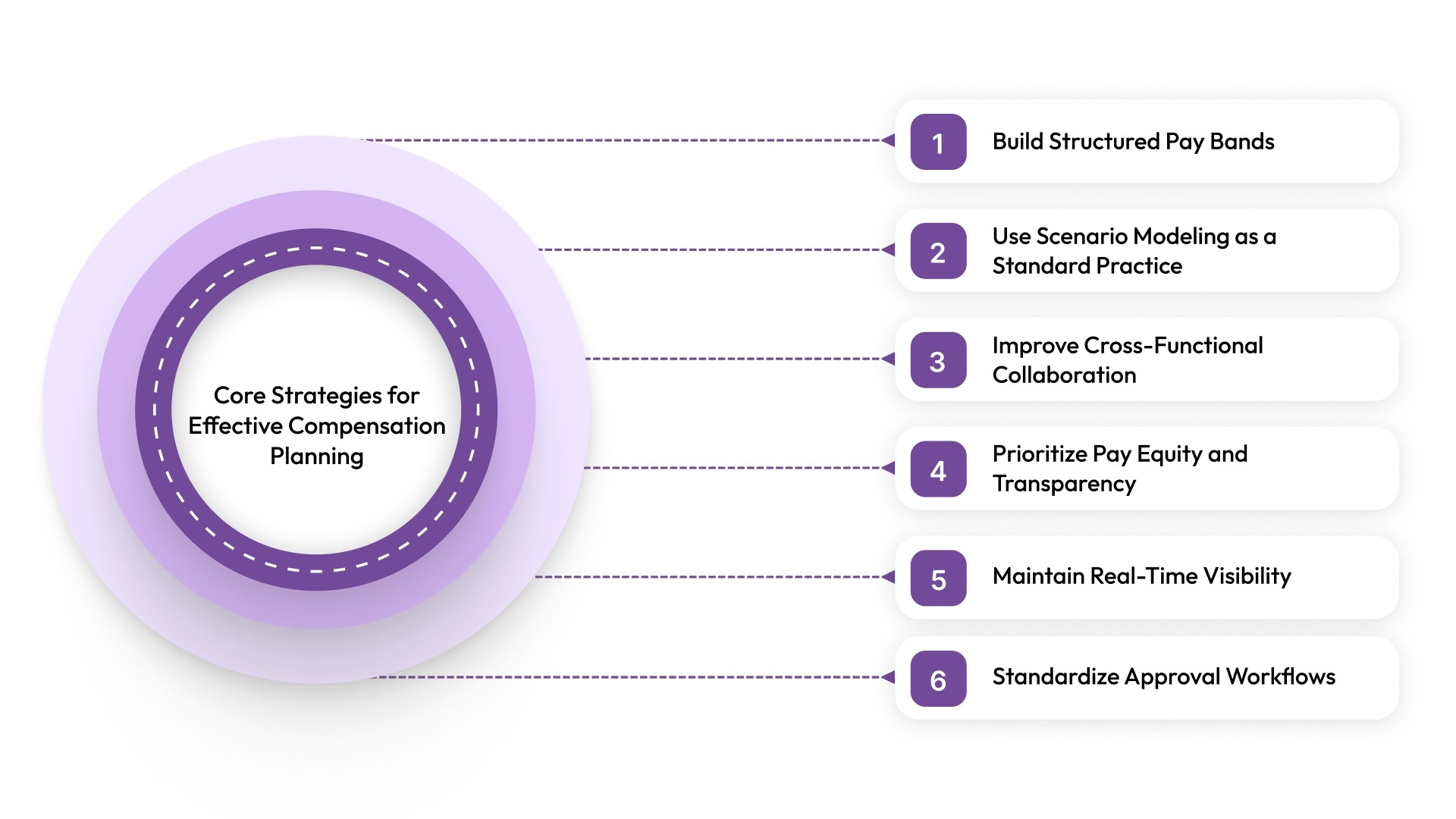
Effective compensation planning requires more than just identifying scenarios. It depends on having clear strategies that guide how decisions are made and implemented.
1. Build Structured Pay Bands
Structured pay bands create a clear framework for how compensation is assigned across roles, levels, and U.S. locations. They reduce inconsistency and make pay decisions easier to justify and scale.
Instead of deciding salaries case by case, pay bands define ranges for each role or level. This helps ensure employees in similar positions are compensated fairly and consistently.
Key actions include:
- Define salary ranges by role, level, and geography
- Align bands with market benchmarks and internal equity
- Review and update bands periodically based on market shifts
With structured pay bands in place, compensation decisions become more predictable and easier to manage during hiring, promotions, and adjustments.
2. Use Scenario Modeling as a Standard Practice
Scenario modeling helps teams evaluate multiple compensation outcomes before making final decisions. It reduces risk by showing how different choices affect budgets and workforce costs.
Instead of relying on a single plan, HR and Finance teams can compare multiple compensation scenarios side by side. This makes trade-offs more visible and easier to evaluate.
Key actions include:
- Model different salary increase percentages across teams
- Compare hiring vs. promotion-based growth strategies
- Evaluate compensation changes under different budget conditions
This approach helps leaders avoid reactive decisions and instead choose options that balance cost, equity, and business needs.
3. Improve Cross-Functional Collaboration
Compensation planning works best when HR and Finance operate from a shared understanding of workforce goals and budget limits. Lack of alignment often leads to delays or conflicting decisions.
When both teams collaborate early in the planning process, compensation decisions become more realistic and easier to execute. It also reduces last-minute changes during approval cycles.
Key actions include:
- Involve Finance early in compensation planning cycles
- Share workforce cost implications before finalizing decisions
- Align on headcount and compensation priorities together
This ensures compensation planning reflects both people's strategy and financial discipline.
4. Prioritize Pay Equity and Transparency
Pay equity ensures employees in similar roles are compensated fairly, while transparency builds trust in compensation decisions across the organization.
Without clear visibility into pay structures, inconsistencies can emerge over time. Scenario planning helps identify and correct these gaps before they become larger issues.
Key actions include:
- Regularly audit compensation across roles and levels
- Identify and address unexplained pay differences
- Communicate the compensation structure clearly to stakeholders
A transparent approach reduces retention risks and supports a more consistent employee experience.
5. Maintain Real-Time Visibility
Real-time visibility into compensation and headcount data helps teams make faster and more accurate decisions. Without it, planning becomes reactive and less reliable.
When data is updated in real time, HR and Finance can immediately see how decisions impact budgets and workforce plans.
Key actions include:
- Track compensation changes as they happen
- Monitor headcount costs against budget in real time
- Use centralized dashboards for workforce insights
This improves confidence in decision-making and reduces delays caused by outdated information.
6. Standardize Approval Workflows
Standardized approval workflows help reduce delays and inconsistencies in compensation decisions. They ensure every request follows a clear and predictable process.
Without structured workflows, approvals often become fragmented and slow, especially during compensation cycles or high hiring periods.
Key actions include:
- Define clear approval paths for compensation changes
- Automate routing based on role, level, or department
- Track approval status in a centralized system
This helps teams move faster while maintaining accountability and consistency across decisions.
These strategies create a foundation for compensation planning that is both structured and adaptable. They allow organizations to manage complexity without losing control over key decisions.
Common Challenges in Compensation Scenario Planning
Despite its benefits, compensation scenario planning comes with several challenges. These issues often stem from outdated processes and disconnected systems.
- Fragmented data sources: Compensation data sits across HRIS, payroll, and finance tools, making it difficult to build a single, accurate view of workforce costs.
- Slow approvals: Multi-step approval workflows without structure delay compensation decisions, affecting hiring speed and promotion cycles.
- Weak cost visibility: HR and Finance teams often lack real-time insight into total compensation spend, reducing confidence in scenario comparisons.
- Misaligned assumptions: Different teams use different inputs for the same scenario, leading to conflicting outputs and reduced planning accuracy.
- Rigid planning cycles: Annual or static planning models fail to keep up with mid-year changes in hiring needs, market benchmarks, or retention risks.
Addressing these challenges requires more than process changes. It often involves adopting systems that bring data, workflows, and collaboration into a single operating environment instead of disconnected tools.
Also Read: Creating an Effective Employee Compensation Plan
How AI and Analytics Are Transforming Compensation Planning
AI and analytics are changing how compensation planning is approached. They provide deeper insights and improve the speed of decision-making.
- Faster analysis of compensation data: AI tools process large compensation datasets quickly, helping HR teams identify trends and patterns without manual effort or spreadsheet-heavy work.
- Improved pay equity visibility: Analytics highlight gaps in compensation across roles, levels, and locations, making it easier to detect inconsistencies in pay structures.
- More accurate forecasting of workforce costs: Predictive models help estimate how salary changes, promotions, or hiring decisions will impact future budgets.
- Scenario modeling at scale: AI enables teams to test multiple compensation scenarios quickly, comparing outcomes like cost impact, retention risk, and hiring feasibility.
- Data-driven compensation recommendations: Systems can suggest salary ranges or adjustments based on historical data, market benchmarks, and internal pay trends. These are recommendations, not decisions, based on data signals.
However, AI should be used as a support layer. Final decisions still require human judgment and business context.
How CandorIQ Can Help Strengthen Compensation Planning and Scenario Modeling
Managing compensation scenarios manually often leads to inconsistent decisions and limited visibility into workforce costs.
CandorIQ helps address these challenges by bringing compensation and headcount planning into a single, structured system. This allows teams to model scenarios, track decisions, and collaborate in real time.
- Compensation & Payband Builder: Creates structured pay bands across roles, levels, and U.S. locations in one system. It helps maintain consistent pay decisions using benchmarks while reducing spreadsheet dependency.
- Compensation Cycle: Automates merit increases, bonuses, and salary reviews with structured approvals. It helps teams run compensation cycles faster with better budget visibility.
- Employee Total Rewards: Shows employees a clear breakdown of salary, bonus, equity, and benefits. This improves transparency and reduces compensation-related queries.
- Headcount Scenario Planning: Let’s teams model hiring, promotion, and compensation scenarios before decisions are made. It shows how each option impacts cost, budget, and hiring capacity.
- Headcount Requests & Approvals: Standardizes hiring requests with role, compensation, and budget details. Automated workflows speed up approvals and improve accountability.
- Workforce Management: Gives a single view of roles, attrition, promotions, and plan vs actual headcount. It helps leaders track workforce health and alignment.
- Candidate Offers: Builds structured offers with full compensation details, including salary and equity. It improves consistency and helps speed up offer acceptance.
- AI Agent: Provides insights for compensation and workforce decisions using benchmarks and internal data. It helps identify gaps and model scenarios faster.
By bringing these elements into one system, CandorIQ helps HR leaders improve visibility, reduce manual work, and make more consistent compensation decisions.
Contact us to learn more.
.png)
FAQs
1. How do you design incentive plans for sales teams in volatile markets?
Design a flexible mix of fixed and variable pay, with quarterly or monthly adjustments. Use risk-adjusted targets, short sales cycles, and leading indicators, so incentives stay motivating despite demand fluctuations.
2. What metrics should guide budget allocation for merit increases?
Use performance ratings, compa-ratios, market benchmarks, retention risk, and internal pay equity. Combine these with overall compensation budget constraints to ensure fair, competitive, and strategically aligned merit increase distribution.
3. How do you align compensation with company-wide U.S. pay equity goals?
Conduct regular pay equity audits, standardize salary bands, and remove bias from performance reviews. Track representation metrics and support transparent pay practices that promote fair advancement across all employee groups in the U.S.
4. How does inflation affect compensation planning in 2026?
Inflation increases salary pressure due to higher living costs and wage expectations. Organizations must adjust budgets, apply cost-of-living increases, and balance real wage preservation with financial sustainability and market competitiveness.
5. What U.S. considerations apply to compensation strategies for multi-state and globally distributed teams?
Consider U.S. state labor laws, tax structures, local cost-of-living differences, and remote-work pay practices. For U.S.-based employers with cross-border workers, exchange rates and local market norms can also affect compensation design.
Ready to modernize your workforce and compensation strategy?
See how CandorIQ brings workforce planning and compensation together with AI.