

Understanding At-Risk Pay in Compensation Plans in 2026
Understand at-risk pay from design to execution. Learn how to build fair, effective variable pay plans that scale with your distributed workforce.


At-risk pay was once considered a sales compensation tactic. It lets you reward performance without permanently expanding your fixed cost base, and align what employees earn with what the business actually needs them to do.
But now, with the annual salary increase down to 3.5% in 2026, it has become a core strategy for teams to align performance, costs, and accountability. Although the fixed salary budgets are contracting, employee pay expectations are not.
So, as salary budgets tighten and performance expectations rise, companies are shifting more compensation into variable, performance-linked models.
But when goals, metrics, and payouts are not clearly defined, at-risk pay drives confusion rather than performance. This guide will help you design at-risk pay plans that actually work.
Key Takeaways
- At-risk pay is any portion of compensation that depends on performance, and structuring it correctly determines whether it motivates or backfires.
- The right pay mix (base vs. variable) depends on role, seniority, and function, not just industry norms.
- Pay equity gaps are a growing legal exposure: variable pay plans that create disparate outcomes across gender, race, or geography can trigger compliance risk under evolving state and federal transparency laws.
- Effective at-risk plans require payout curves, measurable goals, and annual recalibration against market benchmarks. Cliff-edge designs destroy trust.
- CandorIQ helps scaling companies design, model, and manage at-risk pay across distributed teams, with built-in equity analysis and compensation benchmarking.
What Is At-Risk Pay?
At-risk pay is the portion of an employee's total compensation that is not guaranteed. It is earned along with base pay only when specific performance conditions are met.

At-Risk Pay vs. Variable Pay vs. Incentive Pay
However, at-risk pay is one of those terms that gets used loosely, often interchangeably with variable pay or incentive pay, and that imprecision causes real problems when you're trying to build or audit a compensation plan.
Here's how they actually differ:
At-risk pay is typically expressed as a ratio of fixed-to-variable pay. A 70/30 plan means 70% is guaranteed base salary and 30% is at-risk. Total Target Compensation (TTC) is the full amount an employee earns if they hit 100% of their targets. There are different structures organizations use to implement it.
Types of At-Risk Pay Structures, and Which Roles They Fit
At-risk pay isn't one-size-fits-all. Here's how to think through which structure fits which context:
1. Performance Bonuses (Individual vs. Team vs. Company-Wide)
Performance bonuses are paid out when an employee, team, or company hits defined targets. Individual bonuses work well for roles with clear, measurable personal output.
Team bonuses are better suited for collaborative functions like engineering or product. Company-wide bonuses (often tied to revenue or EBITDA) create broad alignment but dilute the line of sight between individual effort and reward.
2. Commission-Based Pay (Sales and Customer-Facing Roles)
Commission structures pay a percentage of the revenue or value generated by the employee. They're most common in sales, business development, and some customer success roles.
The key design decision is whether to use a flat rate, an accelerator above quota, or a tiered structure that increases payout at higher attainment levels.
3. Profit Sharing Plans
Profit sharing distributes a portion of company profits to employees, typically on an annual cycle. It's a strong tool for company-wide alignment, but the payout is often too removed from individual behavior to drive day-to-day motivation. It works best as a supplement to other incentive structures, not a standalone.
4. Equity and Stock-Based Incentives (RSUs, Options, PSUs)
Equity ties employees to long-term company value. RSUs (Restricted Stock Units) vest over time and deliver value regardless of stock price movement at grant. Options give the right to buy at a set price, valuable only if the stock appreciates.
PSUs (Performance Stock Units) vest based on hitting specific milestones. Equity is most effective for senior roles and critical retention scenarios.
5. Spot Awards, Discretionary vs. Non-Discretionary Bonuses
Spot awards are one-time, immediate recognition payments. Discretionary bonuses are granted at management's discretion without a pre-announced formula. Non-discretionary bonuses are promised in advance and tied to defined criteria.
The FLSA distinction matters for overtime calculations: non-discretionary bonuses must be included in the regular rate of pay when calculating overtime for non-exempt employees. Discretionary bonuses do not.
Quick-Reference Matrix: Which Structure Fits Which Role Level
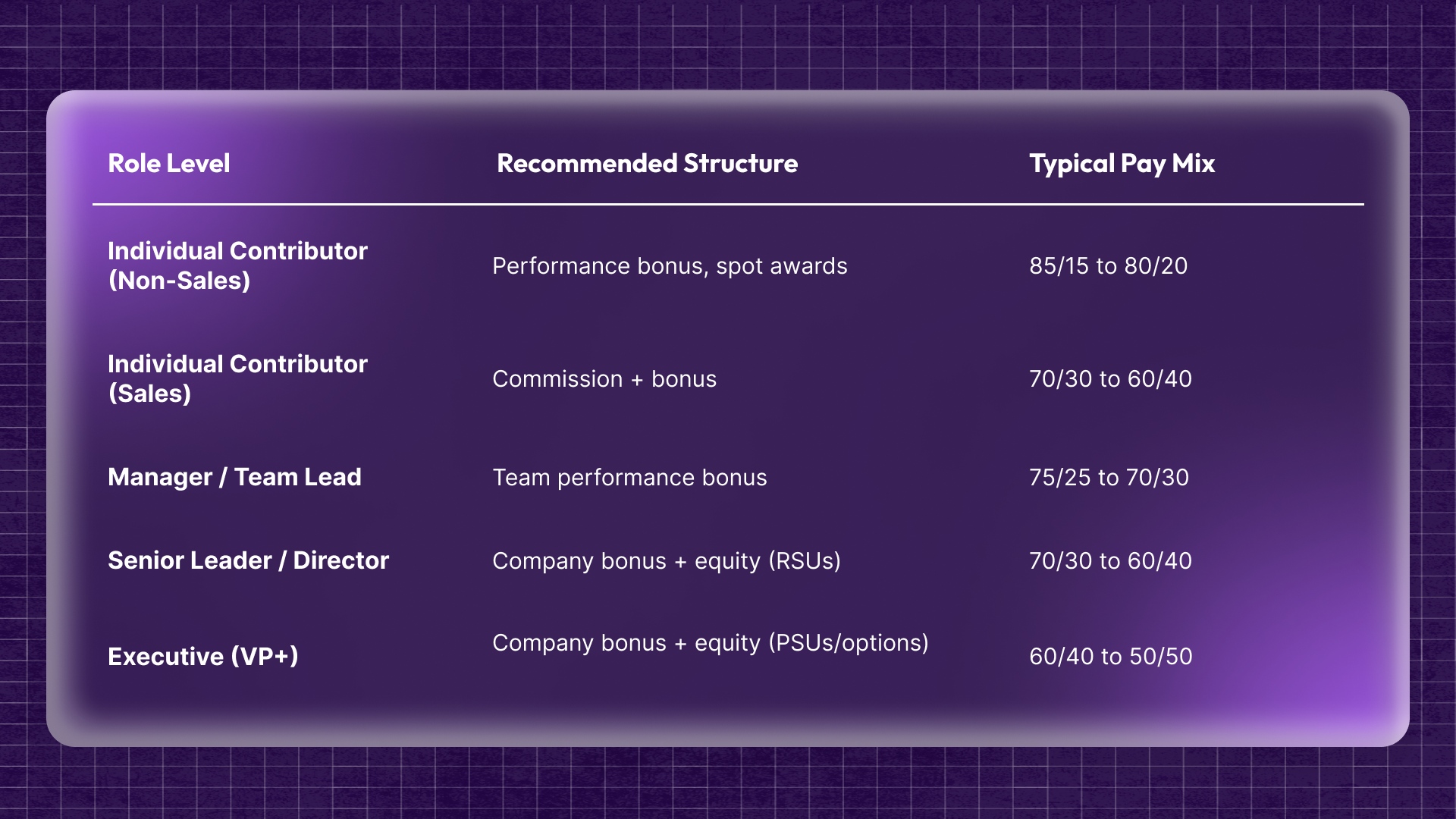
The ratio signals how much of the role's output is measurable and within the employee's direct control. Higher variability works only when targets are clear, achievable, and fair.
Also Read: Understanding Employee Compensation: Beyond Just Salary
Once you've identified the right structure for each role, the next challenge is making the numbers work. That's where pay mix ratios and payout mechanics come in.
How to Calculate At-Risk Pay to Decide Fair Compensation
Calculating at-risk pay starts with Total Target Compensation (TTC), the total amount an employee earns at 100% attainment.
Formula:
At-Risk Pay = TTC × Variable Pay Percentage
For example, an account executive with a $120,000 TTC on a 60/40 plan has a $72,000 base salary and $48,000 in at-risk variable pay. If they achieve 80% of the quota, they earn 80% of the variable component, which is $38,400 for total compensation of $110,400.
More sophisticated plans use payout curves rather than straight-line calculations:
- Below threshold (e.g., <70% attainment): No payout
- Threshold to target (70–100%): Linear payout from 50–75% of variable
- Above target (100%+): Accelerated payout, e.g., 150% of variable for every point above 100%
Payout curves reduce cliff effects and keep employees engaged across the full performance spectrum. But once your structure and math are solid, distributed teams introduce one more layer of complexity that most plans overlook entirely.
How Pay Mix Should Shift for Distributed and Remote Teams
Remote and distributed teams introduce a variable that's easy to overlook: geography. If you're paying the same variable targets to an employee in San Francisco as one in Austin, you may be creating unintended inequity or overpaying in one market and under-compensating in another.
Geo-adjusting at-risk pay requires a clear policy decision. Most companies take one of three approaches:
- Location-based base pay with standardized variable: Adjust the base salary by location tier while keeping the variable structure consistent. This is the most common approach for sales teams.
- Fully localized TTC: Adjust both base and variable targets by location. More complex to administer but more equitable in outcome.
- National rate with cost-of-labor adjustment: Set pay at a national median and apply a multiplier based on cost of labor, not cost of living. This approach is gaining traction as companies standardize remote work policies.
Whichever model you choose, document it clearly and apply it consistently. Inconsistent geo-adjustment is one of the fastest routes to pay equity claims. This brings us to the most important question, which is how at-risk pay benefits your business.
Also Read: Mastering Employee Pay Growth Modeling Techniques

Why Companies Use At-Risk Pay: Benefits & Business Impact
Naturally, when at-risk pay is built into a compensation strategy intentionally, it solves problems that fixed pay simply can't. For example,
- Cost flexibility: Variable pay scales with business performance. In a down quarter, payouts contract naturally. In a strong quarter, top performers earn more without requiring a permanent salary adjustment.
- Talent differentiation: Flat salary structures reward tenure, not performance. At-risk pay gives you a tool to reward top contributors without creating internal equity problems from ad hoc raises.
- Alignment: When employees' earnings are tied to the right metrics, they focus on what actually moves the business forward.
- Attraction and retention: In competitive talent markets, strong on-target earnings (OTE) attract candidates who are confident in their ability to perform and want to be compensated for it.
These benefits only materialize when the plan is designed carefully. Poorly structured at-risk pay creates the opposite effect, such as disengagement, turnover, and pay inequity.
5 Real Risks of At-Risk Pay And How to Design Around Them

At-risk pay done poorly creates more problems than it solves. These are the five most common failure modes and how to address each one:
1. Demotivation When Targets Feel Unachievable
When targets are set too high, employees disengage rather than stretch. Research consistently shows that goals perceived as impossible reduce effort rather than increase it. Calibrate targets using historical attainment data.
2. Short-Termism, When Incentives Reward the Wrong Behaviors:
Commission structures optimized for closed revenue can incentivize shortcuts like overselling, customer mismatches, or discounting that damage margins. Build in metrics that reflect quality and retention, not just volume.
Customer health scores, net revenue retention, or margin thresholds can balance short-term incentives effectively.
3. Pay Equity Gaps Across Gender, Race, and Geography
Variable pay is one of the primary drivers of compensation disparity. When discretionary bonuses are distributed inconsistently or when targets systematically disadvantage certain groups, the legal and reputational exposure is significant.
Pay transparency laws in California, New York, Colorado, and other states are expanding requirements for documenting and disclosing compensation ranges. Audit variable pay outcomes by demographic group annually.
4. Collaboration Breakdown in Team-Based Environments
Individual incentives in collaborative environments create perverse dynamics. People optimize for their own metrics at the expense of shared outcomes.
If your team needs to work together to deliver results, consider team-level bonus pools or dual metrics that include both individual and collective performance.
5. Budget Overruns When Performance Exceeds Plan
Accelerated commission structures can create significant over-plan costs in strong performance years. Model your payout curves at multiple attainment scenarios like 80%, 100%, 120%, and 150%, before you launch a plan.
Build a cap or a renegotiation clause for outlier performance if budget exposure is a concern.
Also Read: How to Create an Effective Employee Incentive Plan
Each of these risks has a design solution. Along with that, there are certain practices that separate plans that hold up from plans that quietly erode trust.
5 Best Practices for Designing Effective At-Risk Pay Plans
Designing an effective plan is less about increasing variable pay and more about getting the structure right, so employees understand what is expected, believe the goals are achievable, and trust the system behind it.
Here are the practices that make that work:
- Set Goals That Are Measurable, Fair, and Within the Employee's Control: Avoid setting goals that are influenced by factors outside the employee's control, like market conditions, product gaps, and resource constraints. Use the controllability test. If a strong performer couldn't hit this target in a bad external environment, reconsider the metric.
- Build Payout Curves, Avoid Cliff Edges: Cliff-edge designs, where an employee earns nothing below a single threshold and full payout above it, create anxiety and binary outcomes. Graduated curves reward partial achievement and keep employees engaged throughout the performance period.
- Include Clawback Provisions for Enterprise-Grade Plans: Clawback provisions allow you to recover variable pay if underlying results are later restated or reversed. They're standard in executive compensation plans and increasingly common in sales. They align payout with durable outcomes.
- Communicate Proactively: Most importantly, employees who don't understand how their variable pay is calculated don't trust it, and an incentive that isn't trusted doesn't motivate. Share the full plan document at the start of each cycle. Provide ongoing attainment updates. Make it easy to model expected earnings.
- Review and Recalibrate At-Risk Pay Annually Against Market Benchmarks: Compensation benchmarks shift year over year. So, build an annual review into your compensation calendar that includes external benchmarking, internal equity analysis, and attainment data from the prior year.
Following these five practices will get your plan to a defensible starting point. But executing them consistently, across geographies, departments, and rapid headcount growth, is where the operational challenge really begins. That's where the right tooling matters.
How CandorIQ Helps You Manage At-Risk Pay for Your Scaling Distributed Team in 2026
Managing at-risk pay manually can lead to errors, delays, and a lack of transparency. By the time a compensation decision surfaces a problem, a pay equity gap, a budget overrun, or a misaligned quota, it's become uncontrolled.

CandorIQ is a comprehensive compensation and headcount planning platform built to replace that fragmented process. It consolidates pay band management, compensation cycles, headcount forecasting, offer workflows, and workforce analytics into a single system.
Here's what that looks like in practice:
- Compensation & Pay Band Builder: Define pay bands by level, location, and department. Apply location-based salary adjustments using benchmark datasets, visualize pay distribution in real time, and maintain version control for historical auditability.
- Compensation Cycle Management: Automate merit and bonus reviews with built-in approval logic, in-platform collaboration, and real-time budget tracking by department.
- Candidate Offers & Total Comp Transparency: Give candidates and employees a clear view of their full compensation package, salary, equity, bonus, and benefits, with future-value equity modeling and interactive help content built in.
- Headcount Scenario Planning: Model future org structures and view their financial implications before committing. Finance and People Ops can collaborate on multiple hiring scenarios, toggle against budget thresholds, and align on workforce plans.
- Headcount Requests & Approvals: Create new hire requests with embedded job details, rationale, and budget data. Route approvals dynamically based on team, location, or compensation range, and sync directly with ATS and finance systems.
- Workforce Management: Track open roles, filled seats, attrition, and promotion rates in one view. Align actuals versus plan on both headcount and compensation, and build custom dashboards for exec, Finance, or HRBP teams.
- AI Agent: Get compensation recommendations based on historical benchmarks and peer data. Ask natural language questions to analyze pay gaps, forecast workforce needs, or model the financial impact of a new incentive structure.
This gives your HR and Finance teams the real-time visibility and cross-functional alignment they need to manage variable pay with confidence.

FAQs
Is at-risk pay the same as variable pay?
They're related but not identical. Variable pay is the broader category, any pay that varies based on output. At-risk pay specifically emphasizes that the variable portion may not be earned at all if performance conditions aren't met. All at-risk pay is variable pay, but not all variable pay frames itself as "at risk."
Can non-sales roles have at-risk pay?
Yes. Performance bonuses tied to individual, team, or company goals can apply to any function, such as engineering, finance, HR, or operations. The key is that the metrics need to be meaningful and within the employee's sphere of influence. Using revenue targets for a non-revenue-generating role, for example, tends to create frustration rather than motivation.
How do pay transparency laws affect at-risk pay disclosure?
An increasing number of U.S. states, including California, New York, Colorado, Washington, and Illinois, require employers to disclose compensation ranges in job postings. Some laws also require employers to provide current employees with pay range information upon request. For at-risk pay, this typically means disclosing the OTE (on-target earnings) range, not just the base. Consult legal counsel for state-specific requirements as this landscape continues to evolve.
What's the difference between discretionary and non-discretionary bonuses?
Non-discretionary bonuses are pre-announced and tied to defined performance criteria. Because they're promised in advance, they must be included in the regular rate of pay for overtime calculations under the FLSA. Discretionary bonuses are granted at management's sole discretion, with no pre-set formula. They do not affect overtime calculations. The distinction matters for compliance, mislabeling a non-discretionary bonus as discretionary is a common FLSA risk.
How do you structure at-risk pay for a distributed remote team?
Start by deciding whether your company uses location-based pay tiers or a national rate. Then apply your pay mix ratios consistently within each tier. Ensure that performance targets are calibrated for the local market, quota targets set for San Francisco may not translate fairly to employees in lower-cost markets. Use a documented, auditable geo-adjustment methodology and review it annually against updated market data.
Ready to modernize your workforce and compensation strategy?
See how CandorIQ brings workforce planning and compensation together with AI.