

AI Compensation Management: How HR Leaders Modernize Pay in 2026
AI compensation management is changing how HR and Finance make pay decisions. See what leading teams are doing differently in 2026.

Your best people are not waiting for your next annual comp review to decide if they are paid fairly. They are already on Levels.fyi, LinkedIn Salary and Glassdoor are comparing numbers.
And the data backs up that urgency. According to SHRM's 2025 Talent Trends report, 43% of organizations now use AI for HR tasks, up from just 26% in 2024, with compensation planning among the fastest-growing applications. The shift is happening because traditional pay processes, built on spreadsheets and annual surveys, cannot keep up with how fast the talent market moves.
AI compensation management fixes that. It integrates real-time market data, internal pay history, and budget constraints into a single workflow, enabling HR and finance teams to make faster, fairer, and more defensible pay decisions.
This guide covers what it is, why manual approaches break at scale, and how to put it to work in your organization.
In a Nutshell
- AI compensation management combines internal pay data, market benchmarks, and budget context to enable faster, more consistent pay decisions.
- Traditional spreadsheet-based compensation planning breaks down at scale due to fragmented data, outdated salary benchmarks, and limited visibility into pay equity.
- AI improves compensation management through continuous market benchmarking, pay equity monitoring, compensation scenario modeling, and automated merit workflows.
- Successful implementation depends on clean compensation data, a clearly defined compensation philosophy, and close collaboration between HR and Finance.
- Platforms like CandorIQ enable AI-driven compensation management by integrating pay bands, headcount planning, approval workflows, and workforce analytics into a single system.
What Is AI Compensation Management?
AI compensation management refers to the use of artificial intelligence to analyze, manage, and optimize employee pay decisions. It is not a single feature. It is a capability category that touches every stage of the compensation workflow, from building pay bands to running merit cycles to communicating total rewards.
At its core, it connects three things that have traditionally lived in separate systems:
- Internal compensation data from your HRIS, payroll system, and performance platform.
- External market intelligence from real-time salary surveys and benchmarking sources.
- Business context from your headcount plan, approved budget, and growth targets.
When these inputs are unified, AI can surface insights that would take a compensation analyst days to produce manually. It can flag a role below the 25th market percentile, identify a department in which female employees are systematically paid below their male peers at the same level, or model the cost of a 4% average merit increase across three different hiring scenarios.
Why Traditional Compensation Management Breaks at Scale?
For a 50-person company with one office, a well-maintained spreadsheet can handle compensation planning. HR can track salaries, review raises, and manage adjustments without too much complexity.
But once a company grows to hundreds of employees across locations, everything begins to overlap. At that point, traditional compensation systems start to struggle.
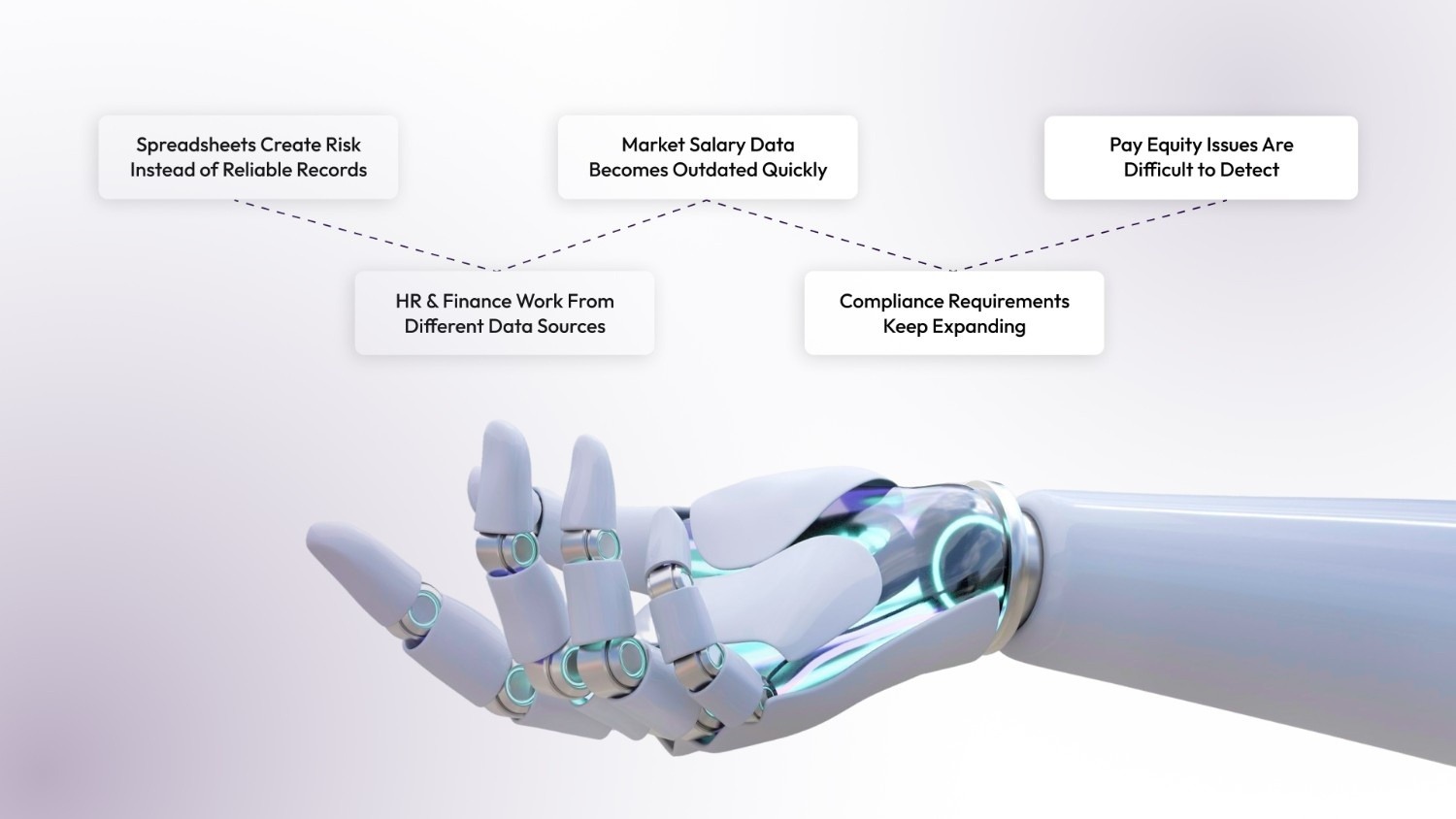
Here are the main reasons compensation management breaks down as organizations scale.
- Spreadsheets Create Risk Instead of Reliable Records: Compensation planning often relies on shared spreadsheets that multiple managers update. As versions multiply, errors, missing data, and conflicting numbers become harder to track.
- HR and Finance Work From Different Data Sources: HR may build compensation recommendations while finance analyzes payroll impact separately. Without a shared system, both teams end up working with different numbers.
- Market Salary Data Becomes Outdated Quickly: Many companies benchmark salaries once or twice a year. In fast-moving job markets, compensation levels can change much faster than that.
- Compliance Requirements Keep Expanding: Pay transparency laws require companies to disclose salary ranges and maintain clear compensation records. Managing this manually becomes harder as organizations grow.
- Pay Equity Issues Are Difficult to Detect: Differences in hiring offers, promotions, or location-based pay can slowly create compensation gaps. Without strong visibility into workforce data, these issues often go unnoticed.
As organizations scale, compensation planning requires better visibility, coordination, and data accuracy than traditional tools can provide.
Suggested Read: Enterprise Compensation Management: The Basics
How AI Improves Compensation Management?
AI does not patch the problems with traditional compensation management. It replaces the conditions that give rise to them. Here is where the impact is most clearly felt for HR and finance teams.
- Continuous Market Benchmarking: AI platforms ingest compensation survey data and labor market signals to keep salary benchmarks current. Instead of refreshing salary bands once a year, teams can see where their pay stands against the market in real time.
- Smarter Pay Recommendations: AI models can analyze internal factors like role, performance, tenure, and pay history alongside market benchmarks to recommend salary adjustments, promotions, or equity grants. This helps compensation teams make decisions that are consistent across the organization.
- Pay Equity Monitoring: Compensation teams often discover pay gaps only after audits. AI can continuously analyze compensation data across roles, levels, and demographics to flag potential pay equity issues early.
- Compensation Scenario Modeling: AI tools enable teams to simulate compensation changes before implementation. For example, HR and Finance can model the cost of a 5% merit increase across departments or understand the budget impact of promotion cycles.
- Automated Compensation Workflows: Merit cycles, promotion adjustments, and compensation approvals involve multiple stakeholders. AI-driven systems can automate these workflows, reducing manual coordination between HR, Finance, and managers.
- Unified Compensation Data: AI systems bring together HRIS data, payroll information, and external market benchmarks into a single environment. This gives compensation leaders a clearer view of pay distribution, budget utilization, and compensation trends across the organization.
Still running merit cycles in Excel? CandorIQ gives HR and Finance a shared, AI-powered workspace to plan, approve, and execute compensation decisions with full budget visibility. Book a Demo to explore more.
Key Use Cases of AI Compensation Management
AI compensation management surfaces across every stage of the pay workflow. The table below maps the most impactful use cases, what AI actually does in each case, and the business outcome for HR and finance teams.
Real-World Example: Headcount Scenario Modeling
Consider a growth-stage SaaS company planning its next fiscal year. The CFO wants to understand the payroll impact of three possible headcount plans: conservative, on-target, and accelerated growth.
- Without AI, HR pulls headcount data, Finance models costs in a separate system, and there are multiple rounds of back-and-forth before a single number is agreed on.
- With AI compensation management, both teams work from the same platform, scenarios toggle in real time, and budget impact updates instantly. Leadership sees the full picture before making a decision, not after committing to a headcount plan.
Also Read: Top Benefits of a Talent Management System for Growing Organizations.
How to Successfully Implement AI in Compensation Management?
The organizations that see the most value from AI compensation management treat it as a process change first and a software implementation second.
Follow these steps to set the implementation up for success from day one:
Step 1: Start with Data Quality, Not Software Selection
AI is only as accurate as the data feeding it. Before evaluating any platform, audit the health of your compensation data. Inconsistent job titles, missing levels, and incomplete location records will produce unreliable output from even the best tool.
- Map your job architecture and standardize titles and levels across departments.
- Confirm every employee record includes role, level, location, hire date, current salary, and last review date.
Step 2: Define Your Compensation Philosophy Before You Configure Anything
AI can execute your compensation strategy with precision. It cannot define one for you. Align with leadership on the fundamentals before configuring pay bands or running benchmarking:
- Where do you want to sit relative to the market? 50th percentile, 75th, or higher for specific critical roles?
- How do you handle geographic pay differentials? National bands, location-adjusted rates, or a hybrid?
- What is your philosophy on pay equity? Do you commit to regular audits and public reporting?
- What budget constraints are non-negotiable, and where do you have flexibility?
Step 3: Bring Finance and HR Together From Day One
Make Finance and HR co-owners of the platform from the start. When Finance only sees compensation data at the approval stage, it becomes a gatekeeper. When they are part of the same workflow from scenario modeling through approval, they become partners.
- Set up shared dashboards that both teams can see without exporting data.
- Include Finance in the approval logic design, not just as final approvers.
- Agree on how budget utilization is calculated and reported before the first merit cycle runs.
Step 4: Run a Controlled Pilot Before Full Rollout
Choose one compensation cycle, one department, or one use case to test first. A controlled pilot lets you identify data gaps, refine workflows, and build manager confidence.
- Teams that skip the pilot phase often spend the first full cycle putting out fires that a smaller test would have caught.
- Document what you learn. Pilot insights directly shape how you configure the platform at scale.
Step 5: Invest in Manager Training
AI tools surface recommendations. Managers make final decisions. Build training that covers:
- How AI-generated pay ranges are calculated and what data sources they draw from
- When to follow the recommendation and when to apply judgment, the system cannot capture.
- An upcoming promotion, a retention risk a survey has not flagged yet, or a specific circumstance a manager sees firsthand.
Also Read: Compensation Management Software Guide for HR Teams in 2025.
What to Look for in an AI Compensation Management Platform?
Not every platform delivers on its AI promises. These are the criteria that separate genuinely capable platforms from ones that automate the surface without solving the underlying problem.
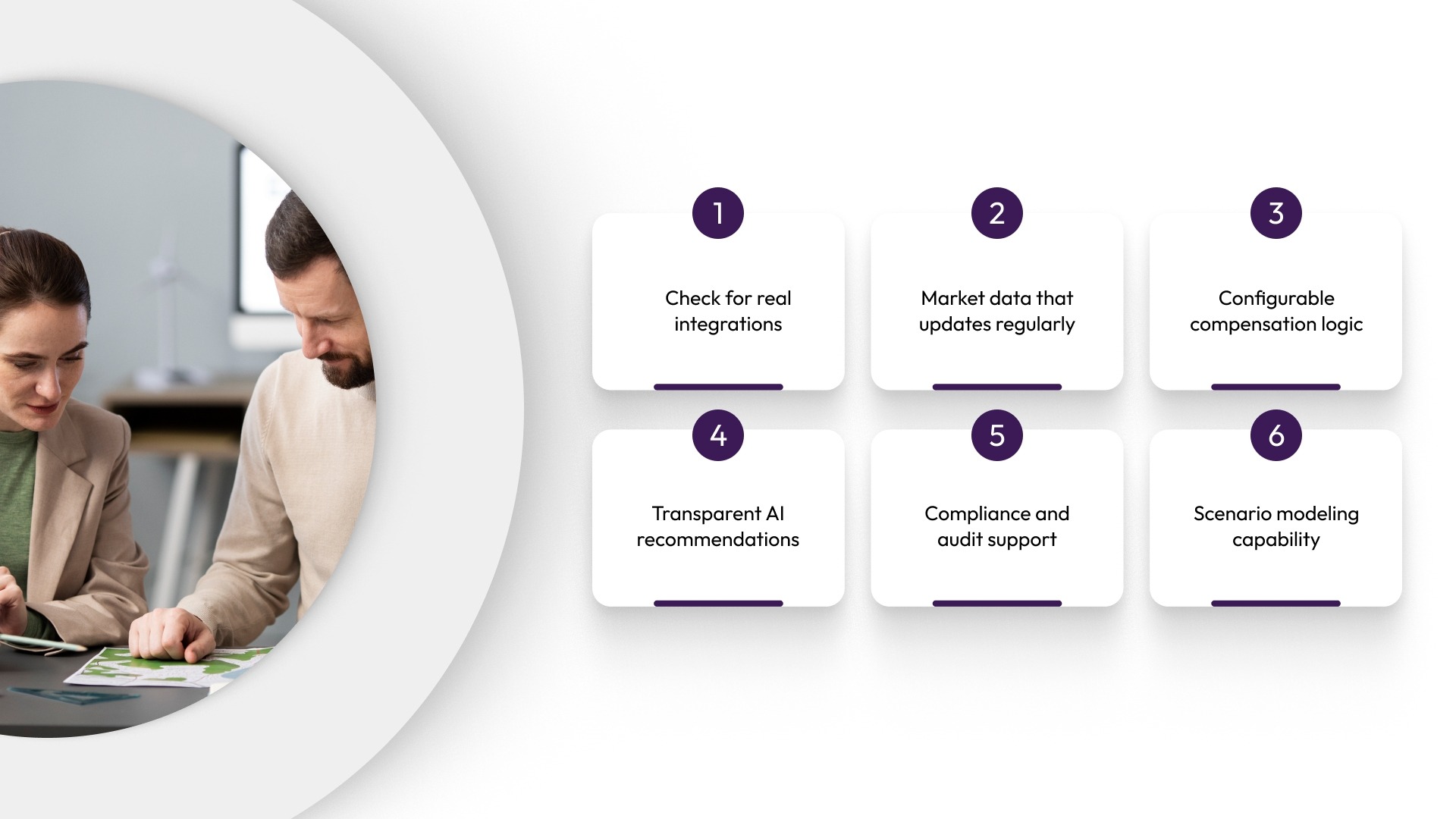
Evaluate each vendor against these six criteria before making a decision:
- Check for real integrations: The platform should connect natively to your HRIS, ATS, and payroll system. Data should flow in automatically and stay current. If onboarding requires CSV exports and manual imports, the process is still manual.
- Market data that updates regularly: Ask every vendor how often their benchmark data refreshes. A platform built on annual survey data is still a lagging indicator, just in software form. Look for tools that pull from multiple data sources and update frequently.
- Configurable compensation logic: Every organization has a different job architecture, geographic footprint, and approval structure. The right platform lets you configure pay bands and routing rules to match your organization, not the other way around.
- Transparent AI recommendations: When AI suggests a pay range or flags a gap, it should explain why. What data sources were used? What factors were controlled for? Opaque outputs create distrust. Managers who cannot explain a decision to an employee should not have to make one.
- Compliance and audit support: With pay transparency requirements expanding across U.S. states, you need a clear record of every compensation decision. The platform should log decisions, flag policy violations before approval, and produce documentation ready for leadership or regulators.
- Scenario modeling capability: Finance needs to see the budget impact of each option before approving. Platforms that support only one-option-at-a-time planning create a bottleneck where speed matters most.
Suggested Read: Understanding Merit-Based Pay: Benefits and Implementation
How CandorIQ Supports AI Compensation Management?
CandorIQ is a modern headcount and compensation planning platform built for HR and finance teams that have outgrown spreadsheets. Trusted by 300+ organizations, it brings AI agents into the core workflows where compensation decisions get made, so both teams can move fast, stay aligned, and make decisions with confidence.
Here is what CandorIQ delivers across the AI compensation management workflow:
AI Agent: Your On-Demand Compensation Analyst
CandorIQ's built-in AI Agent lets you ask natural language questions directly about your workforce and compensation data. No report building. No waiting for an analyst. You ask, the system answers with data-backed insight.
- Which roles in engineering are below the 50th market percentile?
- Which department has the highest pay equity risk?
- Which employees are most likely to seek outside offers in the next 90 days?
- What does a 4% average merit increase cost us in Q2 versus a 3.5% increase?
The AI Agent also surfaces proactive recommendations based on historical benchmarks and peer data, giving CPOs, CFOs, and HR business partners strategic insight when they need it, without waiting for someone to pull it.
Compensation and Payband Builder
Build and manage pay bands by level, location, and department with full version history and real-time audit trail. Apply geo-adjusted salary benchmarks to your pay structure. Visualize where every employee sits within their band. CandorIQ eliminates the spreadsheet and gives you a live compensation architecture that reflects both current market conditions and your internal structure.
For compliance teams and legal, every change to a pay band is logged with a timestamp, reason, and approver. That record exists whether you need it for internal governance or external reporting.
Compensation Cycle Automation
CandorIQ automates merit and bonus cycles end-to-end. Managers receive their budget allocation, review AI-generated recommendations for their team, add rationale notes, and submit approvals, all within the platform.
- Real-time budget tracking so Finance sees utilization as approvals come in, not after the cycle closes.
- Automated routing based on compensation level, team size, or org structure.
- Policy guardrails that flag outlier recommendations before they reach final approval.
- Slack and email integrations to keep the cycle moving without chasing reminders manually.
Cycles that used to take three to four weeks close in under a week. The back-and-forth between HR and Finance drops from dozens of emails to a single shared workflow.
Headcount Scenario Planning
CandorIQ lets HR and Finance model future org structures together, in real time, on the same platform. Toggle between a conservative headcount plan and an accelerated one. See how each scenario affects total payroll, cash burn, and budget thresholds. Share the output with leadership before a decision is made, not after a spreadsheet has been circulated for three rounds of edits.
For budget-sensitive CFOs and FP&A leaders, this feature replaces a full day of modeling with a 20-minute collaborative session.
Headcount Requests and Approvals
Every new hire request in CandorIQ includes embedded job details, compensation context, budget rationale, and routing rules. Approvals vary dynamically by team, location, or pay range. The approved request syncs directly with your ATS and finance system, so hiring velocity stays high and the paper trail stays clean.
Conclusion
AI compensation management is not a future trend. It is already changing how winning teams in the talent market make pay decisions.
The organizations pulling ahead are not necessarily spending more on compensation. They are spending it smarter. They benchmark in real time. They close merit cycles in days. They catch pay equity gaps before they become problems. They model headcount costs before Finance signs off, not after. And they give employees clear visibility into the value of their total compensation package.
All of that is possible because they have stopped treating compensation as a spreadsheet problem and started treating it as a data problem, with the right tools to solve it.
CandorIQ was built for exactly this. It connects the data, automates the workflow, and gives HR and finance teams the AI-powered visibility they need to make compensation decisions quickly, accurately, and equitably.
If you are ready to build a compensation process that keeps pace with your business, start with CandorIQ. Book a demo today.
.png)
FAQs
1. How is AI used in compensation and benefits?
AI analyzes internal salary data, market benchmarks, and workforce trends to recommend pay adjustments, identify risks, automate compensation workflows, and help HR teams design competitive and sustainable reward strategies.
2. What are the risks of using AI in compensation decisions?
The main risks include biased training data, inaccurate job architecture, and a lack of transparency in recommendations. Organizations must audit data sources, maintain oversight, and ensure human review before final decisions.
3. How accurate are AI salary benchmarking tools?
Accuracy depends on data quality and sources. Platforms using multiple real-time compensation datasets and updated labor market signals typically produce more reliable benchmarks than static annual survey data.
4. Can AI predict employee turnover related to compensation?
Some AI tools analyze compensation gaps, promotion timing, engagement signals, and market benchmarks to identify employees who may be underpaid relative to peers and therefore more likely to explore external offers.
5. How do companies maintain transparency when using AI for pay decisions?
Organizations maintain transparency by documenting compensation frameworks, explaining factors behind AI recommendations, maintaining clear pay bands, and ensuring managers can communicate how salary decisions were determined.
Ready to modernize your workforce and compensation strategy?
See how CandorIQ brings workforce planning and compensation together with AI.