
Jun 4, 2026

Position Management in Practice: Getting HR and Finance Aligned
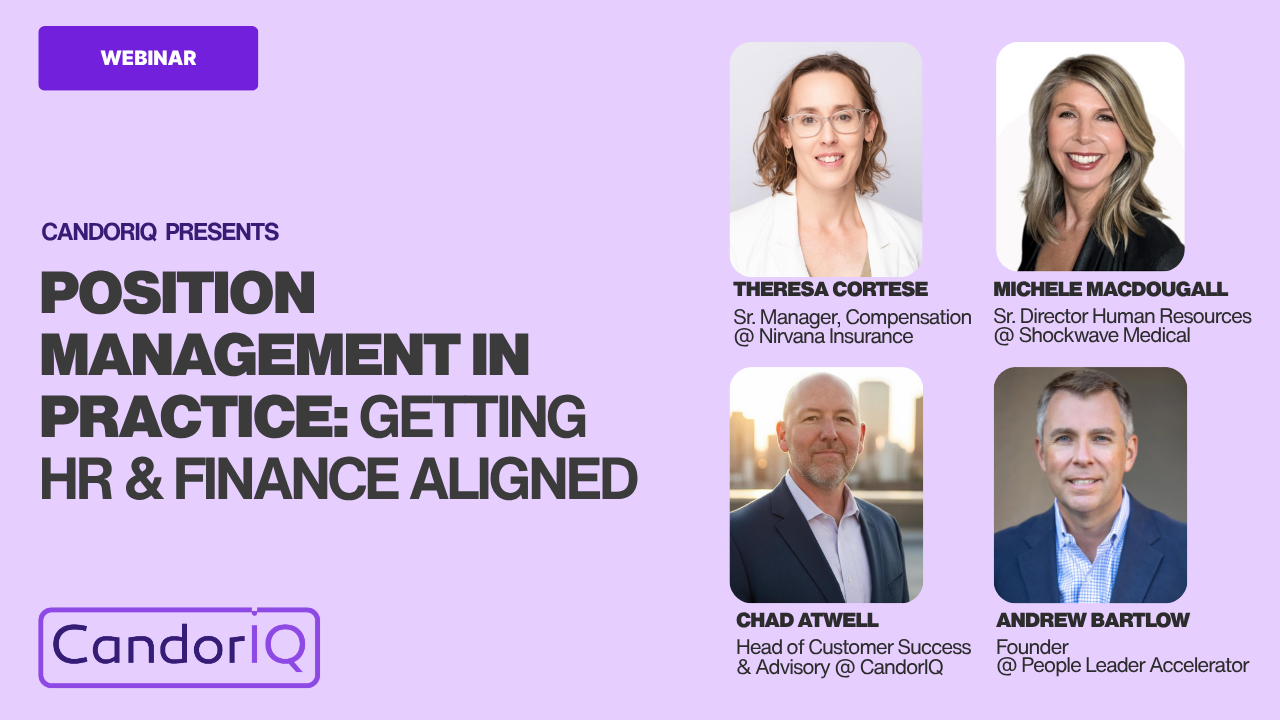
Position Management in Practice: Getting HR and Finance Aligned
12:00 PM

Webinar recap: Chad Atwell sits down with Andrew Bartlow, Theresa Cortese, and Michele MacDougall from People Leader Accelerator to unpack why HR and Finance alignment is so hard and what the teams getting it right are actually doing differently.

For years, HR and Finance have run on parallel tracks. HR thinks in headcount, roles, and people. Finance thinks in budget, burn, and forecast. Most companies bridge the gap with spreadsheets, late-night emails, and a lot of goodwill.

But as discussed in our latest CandorIQ webinar, that approach is hitting its limit. Tighter budgets, AI reshaping roles, and continuous workforce planning have made position management one of the highest-leverage problems a company can solve right now.

The conversation focused less on systems, and more on relationships, shared definitions, and the practical moves teams can make starting tomorrow.

Below is my recap of the conversation, but you can catch the webinar HERE (it's worth the watch!).

1. Where HR and Finance Alignment Actually Breaks Down

Across nearly every company, the same patterns show up. Hiring plans live in one system. Budgets live in another. Approvals happen async, and by the time Finance sees a req, HR has already promised the hire.

"The HR–Finance handoff doesn't break because people are bad at their jobs. It breaks because they're working from different versions of the truth." -— Andrew Bartlow

"Backfill vs. net new" gets muddled. Reorgs and internal moves wreck the plan. And nobody has a shared definition of "open" vs. "approved" vs. "filled."

2. Position Management Is a Relationship, Not a System

One of the biggest reframes from the conversation:

"Position management is a relationship, not a system." — Theresa Cortese

You can buy the best software in the world, but if HR and Finance aren't sitting in the same room with the same plan, it won't matter. The tooling amplifies the relationship, good or bad.

3. What Good Actually Looks Like

For companies doing this well, the workflow is surprisingly consistent:

  • One source of truth, HR and Finance look at the same plan
  • Positions exist independently of people (you can plan a Q3 hire without a name attached)
  • Clear status states everyone agrees on: Draft → Approved → Open → Filled → Closed
  • Approvals built into the workflow, not chased over Slack
  • Monthly or quarterly review cadence, not annual

"Start with the org chart, not the spreadsheet." - Michele MacDougall

4. The Part Most Companies Skip

Most teams want to jump straight to "run." But the cleanup phase is where the value gets unlocked.

"First 30, 60, 90 days look like cleaning the inventory, aligning on definitions with Finance, then building the cadence. Skip those steps and your tool just becomes a prettier spreadsheet." — Chad Atwell

When CandorIQ customers first come in, the most common surprise isn't the tooling gap, it's the number of ghost reqs, stale positions, and manual reconciliations being done every month.

5. Why This Matters More Now

Headcount planning has always been hard. But the last 18 months have made it urgent.

"A wrong hire used to be a Q4 conversation. Now it's a Monday morning Slack from your CFO." — Theresa Cortese

Three forces are converging:

  • Tighter budgets and sharper CFO scrutiny
  • AI reshaping what roles even look like (and which get backfilled vs. eliminated)
  • Workforce planning moving from annual to continuous

The cost of misalignment is higher than it's ever been.

6. AI Is an Accelerant, Not the Answer

A common question came up: where does AI fit into all this?

"AI makes analysis easier. But the decision still requires HR and Finance to agree on what they're optimizing for. Tooling alone won't fix a relationship problem." — Chad Atwell

AI is best deployed as an enabler, reconciliation, anomaly detection, scenario modeling — not as the thing that fixes alignment itself.

7. Practical Moves for the Next 30 Days

The panel's rapid-round on what teams can do tomorrow:

  • Andrew: Get HR and Finance into the same monthly meeting with one shared document not two
  • Theresa: Align on definitions before tools agree on what "approved" means
  • Michele: Start with the org chart, not the spreadsheet
  • Chad: Audit your current open reqs most teams find 10–20% are stale or duplicated

8. The Mindset Shift

When asked what HR leaders should take back to their Finance partner tomorrow:

"Stop bringing two plans into the room. Bring one." — Andrew Bartlow

"Your Finance partner isn't the obstacle. They're the multiplier, if you let them be." — Michele MacDougall

The Big Takeaway

Position management isn't a tooling decision. It's an operating model shift.

The companies that win in 2026 won't be the ones with the most sophisticated systems. They'll be the ones where HR and Finance are looking at one plan, not two.

That alignment doesn't come from software. It comes from shared language, shared cadence, and shared accountability.

Tools amplify alignment. They don't create it.

Watch the full webinar HERE.