

Workforce Planning Beyond Headcount: Getting Your People Strategy Ready for 2027, With Kathryn Gombos
Watch the recording
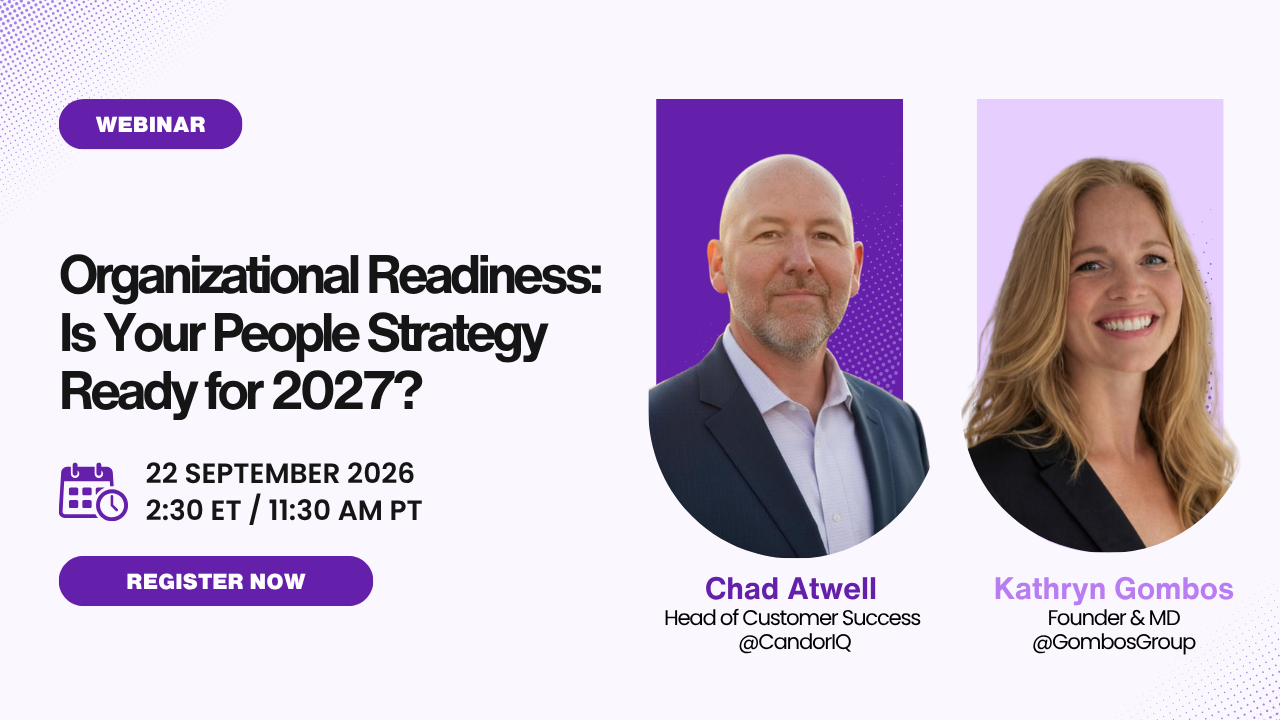
As companies start planning for 2027, having a headcount plan isn’t the same as having a workforce strategy. In this conversation, Chad Atwell and Kathryn Gombos unpack what organizational readiness actually looks like—and why it starts with understanding the work a business needs to accomplish before deciding how many people to hire. They explore how leaders can connect business strategy with workforce skills, organizational design, compensation, and the mix of employees, contractors, technology, and AI needed to get the work done.
The discussion also dives into why companies shouldn’t automatically backfill every role, how AI is changing the skills organizations need, and why HR and Finance need to plan the workforce together. Chad and Kathryn share practical ways to rethink work, identify opportunities to grow, redesign, invest differently, or streamline—and build a workforce plan that can actually adapt as the business changes.
Watch the webinar HERE
What the conversation covers
Readiness starts with strategic clarity, not the budget
Kathryn treats a finished budget and hiring plan as outputs of readiness, not proof of it. Her test is whether the organization can explain how it will execute the strategy over a two to three year horizon, and whether that clarity survives the trip from the executive team to directors and frontline managers. From there she works through five steps in order: strategic clarity, the skills the work needs now and later, organizational design, leadership readiness, and finally rewards and talent strategy aligned to all of it. Jump to this section
Headcount is one outcome of workforce planning
The two terms get used interchangeably, but Kathryn separates them. Workforce planning starts with the work that needs doing and the skills it requires, then decides how to staff it: employees, contractors, or AI. Headcount and cost fall out of those choices. Chad adds the Finance view, where contractor and consultant spend sits apart from employee cost, and argues that seeing both together is what lets a company compare an 80/20 employee to contractor mix against the alternatives. Jump to this section
Four levers for trading off investment: grow, redesign, invest differently, streamline
When leaders weigh what to fund and what to pull back from, Kathryn starts with strategy and the company's appetite for risk, then sorts options into four buckets. Grow through the critical and emerging skills tied to revenue. Redesign workflows instead of forcing an old spreadsheet into new technology. Invest differently by choosing when to build skills internally and when to buy or borrow them, including cleaning up core data so it is ready for AI. Streamline by cutting duplicative, low-value work, like a finance team that still prints invoices off a fax machine. Jump to this section
Don't backfill on autopilot
Both argue that a departure is the best moment to question the role. Jobs are often built around the person who held them, so an automatic backfill can lock in work that no longer fits. Kathryn wants HR business partners to have already modeled what happens if a role opens up, so the conversation is ready before attrition happens. Chad's answer to the worry that this slows hiring is a defined approval workflow, which makes the pause quick instead of a five-signature spreadsheet chase. Jump to this section
AI changes the work, not the fundamentals of pay
Kathryn's advice before any AI redesign is a reality check: know where workforce data lives and whether it can be trusted. She expects skills frameworks to reward adaptability and learning agility more than mastery, while Chad argues human skills like communication and empathy become more valuable as routine work is automated. On compensation, both say the fundamentals hold. Pay still rewards value created, though Kathryn floats new incentive and equity designs, such as phantom stock, for people who own the AI doing their work. Jump to this section
Full transcript
00:01 Chad Atwell, CandorIQ
Hi, everybody. Hi, I'm Chad Atwell. I, I lead customer success and do a lot of advisory work with, customers here at CandorIQ. Really appreciate you, tuning in for our live session today with, Kathryn Gombos. You know, we both spend a lot of time talking with HR leaders, folks in total rewards, finance teams. Right now, especially going into fall, there's a lot of conversations about year-end planning. And, and both Kathryn and I have spent a lot of time working in compensation, but, workforce planning is, is a big focus for a for a lot of the work that we do as well. So just really, really happy to have Kathryn on, the session today, where we can kind of talk about a mix of things going into year end. Very much focused on this idea of organizational readiness and, and not just head count planning, but hopefully getting beyond that and talking about real sort of workforce planning. And of course, we'll dive into some juicy little compensation topics along the way as well. But thanks, Kathryn, for joining us. You wanna do a quick intro for yourself?
01:07 Kathryn Gombos, Gombos Group
Sure, sure. Thanks for having me. Always, always enjoy our conversations, Chad. Kathryn Gombos. I founded Gombos Group in 2022, and we support organizations with, you know, just kind of full suite total rewards support, including workforce planning, job architecture, comp structures. And, have spent about 15, 20 years in this space, whether it be, consulting, when primarily in the consulting space, but also in-house, supporting from a comp perspective and a head of HR perspective. So this stuff is what lights me up. I get excited about this. I think there's a lot of good opportunity for, for organizations and, and it really just has an impact on, on our communities and our, and our neighbors. So.
01:47 Chad Atwell, CandorIQ
That's awesome. Yeah. I, you know, some people ask me, 'cause I've, I've jumped around a little bit in my career and, and definitely I've, I've been with CandorIQ now for a few years. And, people ask me, like, what drew me to it, and it is sort of this unique combination of a, of a tech vendor that's addressing both compensation and head count together. It's just such a magic combination. I actually speak on this one particular topic, with some of the, WorldatWork affiliates, and cross our fingers maybe at the conference next year. Like, how do compensation people sort of go broader? Like, how do they kind of open their aperture a little bit? And it ultimately becomes, like, workforce planning. How do you get more involved in planning what the future direction of the business is going to be? You're already playing a very strategic, very important role under the compensation umbrella, but there's more to it than that, right? And so there's this idea that we'll talk through today around compensation, you know, overall workforce spend, but then there's this idea of, like, readiness and, like, organizational, readiness and, and that's kind of where I want to start. Maybe just, you know, any, either of us will, will sit down with leaders here between now and the end of the year, and if you hear somebody say, you know, "We're ready, we know what our plan is for 2027," you know, what does that mean to you, sort of this idea of readiness? How do you define that? How would you maybe poke and, and prod a leader to really test if they know what they're talking about when it comes to that too?
03:22 Kathryn Gombos, Gombos Group
Sure. Sure. Yeah, I mean, I think, oftentimes the, the check the box activities around organizational readiness look like, do we have our budget in place? Do we have clarity on sort of what we need from, a head count perspective, how many more people, what our hiring plan is? And I think, I think those things matter, but I actually think they're really an output of good readiness thinking. So when I think about organizational readiness, I, I want, I want to be able to clearly articulate how our current organization is gonna execute the business strategy that we say we want to achieve. And, and not, you know, tomorrow. We're, we're also thinking, you know, with a longer planning horizon, two to three years down the road. So before we can say we're getting ready for 2027, I mean, that's kind of one of the first questions I'm thinking through in my head is, am I dealing with a leadership team that is thinking about quarterly planning horizons, or are we two to three years down the road? And I think a lot of that comes with that strategic clarity. So first, do we have strategic clarity? Do, do we have a shared understanding at the, you know, executive level in their partnership with the board? But then also, how does that clarity trickle down to the directors? Because directors are charged with operationalizing that strategy. And is there alignment there, or does the, the game of telephone happen as we work our way to the frontline managers? So first and foremost, strategic clarity. Oftentimes that's kind of where you spin. And then from there, that's when we can start to think about, all right, what capabilities do we have within our in our workforce, right? Do we have the skills that are needed today? Do we have the skills that are required for the future? Knowing that the future is, and will always be, and has been unknown but we can make some assumptions of what that might be. And I think that becomes kind of more relevant today with this shift in AI, right? This transition from pre-internet to internet is probably less great than pre-AI to post-AI.
05:25 Chad Atwell, CandorIQ
Yeah, that was a big shift back then, for sure. Yeah.
05:28 Kathryn Gombos, Gombos Group
Yeah, yeah. Right, and I think about, you know, the talent that, that grows up with a phone in their hand or grows up with self-driving cars. That's gonna be a very different capability and, and analysis around the workforce. So that would be probably my second step is, do we have real clarity on what skills we're relying on in the next few years, 2027 at least? With those two things, then we think about organizational design, right? So how is the company structured, and are we structured in a way that sort of reduces friction and, and helps decisions be made, More soundly, more quickly with accountability, or are there barriers to that, that execution? Which kind of leads to that fourth step in my mind around leadership readiness. So not just, you know, can you come up with a plan? Can you assess what skills are needed and can you design an organization that helps you get there to that, that strategic plan? But are you as a leader ready to sort of adapt and evolve and yourself, but then also kind of coach and mentor and develop those along with us? And then I'd say the last one, which, you know, speaks to our, our hearts is, is really just getting those those reward strategies and that talent strategy to align with all of that. You know, so thinking about, rewarding the right behaviors and capabilities and, and, and making sure that that all sort of is in alignment with the other, the other few steps to know whether or not we're ready for next year and the years to come.
06:57 Chad Atwell, CandorIQ
That's awesome. Yeah. I, I, I think the, you know, we work with a real mix of different types of customers, variety of different industries and sizes and US and global and, and just a, a wide variety. I love those five steps are universal. Like, just being able to say, if you can't get to that strategic clarity to begin with, do not pass go. Like, you, you are not moving to the next stage. And there, it, it, and, and then you circle around to the leadership aspect of it. Obviously, just being able to have that clarity in the first place requires a momentous amount of leadership, that you're not just taking in all of the, the priorities and the talking points from all of the other leaders in your business, but you're making a very firm directional decision on what that should be and what, what, what your course is going to look like, not just for the next year, but maybe three years down the road and setting that vision, for sure. But yeah, we'll, we'll circle back to all of those topics. Appreciate you kind of setting that up. But I, I think even for the, the smallest organizations, that we work with, there's still a lot of good, discussion around what they're trying to achieve, especially when you're in a startup phase like we're in as well. It's just being able to address, like, where is the next high growth area? Where are we trying to build more infrastructure? Like, just trying to moderate and balance all of those different priorities as well. But
08:27 Kathryn Gombos, Gombos Group
Yeah. Yeah. I think your point about kind of those steps being universal is something that I've found to be true. I'd be curious if you think so too, but you know, that the challenges that executives face kind of regardless of industry, location, or size even they're similar challenges. And so it's, it's a, it's a tough job, right? To have to take in all these great ideas and sort of synthesize them into, like, this is what we're gonna do, but it's an important one to get kind of all folks rowing in the same direction.
08:54 Chad Atwell, CandorIQ
Yeah. And, which is, which is strange because I think my experience with anything related to headcount planning, workforce planning, whatever it is that we call it, I think most organizations don't get there for a very long time in their, in their journey. They will, you know, try to set priorities and then immediately becomes about hiring and hiring to bring in growth, to accommodate growth, to be able to, like, sustain growth. Like, the, that they're just hiring to be able to do that, and it's very often a very, you know, ad hoc kind of a process for them. So it is interesting how critical the workforce planning part of it is, and so many organizations still just don't really get to it and for you know a very long part of their history. Sometimes even enterprise level companies, you know, they just don't take it on as much as they possibly should for that.
09:44 Kathryn Gombos, Gombos Group
Right. Right. Yeah. I mean, it can be a little bit easier to just sort of run the same playbook than it is to sort of say like, "Okay, how are we gonna, how are we gonna really think this through?"
09:54 Chad Atwell, CandorIQ
Exactly. Yeah. So I, I'll, I'll give you just a, a real standard example. Most of our customers that come to us, if they're using us for compensation planning or workforce planning, any of that, it all starts usually with a spreadsheet. They have a spreadsheet that they wanna use, that they wanna replicate into our tool, and we're very, kind hopefully with them about, you know, yeah, this is not just automating a spreadsheet, this is building out a function and a, a new, muscle for you as an organization very often. So talk a little bit more about that, like how organizations just kind of take the you know, whatever spreadsheet they have, they just replicate that and kind of keep marching forward, if they don't have another system in place already.
10:38 Kathryn Gombos, Gombos Group
Yeah. Yeah. I mean, I think about that, so what it sparks for me is the idea around sort of job architecture and job descriptions and the opportunity there, right? Instead of we lost a financial planning analysis P2, right? Is this an opportunity to sort of reassess how the work is getting done? So to your point, right, are we just replicating the spreadsheet in a new system, or are we getting a new system that helps us think differently about how to do this stuff more effectively with better insights, all of that good stuff. So, you know, pretty similarly when you think about job architecture, you know, instead of just rehiring and backfilling that role, it's a good opportunity to sort of say like, "Is this, is this actually the work that's being done, the work that we need done, and designed in the way that helps us achieve our, our, our business outcomes from a strategy perspective, but also from a financial planning and headcount, perspective as well?" Which kind of in my mind kind of loops back to a tool like yours, right? That kind of helps connect the dots, there between, you know, are we, really taking this as an opportunity to, to, to think about how we could do this better or are we just trying to replicate what we've always done?
11:46 Chad Atwell, CandorIQ
Sure. Yeah. And sometimes, I mean, not every organization is completely changing their strategy from year to year, right? So there is something to be said about kind of having a a slow and steady, wins the race for some organizations. But to your point, that whole dynamic around technology and AI and skills, in the workforce is definitely accelerating, if not completely changing in some cases. And, just being able to stay on top of what that means, it opens up all kinds of new opportunities. I think that's the one thing for me that I think when you get past the worksheet, because the worksheet is one scenario, right? You're, you're really just looking at kind of one future for yourself. And now, now that we've seen however many hundreds of Marvel films are, are out there, we know that there are multiple universes, that are ours to sort of, pursue on any given basis. And, for, for organizations being able to understand, like, I can actually model out different scenarios, different universes or different, future, you know, scenarios for ourselves, just being able to kind of look at what's a high growth scenario, what's a lower growth scenario, what's something that is completely brand new to us that we haven't done before? What are the types of skills and other things that we would need for that too, but.
13:06 Kathryn Gombos, Gombos Group
Right. Yeah. And, and I also like sort of what you mentioned too is, you know, if we have sort of a stable strategy, there's clarity on that, right? Now we can do what you're talking about, to sort of tinker with. You know, where is there opportunities to, to streamline, to think about, you know, just alternative methods of getting the work done that might be more effective or create a better employee experience.
13:28 Chad Atwell, CandorIQ
Well, just, just at the sort of the terminology level, I mean, so when you hear headcount plan or workforce or any of those things, what are some of the things that you kind of How do you differentiate between those, and what's kind of your go-to term if you're trying to kind of put it in front of a leader to say, "This is really what " I mean, if I'm gonna give you an A+ on achieving a strategy, this is what I would typically call it. What, what do you call it?
13:56 Kathryn Gombos, Gombos Group
Yeah. Yeah. It, it's funny because they do sometimes become synonyms for each other, depending on kind of where, where we are as an organization. I think that headcount is, is only one outcome of workforce planning. So when I think about workforce planning, I'm thinking about, you know, again, what is the work that we need to get done? Are we clear about that? And then with that work, do we understand the skills that are required to do that, which could help us in organizing the work which becomes kind of, to your earlier point, like that combination of, of technology and people and, and good processes. So I think with that kind of thinking, that workforce planning hat on, one of the outputs is how many employees do we need? How many contractors do we need? Is this something that would be great for an AI, you know, partner, or employee, if you will? Where, how do we wanna structure that? Where do they sit? What, you know, what is, what is sort of the right org design from that? And then, and then you think about the cost implications of it. So yeah, when I think about workforce planning, right, and headcount, headcount is really just one outcome. It's a, it's a helpful driver, in sort of how, how we're gonna manage how the work gets done. But some of the other things that come out of that workforce strategy is sort of thinking about whether we're a development culture. Do we have the right, you know, skills, and competency libraries? That, you know, other things like that that kind of, are a part of that full HR suite of, of people support and people strategy.
15:31 Chad Atwell, CandorIQ
Yeah. And that's, I think that's really unique because I, I've seen this from the finance point of view, and the finance is much more numbers, numbers, numbers. Like we wanna, we want everything to tie together and balance at the end of the day, right? We have a certain amount of growth, certain amount of sales, profit, other things that we're trying to shoot for. We need to know that we have the right number of people to accommodate that. But from the HR angle of working with, like, people leaders, they think about it from are we a build versus buy kind of a culture? Are we really investing in our people? Can we take the time that we need to develop leaders in this space, or do we need to bring in more sort of outside expertise and that kind of things as well? So that, that makes a big difference to me too. The workforce part of the planning process is just understanding what does that make up of your workforce. You, you mentioned it, this is another thing that I think, you know, most people don't really go there immediately, but finance is very often looking at, non-employee expenses, right? They're looking at contractors and consultants and other things potentially that are lining up on that side of the balance sheet, where employee cost and everything else is somewhere in the HR side. And having those together, understanding, look, we can achieve this a couple of different ways. If you identify what your, what your future scenario is, and you look at it from more 80% employees and 20% contractors, or you start to mix that up, then you can really see where some of the trade-offs are when it comes to overall cost. But then it's also that idea of, like, we're bringing in outside expertise where we need it. We just don't have the ability to ramp up as fast as we want on some of those things.
17:14 Kathryn Gombos, Gombos Group
Absolutely. Absolutely. I actually really love that thinking and that partnership with finance 'cause it's super important. But I also really love the HR angle of, okay, that, that role, costs, I don't know, let's just say 50K. Well, the, the productivity and the output of somebody who's a frustrated 50K employee versus, you know, somebody who is enabled and effective, right? The output and which is what we're paying for, those business outcomes, is quite different. So, you know, HR is also looking not just at sort of the people component or maybe the, the future of HR is not just looking at sort of the people component, but really that work architect component, right? So if we have a timekeeping system that spins and times out, well, that frustrated employee is not gonna get their time cards submitted. They're not gonna get payroll. That process is gonna become a problem week over week over week. There's a lot of money in getting that one thing right that HR can, can support that finance doesn't see because it's still 50, 50K, you know, employees. Anyway.
18:14 Chad Atwell, CandorIQ
That's awesome. I, I, I've used that work architect term before as well, and it, it is such a, you know, the eyes light up when I use it because I think especially people in compensation, they've worked in job architecture for so long, but then when you kind of take them out of what that traditional sort of job structure looks like and you actually say, "No, this is actually a work problem, not just a job problem," there's a lot of really nebulous stuff. It's almost, you can kind of feel people get a little bit uneasy with it. It's a sort of like taking away their, their crutch of just normally designing for jobs, but now let's back it up and actually look at some of the work that goes in.
18:53 Kathryn Gombos, Gombos Group
Yeah. Yeah, and I think it's demanding a lot of sort of adaptability and, and development in the HR space 'cause we are sort of more traditionally used to, you know, job families and levels, rather than taking that as an opportunity to, to think about that work architecture and is this job designed correctly? Can I, can I help other leaders think together about where there's opportunity to reduce friction and you know, create a better culture, all of that good stuff that really does drive business outcomes.
19:18 Chad Atwell, CandorIQ
Yeah, yeah. Where do you, where do you kind of, help organizations think about, you know, obviously any future scenario there's gonna be some trade-offs between what we're investing in, what we're sort of pulling back from. What are some of the things that you use with leaders today to kind of help guide them on that journey a little bit? You know, investing in new possibilities takes a lot of risk, but there's also sometimes some great rewards with that. So, how do you kind of walk them through that?
19:46 Kathryn Gombos, Gombos Group
Yeah. So it's interesting because I sort of first want to think about again, business strategy, but then I kind of layer in the values, right? Are you an organization that wants to take a ton of risk, or are you risk adverse, right? So then that kind of helps us think about where on the spectrum. If you've got values that compete with each other, that's, now we're talking a different type of effort and alignment. But I usually think about, at least a few, maybe, maybe four categories that I think about. So, you know, when we think about sort of, how we grow, the business, a lot of times that's sort of through those critical skills, what are the emerging capabilities that are coming, and having an understanding of where that revenue generation is coming from so that we are aware of how we can differentiate ourselves, not just competitively from a, a business perspective, from a people perspective as well. So when I'm thinking about, you know, how we, how we sort of, grow, those are some of the little, the levers that I'm thinking about underneath that category. Also thinking through, like where are there opportunities to redesign? So do we take this spreadsheet and try to force it into a technology, or do we allow this technology to sort of change the way that we do our work for quicker, faster gains? Does that reduce bottlenecks in workflows because, you know, we're not trying to replicate what we've done before, we're, we're adapting to, you know, this, this new environment. And then, you know, trying to identify when decision-making becomes a bottleneck. So that could be a redesign in the way that we, we either organize work or empower leaders, that kind of thing. I think the third category is, well, to your, kind of to your question is how, how do we invest differently? I think a lot of, traditional thinking is that you can sort of buy talent buy expertise. And in some cases, that's true, right? It, it is, it does make sense to maybe, buy or borrow, an area of expertise that longer term doesn't necessarily make sense to bring in and, and have as a as a fixed cost in your organization. So then thinking about where, where can we upskill? Where are there opportunities to reskill? You know, are we investing in developing our folks to not just be ready for the change and the pace of change that's coming, but to lead through those and to mentor and develop others through those? And then, you know, with AI, right, do we, do we have, you know, clarity in our, in our, in what data exists, how it's being managed? Are we confident in the sources of truth there? So is that a way to invest our time and efforts? And let's get the right core data sets clean and, and ready for AI, and, and other enabling technologies. And then I think the last place that I think about is sort of where, where there's duplicative, where there's an opportunity to sort of streamline work. So whether that's, seeing that there's duplicative work or, low-value processes like, an organization I was talking to just this week, their finance group, takes an invoice, print it off a fax machine, and goes and plugs it into you know, their system. It's like that's a low-value process. Let's see if we can update that. So yeah, those are some of the areas that I think about. So it's kind of, you know, where, where do we wanna grow? Where do we wanna redesign? How can we invest differently? And where is there an opportunity to just sort of streamline and, and, and eliminate, duplicative or poor processes?
23:11 Chad Atwell, CandorIQ
Sure. Yeah. Yep. Yeah, even that incremental, like, just sort of stop doing some things that are really dragging down resources so you can start to point those towards more, you know, potentially risky areas, but, but also hopefully some things where you can get some real efficiencies and just be able to build better for the future. That makes a lot of sense, yeah. One of the big things that, like, we go through this process of implementing our technology with a, with a customer, and we eventually get to this idea of, like, how do you, you know, what is your workflow today as far as approving new headcount that comes through and filling roles, or, you know, this idea of, like, when someone leaves, is there an automatic backfill, or does that go through, you know, a channel? And I, I don't think I'm embarrassing anyone to say we get some blank stares around that, that oftentimes, there don't seem to be as many sort of, real documented or formal workflows around how, replacing people in the organization is done or just opening new roles and, and filling those, those sorts of things. I mean, why should organizations Just take a pause. Like, just, just do a little bit of a time check around should we be backfilling this role just because someone left? Like, how do you work with organizations around that kind of logic?
24:37 Kathryn Gombos, Gombos Group
Yeah. You know, it, it, it becomes tough because we're comfortable with the way that work is being done. So this kind of goes back to that leadership readiness, you know, pillar. Because truly we have to be prioritizing adaptability today probably more than the last five years, and certainly coming in, in the, in, in the, in the near term. So I actually find that to be a very strong, There's a strong kind of business case for taking that pause, because it gives us an opportunity to look at, at the whole picture and say, you know, are we just doing this because we're comfortable with the way that work is being done, or are we going to be less competitive? Whether it's in the talent space or with our, with our, you know, direct competitors for business. And I, and I often sort of help I often think that the best way to help organizations through that is to just have a conversation about how is that work being done and, and, and just sort of poke holes at, well, is there another way? Could somebody else do that? How, how might we think about this differently? When organizations go straight to just backfill and don't sort of take that moment to pause, we could be further in the hole than if we just let it be for a minute.
26:04 Chad Atwell, CandorIQ
I mean, you're just taking the opportunity Like, we think about turnover, this idea of sort of good turnover and bad turnover and, you know, every kind of opportunity, around turnover is, is, is a good chance for us to talk about work redesign if there's a way for us to do anything. I've actually seen organizations that will do some of this in their exit interview strategy as well. Sort of like, what were things about the work that potentially got in the way of you being able to do things that you wanted to do or other things like that, and just, just taking that little moment around should we be doing it the exact same way? Do we hire at the exact same level? Do we bring in the, the, you know the same, you know, copycat, sort of the person that was there before? Like, there should definitely be an opportunity for every leader to say, "We should really just take a minute and look at every process that we're sort of working through with this role. What are some things potentially that we wanted to do where we had limitations with skills or capabilities?" Some other things like that. For sure.
27:07 Kathryn Gombos, Gombos Group
Yeah. Yeah. Too often sort of the jobs are built around the person and what they're capable of doing. And, and when someone leaves, that's becomes kind of one of those, okay, what did they bring to the table and what was it that we as an organization brought to the table in terms of systems and culture and collaboration opportunities? 'Cause, you know, that might be where it's time to sort of reshuffle the work to And maybe don't need to backfill, you know?
27:30 Chad Atwell, CandorIQ
Yeah. Yeah. And, I, I, I can hear already people who are talking about, you know, we're They hear us talking about this idea of taking a breath and sort of evaluating backfills, and it's like, oh, that sounds like a really slow process. That's really gonna kinda get in the way of growth potentially. But that is the purpose of having some of these systems in place. If you're working off of worksheets and you have to get five people to approve a backfill, yes, that's gonna slow things down for sure. But when you have a system, like CandorIQ or other workforce management systems out there, you've already configured it in a way that allows you to kind of get immediate approval or review, at least get those touch points in place so people can say, "Oh, let's take a beat and kinda just think about what we do in this situation," as opposed to just rushing right into a backfill on that.
28:20 Kathryn Gombos, Gombos Group
And, and if I'm sort of an HR leader who's thinking about succession planning and workforce readiness, right, these are conversations that as an HRBP supporting, a department or a part of the organization, right we've probably tested out some of these scenarios. So if this role were to leave, how would we redesign the work on this team? Or let's put ourselves two years down the road. What do we anticipate that work might be, and how do we either develop the folks that we have or, or prepare ourselves for when attrition allows for a change? Rather than being reactive when someone leaves. We might have a, already some drafts or some thoughts about how we could, how we could proceed.
28:57 Chad Atwell, CandorIQ
Well, I, we've kind of alluded to it, but definitely going into 2027 I think there's a lot of I mean, there's a fair amount of hype, right, around some of this, but a lot of it is also real that things are drastically different, in when it comes to just in general the work that needs to be done, the way the work needs to be done, the skills that are required for a lot of that. Things are definitely evolving. We can see it in, studies. We can see it even in some of the market data that we probably peruse on a, on a nightly basis while we're trying to go to sleep. It's just like we see that the work is changing, that you don't need as many potentially entry-level positions as you did before, that sort of thing, because AI is starting to fill the gap around some of those basic, foundational, work activities that happen at these companies. Companies are planning roles, you know, 12 months in front of them, two or three years in front of them. How do you kinda work with an organization to say, "Okay, yeah, things are moving fast. Things are changing. We can't exactly, forecast where things are gonna be 12 months from now," but how do you work with them to anticipate some of those changes, understand sort of what's coming, get them ready just from an overall readiness perspective?
30:16 Kathryn Gombos, Gombos Group
Yeah. Yeah. I think, I think to your earlier point, like, the hype is, the hype is, is loud, you know? And we see a lot of, you know, folks that are, or organizations that are making choices on layoffs in the, in, you know, the name of AI. And, I, I almost want Most leaders to take a reality check of sort of their current state. Like, if your job descriptions are still typewriters you know, John, you might not be at the front end of this AI hype. And so thinking about kind of where you are realistically and then, and then making the plan on how to get to where, where the future of work is coming. So that becomes kind of think you know, lifting up the hood and making sure we've got oil in the car, we've got washer fluid, right? Some of those basic foundational things before, you know, we start thinking about, you know, how we might redesign all of this work. It, it kind of goes back to my earlier point of like, do we know what data we have? Can we trust this data? Is it maintained and organized? Because that's gonna feed into how we do and use AI and adjust our workflows or, or work processes. So yeah. So those I mean, I, I, I almost forget the question now at this point, but it's kind of those are some of the things that I'm thinking about when we're, when we're getting excited about what can happen. We really need to make sure we're clear on where we are today and do we have basic foundations in place that help us get there.
31:38 Chad Atwell, CandorIQ
Yeah. Well, I, I think, yeah, it really comes down to, at least when I think about it from the HR perspective, again, sort of in this theme of like hype, the idea around skills continues to come up, right? And this is going back, you know, I was at Deloitte for a long time. I've been in consulting organizations and different technology companies. Everybody's sort of has their own view on what skills either brings or doesn't bring to a standard like job architecture and the way we kind of, you know, work thing, these things out. So, what do you see as the skills component here? Do you see it as sort of the new foundation that a lot of companies are building on? Is it more of a, you know, something that you're adding to the, the recipe to kind of spice things up a little bit? Like where, where do you kind of see that with your, clients today?
32:29 Kathryn Gombos, Gombos Group
Yeah, I mean, I, I still think, sort of the basic, you know, as we think of it, like a taxonomy of jobs, job families, job levels, I think that still is the foundation. I think that we can, you know, add skills the same way that we have in the past with skills and competencies to be a little bit more clear on the right talent for that work or that job. And I think that we're gonna see a change in skills and, and competencies, where in, in the future it was sort of or excuse me, in the past, it was sort of like what, what education what knowledge did they gain, you know, are they able to apply it, and then have they mastered that? I think it's gonna look a little bit more, like, like testing, iterative, where, okay, we, we've learned this, we're applying it, and we don't need to master it 'cause we're already ready for the next thing. It becomes more about this, adaptability and resilience and, sort of learning agility. I think those are gonna be the things that we look for in talent but I don't think that those are gonna be the things that define how the work is done.
33:35 Chad Atwell, CandorIQ
Yeah. I, I mean, I, we the example that's already, it's always thrown out there as sort of like, you know, when ATMs kind of came and, you know, bank tellers had to readjust. They didn't go away entirely. They, just sort of reskilled and became more, you know, kind of customer-facing, kind of working through different account issues, that sort of thing. I think about the fact, going back to your, your, you know, sort of internet, example none of us are, measuring level of internet proficiency at this point, right? That's just not something that we do on a regular basis with our employees. So I, I really do feel like there's gonna be a point here. We're, we're in this initial sort of hype curve, where there's a lot of things happening. A lot of people are getting onboarded to a bunch of different types of technologies. Eventually, that will settle over time, and companies will sort of adjust into what is their, you know, their own approach, what they want to use or what their best practice is, if there is one around that. And the skills will become just like any other technology that we've taken on. You've had to learn how to use, Excel. You've had to use, you know, PowerPoint. You've had to use a variety of different tools and technology to make you better at what you do. This is arguably a much, much better tool than a lot of those other tools that we've had before, and definitely requires a fair amount of training. But eventually, measuring skills, like for AI proficiency, I, I don't really see that being a thing, you know.
35:07 Kathryn Gombos, Gombos Group
I, yeah, I hear you. And maybe instead what we measure is how well someone's able to make their work something AI could do, so that they can then turn their attention to something that really does require that human input. Yeah. That might be a thing.
35:23 Chad Atwell, CandorIQ
Yeah, I, I again, I, it could very much be hype, but I think there's a fair amount of studies that are coming back now saying essentially that the human skills, the communication and sort of, you know, being able to show true appreciation to your customers and sort of empathizing with them and that sort of thing, that is the stuff that is now being lost in a lot of the AI technology that's coming out. As great as it is making us more efficient, it's just not making us always better at the experience. And I, I, we went through so much of this, like identifying the employee experience and the customer experience and those sorts of things, and then all of a sudden we get this great tool, and it's like, no, efficiency is what we want. We don't care about experience anymore or anything like that. So having that real human experience as part of all of those processes will continue, I think, to be really important. I know it is for me anyway.
36:19 Kathryn Gombos, Gombos Group
Yeah. Yeah, I would agree, and I, I think it's at, at, at the heart of really what businesses are out here doing, right? We're here to solve sort of people challenges whether that be the lawn mowing service or the software tool that helps us, hire better, you know. Those are human elements.
36:37 Chad Atwell, CandorIQ
Yeah, yeah. Well, if we, we've kind of talked on skills and, you know, some of the different, perspectives around human versus tech and workforce planning, some of the different things to organize around readiness and capabilities. But at the end of the day, employees are still hoping to get paid, and they want to know, where potentially they can grow and get more pay and compensation as they go forward. So let's kind of bring it back to our favorite topic around compensation. Does anything change here when it comes to that, that the way you design pay plans and, you know, incentive plans or any of those things around work redesign and skills, does it really change anything from a compensation perspective?
37:25 Kathryn Gombos, Gombos Group
Yes and no, right? So here's where, like, my consultant, it depends. I think the fundamentals haven't and wouldn't really change, right? Compensation has sort of always been about, sort of rewarding and, and, and, and, incentivizing value creation for a business. So I think that kind of stays true, right? We still want higher productivity. We still want faster innovation, greater profitability. You know, these are sort of core business needs that we have always paid people to do. I think that stays the same. I, I think there may be some differentiation when we think about, AI and how you as, somebody who is doing work could own AI doing the work for you in a sense. That that might change how we think about incentives, how we think about maybe potentially equity. I sort of hypothesize whether some more private companies might build some phantom stock programs that help sort of see that, that way through the AI evolution. But that's just kind of me spitballing thinking, you know, what could it be? I think for me the, the fundamentals are gonna remain the same.
38:40 Chad Atwell, CandorIQ
Yeah, yeah. No, I, I, I see it the same way. You know, I have taught the variable pay course for WorldatWork, and you know, every time I talk about really true incentives, it's an outcome conversation, right? What is the real, what is the outcome that we're trying to get to? Which, I mean, circles back all the way to your first point around let's have some real strategic clarity around what, what it is that we're adding overall as a business. What is the value that we're bringing to our customers? What are we bringing to the overall economy or the broader, you know, environment? But, how does that then get communicated through performance management practices and evaluating what's really important to creating that value in our business as opposed to doing things better, faster, cheaper. Let's create something that's actually really meaningful for employees to spend their time on and be able to kind of, you know, rethink some different ways that we do it or come up with some different new products and services that we haven't offered before. Like, those are all opportunities that the technology gives us now to not spend as much time just doing constant sort of manual labor and those sorts of things. We can rethink kind of what, what companies are offering in that space.
39:54 Kathryn Gombos, Gombos Group
Yeah. Yeah. I love that, and you also hit on a point that I think is super important too is, you know, not just being able to design that and making sure that it all sort of is in alignment, but how do we communicate it? Because that's, that's really where the rubber hits the road, right? If there's, there's clarity, then let's make sure we're communicating with clarity as well and, and in a way that motivates and, and gets that sort of additional effort out of folks.
40:18 Chad Atwell, CandorIQ
We offer a, a total rewards portal for employees to view all that information, and that's becoming even more important with, transparency and, being able to communicate kind of where people are in their range with, the European regulations that came out earlier this year. Like, just being able to help people understand where they are potentially, where they can get. I mean, in Colorado where I live, we're very much focused with pay transparency around career growth and communicating. You know, you can communicate ranges to people when they first join, but then for a lot of organizations, that's where that conversation stops, right? So you want to be able to give an organization the ability to show visibly and hopefully transparently to their employees where are the opportunities for you to grow your career and be able to really make some meaningful progress, not just in compensation, but in the work that you're doing and, and all the value that you're contributing as well.
41:13 Kathryn Gombos, Gombos Group
Absolutely. Yeah. And then, and being sure that that, what you're communicating is not aspirational, right? That that's that's backed by evidence, that we actually do have these, these opportunities. Yeah.
41:24 Chad Atwell, CandorIQ
Yeah. Are you, Do you still see a lot of, pay equity work kind of in your consulting work today? Is that still a topic that comes up pretty regularly?
41:31 Kathryn Gombos, Gombos Group
Yeah, it certainly does. I think it comes from two lenses. One, you know, sort of meeting the regulatory requirements, wanting to make sure that, you know, you've managed that risk. But I think on the other end, I, I'm seeing that as a little bit more of a proactive approach to testing whether or not we've got the right, comp philosophy or that, you know, that this that pay equity shows us evidence that we are actually doing what we say we're gonna do from a comp philosophy perspective. But also in sort of allowing you to put the Superman cape on and, and speak broadly to the organization of, like, "This is something that we do. This is something that we care about because we know it matters to you as an employee." Which is what we see in that, you know, engagement data for years now. It's a, a lot less about kind of my paycheck, but more about that fairness and, you know, the mission orientation and the collaboration and the management, of your team. So that pay equity analysis I think is a very helpful tool for, for one, mitigating risk because, you know, the law is kind of forcing us that way. But for those that are sort of thinking about it more ethically, morally, and then from the supporting your, what you're stating you're doing, you know, having that evidence, from a pay equity study is, is, really really helpful.
42:45 Chad Atwell, CandorIQ
That's good. And also, I mean, just it's not all about brand, but it is about brand, right? In your, as an employer brand, it is becoming increasingly just required. Candidates, employees, everybody wants to know kind of where you stand on that topic around transparency and equity, and just being able to kind of back that up with real evidence is, is a big part of it. Yeah.
43:07 Kathryn Gombos, Gombos Group
Yeah. I think it's fascinating when you think about some of the recruiting data on how fewer quality applicants you get when you're not transparent in the post. And then I think you see that in, on the inside as well, you know, people who attract somebody, bring them in, and they start to realize, well, that, that post and those conversations were aspirational. I see no evidence of it being true. You know, that becomes an expensive, you know, whatever that term is.
43:33 Chad Atwell, CandorIQ
Well, I'm gonna close us out just with some rapid fire. We've kind of covered a bunch of different topics and I want to make sure we kind of get your final points on any of those. But, so you're talking with an executive or a business leader at one of your clients, and they say something that is just an obvious sign that they're not, as an organization, ready for 2027. What is one of those things potentially that comes up that's just a sure giveaway that they haven't thought through this as much as they should have?
44:03 Kathryn Gombos, Gombos Group
You know, where my head went was, well, I'm not able to pull that census report because it's in that system, and in this system and in that system. We've got some work to do.
44:15 Chad Atwell, CandorIQ
Yeah. Yeah. Yeah. And definitely I, my, my answer for that one is if they mention anything regarding, yes, we have a head count plan, it's sort of like, great, okay. Let's talk about what that head count plan means and what you're actually trying to achieve through it and, you know, get them to back up into hopefully where those growth opportunities are, that sort of thing. One workforce assumption companies should stop carrying into 2027, something that they're doing today that potentially they shouldn't, continue to, to do going forward.
44:51 Kathryn Gombos, Gombos Group
Well, I mean, I think back to our conversation about sort of just automating the backfill and the head count process right? Let that be, if I, I Let that be an opportunity to pause and say, you know, "Is this intentional?" Or are we just kind of running the motion?
45:08 Chad Atwell, CandorIQ
Yeah. Yeah. One, I We're a very data-driven company, a lot of metrics and that sort of thing. Any particular metrics that you think are really great advantages for either people leaders or leadership teams to have in place for, for next year?
45:22 Kathryn Gombos, Gombos Group
Hmm. Well, if you can get to a point where you feel like you have ROI on employee level, that's pretty exciting stuff. But I think, kind of more realistically, if you're in growth mode, you know, how, how is your sort of attrition and time to hire? If you are in stabilizing mode, you know, how are the development, opportunities and outcomes? You know, those are sort of the two different things that I would think about, and then what metric behind it. And it kind of depends on the situation we're in.
45:50 Chad Atwell, CandorIQ
Right. Right. Yeah. I've seen, I think a metric, really what it is is a data point. It's something that allows a company to say, "Oh, again, for any given amount of work, whatever this bucket of work is that needs to get done, if we bring in an employee, this is what it looks like, or a contractor, this is what it looks like." Or how do we break this up into different pieces that then allows us to kind of work with some different employment models or different groups of, you know, different types of workforce models around it. Like, that is magic to so many organizations because now they can really see that there are some options. It's not the fact that we just have to automatically backfill the role the way it was done before. We do have the ability to kind of break some things up and do it differently. Cool. One question, just thinking about this dynamic of CHRO and CFO sort of working together on next year's plan, is there a specific question that you would equip a CHRO to kind of talk to their CFO about how they work together and collaborate on this sort of an idea?
46:57 Kathryn Gombos, Gombos Group
Yeah. I mean, I, I would hope that, you know, we're, as HR, comfortable talking finance language, comfortable talking sort of, sales and business strategy language. So I think that would sort of be one question a CHRO could ask their finance, sort of before approving next year's plan, is just sort of, do we have a good understanding of what that cost is going to be and what the expected outcomes are? And then from a finance perspective, right, they care about just sort of, like, the balance sheet, the cost, the debits and credits and that, all of that good stuff. From an HR perspective, can you help your finance folks see that that cost isn't necessarily the same at each employee? And so, you know, where, where we can have a conversation about, reducing friction and improving the employee experience to get more ROI out of that cost. And those are kind of Find a way to have that conversation, I think is a, is a good one.
48:01 Chad Atwell, CandorIQ
Right. No, and I think one thing that I'll typically say to a lot of CHROs when they kind of get on this track of, you know, collaborating a little more closely with with finance and those sorts of things, this is not a one and done situation at all. Like, this is, you are building a relationship here. This is a conversation that needs to happen monthly, you know, maybe every other week there needs to be something. Obviously, the tools that we have, the systems that we put in place, they allow us to stay on top of the data, the dashboards, and those sorts of things. But when there are material sort of strategic changes happening within the business, you have to be in front of that, and you have to know, like, sometimes it's the finance person that understands that first, or it's the operations leader who knows that first. And, you know, if you're not plugged in for, as a CHRO in those conversations, then obviously you're just not part of the, part of the conversation.
48:56 Kathryn Gombos, Gombos Group
Yeah. Yeah, and sort of ensuring that feedback loop because you know, you get good examples of how operations and finance might be the first to know, but your employee relations case could tell you you've got an issue on the shop floor and we're not getting good work done over there. But that spend is still there, so let's work together, you know, on how we can improve that, you know whatever it may be.
49:13 Chad Atwell, CandorIQ
Well, I really appreciate your time today, Kathryn. We'll, we'll wrap it up there, but appreciate your insights, just your experience, certainly your friendship as well as, as a colleague in this space for, however many years that we've been connecting on this topic and that sort of thing. But really appreciate your time, and thanks to everyone who's either tuned in for the live session or is just tuning in for some of the recordings later on. Appreciate your time as well, and we'll talk to you more, hopefully, in 2027.
49:41 Kathryn Gombos, Gombos Group
Yes. Thank you, Chad. Appreciate it.
49:42 Chad Atwell, CandorIQ
Thanks.
Ready to modernize your workforce and compensation strategy?
See how CandorIQ brings workforce planning and compensation together with AI.