

Total Rewards Employee Presentation: What to Include and What to Skip
Learn what to include in a total rewards employee presentation, what to skip, and how to explain pay, benefits, and growth with clarity.


Most total rewards employee presentations miss the mark. They list salary, benefits, and perks, yet employees still walk away unsure what their rewards really mean.
A strong total rewards employee presentation does more than inform. It explains value, sets expectations, and shows how compensation connects to growth, performance, and long-term opportunity.
This blog breaks down how to build a clear, strategy-led presentation. You’ll learn what to include, which data makes it credible, and how to deliver it in a way that supports real decisions for employees and leaders alike.
TL;DR
- A strong total rewards employee presentation explains how rewards work, not just what employees receive.
- Strategy-led structure builds trust, clarity, and consistency across pay, benefits, and growth.
- Decision-ready data, such as pay ranges, equity signals, and retention risk, improves credibility.
- Clear delivery and visuals matter more than detailed slides or exhaustive metrics.
- Centralized systems make rewards presentations easier to maintain as teams scale.
What “Total Rewards” Really Means When You’re Presenting to Employees
A total rewards employee presentation is not a payroll breakdown. It explains how your company rewards contribution, growth, and long-term commitment.
Total rewards include:
- Base pay and variable compensation
- Benefits and equity
- Career growth, flexibility, and recognition
When presented clearly, it shows the full value of rewards, not just the paycheck.
For employees, this presentation answers practical questions:
- How is pay determined?
- What does growth look like here?
- How do benefits and equity fit into long-term value?
Without this context, rewards feel fragmented and easy to undervalue.
For organizations, the goal is clarity and trust. A strong presentation explains fairness, consistency, and intent behind compensation decisions, reducing confusion and repeated questions during compensation cycles.
That’s why strategy comes before slides. When employees understand the “why” behind rewards, the numbers make sense.

The Building Blocks of a Strong Total Rewards Employee Presentation
A clear total rewards employee presentation works best when each component answers one simple question for employees: “What does this mean for me?”
Below are the core building blocks, framed by outcomes rather than descriptions.
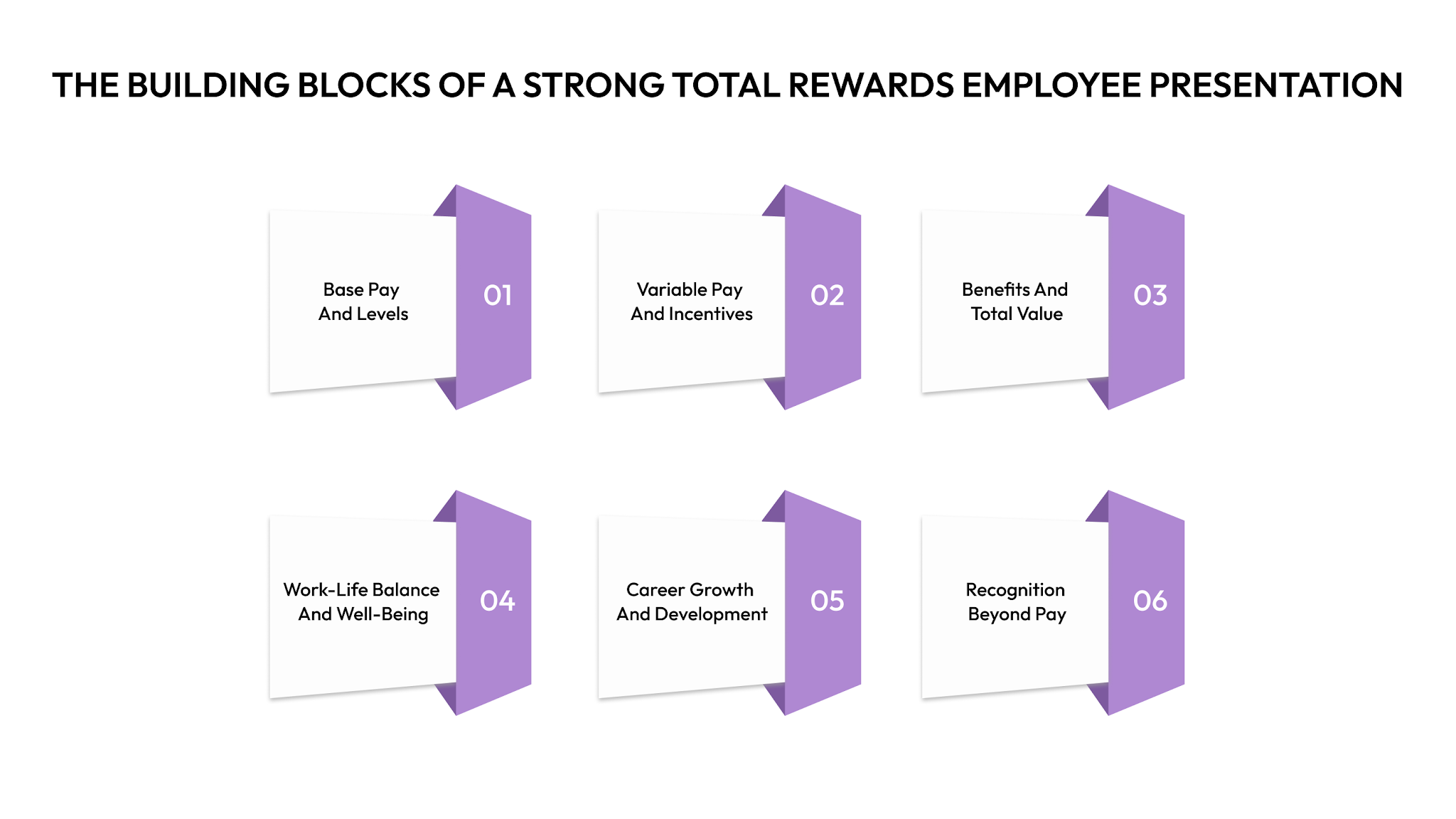
Base Pay and Levels
- Clarifies how roles are priced and how pay grows over time
- Reduces confusion around salary bands and promotions
- Builds confidence in fairness and consistency
Variable Pay and Incentives
- Shows how performance links to additional earnings
- Helps employees understand what drives bonuses or commissions
- Reinforces alignment between effort and reward
Benefits and Total Value
- Highlights employer investment beyond salary
- Helps employees recognize the real value of benefits they may overlook
- Improves appreciation of the full compensation package
Work-Life Balance and Well-Being
- Demonstrates support beyond compensation
- Signals long-term commitment to employee sustainability
- Strengthens engagement and retention
Career Growth and Development
- Connects rewards to future opportunity, not just current pay
- Reinforces learning, progression, and internal mobility
- Helps employees visualize a longer-term path at the company
Recognition Beyond Pay
- Reinforces that impact is noticed and valued
- Supports motivation where money alone does not
- Strengthens culture and belonging
Each of these blocks should be visible in the presentation, but never treated equally. The emphasis should reflect what your workforce values most and what your company is trying to reinforce.
Connecting Total Rewards to Your Company’s Goals and Culture
A total rewards employee presentation works best when it explains why rewards look the way they do at your company. Here’s how rewards connect to business priorities and cultural values:
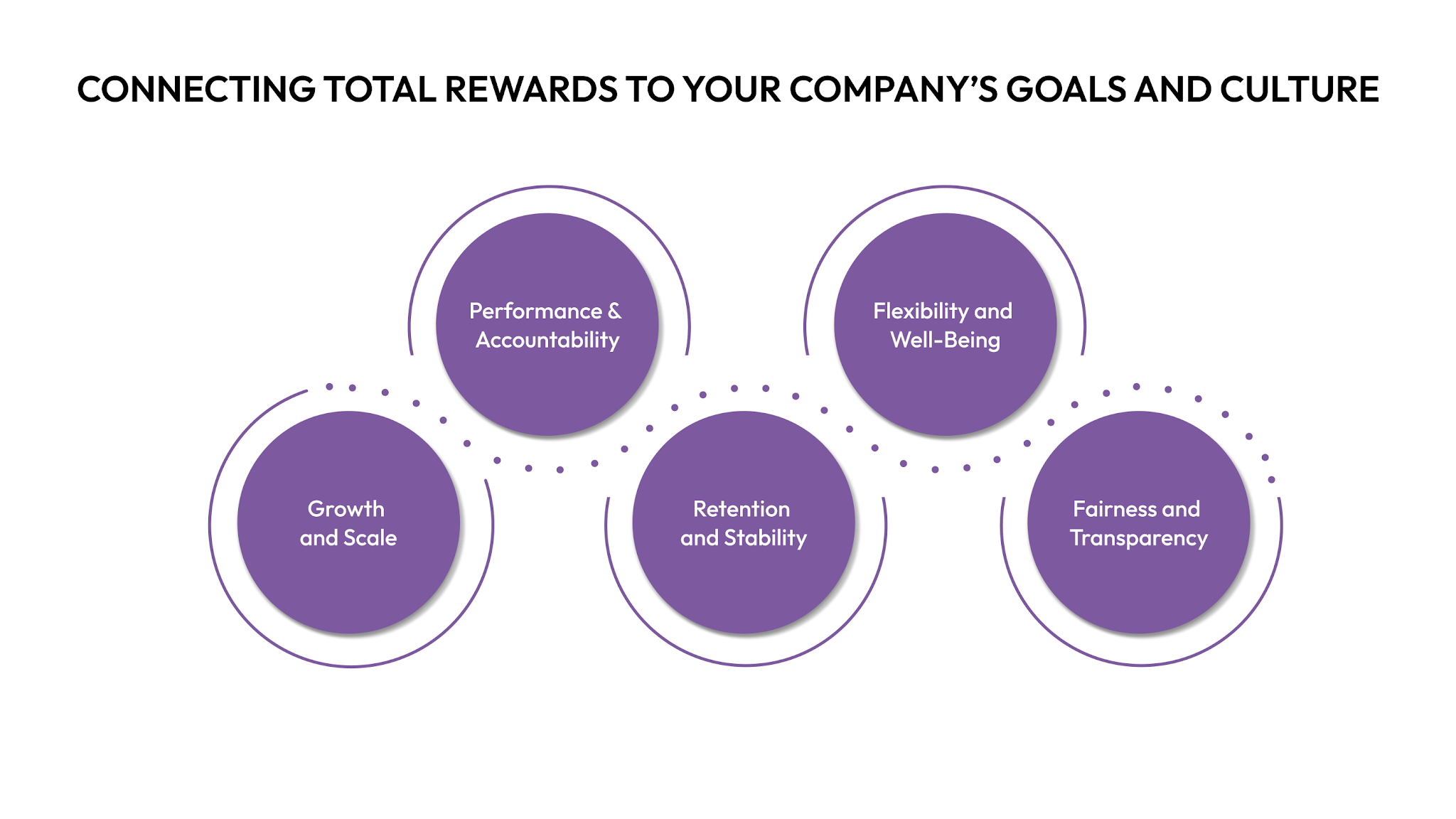
Business Goals → Reward Signals → Employee Takeaway
- Growth and Scale
- Reward signal: Structured pay bands, clear promotion paths
- Employee takeaway: Growth is planned, not arbitrary
- Performance and Accountability
- Reward signal: Variable pay tied to outcomes
- Employee takeaway: Impact and results are recognized
- Retention and Stability
- Reward signal: Competitive benefits, equity, long-term incentives
- Employee takeaway: Staying longer has increasing value
- Flexibility and Well-Being
- Reward signal: Remote work options, wellness support
- Employee takeaway: Sustainability matters, not just output
- Fairness and Transparency
- Reward signal: Consistent pay structures and clear criteria
- Employee takeaway: Decisions follow logic, not favoritism
When employees see this connection clearly, rewards stop feeling like isolated perks. They start to feel intentional.
How to Speed Up and Strengthen Your Total Rewards Presentation
Here’s how to build a total rewards employee presentation that is clear, focused, and efficient to deliver. The goal is to communicate what matters most without overloading employees or slowing teams down.
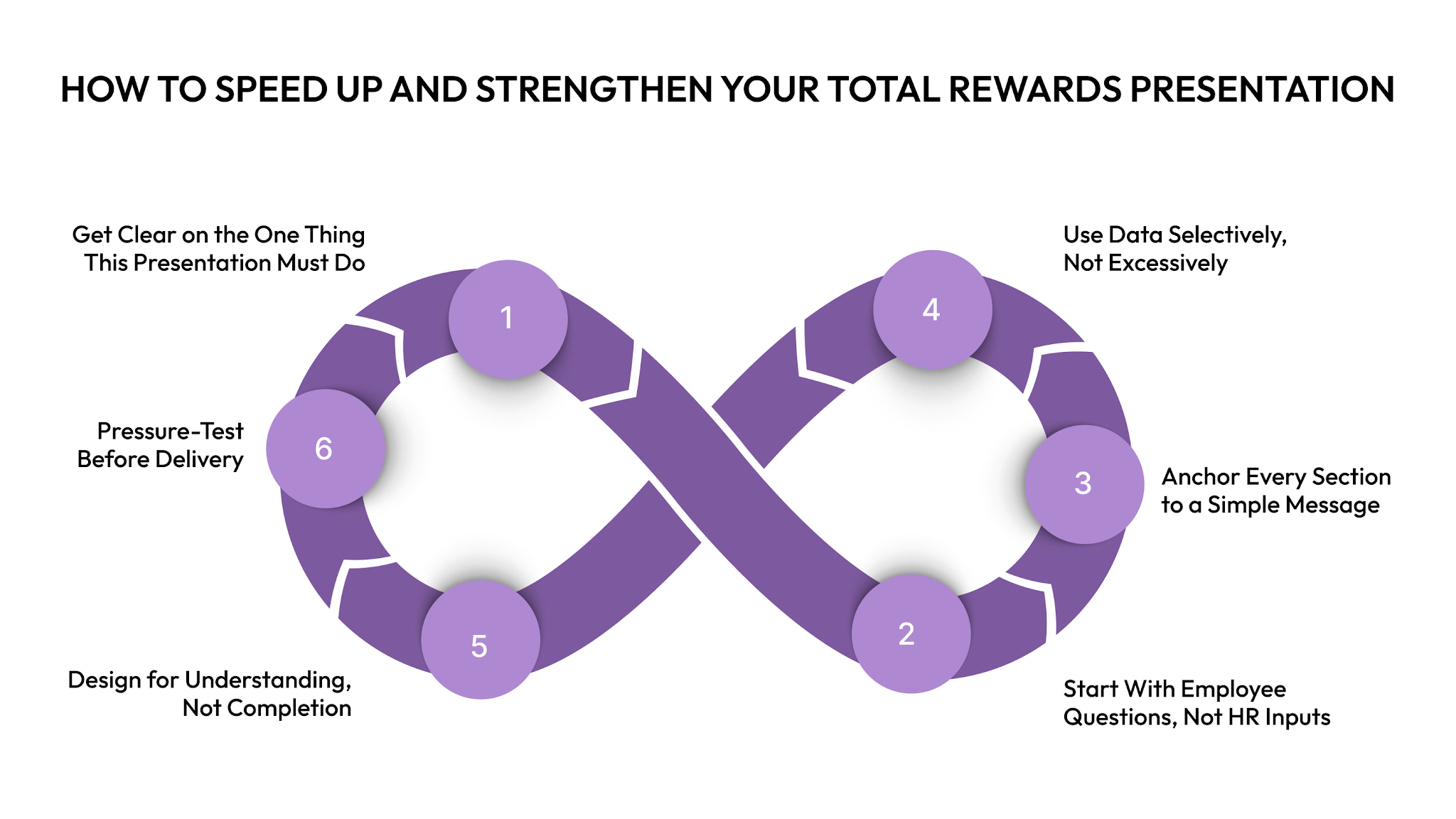
A strong structure makes both preparation and delivery easier.
Step 1: Get Clear on the One Thing This Presentation Must Do
- Decide the primary outcome before building slides
- Common goals: explain comp changes, reinforce transparency, support retention
- Avoid trying to answer every rewards question at once
Step 2: Start With Employee Questions, Not HR Inputs
- What employees usually ask during comp cycles
- Where confusion or skepticism shows up
- Use those questions to shape the flow of the presentation
Step 3: Anchor Every Section to a Simple Message
- One idea per section, not multiple explanations
- Pair each data point with a short explanation of why it matters
- If a slide needs heavy narration, it needs simplification
Step 4: Use Data Selectively, Not Excessively
- Show only the data that supports understanding and trust
- Remove metrics that do not lead to action or clarity
- Focus on context, not raw numbers
Step 5: Design for Understanding, Not Completion
- Visuals should explain relationships, not decorate slides
- Favor comparisons, ranges, and trends over dense tables
- If employees cannot explain the slide back, it needs rework
Step 6: Pressure-Test Before Delivery
- Review the presentation with HR, Finance, or managers
- Identify where questions or misinterpretations might arise
- Refine language before presenting to a larger audience
A strong total rewards employee presentation feels deliberate. When the structure is clear and the message is focused, delivery becomes faster and more confident.
The Data and Analytics That Make a Rewards Presentation Credible
Employees and leaders both look for signals of fairness and consistency. The right data builds confidence, while unnecessary metrics create confusion.
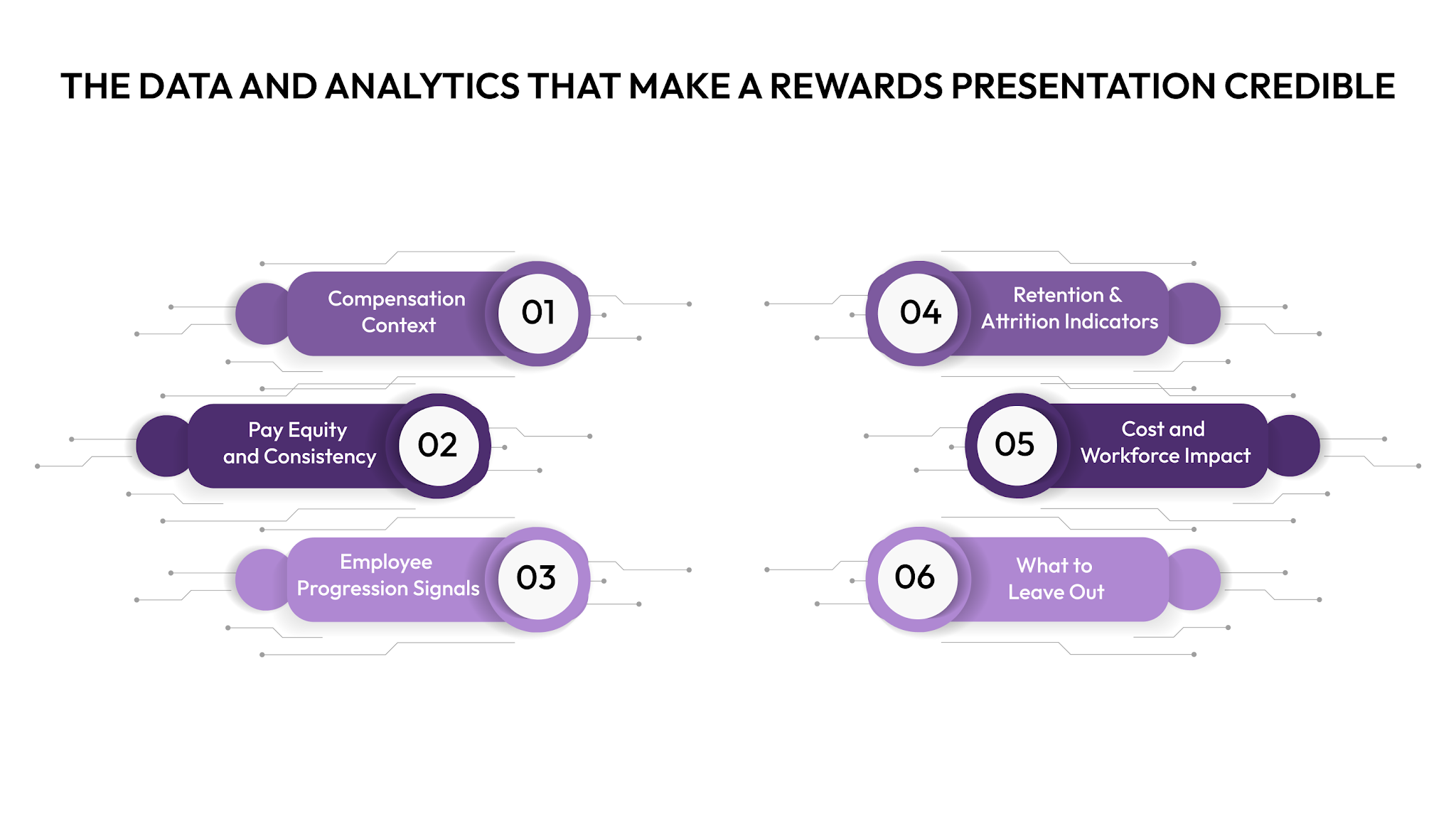
Here's a checklist of the analytics that help explain decisions and support trust:
1. Compensation Context
- Shows how internal pay compares to the market
- Explains ranges, not just averages
- Accounts for role, level, and location differences
2. Pay Equity and Consistency
- Highlights gaps or compression risks clearly
- Distinguishes structural issues from one-off cases
- Supports fairness without exposing sensitive details
3. Employee Progression Signals
- Connects pay growth to level movement or performance
- Clarifies what drives increases over time
- Reduces assumptions about promotions or raises
4. Retention and Attrition Indicators
- Identifies roles or teams with higher exit risk
- Links rewards data to retention outcomes
- Helps leaders decide where adjustment matters most
5. Cost and Workforce Impact
- Shows total rewards cost per employee
- Connects headcount changes to rewards spend
- Provides Finance with predictability, not surprises
6. What to Leave Out
- Metrics that cannot be explained in one sentence
- Data that does not change behavior or decisions
- Deep internal benchmarks that distract employees
When analytics pass this scorecard, the presentation earns credibility. Employees gain confidence in fairness, and leaders gain clarity on tradeoffs and priorities.
How to Present Total Rewards So Employees Actually Understand It
Even well-designed content can fall flat if delivery is unclear, and how rewards are explained matters as much as what is shown. Below are some simple, practical ways to present information so employees can follow, absorb, and ask informed questions.
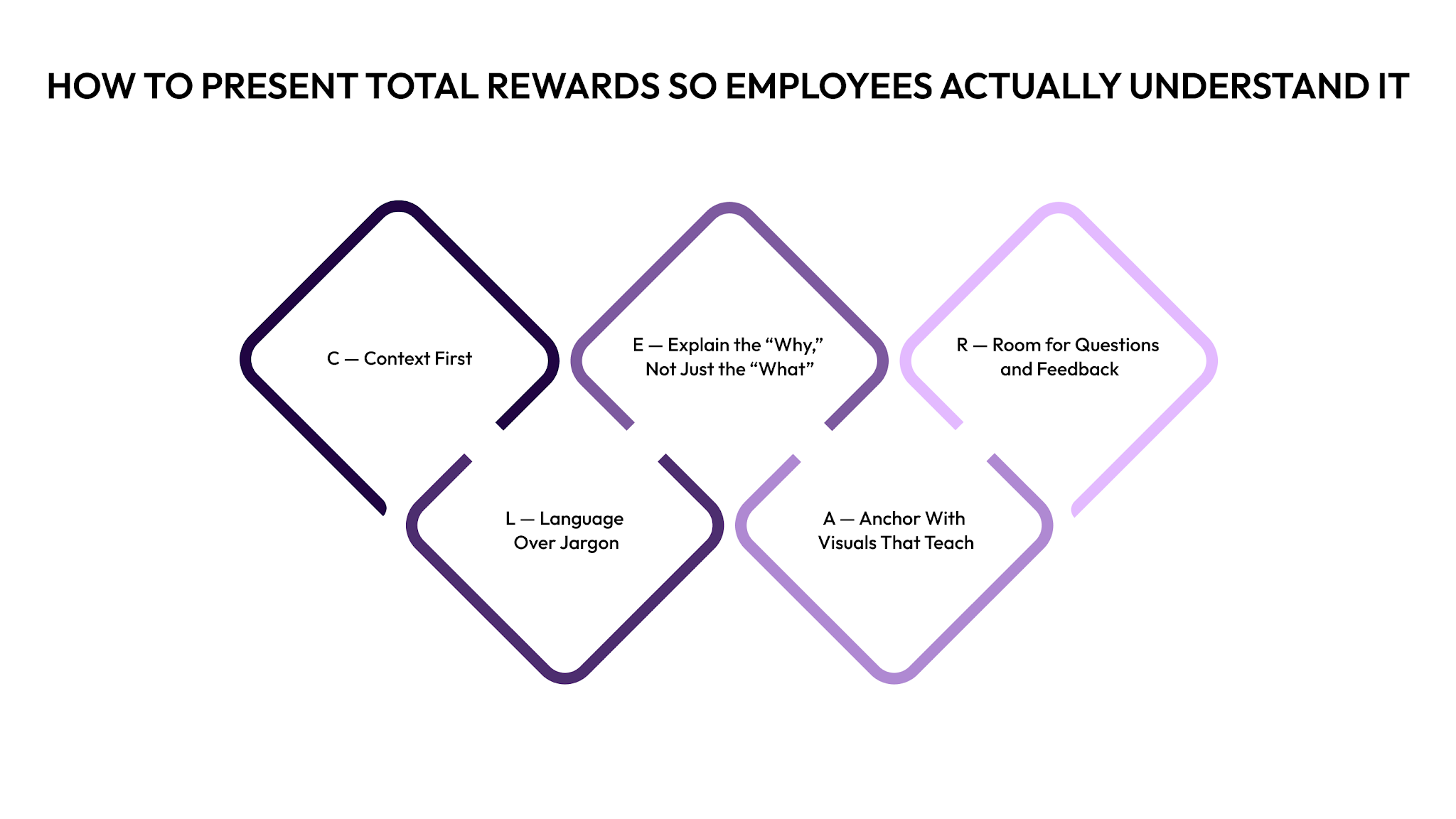
C — Context First
- Start with why the presentation exists
- Explain what decisions or understanding it should enable
- Set expectations on what will and won’t be covered
L — Language Over Jargon
- Use plain language instead of HR or finance terms
- Replace policy phrasing with everyday explanations
- If a term needs defining, simplify the concept instead
E — Explain the “Why,” Not Just the “What”
- Pair every number with reasoning
- Explain how decisions are made, not just outcomes
- Address common assumptions before they turn into doubts
A — Anchor With Visuals That Teach
- Use ranges, comparisons, and trends
- Avoid dense tables or text-heavy slides
- Design slides so they can stand on their own
R — Room for Questions and Feedback
- Build in time for discussion
- Treat questions as signals, not interruptions
- Clarify, don’t defend
A well-delivered total rewards employee presentation feels transparent and calm. When delivery is structured and intentional, trust increases and resistance drops.
How CandorIQ Makes Total Rewards Employee Presentations Easier to Build and Keep Accurate
Defining a total rewards approach is one step. Applying it consistently across teams is another. CandorIQ gives HR and Finance leaders a single platform to manage compensation, equity, and headcount with clarity.
The platform brings together payband management, compensation cycles, headcount planning, and offer workflows in one system, helping teams reduce manual errors and move away from spreadsheets and disconnected tools.
- One place for all rewards data: Brings compensation, pay bands, benefits context, and headcount into a single system, reducing slide rework and version confusion.
- Always-current numbers: Keeps presentations aligned with real-time compensation and headcount data, so teams avoid presenting outdated or conflicting figures.
- Clear collaboration between HR and Finance: Helps both teams work from the same assumptions, improving trust in rewards discussions and budget conversations.
- Consistent pay structures across roles and locations: Supports fair, repeatable explanations of pay ranges, progression, and geographic differences.
- Decision-ready insights, not static slides: Makes it easier to answer follow-up questions using live data instead of rebuilding decks after every meeting.
- Less time explaining, more time aligning: Reduces repetitive employee questions by presenting rewards clearly, visually, and consistently.
By centralizing rewards and workforce data, CandorIQ makes total rewards employee presentations a repeatable process that scales with the organization.
Conclusion
A clear total rewards employee presentation plays a critical role in growing organizations. It brings transparency to compensation decisions, helps employees understand the full value of their rewards, and supports consistency across roles, teams, and locations. Without this clarity, even well-intended rewards programs can feel fragmented and undervalued.
Tools like CandorIQ make delivering and maintaining these presentations far easier. By centralizing compensation, headcount, and workforce data, teams can move away from static slides and manual updates toward accurate, decision-ready communication that stays aligned with business goals.
Looking to simplify how you communicate total rewards? Book a demo with CandorIQ and see how your team can manage compensation, equity, and headcount with clarity and confidence.
.png)
FAQs
Q1. Who should own a total rewards employee presentation—HR or Finance?
A total rewards employee presentation works best when HR and Finance co-own it. HR brings context on compensation philosophy and employee impact, while Finance ensures accuracy around budgets and cost implications. Shared ownership keeps the message consistent and credible.
Q2. How often should a total rewards employee presentation be updated?
It should be refreshed whenever compensation structures, benefits, or headcount plans change. Many growing companies update it during compensation cycles, major hiring phases, or organizational changes to avoid sharing outdated or misleading information.
Q3. Should total rewards presentations be the same for all employee groups?
No. While the core structure should stay consistent, messaging and depth should vary by audience. Individual contributors, managers, and executives often need different levels of detail and context to fully understand rewards decisions.
Q4. What is the biggest mistake teams make when presenting total rewards?
The most common mistake is overwhelming employees with numbers without explanation. Data without context leads to confusion and mistrust. A strong presentation explains why decisions are made, not just what the numbers are.
Q5. Can a total rewards employee presentation help with retention?
Yes. Clear communication around pay structure, growth, and long-term value helps employees see a future at the company. When employees understand how rewards evolve over time, uncertainty drops, and retention improves.
Ready to modernize your workforce and compensation strategy?
See how CandorIQ brings workforce planning and compensation together with AI.