

Best Practices for Integrating HR Tools with Systems
Learn best practices for integrating HR tools with compensation, payroll, and finance systems to build strategic HR operations as your company scales.

When your HR tech stack becomes a liability, the signs are clear: recruiters juggle data, Finance relies on spreadsheets, and compensation teams manually transfer salary info. For companies scaling from 50 to 5,000 employees, these integration issues aren't just inconvenient; they're strategic risks.
Miscommunication between HR and Finance can derail budgets, and disconnected tools lead to pay equity problems. Fragmented systems block the real-time collaboration that CFOs and CHROs need. The solution isn’t better tools, but a cohesive integration strategy that breaks down silos, fosters collaboration, and shifts HR from a tactical to a strategic role.
This blog will outline best practices for integrating HR tools with your system.
Key Takeaways
- Disconnected HR systems can lead to strategic blindness, compensation drift, budget surprises, and talent bottlenecks, hindering company growth.
- Finance-HR integration is essential for real-time cost modeling, scenario planning, and shared accountability, transforming how HR and Finance collaborate.
- Compensation integration ensures real-time offer workflows and payroll alignment, preventing pay equity issues and providing audit visibility.
- Effective integration practices focus on strategic impact, governance, testing with real scenarios, and supporting lean teams.
- Choosing the right integration approach depends on company size and complexity, with all-in-one platforms, unified APIs, or custom solutions suited to different needs.
What is HR Tool Integration?
HR tool integration is the seamless flow of data between your HR platforms and business systems like payroll, finance, and benefits. But if you're a CPO or CFO, you already know that. What really matters is understanding why integrations fail at scaling companies, and the costs that come with those failures.
The Real Cost of Disconnected HR Systems
When your recruiting tool doesn't sync with your HRIS, which doesn't connect with your compensation platform, and data has to be manually exported to the financial planning system, you're not just losing efficiency. You're creating four key failure points:
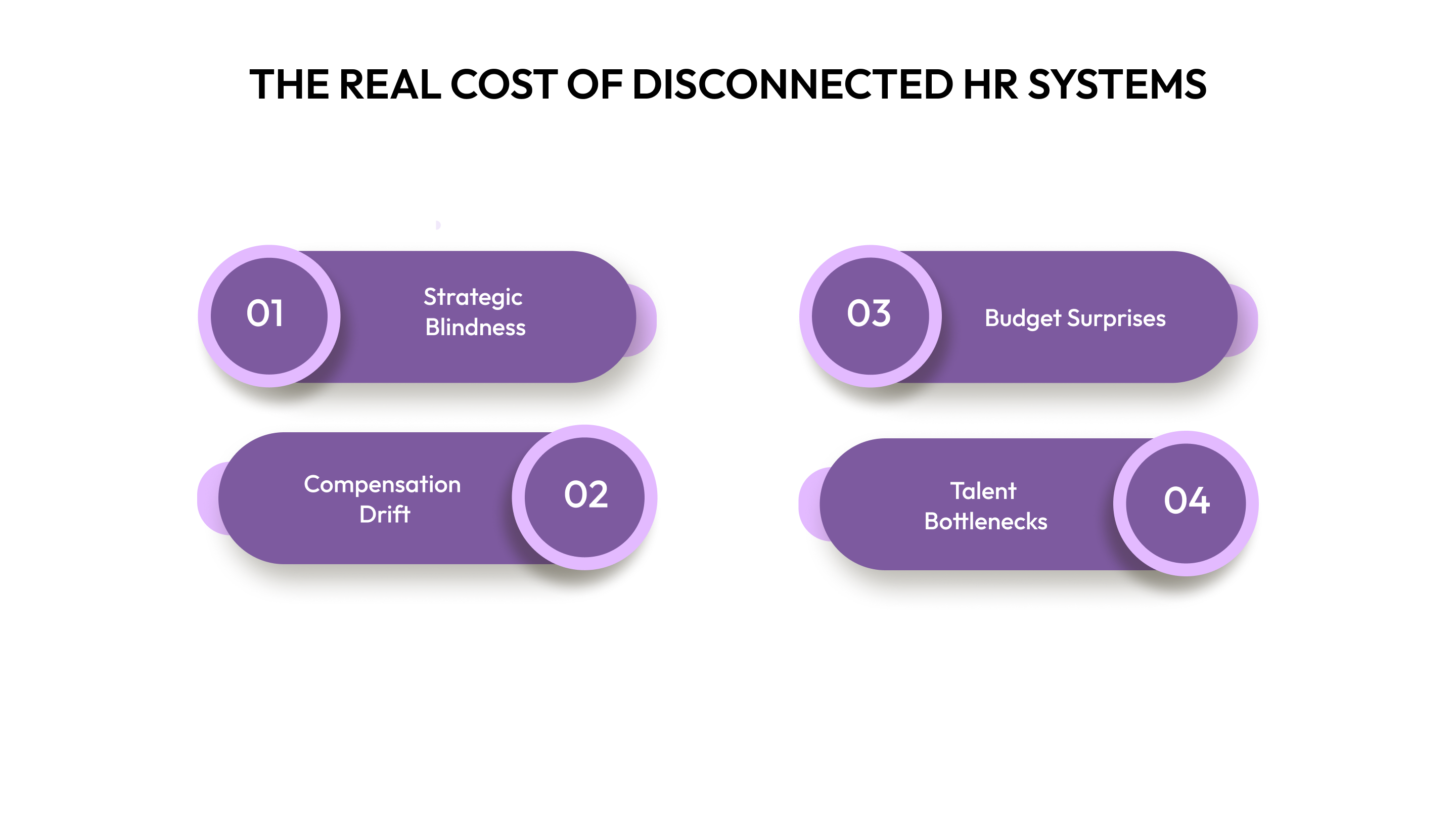
- Strategic Blindness: Your CFO can’t model workforce costs in real-time, and your CPO can't prove recruiting ROI. When the board asks, “What happens if we accelerate hiring by 30%?” neither can answer.
- Compensation Drift: Without integration between your comp bands, offer workflows, and HRIS, new hires gradually fall outside your pay equity framework. You won’t notice until an audit or when top talent leaves for better pay.
- Budget Surprises: When headcount planning happens in HR spreadsheets and finance builds models in others, reconciliation only happens quarterly, by which point you've already overshot your budget.
- Talent Bottlenecks: Manual data entry delays candidate movement from “offer signed” to “employee provisioned” by 3-5 days, giving competitors time to swoop in with counteroffers.
For companies growing from 200 to 500 employees, these problems snowball. What worked with 50 employees becomes unsustainable fast.
.png)
The Integration Approaches That Actually Work
Most HR integration content breaks things down into neat categories: native integrations, custom APIs, unified platforms. In reality, scaling companies need a hybrid approach focused on strategic impact, not just technical perfection.
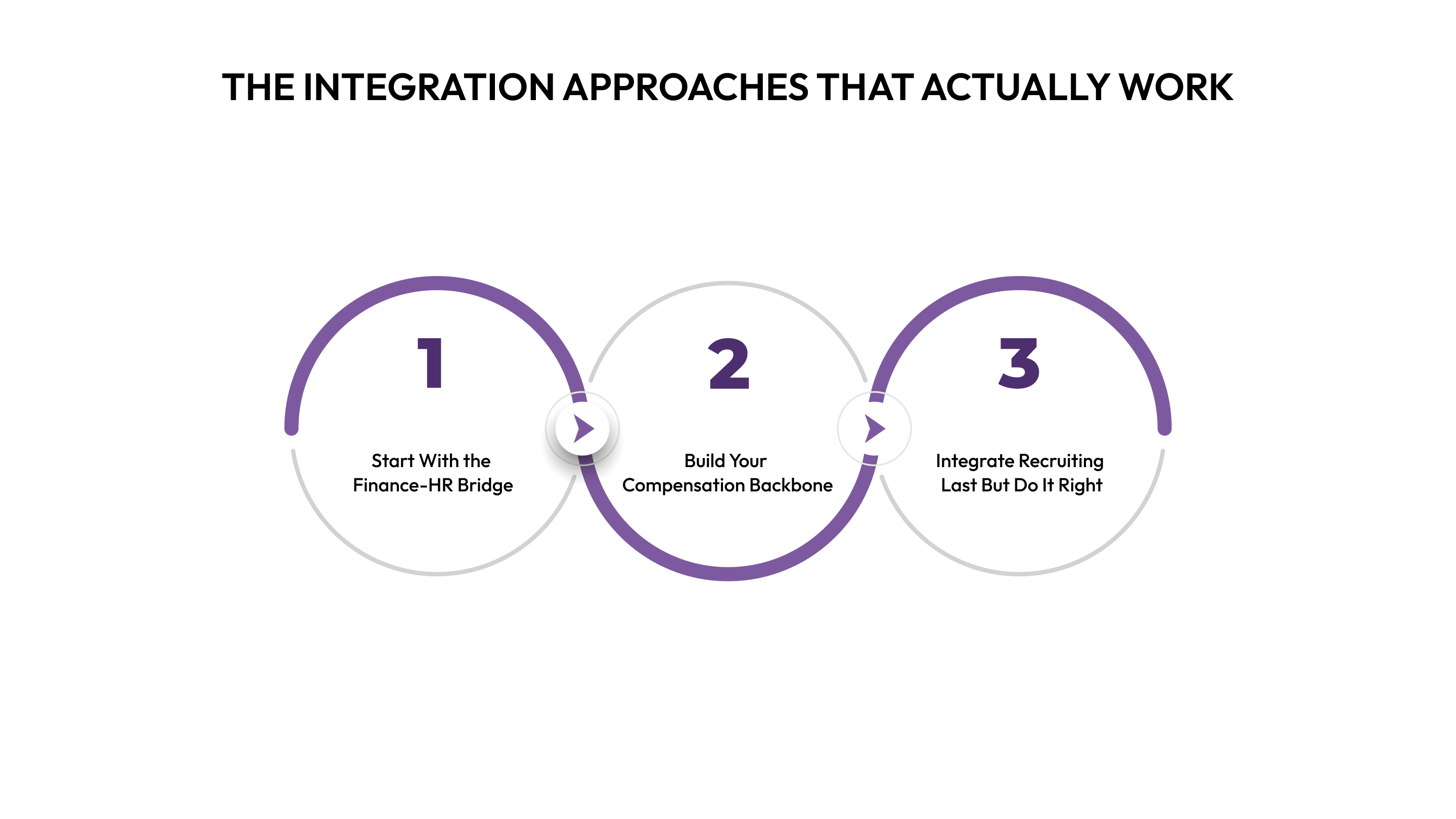
Start With the Finance-HR Bridge
The most overlooked integration connects HR planning tools with FP&A systems. This isn’t about syncing employee records. It’s about enabling collaborative workforce planning.
When your headcount forecasting tool integrates with financial models, you unlock several key benefits:
- Real-time cost modeling: Your CFO immediately sees the P&L impact when HR adjusts hiring timelines or changes comp assumptions, no more last-minute surprises.
- Scenario planning at speed: Testing different hiring scenarios becomes quick and easy, no more days spent on spreadsheets.
- Shared accountability: HR and Finance work off the same data, shifting the focus from "whose numbers are right?" to "what decision should we make?"
This integration solves a C-suite problem, not just an operational one, making it a high-impact starting point.
Second, Build Your Compensation Backbone
For companies using structured compensation approaches like pay bands or geo-adjusted salaries, integration between your compensation tool and HRIS/payroll is a must.
The common issue: compensation bands exist in one system, offers in another, and payroll is updated manually. By the time someone notices a violation, the candidate’s already started.
Proper integration ensures:
- Real-time offer workflows: The system flags offers that breach compensation bands before they’re extended.
- Automatic payroll alignment: Offers flow into payroll, with salary, equity, and geo-adjustments automatically applied.
- Audit trail visibility: All compensation decisions are logged, ensuring defensible documentation for equity audits.
For companies with distributed teams, this integration prevents chaos in managing pay scales across locations.
Integrate Recruiting Last But Do It Right
It might seem counterintuitive, but recruiting integration is often the last priority. Many companies already have decent ATS-to-HRIS integrations, but the real gap appears after the offer: the manual handoff between recruiting, HR operations, IT, and finance.
Key integrations here:
- Offer acceptance triggers: Automatically create employee records in the HRIS, including title, comp, start date, manager, and location.
- Provisioning workflows: Alert IT, assign equipment, create accounts, and schedule onboarding before day one.
- Budget tracking: Decrease your hiring plan and update financial forecasts as soon as the offer is accepted.
This "last mile" integration improves the new hire experience and gives finance real-time visibility into budget consumption.
Also Read: Ultimate Guide to HR Integration: Top Use Cases and Benefits
6 Best Practices for Integrating HR Tools with Systems
Based on what actually works at companies scaling from 50-5,000 employees, here are the practices that matter more than the technical details.
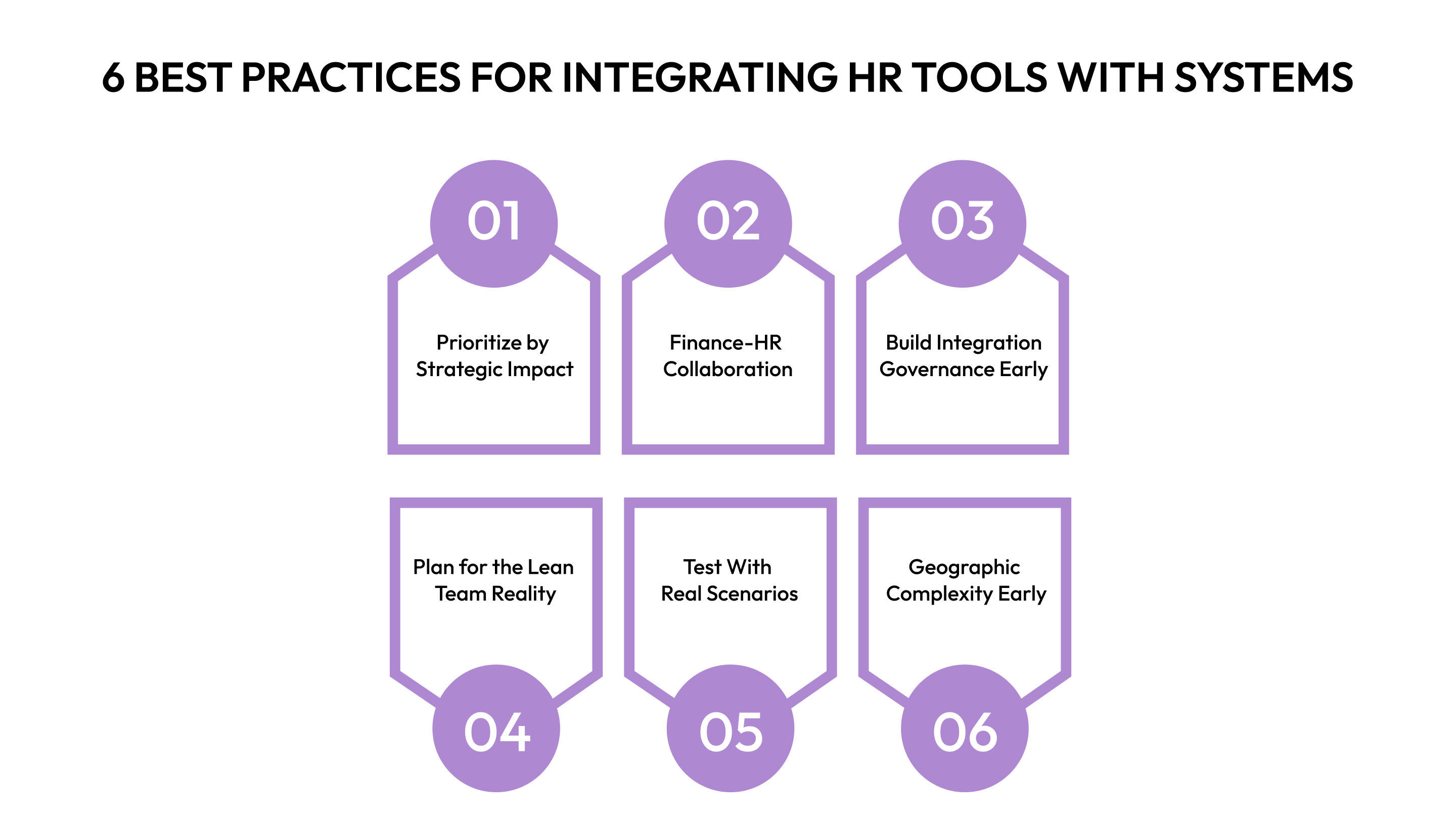
Practice 1: Prioritize by Strategic Impact, Not User Volume
Most companies prioritize integrations based on how many people use the system. This is backwards.
Your payroll integration might touch 500 employees, but your headcount planning integration affects every strategic decision your executive team makes. Weight your integration roadmap toward C-suite decision support, not operational convenience.
Ask: "Which integration would most change what questions our leadership can answer?" Build that first.
Practice 2: Design for Finance-HR Collaboration, Not HR Efficiency
Integration strategies often optimize for "reducing HR admin time." This misses the bigger opportunity.
The integration that connects your compensation and headcount planning tools with your financial model doesn't save HR much time. But it transforms the Finance-HR relationship from adversarial (arguing about numbers) to collaborative (making decisions together).
For scaling companies, this relationship shift is worth more than any time savings.
Practice 3: Build Integration Governance Early
When you're small, informal data management works fine. At scale, you need clear answers to questions like:
- Which system is the source of truth for employee location? For compensation? For job titles?
- When someone changes a compensation band, how quickly should that propagate to other systems?
- Who approves exceptions when integrated systems disagree?
Document these decisions before integration, not after. Otherwise, you'll discover you've automated inconsistent processes, which is worse than manual inconsistency.
Practice 4: Plan for the Lean Team Reality
If you're reading this, you probably don't have a dedicated HR operations team of 10 people. You have 1-3 people juggling everything from recruiting to comp to compliance.
Integration strategy for lean teams means:
- Ruthlessly limiting point solutions. Every additional system is exponentially harder to integrate. Better to have fewer, more capable platforms like CandorIQ than a dozen specialized tools.
- Accepting good-enough automation. Perfect API integration might be ideal, but scheduled batch syncing that runs nightly might be sufficient for your scale.
- Buying integration, not building it. Unless you have significant engineering resources, favor platforms with native integrations or unified APIs over custom-built connectors.
The best integration is one your small team can actually maintain, not the most technically sophisticated one.
Practice 5: Test With Real Scenarios, Not Sample Data
Integration testing typically uses clean test data: "Employee A gets hired, data flows to System B." This misses the messy reality.
Test with scenarios that actually break things:
- An employee gets hired, changes teams before their start date, then has their start date pushed back. Does data stay consistent across systems?
- Finance changes the budget mid-quarter. Does your headcount planning tool reflect this, or are you now hiring against an outdated number?
- Someone gets promoted with a salary adjustment effective two weeks from now. Do all systems reflect the correct salary on the correct date?
These edge cases, which aren't really edge cases at scale, reveal whether your integration can handle real organizational complexity.
Practice 6: Build for Geographic Complexity Early
Even if you're not global yet, you probably have employees in multiple states or regions. This geographic distribution creates compensation complexity that many HR systems don't handle well.
When building integrations, ensure your systems can handle:
- Location-specific pay bands that automatically adjust based on employee location
- Geo-adjusted compensation that recalculates when someone relocates
- Multi-location compliance for different labor laws and regulations
Building this flexibility early is far easier than retrofitting it when you've already got hundreds of employees across dozens of locations.
Check out how AI agents are transforming HR.
What Can Go Wrong in Integrating HR Tools with Systems?
Most integration content stops at best practices. But if you're leading HR or Finance at a scaling company, you need to know what actually fails and why.
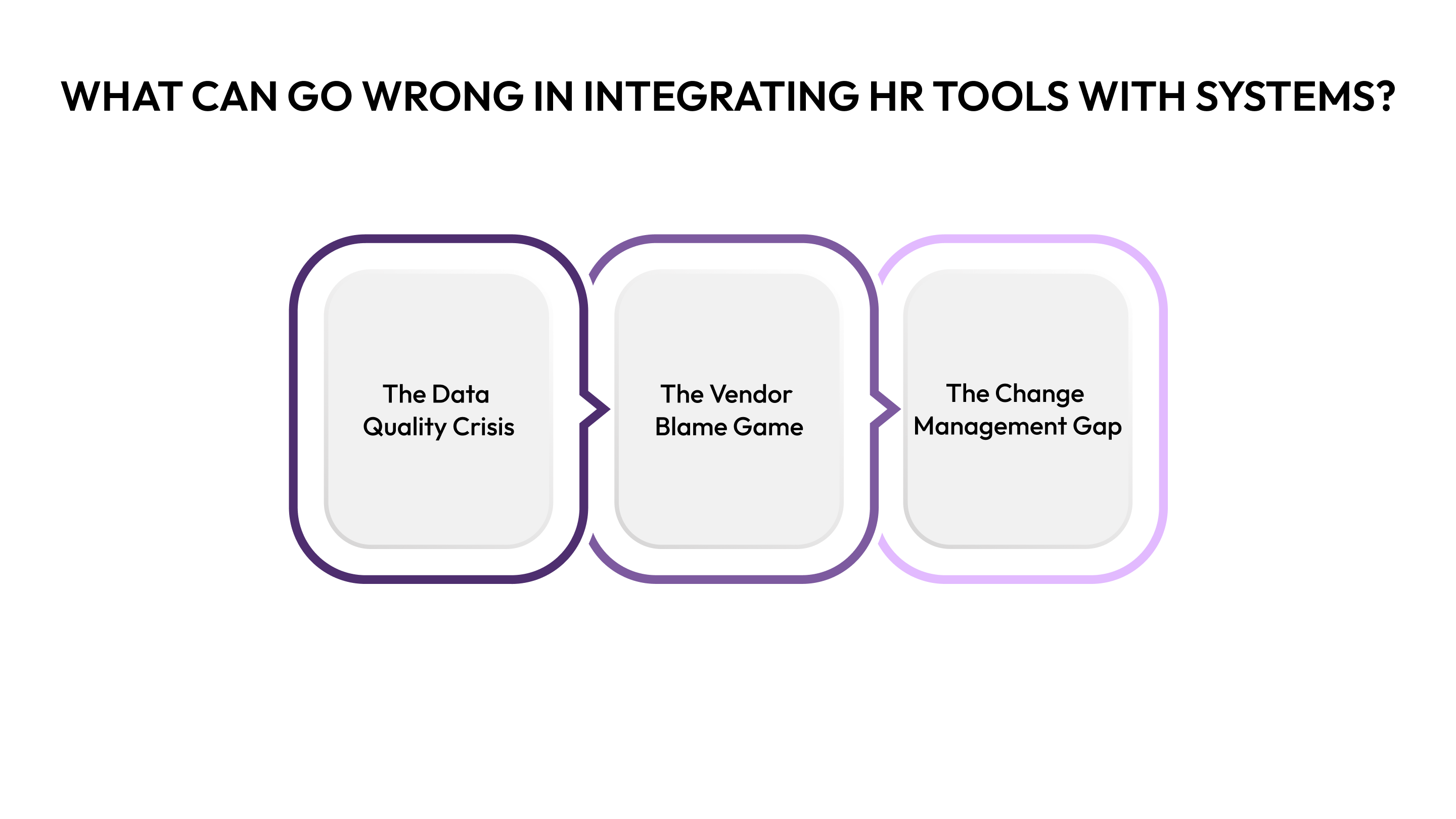
The Data Quality Crisis
Integration amplifies bad data. What was once a manually fixable error in a spreadsheet becomes a cascading problem across payroll, HRIS, and financial models when that data flows automatically.
Before integrating, invest in data cleanup:
- Standardize employee identifiers: Use consistent identifiers like employee IDs across all systems, not emails in one and IDs in another.
- Audit compensation data: Check for inconsistencies, such as variations in job titles like "Senior Software Engineer" vs. "Sr. Software Engineer."
- Document data definitions: Clearly define terms like "base salary" and whether it includes bonuses or equity.
Plan for 2-4 weeks of data cleanup before integration. Skipping this step means months of firefighting.
The Vendor Blame Game
When integration breaks, and it will, you need clear documentation:
- Integration architecture diagrams: Show what connects to what.
- Data flow documentation: Specify what data flows from which system and when.
- Error logging: Capture detailed logs to diagnose failures.
Without this, you’ll waste time with vendors blaming each other while your team manually reconciles data.
The Change Management Gap
The hardest part of integration isn’t technical. It’s getting people to trust the system over spreadsheets. Finance will want to keep their headcount spreadsheet “just in case.” Compensation teams will want to manually verify offers. HR will want backup records.
This is about organizational change, not just technology. Plan for it:
- Run systems in parallel: Let the system and manual processes coexist for a full cycle (comp review, headcount planning, or a quarter of reporting).
- Create escalation paths: Ensure clear processes for handling discrepancies.
- Celebrate success: Acknowledge when the system catches errors that humans would have missed.
Technology works faster than trust builds, so budget time for the human side of the change.
Also Read: How You Can Solve HR Challenges with Integrated Systems
When to Build, Buy, or Outsource Integration
The strategic question isn't "should we integrate?" but "what integration approach matches our resources and complexity?"
All-in-One Platforms: The 80/20 Solution
For most scaling companies, the best option is to buy a platform that integrates compensation, headcount planning, HRIS, and payroll into one system.
While you sacrifice some specialized functionality, you gain:
- Integration that works out of the box without engineering resources
- A single vendor relationship, when issues arise
- Consistent data models across all modules
This is ideal if you have fewer than five people managing HR operations and are scaling quickly. The efficiency of integrated workflows outweighs the feature gap of specialized tools.
.png)
Best-of-Breed + Unified APIs: The Sophistication Play
If you require specialized functionality, like complex equity management or unique compensation structures, you’ll need multiple best-of-breed tools.
In this case, opt for platforms like CandorIQ with unified APIs that connect multiple HRIS systems through one interface, rather than building point-to-point integrations. This is the right choice if you have engineering resources and need functionality beyond what all-in-one platforms offer.
Custom Integration: The Enterprise Necessity
Custom-built integrations are rarely necessary for scaling companies. However, they make sense when:
- You have proprietary systems that need to integrate with HR (common in financial services or regulated industries)
- Your compensation structure is so unique that no commercial platform can support it
- You have the engineering resources to justify the flexibility trade-off
For companies under 1,000 employees, custom integration is often premature optimization.
Final Words!
HR tool integration is key for scaling companies. When done right, it enhances collaboration between Finance and HR, speeds up workforce decisions, and supports growth plans. The choices you make now on integration will determine if HR becomes a strategic asset or a bottleneck.
Companies that get it right enable faster, more confident decisions with better alignment between HR and Finance, creating a competitive edge in today’s talent market.
CandorIQ streamlines compensation and headcount planning by integrating pay bands, comp cycles, and forecasting. We help HR teams align with Finance for fair pay and budget management. Book a demo now!
Frequently Asked Questions
1. What are the key benefits of integrating HR tools with payroll and finance systems?
Integration improves real-time data sharing between departments, enhancing decision-making, reducing errors, and fostering collaboration between HR and Finance teams.
2. How does HR tool integration improve compensation management?
Integration ensures compensation data flows seamlessly between tools, preventing pay discrepancies, ensuring compliance, and automating payroll adjustments based on geo-location and compensation bands.
3. What is the role of testing in HR tool integration?
Testing with real scenarios ensures systems can handle the complexities of actual business operations, such as changes in hire dates or salary adjustments, without breaking the flow of data.
4. What challenges might arise during HR tool integration?
Common challenges include data quality issues, vendor blame games, and change management difficulties. Addressing these issues early with clear documentation and governance practices can minimize risks.
5. How can small teams manage HR tool integrations effectively?
Small teams should prioritize integration strategies that balance simplicity and functionality, opting for platforms with native integrations or unified APIs to avoid complex, resource-heavy custom builds.
Ready to modernize your workforce and compensation strategy?
See how CandorIQ brings workforce planning and compensation together with AI.