

The HR & Finance Glossary: 16 Essential Workforce Planning and Compensation Terms
Understand 16 essential HR and Finance terms, from headcount planning and workforce budgeting to pay equity, merit cycles, and total compensation.
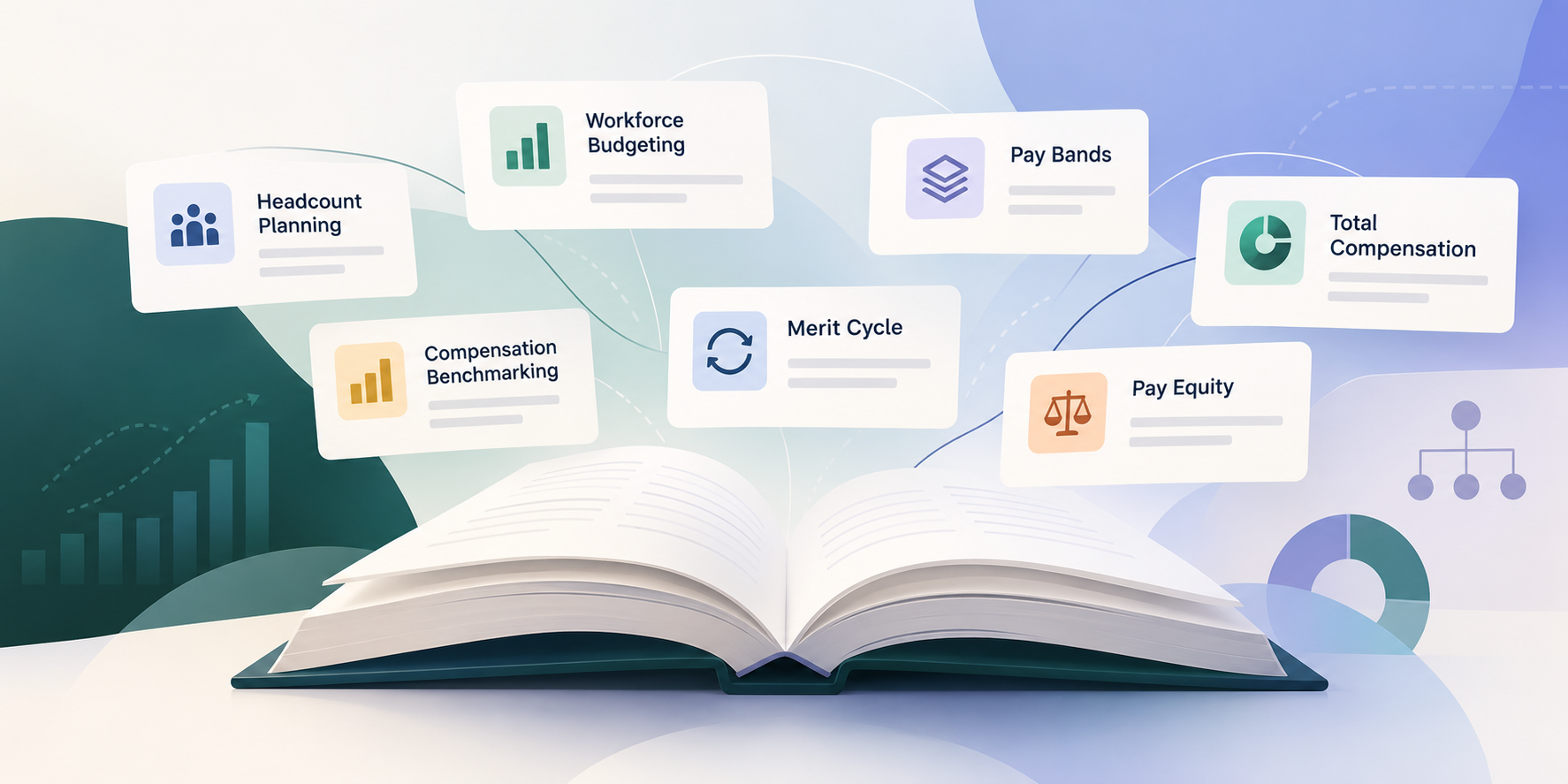

The HR & Finance Glossary: 16 Essential Workforce Planning and Compensation Terms
HR and Finance share responsibility for one of the largest investments a company makes: its people. But managing that investment comes with its own language.
From headcount planning and workforce budgeting to merit cycles and equity compensation, understanding the terminology is the first step toward building a more connected, strategic approach to managing people and costs.
Whether you're building a compensation strategy, preparing for your next planning cycle, or trying to get HR and Finance on the same page, here are 16 terms worth knowing.
Workforce Planning & Headcount
1. Headcount Planning
Headcount planning is the process of determining how many employees a company needs, in which roles, and when, to achieve its business goals.
It goes beyond counting employees. Effective headcount planning considers hiring timelines, attrition, backfills, organizational structure, and the full cost of each position.
When HR and Finance work from a shared headcount plan, they can make more informed decisions about where to invest, when to hire, and how to balance growth with financial constraints.
2. Workforce Budgeting
Workforce budgeting is the process of forecasting and managing the total costs associated with a company's workforce.
Unlike basic headcount budgeting, workforce budgeting accounts for more than salaries. It includes bonuses, benefits, employer taxes, equity compensation, and other employment-related expenses.
Because people costs often represent a significant portion of operating expenses, accurate workforce budgeting is essential for financial planning. Connecting workforce budgets to actual employee and position data helps teams understand where spending stands and how future hiring or compensation decisions will affect it.
3. Scenario Planning
Scenario planning allows organizations to model different workforce decisions and evaluate their potential impact before committing to a plan.
For example, what happens if a company delays hiring by three months? Reallocates five positions to a different department? Expands into a new country?
Scenario planning helps HR and Finance compare the financial and organizational implications of these decisions, making it easier to adapt when business priorities change.
4. Position Management
Position management is the practice of tracking and managing individual roles within an organization, independently of the employees who occupy them.
Unlike employee-based tracking, position management maintains visibility into both filled and vacant positions, including their budgets, reporting structures, and approval status.
This distinction is especially useful when managing backfills, reorganizations, and long-term workforce plans. An employee may leave, but the position—and its associated budget—can remain part of the plan.
Compensation & Pay Structures
5. Base Salary
Base salary is the fixed amount an employee earns before bonuses, commissions, equity, benefits, or other forms of additional compensation.
It's the foundation of most compensation packages and a critical input for budgeting, benchmarking, and pay equity analysis.
While base salary is often the most visible component of compensation, it doesn't necessarily represent the full value of an employee's rewards package.
6. Total Compensation
Total compensation refers to the combined value of an employee's direct financial compensation, typically including base salary, bonuses, commissions, and equity awards.
It's an important distinction from base salary, particularly when comparing offers, evaluating compensation competitiveness, or communicating the value of an employee's package.
Total compensation is also different from total rewards, which encompasses a broader set of benefits and noncash offerings, such as health insurance, retirement contributions, paid time off, and other employee perks.
7. Variable Pay
Variable pay is compensation that changes based on performance, results, or predefined business objectives.
Common examples include sales commissions, performance bonuses, profit sharing, and incentive-based awards.
Unlike base salary, variable pay isn't necessarily guaranteed. Organizations use it to align compensation with individual, team, or company performance, while maintaining flexibility in how compensation budgets are allocated.
8. Equity Compensation
Equity compensation gives employees an ownership interest or ownership-linked financial incentive in the company.
Common forms include stock options, restricted stock units (RSUs), and restricted stock awards.
Equity can be a valuable tool for attracting and retaining employees, particularly at startups and high-growth companies. However, its value depends on factors such as vesting schedules, company valuation, liquidity, and the type of award.
Understanding equity compensation is essential for communicating the full value of employee offers and rewards.
9. Compensation Benchmarking
Compensation benchmarking is the process of comparing an organization's pay practices against relevant market data.
Companies use benchmarking to establish competitive salary ranges, evaluate existing employee compensation, and make informed decisions about new hires and promotions.
Effective benchmarking accounts for factors such as job responsibilities, level, geography, industry, and company size. The quality and relevance of the underlying data are just as important as the numbers themselves.
10. Pay Bands
Pay bands, also called salary bands or pay ranges, define the compensation range assigned to a particular job, level, or group of roles.
They typically include a minimum, midpoint, and maximum salary, giving organizations a consistent framework for making compensation decisions.
Well-designed pay bands help companies maintain internal consistency, respond to market changes, and give managers clearer guidance when making offers or recommending raises.
Compensation Cycles & Pay Equity
11. Compensation Review
A compensation review is a structured evaluation of employee pay to determine whether adjustments are appropriate.
Reviews may consider market competitiveness, internal pay equity, employee performance, promotions, retention risks, and budget availability.
They can occur during scheduled compensation cycles or in response to specific business needs. A consistent review process helps organizations make pay decisions based on clear criteria rather than isolated negotiations or subjective judgment.
12. Merit Cycle
A merit cycle is a scheduled process for evaluating employee performance and allocating performance-based salary increases.
Often part of a broader compensation cycle, merit cycles typically involve HR, Finance, and managers working together to recommend, review, and approve pay adjustments.
A successful merit cycle balances employee recognition with internal equity, market competitiveness, and budget constraints.
For organizations managing hundreds or thousands of employees, centralized data, clear approval workflows, and budget visibility can make the difference between a strategic process and a spreadsheet marathon.
13. Pay Transparency Laws
Pay transparency laws are regulations governing how employers disclose compensation information to employees and job candidates.
Depending on the jurisdiction, requirements may include publishing salary ranges in job postings, providing pay information upon request, or reporting compensation data.
These laws vary significantly by location and continue to evolve. For employers, compliance requires accurate pay ranges, consistent compensation practices, and clear processes for maintaining and communicating pay information.
14. Fair Pay Act
Fair Pay Act is a term associated with legislation intended to address unlawful compensation discrimination and promote equitable pay practices.
In the United States, the term can refer to different federal or state laws and proposals, each with its own scope and requirements.
For HR and compensation teams, the broader principle is consistent: pay decisions should be grounded in legitimate, documented criteria, with processes to identify and address unjustified compensation disparities.
HR & Finance Systems and Data
15. HRIS (Human Resource Information System)
An HRIS is a software system used to store, organize, and manage core employee information.
It typically includes employee records, job details, reporting relationships, employment status, and other workforce data. Some HRIS platforms also support payroll, benefits, and performance management.
While an HRIS is often the system of record for employee information, strategic workforce and compensation planning may require additional data from Finance, recruiting systems, equity platforms, and market benchmarks.
Connecting these sources helps organizations make decisions based on a more complete picture of their workforce.
16. Cap Table
A cap table, short for capitalization table, is a record of a company's ownership structure.
It tracks equity ownership, including shares, options, and other securities held by founders, investors, and employees.
For HR and Finance, cap table data is especially important when managing equity compensation, evaluating new grants, and understanding dilution.
Connecting equity data with compensation planning makes it easier to assess the full value and financial implications of employee rewards.
Connecting the Dots: Why These Terms Matter Together
Each of these concepts serves a distinct purpose, but they're most valuable when considered together.
A headcount plan determines which positions an organization needs. Workforce budgeting establishes what those positions will cost. Compensation benchmarking and pay bands guide how employees are paid, while merit cycles and compensation reviews help keep those decisions competitive, equitable, and financially sustainable.
The challenge is that these processes often live in different systems, owned by different teams.
When HR and Finance work with disconnected data, even straightforward questions can become complicated:
- Can we afford to fill this position?
- How will the next merit cycle affect our workforce budget?
- Are our compensation ranges competitive and internally consistent?
- What happens to our hiring plan if business priorities change?
Answering these questions shouldn't require reconciling five spreadsheets and chasing down three department heads.
CandorIQ brings workforce planning, compensation management, and total rewards together in one AI-native platform, giving HR and Finance a shared view of their people investments.
Because understanding the terminology is useful. Putting it all to work together is where the real value begins.
Ready to connect your workforce and compensation strategy? See CandorIQ in action.
Ready to modernize your workforce and compensation strategy?
See how CandorIQ brings workforce planning and compensation together with AI.