

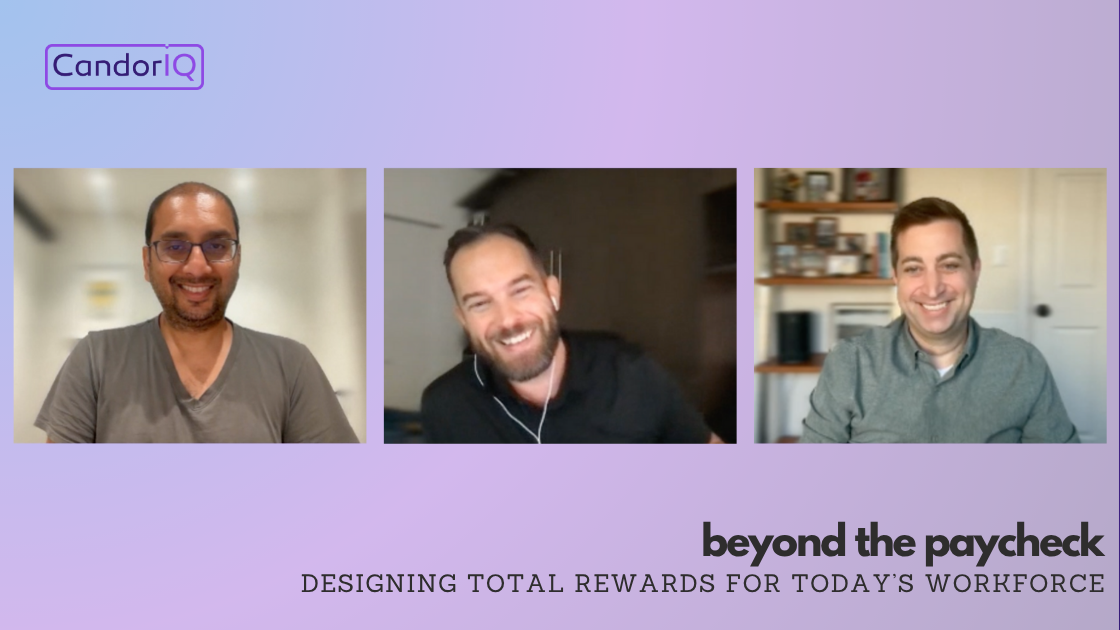
Designing Total Rewards People Actually Use, With Dave Carhart and Sean Raible
Watch the recording
Pay alone isn’t enough to attract and retain talent anymore. Employees increasingly expect holistic rewards—benefits, perks, flexibility, and growth opportunities—that align with both their needs and their values. Yet many organizations still struggle to design programs that feel meaningful to employees while staying aligned with financial and strategic goals.Join Dave Carhart, HR leader and advisor, Sean Raible, seasoned total rewards executive, and Haris Ikram, CEO & Co-Founder of CandorIQ, for a candid conversation on rethinking total rewards in today’s environment.We’ll explore:• Why total rewards strategies need to evolve beyond compensation• Which benefits and perks resonate most with today’s workforce• Practical frameworks for aligning rewards with employee expectations and business realities• How HR and Finance can partner to design sustainable, high-impact programsWhether you’re reimagining your benefits, building a rewards philosophy, or looking to strengthen retention, this session will provide actionable insights for today’s leaders.
Read the recap blog here.
Full transcript
00:02 Haris Ikram, CandorIQ
Happy Friday everyone. We've got the dream team. Sean Raible from Game Plan CA, and Dave Carhart from People Catalyst. Two amazing comp and benefits experts who are also my friends, so this will be a fun jam session. Our topic today is Beyond the Paycheck, designing compensation and total rewards in 2025. What do employers want, what do employees want, what's the American perspective, what's the Canadian perspective, and is there any difference.
01:01 Dave Carhart, People Catalyst
I spent my career in a variety of HR leadership roles, led the people team at several different startups, and have gone through an IPO and a successful acquisition. Now I work with a wide variety of growing and mid-market companies on compensation and other topics.
01:41 Sean Raible, Game Plan CA
Thank you for letting me jam here today. I'm Sean from Game Plan, based in Vancouver, BC. We have clients in the US and Canada where we do everything from job architecture, pay bands, variable pay, and exec comp, and then we get into the benefits space. We also play in the HR technology space, helping organizations either optimize what they have or go shopping. Five years in consulting, with clients from startups and nonprofits all the way to large multinationals. Before that, 20 years in house, probably 34 countries in terms of global reach. I've done Workday several times, SuccessFactors, and global career frameworks multiple times. To me it's all about the people. You can design great programs, but how do you implement them? How do you execute them? How does this land for somebody at the paycheck, when they actually receive it?
03:32 Dave Carhart, People Catalyst
Competitive pay is table stakes, particularly in an era of pay transparency, where organizations are sharing directly, and if not, people can go online and see a whole range of information. So you have to get it right. If you get it wrong you obviously have issues, but it's not enough to just get competitive pay right. People know that however great the relationship is and however wonderful the opportunity is, you're not their last employer. So they're also thinking about the long term. What sort of development, what kind of skills are they going to gain, what opportunities are they going to have, how is working with you going to enhance their human capital and their future opportunities. And in the meantime, we all spend so much time at work and invest so much of ourselves into work. So it's natural for expectations of the opportunity while you're there to go beyond that, to look at the whole package and the range of benefits, and how are they helping to take care of me.
05:20 Dave Carhart, People Catalyst
It's always tough to pull out exactly what's a generational shift versus what's affecting everybody, or cohorts as they go through life. That's partially why we talk so much about personalization. How do you provide structures that allow people to personalize what benefits they have access to, and customize what type of career path and opportunities they take through your company? There isn't going to be one Gen Alpha expectation where if you just do this one thing, you're set. People's preferences are going to be a really wide range.
06:35 Sean Raible, Game Plan CA
The challenge we all face is the ever increasing cost for benefits and wages. Beyond personalization, what we're seeing more is focus on mental health, wellbeing, wellness. Beyond contests, it's about understanding the human center. We all go through stuff. Things happen to us through our journey in life, and as an organization, what are the supports we offer around wellness, mental health, and financial wellness that help us through those moments. When it matters most, that's where you get that connection, that story: when I went through a hard time, my company was there for me. Paid time off when I need it most, so it doesn't run out. Sorry that a family member passed away, but you only get a day, come back. That's when you lose the human center piece. So when we look at total rewards programs, it's putting a human centered lens on it. What does this feel like when you actually have to execute that plan or that benefit? What would that employee and their family feel? Will they get the right coverage? We worked a lot on short-term disability design programs. How does that claims manager handle a mental health related case? Are they declining things, or are they doing all the steps you expect as an employer? I've seen many times in my career where things get declined, and then when they get escalated it turns out they should have been approved. Think of the stress on that employee and their family at the moment they get declined. So for me it's making sure we stress test. Try the EAP line. What's the script the disability providers or claims reviewers are using with your employees?
09:04 Haris Ikram, CandorIQ
Human centered design is a really good point. One of the things I see is that a lot of benefits go unused. We see that because we track that information. What that tells me is that sometimes organizations are checking the box with benefits, or not connecting the dots between the business goals and objectives. Is it aggressive hiring? Is it retention? Is it something else? Long term incentives or equity could be a great way to keep people, but so could the right mix of benefits at the right time.
10:25 Dave Carhart, People Catalyst
I think about employee outcomes, business outcomes, and financial outcomes. What does something mean for an individual employee, like Sean was talking about, when they're going through a really tough time, maybe taking care of someone in their family who's had an illness? What does it mean for the business, having people productive against whatever priorities you're setting? And then the financial side. There are a lot of things we all want to do and there are constraints, so make sure you're working within them. I think having multiple ways of understanding what's important to employees matters. Surveys, focus groups, and relying a lot on really strong HR business partners who know their organizations and can help make sense of the quantitative data. Drawing from a range of signals, rather than operating on what was the last article I saw that said this is the hot new thing, or who is shouting the loudest.
12:15 Haris Ikram, CandorIQ
Even if there's research and surveys, that's a good baseline, but you want your HR business partners to have a pulse on the ground. What are people actually valuing? Are the benefits and the comp driving the right behavior? I'd extrapolate that to the talent and recruiting team too. What's resonating with candidates, what's working and what's not. With comp you can get pretty immediate signals. Having that iterative feedback loop is key.
13:16 Dave Carhart, People Catalyst
It's one of the reasons I've come to really love benefits. I grew up as an HR person convinced that benefits were the most boring part of HR that I never wanted to touch. Over time I've learned, and it goes back to what Sean was talking about, how much a human-centered approach can connect an individual with the company and be really meaningful in their lives. It's challenging to do that in some aspects of compensation, because you need your cash and equity grounded in a rigorous structure, and the decisions grounded in rigorous and consistent assessment of performance. To get the outcomes you want and to have trust from employees that they're being treated fairly, those things really matter. There are places where companies get themselves in trouble by trying to offer choice in the wrong places. Some of the ideas around cash versus equity trade-offs can create really big challenges. On the cash and equity side, it's more around customization and personalization in someone's career journey, and helping them understand how compensation outcomes relate to that so they can make choices. Maybe I want to be much more intentional about working toward a promotion from engineer to senior engineer. If I understand how the comp structure works, I can make decisions that guide my own career journey in a way that makes sense for me.
15:23 Haris Ikram, CandorIQ
I remember a couple of years back when Netflix rolled out a program where you could move the dial from 100 percent cash to 100 percent equity, and a number of other companies have tried that, including some I've worked with that got to about 90 percent of the dial. It sounds good on paper, and maybe a company like Netflix can pull it off, but most organizations can't, and it doesn't necessarily drive the behaviors you think it will. What struck me is that you want to think about where the employee is in their life and in their career ladder. If you're thinking about retention and engagement and motivation, there are many other levers. Are they in the right job, the right role, are they getting promoted, are they getting the right projects, the right feedback? It's not just about giving you a four year equity grant so you'll stick around for it. That's only part of it, and all those other pieces matter more.
17:04 Sean Raible, Game Plan CA
There are two concepts I was taught years ago by executives that I carry with me. One is thinking about total rewards as four buckets: rewards, opportunity to grow and develop, leadership, and environment, meaning the tools and how we interact with the workplace. Rewards, opportunity, leadership, environment. Being intentional about what each of those is and how we're offering them. The other framework is the sweet spot, three forces. What's the market doing? What's my business strategy and affordability? What are our employees saying? It's never going to make everybody happy, but you want to find that sweet spot, and it can change over time. There are old WorldatWork journals from years ago about this transformational dialogue, this ongoing dialogue, that you need to keep at. I've been doing this for 25 years and it'll always be the same thing: you have to understand what's driving engagement in one business unit or high retention versus another, or certain job families. You need to get under the hood and understand your data. What's the starting point? What is good retention? I worked for retailers where 70 percent retention of commission salespeople was great. So there are dynamics to understanding your data before you can figure out how to drive retention and engagement.
19:29 Sean Raible, Game Plan CA
The flexible work arrangement topic is hot right now, full return to office versus hybrid. You see the articles in the US and Canada, bigger firms putting a line in the sand, and you see the other side asking, what about accommodations, what about the fact that I was hired during the pandemic. I've seen examples where it's a multi-year notice: in three years you're going to come back. Think about engagement and retention there. If I know it's going to change but it's a few years out, I'm good for now, and as an executive team you're okay with some turnover. Managers say, I still want to accommodate that situation, they've got a new kid at home, can I break the rule a little for this employee, they're still getting all their work done. That's the real talk. You need to understand what's happening before you make those policy changes. The other big one is learning and development support. We see organizations whose strategy is that they need people out of trade schools or with certain certificates, so how can I support their education earlier? Get to know us, we're going to support your education, and then they come join us. As for ongoing development, that's an investment in your employees. People aren't staying 20 or 30 years. People will shop and go somewhere else, and that's becoming the norm. So let's have the best relationship we can, employer and employee, be honest and transparent and grow together. And if you go, all the best, hope you come back. Having that mature adult conversation versus, I can't believe you left us. People sit 10 years in a company and leave and it feels weird, and they don't feel they want to go back. So think about how we support development but also have that mature conversation: welcome back any time.
21:58 Sean Raible, Game Plan CA
Think about what that moment means. It might wipe out all the good you had in that employee relationship. I've seen organizations do it well, where it's, you graduated from us, all the best, welcome back, and people do come back because of the culture. That starts at the top, versus the ones going, never hire them again, I can't believe they left us. It's a very different culture, and that's regardless of pay and benefits. Those things matter. People talk. I can't believe they treated so and so like that after 10 years of their career. Organizations that talk about it and coach managers on how to show up make a huge difference.
23:07 Haris Ikram, CandorIQ
It makes me think of when I was at Salesforce, almost a decade ago now. In 2014 and 2015, so many people left and came back. Anecdotally it felt like about a fifth of people were boomerangs. It's a bigger organization, but there were a lot of internal mobility programs. So instead of, I'm not happy in this role, I'm not growing, I'm going to look outside, they really encouraged and protected and supported people moving from one team to another, one project to another. That's why people stayed there a long time, at least back in the day.
24:26 Dave Carhart, People Catalyst
I don't think I have the answer that solves return to office for everyone. The most important thing is to make a clear decision that you align the leadership around and that you're willing to stand behind. There's a lot of logic to an organized hybrid that's two or three days a week on the same days, and that's a model many companies are attempting to build as their standard. But precisely because of that, there's space in the market for another set of companies to hold really fast to a fully virtual strategy, and in doing so pick up a lot of talent that might be deciding to leave the companies going back into the office. So there's not one right decision, but it is important to make a decision, and to know why you're making it and align the rest of your strategy with it. Your comp structure and your benefits: how are those pieces supporting what we've set out as the future plan? If you're bringing people back into the office, there should be a real reason for them to be there, and the benefits should support that as well.
26:32 Sean Raible, Game Plan CA
It comes down to utilization data. Working with your benefits providers to figure out who's using what. What we're seeing more is layering in demographics from a DEI perspective. Organizations are starting to think about where utilization might break down, not just by job level or city but by demographic, gender or ethnic background, and whether there are unintended things happening in terms of access to our benefits. Focus groups and interviews, talking to people about what's working. Sometimes through those conversations people realize, oh, we have that. That's where you see the wide eyes: I didn't know we had that. So there's an opportunity in that discovery period to educate people on what we actually have, and to hear what's hot for them. There's a lot of good market data, and the key is where you're getting it and aligning it with your compensation strategy. A lot of times you see differences: we're using this industry revenue cut for comp but doing something completely different for benefits. I challenge those and ask, why would we use different data cuts? There may be an intentional reason. We want all industries for benefits but just our industry for something else. Be intentional. A lot of the time it isn't intentional, they're just different benchmarking exercises. And understand what good looks like. What is P50 benefits? Define it well, element by element, because sometimes you might be over. You want to build a grid: we're above on retirement, we're low on this. That helps an executive team understand that overall we're here, but these are the gaps.
29:03 Sean Raible, Game Plan CA
Understand what you're spending on services, contracts, commissions, and fees with benefits. There's usually some money in there. If you're on a full commission model versus a fixed rate, please go look at it, because there could be dollars. There usually are dollars in moving from a commission based model with your benefits provider to a fixed fee, and then you can redeploy those dollars into your employees' benefits. While I have the mic: please talk to your benefits broker and understand your fee agreement. At the last company it was about 90,000 dollars a year in extra fees, and they were a 2,000 person employer. There are dollars there, and it gets bigger as you become a bigger employer, but if you don't check it, you're a cash cow for them and they'll just keep renewing you.
30:12 Haris Ikram, CandorIQ
One of the things we see at CandorIQ is a pretty major disconnect in communicating total rewards to employees and candidates. A lot of the time a company has an amazing compensation structure, base plus bonus and variable and accelerators and equity, and employees don't perfectly understand those levers. They have a ton of benefits and perks and they don't know how to maximize them. There are so many times we see a conversation where the employee says, my equity is going to be fully vested, what should I do, at the last minute. Our customers' HR teams get that a lot. Or, I only selected the health care benefits, vision and dental, and I didn't take advantage of these other things. So having employees understand their comp and benefits, and having managers understand them too, because HR can't carry all of it, and even when there are FAQs people don't necessarily absorb the information.
32:38 Dave Carhart, People Catalyst
Managers are the messengers in so many cases, so make sure they really understand the comp philosophy. They don't need to be a benefits expert, but at least understand the philosophy and the broad mix of what's available so they can help explain it to the employee. It's also where I'm really excited about some of the applications of AI, whether through benefits platforms or directly for the HR team. One of the things that's so much easier is the ability to create content, to create the FAQ in 30 seconds, and also to turn it into a video and put out multimedia content. Benefits and total rewards is one of the key places to think about that.
34:05 Sean Raible, Game Plan CA
I agree, technology is there to really improve our marketing. It's a marketing lens, thinking about your customer being the employee. There are great examples where employees build the content. Let's go build a video campaign, and we'll have a contest for talking about our new 401k matching. I saw this at one company: create a cool video, put it on YouTube, talk about it your own way. They were like little mini movies. There's a sense of empowering employees in how you do your benefits communication. Have fun with it. The enrollment went up, people understood the matching and how it worked, but it was through a fun way of engaging employees to help us market and explain it simply. That's way better than a pamphlet or a brochure. Yes, your website needs to be clear, but thinking outside the box and engaging your employees is amazing, whether it's your marketing team or a broader group.
34:32 Dave Carhart, People Catalyst
It starts with partnership. The relationship I've had with my counterparts in finance from day one is one of the relationships I've always invested in most, because there are going to be limits and you want to be sitting down with that person, ultimately advising the CEO or other decision makers, and really hashing through what the trade-offs are. Even if you have differing views on exactly what decisions get made, you get to a clear and aligned understanding of what the cost and our spend across different categories is, what we're trying to accomplish, and what limits we're working within. It's also the opportunity to build a much broader relationship with the finance leader across a range of topics, even when it's not compensation. They're going to be a key stakeholder in so much of what the HR leader works on. Being able to speak in financial language, understand the financial implications, and build trust during compensation discussions is really important for setting up a successful partnership.
36:19 Sean Raible, Game Plan CA
It's understanding the business first. Sitting with finance, understanding the P and L, how dollars come in and go out, and what the pressures are. What's the strategy, what's our structure, the people and the rewards. You can't go fix reward programs without understanding strategy and structure and workforce planning and where we're going. What are the talents we need today, and going forward? Sometimes the forecast isn't five years anymore, it's two to three. Then, where do we want to transform the business versus optimize or just keep the lights on? Whenever we do this work it's a building block. Do we understand our jobs? Do we understand base salary? Do we think about all of those components and why they exist? What does base pay for? What's the bonus driving? What's the equity for? Are we double dipping? Where's the governance? Who signs off on a sign-on bonus or a special deal? Where are the bodies buried? Let's talk about it and have real conversations. Even if you're a small organization you can have a mini total rewards steering committee. At an organization I worked at we also had a management council, mid-level managers from different parts talking about the data. What are we seeing in turnover and absenteeism? Getting their insights, and someone says, I think it's because of that. Engaging mid-level managers keeps the conversation going and lets you connect the dots. The last thing I've seen work really well is where CEOs spend time with employees directly. I saw this in the survey, what does that mean out here in the warehouse, or up north on a site?
39:00 Sean Raible, Game Plan CA
HR should be boots on the ground. That's where you start to go, now I understand. Then you're constantly in that flow of input and conversation, having transformational dialogue, because those three forces don't stay steady, they continually shift. When you think about big technology changes or big reorgs, that has huge impact on people's mental health and how they do their work. You'll see it in your own data. Oh yeah, that's when we implemented that new ERP, absenteeism went up six days. We had a big reorg and the same thing. You'll see spikes. The data you can bring to executives around those key metrics matters. Connect sick day usage to business initiatives and success. Did revenue go up when we did that? Did safety improve? That's where it starts to go, should we make a change somewhere.
40:41 Sean Raible, Game Plan CA
The biggest thing is the human center piece. Not losing sight of what that means in your organization and for your workforce, and balancing that with being generous where you can but also mindful of cost. It's not an off the shelf program. You have to understand what makes sense for you as an organization, and then set up that framework for good transformational dialogue at the executive level and with employees to inform your total rewards strategy. And it doesn't all get done in a year. It takes time, so you have to build that plan.
41:31 Dave Carhart, People Catalyst
Benchmarking is critical, but informed by the business context and your strategy on where you want to be. Get rigorous on performance when you need to make trade-offs and decisions on cash and equity. Then figure out how to bring in choice and personalization and customization in benefits and in careers, and support people with the right leadership, because in the end the manager is going to be the messenger on a lot of things.
42:12 Haris Ikram, CandorIQ
The last thing I'll add is communication and education. Having great comp and benefits gets you so far, but you need employees to understand them, appreciate them, and use them. You want to empower managers so they understand them and can drive that. And ultimately it's the culture, the environment, and the career opportunities you create that bring people in and keep them for the long term, and sometimes even boomerang. You can be formulaic, and it's good to have a philosophy and structure, but these are also very human decisions.
Ready to modernize your workforce and compensation strategy?
See how CandorIQ brings workforce planning and compensation together with AI.