

The Importance of Compensation Management for HR and Finance
Learn why compensation management matters, how it boosts attraction and retention, and how HR and Finance can run it well.


In today’s labor market, compensation is one of the strongest signals of how an organization values its people. But managing compensation effectively is no longer just about setting salaries or issuing bonuses. It is about building a transparent, data-driven, and equitable system that aligns employee rewards with business goals.
The companies that treat compensation management as a strategic discipline, not a yearly HR task, see tangible benefits: higher retention, more consistent pay equity, better hiring velocity, and stronger budget control. For HR and Finance teams, this makes compensation management one of the most important levers for both culture and cost predictability.
In this blog, we’ll explore why compensation management is critical for both HR and Finance, what it includes, and common challenges.
Key Takeaways
- Compensation management is a business essential, not just an HR function. It directly affects talent attraction, retention, and financial predictability.
- A structured system improves fairness and performance. Defined pay bands, data transparency, and merit governance create trust and consistency.
- Technology transforms compensation management. Integrations and analytics replace spreadsheets, ensuring compliance and visibility.
- Measurable outcomes matter. Metrics like compa-ratio, offer acceptance rate, and budget adherence reflect effectiveness.
What Compensation Management Includes
Compensation management refers to the structured process of planning, implementing, and monitoring how employees are paid. It includes both the financial and non-financial rewards that make up total compensation.
A well-defined compensation management framework includes:
- Direct compensation: Base pay, hourly wages, commissions, and performance-based bonuses.
- Indirect compensation: Benefits such as health coverage, insurance, and retirement plans.
- Variable pay and incentives: Short-term or long-term bonuses linked to performance goals.
- Equity or stock options: Ownership-based rewards that build loyalty and align employees with company growth.
- Non-monetary recognition: Perks, learning budgets, or well-being benefits that reinforce engagement.
- Governance and data systems: Tools, HRIS integrations, and approval workflows that ensure accuracy and compliance.
When managed effectively, these components form a unified ecosystem. Employees understand how their compensation evolves, while HR and Finance maintain consistency and control across the organization.
Also read: Complete Guide to Employee Compensation and Benefits.
The Business Importance of Compensation Management
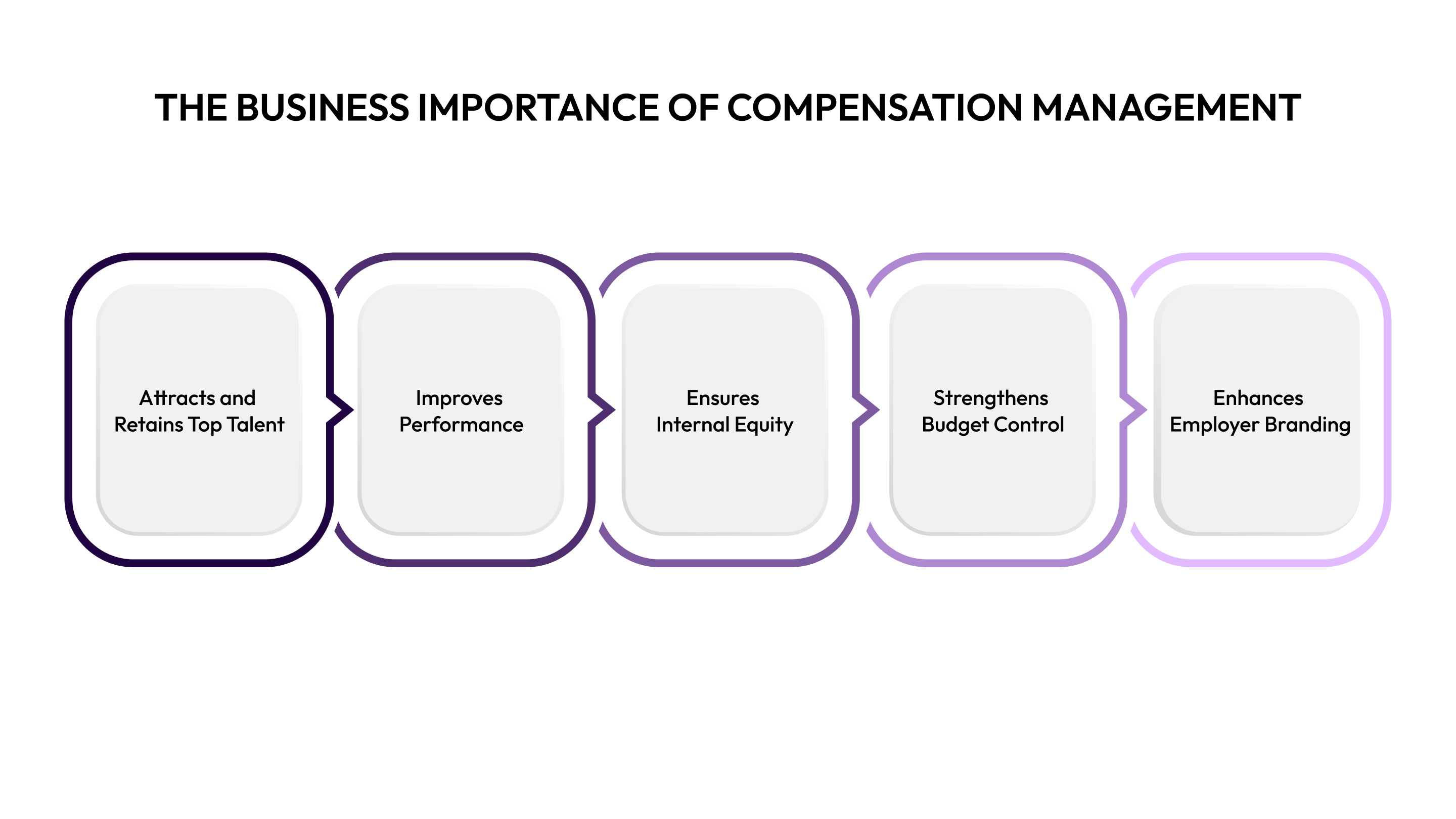
Compensation management is not simply an HR best practice. It is a core business function that shapes hiring outcomes, engagement, financial discipline, and brand reputation.
Here are the primary ways it drives measurable value:
1. Attracts and Retains Top Talent
Competitive and well-structured pay programs signal fairness and market alignment. Candidates today evaluate salary ranges, benefits, and equity transparency before applying. Employers that maintain consistent compensation governance attract more qualified applicants and improve retention rates among existing employees.
2. Improves Performance and Motivation
Linking pay to performance helps employees see the connection between results and rewards. When incentives are clearly communicated and data-backed, they inspire accountability and boost productivity across teams.
3. Ensures Internal Equity and Compliance
Effective compensation management prevents pay disparities and bias. By maintaining consistent job levels, pay bands, and adjustment criteria, companies can ensure fairness across roles and demographics. This also supports compliance with evolving pay transparency and equal pay laws.
4. Strengthens Budget Control
For CFOs and FP&A teams, compensation is often the single largest expense line. Managing it strategically enables accurate forecasting, predictable budgets, and controlled burn rates. Compensation management tools also help analyze spend by department, geography, or team, providing early insight into financial risks.
5. Enhances Employer Branding
Transparent compensation policies communicate maturity and trustworthiness. When employees know that pay decisions are data-driven and equitable, they become advocates of the company’s culture, boosting its reputation in the talent market.
.png)
Related: Comprehensive Guide to Compensation Management Benefits.
Common Challenges and Failure Points
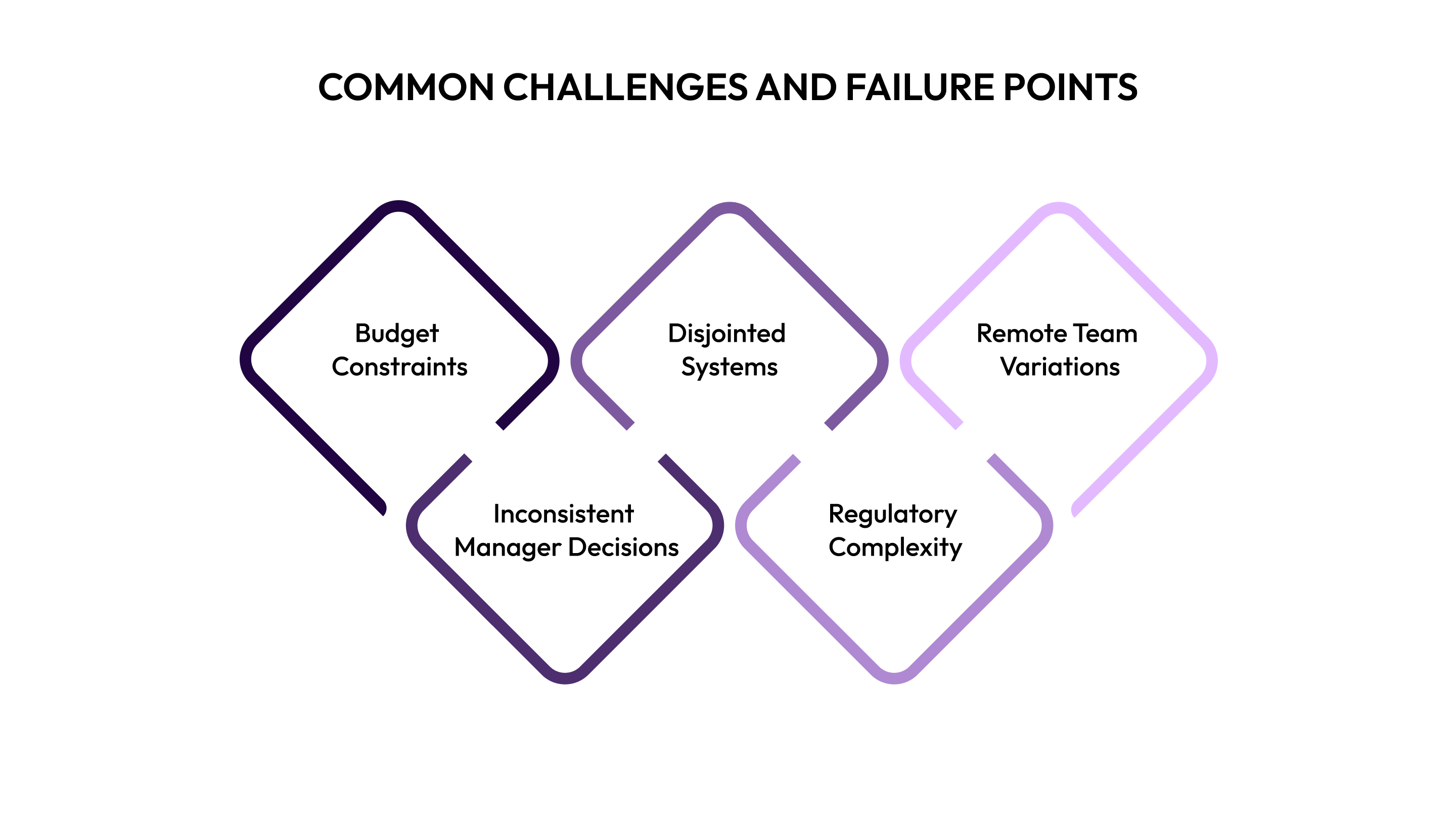
Even organizations with the best intentions struggle to manage compensation effectively. These challenges often stem from fragmented data, subjective decision-making, and limited visibility between HR and Finance. Recognizing them early helps teams build stronger systems that sustain both fairness and control.
Here are the most common issues companies face:
- Budget constraints and market inflation: Rising salary expectations and changing labor markets make it difficult to balance competitiveness with cost efficiency. Without clear pay bands, HR leaders can overspend on offers or lose candidates to faster-moving competitors.
- Inconsistent manager decisions: When merit reviews rely on judgment instead of data, pay inconsistencies and bias creep in. This can lead to dissatisfaction and even compliance risks.
- Disjointed systems and spreadsheets: Manual processes make tracking salary changes, approvals, and equity adjustments cumbersome. Errors and version conflicts create reporting challenges for Finance.
- Regulatory complexity: New pay transparency and equity laws across U.S. states have raised compliance expectations. Employers must now disclose pay ranges and maintain a documented rationale for pay decisions.
- Global and remote team variations: For organizations operating across multiple regions, factors such as currency, benefits structure, and taxation increase the difficulty of maintaining parity and fairness.
The key to addressing these challenges is collaboration and automation, centralizing compensation workflows to ensure consistent, auditable decisions.
Also read: 2025 Pay Transparency Laws by State Guide.
How HR and Finance Should Run Compensation Management Together
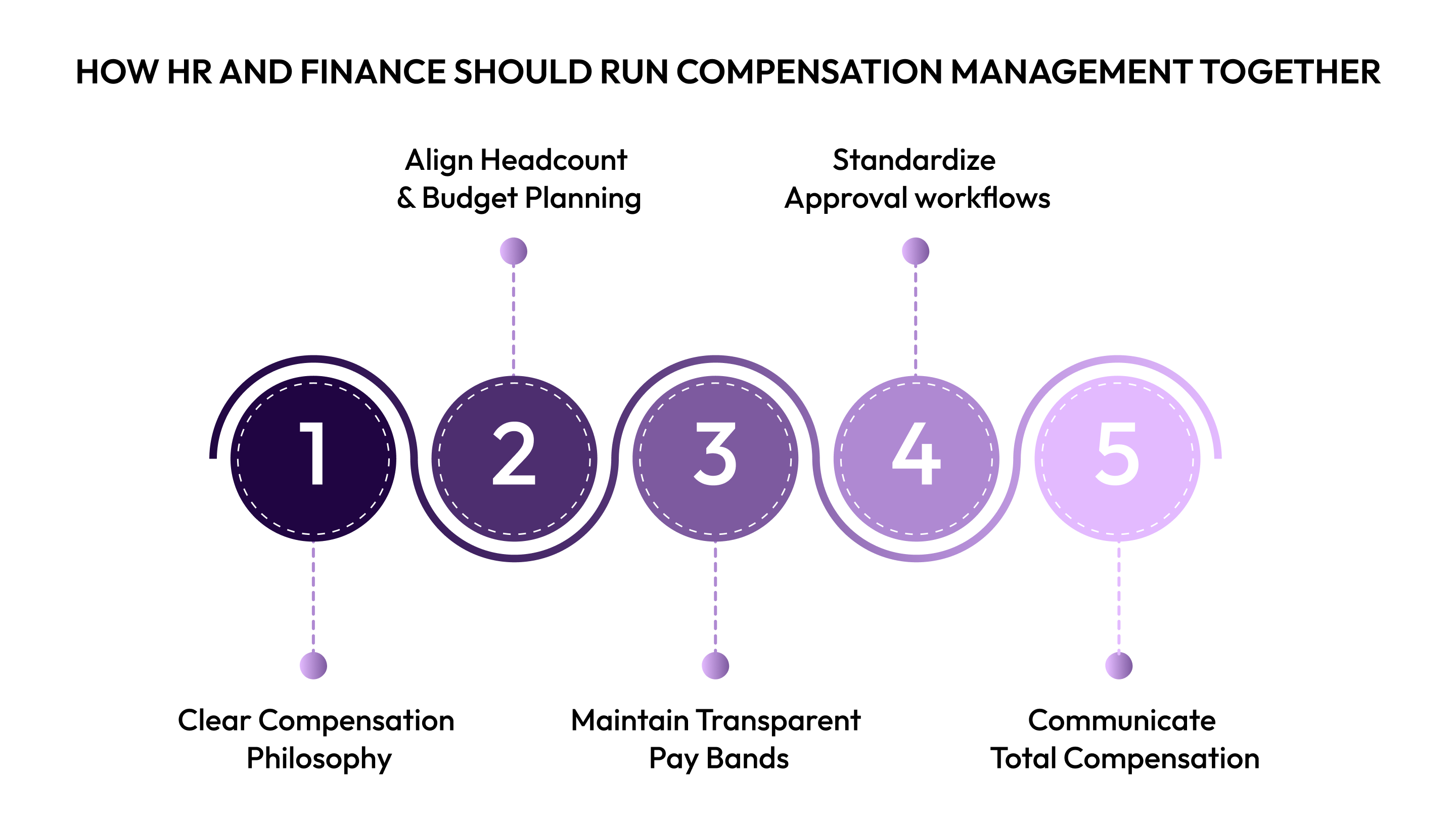
Compensation management works best when HR and Finance share one connected plan. HR brings understanding of market trends, performance data, and employee needs, while Finance ensures sustainability and governance. Together, they can create a compensation structure that motivates employees while protecting the organization’s financial health.
A few foundational principles define strong collaboration:
- Establish a clear compensation philosophy: Document how the company approaches pay, whether it leads, matches, or lags market rates, and communicate that philosophy across leadership and management levels.
- Align headcount and budget planning: HR and Finance should synchronize hiring forecasts, merit cycles, and compensation adjustments within one shared model.
- Maintain transparent pay bands: Publish clear salary ranges internally so managers understand the boundaries for new hires and promotions.
- Standardize approval workflows: Move away from scattered email chains to structured, rule-based approval systems that reduce cycle time and maintain accountability.
- Communicate total compensation clearly: Employees should understand the full scope of their pay and benefits, not just their paycheck. Total compensation statements help demonstrate transparency and long-term value.
Collaboration ensures that decisions about people and pay align with business objectives and budgets, creating a single source of truth for workforce costs.
Also read: Creating an Internal Alignment Compensation Strategy.
Practical Framework to Operationalize Compensation Management
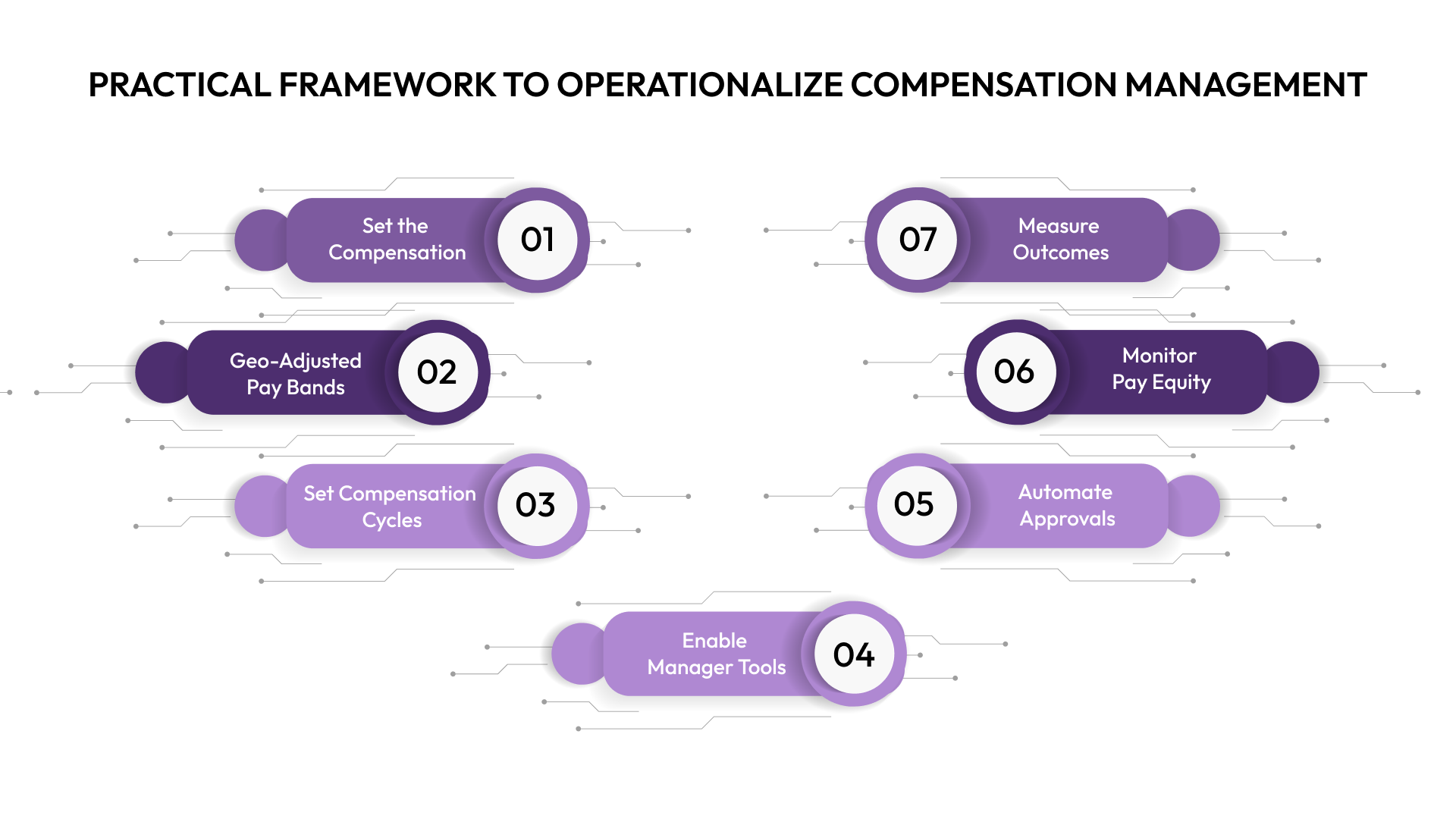
Having a plan is one thing; turning it into an efficient, repeatable system is another. The following framework outlines the key steps HR and Finance teams can take to operationalize compensation management with structure and confidence.
- Benchmark and set the compensation philosophy: Use reliable salary data from multiple market sources to determine competitive ranges by role, level, and location. Ensure leadership alignment on the guiding philosophy before implementation.
- Build geo-adjusted pay bands: Define salary bands for each level and region based on both market data and internal equity. Document criteria for movement between levels to create clarity for employees and managers.
- Set compensation cycles: Establish regular calendars for merit reviews, bonuses, and equity refreshes. Consistent timing promotes fairness and avoids off-cycle exceptions that disrupt budgets.
- Enable manager tools and training: Equip managers with data dashboards, guidelines, and total-comp calculators to make informed pay decisions during review cycles.
- Automate approvals and reporting: Use technology to streamline request flows, maintain audit trails, and provide Finance with real-time visibility into spending against budgets.
- Monitor pay equity and performance alignment: Continuously review salary distribution metrics such as compa-ratio, range penetration, and pay parity. Proactively address outliers.
- Measure outcomes: Evaluate offer acceptance rates, merit cycle completion time, and overall budget adherence after each cycle. These metrics close the feedback loop and inform future decisions.
Related: Understanding Pay Bands and How to Create Them.
Technology and Data: What a Modern Stack Requires
Modern compensation management cannot rely on spreadsheets or disconnected systems. The complexity of managing pay structures, equity, bonuses, and compliance demands requires integrated, real-time data. For both HR and Finance, technology creates the foundation for transparency, accuracy, and speed.
A strong compensation management tech stack includes:
- Integration with HRIS, ATS, and payroll: Unified data ensures that every change from new hire approvals to merit increases is reflected automatically across systems.
- Scenario planning tools: These allow Finance and People teams to model different headcount and merit scenarios, helping them make data-backed decisions before budgets are finalized.
- Analytics and dashboards: Real-time metrics such as pay distribution, budget utilization, and compa-ratio trends provide ongoing visibility to executives.
- Configurable approval logic: Role-based approvals and workflow automation help maintain governance while reducing cycle time.
- Audit and compliance support: Detailed logs and version histories ensure traceability and accountability in every pay decision.
An integrated approach not only saves time but also builds trust across teams and with employees.
Also read: 2025 Compensation Management Software Guide for HR Teams.
Measuring Success: Metrics That Matter to HR and Finance
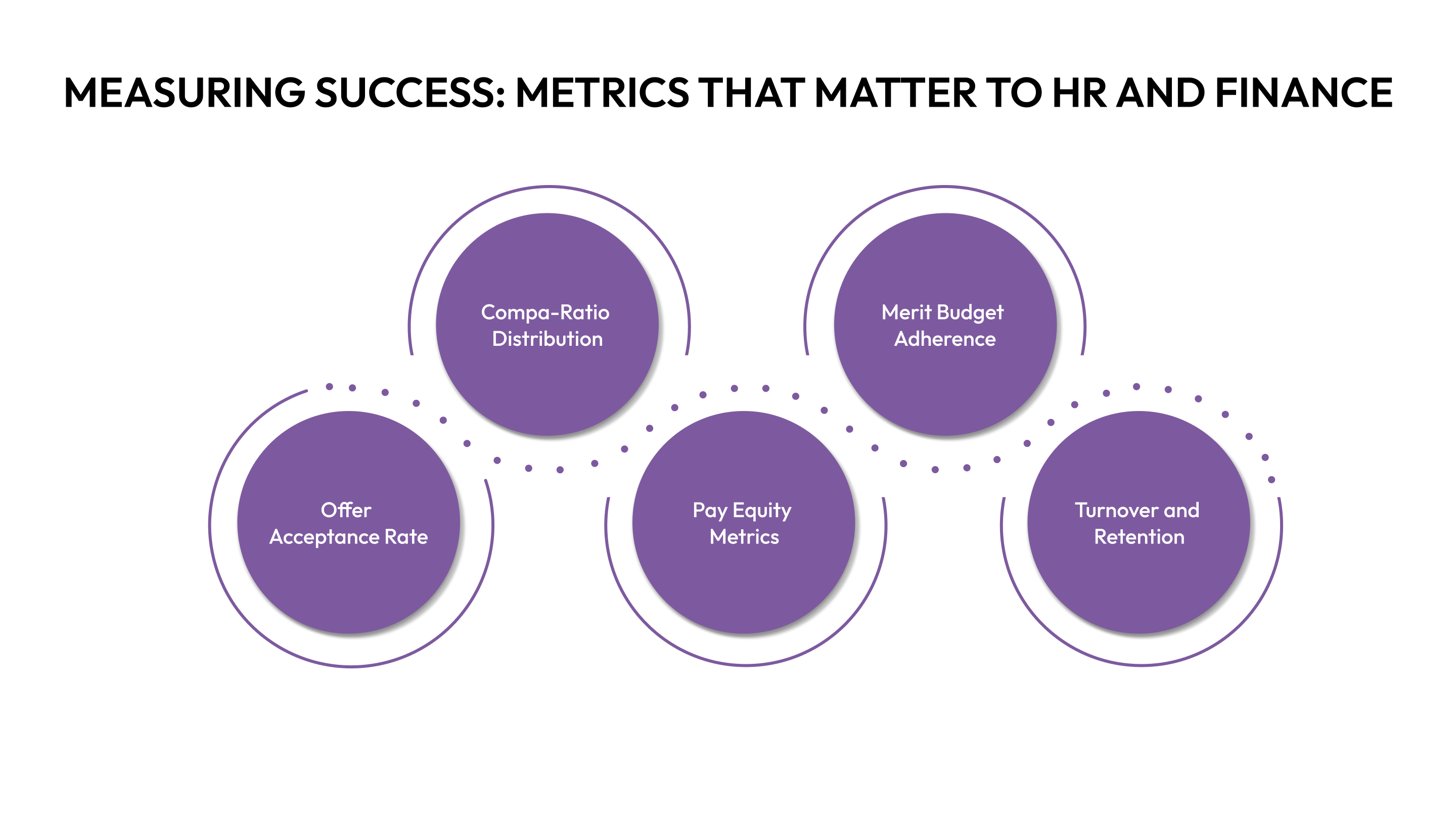
Successful compensation management programs are measurable. By tracking the right key performance indicators (KPIs), HR and Finance can gauge how effectively their strategies balance competitiveness, fairness, and financial control.
Some of the most impactful metrics include:
- Offer acceptance rate: Measures the effectiveness of the pay strategy and employer brand.
- Compa-ratio distribution: Indicates how employee pay compares to market midpoints, helping identify outliers.
- Pay equity metrics: Track gender and demographic parity to identify and close compensation gaps.
- Merit budget adherence: Shows how closely the organization stays within planned salary adjustment budgets.
- Turnover and retention in key roles: Helps connect compensation practices to engagement and workforce stability.
Regularly reviewing these indicators enables continuous improvement and better forecasting. Finance can then model future payroll expenses and align them with revenue projections.
Related: Compensation Forecasting: Predict Future Payroll Costs.
.png)
How CandorIQ Simplifies Compensation Management
Managing compensation across multiple roles, geographies, and cycles can be complex, especially when HR and Finance operate in silos. CandorIQ brings every aspect of compensation and headcount planning into one unified platform, giving teams a single source of truth for pay decisions.
Here’s how we make compensation management simpler, faster, and more strategic:
- Unified data model: CandorIQ connects HRIS, payroll, and ATS systems so pay and headcount data stay accurate, current, and synchronized.
- Payband Builder: Create and maintain geo-adjusted salary bands that reflect internal equity and market competitiveness.
- Compensation Cycle automation: Manage merit and bonus reviews in one collaborative workspace, with approval logic, reminders, and real-time visibility.
- Candidate Offers module: Present total compensation clearly; salary, equity, and benefits, helping recruiters close offers faster with transparency.
- Scenario planning: Model hiring plans, merit budgets, and equity refreshes instantly to forecast spend and stay aligned with business goals.
At CandorIQ, our goal is to help HR and Finance teams replace spreadsheets and guesswork with a structured, transparent, and data-driven approach to compensation.
Conclusion
Compensation management is not just about payroll accuracy or annual reviews. It’s about creating a consistent framework that rewards performance, promotes equity, and strengthens financial discipline.
For HR leaders, a structured compensation system builds trust and engagement across the organization. For Finance teams, it delivers visibility and control over one of the company’s largest investments — its people. Together, these outcomes create a culture where transparency and performance reinforce each other.
At CandorIQ, we believe compensation should never be a reactive exercise. It should be a strategic partnership between HR and Finance — powered by data, transparency, and collaboration.
We help teams design pay structures that scale, automate review cycles that used to take weeks, and bring every workforce decision into clear financial focus.
If you’re ready to make compensation a competitive advantage, we at CandorIQ would love to show you how.
Book a demo to see how our unified platform helps you plan smarter, pay fairly, and build trust across your organization.
FAQ
Q1: What is compensation management, and why is it important?
Compensation management is the strategic process of designing, implementing, and monitoring how employees are rewarded, including salary, benefits, bonuses, and equity. It is important because it helps attract and retain talent, align pay with business goals, maintain fairness, and control payroll costs.
Q2: How often should companies review their compensation structure?
While many organizations conduct a formal review annually, high-growth companies or those in competitive markets may review salary ranges and reward programs more frequently. Regular reviews ensure competitiveness, alignment with business strategy, and compliance with pay-equity laws.
Q3: What are the main challenges in compensation management?
Common challenges include managing rising salary expectations alongside budget constraints, dealing with inconsistent manager decisions, using fragmented spreadsheets instead of integrated systems, navigating changing regulations on pay transparency, and handling compensation for global or remote workforces.
Q4: What metrics should HR and Finance use to measure compensation management success?
Key metrics include offer acceptance rate, pay‐for‐performance alignment, compa‐ratio distribution (how employee pay compares to market midpoint), pay equity metrics, merit budget adherence, and turnover in key roles. These data points reveal how the compensation strategy is functioning.
Q5: What role does technology play in compensation management?
Technology supports compensation management by consolidating data across HRIS, payroll, and ATS systems; enabling scenario planning for budgets; providing real-time dashboards and analytics for pay distribution; automating approval workflows; and maintaining audit-ready records to ensure governance and compliance.
Ready to modernize your workforce and compensation strategy?
See how CandorIQ brings workforce planning and compensation together with AI.