

Global Human Resource Management: Strategies and Best Practices
Unlock the process of employing developing and rewarding individuals in global organizations. Explore strategies, legal compliance, and HR tech solutions.

Managing people across borders comes with both opportunity and complexity. Global organizations today do more than hire. They build diverse, connected teams that work toward shared goals across cultures, laws, and time zones.
The process of employing, developing, and rewarding individuals in international organizations requires clear policies, structured workflows, and cultural awareness.
Employee expectations are rising, and pay fairness has become a key concern. Only 32% of employees believe their pay is fair, and 34% feel their compensation is equitable. At the same time, 28% of workers say they are very or extremely likely to switch employers within the next 12 months.
These numbers show why global HR management is critical. It helps organizations align people strategies with business goals while keeping fairness, clarity, and engagement at the center.
Key Takeaways
- Global HR isn’t just domestic HR on a bigger scale. It requires balancing compliance, culture, and mobility across countries.
- Use headcount trends, compensation insights, and performance metrics to make smarter, faster workforce decisions.
- Create consistent policies across regions while adapting to local laws and cultural differences for fairness and efficiency.
- HR, finance, and leadership working together ensure smoother approvals, accurate budgets, and aligned strategic goals.
What Is Global Human Resource Management (GHRM)?
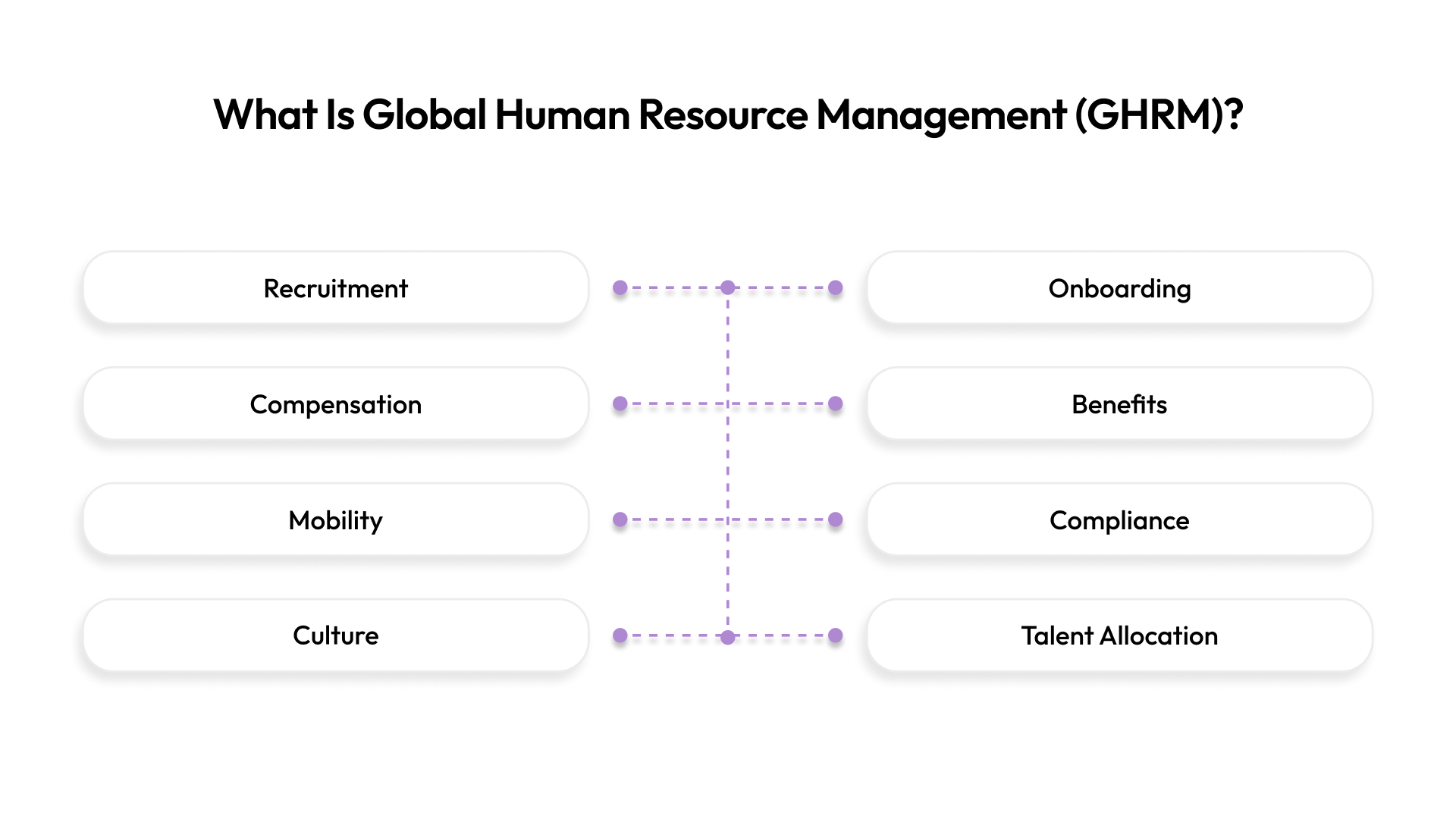
Global Human Resource Management (GHRM) is the process of hiring, developing, and rewarding employees across different countries. It also ensures that talent decisions support the company’s overall goals. Unlike traditional HR, GHRM handles hiring and employee development across many countries. It also manages compliance, cultural needs, and overall workforce planning on a global level.
The scope of GHRM extends beyond operational HR tasks. It includes planning for distributed teams and aligning pay and benefits with local markets. It also ensures policies stay consistent while still respecting regional differences. A strong GHRM framework enables organizations to maintain efficiency, equity, and engagement across diverse geographies.
Key Components of GHRM
A successful GHRM strategy combines multiple functional areas to ensure global workforce effectiveness. Core components include:
- Recruitment: Hiring talent across geographies while balancing local regulations, skills availability, and diversity goals.
- Onboarding: Creating standardized yet localized programs that integrate new hires into the organization’s culture and operations quickly.
- Compensation: Managing pay bands, bonus structures, equity, and allowances across different markets to maintain fairness and competitiveness.
- Benefits: Providing region-specific benefits, from healthcare and insurance to retirement plans, while ensuring global consistency.
- Mobility: Supporting international assignments, relocations, and short-term projects with clear policies and smooth administrative processes.
- Compliance: Ensuring adherence to labor laws, tax regulations, data privacy, and employment standards across all countries of operation.
- Culture: Promoting a cohesive organizational culture that accommodates local norms while reinforcing global values and collaboration.
- Talent Allocation: Strategically deploying the right skills to the right locations, ensuring business needs align with workforce capacity.
Together, these components form a holistic framework that allows organizations to manage their global workforce efficiently, maintain equity, and drive performance consistently across borders.
Understanding what Global Human Resource Management entails sets the stage for exploring how it differs from domestic HR practices and traditional international HR approaches.

How GHRM Differs from Domestic HRM / IHRM
While domestic HRM focuses on managing employees within a single country, GHRM addresses the complexities of cross-border workforce management. Key differences include:
In essence, GHRM builds on international HR (IHRM) principles but integrates strategic, financial, and operational layers to manage a truly global workforce.
Once we see how GHRM differs from traditional HR, it becomes clear why companies need structured global HR practices to support expansion and workforce alignment.
Also Read: What Is an HRIS? A Complete Guide to Human Resource Information Systems
Why GHRM Is Critical for Growth‑Stage & Mid‑Sized Organizations
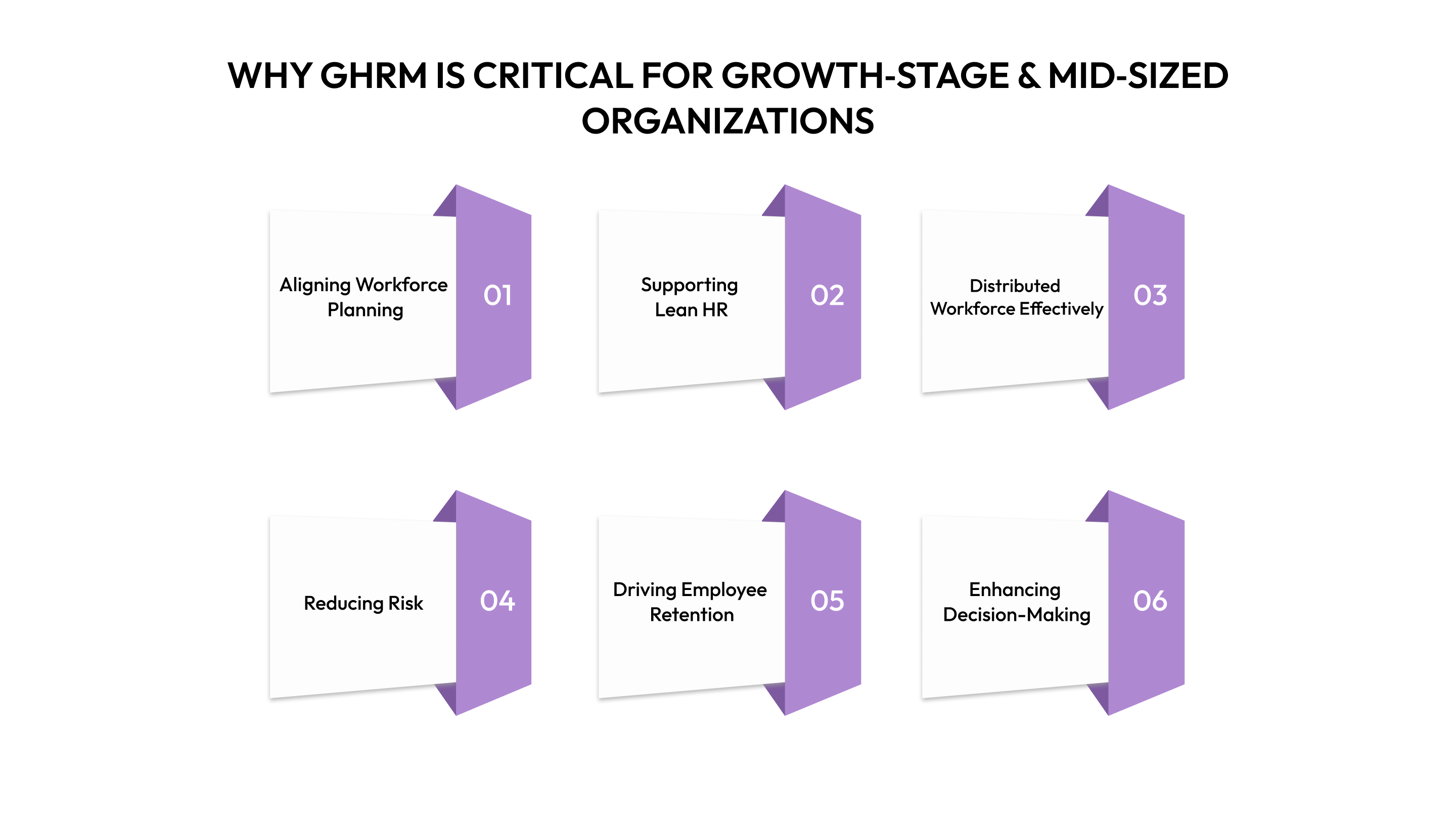
For growth-stage and mid-sized companies, human resources is not just a support function. It is a strategic lever that drives business success. These organizations often operate with lean HR and finance teams, manage distributed workforces, and are scaling headcount rapidly. Without a structured global HR strategy, companies risk misaligned compensation, inefficient workforce planning, and poor employee retention.
1. Aligning Workforce Planning with Business Goals
In companies scaling rapidly, headcount decisions directly impact budgets and operational performance. GHRM allows leadership to forecast workforce needs, link hiring plans with financial targets, and allocate talent efficiently. This alignment ensures teams have the right skills in the right locations while controlling labor costs.
2. Supporting Lean HR and Finance Teams
Mid-sized organizations often have 1–10 HR professionals managing complex compensation and headcount operations. GHRM platforms consolidate multiple functions including pay bands, approvals, scenario planning, and total rewards into one system. This reduces administrative burden, avoids spreadsheet errors, and allows HR teams to focus on strategic initiatives rather than manual processes.
3. Managing a Distributed Workforce Effectively
Global or remote-first teams introduce challenges in pay equity, benefits administration, and cultural integration. GHRM helps maintain consistency in policies, transparency in compensation, and visibility for leadership, enabling employees to feel fairly treated regardless of location.
4. Reducing Risk and Compliance Gaps
Without a global HR framework, companies face risks from regulatory non-compliance, inconsistent compensation, and unstructured approval workflows. GHRM ensures that labor laws, tax obligations, and local employment standards are embedded into processes, reducing the likelihood of costly errors or disputes.
5. Driving Employee Retention and Engagement
Rapidly scaling companies are particularly vulnerable to attrition. Transparent pay structures, competitive benefits, and clear career progression managed through GHRM increase employee satisfaction and loyalty, which directly supports business continuity and productivity.
6. Enhancing Decision-Making with Real-Time Insights
GHRM systems provide dashboards and analytics that track headcount, compensation distribution, attrition trends, and budget utilization in real time. Leaders can make informed decisions faster, prioritize critical hires, and adjust strategies before small issues become major problems.
With a clear understanding of GHRM’s impact, organizations can focus on the people and roles that drive success across global HR operations.
Also Read: Benefits of Compensation Workflow Automation in HR
Identifying Key Stakeholders and ICPs in Global HR
Global Human Resource Management requires collaboration across multiple teams and leadership roles. Identifying the right stakeholders and ideal customer profiles (ICPs) ensures that HR strategies align with organizational priorities, improve efficiency, and support business growth.
1. Chief People Officers (CPOs)
CPOs are the primary leaders responsible for workforce strategy, compensation frameworks, and employee engagement initiatives. Their focus includes:
- Designing fair and competitive pay structures across geographies
- Monitoring diversity, equity, and inclusion (DEI) outcomes
- Ensuring global HR practices support organizational objectives
CPOs rely on GHRM platforms to execute end-to-end compensation cycles, maintain pay transparency, and generate data insights for executive decision-making.
2. Chief Financial Officers (CFOs) / FP&A Leaders
CFOs and financial planning teams oversee budget allocation, headcount forecasting, and burn analysis. Their goals include:
- Linking workforce costs with revenue projections
- Controlling expenses while supporting talent growth
- Collaborating with HR to maintain on-budget hiring
GHRM tools give finance teams real-time visibility into compensation impact, simplifying collaboration and reducing errors in manual reporting.
3. People Operations / HR Business Partners (HRBPs)
HRBPs execute daily operational tasks and act as liaisons between leadership and employees. Their responsibilities include:
- Coordinating compensation reviews and headcount requests
- Managing HR workflows efficiently
- Ensuring consistent communication and reporting across teams
By using a global HR platform, HRBPs gain automation, data visibility, and structured workflows, allowing them to focus on employee experience and strategic initiatives.
4. Recruiting Managers
Recruiting managers handle hiring, offer approvals, and candidate compensation discussions. Key priorities include:
- Maintaining pay equity and competitive offers
- Reducing time-to-hire by streamlining approval processes
- Ensuring candidate experience reflects employer brand
GHRM solutions enable recruiters to access benchmark data, approve offers quickly, and visualize compensation packages, improving hiring outcomes.
5. Other Cross-Functional Stakeholders
In addition to core HR and finance teams, GHRM involves collaboration with:
- Operations leaders: To align headcount with business requirements
- Legal and compliance teams: To ensure adherence to labor laws and regulations
- IT and analytics teams: To integrate HR systems and enable real-time reporting
Once key stakeholders and ideal customer profiles are identified, the next step is to design a global HR strategy that aligns with their needs, drives consistency across regions, and supports organizational growth.
Also read: AI in HR Learning & Development: A Complete Guide
Best Practices for Global HR Management
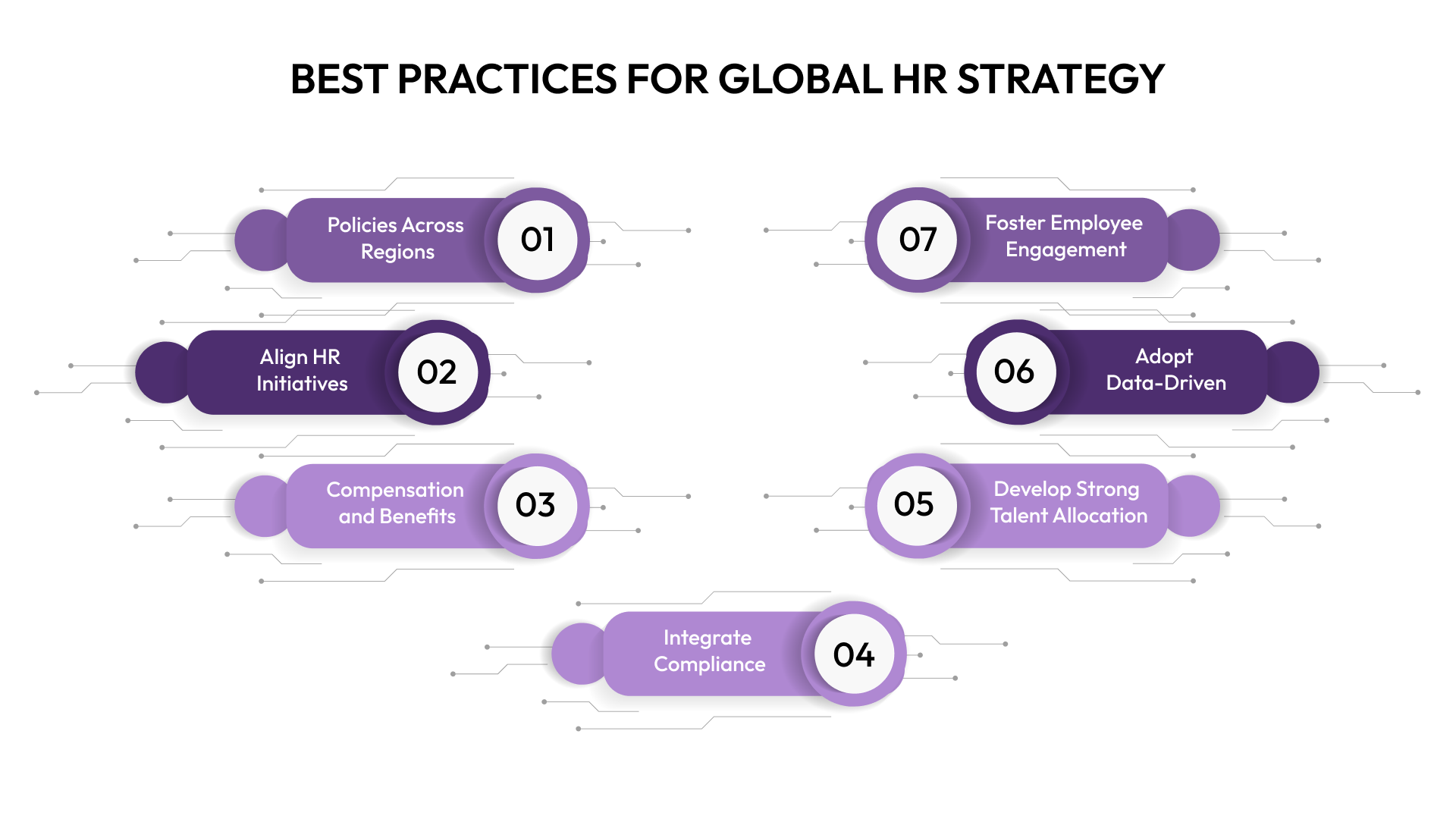
A strong global HR strategy provides structure, clarity, and alignment across regions, helping growth-stage and mid-sized organizations manage distributed teams while scaling efficiently.
1. Standardize Policies Across Regions
Standardization ensures consistency in employee treatment and reduces compliance risks. By developing core HR policies that apply across all locations while incorporating local labor laws, organizations can maintain fairness and simplify HR management. This approach allows teams to operate cohesively without sacrificing flexibility for local nuances.
2. Align HR Initiatives with Organizational Goals
HR decisions should directly support business objectives. Aligning workforce planning, compensation structures, and talent allocation with company growth priorities ensures that every hire, promotion, or compensation adjustment contributes to strategic goals. This alignment also helps finance leaders anticipate budget requirements and make informed headcount decisions.
3. Emphasize Transparency in Compensation and Benefits
Clear communication about pay structures, promotion criteria, and benefits builds trust and strengthens retention. Employees who understand how their compensation is determined feel more engaged and valued. Transparency also supports equity initiatives and reduces the risk of misunderstandings or dissatisfaction across global teams.
4. Integrate Compliance and Risk Management
Global organizations must manage varying labor laws, tax regulations, and employment standards. Embedding compliance checks and risk management into HR processes ensures that policies remain legally sound and reduces exposure to fines or disputes. Continuous monitoring of local regulations supports smooth operations across all regions.
5. Develop Strong Talent Allocation and Mobility Programs
Strategically deploying talent where it creates the most value is crucial for organizational efficiency. Identifying skill gaps, supporting international assignments, and facilitating internal mobility ensures that critical roles are filled by capable employees. Mobility programs also help retain high-performing talent by offering growth opportunities and international exposure.
6. Adopt Data-Driven Workforce Planning
Decisions backed by data allow organizations to anticipate workforce needs and optimize resources. Tracking headcount trends, pay distribution, attrition rates, and other workforce metrics enables HR leaders to make informed strategic choices. Data-driven planning helps identify potential gaps, streamline recruitment, and balance cost with talent requirements.
7. Foster Employee Engagement Through Continuous Feedback
Regular feedback on HR processes, compensation, and overall employee experience allows organizations to respond proactively to concerns. Surveys, one-on-one check-ins, and performance discussions highlight areas for improvement, helping to maintain high engagement levels and reduce turnover across global teams.
While following best practices helps set a strong foundation, overlooking common pitfalls can quickly undermine your global HR efforts. Understanding these critical errors ensures your strategy delivers consistent results across regions.
Critical Errors That Can Derail Global HR Management
Even well-intentioned HR teams can face setbacks when managing global operations. Recognizing and addressing common pitfalls ensures smoother processes, better employee experience, and stronger alignment with business goals.
1. Over-Customizing Systems and Processes
Customizing HR or compensation systems excessively can create unnecessary complexity. Overly tailored workflows make updates difficult, increase training needs, and introduce risks of inconsistent data. Keep core processes standardized while allowing only minimal, strategic adjustments for local requirements.
2. Treating Global HR the Same as Domestic HR
Applying domestic HR practices globally without local adaptation can backfire. Different regions have unique labor laws, cultural norms, and compensation expectations. Ignoring localization risks compliance violations and employee dissatisfaction. Effective global HR balances standardization with regional flexibility.
3. Ignoring Collaboration Between HR, Finance, and Leadership
Silos between HR, finance, and business leaders often lead to misaligned budgets, inaccurate forecasts, and delayed decisions. Regular cross-functional collaboration ensures compensation decisions, headcount planning, and workforce initiatives are aligned with business priorities.
4. Delayed Compensation Cycles and Lack of Real-Time Insights
Slow approvals and manual processes delay compensation cycles, erode employee trust, and create budget blind spots. Without real-time visibility into headcount, pay distribution, or bonuses, leaders struggle to make timely, informed decisions. Automating workflows and integrating data helps teams stay agile.
5. Poor Governance and Audit Trails
Inconsistent pay bands, lack of historical tracking, or insufficient audit controls can lead to inequity, compliance risks, and “pay-band drift.” Maintaining proper governance ensures transparency, supports DEI initiatives, and provides reliable data for reporting and decision-making.
After highlighting the key mistakes to avoid, it’s essential to focus on practical steps that HR and finance teams can take to drive efficiency and accuracy globally.
Practical Tips & Quick Wins for HR/Finance Teams
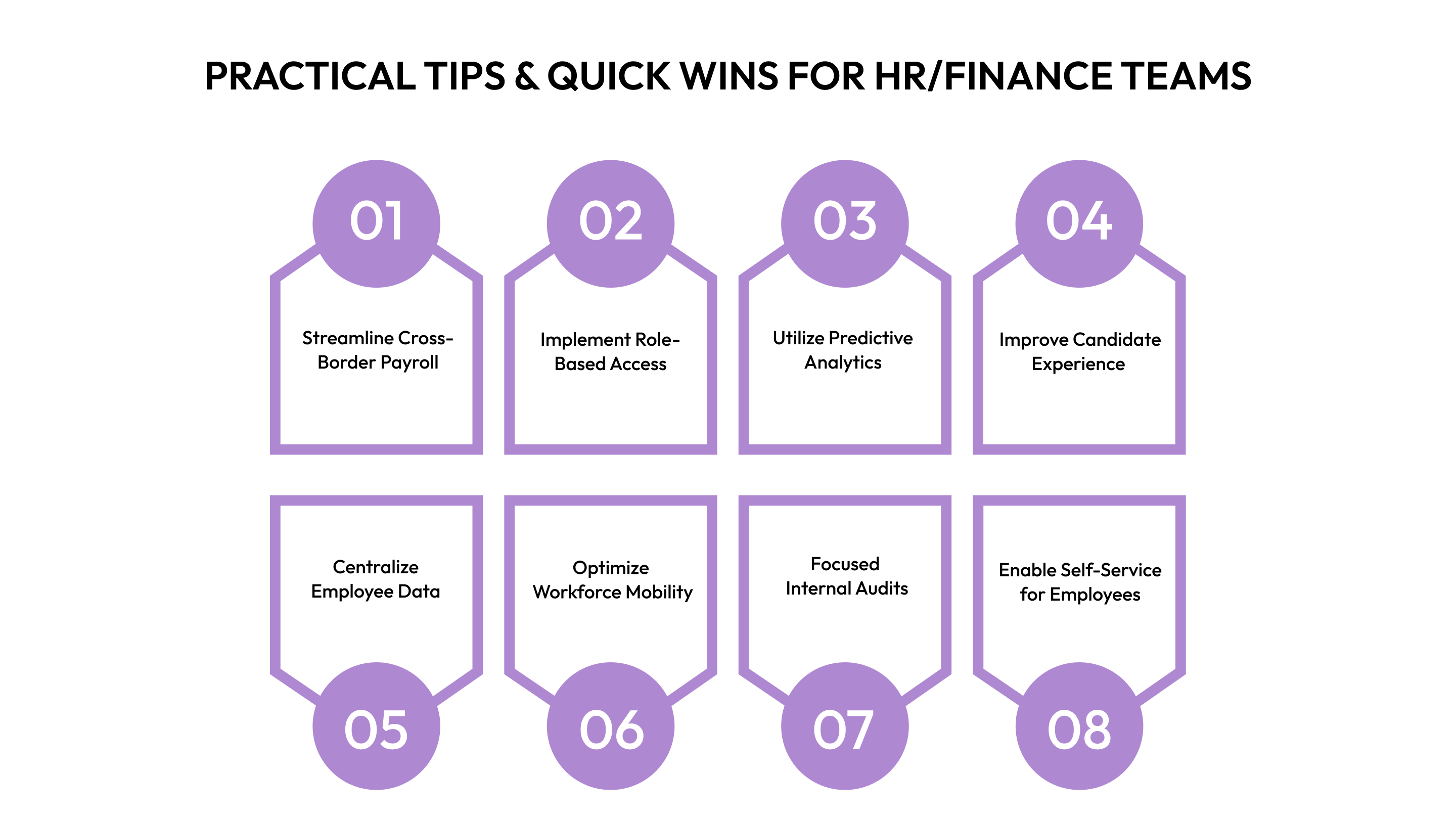
For HR and finance teams, small operational improvements can generate a significant impact when managing global workforces. These steps focus on efficiency, accuracy, and measurable outcomes, helping teams stay ahead while supporting organizational strategy.
1. Streamline Cross-Border Payroll and Benefits Administration
- Consolidate payroll processes across regions using a single platform to reduce errors.
- Automate tax calculations, currency conversions, and benefits administration for each country.
- Track compliance with local labor laws to prevent fines or disputes.
2. Implement Role-Based Access and Approvals
- Define approval workflows for compensation adjustments, promotions, and bonuses.
- Assign access based on role, department, or geography to maintain data security and clarity.
- Monitor approval bottlenecks and address them promptly to speed up processes.
3. Utilize Predictive Analytics for Headcount Forecasting
- Use historical hiring, attrition, and performance data to forecast future workforce needs.
- Model multiple growth scenarios to anticipate budget impacts and talent gaps.
- Adjust hiring strategies proactively to avoid overstaffing or under-resourcing key teams.
4. Improve Candidate Experience During Global Hiring
- Provide candidates with clear total rewards information, including benefits and equity projections.
- Automate offer approvals and communications to reduce delays.
- Track candidate responses and feedback to refine recruitment processes continuously.
5. Centralize Employee Data for Real-Time Insights
- Maintain a unified repository for employee profiles, performance metrics, and compensation history.
- Enable HR and finance teams to access consistent data for reporting and audits.
- Identify patterns in turnover, promotions, and salary adjustments to inform strategic decisions.
6. Optimize Workforce Mobility Programs
- Use structured processes for international assignments, relocations, and transfers.
- Track relocation costs, benefits, and compliance requirements in one system.
- Provide clear guidance to employees to reduce confusion and enhance productivity.
7. Run Short, Focused Internal Audits
- Conduct quarterly checks on payroll, compensation, and headcount accuracy.
- Identify discrepancies early and implement corrective measures immediately.
- Use audit findings to improve standard operating procedures and reduce errors.
8. Enable Self-Service for Employees
- Allow employees to access pay statements, benefits details, and performance data.
- Reduce repetitive HR queries and free up time for strategic tasks.
- Ensure self-service portals are intuitive and localized for global teams.
Implementing these practical tips can streamline daily operations, but using the right platform can take efficiency, accuracy, and collaboration to the next level.
How CandorIQ Supports Effective Global HR Management
Managing a global workforce involves balancing complexity, compliance, and collaboration across regions. CandorIQ provides a unified platform that helps HR and finance teams handle these challenges efficiently while improving transparency and decision-making.
- Centralized Compensation and Payband Management: CandorIQ consolidates pay bands, compensation cycles, and headcount planning in one system. This eliminates the need for scattered spreadsheets and ensures consistency across locations, helping reduce errors and inequity.
- Streamlined Approvals and Real-Time Insights: Automated workflows allow HR and finance teams to approve compensation changes, bonuses, and promotions faster. Leadership gains real-time visibility into budgets, headcount, and compensation impact, enabling proactive decision-making.
- Support for Local and Global Compliance: The platform incorporates geo-adjusted pay structures and regional labor laws, helping companies maintain compliance across multiple countries without manual tracking.
- Data-Driven Talent Allocation: With headcount scenario planning and analytics, HR teams can forecast workforce needs, model hiring scenarios, and allocate talent strategically across geographies.
- Enhanced Employee Experience: CandorIQ provides a total rewards view for employees and candidates, making compensation transparent and improving engagement and retention.
By using CandorIQ, growth-stage and mid-sized organizations can manage global HR operations with greater efficiency, fairness, and strategic impact. It acts as a single source of truth for compensation, headcount, and workforce planning.
Conclusion
Global Human Resource Management is essential for growth-stage and mid-sized organizations managing distributed teams. By standardizing processes, maintaining transparency, and aligning HR decisions with business goals, companies can optimize workforce performance while controlling costs.
Avoiding common pitfalls such as over-customization, ignoring local requirements, delayed compensation cycles, and weak collaboration between HR, finance, and leadership is critical for smooth operations. Implementing structured strategies, utilizing real-time data, and adopting unified platforms can improve efficiency, ensure pay equity, and enhance employee engagement.
CandorIQ provide an integrated solution for managing compensation, headcount, and workforce planning across geographies, making it easier to execute HR strategies effectively. Strengthen your global HR capabilities and support organizational growth. Book a demo with CandorIQ today to see the platform in action.
FAQs
1. How can companies maintain culture consistency across global teams?
Establish core values and communication norms while allowing regional teams to adapt practices for local contexts. Regular check-ins, virtual town halls, and collaborative platforms help reinforce shared culture.
2. What metrics should HR track for global workforce performance?
Key metrics include time-to-hire by region, retention rates, role-specific productivity, pay equity gaps, and international assignment success rates. Tracking these helps leadership make informed workforce decisions.
3. How do companies ensure compliance in multiple countries?
Maintain updated knowledge of local labor laws, taxation, and employment regulations. Using centralized HR systems and automated compliance checks reduces the risk of violations and operational delays.
4. What strategies improve global employee engagement?
Offer transparent career paths, localized benefits, recognition programs, and consistent feedback loops. Engagement platforms and employee surveys provide actionable insights for targeted improvements.
5. How can HR teams handle workforce planning during rapid expansion?
Use scenario-based planning, predictive analytics, and data on attrition and hiring trends to forecast staffing needs. Simulating different growth scenarios prevents overstaffing or under-resourcing key functions.
Ready to modernize your workforce and compensation strategy?
See how CandorIQ brings workforce planning and compensation together with AI.